Heparin-Induced Thrombocytopenia Lawrence Rice, MD Chief, Division of Hematology Clinical Chief, Hem/Onc Service The Methodist Hospital Weill Cornell Medical College Houston, Texas
DVT in a Breast Cancer Patient 69-year-old woman, first Dx Breast Ca in 2002,  on and off chemotherapy last 2 years for  recurrent pleural metastases  First left leg DVT in March ‘06 July ’06  Admitted for progressive leg pain and swelling, worse DVT, despite outpatient warfarin Rx IV heparin, IVC filter (platelets 350K) Two weeks later: Discharged on warfarin (platelets 81K; had been ~80K last several days)
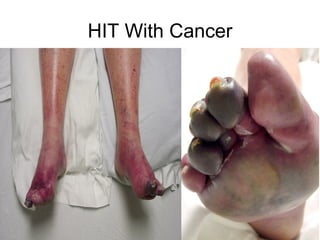
HIT With Cancer
Some Lessons from this Case HIT is a common problem HIT engenders an extreme risk for serious thrombotic complications Unopposed warfarin increases this risk IVC filters should be avoided Alternative anticoagulants should be started expeditiously Therefore, clinicians must be highly informed and remain vigilant for HIT
There are more than 100 HIT stories in the Medical Center every year…
Frequency of HIT Perspectives More than 1 trillion units heparin used yearly in US; 1/3 of hospitalized exposed (12 million) Unfractionated heparin – 3 - 5% incidence; Heart surgery 2.5% incidence LMWHeparin, Catheter-flushes -- ~0.5% Warkentin, NEJM ’95, 11/332 SQ heparin v. 0/333 LMWH developed HIT Laster, 1988, 10/2,000 (0.5%) HIT exposed only to coated vascular catheter Frequency of thromboemboli – 30-75%
Some Paradoxes of HIT Heparin, the most powerful anticoagulant of the twentieth Century, saving uncountable lives and limbs,  also produces the most extreme hypercoagulable disorder, costing thousands yearly their lives and limbs. HIT, an immune reaction to an anticoagulant that lowers platelet count, rarely causes bleeding, it causes thromboses,(and platelet transfusions are contraindicated). Health professionals should be knowledgeable about a reaction that is common, often catastrophic, preventable, treatable, iatrogenic, and a major source of litigation, yet textbooks and medical curriculae pay little attention, and prevailing lack of awareness is shocking.
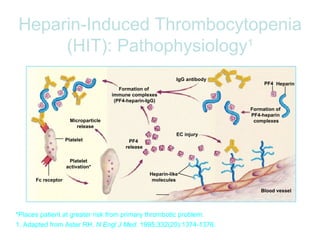
Heparin-Induced Thrombocytopenia (HIT): Pathophysiology 1 *Places patient at greater risk from primary thrombotic problem. 1. Adapted from Aster RH.  N Engl J Med . 1995;332(20):1374-1376. Formation of  PF4-heparin  complexes IgG antibody Formation of  immune complexes (PF4-heparin-IgG) EC injury PF4  release Platelet activation* Microparticle release Fc receptor Platelet Heparin-like molecules Blood vessel PF4 Heparin
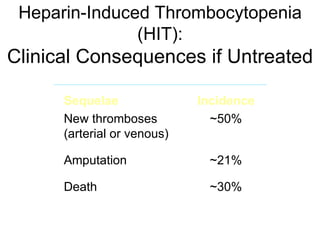
Heparin-Induced Thrombocytopenia (HIT): Clinical Consequences if Untreated Sequelae Incidence New thromboses ~50% (arterial or venous) Amputation ~21% Death ~30% 1. Warkentin TE, Kelton JG.  Am J Med.  2. King DJ, Kelton JG.  Ann Intern Med.
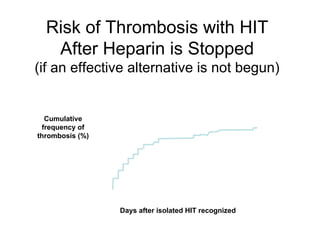
Risk of Thrombosis with HIT After Heparin is Stopped (if an effective alternative is not begun) Warkentin and Kelton.  Am J Med  1996;101. Days after isolated HIT recognized  100 90 80 70 60 50 40 30 20 10 0 52.8% 0 2 4 6 10 12 14 16 8 18 22 26 28 30 24 20 Cumulative frequency of thrombosis (%)
HIT is a Clinico-Pathologic Syndrome Fall in platelet counts (generally >50%) Appropriate time after heparin initiation   (5-12 days) Extreme risk for venous or arterial  thromboembolic complications Eventually: Serologic confirmation of platelet-activating  heparin-PF4 antibodies
Clinical Suspicion for HIT The 4 T’s (Warkentin, 2003) Thrombocytopenia Timing Thrombosis oTher causes for low platelets award 0–2 points for how typical for HIT high prob 6–8 pts; intermed 4-5; low 0-3 The 5 th  T:  The Test
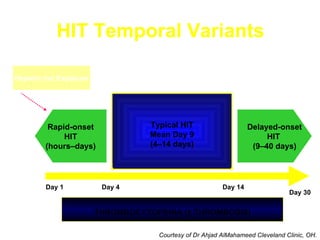
HIT Temporal Variants Courtesy of Dr Ahjad AlMahameed Cleveland Clinic, OH. Day 1 Day 4 Day 14 Day 30 Delayed-onset  HIT  (9 – 40 days) Rapid-onset HIT  (hours – days) Typical HIT Mean Day 9 (4 – 14 days) Heparin (re) Exposure THROMBOCYTOPENIA (± THROMBOSIS)
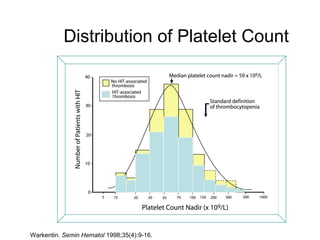
Distribution of Platelet Count Warkentin.  Semin Hematol  1998;35(4):9-16.
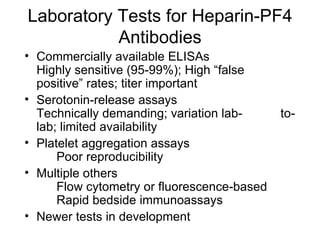
Laboratory Tests for Heparin-PF4 Antibodies Commercially available ELISAs Highly sensitive (95-99%); High “false  positive” rates; titer important Serotonin-release assays Technically demanding; variation lab- to-lab; limited availability Platelet aggregation assays Poor reproducibility Multiple others Flow cytometry or fluorescence-based Rapid bedside immunoassays Newer tests in development
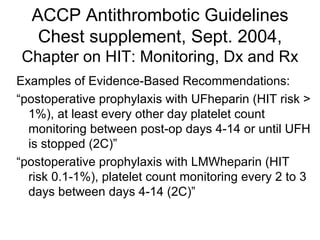
ACCP Antithrombotic Guidelines Chest supplement, Sept. 2004, Chapter on HIT: Monitoring, Dx and Rx Examples of Evidence-Based Recommendations: “ postoperative prophylaxis with UFheparin (HIT risk > 1%), at least every other day platelet count monitoring between post-op days 4-14 or until UFH is stopped (2C)” “ postoperative prophylaxis with LMWheparin (HIT risk 0.1-1%), platelet count monitoring every 2 to 3 days between days 4-14 (2C)”
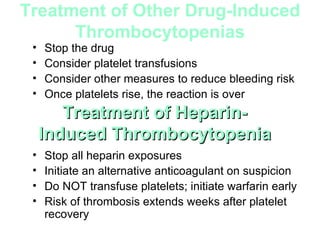
Treatment of Other Drug-Induced Thrombocytopenias Stop the drug Consider platelet transfusions Consider other measures to reduce bleeding risk Once platelets rise, the reaction is over Stop all heparin exposures Initiate an alternative anticoagulant on suspicion Do NOT transfuse platelets; initiate warfarin early Risk of thrombosis extends weeks after platelet recovery  Treatment of Heparin-Induced Thrombocytopenia Rice L.  Arch Intern Med.  2004;164:1961-1964.
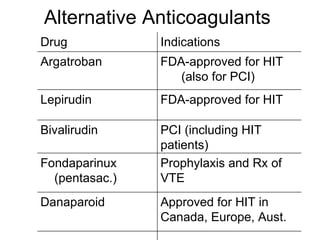
Alternative Anticoagulants  Approved for HIT in Canada, Europe, Aust. Danaparoid Prophylaxis and Rx of  VTE Fondaparinux  (pentasac.) PCI (including HIT patients) Bivalirudin FDA-approved for HIT Lepirudin FDA-approved for HIT  (also for PCI)  Argatroban Indications Drug
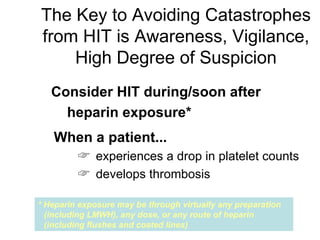
The Key to Avoiding Catastrophes from HIT is Awareness, Vigilance, High Degree of Suspicion When a patient...   experiences a drop in platelet counts develops thrombosis Consider HIT during/soon after heparin exposure* * Heparin exposure may be through virtually any preparation (including LMWH), any dose, or any route of heparin (including flushes and coated lines)
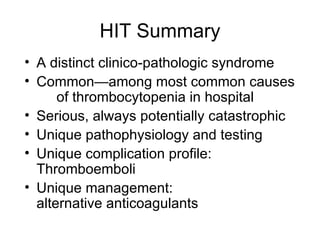
HIT Summary A distinct clinico-pathologic syndrome Common—among most common causes  of thrombocytopenia in hospital Serious, always potentially catastrophic Unique pathophysiology and testing Unique complication profile:  Thromboemboli Unique management:  alternative anticoagulants
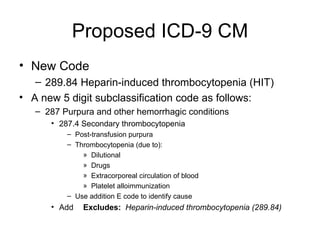
Proposed ICD-9 CM New Code 289.84 Heparin-induced thrombocytopenia (HIT) A new 5 digit subclassification code as follows: 287 Purpura and other hemorrhagic conditions 287.4 Secondary thrombocytopenia Post-transfusion purpura Thrombocytopenia (due to): Dilutional Drugs Extracorporeal circulation of blood Platelet alloimmunization Use addition E code to identify cause Add Excludes:   Heparin-induced thrombocytopenia (289.84)
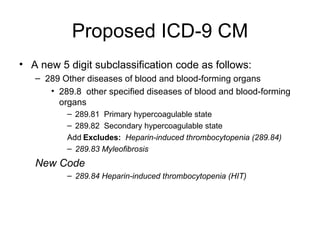
Proposed ICD-9 CM A new 5 digit subclassification code as follows: 289 Other diseases of blood and blood-forming organs 289.8  other specified diseases of blood and blood-forming organs 289.81  Primary hypercoagulable state 289.82  Secondary hypercoagulable state Add Excludes:   Heparin-induced thrombocytopenia (289.84) 289.83 Myleofibrosis New Code 289.84 Heparin-induced thrombocytopenia (HIT)

att4_Rice_Sep07

  • 1.
    Heparin-Induced Thrombocytopenia LawrenceRice, MD Chief, Division of Hematology Clinical Chief, Hem/Onc Service The Methodist Hospital Weill Cornell Medical College Houston, Texas
  • 2.
    DVT in aBreast Cancer Patient 69-year-old woman, first Dx Breast Ca in 2002, on and off chemotherapy last 2 years for recurrent pleural metastases First left leg DVT in March ‘06 July ’06 Admitted for progressive leg pain and swelling, worse DVT, despite outpatient warfarin Rx IV heparin, IVC filter (platelets 350K) Two weeks later: Discharged on warfarin (platelets 81K; had been ~80K last several days)
  • 3.
  • 4.
    Some Lessons fromthis Case HIT is a common problem HIT engenders an extreme risk for serious thrombotic complications Unopposed warfarin increases this risk IVC filters should be avoided Alternative anticoagulants should be started expeditiously Therefore, clinicians must be highly informed and remain vigilant for HIT
  • 5.
    There are morethan 100 HIT stories in the Medical Center every year…
  • 6.
    Frequency of HITPerspectives More than 1 trillion units heparin used yearly in US; 1/3 of hospitalized exposed (12 million) Unfractionated heparin – 3 - 5% incidence; Heart surgery 2.5% incidence LMWHeparin, Catheter-flushes -- ~0.5% Warkentin, NEJM ’95, 11/332 SQ heparin v. 0/333 LMWH developed HIT Laster, 1988, 10/2,000 (0.5%) HIT exposed only to coated vascular catheter Frequency of thromboemboli – 30-75%
  • 7.
    Some Paradoxes ofHIT Heparin, the most powerful anticoagulant of the twentieth Century, saving uncountable lives and limbs, also produces the most extreme hypercoagulable disorder, costing thousands yearly their lives and limbs. HIT, an immune reaction to an anticoagulant that lowers platelet count, rarely causes bleeding, it causes thromboses,(and platelet transfusions are contraindicated). Health professionals should be knowledgeable about a reaction that is common, often catastrophic, preventable, treatable, iatrogenic, and a major source of litigation, yet textbooks and medical curriculae pay little attention, and prevailing lack of awareness is shocking.
  • 8.
    Heparin-Induced Thrombocytopenia (HIT):Pathophysiology 1 *Places patient at greater risk from primary thrombotic problem. 1. Adapted from Aster RH. N Engl J Med . 1995;332(20):1374-1376. Formation of PF4-heparin complexes IgG antibody Formation of immune complexes (PF4-heparin-IgG) EC injury PF4 release Platelet activation* Microparticle release Fc receptor Platelet Heparin-like molecules Blood vessel PF4 Heparin
  • 9.
    Heparin-Induced Thrombocytopenia (HIT):Clinical Consequences if Untreated Sequelae Incidence New thromboses ~50% (arterial or venous) Amputation ~21% Death ~30% 1. Warkentin TE, Kelton JG. Am J Med. 2. King DJ, Kelton JG. Ann Intern Med.
  • 10.
    Risk of Thrombosiswith HIT After Heparin is Stopped (if an effective alternative is not begun) Warkentin and Kelton. Am J Med 1996;101. Days after isolated HIT recognized 100 90 80 70 60 50 40 30 20 10 0 52.8% 0 2 4 6 10 12 14 16 8 18 22 26 28 30 24 20 Cumulative frequency of thrombosis (%)
  • 11.
    HIT is aClinico-Pathologic Syndrome Fall in platelet counts (generally >50%) Appropriate time after heparin initiation (5-12 days) Extreme risk for venous or arterial thromboembolic complications Eventually: Serologic confirmation of platelet-activating heparin-PF4 antibodies
  • 12.
    Clinical Suspicion forHIT The 4 T’s (Warkentin, 2003) Thrombocytopenia Timing Thrombosis oTher causes for low platelets award 0–2 points for how typical for HIT high prob 6–8 pts; intermed 4-5; low 0-3 The 5 th T: The Test
  • 13.
    HIT Temporal VariantsCourtesy of Dr Ahjad AlMahameed Cleveland Clinic, OH. Day 1 Day 4 Day 14 Day 30 Delayed-onset HIT (9 – 40 days) Rapid-onset HIT (hours – days) Typical HIT Mean Day 9 (4 – 14 days) Heparin (re) Exposure THROMBOCYTOPENIA (± THROMBOSIS)
  • 14.
    Distribution of PlateletCount Warkentin. Semin Hematol 1998;35(4):9-16.
  • 15.
    Laboratory Tests forHeparin-PF4 Antibodies Commercially available ELISAs Highly sensitive (95-99%); High “false positive” rates; titer important Serotonin-release assays Technically demanding; variation lab- to-lab; limited availability Platelet aggregation assays Poor reproducibility Multiple others Flow cytometry or fluorescence-based Rapid bedside immunoassays Newer tests in development
  • 16.
    ACCP Antithrombotic GuidelinesChest supplement, Sept. 2004, Chapter on HIT: Monitoring, Dx and Rx Examples of Evidence-Based Recommendations: “ postoperative prophylaxis with UFheparin (HIT risk > 1%), at least every other day platelet count monitoring between post-op days 4-14 or until UFH is stopped (2C)” “ postoperative prophylaxis with LMWheparin (HIT risk 0.1-1%), platelet count monitoring every 2 to 3 days between days 4-14 (2C)”
  • 17.
    Treatment of OtherDrug-Induced Thrombocytopenias Stop the drug Consider platelet transfusions Consider other measures to reduce bleeding risk Once platelets rise, the reaction is over Stop all heparin exposures Initiate an alternative anticoagulant on suspicion Do NOT transfuse platelets; initiate warfarin early Risk of thrombosis extends weeks after platelet recovery Treatment of Heparin-Induced Thrombocytopenia Rice L. Arch Intern Med. 2004;164:1961-1964.
  • 18.
    Alternative Anticoagulants Approved for HIT in Canada, Europe, Aust. Danaparoid Prophylaxis and Rx of VTE Fondaparinux (pentasac.) PCI (including HIT patients) Bivalirudin FDA-approved for HIT Lepirudin FDA-approved for HIT (also for PCI) Argatroban Indications Drug
  • 19.
    The Key toAvoiding Catastrophes from HIT is Awareness, Vigilance, High Degree of Suspicion When a patient... experiences a drop in platelet counts develops thrombosis Consider HIT during/soon after heparin exposure* * Heparin exposure may be through virtually any preparation (including LMWH), any dose, or any route of heparin (including flushes and coated lines)
  • 20.
    HIT Summary Adistinct clinico-pathologic syndrome Common—among most common causes of thrombocytopenia in hospital Serious, always potentially catastrophic Unique pathophysiology and testing Unique complication profile: Thromboemboli Unique management: alternative anticoagulants
  • 21.
    Proposed ICD-9 CMNew Code 289.84 Heparin-induced thrombocytopenia (HIT) A new 5 digit subclassification code as follows: 287 Purpura and other hemorrhagic conditions 287.4 Secondary thrombocytopenia Post-transfusion purpura Thrombocytopenia (due to): Dilutional Drugs Extracorporeal circulation of blood Platelet alloimmunization Use addition E code to identify cause Add Excludes: Heparin-induced thrombocytopenia (289.84)
  • 22.
    Proposed ICD-9 CMA new 5 digit subclassification code as follows: 289 Other diseases of blood and blood-forming organs 289.8 other specified diseases of blood and blood-forming organs 289.81 Primary hypercoagulable state 289.82 Secondary hypercoagulable state Add Excludes: Heparin-induced thrombocytopenia (289.84) 289.83 Myleofibrosis New Code 289.84 Heparin-induced thrombocytopenia (HIT)