Pilonidal sinus
Dr. Zeeshan
 Definition: Infection of the skin and subcutaneous tissue
at or near the upper part of the natal cleft of the
buttocks.
NOT a true cyst
History
 1833- hair containing cyst located just below the coccyx
Mayo
 1880- Hodge coined the term “pilonidal”
Nest of hair
 In 19th
and 20th
century – considered to be congenital
 In WW II
 Patey and Scarf – hypothesised origin of pilonidal sinus
acquired by penetration of hair into subcutaneous tissue.
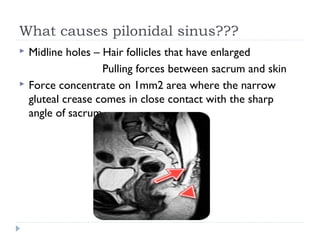
What causes pilonidal sinus???
 Midline holes – Hair follicles that have enlarged
Pulling forces between sacrum and skin
 Force concentrate on 1mm2 area where the narrow
gluteal crease comes in close contact with the sharp
angle of sacrum
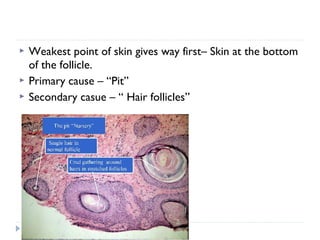
 Weakest point of skin gives way first– Skin at the bottom
of the follicle.
 Primary cause – “Pit”
 Secondary casue – “ Hair follicles”
Cause of pilonidal sinus
 (1) Invader hair
 (2) Force causing hair penetration
 (3) Vulnerability of skin
Anatomy
 Intergluteal cleft: A groove between the buttocks that
extends from just below the sacrum to the perineum.
Anchoring of the deep layers of skin overlying the coccyx
to the anococcygeal raphe
Epidemiology
 Incidence : 26 per 100,000
 Mean age: 19 years for women and 21 years for men
 Sex: M/F ratio – 2:1 to 4:1
 Equal incidence of acute:chronic
Risk factors
 Overweight/ obesity
 Local trauma or irritation
 Sedentary lifestyle/prolonged sitting
 Deep natal cleft
 Family history
Theory
 Acquired vs Congenital
 Tendency to recur following complete excision.
 Tendency to occur in places other than natal cleft.
Pathogenesis
 Hair and inflammation – inciting factors
 On sitting/bending natal cleft stretches- breakage of
follicles- opening of a pore/pit- collection of debris
- pilonidal sinus - abscess
 Proof??
 Pilonidal tract extends cephalad.
 Cavity contains hair, debris or granulation tissue.
Clinical manifestations
 Patient presentation:
- Acute onset mild to severe pain (sitting/bending)
- Intermittent mucoid/purulent/bloody discharge
- Recurrent / persisting pain
- Fever / malaise
Physical examination
 One/more pits in the natal cleft +/- painless sinus opening
cephalad and lateral to cleft
 Tender mass or sinus draining mucoid/bloody or purulent
fluid
Diagnosis
 Clinical
- Finding a pore/sinus in the natal cleft
- No imaging required
Differential diagnosis
 Perianal abscess/ fistula
 Hidradenitis suppurativa
 Perianal complications of Crohn’s disease
 Skin abscess/ furuncle/ carbuncle
 Folliculitis
Surgical treatment
 Drainage with/ without excision
 Marsupialisation
 Excision with primary closure
 Excision with grafting
 Sinus extraction
 Sclerosing injections
ACUTE ABSCESS
-- Incision is performed lateral to
midline midline over area of maximum
fluctuance
- Packing of the wound
- Marsupialisation
Problems
 Recurrence rates are from 20 – 55 %
 During a 3 year period, 73 patients treated with I & D for
first episode of pilonidal abscess
 Healed : 42 patients (58%; 95% CI) within 10 weeks
 Recurrence : 9 patients (21%;95% CI)
 Follow up period : median of 60 months
 Constant cure rate : 76% (CI 95%) after 18 months
Prognosis after simple incision and drainage for a first-episode acute pilonidal abscess.
 Jensen SL, Harling H
 Br J Surg. 1988;75(1):60.
Chronic pilonidal sinus
Surgical approaches:
- Excision
- Wound closure
(1)Primary closure in midline/ off midline
> Z plasty
> V-Y advancement flap
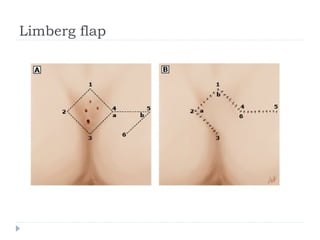
> Rhomboid flap (limberg)
(2) Reconstruction using flaps
Karydakis surgery
 Karydakis believed that hair insertion is the cause for
pilonidal sinus
 Low recurrence rates due to:
- Wound placed away from midline
- Resulting new natal cleft was shallower
 Problems
- Sutured taken over the presacral fascia causing pain
- Patients requiring GA
- Prolonged hospital stay
Modified Karydakis/Basscom II/Cleft
lip
 Use of shallow cleft
 Under LA
 Causes less pain as presacral fascia not included
Z- plasty
Z-plasty for pilonidal sinus

 V-Y Plasty
Limberg flap
Primary versus delayed closure
 Time to wound healing:
- Total of 13 trials done (n= 1421) included data for time
for wound healing (not aggregrated due to high
heterogeneity)
- 9 trials reported a faster time to wound healing following
primary closure.
- Largest trial (n=380) found that patients undergoing
primary repair had a significant faster wound healing rate
compared to open wounds(14.5 versus 60 days)
- Excision with or without primary closure for pilonidal sinus disease.
- Al-Salamah SM, Hussain MI, Mirza SM; J Pak Med Assoc. 2007 Aug;57(8):388-91.
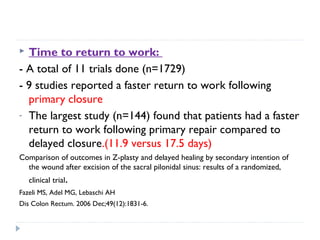
 Time to return to work:
- A total of 11 trials done (n=1729)
- 9 studies reported a faster return to work following
primary closure
- The largest study (n=144) found that patients had a faster
return to work following primary repair compared to
delayed closure.(11.9 versus 17.5 days)
Comparison of outcomes in Z-plasty and delayed healing by secondary intention of
the wound after excision of the sacral pilonidal sinus: results of a randomized,
clinical trial.
Fazeli MS, Adel MG, Lebaschi AH
Dis Colon Rectum. 2006 Dec;49(12):1831-6.
 Recurrence rates:
- Based on 16 trials including 1666 patients , the overall
recurrence rate was 6.9%.
- Primary wound closure was associated with a HIGHER
recurrence rate compared to delayed wound closure.
(8.7 versus 5.3 percent, relative risk RR [1.5] CI1.08-2.17
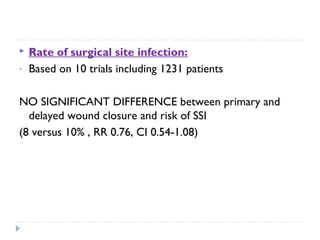
 Rate of surgical site infection:
- Based on 10 trials including 1231 patients
NO SIGNIFICANT DIFFERENCE between primary and
delayed wound closure and risk of SSI
(8 versus 10% , RR 0.76, CI 0.54-1.08)
Off midline versus midline primary
sutured closures
 Sutured off midline wounds – less time to heal (n=100 ,
mean difference 5.4 days, 95% CI 2.3-8.5)
 Risk of SSI was significantly lower for off midline wounds
(n=541, RR 0.27, CI 0.13-0.54)
 Risk of recurrence LOWER for off midline wounds
(n=574, RR=0.22, CI 0.11-0.43)
 The overall complication rate was LOWER for off
midline wounds (n=461, RR=0.23, CI0.08-0.66)
Types of off-midline closure
 While an off midline approach is superior , optimal off
midline approach has not been identified.
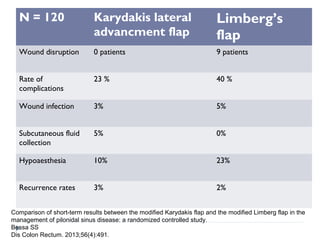
 Two trials were perfomed to determine recurrence and
complications rates between lateral advancement flaps
( modified Karydakis) and modified Limberg’s flap
N = 120 Karydakis lateral
advancment flap
Limberg’s
flap
Wound disruption 0 patients 9 patients
Rate of
complications
23 % 40 %
Wound infection 3% 5%
Subcutaneous fluid
collection
5% 0%
Hypoaesthesia 10% 23%
Recurrence rates 3% 2%
Comparison of short-term results between the modified Karydakis flap and the modified Limberg flap in the
management of pilonidal sinus disease: a randomized controlled study.
Bessa SS
Dis Colon Rectum. 2013;56(4):491.
N=295 Karydakis flap Limberg
Seroma formation 19.8% 7.4%
Wound dehiscence 15.4% 3.7%
Flap maceration 11% 3.7%
Which flap method should be preferred for the treatment of pilonidal sinus? A prospective randomized study.
Arslan K, Said Kokcam S, Koksal H, Turan E, Atay A, Dogru O
Tech Coloproctol. 2013 Feb;
In summary
 Patients with acute pilonidal sinus – I & D
 For patients with chronic pilonidal sinus – An excision of
the sinus and all tracts
 A primary closure is associated with faster wound healing
– however a delayed closure is associated with less
recurrence
 For patients undergoing primary wound closure – off
midline closure recommended
Role of Abx
 Generally limited to clinical setting of cellulitis
 Indications:
- Immunosuppresion
- High risk for Endocarditis
- MRSA
- Concurrent systemic illness

Pilonidal sinus

  • 1.
  • 2.
     Definition: Infectionof the skin and subcutaneous tissue at or near the upper part of the natal cleft of the buttocks. NOT a true cyst
  • 3.
    History  1833- haircontaining cyst located just below the coccyx Mayo  1880- Hodge coined the term “pilonidal” Nest of hair  In 19th and 20th century – considered to be congenital
  • 4.
     In WWII  Patey and Scarf – hypothesised origin of pilonidal sinus acquired by penetration of hair into subcutaneous tissue.
  • 5.
    What causes pilonidalsinus???  Midline holes – Hair follicles that have enlarged Pulling forces between sacrum and skin  Force concentrate on 1mm2 area where the narrow gluteal crease comes in close contact with the sharp angle of sacrum
  • 6.
     Weakest pointof skin gives way first– Skin at the bottom of the follicle.  Primary cause – “Pit”  Secondary casue – “ Hair follicles”
  • 7.
    Cause of pilonidalsinus  (1) Invader hair  (2) Force causing hair penetration  (3) Vulnerability of skin
  • 8.
    Anatomy  Intergluteal cleft:A groove between the buttocks that extends from just below the sacrum to the perineum. Anchoring of the deep layers of skin overlying the coccyx to the anococcygeal raphe
  • 9.
    Epidemiology  Incidence :26 per 100,000  Mean age: 19 years for women and 21 years for men  Sex: M/F ratio – 2:1 to 4:1  Equal incidence of acute:chronic
  • 10.
    Risk factors  Overweight/obesity  Local trauma or irritation  Sedentary lifestyle/prolonged sitting  Deep natal cleft  Family history
  • 11.
    Theory  Acquired vsCongenital  Tendency to recur following complete excision.  Tendency to occur in places other than natal cleft.
  • 12.
    Pathogenesis  Hair andinflammation – inciting factors  On sitting/bending natal cleft stretches- breakage of follicles- opening of a pore/pit- collection of debris - pilonidal sinus - abscess  Proof??  Pilonidal tract extends cephalad.  Cavity contains hair, debris or granulation tissue.
  • 13.
    Clinical manifestations  Patientpresentation: - Acute onset mild to severe pain (sitting/bending) - Intermittent mucoid/purulent/bloody discharge - Recurrent / persisting pain - Fever / malaise
  • 14.
    Physical examination  One/morepits in the natal cleft +/- painless sinus opening cephalad and lateral to cleft  Tender mass or sinus draining mucoid/bloody or purulent fluid
  • 15.
    Diagnosis  Clinical - Findinga pore/sinus in the natal cleft - No imaging required
  • 16.
    Differential diagnosis  Perianalabscess/ fistula  Hidradenitis suppurativa  Perianal complications of Crohn’s disease  Skin abscess/ furuncle/ carbuncle  Folliculitis
  • 17.
    Surgical treatment  Drainagewith/ without excision  Marsupialisation  Excision with primary closure  Excision with grafting  Sinus extraction  Sclerosing injections
  • 18.
    ACUTE ABSCESS -- Incisionis performed lateral to midline midline over area of maximum fluctuance - Packing of the wound - Marsupialisation
  • 20.
    Problems  Recurrence ratesare from 20 – 55 %  During a 3 year period, 73 patients treated with I & D for first episode of pilonidal abscess  Healed : 42 patients (58%; 95% CI) within 10 weeks  Recurrence : 9 patients (21%;95% CI)  Follow up period : median of 60 months  Constant cure rate : 76% (CI 95%) after 18 months Prognosis after simple incision and drainage for a first-episode acute pilonidal abscess.  Jensen SL, Harling H  Br J Surg. 1988;75(1):60.
  • 21.
    Chronic pilonidal sinus Surgicalapproaches: - Excision - Wound closure (1)Primary closure in midline/ off midline > Z plasty > V-Y advancement flap > Rhomboid flap (limberg) (2) Reconstruction using flaps
  • 22.
    Karydakis surgery  Karydakisbelieved that hair insertion is the cause for pilonidal sinus  Low recurrence rates due to: - Wound placed away from midline - Resulting new natal cleft was shallower  Problems - Sutured taken over the presacral fascia causing pain - Patients requiring GA - Prolonged hospital stay
  • 24.
    Modified Karydakis/Basscom II/Cleft lip Use of shallow cleft  Under LA  Causes less pain as presacral fascia not included
  • 25.
  • 26.
  • 27.
  • 28.
  • 30.
    Primary versus delayedclosure  Time to wound healing: - Total of 13 trials done (n= 1421) included data for time for wound healing (not aggregrated due to high heterogeneity) - 9 trials reported a faster time to wound healing following primary closure. - Largest trial (n=380) found that patients undergoing primary repair had a significant faster wound healing rate compared to open wounds(14.5 versus 60 days) - Excision with or without primary closure for pilonidal sinus disease. - Al-Salamah SM, Hussain MI, Mirza SM; J Pak Med Assoc. 2007 Aug;57(8):388-91.
  • 31.
     Time toreturn to work: - A total of 11 trials done (n=1729) - 9 studies reported a faster return to work following primary closure - The largest study (n=144) found that patients had a faster return to work following primary repair compared to delayed closure.(11.9 versus 17.5 days) Comparison of outcomes in Z-plasty and delayed healing by secondary intention of the wound after excision of the sacral pilonidal sinus: results of a randomized, clinical trial. Fazeli MS, Adel MG, Lebaschi AH Dis Colon Rectum. 2006 Dec;49(12):1831-6.
  • 32.
     Recurrence rates: -Based on 16 trials including 1666 patients , the overall recurrence rate was 6.9%. - Primary wound closure was associated with a HIGHER recurrence rate compared to delayed wound closure. (8.7 versus 5.3 percent, relative risk RR [1.5] CI1.08-2.17
  • 33.
     Rate ofsurgical site infection: - Based on 10 trials including 1231 patients NO SIGNIFICANT DIFFERENCE between primary and delayed wound closure and risk of SSI (8 versus 10% , RR 0.76, CI 0.54-1.08)
  • 34.
    Off midline versusmidline primary sutured closures  Sutured off midline wounds – less time to heal (n=100 , mean difference 5.4 days, 95% CI 2.3-8.5)  Risk of SSI was significantly lower for off midline wounds (n=541, RR 0.27, CI 0.13-0.54)  Risk of recurrence LOWER for off midline wounds (n=574, RR=0.22, CI 0.11-0.43)  The overall complication rate was LOWER for off midline wounds (n=461, RR=0.23, CI0.08-0.66)
  • 35.
    Types of off-midlineclosure  While an off midline approach is superior , optimal off midline approach has not been identified.  Two trials were perfomed to determine recurrence and complications rates between lateral advancement flaps ( modified Karydakis) and modified Limberg’s flap
  • 36.
    N = 120Karydakis lateral advancment flap Limberg’s flap Wound disruption 0 patients 9 patients Rate of complications 23 % 40 % Wound infection 3% 5% Subcutaneous fluid collection 5% 0% Hypoaesthesia 10% 23% Recurrence rates 3% 2% Comparison of short-term results between the modified Karydakis flap and the modified Limberg flap in the management of pilonidal sinus disease: a randomized controlled study. Bessa SS Dis Colon Rectum. 2013;56(4):491.
  • 37.
    N=295 Karydakis flapLimberg Seroma formation 19.8% 7.4% Wound dehiscence 15.4% 3.7% Flap maceration 11% 3.7% Which flap method should be preferred for the treatment of pilonidal sinus? A prospective randomized study. Arslan K, Said Kokcam S, Koksal H, Turan E, Atay A, Dogru O Tech Coloproctol. 2013 Feb;
  • 38.
    In summary  Patientswith acute pilonidal sinus – I & D  For patients with chronic pilonidal sinus – An excision of the sinus and all tracts  A primary closure is associated with faster wound healing – however a delayed closure is associated with less recurrence  For patients undergoing primary wound closure – off midline closure recommended
  • 39.
    Role of Abx Generally limited to clinical setting of cellulitis  Indications: - Immunosuppresion - High risk for Endocarditis - MRSA - Concurrent systemic illness