TWO CASES WITH HEMOPTYSIS CASE 2 PROF.S.SUNDAR’S UNIT Dr.V.Jayaprakash
Mr.Marimuthu,  35 years,lorry driver,admitted on 12.2.2009 C/O Breathlessness – 1 day  H/O Presenting illness: The patient was apparently alright 1 day back when he developed acute onset of breathlessness,stationary in course,class 4,aggravated by exertion and relieved by rest and sitting posture H/O orthopnea No H/O chest pain No H/O palpitation/syncope/pedal edema
No H/O cough/hemoptysis/wheeze No H/O fever No H/O abdominal pain/abdominal distension/oliguria No H/O swelling of legs PAST H/O : No H/O of similar illness in the past No H/O recent surgery/travel/immobility No H/O DM/SHT/bronchial asthma/TB/CAHD/CVA/ seizure disorder H/O vascular disease of right lower limb 5 years back for which he had undergone bypass surgery
PERSONAL HISTORY: Mixed diet  Smoker for 10 years; smokes one pack per day Occasionally consumes alcohol  FAMILY HISTORY: Nil significant TREATMENT HISTORY:  Nil significant
GENERAL EXAMINATION Conscious Oriented Afebrile No pallor Central cyanosis No clubbing Dyspneic and tachypneic  No pedal edema/calf muscle tenderness No generalised lymphadenopathy BP – 110/80 mmHg PR – 120/min Dorsalis pedis and posterior tibial pulsation absent in both lower limbs  RR – 35/min JVP – Not elevated
CARDIOVASCULAR SYSTEM: S1S2 heard No murmurs RESPIRATORY SYSTEM: NVBS heard No added sounds ABDOMINAL EXAMINATION: Soft Midline scar+ No organomegaly/ Free fluid CENTRAL NERVOUS SYSTEM: No focal neurological deficit
PROVISONAL DIAGNOSIS ACUTE BREATHLESSNESS FOR EVALUATION ? Pulmonary Thromboembolism No evidence of DVT clinically
 
INVESTIGATIONS Urine routine – Normal CBC: Hb – 13 g% TC – 12000 DC – P85 L16 E4 ESR – 5/12 PCV – 42%  Platelet – 1.2 lakh Blood sugar ®- 107mg% Urea – 27 mg%  Sr creatinine – 0.8 mg% Sr Na+ - 140 mmol/l K+ - 4.1 mmol/l Sr Lipid profile – 186 mg%
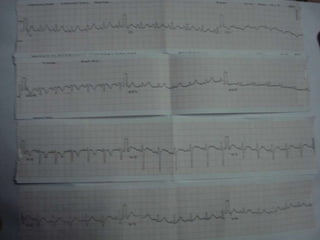
ECG on admission
Chest X ray PA view
CHEST X RAY PA VIEW Prominent pulmonary artery ECG Sinus tachycardia RBBB S1 Q3 T3 pattern  ST segment depression in lead I and ll ST segment depression in left precordial leads Tall R waves in right precordial leads
ECG FINDINGS IN PULMONARY EMBOLISM Low amplitude deflection Right atrial enlargement Right ventricular hypertrophy Right ventricular myocardial ischemia Right ventricular myocardial injury RBBB Atrial tachyarrythmias
ECG FINDINGS IN PULMONARY EMBOLISM FRONTAL PLANE LEADS: S1Q3T3 pattern ST segment depresson in standard lead l and ll Right axis deviation Tall peaked T wave in lead ll  HORIZONTAL LEADS: T wave inversion in right precordial leads ST segment elevation in right precordial leads ST segment depression in left precordial leads Increase in R amplitude in right precordial leads RBBB
ECHOCARDIOGRAM: No RWMA Normal LV systolic function TR mild TRPG 48 mmHg Mild RA/RV dilated D-DIMER LEVEL: 3.27 microgram/ml – POSITIVE (Normal : < 0.5 mcg/ml)
FURTHER INVESTIGATIONS CT Chest – Normal study Doppler study of both lower limbs – No evidence of DVT Lupus anticoagulant  – Negative Anti CardioLipin Antibody (ACLA) – Normal IgG – 5.11 GPLU/ml (Normal - < 10) IgG – 3.65 mPLU/ml (Normal - <7) Protein C levels – 44.6% (Normal :70 – 140%)  Protein S levels – 39.7% (Normal : 60 – 150%) Sr homocysteine level – 20.31 mcmol/l (Normal:5.9 – 16) Antithrombin levels – Not done Factor V Leiden – Not done 15/2/09  18/2/09   23/2/09 PT  17.6  26.3  24.2 aPTT  36.4  40  40.5 INR  1.6  2.8  2.68
 
FINAL DIAGNOSIS PULMONARY THROMOEMBOLISM PROTEIN C DEFICIENCY PROTEIN S DEFICIENCY NO DEEP VENOUS THROMBOSIS
TREATMENT GIVEN Supportive measures Unfractionated Heparin Acenocoumarol Folic acid tablets B – complex supplements
VENOUS THROMBOEMBOLIC DISORDERS (DVT & PE) ETIOLOGY:  Stasis, Hypercoagulability, Venous endothelial injury  STASIS :  Immobilisation (Trauma,Surgery,Immobilisation) HYPERCOAGULABLE STATES : Inherited : Prothrombin gene mutation, partial protein C deficiency, partial protein S deficiency, partial antithrombin deficiency,factor V Leiden, hyperhomocystinemia Acquired : Malignancy, nephrotic syndrome, estrogen use, pregnancy, HIT,APA syndrome, sickle cell disease, marrow fat embolism, amniotic fluid embolism
CLINICAL PRESENTATION   (Signs and symptoms of DVT & PE are neither sensitive nor specific) CLINICAL DECISION RULES: Clinical variable  Score Signs and symptoms of DVT  3.0 Alternative diagnosis less likely than PE  3.0 Heart rate >100/min  1.5 Immobilisation>3 days,Surgery within 4 wks  1.5 Prior PE or DVT  1.5 Hemoptysis  1.0 Cancer  1.0 High clinical likelihood of PE if the point score exceeds 4.0
ASSESSMENT OF SEVERITY OF PE MASSIVE PE:   Systemic Arterial Hypotension MODERATE TO LARGE PE: RV Hypokinesias in Echocardiography Normal Systemic Arterial Pressure SMALL TO MODERATE PE: Normal Right Heart Function Normal Systemic Arterial Pressure
LABORATORY STUDIES D-DIMER: Cross linked fibrin degradation product that may be increased during acute illness or VTE. It has a low positive predictive value and specificity – If positive, requires further evaluation. It has high negative predictive value-If negative,it excludes DVT.
LABORATORY ASSESSMENT OF INHERITED THROMBOPHILIC STATES Prothrombin gene mutation G20210A G20210A mutation  Partial protein C deficiency Partial protein S deficiency Protein C activity Protein S activity,  Free protein S antigen Factor V Leiden Activated protein C resistance, if positive confirm with Factor V Leiden PCR Hyperhomocystinemia Fasting plasma homocysteine levels
LABORATORY ASSESSMENT OF ACQUIRED THROMBOPHILIC STATES ANTIPHOSPHOLIPID ANTIBODY SYNDROME LUPUS ANTICOAGULANT, ANTICARDIOLIPIN ANTIBODY,  BETA 2 GLYCOPROTEIN 1 PNH RBC OR WBC FLOW CYTOMETRY FOR LOSS OF CD55,CD59 MYELOPROLIFERATIVE DISORDER JAK – 2 MUTATION
IMAGING - DVT SPECIFIC TESTING Duplex Examination - Compressive ultrasound performed with doppler testing Venography MRI CT Venography
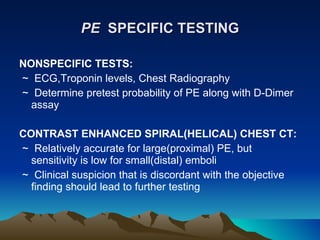
PE   SPECIFIC TESTING NONSPECIFIC TESTS: ~  ECG,Troponin levels, Chest Radiography ~  Determine pretest probability of PE along with D-Dimer assay CONTRAST ENHANCED SPIRAL(HELICAL) CHEST CT: ~  Relatively accurate for large(proximal) PE, but sensitivity is low for small(distal) emboli ~  Clinical suspicion that is discordant with the objective finding should lead to further testing
V/Q SCANNING: Requires administration of radioactive material(via both inhaled and i.v. routes) V/Q scan can be classified as normal, non diagnostic or high probability for PE Use of clinical suspicion improves the accuracy of V/Q scan  When both the findings are discordant, further testing should be performed MR ANGIOGRAPHY PULMONARY ANGIOGRAPHY
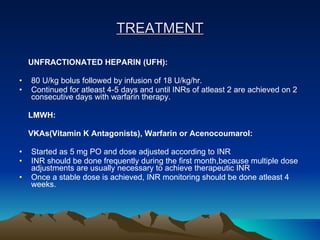
TREATMENT UNFRACTIONATED HEPARIN (UFH): 80 U/kg bolus followed by infusion of 18 U/kg/hr. Continued for atleast 4-5 days and until INRs of atleast 2 are achieved on 2 consecutive days with warfarin therapy. LMWH:   VKAs(Vitamin K Antagonists), Warfarin or Acenocoumarol: Started as 5 mg PO and dose adjusted according to INR INR should be done frequently during the first month,because multiple dose adjustments are usually necessary to achieve therapeutic INR Once a stable dose is achieved, INR monitoring should be done atleast 4 weeks.
THROMBOLYTIC THERAPY- INDICATIONS: Refractory Systemic Hypotension ? Right Ventricular Dysfunction ANTITHROMBIN III INFUSION: In patients with congenital antithrombin lll deficiency - during an acute thromotic episode
INVASIVE SPECIAL THERAPIES IVC FILTERS: 1] Acute DVT states in which there is absolute  contraindication to anticoagulation 2] Recurrent thromboembolic episodes  CATHETER EMBOLECTOMY SURGICAL EMBOLECTOMY
LONG TERM TREATMENT WITH VITAMIN K ANTAGONISTS FOR DVT AND PE First episode of DVT or PE secondary to a transient risk factors 3 mon Recommendation applies to both proximal and calf vein thrombosis First episode of idiopathic DVT or PE 6 – 12 mon Continuation of therapy after 6 -12 mon to be considered First episode of DVT or PE with a documented thrombophilic abnormality 6 – 12 mon Continuation of therapy after 6 -12 mon to be considered First episode of DVT or PE with documented antiphospholipid or >= 2 thrombophilic abnormality 12 mon Continuation of therapy after 12 mon to be considered
COURSE OF THE ILLNESS His breathlessness improved, was able to walk about 100 m without breathlessness. Except for sinus tachycardia, ECG features of PE disappeared. He was discharged at request on 27.2.2009 with advice to continue acitrom and to get readmitted after 3 days for planning CT Angiogram. But he came for admission the next day itself with massive hemoptysis; cause - ?acitrom related ?massive pulmonary embolism and infarct. He was treated with vitamin K, FFP and blood transfusion; shifted to IMCU for intensive care. Evaluation revealed prolonged coagulation parameters. PT- 48 seconds, INR- 4.3. Massive hemoptysis recurred and the patient had hypoxia and altered sensorium. Despite the best possible efforts, the patient succumbed to his illness.
 
ACKNOWLEDGEMENTS THE PATIENT AND HIS FAMILY IMCU TEAM
thank you

Case 2: Pulmonary Thromboembolism

  • 1.
    TWO CASES WITHHEMOPTYSIS CASE 2 PROF.S.SUNDAR’S UNIT Dr.V.Jayaprakash
  • 2.
    Mr.Marimuthu, 35years,lorry driver,admitted on 12.2.2009 C/O Breathlessness – 1 day H/O Presenting illness: The patient was apparently alright 1 day back when he developed acute onset of breathlessness,stationary in course,class 4,aggravated by exertion and relieved by rest and sitting posture H/O orthopnea No H/O chest pain No H/O palpitation/syncope/pedal edema
  • 3.
    No H/O cough/hemoptysis/wheezeNo H/O fever No H/O abdominal pain/abdominal distension/oliguria No H/O swelling of legs PAST H/O : No H/O of similar illness in the past No H/O recent surgery/travel/immobility No H/O DM/SHT/bronchial asthma/TB/CAHD/CVA/ seizure disorder H/O vascular disease of right lower limb 5 years back for which he had undergone bypass surgery
  • 4.
    PERSONAL HISTORY: Mixeddiet Smoker for 10 years; smokes one pack per day Occasionally consumes alcohol FAMILY HISTORY: Nil significant TREATMENT HISTORY: Nil significant
  • 5.
    GENERAL EXAMINATION ConsciousOriented Afebrile No pallor Central cyanosis No clubbing Dyspneic and tachypneic No pedal edema/calf muscle tenderness No generalised lymphadenopathy BP – 110/80 mmHg PR – 120/min Dorsalis pedis and posterior tibial pulsation absent in both lower limbs RR – 35/min JVP – Not elevated
  • 6.
    CARDIOVASCULAR SYSTEM: S1S2heard No murmurs RESPIRATORY SYSTEM: NVBS heard No added sounds ABDOMINAL EXAMINATION: Soft Midline scar+ No organomegaly/ Free fluid CENTRAL NERVOUS SYSTEM: No focal neurological deficit
  • 7.
    PROVISONAL DIAGNOSIS ACUTEBREATHLESSNESS FOR EVALUATION ? Pulmonary Thromboembolism No evidence of DVT clinically
  • 8.
  • 9.
    INVESTIGATIONS Urine routine– Normal CBC: Hb – 13 g% TC – 12000 DC – P85 L16 E4 ESR – 5/12 PCV – 42% Platelet – 1.2 lakh Blood sugar ®- 107mg% Urea – 27 mg% Sr creatinine – 0.8 mg% Sr Na+ - 140 mmol/l K+ - 4.1 mmol/l Sr Lipid profile – 186 mg%
  • 10.
  • 11.
    Chest X rayPA view
  • 12.
    CHEST X RAYPA VIEW Prominent pulmonary artery ECG Sinus tachycardia RBBB S1 Q3 T3 pattern ST segment depression in lead I and ll ST segment depression in left precordial leads Tall R waves in right precordial leads
  • 13.
    ECG FINDINGS INPULMONARY EMBOLISM Low amplitude deflection Right atrial enlargement Right ventricular hypertrophy Right ventricular myocardial ischemia Right ventricular myocardial injury RBBB Atrial tachyarrythmias
  • 14.
    ECG FINDINGS INPULMONARY EMBOLISM FRONTAL PLANE LEADS: S1Q3T3 pattern ST segment depresson in standard lead l and ll Right axis deviation Tall peaked T wave in lead ll HORIZONTAL LEADS: T wave inversion in right precordial leads ST segment elevation in right precordial leads ST segment depression in left precordial leads Increase in R amplitude in right precordial leads RBBB
  • 15.
    ECHOCARDIOGRAM: No RWMANormal LV systolic function TR mild TRPG 48 mmHg Mild RA/RV dilated D-DIMER LEVEL: 3.27 microgram/ml – POSITIVE (Normal : < 0.5 mcg/ml)
  • 16.
    FURTHER INVESTIGATIONS CTChest – Normal study Doppler study of both lower limbs – No evidence of DVT Lupus anticoagulant – Negative Anti CardioLipin Antibody (ACLA) – Normal IgG – 5.11 GPLU/ml (Normal - < 10) IgG – 3.65 mPLU/ml (Normal - <7) Protein C levels – 44.6% (Normal :70 – 140%) Protein S levels – 39.7% (Normal : 60 – 150%) Sr homocysteine level – 20.31 mcmol/l (Normal:5.9 – 16) Antithrombin levels – Not done Factor V Leiden – Not done 15/2/09 18/2/09 23/2/09 PT 17.6 26.3 24.2 aPTT 36.4 40 40.5 INR 1.6 2.8 2.68
  • 17.
  • 18.
    FINAL DIAGNOSIS PULMONARYTHROMOEMBOLISM PROTEIN C DEFICIENCY PROTEIN S DEFICIENCY NO DEEP VENOUS THROMBOSIS
  • 19.
    TREATMENT GIVEN Supportivemeasures Unfractionated Heparin Acenocoumarol Folic acid tablets B – complex supplements
  • 20.
    VENOUS THROMBOEMBOLIC DISORDERS(DVT & PE) ETIOLOGY: Stasis, Hypercoagulability, Venous endothelial injury STASIS : Immobilisation (Trauma,Surgery,Immobilisation) HYPERCOAGULABLE STATES : Inherited : Prothrombin gene mutation, partial protein C deficiency, partial protein S deficiency, partial antithrombin deficiency,factor V Leiden, hyperhomocystinemia Acquired : Malignancy, nephrotic syndrome, estrogen use, pregnancy, HIT,APA syndrome, sickle cell disease, marrow fat embolism, amniotic fluid embolism
  • 21.
    CLINICAL PRESENTATION (Signs and symptoms of DVT & PE are neither sensitive nor specific) CLINICAL DECISION RULES: Clinical variable Score Signs and symptoms of DVT 3.0 Alternative diagnosis less likely than PE 3.0 Heart rate >100/min 1.5 Immobilisation>3 days,Surgery within 4 wks 1.5 Prior PE or DVT 1.5 Hemoptysis 1.0 Cancer 1.0 High clinical likelihood of PE if the point score exceeds 4.0
  • 22.
    ASSESSMENT OF SEVERITYOF PE MASSIVE PE: Systemic Arterial Hypotension MODERATE TO LARGE PE: RV Hypokinesias in Echocardiography Normal Systemic Arterial Pressure SMALL TO MODERATE PE: Normal Right Heart Function Normal Systemic Arterial Pressure
  • 23.
    LABORATORY STUDIES D-DIMER:Cross linked fibrin degradation product that may be increased during acute illness or VTE. It has a low positive predictive value and specificity – If positive, requires further evaluation. It has high negative predictive value-If negative,it excludes DVT.
  • 24.
    LABORATORY ASSESSMENT OFINHERITED THROMBOPHILIC STATES Prothrombin gene mutation G20210A G20210A mutation Partial protein C deficiency Partial protein S deficiency Protein C activity Protein S activity, Free protein S antigen Factor V Leiden Activated protein C resistance, if positive confirm with Factor V Leiden PCR Hyperhomocystinemia Fasting plasma homocysteine levels
  • 25.
    LABORATORY ASSESSMENT OFACQUIRED THROMBOPHILIC STATES ANTIPHOSPHOLIPID ANTIBODY SYNDROME LUPUS ANTICOAGULANT, ANTICARDIOLIPIN ANTIBODY, BETA 2 GLYCOPROTEIN 1 PNH RBC OR WBC FLOW CYTOMETRY FOR LOSS OF CD55,CD59 MYELOPROLIFERATIVE DISORDER JAK – 2 MUTATION
  • 26.
    IMAGING - DVTSPECIFIC TESTING Duplex Examination - Compressive ultrasound performed with doppler testing Venography MRI CT Venography
  • 27.
    PE SPECIFIC TESTING NONSPECIFIC TESTS: ~ ECG,Troponin levels, Chest Radiography ~ Determine pretest probability of PE along with D-Dimer assay CONTRAST ENHANCED SPIRAL(HELICAL) CHEST CT: ~ Relatively accurate for large(proximal) PE, but sensitivity is low for small(distal) emboli ~ Clinical suspicion that is discordant with the objective finding should lead to further testing
  • 28.
    V/Q SCANNING: Requiresadministration of radioactive material(via both inhaled and i.v. routes) V/Q scan can be classified as normal, non diagnostic or high probability for PE Use of clinical suspicion improves the accuracy of V/Q scan When both the findings are discordant, further testing should be performed MR ANGIOGRAPHY PULMONARY ANGIOGRAPHY
  • 29.
    TREATMENT UNFRACTIONATED HEPARIN(UFH): 80 U/kg bolus followed by infusion of 18 U/kg/hr. Continued for atleast 4-5 days and until INRs of atleast 2 are achieved on 2 consecutive days with warfarin therapy. LMWH: VKAs(Vitamin K Antagonists), Warfarin or Acenocoumarol: Started as 5 mg PO and dose adjusted according to INR INR should be done frequently during the first month,because multiple dose adjustments are usually necessary to achieve therapeutic INR Once a stable dose is achieved, INR monitoring should be done atleast 4 weeks.
  • 30.
    THROMBOLYTIC THERAPY- INDICATIONS:Refractory Systemic Hypotension ? Right Ventricular Dysfunction ANTITHROMBIN III INFUSION: In patients with congenital antithrombin lll deficiency - during an acute thromotic episode
  • 31.
    INVASIVE SPECIAL THERAPIESIVC FILTERS: 1] Acute DVT states in which there is absolute contraindication to anticoagulation 2] Recurrent thromboembolic episodes CATHETER EMBOLECTOMY SURGICAL EMBOLECTOMY
  • 32.
    LONG TERM TREATMENTWITH VITAMIN K ANTAGONISTS FOR DVT AND PE First episode of DVT or PE secondary to a transient risk factors 3 mon Recommendation applies to both proximal and calf vein thrombosis First episode of idiopathic DVT or PE 6 – 12 mon Continuation of therapy after 6 -12 mon to be considered First episode of DVT or PE with a documented thrombophilic abnormality 6 – 12 mon Continuation of therapy after 6 -12 mon to be considered First episode of DVT or PE with documented antiphospholipid or >= 2 thrombophilic abnormality 12 mon Continuation of therapy after 12 mon to be considered
  • 33.
    COURSE OF THEILLNESS His breathlessness improved, was able to walk about 100 m without breathlessness. Except for sinus tachycardia, ECG features of PE disappeared. He was discharged at request on 27.2.2009 with advice to continue acitrom and to get readmitted after 3 days for planning CT Angiogram. But he came for admission the next day itself with massive hemoptysis; cause - ?acitrom related ?massive pulmonary embolism and infarct. He was treated with vitamin K, FFP and blood transfusion; shifted to IMCU for intensive care. Evaluation revealed prolonged coagulation parameters. PT- 48 seconds, INR- 4.3. Massive hemoptysis recurred and the patient had hypoxia and altered sensorium. Despite the best possible efforts, the patient succumbed to his illness.
  • 34.
  • 35.
    ACKNOWLEDGEMENTS THE PATIENTAND HIS FAMILY IMCU TEAM
  • 36.