CASE
PRESENTATION
EMERGENCY DEPARTMENT
PRAVEEN RK
• NAME : ABC
• AGE : 74
• SEX : MALE
• OP NO :*******
• DATE : 03/05/2019
• TIME : 12:30 am
• SOURCE OF HISTORY : RELATIVE
• MOA : PRIVATE
HISTORY
• Exacerbation of breathlessness for past one hour. It was
sudden in onset and progressed rapidly. Breathlessness
was present even during rest. Associated orthopnea and
paroxysmal nocturnal dyspnea present. Patient also had
history of cough with expectoration. Scanty sputum was
present. He also had complaints of retrosternal chest pain.
AIRWAY EVALUATION
• PATENT
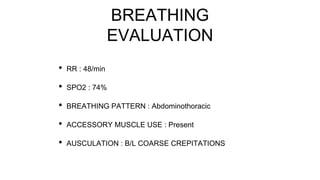
BREATHING
EVALUATION
• RR : 48/min
• SPO2 : 74%
• BREATHING PATTERN : Abdominothoracic
• ACCESSORY MUSCLE USE : Present
• AUSCULATION : B/L COARSE CREPITATIONS
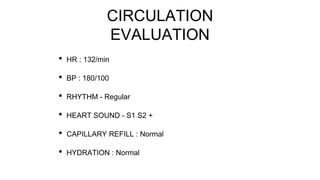
CIRCULATION
EVALUATION
• HR : 132/min
• BP : 180/100
• RHYTHM - Regular
• HEART SOUND - S1 S2 +
• CAPILLARY REFILL : Normal
• HYDRATION : Normal
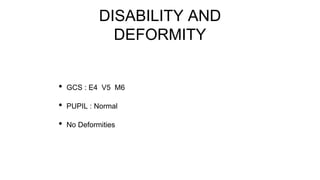
DISABILITY AND
DEFORMITY
• GCS : E4 V5 M6
• PUPIL : Normal
• No Deformities
PAST HISTORY
• T2 DM
• HTN
• CAD
• 3 similar episodes of breathlessness in last 5 years and
needed ICU admission
GENERAL
EXAMINATION
• Pallor +
• B/L pedal edema +
• No icterus, cyanosis, clubbing, lymphadenopathy
SYSTEMIC
EXAMINATION
• RS : B/L Coarse Crepitations
• CVS : S1 S2 +
• Abdomen : soft, nontender
• CNS : No FND
PROVISIONAL
DIAGNOSIS
• ACUTE LEFT HEART FAILURE WITH PULMONARY
EDEMA
INVESTIGATIONS
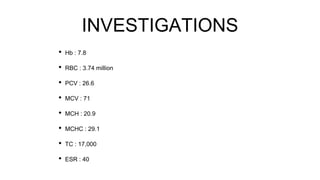
• Hb : 7.8
• RBC : 3.74 million
• PCV : 26.6
• MCV : 71
• MCH : 20.9
• MCHC : 29.1
• TC : 17,000
• ESR : 40
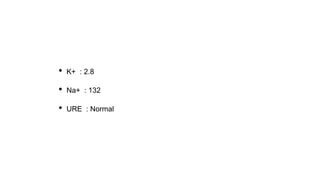
• K+ : 2.8
• Na+ : 132
• URE : Normal
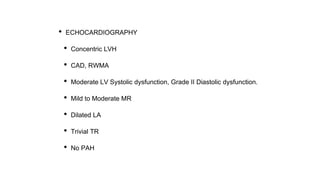
• ECHOCARDIOGRAPHY
• Concentric LVH
• CAD, RWMA
• Moderate LV Systolic dysfunction, Grade II Diastolic dysfunction.
• Mild to Moderate MR
• Dilated LA
• Trivial TR
• No PAH
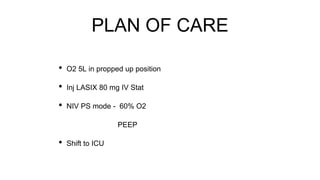
PLAN OF CARE
• O2 5L in propped up position
• Inj LASIX 80 mg IV Stat
• NIV PS mode - 60% O2
PEEP
• Shift to ICU
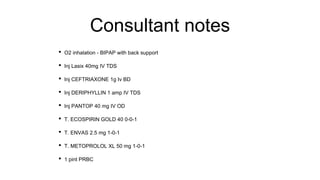
Consultant notes
• O2 inhalation - BIPAP with back support
• Inj Lasix 40mg IV TDS
• Inj CEFTRIAXONE 1g Iv BD
• Inj DERIPHYLLIN 1 amp IV TDS
• Inj PANTOP 40 mg IV OD
• T. ECOSPIRIN GOLD 40 0-0-1
• T. ENVAS 2.5 mg 1-0-1
• T. METOPROLOL XL 50 mg 1-0-1
• 1 pint PRBC
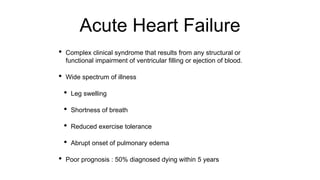
Acute Heart Failure
• Complex clinical syndrome that results from any structural or
functional impairment of ventricular filling or ejection of blood.
• Wide spectrum of illness
• Leg swelling
• Shortness of breath
• Reduced exercise tolerance
• Abrupt onset of pulmonary edema
• Poor prognosis : 50% diagnosed dying within 5 years
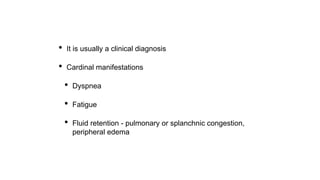
• It is usually a clinical diagnosis
• Cardinal manifestations
• Dyspnea
• Fatigue
• Fluid retention - pulmonary or splanchnic congestion,
peripheral edema
• Myocardial injury or stress triggers activation of RAS and
sympathetic nervous system
• norepinephrine, vasopressin, endothelin, TNF alpha
• These maintains BP and perfusion at the cost of increased
cardiac workload, wall tension, myocardial O2 demand
• Cardiac remodelling occurs
• Triggers more dysfunction
• CLASSIFICATION
• Hypertensive a/c HF
• Pulmonary edema
• Cardiogenic shock
• Acute on chronic HF
• High output failure
• Right HF
Pulmonary Edema
• Acute pulmonary edema usually presents with the rapid
onset of dyspnea at rest, tachypnea, tachycardia, and
severe hypoxemia.
• Crackles and wheezing due to alveolar flooding and airway
compression from peribronchial cuffing may be audible.
• Release of endogenous catecholamines often causes
hypertension.
• CARDIOGENIC PE
• Cardiac abnormalities that lead to an increase in
pulmonary venous pressure shift the balance of forces
between the capillary and the interstitium.
• Hydrostatic pressure is increased and fluid exits the
capillary at an increased rate, resulting in interstitial and, in
more severe cases, alveolar edema.
• The development of pleural effusions may further
compromise respiratory system function and contribute to
breathing discomfort.
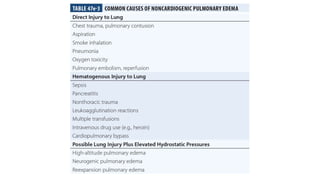
• NON CARDIOGENIC PE
• Lung water increases due to damage of the pulmonary
capillary lining with consequent leakage of proteins and
other macromolecules into the tissue; fluid follows the
protein as oncotic forces are shifted from the vessel to the
surrounding lung tissue.
• This process is associated with dysfunction of the
surfactant lining the alveoli, increased surface forces, and a
propensity for the alveoli to collapse at low lung
volumes.
MANAGEMENT
• Ensure adequate oxygenation and ventilation
• Consider noninvasive ventilation with continuous positive airway
pressure (CPAP) or bilevel positive airway pressure (BiPAP).
Ensure adequate facemask seal, hemodynamic stability, and close
monitoring for adequate tidal volumes, patient cooperation, and
effectiveness.
• While many patients with hypertensive acute heart failure present
with severe hypertension, pulmonary edema can occur with
systolic blood pressures as low as 150 mmHg. Prompt recognition
of this condition and afterload reduction with vasodilators can
improve symptoms and avoid the need for emergent intubation
• Administer nitroglycerin 0.4 mg sublingual up to one dose
per minute or nitroglycerin 0.5 to 0.7 μg/kg/min IV up to
200 μg/min. Titrate dosages based on patient symptoms
blood pressure levels.
• Nitroprusside 0.3 μg/kg/min titrated upward every 5 to 10
minutes as needed to maximum 10 μg/kg/min may be
initiated if elevated blood pressure is unresponsive to
nitroglycerin.
• When volume overload is suspected, consider loop
diuretics such as furosemide 40 mg IV, bumetanide 1 to 3
mg IV, or torsemide 10 to 20 mg IV.
• IV dobutamine induces significant positive inotropic effects,
with mild chronotropic effects. It also induces mild
peripheral vasodilation (decrease in afterload). The
combination effect of increased inotropy with decreased
afterload significantly increases cardiac output.
• Combination use with IV NTG may be ideal for patients with
MI and CPE and mild hypotension to simultaneously reduce
preload and increase cardiac output. In general, avoid
dobutamine in patients with moderate or severe
hypotension (eg, systolic BP < 80 mm Hg), because of the
peripheral vasodilation.
• Moderate dosage of Dopamine 5-10 mcg/kg/min and high
dosages of 15-20 mcg/kg/min dosages only in patients with
CPE who cannot tolerate dobutamine because of severe
hypotension (eg, systolic blood pressure 60-80 mm Hg)
• Norepinephrine is generally reserved for patients with
profound hypotension (eg, systolic blood pressure < 60 mm
Hg). After blood pressure is restored, add other medications
to maintain cardiac output.
• Studies have demonstrated excellent results with ACE inhibitors
for the treatment of acute decompensated CHF and CPE. The
use of ACE inhibitors in CPE is associated with reduced
admission rates to ICUs and decreased endotracheal intubation
rates and length of ICU stay.
• Enalapril 1.25 mg IV or captopril 25 mg, given sublingually,
result in hemodynamic and subjective improvements within 10
minutes. Improvements occur much more slowly with the oral
route.
• Angiotensin II receptor blockers (ARBs) have comparable
beneficial effects in heart failure. Studies have proposed a role
for ACE inhibitors and ARBs in preventing structural and
electrical remodeling of the heart, resulting in a reduced
incidence of arrhythmias.
• Shortness of breath, orthopnea, jugular venous
distention, rales and possibly an S3 may be evident in
patients with normotensive heart failure, even in the
presence of normal vital signs, oxygen and ventilation. For
these patients, treat with loop diuretics initially and then
base additional treatment on responses to therapy.
• Morphine 2 to 5 mg IV can relieve congestion and anxiety
but is associated with adverse events such as need for
mechanical ventilation, prolonged hospitalization, ICU
admission, and mortality.
THANK YOU

Pulmonary Edema - Case Presentation

  • 1.
  • 2.
    • NAME :ABC • AGE : 74 • SEX : MALE • OP NO :******* • DATE : 03/05/2019 • TIME : 12:30 am • SOURCE OF HISTORY : RELATIVE • MOA : PRIVATE
  • 3.
    HISTORY • Exacerbation ofbreathlessness for past one hour. It was sudden in onset and progressed rapidly. Breathlessness was present even during rest. Associated orthopnea and paroxysmal nocturnal dyspnea present. Patient also had history of cough with expectoration. Scanty sputum was present. He also had complaints of retrosternal chest pain.
  • 4.
  • 5.
    BREATHING EVALUATION • RR :48/min • SPO2 : 74% • BREATHING PATTERN : Abdominothoracic • ACCESSORY MUSCLE USE : Present • AUSCULATION : B/L COARSE CREPITATIONS
  • 6.
    CIRCULATION EVALUATION • HR :132/min • BP : 180/100 • RHYTHM - Regular • HEART SOUND - S1 S2 + • CAPILLARY REFILL : Normal • HYDRATION : Normal
  • 7.
    DISABILITY AND DEFORMITY • GCS: E4 V5 M6 • PUPIL : Normal • No Deformities
  • 8.
    PAST HISTORY • T2DM • HTN • CAD • 3 similar episodes of breathlessness in last 5 years and needed ICU admission
  • 9.
    GENERAL EXAMINATION • Pallor + •B/L pedal edema + • No icterus, cyanosis, clubbing, lymphadenopathy
  • 10.
    SYSTEMIC EXAMINATION • RS :B/L Coarse Crepitations • CVS : S1 S2 + • Abdomen : soft, nontender • CNS : No FND
  • 11.
    PROVISIONAL DIAGNOSIS • ACUTE LEFTHEART FAILURE WITH PULMONARY EDEMA
  • 12.
    INVESTIGATIONS • Hb :7.8 • RBC : 3.74 million • PCV : 26.6 • MCV : 71 • MCH : 20.9 • MCHC : 29.1 • TC : 17,000 • ESR : 40
  • 13.
    • K+ :2.8 • Na+ : 132 • URE : Normal
  • 14.
    • ECHOCARDIOGRAPHY • ConcentricLVH • CAD, RWMA • Moderate LV Systolic dysfunction, Grade II Diastolic dysfunction. • Mild to Moderate MR • Dilated LA • Trivial TR • No PAH
  • 15.
    PLAN OF CARE •O2 5L in propped up position • Inj LASIX 80 mg IV Stat • NIV PS mode - 60% O2 PEEP • Shift to ICU
  • 16.
    Consultant notes • O2inhalation - BIPAP with back support • Inj Lasix 40mg IV TDS • Inj CEFTRIAXONE 1g Iv BD • Inj DERIPHYLLIN 1 amp IV TDS • Inj PANTOP 40 mg IV OD • T. ECOSPIRIN GOLD 40 0-0-1 • T. ENVAS 2.5 mg 1-0-1 • T. METOPROLOL XL 50 mg 1-0-1 • 1 pint PRBC
  • 17.
    Acute Heart Failure •Complex clinical syndrome that results from any structural or functional impairment of ventricular filling or ejection of blood. • Wide spectrum of illness • Leg swelling • Shortness of breath • Reduced exercise tolerance • Abrupt onset of pulmonary edema • Poor prognosis : 50% diagnosed dying within 5 years
  • 18.
    • It isusually a clinical diagnosis • Cardinal manifestations • Dyspnea • Fatigue • Fluid retention - pulmonary or splanchnic congestion, peripheral edema
  • 20.
    • Myocardial injuryor stress triggers activation of RAS and sympathetic nervous system • norepinephrine, vasopressin, endothelin, TNF alpha • These maintains BP and perfusion at the cost of increased cardiac workload, wall tension, myocardial O2 demand • Cardiac remodelling occurs • Triggers more dysfunction
  • 21.
    • CLASSIFICATION • Hypertensivea/c HF • Pulmonary edema • Cardiogenic shock • Acute on chronic HF • High output failure • Right HF
  • 22.
    Pulmonary Edema • Acutepulmonary edema usually presents with the rapid onset of dyspnea at rest, tachypnea, tachycardia, and severe hypoxemia. • Crackles and wheezing due to alveolar flooding and airway compression from peribronchial cuffing may be audible. • Release of endogenous catecholamines often causes hypertension.
  • 23.
    • CARDIOGENIC PE •Cardiac abnormalities that lead to an increase in pulmonary venous pressure shift the balance of forces between the capillary and the interstitium. • Hydrostatic pressure is increased and fluid exits the capillary at an increased rate, resulting in interstitial and, in more severe cases, alveolar edema. • The development of pleural effusions may further compromise respiratory system function and contribute to breathing discomfort.
  • 24.
    • NON CARDIOGENICPE • Lung water increases due to damage of the pulmonary capillary lining with consequent leakage of proteins and other macromolecules into the tissue; fluid follows the protein as oncotic forces are shifted from the vessel to the surrounding lung tissue. • This process is associated with dysfunction of the surfactant lining the alveoli, increased surface forces, and a propensity for the alveoli to collapse at low lung volumes.
  • 26.
    MANAGEMENT • Ensure adequateoxygenation and ventilation • Consider noninvasive ventilation with continuous positive airway pressure (CPAP) or bilevel positive airway pressure (BiPAP). Ensure adequate facemask seal, hemodynamic stability, and close monitoring for adequate tidal volumes, patient cooperation, and effectiveness. • While many patients with hypertensive acute heart failure present with severe hypertension, pulmonary edema can occur with systolic blood pressures as low as 150 mmHg. Prompt recognition of this condition and afterload reduction with vasodilators can improve symptoms and avoid the need for emergent intubation
  • 27.
    • Administer nitroglycerin0.4 mg sublingual up to one dose per minute or nitroglycerin 0.5 to 0.7 μg/kg/min IV up to 200 μg/min. Titrate dosages based on patient symptoms blood pressure levels. • Nitroprusside 0.3 μg/kg/min titrated upward every 5 to 10 minutes as needed to maximum 10 μg/kg/min may be initiated if elevated blood pressure is unresponsive to nitroglycerin. • When volume overload is suspected, consider loop diuretics such as furosemide 40 mg IV, bumetanide 1 to 3 mg IV, or torsemide 10 to 20 mg IV.
  • 28.
    • IV dobutamineinduces significant positive inotropic effects, with mild chronotropic effects. It also induces mild peripheral vasodilation (decrease in afterload). The combination effect of increased inotropy with decreased afterload significantly increases cardiac output. • Combination use with IV NTG may be ideal for patients with MI and CPE and mild hypotension to simultaneously reduce preload and increase cardiac output. In general, avoid dobutamine in patients with moderate or severe hypotension (eg, systolic BP < 80 mm Hg), because of the peripheral vasodilation.
  • 29.
    • Moderate dosageof Dopamine 5-10 mcg/kg/min and high dosages of 15-20 mcg/kg/min dosages only in patients with CPE who cannot tolerate dobutamine because of severe hypotension (eg, systolic blood pressure 60-80 mm Hg) • Norepinephrine is generally reserved for patients with profound hypotension (eg, systolic blood pressure < 60 mm Hg). After blood pressure is restored, add other medications to maintain cardiac output.
  • 30.
    • Studies havedemonstrated excellent results with ACE inhibitors for the treatment of acute decompensated CHF and CPE. The use of ACE inhibitors in CPE is associated with reduced admission rates to ICUs and decreased endotracheal intubation rates and length of ICU stay. • Enalapril 1.25 mg IV or captopril 25 mg, given sublingually, result in hemodynamic and subjective improvements within 10 minutes. Improvements occur much more slowly with the oral route. • Angiotensin II receptor blockers (ARBs) have comparable beneficial effects in heart failure. Studies have proposed a role for ACE inhibitors and ARBs in preventing structural and electrical remodeling of the heart, resulting in a reduced incidence of arrhythmias.
  • 31.
    • Shortness ofbreath, orthopnea, jugular venous distention, rales and possibly an S3 may be evident in patients with normotensive heart failure, even in the presence of normal vital signs, oxygen and ventilation. For these patients, treat with loop diuretics initially and then base additional treatment on responses to therapy. • Morphine 2 to 5 mg IV can relieve congestion and anxiety but is associated with adverse events such as need for mechanical ventilation, prolonged hospitalization, ICU admission, and mortality.
  • 32.