Deep Venous Thrombosis
&
Pulmonary Embolism
By,
Dr. Sayyed Muzammil Ahmed K
MBBS (MRCP UK internal Medicine) PGDCC (Cardiology)
Clinical Cardiologist & Physician SHALINI HOSPITAL
LIFE MEMBER Indian Medical Association
LIFE MEMBER IACC
Real life case scenarios
CASE 1 MR ABC
• 39 year male patient
NON DM NON HTN
suffered # NOF right femur secondary to RTA
• Took treatment by local quack was kept
immobilsed in bed for 25 days
• Came to hospital for fracture fixation he was
having right sided chest pain,breathlessness,
palpitation since 3 days
• Vitals
pulse 117 / MIN
BP – 110 / 70 mm of Hg
SPO2 – 92 % ON ROOM AIR
• ECG – sinus tachycardia no ST T changes
• ECHO – tachycardia during study
normal sized cardiac chambers
no RWMA
Good LV systolic function
• X ray
• Considering
unexplained tachycardia
tachypnea
SPO2 < 94% on RA
right sided opacity in chest xray
prolonged bed ridden status
• DVT >>> PTE was suspected and
bilateral LL venous doppler and
CT pulmonary angiogram was done.
• Which revealed right sided subsegmental pulmonary
embolism along with pulmonary infarction.
• Surprisingly LL venous Doppler was negative for DVT
indicating that whole thrombus got embolised
Case no 2 Mr XYZ
• 65 year old male patient
• HTN DM OBESE
bilateral OA knees
• Was advised TKR
• Surgery uneventful.
Patient discharged .
• Came to hospital after 15 days with
breathlessness and low saturations
• Bedside ECHO revealed
Dilated RA RV
D shaped LV
Moderate PAH
Dilated IVC non collapsing
• Bedside BILATERAL LL venous doppler
revealed
DVT of operated leg.
• CTPA confirmed presence of pulmonary
embolism
Case no 3 mrs PQR
• 39 year old female… NON DM NON HTN
suffred RTA.. Fractured Tibia..
• came to hospital for fracture fixation
• Surgery went uneventful..
• Came to hospital 20 days back with DVT of operated
limb..
• It was HITT ( heparin inudued thrombocytopenia
thrombosis ) due to use of clexane as DVT prophylaxis
• Treated with fondarinaux later discharged on
dabigatran
Case no 3 Mr PQR
• 55 yr old male.. police constable by profession.
• he was a known case of pulmonary kochs.. drug
defaulter.. still on ATT..
• he was not feeling well since 1 month.. lethargic
malaise..
• he developed..over night swelling of left lower limb..
which was painful.
• ERP have already done bilateral venous doppler..which
revealed acute DVT....
• according to NICE Guidelines..
• if you encounter any patient above 40 yr of age.
without any obvious precipitating cause of DVT.
like limb injury fracture bed ridden status.. then
search for occult malignancy...
• his hb came as 5.8.. so UGI ENDOSCOPY.. was
done which revealed large ulcer in stomach..
• biospy of which revealed.. gastric carcinoma..
• Venous thromboembolism (VTE) constitutes two
clinical entities ie DVT & PE both having same
pathophysiological process.
• PE has been declared as most common
preventable cause of death
• DVT & PE survivors can develop complications like
POST THROMBOTIC SYNDROME (PTS), CHRONIC
THROMBOEMBOLIC PULMONARY HYPERTENSION
( CTEPH)
Acquired risk factors for hypercoagulability
• Immobilization
• Surgery
• Trauma
• Pregnancy
• Use of OC pills
• Hormone replacement therapy
• Malignancy
• Antiphospholipid antibody syndrome
• Heparin induced thrombocytopenia
• Myelopropliferative disorders
• Smoking & obesity
• Inflammatory bowel diseases
• Pacemakers & central venous catheters
• Nephrotic syndrome
inherited risk factors for hypercoagulability
( most common)
• Factor V leiden mutation
• Prothrombin gene mutation (G20210A)
• Deficiency of protein C, protein and
antithrombin
• Hyperhomocysteinemia
• Elevated factor VIII levels
PATHOPHYSIOLOGY
• VIRCHOWS TRIAD..
1) stasis
2) hypercoagulability
3) injury to vessel wall
• Hypercoagulability can be due to inherited or
acquired risk factors
Clinical manifestations of DVT
• Pain and swelling
• SIGNS
increased warmth ,tenderness ,
dilated collateral veins
Cyanosis (extreme)
gangrene( extreme)
• HOMANS sign – dorsiflesion of ankle with
knee at 30 degree flexion causes calf pain
• Phelgmasia cerulea dolens– it’s a vascular
emergency where thrombus completely
occludes venous outflow causing massive limb
swelling ischaemia and venous gangrene
• Its seen in
CANCER
HIT
other hypercoagulable states
• Treated by urgent anticoagulation limb
elevation catheter directed or surgical
embolectomy
DIAGNOSIS OF DVT
• Clinical examination is unreliable as DD like
ruptured bakers cyst cellulites too look clinically
same like DVT
• Pre test probability scores
• WELLS SCORE
• Lower limb venous doppler study
sensitivity and specificity of 98%
operator dependent
inability to compress the vein with ultrasound
probe is diagnostic of DVT
Wells score
Wells score
• High ----- 3 or greater
• Moderate---- 1 or 2
• Low ----- 0 or less
• D-dimer – sensitivity and negative predictive
value is high
low pre test probability and negative D-dimer
has extremely high negative predictive value
for VTE
positive D- dimer is actually non specific..as
its positive in many other disease conditions.
• Venography was used in earlier days
Pathophysiology of pulmonary
embolism
• DVT thrombus gets dislodged travels in
venacava >> RA >> RV >> gets stuck in
pulmonary artery
• Decreased right ventriculat outflow leads to
decreased preload to LV and decreased
cardiac output. Shock can ensue
• Sudden development of ventilation perfusion
mismatch leads to hypoxia.. Which triggers
tachypnoea to compensate hypoxia
• Dilated right ventricle causes RCA obstruction
and RCA territory ischemia which again
contributes to failure of RV
• Cardiopulmonary collapse from PE is more
common in patients with underlying CAD or
other cardiopulmonary diseases.
Clinical manifestations of pulmonary
embolism
• Sudden onset of dyspnoea
• Hemoptysis
• Pleuritic chest pain
• Shock ( hemodynamic collapse)
• Palpitations
• Due to acute corpulmonale, pulmonary
infarction
Vital signs in Pulmonary embolism
• Tachycardia > 100/ min
• Tachypnoea
• Low saturations < 94 % in Room Air
• Low blood pressure
• Altered mental status due to hypoxia and
shock
Diagnosis of PE
ECG
• Most common finding SINUS TACHYCARDIA
• Most specific finding S1 Q3 T3
• Atrial fibrillation , RV strain, RBBB, ST T
changes
MASSIVE BILATERAL PULMONARY EMBOLUS
S1Q3T3
Sinus tachycardia.
Simultaneous T-wave inversions in the anterior (V1-4) and inferior leads (II, III, aVF).
Non-specific ST changes – slight ST elevation in III and aVF.
Chest X RAY
• Its helpful to rule out other causes of
breathlessness ( COPD exacerbation.
Pneumothorax, pneumonia, pulmonary
edema ARDS )
• Westermark sign ( regional oligemia)
• Hamptons hump ( pleural based wedge
shaped shadow)
• Pallas sign ( enlarged right inferion PA)
ECHO
• More than 50 % patients with
hemodynamically stable PE will not have any
ECHO changes
• Patient with hemodynamic collapse can have
• RA RV dilatation, RV dysfunction, mc connells
sign, TR with high RVSP pulmonary arterial
hypertension . Dilated IVC . Visualization of
thrombus in RA RV or Pulmonary artery
ECHO VIDEO CLIPS
• TROPONIN>>> can be elevated due to RV
ischemia , RV strain, RCA occlusion due to
raised RV pressure
• Elevation of Troponin is BAD prognostic
marker in pulmonary embolism
• BNP >>> elevation of BNP in absence of renal
dysfunction indicates RV dysfunction
• ABG >>> hypoxia due to ventilation perfusion
mismatch
• respiratory alkalosis due to CO2 wash out
secondary to tachypnoa
CT Pulmonary Angiogram
• CT imaging is now standard technique for PE
diagnosis
• Widely available and ability to directly
visualize thrombus
• It excludes other diseases too AORTIC
DISSECTION PNEMONIA MALIGNANCY
• Major disadvantage – radiation higher cost
contrast induced nephropathy
Ventilation- perfusion scanning
(V/Q scanning)
• Second line diagnostic modality
• CT contraindicated patients – Renal
insufficiency, contrast allergy , pregnancy.
• Unmatched defect is diagnostic of pulmonary
embolism
• Pulmonary angiography – remains gold
standard for diagnsosis of PE , nowdays being
used infrequently due to advent of CT PA
• Magnetic resonance angiography >>> to avoid
radiation exposure to avoid contrast in allergic
patients
TREATMENT OF DVT
• The Goal of treatment is relief of symptoms and
prevention of PE CTEPH PTS Recurrent VTE
• once diagnosis of DVT is confirmed immediate
anticoagulation should be started.
• initial therapy should include
HEPARIN/LMWH/FONDAPARINUX
followed by Vitamin K Antagonist VKA ( warfarin
/ acenocaoumoral)
• NOAC
• HEPARIN – UFH
80 mg/kg bolus followed by 18 U/kg/hr IV infusion… target
aPTT is 1.5 to 2.5 times the control aPTT
• LMWH– Enoxaparin(Clexane)
either once daily injection of 1.5 mg/kg/day
or
twice daily injection of 1 mg/kg/day
• FONDAPARINUX – its administered as once daily
subcutaneous injection
5 --- < 50 kg
7.5 --- 50 to 100 kg
10 mg --- > 100 kg
VITAMIN K ANTAGONIST / WARFARIN
• Once anticoagulation with
UFH/LMWH/FONDAPARINUX is begun
• VITAMIN K ANTAGONIST should be started
• And Overlap should be continued till 4 to 5
days till Thepareutic INR is reached
• Therapeutic INR 2 to 3
WARFARIN INDUCED SKIN NECROSIS
NEWER ORAL ANTICOAGULANTS
• RIVAROXABAN/APIXABAN
can be started as monotherapy no overlap or initial
treatment with UFH or LMWH is required.
RIVAROXABAN15 mg orally twice daily for 21 days
followed by 20 mg once daily.
APIXABAN– 10 mg BD for 7 days followed by 5 mg
BD for upto 6 month ( beyond 6 month 2.5 mg BD)
DABIGATRAN – preferably administered after 5 days
course of Parenteral anticoagulation
150 mg twice daily
THROMBOLYTIC THERAPY
• Thrombolytic therapy is reserved for those
cases of DVT which threaten the limb,
ileofemoral DVT
• Its given as catheter directed approach or
systemic approach in catheter directed
approach is not available.
• It promotes early recanalisation , prevents
PTS.
IVC filter
INDICATIONS
• Contraindication to anticoagulation
• Complication from anticoagulation ( ataxia
recurrent falls)
• Recurrent thromboembolization despite
adequate anticoagulation
• Massive PE
ilieocaval DVT
free floating proximal DVT
cardiac and pulmonary insufficiency
DURATION OF ANTICOAGULATION
• Duration of anticoagulation depends upon risk
of recurrence
• Risk factors for recurrence are
• IDIOPATHIC DVT, HYPERCOAGULABLE
STATES,MALIGNANCY, elevated D dimer levels,
male sex, high BMI,
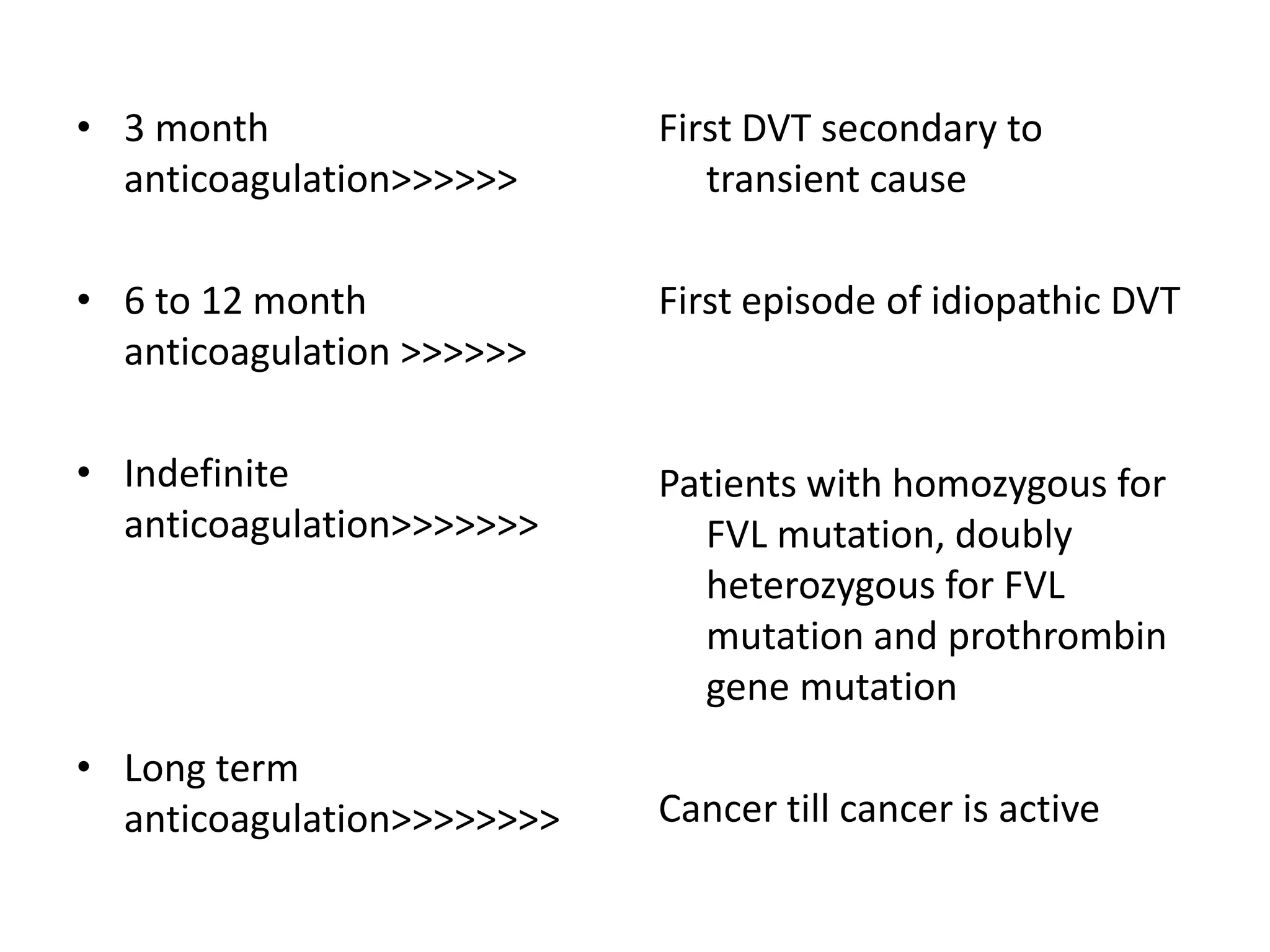
• 3 month
anticoagulation>>>>>>
• 6 to 12 month
anticoagulation >>>>>>
• Indefinite
anticoagulation>>>>>>>
• Long term
anticoagulation>>>>>>>>
First DVT secondary to
transient cause
First episode of idiopathic DVT
Patients with homozygous for
FVL mutation, doubly
heterozygous for FVL
mutation and prothrombin
gene mutation
Cancer till cancer is active
PE treatment
• Respiratory support with oxygen inhalation or
intubation when needed.
• Hemodynamic support with IV fluids, vasopressors
noradrenaline,
• Anticoagulation with UFH/LMWH /FONDAPARINUX
• Followed by VKA
• NOAC as indicated in DVT treatment
• Thrombolytic therapy ..
Indication of Thrombolysis in Pe
• Hemodynamically unstable patient with
perstistent hypotension ie BP less than 90
systolic or decrease in BP > 40 mm of hg
systolic from base line due to aute
PE..Hypotension requiring inotrops
• Possible indication in hemodynamically stable
patients with following criteria
• Signs of detrioration appear – increasing
tachycardia, worsening hypoxia, clinical signs of
shock,worsening right heart function
• Severe or worsening right ventricular dysfunction
("submassive PE")
• Cardiopulmonary arrest due to PE (eg, BP >90
mmHg after resuscitation)
• Extensive clot burden (eg, large perfusion defects
on ventilation/perfusion scan or extensive
embolic burden on computed tomography)
• Free-floating right atrial or ventricular thrombus
Contraindication to Thrombolysis
• intracranial neoplasm
• recent (ie, <2 months) intracranial or spinal
surgery or trauma
• history of a hemorrhagic stroke
• active bleeding or bleeding diathesis
• nonhemorrhagic stroke within the previous
three months
Thrombolytic agents
• Alteplase ---- 100 mg intravenously over two
hours.
• Streptokinase – 250,000 units intravenously
over the initial 30 minutes, then
100,000 units/hour for 24 hours.
• Urokinase – 4400 units/kg intravenously over
the initial 10 minutes, then 4400 units/kg per
hour for 12 hours
• Tenecteplase --- single IV bolus injection in
seconds .
• <60 kg: 30 mg
• ≥60 to <70 kg: 35 mg
• ≥70 to <80 kg: 40 mg
• ≥80 to <90 kg: 45 mg
• ≥90 kg: 50 mg
deep vein thrombosis ANTICOAGULANTS.pptx

deep vein thrombosis ANTICOAGULANTS.pptx

  • 1.
    Deep Venous Thrombosis & PulmonaryEmbolism By, Dr. Sayyed Muzammil Ahmed K MBBS (MRCP UK internal Medicine) PGDCC (Cardiology) Clinical Cardiologist & Physician SHALINI HOSPITAL LIFE MEMBER Indian Medical Association LIFE MEMBER IACC
  • 2.
    Real life casescenarios CASE 1 MR ABC • 39 year male patient NON DM NON HTN suffered # NOF right femur secondary to RTA • Took treatment by local quack was kept immobilsed in bed for 25 days • Came to hospital for fracture fixation he was having right sided chest pain,breathlessness, palpitation since 3 days
  • 3.
    • Vitals pulse 117/ MIN BP – 110 / 70 mm of Hg SPO2 – 92 % ON ROOM AIR • ECG – sinus tachycardia no ST T changes • ECHO – tachycardia during study normal sized cardiac chambers no RWMA Good LV systolic function
  • 4.
  • 5.
    • Considering unexplained tachycardia tachypnea SPO2< 94% on RA right sided opacity in chest xray prolonged bed ridden status • DVT >>> PTE was suspected and bilateral LL venous doppler and CT pulmonary angiogram was done. • Which revealed right sided subsegmental pulmonary embolism along with pulmonary infarction. • Surprisingly LL venous Doppler was negative for DVT indicating that whole thrombus got embolised
  • 6.
    Case no 2Mr XYZ • 65 year old male patient • HTN DM OBESE bilateral OA knees • Was advised TKR • Surgery uneventful. Patient discharged . • Came to hospital after 15 days with breathlessness and low saturations
  • 7.
    • Bedside ECHOrevealed Dilated RA RV D shaped LV Moderate PAH Dilated IVC non collapsing • Bedside BILATERAL LL venous doppler revealed DVT of operated leg. • CTPA confirmed presence of pulmonary embolism
  • 8.
    Case no 3mrs PQR • 39 year old female… NON DM NON HTN suffred RTA.. Fractured Tibia.. • came to hospital for fracture fixation • Surgery went uneventful.. • Came to hospital 20 days back with DVT of operated limb.. • It was HITT ( heparin inudued thrombocytopenia thrombosis ) due to use of clexane as DVT prophylaxis • Treated with fondarinaux later discharged on dabigatran
  • 9.
    Case no 3Mr PQR • 55 yr old male.. police constable by profession. • he was a known case of pulmonary kochs.. drug defaulter.. still on ATT.. • he was not feeling well since 1 month.. lethargic malaise.. • he developed..over night swelling of left lower limb.. which was painful. • ERP have already done bilateral venous doppler..which revealed acute DVT....
  • 10.
    • according toNICE Guidelines.. • if you encounter any patient above 40 yr of age. without any obvious precipitating cause of DVT. like limb injury fracture bed ridden status.. then search for occult malignancy... • his hb came as 5.8.. so UGI ENDOSCOPY.. was done which revealed large ulcer in stomach.. • biospy of which revealed.. gastric carcinoma..
  • 11.
    • Venous thromboembolism(VTE) constitutes two clinical entities ie DVT & PE both having same pathophysiological process. • PE has been declared as most common preventable cause of death • DVT & PE survivors can develop complications like POST THROMBOTIC SYNDROME (PTS), CHRONIC THROMBOEMBOLIC PULMONARY HYPERTENSION ( CTEPH)
  • 12.
    Acquired risk factorsfor hypercoagulability • Immobilization • Surgery • Trauma • Pregnancy • Use of OC pills • Hormone replacement therapy • Malignancy • Antiphospholipid antibody syndrome • Heparin induced thrombocytopenia • Myelopropliferative disorders • Smoking & obesity • Inflammatory bowel diseases • Pacemakers & central venous catheters • Nephrotic syndrome
  • 13.
    inherited risk factorsfor hypercoagulability ( most common) • Factor V leiden mutation • Prothrombin gene mutation (G20210A) • Deficiency of protein C, protein and antithrombin • Hyperhomocysteinemia • Elevated factor VIII levels
  • 14.
    PATHOPHYSIOLOGY • VIRCHOWS TRIAD.. 1)stasis 2) hypercoagulability 3) injury to vessel wall • Hypercoagulability can be due to inherited or acquired risk factors
  • 15.
    Clinical manifestations ofDVT • Pain and swelling • SIGNS increased warmth ,tenderness , dilated collateral veins Cyanosis (extreme) gangrene( extreme) • HOMANS sign – dorsiflesion of ankle with knee at 30 degree flexion causes calf pain
  • 16.
    • Phelgmasia ceruleadolens– it’s a vascular emergency where thrombus completely occludes venous outflow causing massive limb swelling ischaemia and venous gangrene • Its seen in CANCER HIT other hypercoagulable states • Treated by urgent anticoagulation limb elevation catheter directed or surgical embolectomy
  • 17.
    DIAGNOSIS OF DVT •Clinical examination is unreliable as DD like ruptured bakers cyst cellulites too look clinically same like DVT • Pre test probability scores • WELLS SCORE • Lower limb venous doppler study sensitivity and specificity of 98% operator dependent inability to compress the vein with ultrasound probe is diagnostic of DVT
  • 18.
  • 19.
    Wells score • High----- 3 or greater • Moderate---- 1 or 2 • Low ----- 0 or less
  • 20.
    • D-dimer –sensitivity and negative predictive value is high low pre test probability and negative D-dimer has extremely high negative predictive value for VTE positive D- dimer is actually non specific..as its positive in many other disease conditions. • Venography was used in earlier days
  • 21.
    Pathophysiology of pulmonary embolism •DVT thrombus gets dislodged travels in venacava >> RA >> RV >> gets stuck in pulmonary artery • Decreased right ventriculat outflow leads to decreased preload to LV and decreased cardiac output. Shock can ensue • Sudden development of ventilation perfusion mismatch leads to hypoxia.. Which triggers tachypnoea to compensate hypoxia
  • 22.
    • Dilated rightventricle causes RCA obstruction and RCA territory ischemia which again contributes to failure of RV • Cardiopulmonary collapse from PE is more common in patients with underlying CAD or other cardiopulmonary diseases.
  • 23.
    Clinical manifestations ofpulmonary embolism • Sudden onset of dyspnoea • Hemoptysis • Pleuritic chest pain • Shock ( hemodynamic collapse) • Palpitations • Due to acute corpulmonale, pulmonary infarction
  • 24.
    Vital signs inPulmonary embolism • Tachycardia > 100/ min • Tachypnoea • Low saturations < 94 % in Room Air • Low blood pressure • Altered mental status due to hypoxia and shock
  • 25.
    Diagnosis of PE ECG •Most common finding SINUS TACHYCARDIA • Most specific finding S1 Q3 T3 • Atrial fibrillation , RV strain, RBBB, ST T changes
  • 26.
  • 27.
  • 28.
    Sinus tachycardia. Simultaneous T-waveinversions in the anterior (V1-4) and inferior leads (II, III, aVF). Non-specific ST changes – slight ST elevation in III and aVF.
  • 29.
    Chest X RAY •Its helpful to rule out other causes of breathlessness ( COPD exacerbation. Pneumothorax, pneumonia, pulmonary edema ARDS ) • Westermark sign ( regional oligemia) • Hamptons hump ( pleural based wedge shaped shadow) • Pallas sign ( enlarged right inferion PA)
  • 33.
    ECHO • More than50 % patients with hemodynamically stable PE will not have any ECHO changes • Patient with hemodynamic collapse can have • RA RV dilatation, RV dysfunction, mc connells sign, TR with high RVSP pulmonary arterial hypertension . Dilated IVC . Visualization of thrombus in RA RV or Pulmonary artery
  • 34.
  • 35.
    • TROPONIN>>> canbe elevated due to RV ischemia , RV strain, RCA occlusion due to raised RV pressure • Elevation of Troponin is BAD prognostic marker in pulmonary embolism • BNP >>> elevation of BNP in absence of renal dysfunction indicates RV dysfunction • ABG >>> hypoxia due to ventilation perfusion mismatch • respiratory alkalosis due to CO2 wash out secondary to tachypnoa
  • 36.
    CT Pulmonary Angiogram •CT imaging is now standard technique for PE diagnosis • Widely available and ability to directly visualize thrombus • It excludes other diseases too AORTIC DISSECTION PNEMONIA MALIGNANCY • Major disadvantage – radiation higher cost contrast induced nephropathy
  • 38.
    Ventilation- perfusion scanning (V/Qscanning) • Second line diagnostic modality • CT contraindicated patients – Renal insufficiency, contrast allergy , pregnancy. • Unmatched defect is diagnostic of pulmonary embolism
  • 40.
    • Pulmonary angiography– remains gold standard for diagnsosis of PE , nowdays being used infrequently due to advent of CT PA • Magnetic resonance angiography >>> to avoid radiation exposure to avoid contrast in allergic patients
  • 41.
    TREATMENT OF DVT •The Goal of treatment is relief of symptoms and prevention of PE CTEPH PTS Recurrent VTE • once diagnosis of DVT is confirmed immediate anticoagulation should be started. • initial therapy should include HEPARIN/LMWH/FONDAPARINUX followed by Vitamin K Antagonist VKA ( warfarin / acenocaoumoral) • NOAC
  • 42.
    • HEPARIN –UFH 80 mg/kg bolus followed by 18 U/kg/hr IV infusion… target aPTT is 1.5 to 2.5 times the control aPTT • LMWH– Enoxaparin(Clexane) either once daily injection of 1.5 mg/kg/day or twice daily injection of 1 mg/kg/day • FONDAPARINUX – its administered as once daily subcutaneous injection 5 --- < 50 kg 7.5 --- 50 to 100 kg 10 mg --- > 100 kg
  • 43.
    VITAMIN K ANTAGONIST/ WARFARIN • Once anticoagulation with UFH/LMWH/FONDAPARINUX is begun • VITAMIN K ANTAGONIST should be started • And Overlap should be continued till 4 to 5 days till Thepareutic INR is reached • Therapeutic INR 2 to 3
  • 44.
  • 45.
    NEWER ORAL ANTICOAGULANTS •RIVAROXABAN/APIXABAN can be started as monotherapy no overlap or initial treatment with UFH or LMWH is required. RIVAROXABAN15 mg orally twice daily for 21 days followed by 20 mg once daily. APIXABAN– 10 mg BD for 7 days followed by 5 mg BD for upto 6 month ( beyond 6 month 2.5 mg BD) DABIGATRAN – preferably administered after 5 days course of Parenteral anticoagulation 150 mg twice daily
  • 46.
    THROMBOLYTIC THERAPY • Thrombolytictherapy is reserved for those cases of DVT which threaten the limb, ileofemoral DVT • Its given as catheter directed approach or systemic approach in catheter directed approach is not available. • It promotes early recanalisation , prevents PTS.
  • 47.
    IVC filter INDICATIONS • Contraindicationto anticoagulation • Complication from anticoagulation ( ataxia recurrent falls) • Recurrent thromboembolization despite adequate anticoagulation • Massive PE ilieocaval DVT free floating proximal DVT cardiac and pulmonary insufficiency
  • 48.
    DURATION OF ANTICOAGULATION •Duration of anticoagulation depends upon risk of recurrence • Risk factors for recurrence are • IDIOPATHIC DVT, HYPERCOAGULABLE STATES,MALIGNANCY, elevated D dimer levels, male sex, high BMI,
  • 49.
    • 3 month anticoagulation>>>>>> •6 to 12 month anticoagulation >>>>>> • Indefinite anticoagulation>>>>>>> • Long term anticoagulation>>>>>>>> First DVT secondary to transient cause First episode of idiopathic DVT Patients with homozygous for FVL mutation, doubly heterozygous for FVL mutation and prothrombin gene mutation Cancer till cancer is active
  • 50.
    PE treatment • Respiratorysupport with oxygen inhalation or intubation when needed. • Hemodynamic support with IV fluids, vasopressors noradrenaline, • Anticoagulation with UFH/LMWH /FONDAPARINUX • Followed by VKA • NOAC as indicated in DVT treatment • Thrombolytic therapy ..
  • 51.
    Indication of Thrombolysisin Pe • Hemodynamically unstable patient with perstistent hypotension ie BP less than 90 systolic or decrease in BP > 40 mm of hg systolic from base line due to aute PE..Hypotension requiring inotrops
  • 52.
    • Possible indicationin hemodynamically stable patients with following criteria • Signs of detrioration appear – increasing tachycardia, worsening hypoxia, clinical signs of shock,worsening right heart function • Severe or worsening right ventricular dysfunction ("submassive PE") • Cardiopulmonary arrest due to PE (eg, BP >90 mmHg after resuscitation) • Extensive clot burden (eg, large perfusion defects on ventilation/perfusion scan or extensive embolic burden on computed tomography) • Free-floating right atrial or ventricular thrombus
  • 53.
    Contraindication to Thrombolysis •intracranial neoplasm • recent (ie, <2 months) intracranial or spinal surgery or trauma • history of a hemorrhagic stroke • active bleeding or bleeding diathesis • nonhemorrhagic stroke within the previous three months
  • 54.
    Thrombolytic agents • Alteplase---- 100 mg intravenously over two hours. • Streptokinase – 250,000 units intravenously over the initial 30 minutes, then 100,000 units/hour for 24 hours. • Urokinase – 4400 units/kg intravenously over the initial 10 minutes, then 4400 units/kg per hour for 12 hours
  • 55.
    • Tenecteplase ---single IV bolus injection in seconds . • <60 kg: 30 mg • ≥60 to <70 kg: 35 mg • ≥70 to <80 kg: 40 mg • ≥80 to <90 kg: 45 mg • ≥90 kg: 50 mg