HEME DEGRADATION &
JAUNDICE
M.SABARINATHAN
Assistant professor
• RBC’s life span 120 days
• RBC’s are taken up and degraded by the
macrophages of the reticulo-endothelial
system in the spleen and liver.
• The hemoglobin is cleaved to the protein part
globin and non-protein heme
• Fate of globin- reutilized for the formation of
hemoglobin or degraded to the individual
amino acids.
• Sources of heme
80% of the heme – erythrocytes
20% of the heme - immature RBC, myoglobin
and cytochromes.
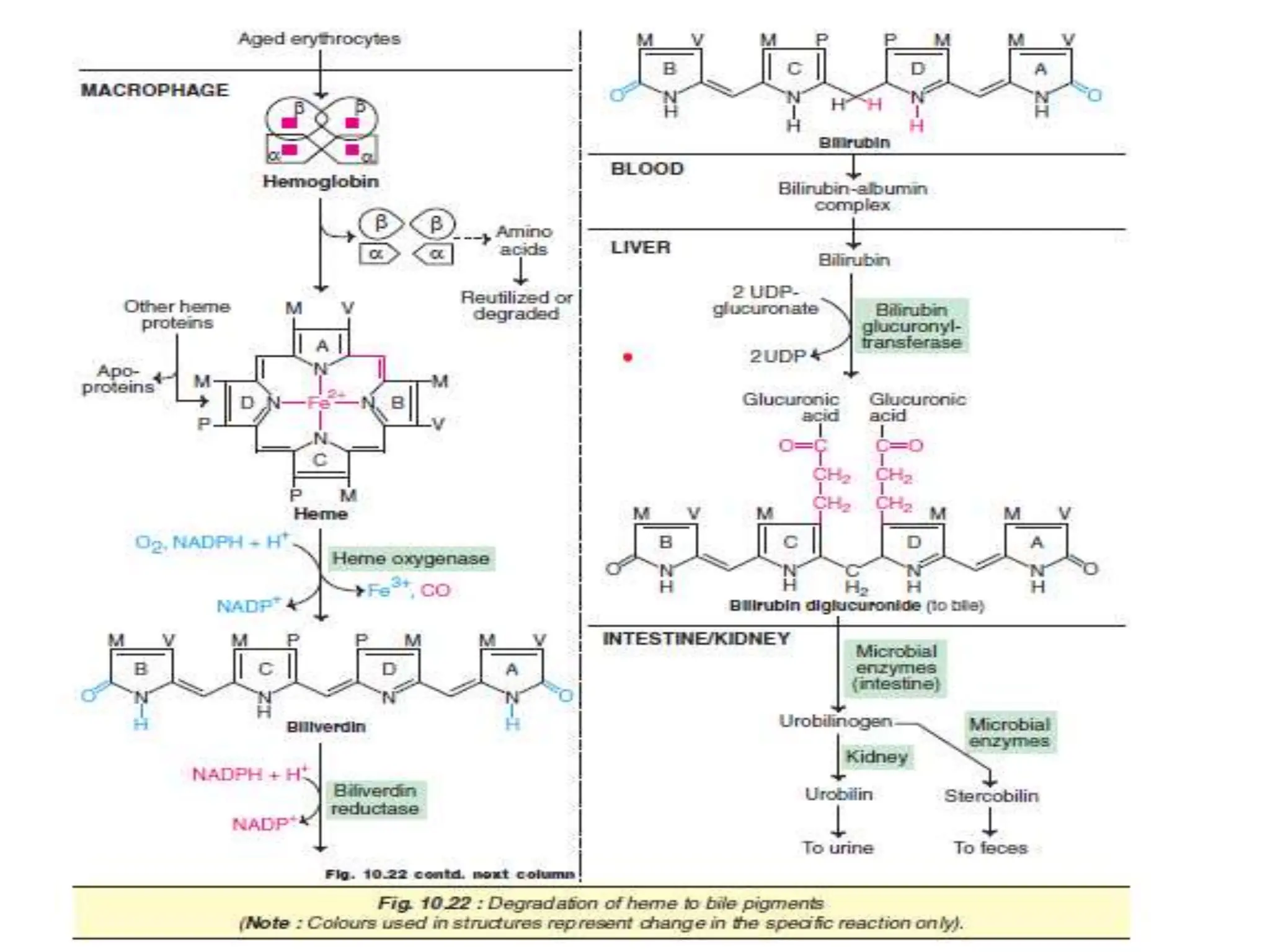
1. Bilirubin formation by Heme oxygenase &
biliverdin reductase
2.Transport of bilirubin in Liver
3. Conjugation of bilirubin
4. Excretion of bilirubin into bile
5. Fate of bilirubin
1.Billirubin formation
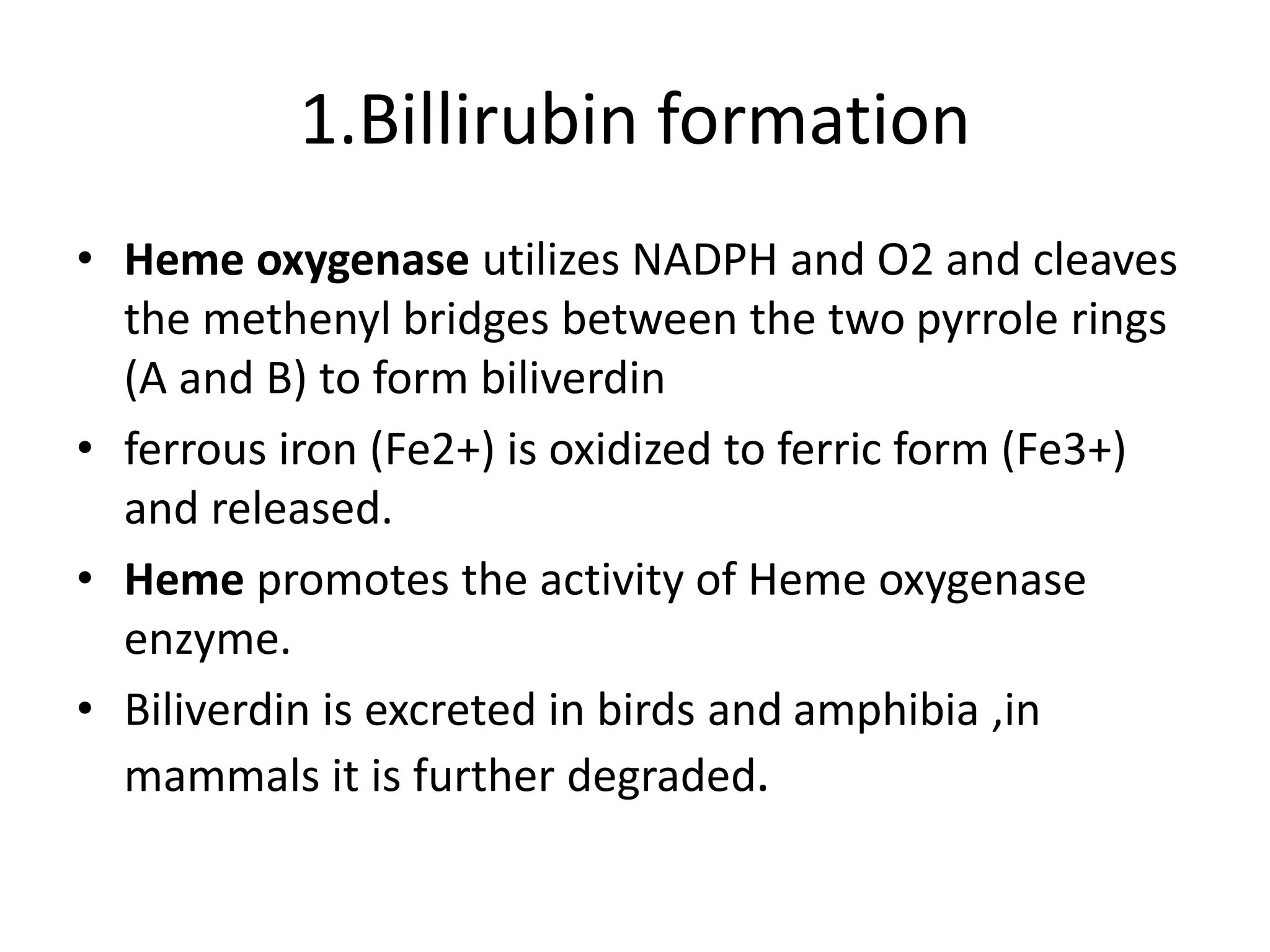
• Heme oxygenase utilizes NADPH and O2 and cleaves
the methenyl bridges between the two pyrrole rings
(A and B) to form biliverdin
• ferrous iron (Fe2+) is oxidized to ferric form (Fe3+)
and released.
• Heme promotes the activity of Heme oxygenase
enzyme.
• Biliverdin is excreted in birds and amphibia ,in
mammals it is further degraded.
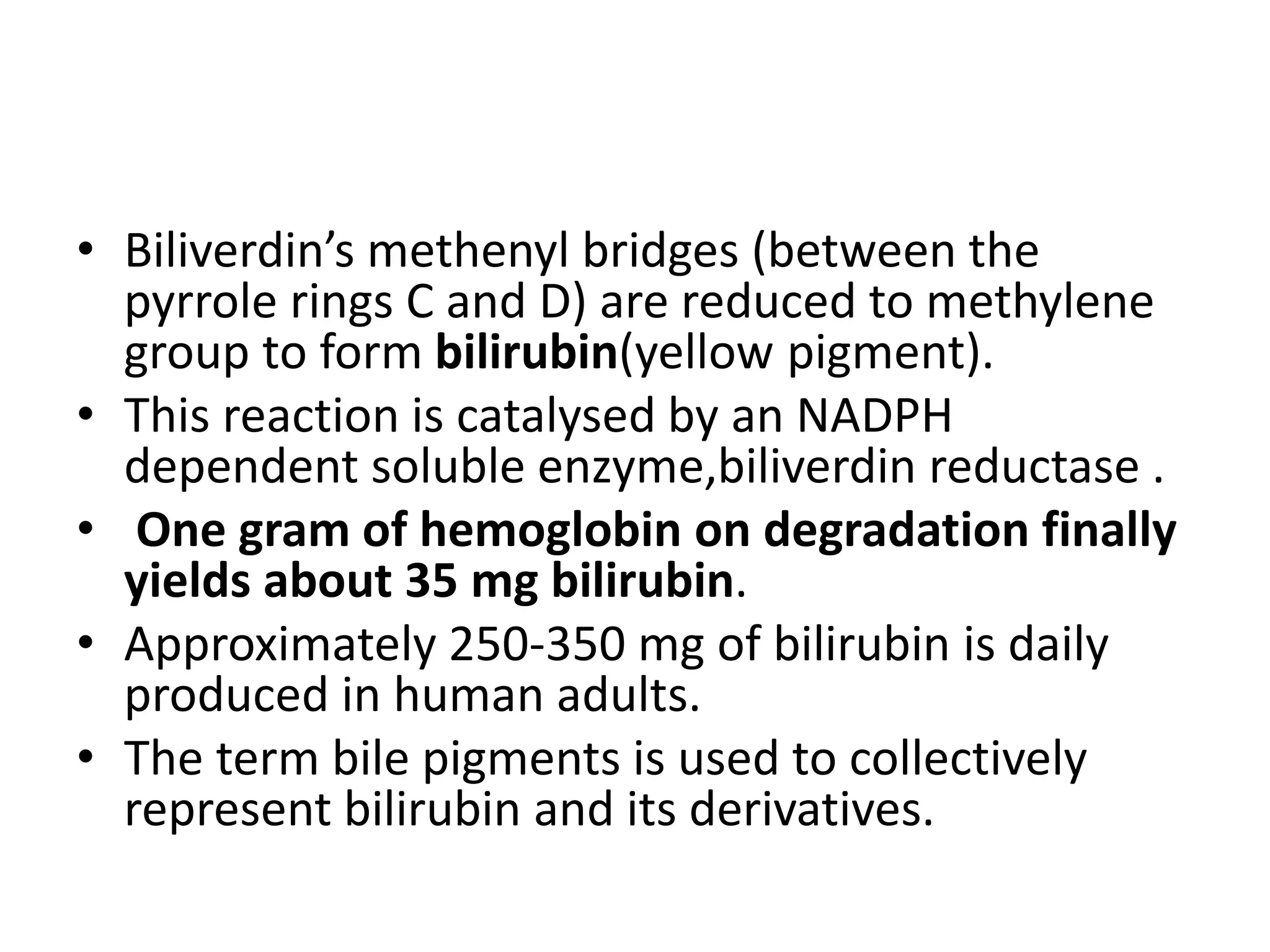
• Biliverdin’s methenyl bridges (between the
pyrrole rings C and D) are reduced to methylene
group to form bilirubin(yellow pigment).
• This reaction is catalysed by an NADPH
dependent soluble enzyme,biliverdin reductase .
• One gram of hemoglobin on degradation finally
yields about 35 mg bilirubin.
• Approximately 250-350 mg of bilirubin is daily
produced in human adults.
• The term bile pigments is used to collectively
represent bilirubin and its derivatives.
Transport of bilirubin to liver
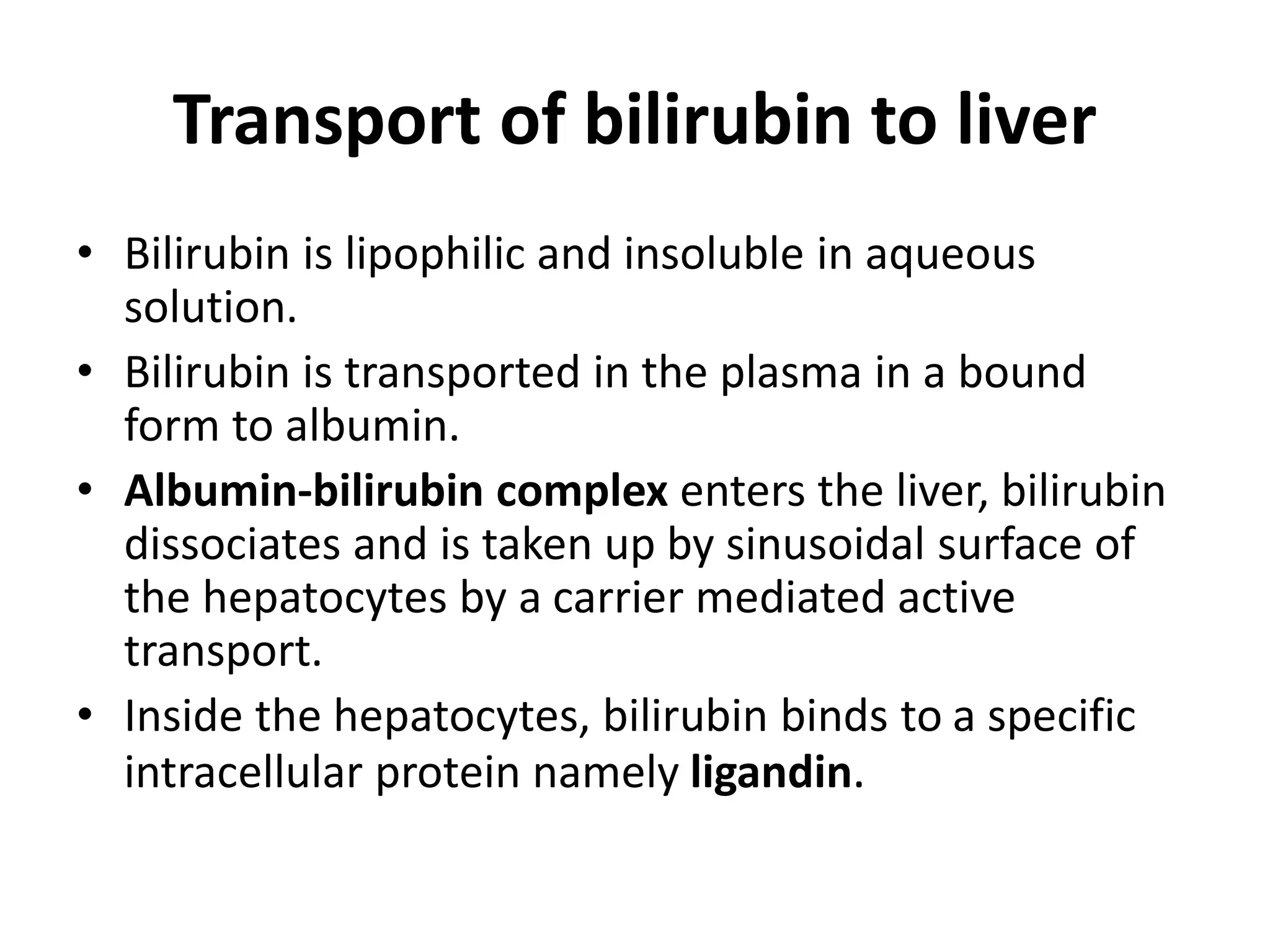
• Bilirubin is lipophilic and insoluble in aqueous
solution.
• Bilirubin is transported in the plasma in a bound
form to albumin.
• Albumin-bilirubin complex enters the liver, bilirubin
dissociates and is taken up by sinusoidal surface of
the hepatocytes by a carrier mediated active
transport.
• Inside the hepatocytes, bilirubin binds to a specific
intracellular protein namely ligandin.
Conjugation of bilirubin in liver
• Bilirubin is conjugated with two molecules of
glucuronate supplied by UDP-glucuronate.
• This reaction, catalysed by bilirubin
glucuronyltransferase (of smooth endoplasmic
reticulum) results in the formation of a water soluble
bilirubin diglucuronide.
• Bilirubin glucuronyltransferase can be induced by a
drugs phenobarbital.
Excretion of bilirubin into bile
• Conjugated bilirubin is excreted into the bile
canaliculi against a concentration gradient which
then enters the bile.
• The transport of bilirubin diglucuronide is an active,
energy-dependent and rate limiting process.
• This step is easily susceptible to any impairment in
liver function.
• Almost 98% of the bilirubin that enters bile in
the conjugated form.
Fate of bilirubin
• Bilirubin glucuronides are hydrolysed in the intestine
by specific bacterial enzymes namely Beta-
glucuronidases to liberate bilirubin , and then
converted to urobilinogen (colourless compound), a
small part of which may be reabsorbed into the
circulation.
• Urobilinogen can be converted to urobilin (an yellow
colour compound) in the kidney and excreted. The
characteristic colour of urine is due to urobilin.
• A major part of urobilinogen is converted by bacteria
to stercobilin which is excreted along with feces. The
characteristic brown colour of feces is due to
stercobilin.
Jaundice
• serum total bilirubin conc is 0.2 to 1.0 mg/dl.
• Jaundice (French : Jaune-yellow) is
characterized by yellow colour of the white of
the eyes (sclerae) and skin.
• It is caused by the deposition of bilirubin due
to its elevated levels in the serum.
• The term hyperbilirubinemia is used to
represent the increased concentration of
serum bilirubin.
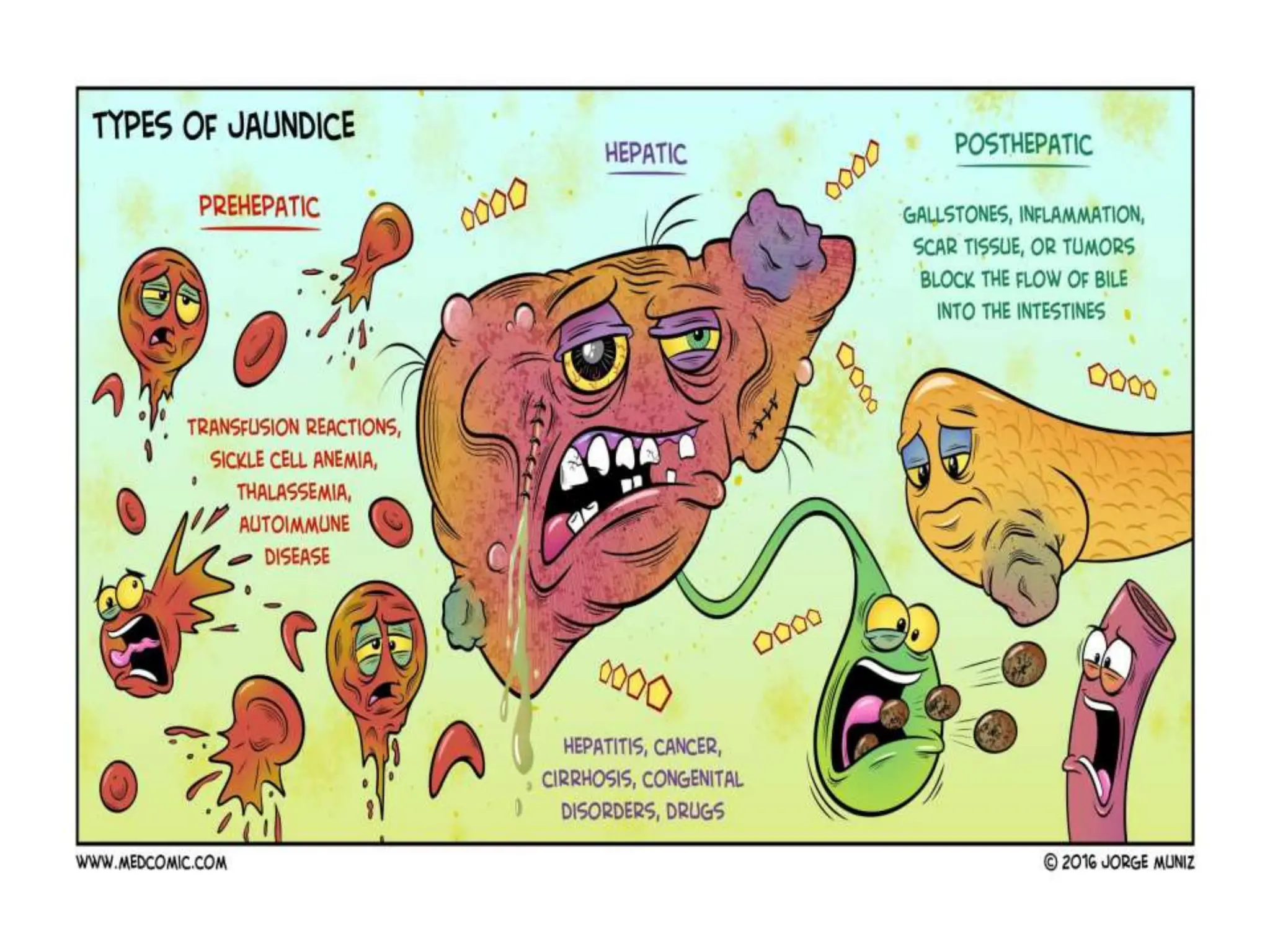
Classification of jaundice
Jaundice is classified into three major types
• Hemolytic jaundice
• Hepatic (hepatocellular) jaundice
• Obstructive (regurgitation) jaundice
1. Hemolytic jaundice :
• Hemolytic jaundice associated with increased
hemolysis of erythrocytes (e.g. incompatible blood
transfusion, malaria, sickle-cell anemia). This results in
the overproduction of bilirubin beyond the ability of
the liver to conjugate and excrete the same.
• In hemolytic jaundice, more bilirubin is excreted into
the bile leading to the increased formation of
urobilinogen and stercobilinogen.
• Hemolytic jaundice is characterized by
a) Elevation in the serum unconjugated bilirubin.
b) Increased excretion of urobilinogen in urine.
c) Dark brown colour of feces due to high content of
stercobilinogen
Hepatic (hepatocellular) jaundice
• Hepatic jaundice is caused by dysfunction of the liver
due to damage to the parenchymal cells.
• This may be attributed to viral infection (viral hepatitis),
poisons and toxins (chloroform, carbon tetrachloride,
phosphorus etc.) cirrhosis of liver, cardiac failure etc.
• Damage to the liver adversely affects the bilirubin
uptake and its conjugation by liver cells.
• Hepatic jaundice is characterized by
a) Increased levels of conjugated and unconjugated
bilirubin in the serum.
b) Dark coloured urine due to the excessive excretion
of bilirubin and urobilinogen.
• Increased activities of alanine transaminase
(SGPT) and aspartate transaminase (SGOT)
released into circulation due to damage to
hepatocytes.
• The patients pass pale, clay coloured stool due
to the absence of stercobilinogen.
• The affected individuals experience nause and
anorexia (loss of appetite).
Obstructive (regurgitation) jaundice
• Obstructive jaundice is due to an obstruction in the bile duct that
prevents the passage of bile into the intestine. The obstruction may
be caused by gall stones, tumors etc.
• Due to the blockage in bile duct, the conjugated bilirubin from the
liver enters the circulation. Obstructive jaundice is characterized by
a) Increased concentration of conjugated bilirubin in serum.
b) Serum alkaline phosphatase is elevated as it is released from the
cells of the damaged bile duct.
c) Dark coloured urine due to elevated excretion of bilirubin and clay
coloured feces due to absence of stercobilinogen.
d) Feces contain excess fat indicating impairment in fat digestion
and absorption in the absence of bile (specifically bile salts).
e) The patients experience nausea and gastrointestinal pain.
JAUNDICE DUE TO GENETIC DEFECTS
• Neonatal-physiologic jaundice
• Crigler-Najjar syndrome type I
• Crigler-Najjar syndrome type II
• Gilbert’s disease
Crigler-Najjar syndrome type I
• This is also known as congenital Non-
hemolytic jaundice.
• It is a rare disorder
• due to a defect in the hepatic enzyme
UDPglucuronyltransferase.
children die within first two years of life.
Crigler-Najjar syndrome type I
• This is again a rare hereditary disorder
• due to defect in the bilirubin conjugation.
• hepatic UDP-glucuronyltransferase catalyses
the addition of second glucuronyl group is
defective.
• The serum bilirubin concentration is usually
less than 20 mg/dl
• less dangerous than type I.
Gilbert’s disease
• This is a combination of disorders.
These include
1. A defect in the uptake of bilirubin by liver
cells.
2. An impairment in conjugation due to reduced
activity of UDP-glucuronyltransferase.
3. Decreased hepatic clearance of bilirubin

HEME DEGRADATION and Jaundice Powerpoint presentation

  • 1.
  • 2.
    • RBC’s lifespan 120 days • RBC’s are taken up and degraded by the macrophages of the reticulo-endothelial system in the spleen and liver. • The hemoglobin is cleaved to the protein part globin and non-protein heme • Fate of globin- reutilized for the formation of hemoglobin or degraded to the individual amino acids.
  • 3.
    • Sources ofheme 80% of the heme – erythrocytes 20% of the heme - immature RBC, myoglobin and cytochromes.
  • 4.
    1. Bilirubin formationby Heme oxygenase & biliverdin reductase 2.Transport of bilirubin in Liver 3. Conjugation of bilirubin 4. Excretion of bilirubin into bile 5. Fate of bilirubin
  • 6.
    1.Billirubin formation • Hemeoxygenase utilizes NADPH and O2 and cleaves the methenyl bridges between the two pyrrole rings (A and B) to form biliverdin • ferrous iron (Fe2+) is oxidized to ferric form (Fe3+) and released. • Heme promotes the activity of Heme oxygenase enzyme. • Biliverdin is excreted in birds and amphibia ,in mammals it is further degraded.
  • 7.
    • Biliverdin’s methenylbridges (between the pyrrole rings C and D) are reduced to methylene group to form bilirubin(yellow pigment). • This reaction is catalysed by an NADPH dependent soluble enzyme,biliverdin reductase . • One gram of hemoglobin on degradation finally yields about 35 mg bilirubin. • Approximately 250-350 mg of bilirubin is daily produced in human adults. • The term bile pigments is used to collectively represent bilirubin and its derivatives.
  • 8.
    Transport of bilirubinto liver • Bilirubin is lipophilic and insoluble in aqueous solution. • Bilirubin is transported in the plasma in a bound form to albumin. • Albumin-bilirubin complex enters the liver, bilirubin dissociates and is taken up by sinusoidal surface of the hepatocytes by a carrier mediated active transport. • Inside the hepatocytes, bilirubin binds to a specific intracellular protein namely ligandin.
  • 9.
    Conjugation of bilirubinin liver • Bilirubin is conjugated with two molecules of glucuronate supplied by UDP-glucuronate. • This reaction, catalysed by bilirubin glucuronyltransferase (of smooth endoplasmic reticulum) results in the formation of a water soluble bilirubin diglucuronide. • Bilirubin glucuronyltransferase can be induced by a drugs phenobarbital.
  • 10.
    Excretion of bilirubininto bile • Conjugated bilirubin is excreted into the bile canaliculi against a concentration gradient which then enters the bile. • The transport of bilirubin diglucuronide is an active, energy-dependent and rate limiting process. • This step is easily susceptible to any impairment in liver function. • Almost 98% of the bilirubin that enters bile in the conjugated form.
  • 11.
    Fate of bilirubin •Bilirubin glucuronides are hydrolysed in the intestine by specific bacterial enzymes namely Beta- glucuronidases to liberate bilirubin , and then converted to urobilinogen (colourless compound), a small part of which may be reabsorbed into the circulation. • Urobilinogen can be converted to urobilin (an yellow colour compound) in the kidney and excreted. The characteristic colour of urine is due to urobilin. • A major part of urobilinogen is converted by bacteria to stercobilin which is excreted along with feces. The characteristic brown colour of feces is due to stercobilin.
  • 12.
    Jaundice • serum totalbilirubin conc is 0.2 to 1.0 mg/dl. • Jaundice (French : Jaune-yellow) is characterized by yellow colour of the white of the eyes (sclerae) and skin. • It is caused by the deposition of bilirubin due to its elevated levels in the serum. • The term hyperbilirubinemia is used to represent the increased concentration of serum bilirubin.
  • 13.
    Classification of jaundice Jaundiceis classified into three major types • Hemolytic jaundice • Hepatic (hepatocellular) jaundice • Obstructive (regurgitation) jaundice
  • 15.
    1. Hemolytic jaundice: • Hemolytic jaundice associated with increased hemolysis of erythrocytes (e.g. incompatible blood transfusion, malaria, sickle-cell anemia). This results in the overproduction of bilirubin beyond the ability of the liver to conjugate and excrete the same. • In hemolytic jaundice, more bilirubin is excreted into the bile leading to the increased formation of urobilinogen and stercobilinogen. • Hemolytic jaundice is characterized by a) Elevation in the serum unconjugated bilirubin. b) Increased excretion of urobilinogen in urine. c) Dark brown colour of feces due to high content of stercobilinogen
  • 16.
    Hepatic (hepatocellular) jaundice •Hepatic jaundice is caused by dysfunction of the liver due to damage to the parenchymal cells. • This may be attributed to viral infection (viral hepatitis), poisons and toxins (chloroform, carbon tetrachloride, phosphorus etc.) cirrhosis of liver, cardiac failure etc. • Damage to the liver adversely affects the bilirubin uptake and its conjugation by liver cells. • Hepatic jaundice is characterized by a) Increased levels of conjugated and unconjugated bilirubin in the serum. b) Dark coloured urine due to the excessive excretion of bilirubin and urobilinogen.
  • 17.
    • Increased activitiesof alanine transaminase (SGPT) and aspartate transaminase (SGOT) released into circulation due to damage to hepatocytes. • The patients pass pale, clay coloured stool due to the absence of stercobilinogen. • The affected individuals experience nause and anorexia (loss of appetite).
  • 18.
    Obstructive (regurgitation) jaundice •Obstructive jaundice is due to an obstruction in the bile duct that prevents the passage of bile into the intestine. The obstruction may be caused by gall stones, tumors etc. • Due to the blockage in bile duct, the conjugated bilirubin from the liver enters the circulation. Obstructive jaundice is characterized by a) Increased concentration of conjugated bilirubin in serum. b) Serum alkaline phosphatase is elevated as it is released from the cells of the damaged bile duct. c) Dark coloured urine due to elevated excretion of bilirubin and clay coloured feces due to absence of stercobilinogen. d) Feces contain excess fat indicating impairment in fat digestion and absorption in the absence of bile (specifically bile salts). e) The patients experience nausea and gastrointestinal pain.
  • 19.
    JAUNDICE DUE TOGENETIC DEFECTS • Neonatal-physiologic jaundice • Crigler-Najjar syndrome type I • Crigler-Najjar syndrome type II • Gilbert’s disease
  • 20.
    Crigler-Najjar syndrome typeI • This is also known as congenital Non- hemolytic jaundice. • It is a rare disorder • due to a defect in the hepatic enzyme UDPglucuronyltransferase. children die within first two years of life.
  • 21.
    Crigler-Najjar syndrome typeI • This is again a rare hereditary disorder • due to defect in the bilirubin conjugation. • hepatic UDP-glucuronyltransferase catalyses the addition of second glucuronyl group is defective. • The serum bilirubin concentration is usually less than 20 mg/dl • less dangerous than type I.
  • 22.
    Gilbert’s disease • Thisis a combination of disorders. These include 1. A defect in the uptake of bilirubin by liver cells. 2. An impairment in conjugation due to reduced activity of UDP-glucuronyltransferase. 3. Decreased hepatic clearance of bilirubin