Helmholtz equation
(Motivation and solutions)
Muhammad Hassaan Saleem
(PHYMATHS)
Helmholtz equation
The Helmholtz equation is given as;
𝛻2 𝜓 + 𝑘2 𝜓 = 0 𝑘 ∈ ℛ
Where
𝜓(𝑥, 𝑦, 𝑧) is a function of 𝑥, 𝑦 and 𝑧
𝑘2 is a constant
Note : 𝜓 should have continuous first and second partial derivatives
with respect to 𝑥, 𝑦, 𝑧
Motivations for
Helmholtz equation
Motivation for Helmholtz equation
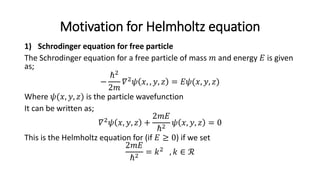
1) Schrodinger equation for free particle
The Schrodinger equation for a free particle of mass 𝑚 and energy 𝐸 is given
as;
−
ℏ2
2𝑚
𝛻2
𝜓 𝑥, , 𝑦, 𝑧 = 𝐸𝜓(𝑥, 𝑦, 𝑧)
Where 𝜓(𝑥, 𝑦, 𝑧) is the particle wavefunction
It can be written as;
𝛻2
𝜓 𝑥, 𝑦, 𝑧 +
2𝑚𝐸
ℏ2
𝜓 𝑥, 𝑦, 𝑧 = 0
This is the Helmholtz equation for (if 𝐸 ≥ 0) if we set
2𝑚𝐸
ℏ2
= 𝑘2 , 𝑘 ∈ ℛ
Motivation for Helmholtz equation
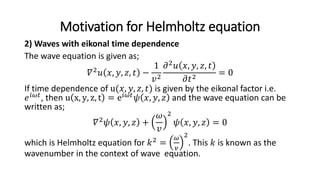
2) Waves with eikonal time dependence
The wave equation is given as;
𝛻2 𝑢 𝑥, 𝑦, 𝑧, 𝑡 −
1
𝑣2
𝜕2 𝑢 𝑥, 𝑦, 𝑧, 𝑡
𝜕𝑡2
= 0
If time dependence of u(𝑥, 𝑦, 𝑧, 𝑡) is given by the eikonal factor i.e.
𝑒 𝑖𝜔𝑡, then u x, y, z, t = e𝑖𝜔𝑡 𝜓 𝑥, 𝑦, 𝑧 and the wave equation can be
written as;
𝛻2
𝜓 𝑥, 𝑦, 𝑧 +
𝜔
𝑣
2
𝜓 𝑥, 𝑦, 𝑧 = 0
which is Helmholtz equation for 𝑘2 =
𝜔
𝑣
2
. This 𝑘 is known as the
wavenumber in the context of wave equation.
Solutions of Helmholtz
equation
Solution in Cartesian coordinates
The explicit form of Helmholtz equation in Cartesian coordinates is given as;
𝜕2 𝜓 𝑥, 𝑦, 𝑧
𝜕𝑥2
+
𝜕2 𝜓 𝑥, 𝑦, 𝑧
𝜕𝑦2
+
𝜕2 𝜓 𝑥, 𝑦, 𝑧
𝜕𝑧2
+ 𝑘2
𝜓 𝑥, 𝑦, 𝑧 = 0 (𝑖)
We now employ a method known as method of separation of variables.
We assume a solution of the form;
𝜓 𝑥, 𝑦, 𝑧 = 𝑋 𝑥 𝑌 𝑦 𝑍 𝑧 (𝑖𝑖)
Where
𝑋(𝑥) is a function of 𝑥 only
𝑌(𝑦) is a function of 𝑦 only
𝑍(𝑧) is a function of 𝑧 only
Solution in Cartesian coordinates
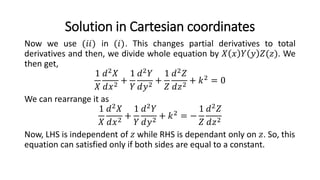
Now we use (𝑖𝑖) in (𝑖). This changes partial derivatives to total
derivatives and then, we divide whole equation by 𝑋 𝑥 𝑌 𝑦 𝑍(𝑧). We
then get,
1
𝑋
𝑑2 𝑋
𝑑𝑥2
+
1
𝑌
𝑑2 𝑌
𝑑𝑦2
+
1
𝑍
𝑑2 𝑍
𝑑𝑧2
+ 𝑘2 = 0
We can rearrange it as
1
𝑋
𝑑2 𝑋
𝑑𝑥2
+
1
𝑌
𝑑2 𝑌
𝑑𝑦2
+ 𝑘2 = −
1
𝑍
𝑑2 𝑍
𝑑𝑧2
Now, LHS is independent of 𝑧 while RHS is dependant only on 𝑧. So, this
equation can satisfied only if both sides are equal to a constant.
Solution in Cartesian coordinates
This means that
1
𝑍
𝑑2 𝑍
𝑑𝑧2
= − 𝑛 2
⇒ 𝑍 𝑧 = 𝐴 𝑧 sin 𝑛𝑧 + 𝐵𝑧 cos(𝑛𝑧)
where 𝑛2 is a positive constant while 𝐴 𝑧 and 𝐵𝑧 are arbitrary constants.
Note : We have choosen 𝑛2 to be positive because it gives a solution
which doesn’t grow exponentially and thus, gives physically more
relevant solution (e.g. for the case when 𝜓 represents a wavefunction).
We can do the same procedure for 𝑋(𝑥) and 𝑌(𝑦) functions.
Solution in Cartesian coordinates
When we perform the same procedure for 𝑋 𝑥 , Y(y) and 𝑍(𝑧) functions,
we get;
𝑋 𝑥 = 𝑋𝑙(𝑥) = 𝐴 𝑥 sin 𝑙𝑥 + 𝐵𝑥 cos(𝑙𝑥)
𝑌 𝑦 = 𝑌 𝑚 𝑦 = 𝐴 𝑦 sin 𝑚𝑦 + 𝐵𝑦 cos(𝑚𝑦)
𝑍 𝑧 = 𝑍 𝑛 𝑧 = 𝐴 𝑧 sin 𝑛𝑧 + 𝐵𝑧 cos(𝑛𝑧)
Where 𝑙, 𝑚, 𝑛, 𝐴 𝑥,𝑦,𝑧 , 𝐵 𝑥,𝑦,𝑧 are constants.
We see that each solution are labelled by a parameter i.e. 𝑙, 𝑚 and 𝑛.
With these equations, we also get the equation
𝑙2 + 𝑚2 + 𝑛2 = 𝑘2
We can thus deduce that 𝜓𝑙𝑚𝑛 𝑥, 𝑦, 𝑧 = 𝑋𝑙 𝑥 𝑌 𝑚 𝑦 𝑍 𝑛(𝑧)
We can see that 𝜓 is labelled now by three parameters.
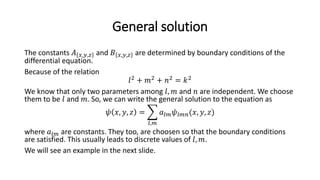
General solution
The constants 𝐴 𝑥,𝑦,𝑧 and 𝐵 𝑥,𝑦,𝑧 are determined by boundary conditions of the
differential equation.
Because of the relation
𝑙2
+ 𝑚2
+ 𝑛2
= 𝑘2
We know that only two parameters among 𝑙, 𝑚 and 𝑛 are independent. We choose
them to be 𝑙 and 𝑚. So, we can write the general solution to the equation as
𝜓 𝑥, 𝑦, 𝑧 =
𝑙,𝑚
𝑎𝑙𝑚 𝜓𝑙𝑚𝑛(𝑥, 𝑦, 𝑧)
where 𝑎𝑙𝑚 are constants. They too, are choosen so that the boundary conditions
are satisfied. This usually leads to discrete values of 𝑙, 𝑚.
We will see an example in the next slide.
An example: Particle in a cubic box.
In problem of particle in a cubic box of length 𝑎, we have 𝑘2
= 2𝑚𝐸/ℏ2
. The
Schrodinger equation was quoted as a Helmholtz equation already and this
problem has the following boundary conditions
𝜓 0, 𝑦, 𝑧 = 𝜓 𝑎, 𝑦, 𝑧 = 0
𝜓 𝑥, 0, 𝑧 = 𝜓 𝑥, 𝑎, 𝑧 = 0
𝜓 𝑥, 𝑦, 0 = 𝜓 𝑥, 𝑦, 𝑎 = 0
Because of the vanishing of the 𝜓 function on 𝑥 = 0, 𝑦 = 0 and 𝑧 = 0, we
deduce that 𝐵𝑥 = 0, 𝐵𝑦 = 0, 𝐵𝑧 = 0 and thus, we write the solution as
𝜓 𝑥, 𝑦, 𝑧 =
𝑙,𝑚
𝑎𝑙𝑚 sin 𝑙𝑥 sin 𝑚𝑦 sin(𝑛𝑧)
Where we have absorbed the arbitrary constants 𝐴 𝑥, 𝐴 𝑦 and 𝐴 𝑧 into 𝑎𝑙𝑚.
An example : Particle in a cubic box
Applying the remaining boundary conditions, we get;
sin 𝑙𝑎 = 0 ⇒ 𝑙 =
𝑐1 𝜋
𝑎
, sin 𝑚𝑎 = 0 ⇒ 𝑚 =
𝑐2 𝜋
𝑎
,
sin 𝑛𝑎 = 0 ⇒ 𝑛 =
𝑐3 𝜋
𝑎
Where 𝑐 1,2,3 = 1,2,3,4,5, …
Due to the relation 𝑙2
+ 𝑚2
+ 𝑛2
= 𝑘2
, we have
2𝑚𝐸
ℏ2
=
𝜋2
𝑎2
𝑐1
2
+ 𝑐2
2
+ 𝑐3
2
⇒ 𝐸 =
ℏ2 𝜋2
2𝑚𝑎2
𝑐1
2
+ 𝑐2
2
+ 𝑐3
2
This gives the energy levels which the particle can attain.
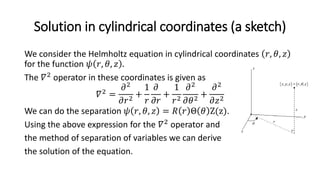
Solution in cylindrical coordinates (a sketch)
We consider the Helmholtz equation in cylindrical coordinates 𝑟, 𝜃, 𝑧
for the function 𝜓 𝑟, 𝜃, 𝑧 .
The 𝛻2
operator in these coordinates is given as
𝛻2 =
𝜕2
𝜕𝑟2
+
1
𝑟
𝜕
𝜕𝑟
+
1
𝑟2
𝜕2
𝜕𝜃2
+
𝜕2
𝜕𝑧2
We can do the separation 𝜓 𝑟, 𝜃, 𝑧 = 𝑅 𝑟 Θ 𝜃 Z(z).
Using the above expression for the 𝛻2 operator and
the method of separation of variables we can derive
the solution of the equation.
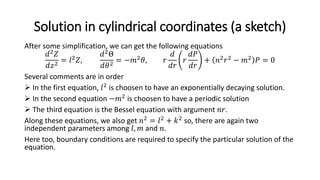
Solution in cylindrical coordinates (a sketch)
After some simplification, we can get the following equations
𝑑2 𝑍
𝑑𝑧2
= 𝑙2 𝑍,
𝑑2Θ
𝑑𝜃2
= −𝑚2 𝜃, 𝑟
𝑑
𝑑𝑟
𝑟
𝑑𝑃
𝑑𝑟
+ 𝑛2 𝑟2 − 𝑚2 𝑃 = 0
Several comments are in order
 In the first equation, 𝑙2 is choosen to have an exponentially decaying solution.
 In the second equation −𝑚2 is choosen to have a periodic solution
 The third equation is the Bessel equation with argument 𝑛𝑟.
Along these equations, we also get 𝑛2
= 𝑙2
+ 𝑘2
so, there are again two
independent parameters among 𝑙, 𝑚 and 𝑛.
Here too, boundary conditions are required to specify the particular solution of the
equation.
Solution in cylindrical coordinates (a sketch)
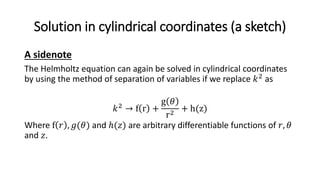
A sidenote
The Helmholtz equation can again be solved in cylindrical coordinates
by using the method of separation of variables if we replace 𝑘2 as
𝑘2 → f r +
g 𝜃
r2
+ h(z)
Where f 𝑟 , 𝑔(𝜃) and ℎ(𝑧) are arbitrary differentiable functions of 𝑟, 𝜃
and 𝑧.
Solution in spherical coordinates
(a sketch)
We can use the expression for 𝛻2 in spherical
coordinates (𝑟, 𝜃, 𝜙) i.e.
𝛻2 =
𝜕2
𝜕𝑟2
+
2
𝑟
𝜕
𝜕𝑟
+
1
𝑟2
𝜕2
𝜕𝜃2
+
cos 𝜃
r2 sin 𝜃
𝜕
𝜕𝜃
+
1
𝑟2 sin2 𝜃
𝜕2
𝜕𝜙2
With it, we can make the separation 𝜓 𝑟, 𝜃, 𝜙 = 𝑅 𝑟 Θ 𝜃 Φ(𝜙) and
use the method of separation of variables to get the equations for 𝑅, Θ
and Φ.
Solution in spherical coordinates (a sketch)
We get these equations;
𝚽 equation
𝑑2
Φ
𝑑𝜙2
= −𝑚2
Φ(𝜙)
The constant −𝑚2 is choosen to make Φ(𝜙) a periodic function of 𝜙.
𝚯 equation
sin2
𝜃
𝑑2
Θ
𝑑 cos 𝜃 2
− 2 cos 𝜃
𝑑Θ
𝑑 cos 𝜃
+ 𝑙 𝑙 + 1 −
𝑚2
sin2 𝜃
Θ = 0
This is an associated Legendre equation in the argument cos 𝜃. The term
𝑙(𝑙 + 1) (where 𝑙 is an integer) comes from the fact that this equation has
non singular solutions only if we have a term 𝑙(𝑙 + 1) there.
Solution in spherical coordinates (a sketch)
R equation
The 𝑅 equation is
𝑑2
𝑅
𝑑𝑟2
+
2
𝑟
𝑑𝑅
𝑑𝑟
+ 𝑘2
𝑅 −
𝑙 𝑙 + 1 𝑅
𝑟2
= 0
This is the spherical Bessel equation with the argument 𝑘𝑟.
So, we can use the known solutions of all these equations to write the
solutions in spherical coordinates.
Sidenote:
The Helmholtz equation can still be solved by separation of variables if we
replace 𝑘2
by
𝑘2
→ 𝑓 𝑟 +
𝑔 𝜃
𝑟2
+
ℎ 𝜙
𝑟2 sin2 𝜃
Where 𝑓 𝑟 , 𝑔(𝜃) and ℎ(𝜙) are arbitrary functions of 𝑟, 𝜃 and 𝜙.
Thank you
for listening
Questions?

Helmholtz equation (Motivations and Solutions)

  • 1.
    Helmholtz equation (Motivation andsolutions) Muhammad Hassaan Saleem (PHYMATHS)
  • 2.
    Helmholtz equation The Helmholtzequation is given as; 𝛻2 𝜓 + 𝑘2 𝜓 = 0 𝑘 ∈ ℛ Where 𝜓(𝑥, 𝑦, 𝑧) is a function of 𝑥, 𝑦 and 𝑧 𝑘2 is a constant Note : 𝜓 should have continuous first and second partial derivatives with respect to 𝑥, 𝑦, 𝑧
  • 3.
  • 4.
    Motivation for Helmholtzequation 1) Schrodinger equation for free particle The Schrodinger equation for a free particle of mass 𝑚 and energy 𝐸 is given as; − ℏ2 2𝑚 𝛻2 𝜓 𝑥, , 𝑦, 𝑧 = 𝐸𝜓(𝑥, 𝑦, 𝑧) Where 𝜓(𝑥, 𝑦, 𝑧) is the particle wavefunction It can be written as; 𝛻2 𝜓 𝑥, 𝑦, 𝑧 + 2𝑚𝐸 ℏ2 𝜓 𝑥, 𝑦, 𝑧 = 0 This is the Helmholtz equation for (if 𝐸 ≥ 0) if we set 2𝑚𝐸 ℏ2 = 𝑘2 , 𝑘 ∈ ℛ
  • 5.
    Motivation for Helmholtzequation 2) Waves with eikonal time dependence The wave equation is given as; 𝛻2 𝑢 𝑥, 𝑦, 𝑧, 𝑡 − 1 𝑣2 𝜕2 𝑢 𝑥, 𝑦, 𝑧, 𝑡 𝜕𝑡2 = 0 If time dependence of u(𝑥, 𝑦, 𝑧, 𝑡) is given by the eikonal factor i.e. 𝑒 𝑖𝜔𝑡, then u x, y, z, t = e𝑖𝜔𝑡 𝜓 𝑥, 𝑦, 𝑧 and the wave equation can be written as; 𝛻2 𝜓 𝑥, 𝑦, 𝑧 + 𝜔 𝑣 2 𝜓 𝑥, 𝑦, 𝑧 = 0 which is Helmholtz equation for 𝑘2 = 𝜔 𝑣 2 . This 𝑘 is known as the wavenumber in the context of wave equation.
  • 6.
  • 7.
    Solution in Cartesiancoordinates The explicit form of Helmholtz equation in Cartesian coordinates is given as; 𝜕2 𝜓 𝑥, 𝑦, 𝑧 𝜕𝑥2 + 𝜕2 𝜓 𝑥, 𝑦, 𝑧 𝜕𝑦2 + 𝜕2 𝜓 𝑥, 𝑦, 𝑧 𝜕𝑧2 + 𝑘2 𝜓 𝑥, 𝑦, 𝑧 = 0 (𝑖) We now employ a method known as method of separation of variables. We assume a solution of the form; 𝜓 𝑥, 𝑦, 𝑧 = 𝑋 𝑥 𝑌 𝑦 𝑍 𝑧 (𝑖𝑖) Where 𝑋(𝑥) is a function of 𝑥 only 𝑌(𝑦) is a function of 𝑦 only 𝑍(𝑧) is a function of 𝑧 only
  • 8.
    Solution in Cartesiancoordinates Now we use (𝑖𝑖) in (𝑖). This changes partial derivatives to total derivatives and then, we divide whole equation by 𝑋 𝑥 𝑌 𝑦 𝑍(𝑧). We then get, 1 𝑋 𝑑2 𝑋 𝑑𝑥2 + 1 𝑌 𝑑2 𝑌 𝑑𝑦2 + 1 𝑍 𝑑2 𝑍 𝑑𝑧2 + 𝑘2 = 0 We can rearrange it as 1 𝑋 𝑑2 𝑋 𝑑𝑥2 + 1 𝑌 𝑑2 𝑌 𝑑𝑦2 + 𝑘2 = − 1 𝑍 𝑑2 𝑍 𝑑𝑧2 Now, LHS is independent of 𝑧 while RHS is dependant only on 𝑧. So, this equation can satisfied only if both sides are equal to a constant.
  • 9.
    Solution in Cartesiancoordinates This means that 1 𝑍 𝑑2 𝑍 𝑑𝑧2 = − 𝑛 2 ⇒ 𝑍 𝑧 = 𝐴 𝑧 sin 𝑛𝑧 + 𝐵𝑧 cos(𝑛𝑧) where 𝑛2 is a positive constant while 𝐴 𝑧 and 𝐵𝑧 are arbitrary constants. Note : We have choosen 𝑛2 to be positive because it gives a solution which doesn’t grow exponentially and thus, gives physically more relevant solution (e.g. for the case when 𝜓 represents a wavefunction). We can do the same procedure for 𝑋(𝑥) and 𝑌(𝑦) functions.
  • 10.
    Solution in Cartesiancoordinates When we perform the same procedure for 𝑋 𝑥 , Y(y) and 𝑍(𝑧) functions, we get; 𝑋 𝑥 = 𝑋𝑙(𝑥) = 𝐴 𝑥 sin 𝑙𝑥 + 𝐵𝑥 cos(𝑙𝑥) 𝑌 𝑦 = 𝑌 𝑚 𝑦 = 𝐴 𝑦 sin 𝑚𝑦 + 𝐵𝑦 cos(𝑚𝑦) 𝑍 𝑧 = 𝑍 𝑛 𝑧 = 𝐴 𝑧 sin 𝑛𝑧 + 𝐵𝑧 cos(𝑛𝑧) Where 𝑙, 𝑚, 𝑛, 𝐴 𝑥,𝑦,𝑧 , 𝐵 𝑥,𝑦,𝑧 are constants. We see that each solution are labelled by a parameter i.e. 𝑙, 𝑚 and 𝑛. With these equations, we also get the equation 𝑙2 + 𝑚2 + 𝑛2 = 𝑘2 We can thus deduce that 𝜓𝑙𝑚𝑛 𝑥, 𝑦, 𝑧 = 𝑋𝑙 𝑥 𝑌 𝑚 𝑦 𝑍 𝑛(𝑧) We can see that 𝜓 is labelled now by three parameters.
  • 11.
    General solution The constants𝐴 𝑥,𝑦,𝑧 and 𝐵 𝑥,𝑦,𝑧 are determined by boundary conditions of the differential equation. Because of the relation 𝑙2 + 𝑚2 + 𝑛2 = 𝑘2 We know that only two parameters among 𝑙, 𝑚 and 𝑛 are independent. We choose them to be 𝑙 and 𝑚. So, we can write the general solution to the equation as 𝜓 𝑥, 𝑦, 𝑧 = 𝑙,𝑚 𝑎𝑙𝑚 𝜓𝑙𝑚𝑛(𝑥, 𝑦, 𝑧) where 𝑎𝑙𝑚 are constants. They too, are choosen so that the boundary conditions are satisfied. This usually leads to discrete values of 𝑙, 𝑚. We will see an example in the next slide.
  • 12.
    An example: Particlein a cubic box. In problem of particle in a cubic box of length 𝑎, we have 𝑘2 = 2𝑚𝐸/ℏ2 . The Schrodinger equation was quoted as a Helmholtz equation already and this problem has the following boundary conditions 𝜓 0, 𝑦, 𝑧 = 𝜓 𝑎, 𝑦, 𝑧 = 0 𝜓 𝑥, 0, 𝑧 = 𝜓 𝑥, 𝑎, 𝑧 = 0 𝜓 𝑥, 𝑦, 0 = 𝜓 𝑥, 𝑦, 𝑎 = 0 Because of the vanishing of the 𝜓 function on 𝑥 = 0, 𝑦 = 0 and 𝑧 = 0, we deduce that 𝐵𝑥 = 0, 𝐵𝑦 = 0, 𝐵𝑧 = 0 and thus, we write the solution as 𝜓 𝑥, 𝑦, 𝑧 = 𝑙,𝑚 𝑎𝑙𝑚 sin 𝑙𝑥 sin 𝑚𝑦 sin(𝑛𝑧) Where we have absorbed the arbitrary constants 𝐴 𝑥, 𝐴 𝑦 and 𝐴 𝑧 into 𝑎𝑙𝑚.
  • 13.
    An example :Particle in a cubic box Applying the remaining boundary conditions, we get; sin 𝑙𝑎 = 0 ⇒ 𝑙 = 𝑐1 𝜋 𝑎 , sin 𝑚𝑎 = 0 ⇒ 𝑚 = 𝑐2 𝜋 𝑎 , sin 𝑛𝑎 = 0 ⇒ 𝑛 = 𝑐3 𝜋 𝑎 Where 𝑐 1,2,3 = 1,2,3,4,5, … Due to the relation 𝑙2 + 𝑚2 + 𝑛2 = 𝑘2 , we have 2𝑚𝐸 ℏ2 = 𝜋2 𝑎2 𝑐1 2 + 𝑐2 2 + 𝑐3 2 ⇒ 𝐸 = ℏ2 𝜋2 2𝑚𝑎2 𝑐1 2 + 𝑐2 2 + 𝑐3 2 This gives the energy levels which the particle can attain.
  • 14.
    Solution in cylindricalcoordinates (a sketch) We consider the Helmholtz equation in cylindrical coordinates 𝑟, 𝜃, 𝑧 for the function 𝜓 𝑟, 𝜃, 𝑧 . The 𝛻2 operator in these coordinates is given as 𝛻2 = 𝜕2 𝜕𝑟2 + 1 𝑟 𝜕 𝜕𝑟 + 1 𝑟2 𝜕2 𝜕𝜃2 + 𝜕2 𝜕𝑧2 We can do the separation 𝜓 𝑟, 𝜃, 𝑧 = 𝑅 𝑟 Θ 𝜃 Z(z). Using the above expression for the 𝛻2 operator and the method of separation of variables we can derive the solution of the equation.
  • 15.
    Solution in cylindricalcoordinates (a sketch) After some simplification, we can get the following equations 𝑑2 𝑍 𝑑𝑧2 = 𝑙2 𝑍, 𝑑2Θ 𝑑𝜃2 = −𝑚2 𝜃, 𝑟 𝑑 𝑑𝑟 𝑟 𝑑𝑃 𝑑𝑟 + 𝑛2 𝑟2 − 𝑚2 𝑃 = 0 Several comments are in order  In the first equation, 𝑙2 is choosen to have an exponentially decaying solution.  In the second equation −𝑚2 is choosen to have a periodic solution  The third equation is the Bessel equation with argument 𝑛𝑟. Along these equations, we also get 𝑛2 = 𝑙2 + 𝑘2 so, there are again two independent parameters among 𝑙, 𝑚 and 𝑛. Here too, boundary conditions are required to specify the particular solution of the equation.
  • 16.
    Solution in cylindricalcoordinates (a sketch) A sidenote The Helmholtz equation can again be solved in cylindrical coordinates by using the method of separation of variables if we replace 𝑘2 as 𝑘2 → f r + g 𝜃 r2 + h(z) Where f 𝑟 , 𝑔(𝜃) and ℎ(𝑧) are arbitrary differentiable functions of 𝑟, 𝜃 and 𝑧.
  • 17.
    Solution in sphericalcoordinates (a sketch) We can use the expression for 𝛻2 in spherical coordinates (𝑟, 𝜃, 𝜙) i.e. 𝛻2 = 𝜕2 𝜕𝑟2 + 2 𝑟 𝜕 𝜕𝑟 + 1 𝑟2 𝜕2 𝜕𝜃2 + cos 𝜃 r2 sin 𝜃 𝜕 𝜕𝜃 + 1 𝑟2 sin2 𝜃 𝜕2 𝜕𝜙2 With it, we can make the separation 𝜓 𝑟, 𝜃, 𝜙 = 𝑅 𝑟 Θ 𝜃 Φ(𝜙) and use the method of separation of variables to get the equations for 𝑅, Θ and Φ.
  • 18.
    Solution in sphericalcoordinates (a sketch) We get these equations; 𝚽 equation 𝑑2 Φ 𝑑𝜙2 = −𝑚2 Φ(𝜙) The constant −𝑚2 is choosen to make Φ(𝜙) a periodic function of 𝜙. 𝚯 equation sin2 𝜃 𝑑2 Θ 𝑑 cos 𝜃 2 − 2 cos 𝜃 𝑑Θ 𝑑 cos 𝜃 + 𝑙 𝑙 + 1 − 𝑚2 sin2 𝜃 Θ = 0 This is an associated Legendre equation in the argument cos 𝜃. The term 𝑙(𝑙 + 1) (where 𝑙 is an integer) comes from the fact that this equation has non singular solutions only if we have a term 𝑙(𝑙 + 1) there.
  • 19.
    Solution in sphericalcoordinates (a sketch) R equation The 𝑅 equation is 𝑑2 𝑅 𝑑𝑟2 + 2 𝑟 𝑑𝑅 𝑑𝑟 + 𝑘2 𝑅 − 𝑙 𝑙 + 1 𝑅 𝑟2 = 0 This is the spherical Bessel equation with the argument 𝑘𝑟. So, we can use the known solutions of all these equations to write the solutions in spherical coordinates. Sidenote: The Helmholtz equation can still be solved by separation of variables if we replace 𝑘2 by 𝑘2 → 𝑓 𝑟 + 𝑔 𝜃 𝑟2 + ℎ 𝜙 𝑟2 sin2 𝜃 Where 𝑓 𝑟 , 𝑔(𝜃) and ℎ(𝜙) are arbitrary functions of 𝑟, 𝜃 and 𝜙.
  • 20.