Solutions Manual (Preliminary) Chapter 1 1.2
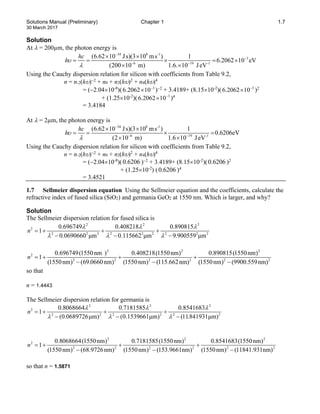
30 March 2017
Preliminary Solutions to Problems and Questions
Chapter 1
Note: Printing errors and corrections are indicated in dark red. See Question 1.47. These are
correct in the e-version of the textbook
1.1 Maxwell's wave equation and plane waves
(a) Consider a traveling sinusoidal wave of the form Ex = Eo cos(ωt − kz + φo). The latter can also be
written as Ex = Eo cos[k(vt − z) + φo], where v = ω/k is the velocity. Show that this wave satisfies
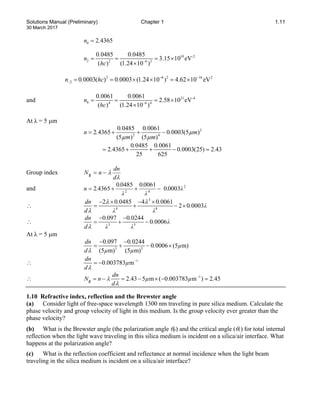
Maxwell's wave equation, and show that v = (µoεoεr)−1/2
.
(b) Consider a traveling function of any shape, even a very short delta pulse, of the form Ex =
f[k(vt − z)], where f is any function, which can be written is Ex = f(φ), φ = k(vt − z). Show that this
traveling function satisfies Maxwell's wave equation. What is its velocity? What determines the form
of the function f?
Solution
(a)
Ex = Eo cos(ωt − kz + φo)
∴
2
2
0
x
E
x
∂
=
∂
and
2
2
0
x
E
y
∂
=
∂
and
2
2
2
cos( )
x
0 0
E
k E t kz
z
ω φ
∂
=
− − +
∂
∴
2
2
2
cos( )
x
0 0
E
E t kz
t
ω ω φ
∂
=
− − +
∂
Substitute these into the wave equation 0
2
2
2
2
2
2
2
2
=
∂
∂
−
∂
∂
+
∂
∂
+
∂
∂
t
E
z
E
y
E
x
E
o
r
o µ
ε
ε to find
2 2
cos( ) cos( ) 0
0 o r o 0 0
k E t kz E t kz
0 ω φ ε ε µ ω ω φ
− − + + + − + =
∴
2
2
1
o r o
k
ω
ε ε µ
=
∴
1
2
( )
o r o
k
ω
ε ε µ
−
=
∴
1
2
( )
o r o
ε ε µ
−
=
v
(b) Let
[ ( )] ( )
x
E f k t z f φ
= − =
v
Take first and second derivatives with respect to x, y, z and t.
Contact me in order to access the whole complete document.
WhatsApp: https://wa.me/message/2H3BV2L5TTSUF1
Email: smtb98@gmail.com
Telegram: https://t.me/solutionmanual
s
m
t
b
9
8
@
g
m
a
i
l
.
c
o
m
s
m
t
b
9
8
@
g
m
a
i
l
.
c
o
m
complete document is available on https://unihelp.xyz/ *** contact me if site not loaded
Solutions Manual (Preliminary) Chapter 1 1.3
30 March 2017
2
2
0
x
E
x
∂
=
∂
2
2
0
x
E
y
∂
=
∂
x
E df
k
z dφ
∂
= −
∂
2 2
2
2 2
x
E d f
k
z dφ
∂
=
∂
x
E df
k
t dφ
∂
=
∂
v
2 2
2 2
2 2
x
E d f
k
t dφ
∂
=
∂
v
2 2 2 2
2 2 2 2
Substitute these into the wave equation 0
o r o
E E E E
x y z t
ε ε µ
∂ ∂ ∂ ∂
+ + − =
∂ ∂ ∂ ∂
to find
2 2
2 2 2
2 2
0
o r o
d f d f
k k
d d
ε ε µ
φ φ
− =
v
∴ 2 1
o r o
ε ε µ
=
v
∴
1
2
( )
o r o
ε ε µ
−
=
v
1.2 Propagation in a medium of finite small conductivity An electromagnetic wave in an
isotropic medium with a dielectric constant εr and a finite conductivity σ and traveling along z obeys
the following equation for the variation of the electric field E perpendicular to z,
t
E
t
E
dz
E
d
o
o
r
o
∂
∂
=
∂
∂
− σ
µ
µ
ε
ε 2
2
2
2
(1)
Show that one possible solution is a plane wave whose amplitude decays exponentially with
propagation along z, that is E = Eoexp(−α′z)exp[j(ωt – kz)]. Here exp(−α′z) causes the envelope of the
amplitude to decay with z (attenuation) and exp[j(ωt – kz)] is the traveling wave portion. Show that in
a medium in which α′ is small, the wave velocity and the attenuation coefficient α′ for the electric
field are given by
r
o
o
k ε
ε
µ
ω 1
=
=
v and
cn
o
ε
σ
α
2
=
′
where n is the refractive index (n = εr
1/2
). (Metals with high conductivities are excluded.)
Solutions Manual (Preliminary) Chapter 1 1.4
30 March 2017
Note: The α′ in this problem characterize the decay rate of the field not the intensity. The actual α for
intensity would be twice the above α′ and hence it would be σ/εocn.
Solution
We can write E = Eoexp(−αz)exp[j(ωt – kz)] as E = Eoexp[jωt – j(k – jα)z]. Substitute this into the
wave resonance condition
[– j(k – jα)]2
Eoexp[jωt – j(k – jα)z] − (jω)2
εoεrµoEoexp[jωt – j(k – jα)z] =
jωµoσ Eoexp[jωt – j(k – jα)z]
∴ −(k – jα)2
+ ω2
εoεrµo = jωµoσ
∴ −k2
+ 2jkα – α2
+ ω2
εoεrµo = jωµoσ
Rearrange into real and imaginary parts and then equating the real parts and imaginary parts
∴ −k2
– α2
+ ω2
εoεrµo + 2jkα = jωµoσ
Real parts
−k2
– α2
+ ω2
εoεrµo = 0
Imaginary parts
2kα = ωµoσ
Thus,
n
n
c
k
k o
o
o
o
ε
σ
σ
µ
σ
µ
ω
σ
ωµ
α
2
2
2
2
=
=
⋅
=
=
where we have assumed ω/k = velocity = c/n (see below).
From the imaginary part
2
2
2
α
ε
ε
µ
ω −
= r
o
o
k
Consider the small α case (otherwise the wave is totally attenuated with very little propagation). Then
r
o
o
k ε
ε
µ
ω2
2
=
and the velocity is
r
o
o
k ε
ε
µ
ω 1
=
=
v
1.3 Point light source What is the irradiance measured at a distance of 1 m and 2 m from a 1 W
light point source?
Solution
Then the irradiance I at a distance r from O is
2
2
)
m
1
(
4
W
1
4 π
π
=
=
r
P
I o
= 8.0 µW cm-2
which drops by a factor of 4 at r = 2 m to become 2.0 µW cm-2
1.4 Gaussian beam A particular HeNe laser beam at 633 nm has a spot size of 0.8 mm. Assuming a
Gaussian beam, what is the divergence of the beam? What are its Rayleigh range and beam width at 10
m?
Solution
Using Eq. (1.1.7), we find,
Solutions Manual (Preliminary) Chapter 1 1.5
30 March 2017
9
3
4 4(633 10 m)
2
(2 ) (0.8 10 m)
o
w
λ
θ
π π
−
−
×
= =
×
= 1.01×10⁻³
rad = 0.058°
The Rayliegh range is
3 2
2 1
2
9
[ (0.8 10 m)]
(633 10 m)
o
o
w
z
π
π
λ
−
−
×
= =
×
= 0.79 m
The beam width at a distance of 10 m is
2w = 2wo[1 + (z/zo)2
]1/2
= (0.8×10⁻³
m){1 + [(10 m)/(0.79 m)]2
}1/2
= 0.01016 m or 10.16 mm.
1.5 Gaussian beam in a cavity with spherical mirrors Consider an optical cavity formed by two
aligned spherical mirrors facing each other as shown in Figure 1.54. Such an optical cavity is called a
spherical mirror resonator, and is most commonly used in gas lasers. Sometimes, one of the reflectors
is a plane mirror. The two spherical mirrors and the space between them form an optical resonator
because only certain light waves with certain frequencies can exist in this optical cavity. The radiation
inside a spherical mirror cavity is a Gaussian beam. The actual or particular Gaussian beam that fits
into the cavity is that beam whose wavefronts at the mirrors match the curvature of the mirrors.
Consider the symmetric resonator shown in Figure 1.54 in which the mirrors have the same radius of
curvature R. When a wave starts at A, its wavefront is the same as the curvature of A. In the middle of
the cavity it has the minimum width and at B the wave again has the same curvature as B. Such a wave
in the cavity can replicate itself (and hence exist in the cavity) as it travels between the mirrors
provided that it has right beam characteristics, that is the right curvature at the mirrors. The radius of
curvature R of a Gaussian beam wavefront at a distance z along its axis is given by
R(z) = z[1 + (zo/z)2
] ; zo = πwo
2
/λ
is the Rayleigh range
Consider a confocal symmetric optical cavity in which the mirrors are separated by L = R.
(a) Show that the cavity length L is 2zo, that is, it is the same as the Rayleigh range, which is the reason
the latter is called the confocal length.
(b) Show that the waist of the beam 2wo is fully determined only by the radius of curvature R of the
mirrors, and given by
2wo = (2λR/π)1/2
(c) If the cavity length L = R = 50 cm, and λ = 633 nm, what is the waist of the beam at the center
and also at the mirrors?
Solutions Manual (Preliminary) Chapter 1 1.6
30 March 2017
Figure 1.54 Two spherical mirrors reflect waves to and from each other. The optical cavity contains a
Gaussian beam. This particular optical cavity is symmetric and confocal; the two focal points coincide at F.
Solution
(a) At / 2
z R
= we have ( )
R z R
= . Substitute these into R(z) = z[1 + (zo/z)2
] to find
R = (R/2)[1 + (2zo/R)2
]
∴
2
2
1
2 





+
=
R
zo
∴ 1
2
=






R
zo
∴ o
z
L 2
=
(b) R = (R/2)[1 + (2zo/R)2
]
∴
2
2
1
2 





+
=
R
zo
∴ 1
2
=






R
zo
Now use zo = πwo
2
/λ,
∴ 1
2 2
=








λ
π
R
wo
∴
π
λ
R
wo
2
2 =
(c) Substitute λ = 633 nm, L = R = 50 cm into the above equation to find 2wo = 449 µm or 0.449 mm.
At the mirror, z = R/2, and also zo = R/2 so that
)
2
(
2
2
/
2
/
1
2
1
2
2 2
/
1
2
/
1
2
2
/
1
2
o
o
o
o w
R
R
w
z
z
w
w =














+
=
















+
= = 0.635 mm
1.6 Cauchy dispersion equation Using the Cauchy coefficients and the general Cauchy equation,
calculate refractive index of a silicon crystal at 200 µm and at 2 µm, over two orders of magnitude
wavelength change. What is your conclusion?
Solutions Manual (Preliminary) Chapter 1 1.7
30 March 2017
Solution
At λ = 200µm, the photon energy is
34 8 -1
3
6 19 -1
(6.62 10 Js)(3 10 ms ) 1
6.2062 10 eV
(200 10 m) 1.6. 10 JeV
hc
hυ
λ
−
−
− −
× ×
=
= × =
×
× ×
Using the Cauchy dispersion relation for silicon with coefficients from Table 9.2,
n = n-2(hυ)−2
+ n0 + n2(hυ)2
+ n4(hυ)4
= (−2.04×10⁻⁸
)( 3
6.2062 10−
× )−2
+ 3.4189+ (8.15×10⁻²
)( 3
6.2062 10−
× )2
+ (1.25×10⁻²
)( 3
6.2062 10−
× )4
= 3.4184
At λ = 2µm, the photon energy is
34 8 -1
6 19 -1
(6.62 10 Js)(3 10 ms ) 1
0.6206eV
(2 10 m) 1.6 10 JeV
hc
hυ
λ
−
− −
× ×
=
= × =
× ×
Using the Cauchy dispersion relation for silicon with coefficients from Table 9.2,
n = n-2(hυ)−2
+ n0 + n2(hυ)2
+ n4(hυ)4
= (−2.04×10⁻⁸
)(0.6206 )−2
+ 3.4189+ (8.15×10⁻²
)(0.6206 )2
+ (1.25×10⁻²
) (0.6206 )4
= 3.4521
1.7 Sellmeier dispersion equation Using the Sellmeier equation and the coefficients, calculate the
refractive index of fused silica (SiO2) and germania GeO2 at 1550 nm. Which is larger, and why?
Solution
The Sellmeier dispersion relation for fused silica is
2 2 2
2
2 2 2 2 2 2 2 2 2
0.696749 0.408218 0.890815
1
0.0690660 μm 0.115662 μm 9.900559 μm
n
λ λ λ
λ λ λ
=
+ + +
− − −
2 2 2
2
2 2 2 2 2 2
0.696749(1550nm ) 0.408218(1550nm) 0.890815(1550nm)
1
(1550nm) (69.0660nm) (1550nm) (115.662nm) (1550nm) (9900.559nm)
n =
+ + +
− − −
so that
n = 1.4443
The Sellmeier dispersion relation for germania is
2 2 2
2
2 2 2 2 2 2
0.8068664 0.7181585 0.8541683
1
(0.0689726μm) (0.1539661μm) (11.841931μm)
n
λ λ λ
λ λ λ
=
+ + +
− − −
2 2 2
2
2 2 2 2 2 2
0.8068664(1550nm) 0.7181585(1550nm) 0.8541683(1550nm)
1
(1550nm) (68.9726nm) (1550nm) (153.9661nm) (1550nm) (11841.931nm)
n =
+ + +
− − −
so that n = 1.5871
Solutions Manual (Preliminary) Chapter 1 1.8
30 March 2017
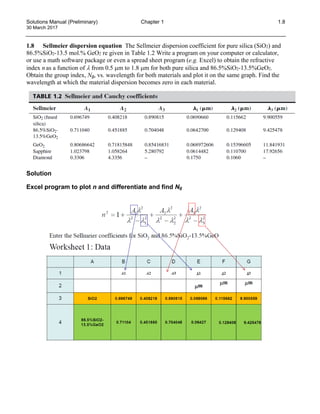
1.8 Sellmeier dispersion equation The Sellmeier dispersion coefficient for pure silica (SiO2) and
86.5%SiO2-13.5 mol.% GeO2 re given in Table 1.2 Write a program on your computer or calculator,
or use a math software package or even a spread sheet program (e.g. Excel) to obtain the refractive
index n as a function of λ from 0.5 µm to 1.8 µm for both pure silica and 86.5%SiO2-13.5%GeO2.
Obtain the group index, Ng, vs. wavelength for both materials and plot it on the same graph. Find the
wavelength at which the material dispersion becomes zero in each material.
Solution
Excel program to plot n and differentiate and find Ng
Solutions Manual (Preliminary) Chapter 1 1.9
30 March 2017
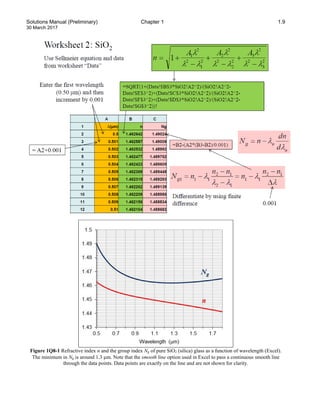
Figure 1Q8-1 Refractive index n and the group index Ng of pure SiO2 (silica) glass as a function of wavelength (Excel).
The minimum in Ng is around 1.3 µm. Note that the smooth line option used in Excel to pass a continuous smooth line
through the data points. Data points are exactly on the line and are not shown for clarity.
Solutions Manual (Preliminary) Chapter 1 1.10
30 March 2017
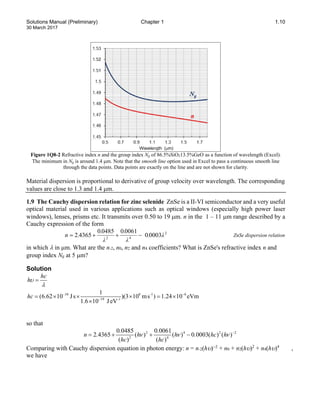
Figure 1Q8-2 Refractive index n and the group index Ng of 86.5%SiO213.5%GeO as a function of wavelength (Excel).
The minimum in Ng is around 1.4 µm. Note that the smooth line option used in Excel to pass a continuous smooth line
through the data points. Data points are exactly on the line and are not shown for clarity.
Material dispersion is proportional to derivative of group velocity over wavelength. The corresponding
values are close to 1.3 and 1.4 µm.
1.9 The Cauchy dispersion relation for zinc selenide ZnSe is a II-VI semiconductor and a very useful
optical material used in various applications such as optical windows (especially high power laser
windows), lenses, prisms etc. It transmits over 0.50 to 19 µm. n in the 1 – 11 µm range described by a
Cauchy expression of the form
2
4
2
0003
0
0061
0
0485
0
4365
2 λ
.
λ
.
λ
.
.
n −
+
+
= ZnSe dispersion relation
in which λ in µm. What are the n-2, n0, n2 and n4 coefficients? What is ZnSe's refractive index n and
group index Ng at 5 µm?
Solution
hc
hυ
λ
=
34 8 -1 6
19 -1
1
(6.62 10 Js )(3 10 ms ) 1.24 10 eVm
1.6 10 JeV
hc − −
−
= × × × = ×
×
so that
2 4 2 2
2 4
0 0485 0 0061
2 4365 ( ) ( ) 0 0003( ) ( )
( ) ( )
. .
n . h h . hc h
hc hc
ν ν ν −
= + + −
Comparing with Cauchy dispersion equation in photon energy: n = n-2(hυ)−2
+ n0 + n2(hυ)2
+ n4(hυ)4
,
we have
Solutions Manual (Preliminary) Chapter 1 1.11
30 March 2017
0 2 4365
n .
=
2 6 2 16 2
2 0 0003( ) 0 0003 (1.24 10 ) 4.62 10 eV
n . hc . − −
− = = × × = ×
and 21 -4
4 4 6 4
0 0061 0 0061
2.58 10 eV
( ) (1.24 10 )
. .
n
hc −
= = = ×
×
At λ = 5 µm
2
2 4
0 0485 0 0061
2 4365 0 0003(5 )
(5 ) (5 )
. .
n . . m
m m
µ
µ µ
= + + −
0 0485 0 0061
2 4365 0 0003(25) 2.43
25 625
. .
. .
= + + − =
Group index
λ
λ
d
dn
n
N −
=
g
and 2
4
2
0003
0
0061
0
0485
0
4365
2 λ
.
λ
.
λ
.
.
n −
+
+
=
∴
3
4 8
2 0 0485 4 0 0061
2 0 0003
dn . .
. λ
d λ λ
λ λ
λ
− × − ×
= + − ×
∴ 3 5
0.097 0 0244
0 0006
dn .
. λ
d λ λ
λ
− −
= + −
At λ = 5 µm
3 5
0.097 0 0244
0 0006 (5 m)
(5 m) (5 m)
dn .
. µ
d µ µ
λ
− −
= + − ×
∴ 1
0.003783 m
dn
µ
dλ
−
= −
∴ 1
2.43 5 m ( 0.003783 m ) 2.45
dn
N n µ µ
d
λ
λ
−
= − = − × − =
g
1.10 Refractive index, reflection and the Brewster angle
(a) Consider light of free-space wavelength 1300 nm traveling in pure silica medium. Calculate the
phase velocity and group velocity of light in this medium. Is the group velocity ever greater than the
phase velocity?
(b) What is the Brewster angle (the polarization angle θp) and the critical angle (θc) for total internal
reflection when the light wave traveling in this silica medium is incident on a silica/air interface. What
happens at the polarization angle?
(c) What is the reflection coefficient and reflectance at normal incidence when the light beam
traveling in the silica medium is incident on a silica/air interface?
10 -2
2 2 6 2
0 0485 0 0485
3.15 10 eV
( ) (1.24 10 )
. .
n
hc −
= = = ×
×
Solutions Manual (Preliminary) Chapter 1 1.12
30 March 2017
(d) What is the reflection coefficient and reflectance at normal incidence when a light beam
traveling in air is incident on an air/silica interface? How do these compare with part (c) and what is
your conclusion?
Solution
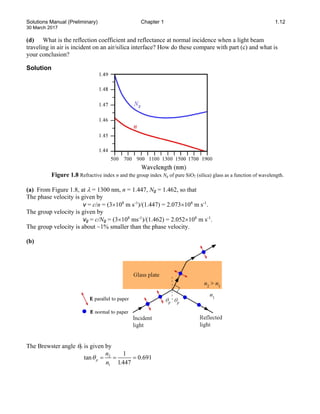
Figure 1.8 Refractive index n and the group index Ng of pure SiO2 (silica) glass as a function of wavelength.
(a) From Figure 1.8, at λ = 1300 nm, n = 1.447, Ng = 1.462, so that
The phase velocity is given by
v = c/n = (3×10⁸
m s-1
)/(1.447) = 2.073×10⁸
m s-1
.
The group velocity is given by
vg = c/Ng = (3×10⁸
ms-1
)/(1.462) = 2.052×10⁸
m s-1
.
The group velocity is about ~1% smaller than the phase velocity.
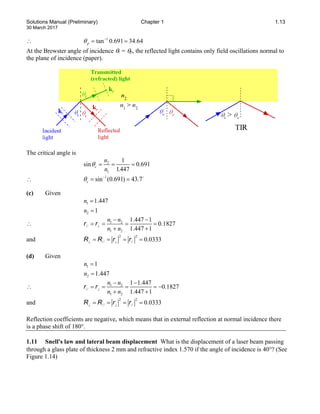
(b)
The Brewster angle θp is given by
2
1
1
tan 0.691
1.447
p
n
n
θ= = =
Solutions Manual (Preliminary) Chapter 1 1.13
30 March 2017
∴ 1
tan 0.691 34.64
p
θ −
= =
At the Brewster angle of incidence θi = θp, the reflected light contains only field oscillations normal to
the plane of incidence (paper).
The critical angle is
2
1
1
sin 0.691
1.447
c
n
n
θ
= = =
∴ 1
sin (0.691) 43.7
c
θ −
= = 
(c) Given
1
2
1.447
1
n
n
=
=
∴ 1 2
//
1 2
1.447 1
0.1827
1.447 1
n n
n n
⊥
− −
= = = =
+ +
r r
and
2 2
// // 0.0333
⊥ ⊥
= = = =
R R r r
(d) Given
1
2
1
1.447
n
n
=
=
∴ 1 2
//
1 2
1 1.447
0.1827
1.447 1
n n
n n
⊥
− −
= = = = −
+ +
r r
and
2 2
// // 0.0333
⊥ ⊥
= = = =
R R r r
Reflection coefficients are negative, which means that in external reflection at normal incidence there
is a phase shift of 180°.
1.11 Snell's law and lateral beam displacement What is the displacement of a laser beam passing
through a glass plate of thickness 2 mm and refractive index 1.570 if the angle of incidence is 40°? (See
Figure 1.14)
Solutions Manual (Preliminary) Chapter 1 1.14
30 March 2017
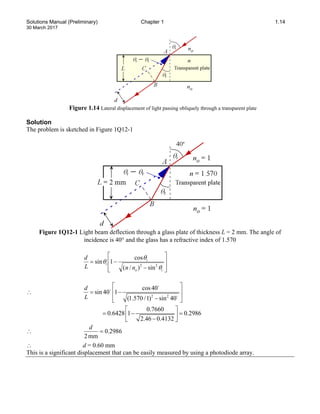
Figure 1.14 Lateral displacement of light passing obliquely through a transparent plate
Solution
The problem is sketched in Figure 1Q12-1
Figure 1Q12-1 Light beam deflection through a glass plate of thickness L = 2 mm. The angle of
incidence is 40° and the glass has a refractive index of 1.570








−
−
=
i
o
i
i
n
n
L
d
θ
θ
θ 2
2
sin
)
/
(
cos
1
sin
∴
2 2
cos40
sin 40 1
(1.570 /1) sin 40
d
L
 
= −
 
 − 
 



0.7660
0.6428 1 0.2986
2.46 0.4132
 
= − =
 
−
 
∴ 2986
.
0
mm
2
=
d
∴ d = 0.60 mm
This is a significant displacement that can be easily measured by using a photodiode array.
Solutions Manual (Preliminary) Chapter 1 1.15
30 March 2017
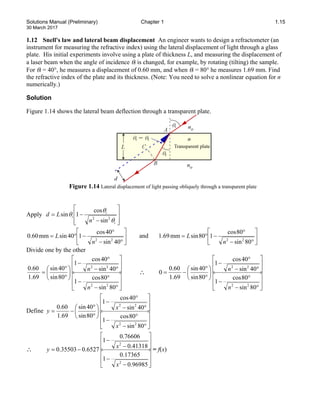
1.12 Snell's law and lateral beam displacement An engineer wants to design a refractometer (an
instrument for measuring the refractive index) using the lateral displacement of light through a glass
plate. His initial experiments involve using a plate of thickness L, and measuring the displacement of
a laser beam when the angle of incidence θi is changed, for example, by rotating (tilting) the sample.
For θi = 40°, he measures a displacement of 0.60 mm, and when θi = 80° he measures 1.69 mm. Find
the refractive index of the plate and its thickness. (Note: You need to solve a nonlinear equation for n
numerically.)
Solution
Figure 1.14 shows the lateral beam deflection through a transparent plate.
Figure 1.14 Lateral displacement of light passing obliquely through a transparent plate
Apply








−
−
=
i
i
i
n
L
d
θ
θ
θ 2
2
sin
cos
1
sin






°
−
°
−
°
=
40
sin
40
cos
1
40
sin
mm
60
.
0
2
2
n
L and 





°
−
°
−
°
=
80
sin
80
cos
1
80
sin
mm
69
.
1
2
2
n
L
Divide one by the other






°
−
°
−






°
−
°
−






°
°
=
80
sin
80
cos
1
40
sin
40
cos
1
80
sin
40
sin
69
.
1
60
.
0
2
2
2
2
n
n
∴






°
−
°
−






°
−
°
−






°
°
−
=
80
sin
80
cos
1
40
sin
40
cos
1
80
sin
40
sin
69
.
1
60
.
0
0
2
2
2
2
n
n
Define






°
−
°
−






°
−
°
−






°
°
−
=
80
sin
80
cos
1
40
sin
40
cos
1
80
sin
40
sin
69
.
1
60
.
0
2
2
2
2
x
x
y
∴






−
−






−
−
−
=
96985
.
0
17365
.
0
1
41318
.
0
76606
.
0
1
6527
.
0
35503
.
0
2
2
x
x
y = f(x)
Solutions Manual (Preliminary) Chapter 1 1.16
30 March 2017
We can plot y = f(x) vs. x, and find where f(x) cross the x-axis, which will give x = n
The above graph was generated in LiveMath (Theorist) (http://livemath.com)
Clearly, the x-axis is cut at n ≈ 1.575
Substitute n = 1.575 into one of the equations i.e.






°
−
°
−
°
=
40
sin
575
.
1
40
cos
1
40
sin
mm
60
.
0
2
2
L
Solving for L we find L ≈ 2.0 mm.
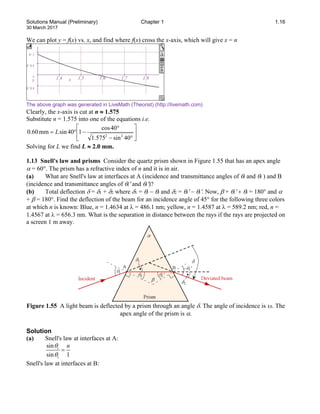
1.13 Snell's law and prisms Consider the quartz prism shown in Figure 1.55 that has an apex angle
α = 60°. The prism has a refractive index of n and it is in air.
(a) What are Snell's law at interfaces at A (incidence and transmittance angles of θi and θt ) and B
(incidence and transmittance angles of θi′ and θt′)?
(b) Total deflection δ = δ1 + δ2 where δ1 = θi − θt and δ2 = θt′ − θi′. Now, β + θi′ + θt = 180° and α
+ β = 180°. Find the deflection of the beam for an incidence angle of 45° for the following three colors
at which n is known: Blue, n = 1.4634 at λ = 486.1 nm; yellow, n = 1.4587 at λ = 589.2 nm; red, n =
1.4567 at λ = 656.3 nm. What is the separation in distance between the rays if the rays are projected on
a screen 1 m away.
Figure 1.55 A light beam is deflected by a prism through an angle δ. The angle of incidence is υi. The
apex angle of the prism is α.
Solution
(a) Snell's law at interfaces at A:
sin
sin 1
i
t
n
θ
θ
=
Snell's law at interfaces at B:
0 .0 5
0
0 .0 5
0 .1
y 1.4 1.5 1.6 1.7 1.8
x

Solutions for Problems in Optoelectronics & Photonics, 2nd Edition by Safa Kasap

  • 1.
    Solutions Manual (Preliminary)Chapter 1 1.2 30 March 2017 Preliminary Solutions to Problems and Questions Chapter 1 Note: Printing errors and corrections are indicated in dark red. See Question 1.47. These are correct in the e-version of the textbook 1.1 Maxwell's wave equation and plane waves (a) Consider a traveling sinusoidal wave of the form Ex = Eo cos(ωt − kz + φo). The latter can also be written as Ex = Eo cos[k(vt − z) + φo], where v = ω/k is the velocity. Show that this wave satisfies Maxwell's wave equation, and show that v = (µoεoεr)−1/2 . (b) Consider a traveling function of any shape, even a very short delta pulse, of the form Ex = f[k(vt − z)], where f is any function, which can be written is Ex = f(φ), φ = k(vt − z). Show that this traveling function satisfies Maxwell's wave equation. What is its velocity? What determines the form of the function f? Solution (a) Ex = Eo cos(ωt − kz + φo) ∴ 2 2 0 x E x ∂ = ∂ and 2 2 0 x E y ∂ = ∂ and 2 2 2 cos( ) x 0 0 E k E t kz z ω φ ∂ = − − + ∂ ∴ 2 2 2 cos( ) x 0 0 E E t kz t ω ω φ ∂ = − − + ∂ Substitute these into the wave equation 0 2 2 2 2 2 2 2 2 = ∂ ∂ − ∂ ∂ + ∂ ∂ + ∂ ∂ t E z E y E x E o r o µ ε ε to find 2 2 cos( ) cos( ) 0 0 o r o 0 0 k E t kz E t kz 0 ω φ ε ε µ ω ω φ − − + + + − + = ∴ 2 2 1 o r o k ω ε ε µ = ∴ 1 2 ( ) o r o k ω ε ε µ − = ∴ 1 2 ( ) o r o ε ε µ − = v (b) Let [ ( )] ( ) x E f k t z f φ = − = v Take first and second derivatives with respect to x, y, z and t. Contact me in order to access the whole complete document. WhatsApp: https://wa.me/message/2H3BV2L5TTSUF1 Email: smtb98@gmail.com Telegram: https://t.me/solutionmanual s m t b 9 8 @ g m a i l . c o m s m t b 9 8 @ g m a i l . c o m complete document is available on https://unihelp.xyz/ *** contact me if site not loaded
  • 2.
    Solutions Manual (Preliminary)Chapter 1 1.3 30 March 2017 2 2 0 x E x ∂ = ∂ 2 2 0 x E y ∂ = ∂ x E df k z dφ ∂ = − ∂ 2 2 2 2 2 x E d f k z dφ ∂ = ∂ x E df k t dφ ∂ = ∂ v 2 2 2 2 2 2 x E d f k t dφ ∂ = ∂ v 2 2 2 2 2 2 2 2 Substitute these into the wave equation 0 o r o E E E E x y z t ε ε µ ∂ ∂ ∂ ∂ + + − = ∂ ∂ ∂ ∂ to find 2 2 2 2 2 2 2 0 o r o d f d f k k d d ε ε µ φ φ − = v ∴ 2 1 o r o ε ε µ = v ∴ 1 2 ( ) o r o ε ε µ − = v 1.2 Propagation in a medium of finite small conductivity An electromagnetic wave in an isotropic medium with a dielectric constant εr and a finite conductivity σ and traveling along z obeys the following equation for the variation of the electric field E perpendicular to z, t E t E dz E d o o r o ∂ ∂ = ∂ ∂ − σ µ µ ε ε 2 2 2 2 (1) Show that one possible solution is a plane wave whose amplitude decays exponentially with propagation along z, that is E = Eoexp(−α′z)exp[j(ωt – kz)]. Here exp(−α′z) causes the envelope of the amplitude to decay with z (attenuation) and exp[j(ωt – kz)] is the traveling wave portion. Show that in a medium in which α′ is small, the wave velocity and the attenuation coefficient α′ for the electric field are given by r o o k ε ε µ ω 1 = = v and cn o ε σ α 2 = ′ where n is the refractive index (n = εr 1/2 ). (Metals with high conductivities are excluded.)
  • 3.
    Solutions Manual (Preliminary)Chapter 1 1.4 30 March 2017 Note: The α′ in this problem characterize the decay rate of the field not the intensity. The actual α for intensity would be twice the above α′ and hence it would be σ/εocn. Solution We can write E = Eoexp(−αz)exp[j(ωt – kz)] as E = Eoexp[jωt – j(k – jα)z]. Substitute this into the wave resonance condition [– j(k – jα)]2 Eoexp[jωt – j(k – jα)z] − (jω)2 εoεrµoEoexp[jωt – j(k – jα)z] = jωµoσ Eoexp[jωt – j(k – jα)z] ∴ −(k – jα)2 + ω2 εoεrµo = jωµoσ ∴ −k2 + 2jkα – α2 + ω2 εoεrµo = jωµoσ Rearrange into real and imaginary parts and then equating the real parts and imaginary parts ∴ −k2 – α2 + ω2 εoεrµo + 2jkα = jωµoσ Real parts −k2 – α2 + ω2 εoεrµo = 0 Imaginary parts 2kα = ωµoσ Thus, n n c k k o o o o ε σ σ µ σ µ ω σ ωµ α 2 2 2 2 = = ⋅ = = where we have assumed ω/k = velocity = c/n (see below). From the imaginary part 2 2 2 α ε ε µ ω − = r o o k Consider the small α case (otherwise the wave is totally attenuated with very little propagation). Then r o o k ε ε µ ω2 2 = and the velocity is r o o k ε ε µ ω 1 = = v 1.3 Point light source What is the irradiance measured at a distance of 1 m and 2 m from a 1 W light point source? Solution Then the irradiance I at a distance r from O is 2 2 ) m 1 ( 4 W 1 4 π π = = r P I o = 8.0 µW cm-2 which drops by a factor of 4 at r = 2 m to become 2.0 µW cm-2 1.4 Gaussian beam A particular HeNe laser beam at 633 nm has a spot size of 0.8 mm. Assuming a Gaussian beam, what is the divergence of the beam? What are its Rayleigh range and beam width at 10 m? Solution Using Eq. (1.1.7), we find,
  • 4.
    Solutions Manual (Preliminary)Chapter 1 1.5 30 March 2017 9 3 4 4(633 10 m) 2 (2 ) (0.8 10 m) o w λ θ π π − − × = = × = 1.01×10⁻³ rad = 0.058° The Rayliegh range is 3 2 2 1 2 9 [ (0.8 10 m)] (633 10 m) o o w z π π λ − − × = = × = 0.79 m The beam width at a distance of 10 m is 2w = 2wo[1 + (z/zo)2 ]1/2 = (0.8×10⁻³ m){1 + [(10 m)/(0.79 m)]2 }1/2 = 0.01016 m or 10.16 mm. 1.5 Gaussian beam in a cavity with spherical mirrors Consider an optical cavity formed by two aligned spherical mirrors facing each other as shown in Figure 1.54. Such an optical cavity is called a spherical mirror resonator, and is most commonly used in gas lasers. Sometimes, one of the reflectors is a plane mirror. The two spherical mirrors and the space between them form an optical resonator because only certain light waves with certain frequencies can exist in this optical cavity. The radiation inside a spherical mirror cavity is a Gaussian beam. The actual or particular Gaussian beam that fits into the cavity is that beam whose wavefronts at the mirrors match the curvature of the mirrors. Consider the symmetric resonator shown in Figure 1.54 in which the mirrors have the same radius of curvature R. When a wave starts at A, its wavefront is the same as the curvature of A. In the middle of the cavity it has the minimum width and at B the wave again has the same curvature as B. Such a wave in the cavity can replicate itself (and hence exist in the cavity) as it travels between the mirrors provided that it has right beam characteristics, that is the right curvature at the mirrors. The radius of curvature R of a Gaussian beam wavefront at a distance z along its axis is given by R(z) = z[1 + (zo/z)2 ] ; zo = πwo 2 /λ is the Rayleigh range Consider a confocal symmetric optical cavity in which the mirrors are separated by L = R. (a) Show that the cavity length L is 2zo, that is, it is the same as the Rayleigh range, which is the reason the latter is called the confocal length. (b) Show that the waist of the beam 2wo is fully determined only by the radius of curvature R of the mirrors, and given by 2wo = (2λR/π)1/2 (c) If the cavity length L = R = 50 cm, and λ = 633 nm, what is the waist of the beam at the center and also at the mirrors?
  • 5.
    Solutions Manual (Preliminary)Chapter 1 1.6 30 March 2017 Figure 1.54 Two spherical mirrors reflect waves to and from each other. The optical cavity contains a Gaussian beam. This particular optical cavity is symmetric and confocal; the two focal points coincide at F. Solution (a) At / 2 z R = we have ( ) R z R = . Substitute these into R(z) = z[1 + (zo/z)2 ] to find R = (R/2)[1 + (2zo/R)2 ] ∴ 2 2 1 2       + = R zo ∴ 1 2 =       R zo ∴ o z L 2 = (b) R = (R/2)[1 + (2zo/R)2 ] ∴ 2 2 1 2       + = R zo ∴ 1 2 =       R zo Now use zo = πwo 2 /λ, ∴ 1 2 2 =         λ π R wo ∴ π λ R wo 2 2 = (c) Substitute λ = 633 nm, L = R = 50 cm into the above equation to find 2wo = 449 µm or 0.449 mm. At the mirror, z = R/2, and also zo = R/2 so that ) 2 ( 2 2 / 2 / 1 2 1 2 2 2 / 1 2 / 1 2 2 / 1 2 o o o o w R R w z z w w =               + =                 + = = 0.635 mm 1.6 Cauchy dispersion equation Using the Cauchy coefficients and the general Cauchy equation, calculate refractive index of a silicon crystal at 200 µm and at 2 µm, over two orders of magnitude wavelength change. What is your conclusion?
  • 6.
    Solutions Manual (Preliminary)Chapter 1 1.7 30 March 2017 Solution At λ = 200µm, the photon energy is 34 8 -1 3 6 19 -1 (6.62 10 Js)(3 10 ms ) 1 6.2062 10 eV (200 10 m) 1.6. 10 JeV hc hυ λ − − − − × × = = × = × × × Using the Cauchy dispersion relation for silicon with coefficients from Table 9.2, n = n-2(hυ)−2 + n0 + n2(hυ)2 + n4(hυ)4 = (−2.04×10⁻⁸ )( 3 6.2062 10− × )−2 + 3.4189+ (8.15×10⁻² )( 3 6.2062 10− × )2 + (1.25×10⁻² )( 3 6.2062 10− × )4 = 3.4184 At λ = 2µm, the photon energy is 34 8 -1 6 19 -1 (6.62 10 Js)(3 10 ms ) 1 0.6206eV (2 10 m) 1.6 10 JeV hc hυ λ − − − × × = = × = × × Using the Cauchy dispersion relation for silicon with coefficients from Table 9.2, n = n-2(hυ)−2 + n0 + n2(hυ)2 + n4(hυ)4 = (−2.04×10⁻⁸ )(0.6206 )−2 + 3.4189+ (8.15×10⁻² )(0.6206 )2 + (1.25×10⁻² ) (0.6206 )4 = 3.4521 1.7 Sellmeier dispersion equation Using the Sellmeier equation and the coefficients, calculate the refractive index of fused silica (SiO2) and germania GeO2 at 1550 nm. Which is larger, and why? Solution The Sellmeier dispersion relation for fused silica is 2 2 2 2 2 2 2 2 2 2 2 2 2 0.696749 0.408218 0.890815 1 0.0690660 μm 0.115662 μm 9.900559 μm n λ λ λ λ λ λ = + + + − − − 2 2 2 2 2 2 2 2 2 2 0.696749(1550nm ) 0.408218(1550nm) 0.890815(1550nm) 1 (1550nm) (69.0660nm) (1550nm) (115.662nm) (1550nm) (9900.559nm) n = + + + − − − so that n = 1.4443 The Sellmeier dispersion relation for germania is 2 2 2 2 2 2 2 2 2 2 0.8068664 0.7181585 0.8541683 1 (0.0689726μm) (0.1539661μm) (11.841931μm) n λ λ λ λ λ λ = + + + − − − 2 2 2 2 2 2 2 2 2 2 0.8068664(1550nm) 0.7181585(1550nm) 0.8541683(1550nm) 1 (1550nm) (68.9726nm) (1550nm) (153.9661nm) (1550nm) (11841.931nm) n = + + + − − − so that n = 1.5871
  • 7.
    Solutions Manual (Preliminary)Chapter 1 1.8 30 March 2017 1.8 Sellmeier dispersion equation The Sellmeier dispersion coefficient for pure silica (SiO2) and 86.5%SiO2-13.5 mol.% GeO2 re given in Table 1.2 Write a program on your computer or calculator, or use a math software package or even a spread sheet program (e.g. Excel) to obtain the refractive index n as a function of λ from 0.5 µm to 1.8 µm for both pure silica and 86.5%SiO2-13.5%GeO2. Obtain the group index, Ng, vs. wavelength for both materials and plot it on the same graph. Find the wavelength at which the material dispersion becomes zero in each material. Solution Excel program to plot n and differentiate and find Ng
  • 8.
    Solutions Manual (Preliminary)Chapter 1 1.9 30 March 2017 Figure 1Q8-1 Refractive index n and the group index Ng of pure SiO2 (silica) glass as a function of wavelength (Excel). The minimum in Ng is around 1.3 µm. Note that the smooth line option used in Excel to pass a continuous smooth line through the data points. Data points are exactly on the line and are not shown for clarity.
  • 9.
    Solutions Manual (Preliminary)Chapter 1 1.10 30 March 2017 Figure 1Q8-2 Refractive index n and the group index Ng of 86.5%SiO213.5%GeO as a function of wavelength (Excel). The minimum in Ng is around 1.4 µm. Note that the smooth line option used in Excel to pass a continuous smooth line through the data points. Data points are exactly on the line and are not shown for clarity. Material dispersion is proportional to derivative of group velocity over wavelength. The corresponding values are close to 1.3 and 1.4 µm. 1.9 The Cauchy dispersion relation for zinc selenide ZnSe is a II-VI semiconductor and a very useful optical material used in various applications such as optical windows (especially high power laser windows), lenses, prisms etc. It transmits over 0.50 to 19 µm. n in the 1 – 11 µm range described by a Cauchy expression of the form 2 4 2 0003 0 0061 0 0485 0 4365 2 λ . λ . λ . . n − + + = ZnSe dispersion relation in which λ in µm. What are the n-2, n0, n2 and n4 coefficients? What is ZnSe's refractive index n and group index Ng at 5 µm? Solution hc hυ λ = 34 8 -1 6 19 -1 1 (6.62 10 Js )(3 10 ms ) 1.24 10 eVm 1.6 10 JeV hc − − − = × × × = × × so that 2 4 2 2 2 4 0 0485 0 0061 2 4365 ( ) ( ) 0 0003( ) ( ) ( ) ( ) . . n . h h . hc h hc hc ν ν ν − = + + − Comparing with Cauchy dispersion equation in photon energy: n = n-2(hυ)−2 + n0 + n2(hυ)2 + n4(hυ)4 , we have
  • 10.
    Solutions Manual (Preliminary)Chapter 1 1.11 30 March 2017 0 2 4365 n . = 2 6 2 16 2 2 0 0003( ) 0 0003 (1.24 10 ) 4.62 10 eV n . hc . − − − = = × × = × and 21 -4 4 4 6 4 0 0061 0 0061 2.58 10 eV ( ) (1.24 10 ) . . n hc − = = = × × At λ = 5 µm 2 2 4 0 0485 0 0061 2 4365 0 0003(5 ) (5 ) (5 ) . . n . . m m m µ µ µ = + + − 0 0485 0 0061 2 4365 0 0003(25) 2.43 25 625 . . . . = + + − = Group index λ λ d dn n N − = g and 2 4 2 0003 0 0061 0 0485 0 4365 2 λ . λ . λ . . n − + + = ∴ 3 4 8 2 0 0485 4 0 0061 2 0 0003 dn . . . λ d λ λ λ λ λ − × − × = + − × ∴ 3 5 0.097 0 0244 0 0006 dn . . λ d λ λ λ − − = + − At λ = 5 µm 3 5 0.097 0 0244 0 0006 (5 m) (5 m) (5 m) dn . . µ d µ µ λ − − = + − × ∴ 1 0.003783 m dn µ dλ − = − ∴ 1 2.43 5 m ( 0.003783 m ) 2.45 dn N n µ µ d λ λ − = − = − × − = g 1.10 Refractive index, reflection and the Brewster angle (a) Consider light of free-space wavelength 1300 nm traveling in pure silica medium. Calculate the phase velocity and group velocity of light in this medium. Is the group velocity ever greater than the phase velocity? (b) What is the Brewster angle (the polarization angle θp) and the critical angle (θc) for total internal reflection when the light wave traveling in this silica medium is incident on a silica/air interface. What happens at the polarization angle? (c) What is the reflection coefficient and reflectance at normal incidence when the light beam traveling in the silica medium is incident on a silica/air interface? 10 -2 2 2 6 2 0 0485 0 0485 3.15 10 eV ( ) (1.24 10 ) . . n hc − = = = × ×
  • 11.
    Solutions Manual (Preliminary)Chapter 1 1.12 30 March 2017 (d) What is the reflection coefficient and reflectance at normal incidence when a light beam traveling in air is incident on an air/silica interface? How do these compare with part (c) and what is your conclusion? Solution Figure 1.8 Refractive index n and the group index Ng of pure SiO2 (silica) glass as a function of wavelength. (a) From Figure 1.8, at λ = 1300 nm, n = 1.447, Ng = 1.462, so that The phase velocity is given by v = c/n = (3×10⁸ m s-1 )/(1.447) = 2.073×10⁸ m s-1 . The group velocity is given by vg = c/Ng = (3×10⁸ ms-1 )/(1.462) = 2.052×10⁸ m s-1 . The group velocity is about ~1% smaller than the phase velocity. (b) The Brewster angle θp is given by 2 1 1 tan 0.691 1.447 p n n θ= = =
  • 12.
    Solutions Manual (Preliminary)Chapter 1 1.13 30 March 2017 ∴ 1 tan 0.691 34.64 p θ − = = At the Brewster angle of incidence θi = θp, the reflected light contains only field oscillations normal to the plane of incidence (paper). The critical angle is 2 1 1 sin 0.691 1.447 c n n θ = = = ∴ 1 sin (0.691) 43.7 c θ − = =  (c) Given 1 2 1.447 1 n n = = ∴ 1 2 // 1 2 1.447 1 0.1827 1.447 1 n n n n ⊥ − − = = = = + + r r and 2 2 // // 0.0333 ⊥ ⊥ = = = = R R r r (d) Given 1 2 1 1.447 n n = = ∴ 1 2 // 1 2 1 1.447 0.1827 1.447 1 n n n n ⊥ − − = = = = − + + r r and 2 2 // // 0.0333 ⊥ ⊥ = = = = R R r r Reflection coefficients are negative, which means that in external reflection at normal incidence there is a phase shift of 180°. 1.11 Snell's law and lateral beam displacement What is the displacement of a laser beam passing through a glass plate of thickness 2 mm and refractive index 1.570 if the angle of incidence is 40°? (See Figure 1.14)
  • 13.
    Solutions Manual (Preliminary)Chapter 1 1.14 30 March 2017 Figure 1.14 Lateral displacement of light passing obliquely through a transparent plate Solution The problem is sketched in Figure 1Q12-1 Figure 1Q12-1 Light beam deflection through a glass plate of thickness L = 2 mm. The angle of incidence is 40° and the glass has a refractive index of 1.570         − − = i o i i n n L d θ θ θ 2 2 sin ) / ( cos 1 sin ∴ 2 2 cos40 sin 40 1 (1.570 /1) sin 40 d L   = −    −       0.7660 0.6428 1 0.2986 2.46 0.4132   = − =   −   ∴ 2986 . 0 mm 2 = d ∴ d = 0.60 mm This is a significant displacement that can be easily measured by using a photodiode array.
  • 14.
    Solutions Manual (Preliminary)Chapter 1 1.15 30 March 2017 1.12 Snell's law and lateral beam displacement An engineer wants to design a refractometer (an instrument for measuring the refractive index) using the lateral displacement of light through a glass plate. His initial experiments involve using a plate of thickness L, and measuring the displacement of a laser beam when the angle of incidence θi is changed, for example, by rotating (tilting) the sample. For θi = 40°, he measures a displacement of 0.60 mm, and when θi = 80° he measures 1.69 mm. Find the refractive index of the plate and its thickness. (Note: You need to solve a nonlinear equation for n numerically.) Solution Figure 1.14 shows the lateral beam deflection through a transparent plate. Figure 1.14 Lateral displacement of light passing obliquely through a transparent plate Apply         − − = i i i n L d θ θ θ 2 2 sin cos 1 sin       ° − ° − ° = 40 sin 40 cos 1 40 sin mm 60 . 0 2 2 n L and       ° − ° − ° = 80 sin 80 cos 1 80 sin mm 69 . 1 2 2 n L Divide one by the other       ° − ° −       ° − ° −       ° ° = 80 sin 80 cos 1 40 sin 40 cos 1 80 sin 40 sin 69 . 1 60 . 0 2 2 2 2 n n ∴       ° − ° −       ° − ° −       ° ° − = 80 sin 80 cos 1 40 sin 40 cos 1 80 sin 40 sin 69 . 1 60 . 0 0 2 2 2 2 n n Define       ° − ° −       ° − ° −       ° ° − = 80 sin 80 cos 1 40 sin 40 cos 1 80 sin 40 sin 69 . 1 60 . 0 2 2 2 2 x x y ∴       − −       − − − = 96985 . 0 17365 . 0 1 41318 . 0 76606 . 0 1 6527 . 0 35503 . 0 2 2 x x y = f(x)
  • 15.
    Solutions Manual (Preliminary)Chapter 1 1.16 30 March 2017 We can plot y = f(x) vs. x, and find where f(x) cross the x-axis, which will give x = n The above graph was generated in LiveMath (Theorist) (http://livemath.com) Clearly, the x-axis is cut at n ≈ 1.575 Substitute n = 1.575 into one of the equations i.e.       ° − ° − ° = 40 sin 575 . 1 40 cos 1 40 sin mm 60 . 0 2 2 L Solving for L we find L ≈ 2.0 mm. 1.13 Snell's law and prisms Consider the quartz prism shown in Figure 1.55 that has an apex angle α = 60°. The prism has a refractive index of n and it is in air. (a) What are Snell's law at interfaces at A (incidence and transmittance angles of θi and θt ) and B (incidence and transmittance angles of θi′ and θt′)? (b) Total deflection δ = δ1 + δ2 where δ1 = θi − θt and δ2 = θt′ − θi′. Now, β + θi′ + θt = 180° and α + β = 180°. Find the deflection of the beam for an incidence angle of 45° for the following three colors at which n is known: Blue, n = 1.4634 at λ = 486.1 nm; yellow, n = 1.4587 at λ = 589.2 nm; red, n = 1.4567 at λ = 656.3 nm. What is the separation in distance between the rays if the rays are projected on a screen 1 m away. Figure 1.55 A light beam is deflected by a prism through an angle δ. The angle of incidence is υi. The apex angle of the prism is α. Solution (a) Snell's law at interfaces at A: sin sin 1 i t n θ θ = Snell's law at interfaces at B: 0 .0 5 0 0 .0 5 0 .1 y 1.4 1.5 1.6 1.7 1.8 x