Arsenic toxicity
Domina Petric, MD
Arsenic
• semiconductors
• wood preservatives for industrial
applications (marine timbers,
utility poles)
• nonferrous alloys
• glass
• gel-based insecticidal ant baits
• veterinary pharmaceuticals
Arsenic
In some regions of the world, ground water may contain
high levels of arsenic (from natural mineral deposits).
Arsine (arsenous hydride, AsH3) gas has potent
hemolytic effect.
Arsine gas is manufactured predominantly for use in the
semiconductor industry.
Arsenic trioxide is sometimes used as orphan drug for
the treatment of relapsed acute promyelocytic leukemia.
Melarsoprol (trivalent arsenical) is used in the treatment
of advanced African trypanosomiasis.
Pharmacokinetics
• Soluble arsenic compounds are well
absorbed through the respiratory and
gastrointestinal tract.
• Percutaneus absorption is limited, but
it may be clinically significant after
heavy exposure to concentrated
arsenic reagents.
Pharmacokinetics
Pharmacokinetics
Pharmacokinetics
• After massive ingestions, the
elimination half-life is prolonged.
• Inhalation of arsenic compounds of
low solubility may result in prolonged
retention in the lung.
• It may not be reflected by urinary
arsenic excretion.
Pharmacokinetics
• Arsenic binds to sulfhydryl groups
present in keratinized tissue.
• Following cessation of exposure,
hair, nails and skin may contain
elevated levels after urine values
have returned to normal.
Pharmacodynamics
• Interference with enzyme function
may result from sulfhydryl group
binding by trivalent arsenic or by
substitution for phosphate.
• Inorganic arsenic or its metabolites
may induce oxidative stress, alter
gene expression and interfere with
cell signal transduction.
Pharmacodynamics
Inorganic trivalent arsenic
(As3+, arsenite) is
generally two to ten times
more acutely toxic than
inorganic pentavalent
arsenic (As5+, arsenate).
Pharmacodynamics
• Trivalent form of the methylated
metabolites (monomethylarsounous
acid, MMA) may be more toxic than
the inorganic parent compounds.
• Reduced efficiency in the methylation
of MMA to DMA is associated with an
increased risk of chronic adverse
effects.
Pharmacodynamics
S-adenosylmethionine is a
universal methyl donor in the
body.
Arsenic methylation also requires
S-adenosylmethionine.
Pharmacodynamics
• Arsine gas is oxidized in vivo and
exerts a potent hemolytic effect
associated with alteration of ion
flux across the erythrocyte
membrane.
• It also disrupts cellular respiration
in other tissues.
Pharmacodynamics
Arsenic is human
carcinogen and it has
been associated with
cancer of the lung, skin
and bladder.
MAJOR FORMS OF ARSENIC
INTOXICATION
Acute inorganic arsenic poisoning
Chronic inorganic arsenic poisoning
Arsine gas poisoning
Acute inorganic arsenic poisoning
Acute toxic effects are evident
within minutes to hours after
exposure to high doses (tens
to hundreds of milligrams) of
soluble inorganic arsenic
compounds.
Acute inorganic arsenic poisoning
• Initial gastrointestinal signs and
symptoms are NAUSEA,
VOMITING, DIARRHEA and
ABDOMINAL PAIN.
• Diffuse capillary leak, combined with
gastrointestinal fluid loss, may result
in hypotension, shock and death.
Acute inorganic arsenic poisoning
• Cardiopulmonary toxicity includes
CONGESTIVE CARDIOMYOPATHY,
CARDIOGENIC OR
NONCARDIOGENIC PULMONARY
OEDEMA and VENTRICULAR
ARRHYTHMIAS.
• This may occur promptly or after a
delay of several days.
Acute inorganic arsenic poisoning
Pancytopenia usually
develops within one
week.
Basophilic stippling of
erythrocytes may be
present soon after.
Acute inorganic arsenic poisoning
Central nervous system effects:
• delirium
• encephalopathy
• coma
CNS effects may occur within the
first few days of intoxication.
Acute inorganic arsenic poisoning
• An ascending sensorimotor
peripheral neuropathy may begin to
develop after a delay of 2-6 weeks.
• This neuropathy may ultimately
involve the proximal musculature
and result in neuromuscular
respiratory failure.
Acute inorganic arsenic poisoning
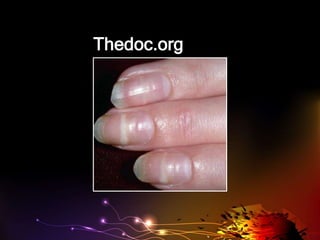
• Months after an acute poisoning,
transverse white striae may be
visible in the nails.
• These striae are called
ALDRICH-MEES lines.
Thedoc.org
Acute inorganic arsenic poisoning
Diagnosis should be considered in
patients presenting with:
• abrupt onset of gastroenteritis in
combination with hypotension and
metabolic acidosis
• cardiac dysfunction, pancytopenia,
peripheral neuropathy
Acute inorganic arsenic poisoning
• The diagnosis may be confirmed
by demonstration of elevated
amounts of inorganic arsenic and
its metabolites in the urine:
several thousand micrograms in
the first 2-3 days after acute
symptomatic poisoning.
Acute inorganic arsenic poisoning
Arsenic
disappears rapidly
from the blood.
Treatment
• Appropriate gut decontamination!
• Intensive supportive care!
Prompt chelation with:
• UNITHIOL 3-5 mg/kg iv. every 4-6
hours or
• DIMERCAPROL 3-5 mg/kg im. every
4-6 hours
Treatment
If diagnostic suspicion
is high, treatment with
chelation should be
immediate.
Chronic inorganic arsenic poisoning
• Overt noncarcinogenic effects may
be evident after chronic absorption
of more than 0,01 mg/kg/d (500-
1000 mcg/d in adults).
• The time to appearance of
symptoms varies with dose and
interindividual tolerance.
Chronic inorganic arsenic poisoning
• fatigue
• weight loss
• weakness
• anemia
• nonspecific
gastrointestinal
complaints
sensorimotor
peripheral
neuropathy
stocking glove
pattern of
dysesthesia
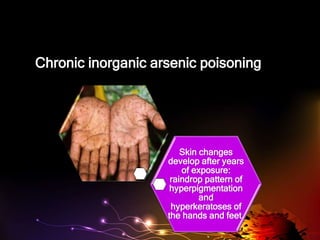
Chronic inorganic arsenic poisoning
Skin changes
develop after years
of exposure:
raindrop pattern of
hyperpigmentation
and
hyperkeratoses of
the hands and feet.
Chronic inorganic arsenic poisoning
• Peripheral vascular disease and
noncirrhotic portal hypertension may
also occur.
• There may also be link to
hypertension, diabetes, chronic
nonmalignant respiratory disease
and adverse reproductive outcomes.
Chronic inorganic arsenic poisoning
Cancer of the lung,
skin and bladder may
appear years after
exposure to arsenic.
Chronic inorganic arsenic poisoning
Administration of arsenite in cancer
chemotherapy regimens (10-20 mg
daily dose) for weeks to a few months
may cause:
• prolongation of the QT interval
• malignant ventricular arrhythmias
(torsades de pointes)
Treatment
Termination of exposure and
nonspecific supportive care.
Short term oral chelation unithiol or
succimer.
Dietary supplementation of folate.
Arsine gas poisoning
• After a latent period (2-24 hours
postinhalation) massive intravascular
hemolysis may occur.
Initial symptoms are:
• malaise, headache, dyspnea
• weakness, nausea, vomiting
• abdominal pain, jaundice
• hemoglobinuria
Arsine gas poisoning
Oliguric renal failure is a
consequence of hemoglobin
depositions in the renal tubules.
Renal failure often appears
within 1-3 days.
In massive exposures, lethal
effects on cellular respiration
may occur before renal failure.
Treatment
Intensive supportive care:
• exchange transfusion
• vigorous hydration
• hemodialysis in acute renal failure
Chelating agents have not been
demostrated to be of clinical value in
arsine poisoning.
Literature
• Katzung, Masters, Trevor. Basic
and clinical pharmacology.
• Organics.org
• Pinterest.com
• Thedoc.org
• Sos-arsenic.net

Arsenic toxicity

  • 1.
  • 2.
    Arsenic • semiconductors • woodpreservatives for industrial applications (marine timbers, utility poles) • nonferrous alloys • glass • gel-based insecticidal ant baits • veterinary pharmaceuticals
  • 3.
    Arsenic In some regionsof the world, ground water may contain high levels of arsenic (from natural mineral deposits). Arsine (arsenous hydride, AsH3) gas has potent hemolytic effect. Arsine gas is manufactured predominantly for use in the semiconductor industry. Arsenic trioxide is sometimes used as orphan drug for the treatment of relapsed acute promyelocytic leukemia. Melarsoprol (trivalent arsenical) is used in the treatment of advanced African trypanosomiasis.
  • 4.
    Pharmacokinetics • Soluble arseniccompounds are well absorbed through the respiratory and gastrointestinal tract. • Percutaneus absorption is limited, but it may be clinically significant after heavy exposure to concentrated arsenic reagents.
  • 5.
  • 6.
  • 7.
    Pharmacokinetics • After massiveingestions, the elimination half-life is prolonged. • Inhalation of arsenic compounds of low solubility may result in prolonged retention in the lung. • It may not be reflected by urinary arsenic excretion.
  • 8.
    Pharmacokinetics • Arsenic bindsto sulfhydryl groups present in keratinized tissue. • Following cessation of exposure, hair, nails and skin may contain elevated levels after urine values have returned to normal.
  • 9.
    Pharmacodynamics • Interference withenzyme function may result from sulfhydryl group binding by trivalent arsenic or by substitution for phosphate. • Inorganic arsenic or its metabolites may induce oxidative stress, alter gene expression and interfere with cell signal transduction.
  • 10.
    Pharmacodynamics Inorganic trivalent arsenic (As3+,arsenite) is generally two to ten times more acutely toxic than inorganic pentavalent arsenic (As5+, arsenate).
  • 11.
    Pharmacodynamics • Trivalent formof the methylated metabolites (monomethylarsounous acid, MMA) may be more toxic than the inorganic parent compounds. • Reduced efficiency in the methylation of MMA to DMA is associated with an increased risk of chronic adverse effects.
  • 12.
    Pharmacodynamics S-adenosylmethionine is a universalmethyl donor in the body. Arsenic methylation also requires S-adenosylmethionine.
  • 13.
    Pharmacodynamics • Arsine gasis oxidized in vivo and exerts a potent hemolytic effect associated with alteration of ion flux across the erythrocyte membrane. • It also disrupts cellular respiration in other tissues.
  • 14.
    Pharmacodynamics Arsenic is human carcinogenand it has been associated with cancer of the lung, skin and bladder.
  • 15.
    MAJOR FORMS OFARSENIC INTOXICATION Acute inorganic arsenic poisoning Chronic inorganic arsenic poisoning Arsine gas poisoning
  • 16.
    Acute inorganic arsenicpoisoning Acute toxic effects are evident within minutes to hours after exposure to high doses (tens to hundreds of milligrams) of soluble inorganic arsenic compounds.
  • 17.
    Acute inorganic arsenicpoisoning • Initial gastrointestinal signs and symptoms are NAUSEA, VOMITING, DIARRHEA and ABDOMINAL PAIN. • Diffuse capillary leak, combined with gastrointestinal fluid loss, may result in hypotension, shock and death.
  • 18.
    Acute inorganic arsenicpoisoning • Cardiopulmonary toxicity includes CONGESTIVE CARDIOMYOPATHY, CARDIOGENIC OR NONCARDIOGENIC PULMONARY OEDEMA and VENTRICULAR ARRHYTHMIAS. • This may occur promptly or after a delay of several days.
  • 19.
    Acute inorganic arsenicpoisoning Pancytopenia usually develops within one week. Basophilic stippling of erythrocytes may be present soon after.
  • 20.
    Acute inorganic arsenicpoisoning Central nervous system effects: • delirium • encephalopathy • coma CNS effects may occur within the first few days of intoxication.
  • 21.
    Acute inorganic arsenicpoisoning • An ascending sensorimotor peripheral neuropathy may begin to develop after a delay of 2-6 weeks. • This neuropathy may ultimately involve the proximal musculature and result in neuromuscular respiratory failure.
  • 22.
    Acute inorganic arsenicpoisoning • Months after an acute poisoning, transverse white striae may be visible in the nails. • These striae are called ALDRICH-MEES lines.
  • 23.
  • 24.
    Acute inorganic arsenicpoisoning Diagnosis should be considered in patients presenting with: • abrupt onset of gastroenteritis in combination with hypotension and metabolic acidosis • cardiac dysfunction, pancytopenia, peripheral neuropathy
  • 25.
    Acute inorganic arsenicpoisoning • The diagnosis may be confirmed by demonstration of elevated amounts of inorganic arsenic and its metabolites in the urine: several thousand micrograms in the first 2-3 days after acute symptomatic poisoning.
  • 26.
    Acute inorganic arsenicpoisoning Arsenic disappears rapidly from the blood.
  • 27.
    Treatment • Appropriate gutdecontamination! • Intensive supportive care! Prompt chelation with: • UNITHIOL 3-5 mg/kg iv. every 4-6 hours or • DIMERCAPROL 3-5 mg/kg im. every 4-6 hours
  • 28.
    Treatment If diagnostic suspicion ishigh, treatment with chelation should be immediate.
  • 29.
    Chronic inorganic arsenicpoisoning • Overt noncarcinogenic effects may be evident after chronic absorption of more than 0,01 mg/kg/d (500- 1000 mcg/d in adults). • The time to appearance of symptoms varies with dose and interindividual tolerance.
  • 30.
    Chronic inorganic arsenicpoisoning • fatigue • weight loss • weakness • anemia • nonspecific gastrointestinal complaints sensorimotor peripheral neuropathy stocking glove pattern of dysesthesia
  • 31.
    Chronic inorganic arsenicpoisoning Skin changes develop after years of exposure: raindrop pattern of hyperpigmentation and hyperkeratoses of the hands and feet.
  • 32.
    Chronic inorganic arsenicpoisoning • Peripheral vascular disease and noncirrhotic portal hypertension may also occur. • There may also be link to hypertension, diabetes, chronic nonmalignant respiratory disease and adverse reproductive outcomes.
  • 33.
    Chronic inorganic arsenicpoisoning Cancer of the lung, skin and bladder may appear years after exposure to arsenic.
  • 34.
    Chronic inorganic arsenicpoisoning Administration of arsenite in cancer chemotherapy regimens (10-20 mg daily dose) for weeks to a few months may cause: • prolongation of the QT interval • malignant ventricular arrhythmias (torsades de pointes)
  • 35.
    Treatment Termination of exposureand nonspecific supportive care. Short term oral chelation unithiol or succimer. Dietary supplementation of folate.
  • 36.
    Arsine gas poisoning •After a latent period (2-24 hours postinhalation) massive intravascular hemolysis may occur. Initial symptoms are: • malaise, headache, dyspnea • weakness, nausea, vomiting • abdominal pain, jaundice • hemoglobinuria
  • 37.
    Arsine gas poisoning Oliguricrenal failure is a consequence of hemoglobin depositions in the renal tubules. Renal failure often appears within 1-3 days. In massive exposures, lethal effects on cellular respiration may occur before renal failure.
  • 38.
    Treatment Intensive supportive care: •exchange transfusion • vigorous hydration • hemodialysis in acute renal failure Chelating agents have not been demostrated to be of clinical value in arsine poisoning.
  • 39.
    Literature • Katzung, Masters,Trevor. Basic and clinical pharmacology. • Organics.org • Pinterest.com • Thedoc.org • Sos-arsenic.net