HEAT WAVES
PREVENTION
SECONDARY LEVEL
e-Learning for the Prevention, Preparedness and Response to Natural Disasters
IN THIS LESSON YOU WILL LEARN
● What are heat waves?
● What causes heat waves?
● Signs of heat waves.
● The impact of heat waves. What to be aware of?
● The most important heatwaves in the world throughout
history
e-Learning for the Prevention, Preparedness and Response to Natural Disasters
WHAT IS A HEAT WAVE?
.
e-Learning for the Prevention, Preparedness and Response to Natural Disasters
Do you know what are heatwaves?
e-Learning for the Prevention, Preparedness and Response to Natural Disasters
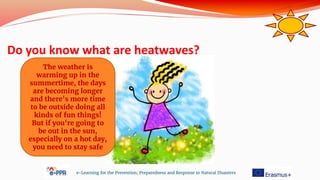
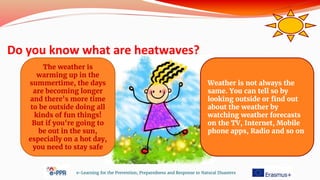
The weather is
warming up in the
summertime, the days
are becoming longer
and there's more time
to be outside doing all
kinds of fun things!
But if you're going to
be out in the sun,
especially on a hot day,
you need to stay safe
Do you know what are heatwaves?
e-Learning for the Prevention, Preparedness and Response to Natural Disasters
Weather is not always the
same. You can tell so by
looking outside or find out
about the weather by
watching weather forecasts
on the TV, Internet, Mobile
phone apps, Radio and so on.
The weather is
warming up in the
summertime, the days
are becoming longer
and there's more time
to be outside doing all
kinds of fun things!
But if you're going to
be out in the sun,
especially on a hot day,
you need to stay safe
Do you know what a heatwave is?
e-Learning for the Prevention, Preparedness and Response to Natural Disasters
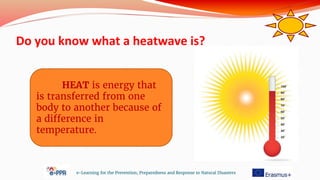
HEAT is energy that
is transferred from one
body to another because of
a difference in
temperature.
Do you know what heatwaves are?
e-Learning for the Prevention, Preparedness and Response to Natural Disasters
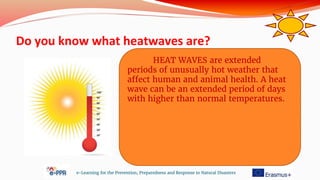
HEAT WAVES are extended
periods of unusually hot weather that
affect human and animal health. A heat
wave can be an extended period of days
with higher than normal temperatures.
Do you know what heatwaves are?
e-Learning for the Prevention, Preparedness and Response to Natural Disasters
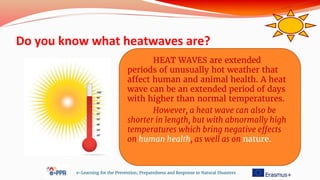
HEAT WAVES are extended
periods of unusually hot weather that
affect human and animal health. A heat
wave can be an extended period of days
with higher than normal temperatures.
However, a heat wave can also be
shorter in length, but with abnormally high
temperatures which bring negative effects
on human health, as well as on nature.
What causes a heat wave?
e-Learning for the Prevention, Preparedness and Response to Natural Disasters
What causes a heatwave?
e-Learning for the Prevention, Preparedness and Response to Natural Disasters
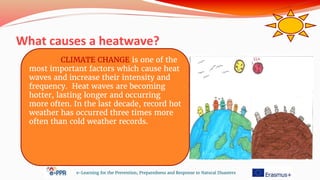
CLIMATE CHANGE is one of the
most important factors which cause heat
waves and increase their intensity and
frequency. Heat waves are becoming
hotter, lasting longer and occurring
more often. In the last decade, record hot
weather has occurred three times more
often than cold weather records.
What causes a heatwave?
e-Learning for the Prevention, Preparedness and Response to Natural Disasters
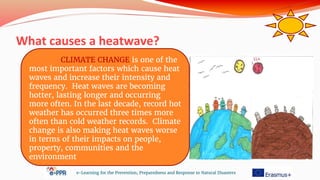
CLIMATE CHANGE is one of the
most important factors which cause heat
waves and increase their intensity and
frequency. Heat waves are becoming
hotter, lasting longer and occurring
more often. In the last decade, record hot
weather has occurred three times more
often than cold weather records. Climate
change is also making heat waves worse
in terms of their impacts on people,
property, communities and the
environment
What causes a heatwave?
e-Learning for the Prevention, Preparedness and Response to Natural Disasters
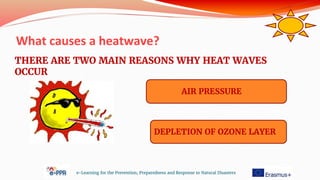
AIR PRESSURE
DEPLETION OF OZONE LAYER
THERE ARE TWO MAIN REASONS WHY HEAT WAVES
OCCUR
What causes a heatwave?
e-Learning for the Prevention, Preparedness and Response to Natural Disasters
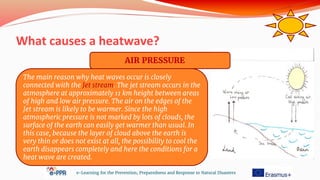
The main reason why heat waves occur is closely
connected with the Jet stream. The jet stream occurs in the
atmosphere at approximately 11 km height between areas
of high and low air pressure. The air on the edges of the
Jet stream is likely to be warmer. Since the high
atmospheric pressure is not marked by lots of clouds, the
surface of the earth can easily get warmer than usual. In
this case, because the layer of cloud above the earth is
very thin or does not exist at all, the possibility to cool the
earth disappears completely and here the conditions for a
heat wave are created.
AIR PRESSURE
What causes a heatwave?
e-Learning for the Prevention, Preparedness and Response to Natural Disasters
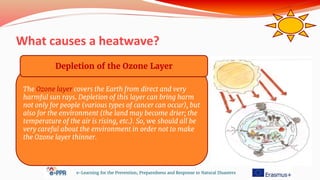
The Ozone layer covers the Earth from direct and very
harmful sun rays. Depletion of this layer can bring harm
not only for people (various types of cancer can occur), but
also for the environment (the land may become drier; the
temperature of the air is rising, etc.). So, we should all be
very careful about the environment in order not to make
the Ozone layer thinner.
Depletion of the Ozone Layer
Signs of heat waves
e-Learning for the Prevention, Preparedness and Response to Natural Disasters
Signs of heat waves
e-Learning for the Prevention, Preparedness and Response to Natural Disasters
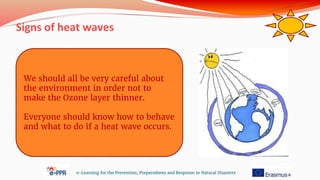
We should all be very careful about
the environment in order not to
make the Ozone layer thinner.
Everyone should know how to behave
and what to do if a heat wave occurs.
Signs of heat waves
e-Learning for the Prevention, Preparedness and Response to Natural Disasters
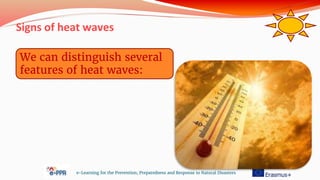
We can distinguish several
features of heat waves:
Signs of heat waves
e-Learning for the Prevention, Preparedness and Response to Natural Disasters
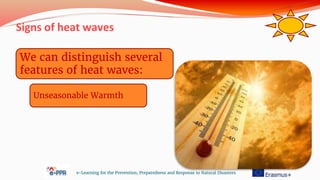
We can distinguish several
features of heat waves:
Unseasonable Warmth
Signs of heat waves
e-Learning for the Prevention, Preparedness and Response to Natural Disasters
We can distinguish several
features of heat waves:
Unseasonable Warmth
Humidity
Signs of heat waves
e-Learning for the Prevention, Preparedness and Response to Natural Disasters
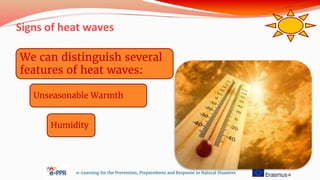
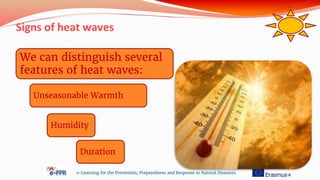
We can distinguish several
features of heat waves:
Unseasonable Warmth
Humidity
Duration
Signs of heat waves
e-Learning for the Prevention, Preparedness and Response to Natural Disasters
UNSEASONABLE WARMTH
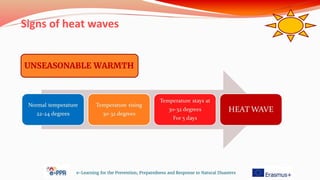
Heat waves are generally characterized by periods of
unseasonable warmth. This is defined in different ways
in different countries. Although this can also happen
and be common during the cooler months, it is
generally considered a heat wave during the warm
months when the air becomes uncomfortably warm.
For example, the air temperature in your town or city
reaches 28-30◦ C for couple of days. The weather
forecast on TV or radio does not promise any changes
– according to forecaster such temperature will
remain during the next 4-5 days. So such a period can
be called a heat wave
Signs of heat waves
e-Learning for the Prevention, Preparedness and Response to Natural Disasters
UNSEASONABLE WARMTH
Heat waves are generally characterized by
periods of unseasonable warmth.
Heat waves are generally characterized by periods of
unseasonable warmth. This is defined in different ways
in different countries. Although this can also happen
and be common during the cooler months, it is
generally considered a heat wave during the warm
months when the air becomes uncomfortably warm.
For example, the air temperature in your town or city
reaches 28-30◦ C for couple of days. The weather
forecast on TV or radio does not promise any changes
– according to forecaster such temperature will
remain during the next 4-5 days. So such a period can
be called a heat wave
Signs of heat waves
e-Learning for the Prevention, Preparedness and Response to Natural Disasters
UNSEASONABLE WARMTH
Heat waves are generally characterized by
periods of unseasonable warmth.
This is defined as being at least 9
degrees Celsius higher than the
average temperature of a region
during the same time of year.
Heat waves are generally characterized by periods of
unseasonable warmth. This is defined in different ways
in different countries. Although this can also happen
and be common during the cooler months, it is
generally considered a heat wave during the warm
months when the air becomes uncomfortably warm.
For example, the air temperature in your town or city
reaches 28-30◦ C for couple of days. The weather
forecast on TV or radio does not promise any changes
– according to forecaster such temperature will
remain during the next 4-5 days. So such a period can
be called a heat wave
Signs of heat waves
e-Learning for the Prevention, Preparedness and Response to Natural Disasters
UNSEASONABLE WARMTH
Signs of heat waves
e-Learning for the Prevention, Preparedness and Response to Natural Disasters
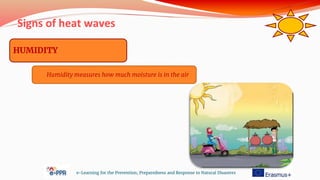
HUMIDITY
Humidity measures how much moisture is in the air
Signs of heat waves
e-Learning for the Prevention, Preparedness and Response to Natural Disasters
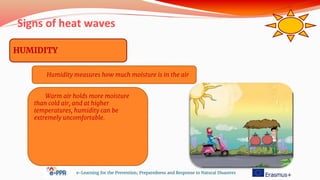
HUMIDITY
Humidity measures how much moisture is in the air
Warm air holds more moisture
than cold air, and at higher
temperatures, humidity can be
extremely uncomfortable.
Signs of heat waves
e-Learning for the Prevention, Preparedness and Response to Natural Disasters
HUMIDITY
Humidity measures how much moisture is in the air
Warm air holds more moisture
than cold air, and at higher
temperatures, humidity can be
extremely uncomfortable.
The reason for this is that the
human body cools itself by the
evaporation of sweat. When the
humidity is too high, sweat does not
effectively evaporate, and people can
easily overheat
Signs of heat waves
e-Learning for the Prevention, Preparedness and Response to Natural Disasters
HUMIDITY
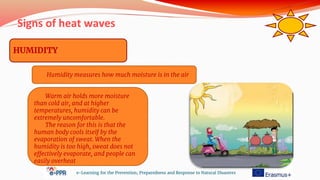
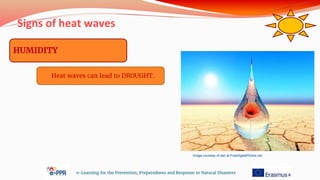
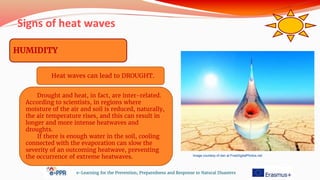
Heat waves can lead to DROUGHT.
Image courtesy of dan at FreeDigitalPhotos.net
Signs of heat waves
e-Learning for the Prevention, Preparedness and Response to Natural Disasters
HUMIDITY
Heat waves can lead to DROUGHT.
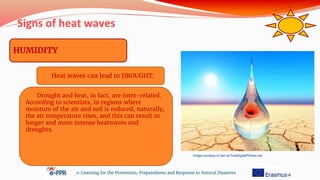
Drought and heat, in fact, are inter-related.
According to scientists, in regions where
moisture of the air and soil is reduced, naturally,
the air temperature rises, and this can result in
longer and more intense heatwaves and
droughts.
Image courtesy of dan at FreeDigitalPhotos.net
Signs of heat waves
e-Learning for the Prevention, Preparedness and Response to Natural Disasters
HUMIDITY
Heat waves can lead to DROUGHT.
Drought and heat, in fact, are inter-related.
According to scientists, in regions where
moisture of the air and soil is reduced, naturally,
the air temperature rises, and this can result in
longer and more intense heatwaves and
droughts.
If there is enough water in the soil, cooling
connected with the evaporation can slow the
severity of an outcoming heatwave, preventing
the occurrence of extreme heatwaves. Image courtesy of dan at FreeDigitalPhotos.net
Signs of heat waves
e-Learning for the Prevention, Preparedness and Response to Natural Disasters
HUMIDITY
Heatwaves occur when a ridge of high pressure
sits over a region for an extended period of time,
bringing down dry, hot air to the ground. As the air
sinks, it warms and compresses and is very hot by
the time it reaches the surface.
Signs of heat waves
e-Learning for the Prevention, Preparedness and Response to Natural Disasters
HUMIDITY
Heatwaves occur when a ridge of high pressure
sits over a region for an extended period of time,
bringing down dry, hot air to the ground. As the air
sinks, it warms and compresses and is very hot by
the time it reaches the surface.
This hot air quickly heats up the ground, which
raises the air temperature. Since the centre of high
pressure areas are usually cloud-free, the direct
sunlight raises daytime temperatures further.
Signs of heat waves
e-Learning for the Prevention, Preparedness and Response to Natural Disasters
HUMIDITY
Heatwaves occur when a ridge of high pressure
sits over a region for an extended period of time,
bringing down dry, hot air to the ground. As the air
sinks, it warms and compresses and is very hot by
the time it reaches the surface.
This hot air quickly heats up the ground, which
raises the air temperature. Since the centre of high
pressure areas are usually cloud-free, the direct
sunlight raises daytime temperatures further.
If humidity is high, temperatures do not cool
much at night. Night-time heat greatly contributes
to overall humidity.
Signs of heat waves
e-Learning for the Prevention, Preparedness and Response to Natural Disasters
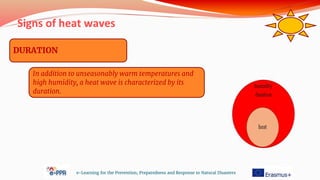
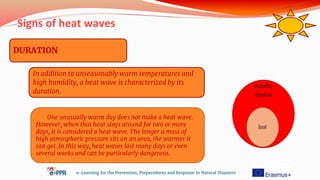
DURATION
In addition to unseasonably warm temperatures and
high humidity, a heat wave is characterized by its
duration.
Signs of heat waves
e-Learning for the Prevention, Preparedness and Response to Natural Disasters
DURATION
One unusually warm day does not make a heat wave.
However, when that heat stays around for two or more
days, it is considered a heat wave. The longer a mass of
high atmospheric pressure sits on an area, the warmer it
can get. In this way, heat waves last many days or even
several weeks and can be particularly dangerous.
In addition to unseasonably warm temperatures and
high humidity, a heat wave is characterized by its
duration.
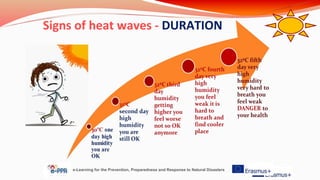
Signs of heat waves - DURATION
e-Learning for the Prevention, Preparedness and Response to Natural Disasters
Signs of heat waves
e-Learning for the Prevention, Preparedness and Response to Natural Disasters
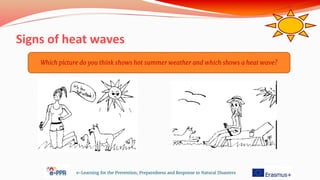
Which picture do you think shows hot summer weather and which shows a heat wave?
THE IMPACT OF HEAT WAVES.
What to be aware of?.
e-Learning for the Prevention, Preparedness and Response to Natural Disasters
The impact of heat waves
e-Learning for the Prevention, Preparedness and Response to Natural Disasters
Each summer, different areas of the world
experience unseasonably warm temperatures for
extended periods of time. Many news stories
follow these heat waves, pointing out several
public health dangers. Heat waves have been
known to cause medical problems and even
deaths. Additionally, heat waves result in higher
energy consumption, as people use more electricity
to power air conditioners in their homes, work
places and cars.
What to be aware of:
e-Learning for the Prevention, Preparedness and Response to Natural Disasters
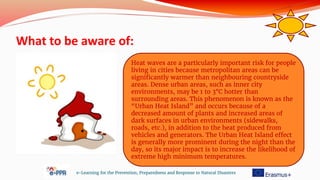
Heat waves are a particularly important risk for people
living in cities because metropolitan areas can be
significantly warmer than neighbouring countryside
areas. Dense urban areas, such as inner city
environments, may be 1 to 3°C hotter than
surrounding areas. This phenomenon is known as the
“Urban Heat Island” and occurs because of a
decreased amount of plants and increased areas of
dark surfaces in urban environments (sidewalks,
roads, etc.), in addition to the heat produced from
vehicles and generators. The Urban Heat Island effect
is generally more prominent during the night than the
day, so its major impact is to increase the likelihood of
extreme high minimum temperatures.
What to be aware of:
e-Learning for the Prevention, Preparedness and Response to Natural Disasters
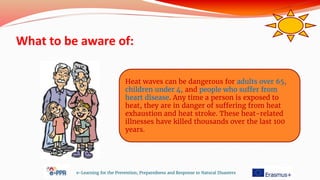
Heat waves can be dangerous for adults over 65,
children under 4, and people who suffer from
heart disease. Any time a person is exposed to
heat, they are in danger of suffering from heat
exhaustion and heat stroke. These heat-related
illnesses have killed thousands over the last 100
years.
What to be aware of:
e-Learning for the Prevention, Preparedness and Response to Natural Disasters
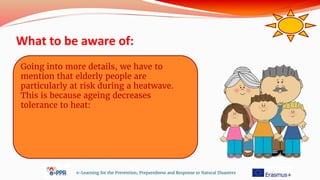
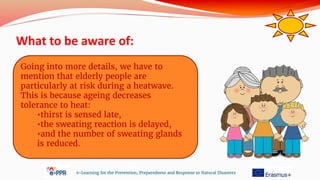
Going into more details, we have to
mention that elderly people are
particularly at risk during a heatwave.
This is because ageing decreases
tolerance to heat:
What to be aware of:
e-Learning for the Prevention, Preparedness and Response to Natural Disasters
Going into more details, we have to
mention that elderly people are
particularly at risk during a heatwave.
This is because ageing decreases
tolerance to heat:
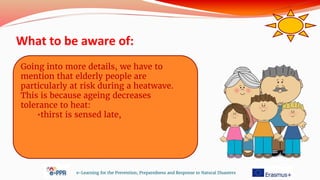
•thirst is sensed late,
What to be aware of:
e-Learning for the Prevention, Preparedness and Response to Natural Disasters
Going into more details, we have to
mention that elderly people are
particularly at risk during a heatwave.
This is because ageing decreases
tolerance to heat:
•thirst is sensed late,
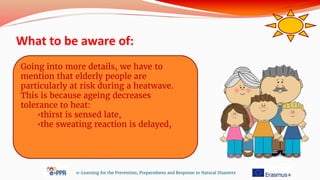
•the sweating reaction is delayed,
What to be aware of:
e-Learning for the Prevention, Preparedness and Response to Natural Disasters
Going into more details, we have to
mention that elderly people are
particularly at risk during a heatwave.
This is because ageing decreases
tolerance to heat:
•thirst is sensed late,
•the sweating reaction is delayed,
•and the number of sweating glands
is reduced.
The impact of heat waves
e-Learning for the Prevention, Preparedness and Response to Natural Disasters
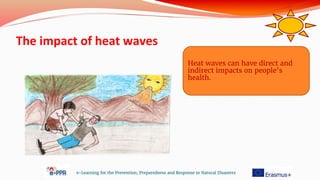
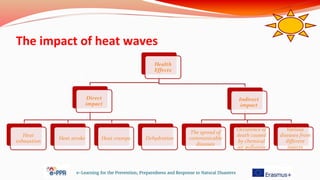
Heat waves can have direct and
indirect impacts on people’s
health.
The impact of heat waves
e-Learning for the Prevention, Preparedness and Response to Natural Disasters
The direct impact of heat waves on human health
e-Learning for the Prevention, Preparedness and Response to Natural Disasters
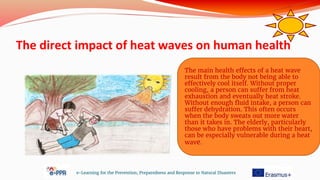
The main health effects of a heat wave
result from the body not being able to
effectively cool itself. Without proper
cooling, a person can suffer from heat
exhaustion and eventually heat stroke.
Without enough fluid intake, a person can
suffer dehydration. This often occurs
when the body sweats out more water
than it takes in. The elderly, particularly
those who have problems with their heart,
can be especially vulnerable during a heat
wave.
The direct impact of heat waves on human health
e-Learning for the Prevention, Preparedness and Response to Natural Disasters
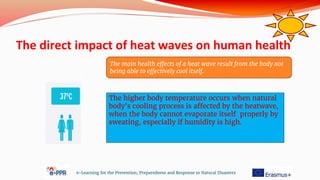
The higher body temperature occurs when natural
body's cooling process is affected by the heatwave,
when the body cannot evaporate itself properly by
sweating, especially if humidity is high.
The main health effects of a heat wave result from the body not
being able to effectively cool itself.
The direct impact of heat waves on human health
e-Learning for the Prevention, Preparedness and Response to Natural Disasters
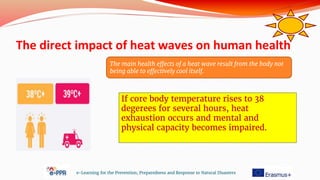
If core body temperature rises to 38
degerees for several hours, heat
exhaustion occurs and mental and
physical capacity becomes impaired.
The main health effects of a heat wave result from the body not
being able to effectively cool itself.
The direct impact of heat waves on human health
e-Learning for the Prevention, Preparedness and Response to Natural Disasters
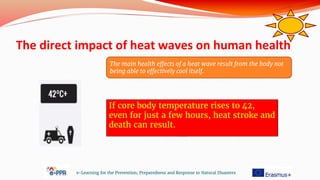
If core body temperature rises to 42,
even for just a few hours, heat stroke and
death can result.
The main health effects of a heat wave result from the body not
being able to effectively cool itself.
The direct impact of heat waves on human health
e-Learning for the Prevention, Preparedness and Response to Natural Disasters
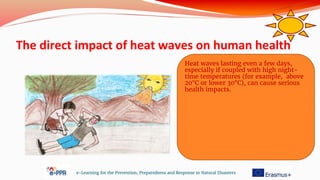
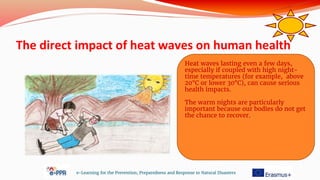
Heat waves lasting even a few days,
especially if coupled with high night-
time temperatures (for example, above
20°C or lower 30°C), can cause serious
health impacts.
The direct impact of heat waves on human health
e-Learning for the Prevention, Preparedness and Response to Natural Disasters
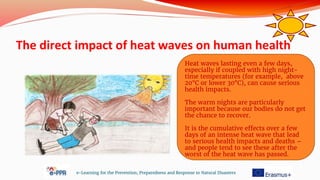
Heat waves lasting even a few days,
especially if coupled with high night-
time temperatures (for example, above
20°C or lower 30°C), can cause serious
health impacts.
The warm nights are particularly
important because our bodies do not get
the chance to recover.
The direct impact of heat waves on human health
e-Learning for the Prevention, Preparedness and Response to Natural Disasters
Heat waves lasting even a few days,
especially if coupled with high night-
time temperatures (for example, above
20°C or lower 30°C), can cause serious
health impacts.
The warm nights are particularly
important because our bodies do not get
the chance to recover.
It is the cumulative effects over a few
days of an intense heat wave that lead
to serious health impacts and deaths –
and people tend to see these after the
worst of the heat wave has passed.
The direct impact of heat waves on human health
e-Learning for the Prevention, Preparedness and Response to Natural Disasters
In summary, we can note that:
• People can suffer from heat cramps, heat exhaustion or even
heat stroke
The direct impact of heat waves on human health
e-Learning for the Prevention, Preparedness and Response to Natural Disasters
In summary, we can note that:
• People can suffer from heat cramps, heat exhaustion or even
heat stroke
• When a heat wave occurs the body can lose lots of water –
dehydration may occur
The direct impact of heat waves on human health
e-Learning for the Prevention, Preparedness and Response to Natural Disasters
In summary, we can note that:
• People can suffer from heat cramps, heat exhaustion or even
heat stroke.
• When a heat wave occurs the body can lose lots of water –
dehydration may occur.
• Also, when trying to cool yourself during the intensive heat by
drinking lost of cold water you can catch the flu
The direct impact of heat waves on human health
e-Learning for the Prevention, Preparedness and Response to Natural Disasters
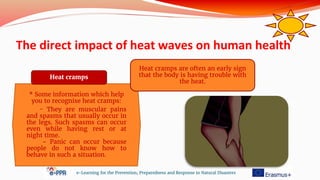
* Some information which help
you to recognise heat cramps:
- They are muscular pains
and spasms that usually occur in
the legs. Such spasms can occur
even while having rest or at
night time.
- Panic can occur because
people do not know how to
behave in such a situation.
Heat cramps
Heat cramps are often an early sign
that the body is having trouble with
the heat.
The direct impact of heat waves on human health
e-Learning for the Prevention, Preparedness and Response to Natural Disasters
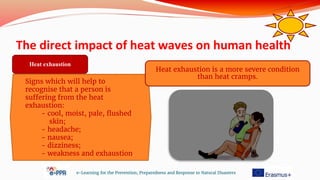
Signs which will help to
recognise that a person is
suffering from the heat
exhaustion:
- cool, moist, pale, flushed
skin;
- headache;
- nausea;
- dizziness;
- weakness and exhaustion.
Heat exhaustion
Heat exhaustion is a more severe condition
than heat cramps.
The direct impact of heat waves on human health
e-Learning for the Prevention, Preparedness and Response to Natural Disasters
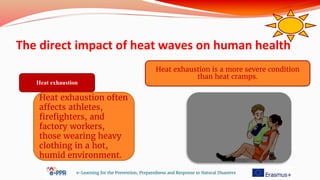
Heat exhaustion
Heat exhaustion is a more severe condition
than heat cramps.
Heat exhaustion often
affects athletes,
firefighters, and
factory workers,
those wearing heavy
clothing in a hot,
humid environment.
The direct impact of heat waves on human health
e-Learning for the Prevention, Preparedness and Response to Natural Disasters
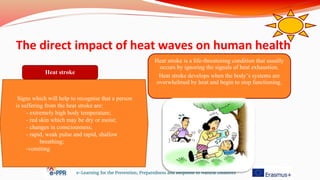
Signs which will help to recognise that a person
is suffering from the heat stroke are:
- extremely high body temperature;
- red skin which may be dry or moist;
- changes in consciousness;
- rapid, weak pulse and rapid, shallow
breathing;
-vomiting
Heat stroke
Heat stroke is a life-threatening condition that usually
occurs by ignoring the signals of heat exhaustion.
Heat stroke develops when the body’s systems are
overwhelmed by heat and begin to stop functioning.
The direct impact of heat waves on human health
e-Learning for the Prevention, Preparedness and Response to Natural Disasters
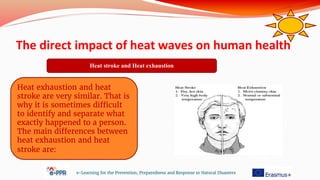
Heat stroke and Heat exhaustion
Heat exhaustion and heat
stroke are very similar. That is
why it is sometimes difficult
to identify and separate what
exactly happened to a person.
The main differences between
heat exhaustion and heat
stroke are:
The direct impact of heat waves on human health
e-Learning for the Prevention, Preparedness and Response to Natural Disasters
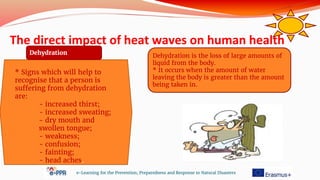
* Signs which will help to
recognise that a person is
suffering from dehydration
are:
- increased thirst;
- increased sweating;
- dry mouth and
swollen tongue;
- weakness;
- confusion;
- fainting;
- head aches.
Dehydration Dehydration is the loss of large amounts of
liquid from the body.
* It occurs when the amount of water
leaving the body is greater than the amount
being taken in.
The indirect impact of heat waves on human health
e-Learning for the Prevention, Preparedness and Response to Natural Disasters
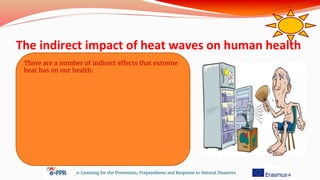
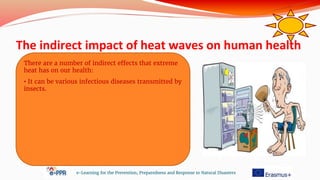
There are a number of indirect effects that extreme
heat has on our health:
The indirect impact of heat waves on human health
e-Learning for the Prevention, Preparedness and Response to Natural Disasters
There are a number of indirect effects that extreme
heat has on our health:
• It can be various infectious diseases transmitted by
insects.
The indirect impact of heat waves on human health
e-Learning for the Prevention, Preparedness and Response to Natural Disasters
There are a number of indirect effects that extreme
heat has on our health:
• It can be various infectious diseases transmitted by
insects.
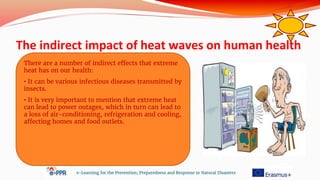
• It is very important to mention that extreme heat
can lead to power outages, which in turn can lead to
a loss of air-conditioning, refrigeration and cooling,
affecting homes and food outlets.
The indirect impact of heat waves on human health
e-Learning for the Prevention, Preparedness and Response to Natural Disasters
There are a number of indirect effects that extreme
heat has on our health:
• It can be various infectious diseases transmitted by
insects.
• It is very important to mention that extreme heat
can lead to power outages, which in turn can lead to
a loss of air-conditioning, refrigeration and cooling,
affecting homes and food outlets.
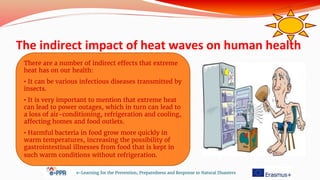
• Harmful bacteria in food grow more quickly in
warm temperatures, increasing the possibility of
gastrointestinal illnesses from food that is kept in
such warm conditions without refrigeration.
The impact of heat waves on infrastructure
e-Learning for the Prevention, Preparedness and Response to Natural Disasters
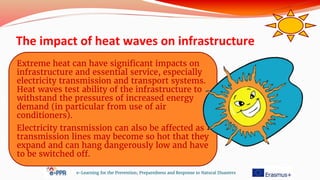
Extreme heat can have significant impacts on
infrastructure and essential service, especially
electricity transmission and transport systems.
Heat waves test ability of the infrastructure to
withstand the pressures of increased energy
demand (in particular from use of air
conditioners).
Electricity transmission can also be affected as
transmission lines may become so hot that they
expand and can hang dangerously low and have
to be switched off.
The impact of heat waves on the environment
e-Learning for the Prevention, Preparedness and Response to Natural Disasters
Heat waves can cause significant damage to nature and the
environment:
The impact of heat waves on the environment
e-Learning for the Prevention, Preparedness and Response to Natural Disasters
Heat waves can cause significant damage to nature and the
environment:
Some species of animals can disappear.
The impact of heat waves on the environment
e-Learning for the Prevention, Preparedness and Response to Natural Disasters
Heat waves can cause significant damage to nature and the
environment:
Some species of animals can disappear.
New species of insects and animals that are heat-resistant
appear.
The impact of heat waves on the environment
e-Learning for the Prevention, Preparedness and Response to Natural Disasters
Heat waves can cause significant damage to nature and the
environment:
Some species of animals can disappear.
New species of insects and animals that are heat-resistant
appear.
Other animals change their usual lifestyle and behaviour.
The impact of heat waves on the environment
e-Learning for the Prevention, Preparedness and Response to Natural Disasters
Heat waves can cause significant damage to nature and the
environment:
Some species of animals can disappear.
New species of insects and animals that are heat-resistant
appear.
Other animals change their usual lifestyle and behaviour.
Fires in open places (forests, meadows) become more
frequent
The impact of heat waves on nature
e-Learning for the Prevention, Preparedness and Response to Natural Disasters
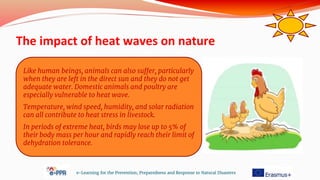
Like human beings, animals can also suffer, particularly
when they are left in the direct sun and they do not get
adequate water. Domestic animals and poultry are
especially vulnerable to heat wave.
Temperature, wind speed, humidity, and solar radiation
can all contribute to heat stress in livestock.
In periods of extreme heat, birds may lose up to 5% of
their body mass per hour and rapidly reach their limit of
dehydration tolerance.
The impact of heat waves on nature
e-Learning for the Prevention, Preparedness and Response to Natural Disasters
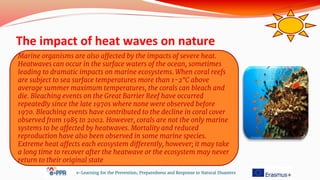
Marine organisms are also affected by the impacts of severe heat.
Heatwaves can occur in the surface waters of the ocean, sometimes
leading to dramatic impacts on marine ecosystems. When coral reefs
are subject to sea surface temperatures more than 1-2°C above
average summer maximum temperatures, the corals can bleach and
die. Bleaching events on the Great Barrier Reef have occurred
repeatedly since the late 1970s where none were observed before
1970. Bleaching events have contributed to the decline in coral cover
observed from 1985 to 2002. However, corals are not the only marine
systems to be affected by heatwaves. Mortality and reduced
reproduction have also been observed in some marine species.
Extreme heat affects each ecosystem differently, however; it may take
a long time to recover after the heatwave or the ecosystem may never
return to their original state
The impact of heat waves on nature
e-Learning for the Prevention, Preparedness and Response to Natural Disasters
Extreme heat has a negative impact on
grain crops (maize, wheat, and soya) as
well as fruit trees (apple, cherry, pear) and
may affect the quality of the fruit. Other
plants also feel the negative impact of heat
waves.
The impact of heat waves on nature
e-Learning for the Prevention, Preparedness and Response to Natural Disasters
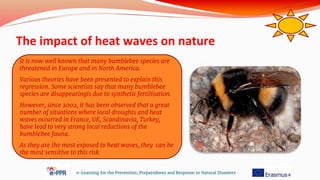
It is now well known that many bumblebee species are
threatened in Europe and in North America.
Various theories have been presented to explain this
regression. Some scientists say that many bumblebee
species are disappearingis due to synthetic fertilisation.
However, since 2002, it has been observed that a great
number of situations where local droughts and heat
waves occurred in France, UK, Scandinavia, Turkey,
have lead to very strong local reductions of the
bumblebee fauna.
As they are the most exposed to heat waves, they can be
the most sensitive to this risk
The impact of heat waves on wildfires
e-Learning for the Prevention, Preparedness and Response to Natural Disasters
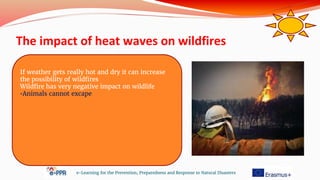
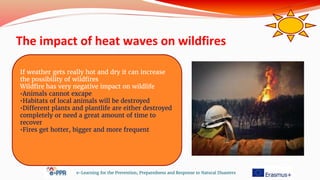
If weather gets really hot and dry it can increase
the possibility of wildfires
Wildfire has very negative impact on wildlife
•Animals cannot excape
The impact of heat waves on wildfires
e-Learning for the Prevention, Preparedness and Response to Natural Disasters
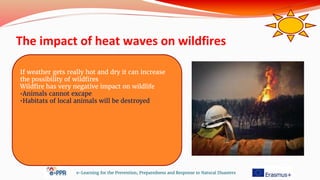
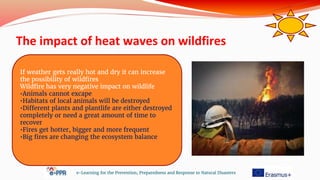
If weather gets really hot and dry it can increase
the possibility of wildfires
Wildfire has very negative impact on wildlife
•Animals cannot excape
•Habitats of local animals will be destroyed
The impact of heat waves on wildfires
e-Learning for the Prevention, Preparedness and Response to Natural Disasters
If weather gets really hot and dry it can increase
the possibility of wildfires
Wildfire has very negative impact on wildlife
•Animals cannot excape
•Habitats of local animals will be destroyed
•Different plants and plantlife are either destroyed
completely or need a great amount of time to
recover
The impact of heat waves on wildfires
e-Learning for the Prevention, Preparedness and Response to Natural Disasters
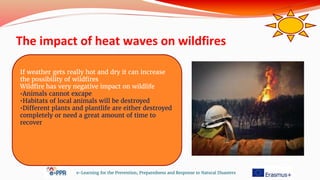
If weather gets really hot and dry it can increase
the possibility of wildfires
Wildfire has very negative impact on wildlife
•Animals cannot excape
•Habitats of local animals will be destroyed
•Different plants and plantlife are either destroyed
completely or need a great amount of time to
recover
•Fires get hotter, bigger and more frequent
The impact of heat waves on wildfires
e-Learning for the Prevention, Preparedness and Response to Natural Disasters
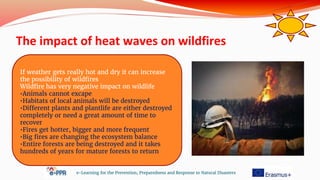
If weather gets really hot and dry it can increase
the possibility of wildfires
Wildfire has very negative impact on wildlife
•Animals cannot excape
•Habitats of local animals will be destroyed
•Different plants and plantlife are either destroyed
completely or need a great amount of time to
recover
•Fires get hotter, bigger and more frequent
•Big fires are changing the ecosystem balance
The impact of heat waves on wildfires
e-Learning for the Prevention, Preparedness and Response to Natural Disasters
If weather gets really hot and dry it can increase
the possibility of wildfires
Wildfire has very negative impact on wildlife
•Animals cannot excape
•Habitats of local animals will be destroyed
•Different plants and plantlife are either destroyed
completely or need a great amount of time to
recover
•Fires get hotter, bigger and more frequent
•Big fires are changing the ecosystem balance
•Entire forests are being destroyed and it takes
hundreds of years for mature forests to return
The most important heatwaves in the
world throughout history
e-Learning for the Prevention, Preparedness and Response to Natural Disasters
The most important heatwaves in the world
throughout history
e-Learning for the Prevention, Preparedness and Response to Natural Disasters
Marble Bar heatwave, 1923-1924.
The world record for the longest sequence of days
above 100◦ Fahrenheit (or 37.8◦ on the Celsius
scale) is held by Marble Bar in the inland Pilbara
district of Western Australia.
The temperature, measured under standard
exposure conditions, reached or exceeded the
century mark every day from 31st October 1923 to
7th April 1924, a total of 160 days.
e-Learning for the Prevention, Preparedness and Response to Natural Disasters
The „Dust Bowl“years of 1930-1936.
Some of the hottest summers on record in the
United States. Nationally, around 5000 deaths
were associated with the heatwave. What lead to
the “Dust Bowl”?
1) The lack of rain that parched the earth and
killed vegetation;
2) Poor land management.
The most important heatwaves in the world
throughout history
The most important heatwaves in the world
throughout history
e-Learning for the Prevention, Preparedness and Response to Natural Disasters
The famous summer of ’76 in the UK.
It was a period of nine weeks; the weather was
consistently dry, sunny and hot. It should also be
remembered that summer of the 1976 marked the
culmination of a prolonged drought which had
begun in April, 1975
The most important heatwaves in the world
throughout history
e-Learning for the Prevention, Preparedness and Response to Natural Disasters
Europe, 2003.
More than 20 000 people died after a record-
breaking heatwave left Europe sweltering in
August 2003. The period of extreme heat is
thought to be the warmest for up to 500 years, and
many European countries experienced their
highest temperatures on record.
The most important heatwaves in the world
throughout history
e-Learning for the Prevention, Preparedness and Response to Natural Disasters
Lithuania, 2006.
Extreme heat affected wildlife in Kuršių Nerija,
the Curonian Spit National Park. At that time 236
hectares of the territory of the National park
burned away in just in five days. Even today the
area is only partially replanted. Further wildfires
occurred after the 2006 fire and the soil was
damaged and is not as heat-resistant now as it
was before.
The most important heatwaves in the world
throughout history
e-Learning for the Prevention, Preparedness and Response to Natural Disasters
Drought and wildfires in Russia in 2010.
After record warm temperatures, drought,
wildfires, and poor air quality during July 2010,
the dismal conditions continued through mid-
August across western Russia. At the beginning of
August, 676 square miles (1 740 square km) were
burning with over 600 active fires.
Copyright Statement
This educational resource has been produced by the partners of the e-PPR Project (e-Learning for the Prevention, Preparedness and
Response to Natural Disasters) with the support of the Erasmus+ programme.
Unless otherwise stated, this educational resource is licensed under a Creative Commons Attribution-ShareAlike 4.0 International
License. It is attributed to the partners of the e-PPR project. Further information can be found at www.e-ppr.eu
The authors are committed to respecting the intellectual property rights of others, and have taken all reasonable efforts to ensure that
the reproduction of content (text, pictures, etc.) has been done with the full consent of copyright holders and that all copyright holders
are acknowledged in such reproductions. If you feel that your copyright has not been fully respected, please contact us by email at
projectmanager@e-ppr.eu.
If you are going to use parts of the content with materials whose copyright holder(s) is/are not the authors, it is your responsibility to
make sure you do so, respecting the original holder’s copyrights.
This content is the sole responsibility of the project partners and can in no way be taken to reflect the views of the European Union.
e-Learning for the Prevention, Preparedness and Response to Natural Disasters
91

Secondary - Heatwaves - Prevention

  • 1.
    HEAT WAVES PREVENTION SECONDARY LEVEL e-Learningfor the Prevention, Preparedness and Response to Natural Disasters
  • 2.
    IN THIS LESSONYOU WILL LEARN ● What are heat waves? ● What causes heat waves? ● Signs of heat waves. ● The impact of heat waves. What to be aware of? ● The most important heatwaves in the world throughout history e-Learning for the Prevention, Preparedness and Response to Natural Disasters
  • 3.
    WHAT IS AHEAT WAVE? . e-Learning for the Prevention, Preparedness and Response to Natural Disasters
  • 4.
    Do you knowwhat are heatwaves? e-Learning for the Prevention, Preparedness and Response to Natural Disasters The weather is warming up in the summertime, the days are becoming longer and there's more time to be outside doing all kinds of fun things! But if you're going to be out in the sun, especially on a hot day, you need to stay safe
  • 5.
    Do you knowwhat are heatwaves? e-Learning for the Prevention, Preparedness and Response to Natural Disasters Weather is not always the same. You can tell so by looking outside or find out about the weather by watching weather forecasts on the TV, Internet, Mobile phone apps, Radio and so on. The weather is warming up in the summertime, the days are becoming longer and there's more time to be outside doing all kinds of fun things! But if you're going to be out in the sun, especially on a hot day, you need to stay safe
  • 6.
    Do you knowwhat a heatwave is? e-Learning for the Prevention, Preparedness and Response to Natural Disasters HEAT is energy that is transferred from one body to another because of a difference in temperature.
  • 7.
    Do you knowwhat heatwaves are? e-Learning for the Prevention, Preparedness and Response to Natural Disasters HEAT WAVES are extended periods of unusually hot weather that affect human and animal health. A heat wave can be an extended period of days with higher than normal temperatures.
  • 8.
    Do you knowwhat heatwaves are? e-Learning for the Prevention, Preparedness and Response to Natural Disasters HEAT WAVES are extended periods of unusually hot weather that affect human and animal health. A heat wave can be an extended period of days with higher than normal temperatures. However, a heat wave can also be shorter in length, but with abnormally high temperatures which bring negative effects on human health, as well as on nature.
  • 9.
    What causes aheat wave? e-Learning for the Prevention, Preparedness and Response to Natural Disasters
  • 10.
    What causes aheatwave? e-Learning for the Prevention, Preparedness and Response to Natural Disasters CLIMATE CHANGE is one of the most important factors which cause heat waves and increase their intensity and frequency. Heat waves are becoming hotter, lasting longer and occurring more often. In the last decade, record hot weather has occurred three times more often than cold weather records.
  • 11.
    What causes aheatwave? e-Learning for the Prevention, Preparedness and Response to Natural Disasters CLIMATE CHANGE is one of the most important factors which cause heat waves and increase their intensity and frequency. Heat waves are becoming hotter, lasting longer and occurring more often. In the last decade, record hot weather has occurred three times more often than cold weather records. Climate change is also making heat waves worse in terms of their impacts on people, property, communities and the environment
  • 12.
    What causes aheatwave? e-Learning for the Prevention, Preparedness and Response to Natural Disasters AIR PRESSURE DEPLETION OF OZONE LAYER THERE ARE TWO MAIN REASONS WHY HEAT WAVES OCCUR
  • 13.
    What causes aheatwave? e-Learning for the Prevention, Preparedness and Response to Natural Disasters The main reason why heat waves occur is closely connected with the Jet stream. The jet stream occurs in the atmosphere at approximately 11 km height between areas of high and low air pressure. The air on the edges of the Jet stream is likely to be warmer. Since the high atmospheric pressure is not marked by lots of clouds, the surface of the earth can easily get warmer than usual. In this case, because the layer of cloud above the earth is very thin or does not exist at all, the possibility to cool the earth disappears completely and here the conditions for a heat wave are created. AIR PRESSURE
  • 14.
    What causes aheatwave? e-Learning for the Prevention, Preparedness and Response to Natural Disasters The Ozone layer covers the Earth from direct and very harmful sun rays. Depletion of this layer can bring harm not only for people (various types of cancer can occur), but also for the environment (the land may become drier; the temperature of the air is rising, etc.). So, we should all be very careful about the environment in order not to make the Ozone layer thinner. Depletion of the Ozone Layer
  • 15.
    Signs of heatwaves e-Learning for the Prevention, Preparedness and Response to Natural Disasters
  • 16.
    Signs of heatwaves e-Learning for the Prevention, Preparedness and Response to Natural Disasters We should all be very careful about the environment in order not to make the Ozone layer thinner. Everyone should know how to behave and what to do if a heat wave occurs.
  • 17.
    Signs of heatwaves e-Learning for the Prevention, Preparedness and Response to Natural Disasters We can distinguish several features of heat waves:
  • 18.
    Signs of heatwaves e-Learning for the Prevention, Preparedness and Response to Natural Disasters We can distinguish several features of heat waves: Unseasonable Warmth
  • 19.
    Signs of heatwaves e-Learning for the Prevention, Preparedness and Response to Natural Disasters We can distinguish several features of heat waves: Unseasonable Warmth Humidity
  • 20.
    Signs of heatwaves e-Learning for the Prevention, Preparedness and Response to Natural Disasters We can distinguish several features of heat waves: Unseasonable Warmth Humidity Duration
  • 21.
    Signs of heatwaves e-Learning for the Prevention, Preparedness and Response to Natural Disasters UNSEASONABLE WARMTH Heat waves are generally characterized by periods of unseasonable warmth. This is defined in different ways in different countries. Although this can also happen and be common during the cooler months, it is generally considered a heat wave during the warm months when the air becomes uncomfortably warm. For example, the air temperature in your town or city reaches 28-30◦ C for couple of days. The weather forecast on TV or radio does not promise any changes – according to forecaster such temperature will remain during the next 4-5 days. So such a period can be called a heat wave
  • 22.
    Signs of heatwaves e-Learning for the Prevention, Preparedness and Response to Natural Disasters UNSEASONABLE WARMTH Heat waves are generally characterized by periods of unseasonable warmth. Heat waves are generally characterized by periods of unseasonable warmth. This is defined in different ways in different countries. Although this can also happen and be common during the cooler months, it is generally considered a heat wave during the warm months when the air becomes uncomfortably warm. For example, the air temperature in your town or city reaches 28-30◦ C for couple of days. The weather forecast on TV or radio does not promise any changes – according to forecaster such temperature will remain during the next 4-5 days. So such a period can be called a heat wave
  • 23.
    Signs of heatwaves e-Learning for the Prevention, Preparedness and Response to Natural Disasters UNSEASONABLE WARMTH Heat waves are generally characterized by periods of unseasonable warmth. This is defined as being at least 9 degrees Celsius higher than the average temperature of a region during the same time of year. Heat waves are generally characterized by periods of unseasonable warmth. This is defined in different ways in different countries. Although this can also happen and be common during the cooler months, it is generally considered a heat wave during the warm months when the air becomes uncomfortably warm. For example, the air temperature in your town or city reaches 28-30◦ C for couple of days. The weather forecast on TV or radio does not promise any changes – according to forecaster such temperature will remain during the next 4-5 days. So such a period can be called a heat wave
  • 24.
    Signs of heatwaves e-Learning for the Prevention, Preparedness and Response to Natural Disasters UNSEASONABLE WARMTH
  • 25.
    Signs of heatwaves e-Learning for the Prevention, Preparedness and Response to Natural Disasters HUMIDITY Humidity measures how much moisture is in the air
  • 26.
    Signs of heatwaves e-Learning for the Prevention, Preparedness and Response to Natural Disasters HUMIDITY Humidity measures how much moisture is in the air Warm air holds more moisture than cold air, and at higher temperatures, humidity can be extremely uncomfortable.
  • 27.
    Signs of heatwaves e-Learning for the Prevention, Preparedness and Response to Natural Disasters HUMIDITY Humidity measures how much moisture is in the air Warm air holds more moisture than cold air, and at higher temperatures, humidity can be extremely uncomfortable. The reason for this is that the human body cools itself by the evaporation of sweat. When the humidity is too high, sweat does not effectively evaporate, and people can easily overheat
  • 28.
    Signs of heatwaves e-Learning for the Prevention, Preparedness and Response to Natural Disasters HUMIDITY Heat waves can lead to DROUGHT. Image courtesy of dan at FreeDigitalPhotos.net
  • 29.
    Signs of heatwaves e-Learning for the Prevention, Preparedness and Response to Natural Disasters HUMIDITY Heat waves can lead to DROUGHT. Drought and heat, in fact, are inter-related. According to scientists, in regions where moisture of the air and soil is reduced, naturally, the air temperature rises, and this can result in longer and more intense heatwaves and droughts. Image courtesy of dan at FreeDigitalPhotos.net
  • 30.
    Signs of heatwaves e-Learning for the Prevention, Preparedness and Response to Natural Disasters HUMIDITY Heat waves can lead to DROUGHT. Drought and heat, in fact, are inter-related. According to scientists, in regions where moisture of the air and soil is reduced, naturally, the air temperature rises, and this can result in longer and more intense heatwaves and droughts. If there is enough water in the soil, cooling connected with the evaporation can slow the severity of an outcoming heatwave, preventing the occurrence of extreme heatwaves. Image courtesy of dan at FreeDigitalPhotos.net
  • 31.
    Signs of heatwaves e-Learning for the Prevention, Preparedness and Response to Natural Disasters HUMIDITY Heatwaves occur when a ridge of high pressure sits over a region for an extended period of time, bringing down dry, hot air to the ground. As the air sinks, it warms and compresses and is very hot by the time it reaches the surface.
  • 32.
    Signs of heatwaves e-Learning for the Prevention, Preparedness and Response to Natural Disasters HUMIDITY Heatwaves occur when a ridge of high pressure sits over a region for an extended period of time, bringing down dry, hot air to the ground. As the air sinks, it warms and compresses and is very hot by the time it reaches the surface. This hot air quickly heats up the ground, which raises the air temperature. Since the centre of high pressure areas are usually cloud-free, the direct sunlight raises daytime temperatures further.
  • 33.
    Signs of heatwaves e-Learning for the Prevention, Preparedness and Response to Natural Disasters HUMIDITY Heatwaves occur when a ridge of high pressure sits over a region for an extended period of time, bringing down dry, hot air to the ground. As the air sinks, it warms and compresses and is very hot by the time it reaches the surface. This hot air quickly heats up the ground, which raises the air temperature. Since the centre of high pressure areas are usually cloud-free, the direct sunlight raises daytime temperatures further. If humidity is high, temperatures do not cool much at night. Night-time heat greatly contributes to overall humidity.
  • 34.
    Signs of heatwaves e-Learning for the Prevention, Preparedness and Response to Natural Disasters DURATION In addition to unseasonably warm temperatures and high humidity, a heat wave is characterized by its duration.
  • 35.
    Signs of heatwaves e-Learning for the Prevention, Preparedness and Response to Natural Disasters DURATION One unusually warm day does not make a heat wave. However, when that heat stays around for two or more days, it is considered a heat wave. The longer a mass of high atmospheric pressure sits on an area, the warmer it can get. In this way, heat waves last many days or even several weeks and can be particularly dangerous. In addition to unseasonably warm temperatures and high humidity, a heat wave is characterized by its duration.
  • 36.
    Signs of heatwaves - DURATION e-Learning for the Prevention, Preparedness and Response to Natural Disasters
  • 37.
    Signs of heatwaves e-Learning for the Prevention, Preparedness and Response to Natural Disasters Which picture do you think shows hot summer weather and which shows a heat wave?
  • 38.
    THE IMPACT OFHEAT WAVES. What to be aware of?. e-Learning for the Prevention, Preparedness and Response to Natural Disasters
  • 39.
    The impact ofheat waves e-Learning for the Prevention, Preparedness and Response to Natural Disasters Each summer, different areas of the world experience unseasonably warm temperatures for extended periods of time. Many news stories follow these heat waves, pointing out several public health dangers. Heat waves have been known to cause medical problems and even deaths. Additionally, heat waves result in higher energy consumption, as people use more electricity to power air conditioners in their homes, work places and cars.
  • 40.
    What to beaware of: e-Learning for the Prevention, Preparedness and Response to Natural Disasters Heat waves are a particularly important risk for people living in cities because metropolitan areas can be significantly warmer than neighbouring countryside areas. Dense urban areas, such as inner city environments, may be 1 to 3°C hotter than surrounding areas. This phenomenon is known as the “Urban Heat Island” and occurs because of a decreased amount of plants and increased areas of dark surfaces in urban environments (sidewalks, roads, etc.), in addition to the heat produced from vehicles and generators. The Urban Heat Island effect is generally more prominent during the night than the day, so its major impact is to increase the likelihood of extreme high minimum temperatures.
  • 41.
    What to beaware of: e-Learning for the Prevention, Preparedness and Response to Natural Disasters Heat waves can be dangerous for adults over 65, children under 4, and people who suffer from heart disease. Any time a person is exposed to heat, they are in danger of suffering from heat exhaustion and heat stroke. These heat-related illnesses have killed thousands over the last 100 years.
  • 42.
    What to beaware of: e-Learning for the Prevention, Preparedness and Response to Natural Disasters Going into more details, we have to mention that elderly people are particularly at risk during a heatwave. This is because ageing decreases tolerance to heat:
  • 43.
    What to beaware of: e-Learning for the Prevention, Preparedness and Response to Natural Disasters Going into more details, we have to mention that elderly people are particularly at risk during a heatwave. This is because ageing decreases tolerance to heat: •thirst is sensed late,
  • 44.
    What to beaware of: e-Learning for the Prevention, Preparedness and Response to Natural Disasters Going into more details, we have to mention that elderly people are particularly at risk during a heatwave. This is because ageing decreases tolerance to heat: •thirst is sensed late, •the sweating reaction is delayed,
  • 45.
    What to beaware of: e-Learning for the Prevention, Preparedness and Response to Natural Disasters Going into more details, we have to mention that elderly people are particularly at risk during a heatwave. This is because ageing decreases tolerance to heat: •thirst is sensed late, •the sweating reaction is delayed, •and the number of sweating glands is reduced.
  • 46.
    The impact ofheat waves e-Learning for the Prevention, Preparedness and Response to Natural Disasters Heat waves can have direct and indirect impacts on people’s health.
  • 47.
    The impact ofheat waves e-Learning for the Prevention, Preparedness and Response to Natural Disasters
  • 48.
    The direct impactof heat waves on human health e-Learning for the Prevention, Preparedness and Response to Natural Disasters The main health effects of a heat wave result from the body not being able to effectively cool itself. Without proper cooling, a person can suffer from heat exhaustion and eventually heat stroke. Without enough fluid intake, a person can suffer dehydration. This often occurs when the body sweats out more water than it takes in. The elderly, particularly those who have problems with their heart, can be especially vulnerable during a heat wave.
  • 49.
    The direct impactof heat waves on human health e-Learning for the Prevention, Preparedness and Response to Natural Disasters The higher body temperature occurs when natural body's cooling process is affected by the heatwave, when the body cannot evaporate itself properly by sweating, especially if humidity is high. The main health effects of a heat wave result from the body not being able to effectively cool itself.
  • 50.
    The direct impactof heat waves on human health e-Learning for the Prevention, Preparedness and Response to Natural Disasters If core body temperature rises to 38 degerees for several hours, heat exhaustion occurs and mental and physical capacity becomes impaired. The main health effects of a heat wave result from the body not being able to effectively cool itself.
  • 51.
    The direct impactof heat waves on human health e-Learning for the Prevention, Preparedness and Response to Natural Disasters If core body temperature rises to 42, even for just a few hours, heat stroke and death can result. The main health effects of a heat wave result from the body not being able to effectively cool itself.
  • 52.
    The direct impactof heat waves on human health e-Learning for the Prevention, Preparedness and Response to Natural Disasters Heat waves lasting even a few days, especially if coupled with high night- time temperatures (for example, above 20°C or lower 30°C), can cause serious health impacts.
  • 53.
    The direct impactof heat waves on human health e-Learning for the Prevention, Preparedness and Response to Natural Disasters Heat waves lasting even a few days, especially if coupled with high night- time temperatures (for example, above 20°C or lower 30°C), can cause serious health impacts. The warm nights are particularly important because our bodies do not get the chance to recover.
  • 54.
    The direct impactof heat waves on human health e-Learning for the Prevention, Preparedness and Response to Natural Disasters Heat waves lasting even a few days, especially if coupled with high night- time temperatures (for example, above 20°C or lower 30°C), can cause serious health impacts. The warm nights are particularly important because our bodies do not get the chance to recover. It is the cumulative effects over a few days of an intense heat wave that lead to serious health impacts and deaths – and people tend to see these after the worst of the heat wave has passed.
  • 55.
    The direct impactof heat waves on human health e-Learning for the Prevention, Preparedness and Response to Natural Disasters In summary, we can note that: • People can suffer from heat cramps, heat exhaustion or even heat stroke
  • 56.
    The direct impactof heat waves on human health e-Learning for the Prevention, Preparedness and Response to Natural Disasters In summary, we can note that: • People can suffer from heat cramps, heat exhaustion or even heat stroke • When a heat wave occurs the body can lose lots of water – dehydration may occur
  • 57.
    The direct impactof heat waves on human health e-Learning for the Prevention, Preparedness and Response to Natural Disasters In summary, we can note that: • People can suffer from heat cramps, heat exhaustion or even heat stroke. • When a heat wave occurs the body can lose lots of water – dehydration may occur. • Also, when trying to cool yourself during the intensive heat by drinking lost of cold water you can catch the flu
  • 58.
    The direct impactof heat waves on human health e-Learning for the Prevention, Preparedness and Response to Natural Disasters * Some information which help you to recognise heat cramps: - They are muscular pains and spasms that usually occur in the legs. Such spasms can occur even while having rest or at night time. - Panic can occur because people do not know how to behave in such a situation. Heat cramps Heat cramps are often an early sign that the body is having trouble with the heat.
  • 59.
    The direct impactof heat waves on human health e-Learning for the Prevention, Preparedness and Response to Natural Disasters Signs which will help to recognise that a person is suffering from the heat exhaustion: - cool, moist, pale, flushed skin; - headache; - nausea; - dizziness; - weakness and exhaustion. Heat exhaustion Heat exhaustion is a more severe condition than heat cramps.
  • 60.
    The direct impactof heat waves on human health e-Learning for the Prevention, Preparedness and Response to Natural Disasters Heat exhaustion Heat exhaustion is a more severe condition than heat cramps. Heat exhaustion often affects athletes, firefighters, and factory workers, those wearing heavy clothing in a hot, humid environment.
  • 61.
    The direct impactof heat waves on human health e-Learning for the Prevention, Preparedness and Response to Natural Disasters Signs which will help to recognise that a person is suffering from the heat stroke are: - extremely high body temperature; - red skin which may be dry or moist; - changes in consciousness; - rapid, weak pulse and rapid, shallow breathing; -vomiting Heat stroke Heat stroke is a life-threatening condition that usually occurs by ignoring the signals of heat exhaustion. Heat stroke develops when the body’s systems are overwhelmed by heat and begin to stop functioning.
  • 62.
    The direct impactof heat waves on human health e-Learning for the Prevention, Preparedness and Response to Natural Disasters Heat stroke and Heat exhaustion Heat exhaustion and heat stroke are very similar. That is why it is sometimes difficult to identify and separate what exactly happened to a person. The main differences between heat exhaustion and heat stroke are:
  • 63.
    The direct impactof heat waves on human health e-Learning for the Prevention, Preparedness and Response to Natural Disasters * Signs which will help to recognise that a person is suffering from dehydration are: - increased thirst; - increased sweating; - dry mouth and swollen tongue; - weakness; - confusion; - fainting; - head aches. Dehydration Dehydration is the loss of large amounts of liquid from the body. * It occurs when the amount of water leaving the body is greater than the amount being taken in.
  • 64.
    The indirect impactof heat waves on human health e-Learning for the Prevention, Preparedness and Response to Natural Disasters There are a number of indirect effects that extreme heat has on our health:
  • 65.
    The indirect impactof heat waves on human health e-Learning for the Prevention, Preparedness and Response to Natural Disasters There are a number of indirect effects that extreme heat has on our health: • It can be various infectious diseases transmitted by insects.
  • 66.
    The indirect impactof heat waves on human health e-Learning for the Prevention, Preparedness and Response to Natural Disasters There are a number of indirect effects that extreme heat has on our health: • It can be various infectious diseases transmitted by insects. • It is very important to mention that extreme heat can lead to power outages, which in turn can lead to a loss of air-conditioning, refrigeration and cooling, affecting homes and food outlets.
  • 67.
    The indirect impactof heat waves on human health e-Learning for the Prevention, Preparedness and Response to Natural Disasters There are a number of indirect effects that extreme heat has on our health: • It can be various infectious diseases transmitted by insects. • It is very important to mention that extreme heat can lead to power outages, which in turn can lead to a loss of air-conditioning, refrigeration and cooling, affecting homes and food outlets. • Harmful bacteria in food grow more quickly in warm temperatures, increasing the possibility of gastrointestinal illnesses from food that is kept in such warm conditions without refrigeration.
  • 68.
    The impact ofheat waves on infrastructure e-Learning for the Prevention, Preparedness and Response to Natural Disasters Extreme heat can have significant impacts on infrastructure and essential service, especially electricity transmission and transport systems. Heat waves test ability of the infrastructure to withstand the pressures of increased energy demand (in particular from use of air conditioners). Electricity transmission can also be affected as transmission lines may become so hot that they expand and can hang dangerously low and have to be switched off.
  • 69.
    The impact ofheat waves on the environment e-Learning for the Prevention, Preparedness and Response to Natural Disasters Heat waves can cause significant damage to nature and the environment:
  • 70.
    The impact ofheat waves on the environment e-Learning for the Prevention, Preparedness and Response to Natural Disasters Heat waves can cause significant damage to nature and the environment: Some species of animals can disappear.
  • 71.
    The impact ofheat waves on the environment e-Learning for the Prevention, Preparedness and Response to Natural Disasters Heat waves can cause significant damage to nature and the environment: Some species of animals can disappear. New species of insects and animals that are heat-resistant appear.
  • 72.
    The impact ofheat waves on the environment e-Learning for the Prevention, Preparedness and Response to Natural Disasters Heat waves can cause significant damage to nature and the environment: Some species of animals can disappear. New species of insects and animals that are heat-resistant appear. Other animals change their usual lifestyle and behaviour.
  • 73.
    The impact ofheat waves on the environment e-Learning for the Prevention, Preparedness and Response to Natural Disasters Heat waves can cause significant damage to nature and the environment: Some species of animals can disappear. New species of insects and animals that are heat-resistant appear. Other animals change their usual lifestyle and behaviour. Fires in open places (forests, meadows) become more frequent
  • 74.
    The impact ofheat waves on nature e-Learning for the Prevention, Preparedness and Response to Natural Disasters Like human beings, animals can also suffer, particularly when they are left in the direct sun and they do not get adequate water. Domestic animals and poultry are especially vulnerable to heat wave. Temperature, wind speed, humidity, and solar radiation can all contribute to heat stress in livestock. In periods of extreme heat, birds may lose up to 5% of their body mass per hour and rapidly reach their limit of dehydration tolerance.
  • 75.
    The impact ofheat waves on nature e-Learning for the Prevention, Preparedness and Response to Natural Disasters Marine organisms are also affected by the impacts of severe heat. Heatwaves can occur in the surface waters of the ocean, sometimes leading to dramatic impacts on marine ecosystems. When coral reefs are subject to sea surface temperatures more than 1-2°C above average summer maximum temperatures, the corals can bleach and die. Bleaching events on the Great Barrier Reef have occurred repeatedly since the late 1970s where none were observed before 1970. Bleaching events have contributed to the decline in coral cover observed from 1985 to 2002. However, corals are not the only marine systems to be affected by heatwaves. Mortality and reduced reproduction have also been observed in some marine species. Extreme heat affects each ecosystem differently, however; it may take a long time to recover after the heatwave or the ecosystem may never return to their original state
  • 76.
    The impact ofheat waves on nature e-Learning for the Prevention, Preparedness and Response to Natural Disasters Extreme heat has a negative impact on grain crops (maize, wheat, and soya) as well as fruit trees (apple, cherry, pear) and may affect the quality of the fruit. Other plants also feel the negative impact of heat waves.
  • 77.
    The impact ofheat waves on nature e-Learning for the Prevention, Preparedness and Response to Natural Disasters It is now well known that many bumblebee species are threatened in Europe and in North America. Various theories have been presented to explain this regression. Some scientists say that many bumblebee species are disappearingis due to synthetic fertilisation. However, since 2002, it has been observed that a great number of situations where local droughts and heat waves occurred in France, UK, Scandinavia, Turkey, have lead to very strong local reductions of the bumblebee fauna. As they are the most exposed to heat waves, they can be the most sensitive to this risk
  • 78.
    The impact ofheat waves on wildfires e-Learning for the Prevention, Preparedness and Response to Natural Disasters If weather gets really hot and dry it can increase the possibility of wildfires Wildfire has very negative impact on wildlife •Animals cannot excape
  • 79.
    The impact ofheat waves on wildfires e-Learning for the Prevention, Preparedness and Response to Natural Disasters If weather gets really hot and dry it can increase the possibility of wildfires Wildfire has very negative impact on wildlife •Animals cannot excape •Habitats of local animals will be destroyed
  • 80.
    The impact ofheat waves on wildfires e-Learning for the Prevention, Preparedness and Response to Natural Disasters If weather gets really hot and dry it can increase the possibility of wildfires Wildfire has very negative impact on wildlife •Animals cannot excape •Habitats of local animals will be destroyed •Different plants and plantlife are either destroyed completely or need a great amount of time to recover
  • 81.
    The impact ofheat waves on wildfires e-Learning for the Prevention, Preparedness and Response to Natural Disasters If weather gets really hot and dry it can increase the possibility of wildfires Wildfire has very negative impact on wildlife •Animals cannot excape •Habitats of local animals will be destroyed •Different plants and plantlife are either destroyed completely or need a great amount of time to recover •Fires get hotter, bigger and more frequent
  • 82.
    The impact ofheat waves on wildfires e-Learning for the Prevention, Preparedness and Response to Natural Disasters If weather gets really hot and dry it can increase the possibility of wildfires Wildfire has very negative impact on wildlife •Animals cannot excape •Habitats of local animals will be destroyed •Different plants and plantlife are either destroyed completely or need a great amount of time to recover •Fires get hotter, bigger and more frequent •Big fires are changing the ecosystem balance
  • 83.
    The impact ofheat waves on wildfires e-Learning for the Prevention, Preparedness and Response to Natural Disasters If weather gets really hot and dry it can increase the possibility of wildfires Wildfire has very negative impact on wildlife •Animals cannot excape •Habitats of local animals will be destroyed •Different plants and plantlife are either destroyed completely or need a great amount of time to recover •Fires get hotter, bigger and more frequent •Big fires are changing the ecosystem balance •Entire forests are being destroyed and it takes hundreds of years for mature forests to return
  • 84.
    The most importantheatwaves in the world throughout history e-Learning for the Prevention, Preparedness and Response to Natural Disasters
  • 85.
    The most importantheatwaves in the world throughout history e-Learning for the Prevention, Preparedness and Response to Natural Disasters Marble Bar heatwave, 1923-1924. The world record for the longest sequence of days above 100◦ Fahrenheit (or 37.8◦ on the Celsius scale) is held by Marble Bar in the inland Pilbara district of Western Australia. The temperature, measured under standard exposure conditions, reached or exceeded the century mark every day from 31st October 1923 to 7th April 1924, a total of 160 days.
  • 86.
    e-Learning for thePrevention, Preparedness and Response to Natural Disasters The „Dust Bowl“years of 1930-1936. Some of the hottest summers on record in the United States. Nationally, around 5000 deaths were associated with the heatwave. What lead to the “Dust Bowl”? 1) The lack of rain that parched the earth and killed vegetation; 2) Poor land management. The most important heatwaves in the world throughout history
  • 87.
    The most importantheatwaves in the world throughout history e-Learning for the Prevention, Preparedness and Response to Natural Disasters The famous summer of ’76 in the UK. It was a period of nine weeks; the weather was consistently dry, sunny and hot. It should also be remembered that summer of the 1976 marked the culmination of a prolonged drought which had begun in April, 1975
  • 88.
    The most importantheatwaves in the world throughout history e-Learning for the Prevention, Preparedness and Response to Natural Disasters Europe, 2003. More than 20 000 people died after a record- breaking heatwave left Europe sweltering in August 2003. The period of extreme heat is thought to be the warmest for up to 500 years, and many European countries experienced their highest temperatures on record.
  • 89.
    The most importantheatwaves in the world throughout history e-Learning for the Prevention, Preparedness and Response to Natural Disasters Lithuania, 2006. Extreme heat affected wildlife in Kuršių Nerija, the Curonian Spit National Park. At that time 236 hectares of the territory of the National park burned away in just in five days. Even today the area is only partially replanted. Further wildfires occurred after the 2006 fire and the soil was damaged and is not as heat-resistant now as it was before.
  • 90.
    The most importantheatwaves in the world throughout history e-Learning for the Prevention, Preparedness and Response to Natural Disasters Drought and wildfires in Russia in 2010. After record warm temperatures, drought, wildfires, and poor air quality during July 2010, the dismal conditions continued through mid- August across western Russia. At the beginning of August, 676 square miles (1 740 square km) were burning with over 600 active fires.
  • 91.
    Copyright Statement This educationalresource has been produced by the partners of the e-PPR Project (e-Learning for the Prevention, Preparedness and Response to Natural Disasters) with the support of the Erasmus+ programme. Unless otherwise stated, this educational resource is licensed under a Creative Commons Attribution-ShareAlike 4.0 International License. It is attributed to the partners of the e-PPR project. Further information can be found at www.e-ppr.eu The authors are committed to respecting the intellectual property rights of others, and have taken all reasonable efforts to ensure that the reproduction of content (text, pictures, etc.) has been done with the full consent of copyright holders and that all copyright holders are acknowledged in such reproductions. If you feel that your copyright has not been fully respected, please contact us by email at projectmanager@e-ppr.eu. If you are going to use parts of the content with materials whose copyright holder(s) is/are not the authors, it is your responsibility to make sure you do so, respecting the original holder’s copyrights. This content is the sole responsibility of the project partners and can in no way be taken to reflect the views of the European Union. e-Learning for the Prevention, Preparedness and Response to Natural Disasters 91