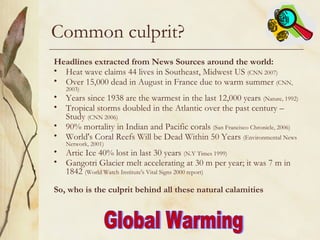
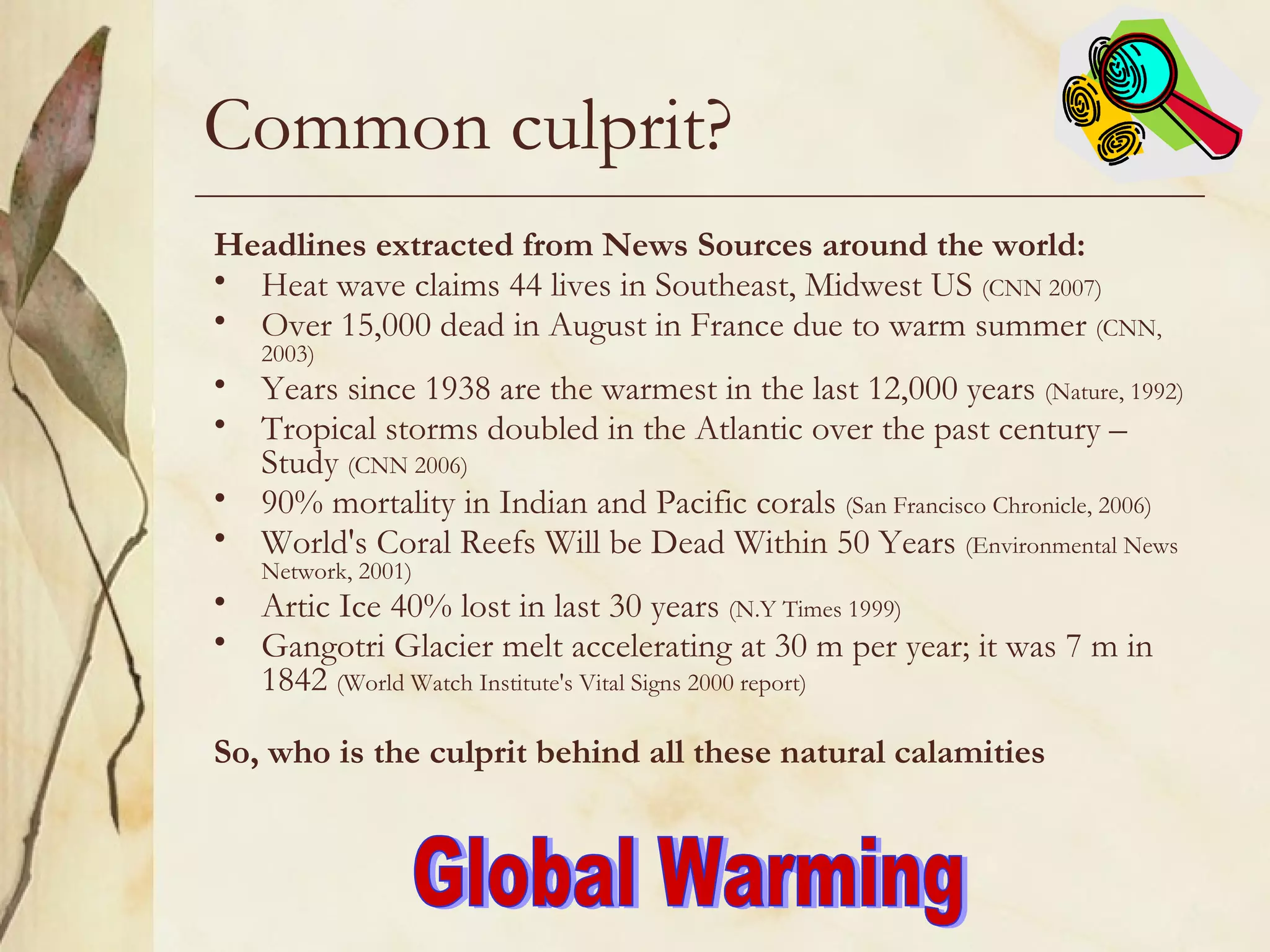
Common culprit? Headlines extracted from News Sources around the world: Heat wave claims 44 lives in Southeast, Midwest US  (CNN 2007) Over 15,000 dead in August in France due to warm summer  (CNN, 2003) Years since 1938 are the warmest in the last 12,000 years  (Nature, 1992) Tropical storms doubled in the Atlantic over the past century – Study  (CNN 2006) 90% mortality in Indian and Pacific corals  (San Francisco Chronicle, 2006) World's Coral Reefs Will be Dead Within 50 Years  (Environmental News Network, 2001) Artic Ice 40% lost in last 30 years  (N.Y Times 1999) Gangotri Glacier melt accelerating at 30 m per year; it was 7 m in 1842  (World Watch Institute's Vital Signs 2000 report) So, who is the culprit behind all these natural calamities Global Warming
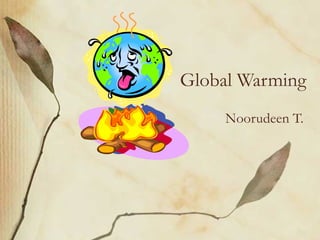
Global Warming Noorudeen T.
Agenda What is Global Warming? Causes Effects How to reduce or reverse it? What role can we play in this?
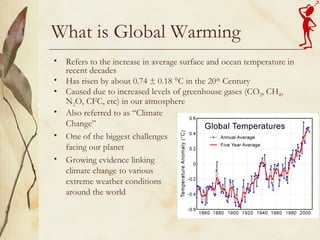
What is Global Warming Refers to the increase in average surface and ocean temperature in recent decades Has risen by about 0.74 ± 0.18 °C in the 20 th  Century Caused due to increased levels of greenhouse gases (CO 2 , CH 4 , N 2 O, CFC, etc) in our atmosphere Also referred to as “Climate Change” One of the biggest challenges facing our planet Growing evidence linking climate change to various extreme weather conditions around the world
Primary Causes CO 2  emitted by power plants, automobiles, buildings, aircrafts, etc. contributes about 60% to global warming Deforestation - about 34 million acres of trees are cut every year contributes about 25% to global warming Other gases like Methane, Nitrous Oxide, CFCs, etc emitted during fossil fuel production and during large-scale farm production contributes about 14% to global warming
Effects Impact on Habitat   destruction of Arctic/Antarctic habitats expanding deserts, melting glaciers rising sea levels submerge low lying coastal areas Impact on wildlife a quarter of all plants, animals and mammals will go extinct by 2100  1 million species are threatened with extinction Affects migration and hibernation cycles of animals Impact on humans About 154,000 people die every year due to global warming spread of tropical diseases extreme storm, flood, drought and heat-wave conditions drying up of glacier-fed rivers affecting water & food security rising sea levels affecting coastal population (expected to rise by about 3 ft by 2100)
How to reduce/reverse it? Reduce greenhouse gas emissions from industries, power plants, etc. Manage transportation better to reduce emissions from automobiles Switch to renewable energy sources like wind, sun, etc. Save forests, plant more trees Reduce consumption and conserve natural resources
What role can we play in this? Reduce consumption, recycle and reuse: conserve wherever possible – it costs energy to produce everything right from the food you eat to rockets that is sent to space. Drive smart: Don’t buy gas-guzzling automobiles; use public transport; otherwise car-pool to work Use less heat or air conditioning, turn off appliances when not in use; use CFL bulbs instead of incandescent bulbs Plant trees Most of all spread the message! Awareness levels are currently very low.
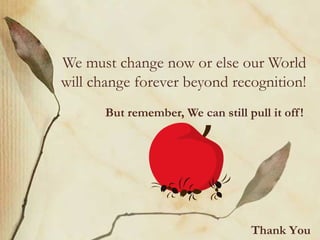
We must change now or else our World will change forever beyond recognition! But remember, We can still pull it off! Thank You

Global Warming

  • 1.
    Common culprit? Headlinesextracted from News Sources around the world: Heat wave claims 44 lives in Southeast, Midwest US (CNN 2007) Over 15,000 dead in August in France due to warm summer (CNN, 2003) Years since 1938 are the warmest in the last 12,000 years (Nature, 1992) Tropical storms doubled in the Atlantic over the past century – Study (CNN 2006) 90% mortality in Indian and Pacific corals (San Francisco Chronicle, 2006) World's Coral Reefs Will be Dead Within 50 Years (Environmental News Network, 2001) Artic Ice 40% lost in last 30 years (N.Y Times 1999) Gangotri Glacier melt accelerating at 30 m per year; it was 7 m in 1842 (World Watch Institute's Vital Signs 2000 report) So, who is the culprit behind all these natural calamities Global Warming
  • 2.
  • 3.
    Agenda What isGlobal Warming? Causes Effects How to reduce or reverse it? What role can we play in this?
  • 4.
    What is GlobalWarming Refers to the increase in average surface and ocean temperature in recent decades Has risen by about 0.74 ± 0.18 °C in the 20 th Century Caused due to increased levels of greenhouse gases (CO 2 , CH 4 , N 2 O, CFC, etc) in our atmosphere Also referred to as “Climate Change” One of the biggest challenges facing our planet Growing evidence linking climate change to various extreme weather conditions around the world
  • 5.
    Primary Causes CO2 emitted by power plants, automobiles, buildings, aircrafts, etc. contributes about 60% to global warming Deforestation - about 34 million acres of trees are cut every year contributes about 25% to global warming Other gases like Methane, Nitrous Oxide, CFCs, etc emitted during fossil fuel production and during large-scale farm production contributes about 14% to global warming
  • 6.
    Effects Impact onHabitat destruction of Arctic/Antarctic habitats expanding deserts, melting glaciers rising sea levels submerge low lying coastal areas Impact on wildlife a quarter of all plants, animals and mammals will go extinct by 2100 1 million species are threatened with extinction Affects migration and hibernation cycles of animals Impact on humans About 154,000 people die every year due to global warming spread of tropical diseases extreme storm, flood, drought and heat-wave conditions drying up of glacier-fed rivers affecting water & food security rising sea levels affecting coastal population (expected to rise by about 3 ft by 2100)
  • 7.
    How to reduce/reverseit? Reduce greenhouse gas emissions from industries, power plants, etc. Manage transportation better to reduce emissions from automobiles Switch to renewable energy sources like wind, sun, etc. Save forests, plant more trees Reduce consumption and conserve natural resources
  • 8.
    What role canwe play in this? Reduce consumption, recycle and reuse: conserve wherever possible – it costs energy to produce everything right from the food you eat to rockets that is sent to space. Drive smart: Don’t buy gas-guzzling automobiles; use public transport; otherwise car-pool to work Use less heat or air conditioning, turn off appliances when not in use; use CFL bulbs instead of incandescent bulbs Plant trees Most of all spread the message! Awareness levels are currently very low.
  • 9.
    We must changenow or else our World will change forever beyond recognition! But remember, We can still pull it off! Thank You