DONE BY : ANWAR

Many of us have this idea that floods (or
flooding) is simply, too much water around
your house. People think that can be fun.
Wrong. Flooding is a lot more than that.
Flooding is extremely dangerous and has
the potential to wipe away an entire city,
coastline or area, and cause extensive
damage to life and property. It also has great
erosive power and can be extremely
destructive, even if it is a foot high.
INTRODUCTI
ON

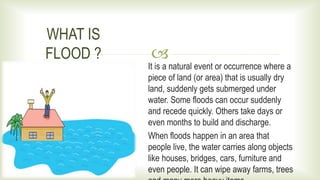
It is a natural event or occurrence where a
piece of land (or area) that is usually dry
land, suddenly gets submerged under
water. Some floods can occur suddenly
and recede quickly. Others take days or
even months to build and discharge.
When floods happen in an area that
people live, the water carries along objects
like houses, bridges, cars, furniture and
even people. It can wipe away farms, trees
WHAT IS
FLOOD ?

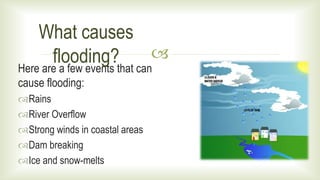
Here are a few events that can
cause flooding:
Rains
River Overflow
Strong winds in coastal areas
Dam breaking
Ice and snow-melts
What causes
flooding?

Some would like to see the causes of
floods as types of floods, but on this page
we shall look at three major flood types:
Flash floods, Rapid on-set floods and
Slow on-set floods.
Flash floods
Rapid on-set floods
Slow on-set floods
Types of
floods
From the causes of floods and the types that
we just read about, you can tell that floods
are more likely to occur in some areas than
others.
Generally, the natural behavior of water (and
flowing water) is that it moves from higher
ground to lower ground. This means if there
is a higher ground adjacent a lower ground,
the lower ground is a lot more likely to
experience floods.
Additionally, anywhere that rains fall, floods
can develop. This is so because anytime
Which areas are more likely
to flood?

Economic
During floods (especially flash floods),
roads, bridges, farms, houses and
automobiles are destroyed. People
become homeless. Additionally, the
government deploys firemen, police and
other emergency apparatuses to help the
affected. All these come at a heavy cost to
people and the government. It usually
takes years for affected communities to be
Effects of
flooding

Environment
The environment also suffers when floods
happen. Chemicals and other hazardous
substances end up in the water and
eventually contaminate the water bodies
that floods end up in. In 2011, a huge
tsunami hit Japan, and sea water flooded
a part of the coastline. The flooding
caused massive leakage in nuclear plants
and has since caused high radiation in that
Effects of
flooding

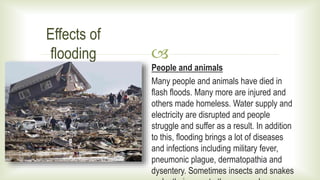
People and animals
Many people and animals have died in
flash floods. Many more are injured and
others made homeless. Water supply and
electricity are disrupted and people
struggle and suffer as a result. In addition
to this, flooding brings a lot of diseases
and infections including military fever,
pneumonic plague, dermatopathia and
dysentery. Sometimes insects and snakes
Effects of
flooding

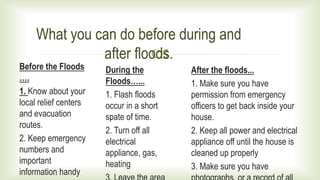
Before the Floods
….
1. Know about your
local relief centers
and evacuation
routes.
2. Keep emergency
numbers and
important
information handy
What you can do before during and
after floods.
During the
Floods…...
1. Flash floods
occur in a short
spate of time.
2. Turn off all
electrical
appliance, gas,
heating
After the floods...
1. Make sure you have
permission from emergency
officers to get back inside your
house.
2. Keep all power and electrical
appliance off until the house is
cleaned up properly
3. Make sure you have

http://eschooltoday.com/natural-disasters/floods/facts-and-tips-on-
flooding.html
http://en.wikipedia.org/wiki/Flood
http://environment.nationalgeographic.com/environment/natural-
disasters/floods-profile/
Resources

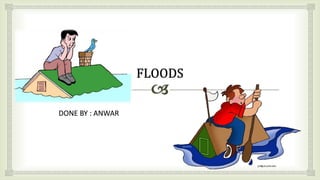
Floods

  • 1.
    DONE BY :ANWAR
  • 2.
     Many of ushave this idea that floods (or flooding) is simply, too much water around your house. People think that can be fun. Wrong. Flooding is a lot more than that. Flooding is extremely dangerous and has the potential to wipe away an entire city, coastline or area, and cause extensive damage to life and property. It also has great erosive power and can be extremely destructive, even if it is a foot high. INTRODUCTI ON
  • 3.
     It is anatural event or occurrence where a piece of land (or area) that is usually dry land, suddenly gets submerged under water. Some floods can occur suddenly and recede quickly. Others take days or even months to build and discharge. When floods happen in an area that people live, the water carries along objects like houses, bridges, cars, furniture and even people. It can wipe away farms, trees WHAT IS FLOOD ?
  • 4.
     Here are afew events that can cause flooding: Rains River Overflow Strong winds in coastal areas Dam breaking Ice and snow-melts What causes flooding?
  • 5.
     Some would liketo see the causes of floods as types of floods, but on this page we shall look at three major flood types: Flash floods, Rapid on-set floods and Slow on-set floods. Flash floods Rapid on-set floods Slow on-set floods Types of floods
  • 6.
    From the causesof floods and the types that we just read about, you can tell that floods are more likely to occur in some areas than others. Generally, the natural behavior of water (and flowing water) is that it moves from higher ground to lower ground. This means if there is a higher ground adjacent a lower ground, the lower ground is a lot more likely to experience floods. Additionally, anywhere that rains fall, floods can develop. This is so because anytime Which areas are more likely to flood?
  • 7.
     Economic During floods (especiallyflash floods), roads, bridges, farms, houses and automobiles are destroyed. People become homeless. Additionally, the government deploys firemen, police and other emergency apparatuses to help the affected. All these come at a heavy cost to people and the government. It usually takes years for affected communities to be Effects of flooding
  • 8.
     Environment The environment alsosuffers when floods happen. Chemicals and other hazardous substances end up in the water and eventually contaminate the water bodies that floods end up in. In 2011, a huge tsunami hit Japan, and sea water flooded a part of the coastline. The flooding caused massive leakage in nuclear plants and has since caused high radiation in that Effects of flooding
  • 9.
     People and animals Manypeople and animals have died in flash floods. Many more are injured and others made homeless. Water supply and electricity are disrupted and people struggle and suffer as a result. In addition to this, flooding brings a lot of diseases and infections including military fever, pneumonic plague, dermatopathia and dysentery. Sometimes insects and snakes Effects of flooding
  • 10.
     Before the Floods …. 1.Know about your local relief centers and evacuation routes. 2. Keep emergency numbers and important information handy What you can do before during and after floods. During the Floods…... 1. Flash floods occur in a short spate of time. 2. Turn off all electrical appliance, gas, heating After the floods... 1. Make sure you have permission from emergency officers to get back inside your house. 2. Keep all power and electrical appliance off until the house is cleaned up properly 3. Make sure you have
  • 11.