WILDFIRES
PREPAREDNESS
SECONDARY LEVEL
e-Learning for the Prevention, Preparedness and Response to Natural Disasters
IN THIS LESSON YOU WILL LEARN
● Why is it important to be prepared?
● How to get information about on-going wildfires
● What can you do to be prepared for a wildfire?
● The importance of following the advice of adults and
professionals
e-Learning for the Prevention, Preparedness and Response to Natural Disasters
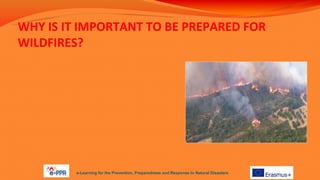
WHY IS IT IMPORTANT TO BE PREPARED FOR
WILDFIRES?
e-Learning for the Prevention, Preparedness and Response to Natural Disasters
WHY IS IT IMPORTANT TO BE PREPARED FOR
WILDFIRES?
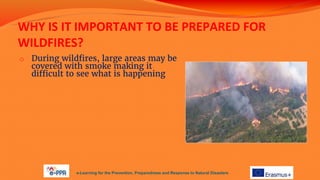
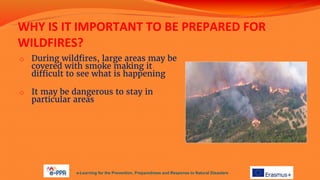
o During wildfires, large areas may be
covered with smoke making it
difficult to see what is happening
e-Learning for the Prevention, Preparedness and Response to Natural Disasters
WHY IS IT IMPORTANT TO BE PREPARED FOR
WILDFIRES?
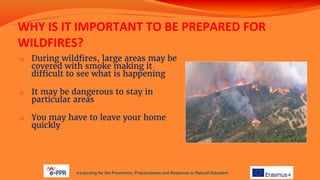
o During wildfires, large areas may be
covered with smoke making it
difficult to see what is happening
o It may be dangerous to stay in
particular areas
e-Learning for the Prevention, Preparedness and Response to Natural Disasters
WHY IS IT IMPORTANT TO BE PREPARED FOR
WILDFIRES?
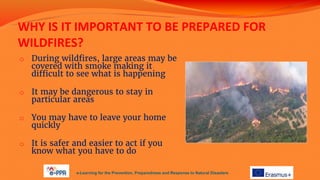
o During wildfires, large areas may be
covered with smoke making it
difficult to see what is happening
o It may be dangerous to stay in
particular areas
o You may have to leave your home
quickly
e-Learning for the Prevention, Preparedness and Response to Natural Disasters
WHY IS IT IMPORTANT TO BE PREPARED FOR
WILDFIRES?
o During wildfires, large areas may be
covered with smoke making it
difficult to see what is happening
o It may be dangerous to stay in
particular areas
o You may have to leave your home
quickly
o It is safer and easier to act if you
know what you have to do
e-Learning for the Prevention, Preparedness and Response to Natural Disasters
How to get information about on-
going wildfires
e-Learning for the Prevention, Preparedness and Response to Natural Disasters
How to get information about on-going wildfires
● From www.meteoalarm.eu
e-Learning for the Prevention, Preparedness and Response to Natural Disasters
www.meteoalarm.eu will provide the
most relevant information needed to
prepare for extreme weather that is
expected anywhere in Europe, including
the UK.
The website will alert you to the possible
occurrence of heavy rain with risk of
flooding, severe thunderstorms, gale-
force winds, heat waves, forest
fires/wildfires, fog, snow or extreme cold
with blizzards, avalanches or severe
coastal tides.
You will be able to see where in Europe
the weather might become dangerous.
www.meteoalarm.eu integrates all
important severe weather information
originating from the official National
Public Weather Services across a large
number of European countries. This
information is presented in one place to
make it easier to compare what is
happening throughout Europe and
identify countries and regions at risk of
severe weather.
● From www.meteoalarm.eu
e-Learning for the Prevention, Preparedness and Response to Natural Disasters
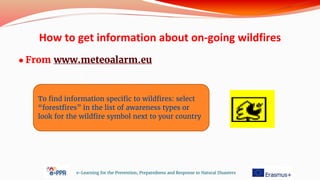
To find information specific to wildfires: select
“forestfires” in the list of awareness types or
look for the wildfire symbol next to your country
How to get information about on-going wildfires
● From www.meteoalarm.eu
e-Learning for the Prevention, Preparedness and Response to Natural Disasters
www.meteoalarm.eu is developed for EUMETNET,
the Network of European Meteorological Services.
This initiative is supported by WMO the World
Meteorological Organization.
How to get information about on-going wildfires?
● From www.meteoalarm.eu
e-Learning for the Prevention, Preparedness and Response to Natural Disasters
The countries participating in www.meteoalarm.eu include:
Austria, Bosnia-Herzegovina, Belgium, Bulgaria,
Switzerland, Cyprus, Czech Republic, Germany, Denmark,
Estonia, Spain, Finland, France, Greece, Croatia, Hungary,
Ireland, Iceland, Italy, Luxemburg, Latvia, Former Yugoslav
Republic of Macedonia, Malta, Montenegro, Netherlands,
Norway, Poland, Portugal, Romania, Serbia, Sweden,
Slovenia, Slovakia, United Kingdom.
How to get information about on-going wildfires?
● FROM NATIONAL METEOROLOGICAL SERVICES
e-Learning for the Prevention, Preparedness and Response to Natural Disasters
In each country, the National Meteorological Services
also provide information and alerts on severe
weather, including wildfires.
How to get information about on-going wildfires?
● FROM NATIONAL METEOROLOGICAL SERVICES
e-Learning for the Prevention, Preparedness and Response to Natural Disasters
In each country, the National Meteorological Services
also provide information and alerts on severe
weather, including wildfires.
Check the weather forecasts to
see if there are any weather
warnings in place for wildfires
How to get information about on-going wildfires?
● FROM NATIONAL METEOROLOGICAL SERVICES
e-Learning for the Prevention, Preparedness and Response to Natural Disasters
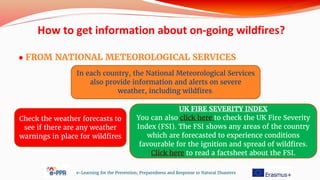
In each country, the National Meteorological Services
also provide information and alerts on severe
weather, including wildfires.
Check the weather forecasts to
see if there are any weather
warnings in place for wildfires
How to get information about on-going wildfires?
UK FIRE SEVERITY INDEX
You can also click here to check the UK Fire Severity
Index (FSI). The FSI shows any areas of the country
which are forecasted to experience conditions
favourable for the ignition and spread of wildfires.
Click here to read a factsheet about the FSI.
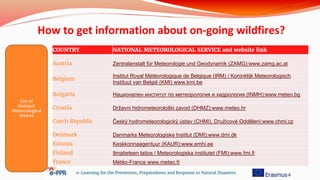
COUNTRY NATIONAL METEOROLOGICAL SERVICE and website link
Austria Zentralanstalt für Meteorologie und Geodynamik (ZAMG):www.zamg.ac.at
Belgium
Institut Royal Météorologique de Belgique (IRM) / Koninklijk Meteorologisch
Instituut van België (KMI) www.kmi.be
Bulgaria Национален институт по метеорология и хидрология (INMH):www.meteo.bg
Croatia Državni hidrometeorološki zavod (DHMZ):www.meteo.hr
Czech Republic Český hydrometeorologický ústav (CHMI), Družicové Oddělení:www.chmi.cz
Denmark Danmarks Meteorologiske Institut (DMI):www.dmi.dk
Estonia Keskkonnaagentuur (KAUR):www.emhi.ee
Finland Ilmatieteen laitos / Meteorologiska institutet (FMI):www.fmi.fi
France Météo-France www.meteo.fr
e-Learning for the Prevention, Preparedness and Response to Natural Disasters
List of
National
Meteorological
Sevices
How to get information about on-going wildfires?
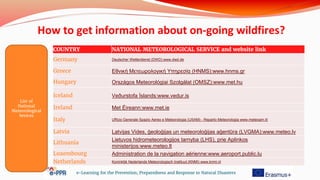
COUNTRY NATIONAL METEOROLOGICAL SERVICE and website link
Germany Deutscher Wetterdienst (DWD) www.dwd.de
Greece Εθνική Μετεωρολογική Υπηρεσία (HNMS):www.hnms.gr
Hungary Országos Meteorológiai Szolgálat (OMSZ):www.met.hu
Iceland Veðurstofa Íslands:www.vedur.is
Ireland Met Éireann:www.met.ie
Italy Ufficio Generale Spazio Aereo e Meteorologia (USAM) - Reparto Meteorologia www.meteoam.it/
Latvia Latvijas Vides, ģeoloģijas un meteoroloģijas aģentūra (LVGMA):www.meteo.lv
Lithuania
Lietuvos hidrometeorologijos tarnyba (LHS), prie Aplinkos
ministerijos:www.meteo.lt
Luxembourg Administration de la navigation aérienne:www.aeroport.public.lu
Netherlands Koninklijk Nederlands Meteorologisch Instituut (KNMI) www.knmi.nl
e-Learning for the Prevention, Preparedness and Response to Natural Disasters
List of
National
Meteorological
Sevices
How to get information about on-going wildfires?
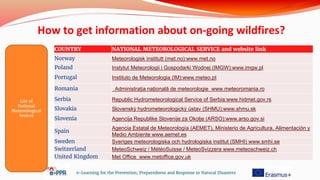
COUNTRY NATIONAL METEOROLOGICAL SERVICE and website link
Norway Meteorologisk institutt (met.no):www.met.no
Poland Instytut Meteorologii i Gospodarki Wodnej (IMGW):www.imgw.pl
Portugal Instituto de Meteorologia (IM):www.meteo.pt
Romania Administrația națională de meteorologie www.meteoromania.ro
Serbia Republic Hydrometeorological Service of Serbia:www.hidmet.gov.rs
Slovakia Slovenský hydrometeorologický ústav (SHMU):www.shmu.sk
Slovenia Agencija Republike Slovenije za Okolje (ARSO):www.arso.gov.si
Spain
Agencia Estatal de Meteorología (AEMET), Ministerio de Agricultura, Alimentación y
Medio Ambiente www.aemet.es
Sweden Sveriges meteorologiska och hydrologiska institut (SMHI) www.smhi.se
Switzerland MeteoSchweiz / MétéoSuisse / MeteoSvizzera www.meteoschweiz.ch
United Kingdom Met Office www.metoffice.gov.uk
e-Learning for the Prevention, Preparedness and Response to Natural Disasters
List of
National
Meteorological
Sevices
e-Learning for the Prevention, Preparedness and Response to Natural Disasters
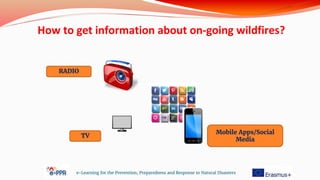
RADIO
How to get information about on-going wildfires?
e-Learning for the Prevention, Preparedness and Response to Natural Disasters
RADIO
TV
How to get information about on-going wildfires?
e-Learning for the Prevention, Preparedness and Response to Natural Disasters
RADIO
Mobile Apps/Social
Media
TV
How to get information about on-going wildfires?
e-Learning for the Prevention, Preparedness and Response to Natural Disasters
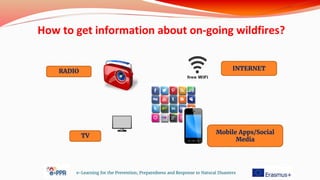
RADIO INTERNET
Mobile Apps/Social
Media
TV
How to get information about on-going wildfires?
e-Learning for the Prevention, Preparedness and Response to Natural Disasters
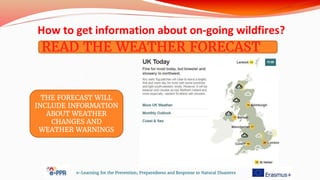
READ THE WEATHER FORECAST
THE FORECAST WILL
INCLUDE INFORMATION
ABOUT WEATHER
CHANGES AND
WEATHER WARNINGS
How to get information about on-going wildfires?
What can you do to be prepared?
e-Learning for the Prevention, Preparedness and Response to Natural Disasters
What can you do to be prepared?
e-Learning for the Prevention, Preparedness and Response to Natural Disasters
In case of a emergency it is very
important that everyone knows what to
do. That’s why it is very important to
have emergency plans at home, school
and at places people work.
What can you do to be prepared?
e-Learning for the Prevention, Preparedness and Response to Natural Disasters
EMERGENCY PLAN
An emergency plan is a plan of what to do during an emergency
such as a storm, fire, flood and what to do before leaving your house,
school if necessary.
An emergency plan contains a list of the steps that need to be
followed in order to stay safe and/or explain how to get to a place of
safety.
What can you do to be prepared?
e-Learning for the Prevention, Preparedness and Response to Natural Disasters
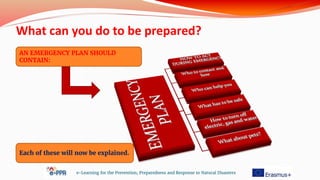
AN EMERGENCY PLAN SHOULD
CONTAIN:
Each of these will now be explained.
EMERGENCY PLAN
e-Learning for the Prevention, Preparedness and Response to Natural Disasters
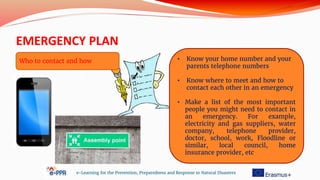
Who to contact and how
EMERGENCY PLAN
e-Learning for the Prevention, Preparedness and Response to Natural Disasters
• Know your home number and your
parents telephone numbers
Who to contact and how
EMERGENCY PLAN
e-Learning for the Prevention, Preparedness and Response to Natural Disasters
• Know your home number and your
parents telephone numbers
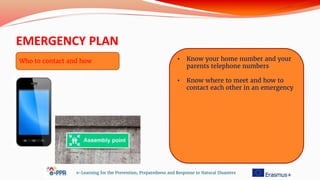
• Know where to meet and how to
contact each other in an emergency
Who to contact and how
EMERGENCY PLAN
e-Learning for the Prevention, Preparedness and Response to Natural Disasters
• Know your home number and your
parents telephone numbers
• Know where to meet and how to
contact each other in an emergency
• Make a list of the most important
people you might need to contact in
an emergency. For example,
electricity and gas suppliers, water
company, telephone provider,
doctor, school, work, Floodline or
similar, local council, home
insurance provider, etc
Who to contact and how
EMERGENCY PLAN
e-Learning for the Prevention, Preparedness and Response to Natural Disasters
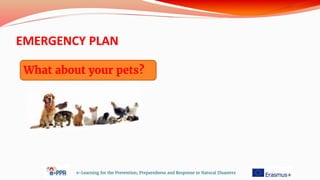
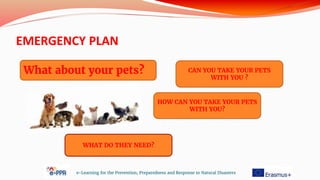
What about your pets?
EMERGENCY PLAN
e-Learning for the Prevention, Preparedness and Response to Natural Disasters
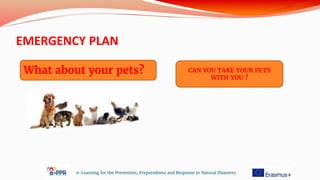
What about your pets? CAN YOU TAKE YOUR PETS
WITH YOU ?
EMERGENCY PLAN
e-Learning for the Prevention, Preparedness and Response to Natural Disasters
What about your pets? CAN YOU TAKE YOUR PETS
WITH YOU ?
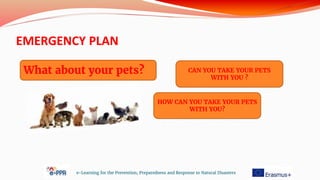
HOW CAN YOU TAKE YOUR PETS
WITH YOU?
EMERGENCY PLAN
e-Learning for the Prevention, Preparedness and Response to Natural Disasters
What about your pets? CAN YOU TAKE YOUR PETS
WITH YOU ?
HOW CAN YOU TAKE YOUR PETS
WITH YOU?
WHAT DO THEY NEED?
EMERGENCY PLAN
e-Learning for the Prevention, Preparedness and Response to Natural Disasters
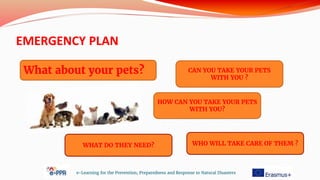
What about your pets? CAN YOU TAKE YOUR PETS
WITH YOU ?
HOW CAN YOU TAKE YOUR PETS
WITH YOU?
WHAT DO THEY NEED? WHO WILL TAKE CARE OF THEM ?
EMERGENCY PLAN
e-Learning for the Prevention, Preparedness and Response to Natural Disasters
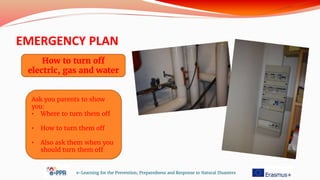
How to turn off
electric, gas and water
Ask you parents to show
you:
• Where to turn them off
• How to turn them off
• Also ask them when you
should turn them off
EMERGENCY PLAN
e-Learning for the Prevention, Preparedness and Response to Natural Disasters
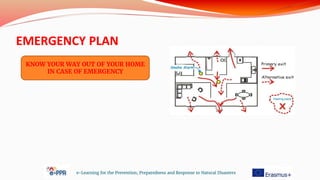
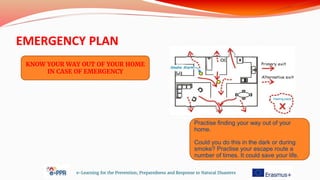
KNOW YOUR WAY OUT OF YOUR HOME
IN CASE OF EMERGENCY
EMERGENCY PLAN
e-Learning for the Prevention, Preparedness and Response to Natural Disasters
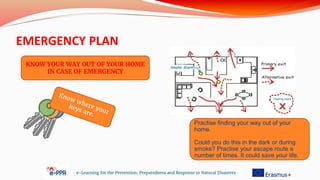
KNOW YOUR WAY OUT OF YOUR HOME
IN CASE OF EMERGENCY
Practise finding your way out of your
home.
Could you do this in the dark or during
smoke? Practise your escape route a
number of times. It could save your life.
EMERGENCY PLAN
e-Learning for the Prevention, Preparedness and Response to Natural Disasters
KNOW YOUR WAY OUT OF YOUR HOME
IN CASE OF EMERGENCY
Practise finding your way out of your
home.
Could you do this in the dark or during
smoke? Practise your escape route a
number of times. It could save your life.
EMERGENCY PLAN
e-Learning for the Prevention, Preparedness and Response to Natural Disasters
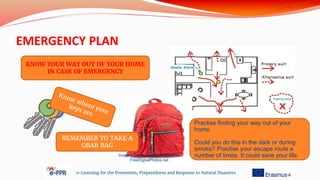
KNOW YOUR WAY OUT OF YOUR HOME
IN CASE OF EMERGENCY
Image courtesy of John Kasawa at
FreeDigitalPhotos.net
Practise finding your way out of your
home.
Could you do this in the dark or during
smoke? Practise your escape route a
number of times. It could save your life.
REMEMBER TO TAKE A
GRAB BAG
EMERGENCY PLAN
e-Learning for the Prevention, Preparedness and Response to Natural Disasters
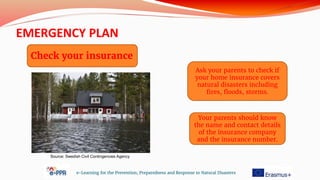
Check your insurance
Ask your parents to check if
your home insurance covers
natural disasters including
fires, floods, storms.
Your parents should know
the name and contact details
of the insurance company
and the insurance number.
Source: Swedish Civil Contingencies Agency
EMERGENCY PLAN
e-Learning for the Prevention, Preparedness and Response to Natural Disasters
REMEMBER…
1. Make an emergency plan with your family
EMERGENCY PLAN
e-Learning for the Prevention, Preparedness and Response to Natural Disasters
REMEMBER…
1. Make an emergency plan with your family
2. Practise your plan so everyone knows what to do
EMERGENCY PLAN
e-Learning for the Prevention, Preparedness and Response to Natural Disasters
REMEMBER…
1. Make an emergency plan with your family
2. Practise your plan so everyone knows what to do
3. Practise leaving your home safely
EMERGENCY PLAN
e-Learning for the Prevention, Preparedness and Response to Natural Disasters
REMEMBER…
1. Make an emergency plan with your family
2. Practise your plan so everyone knows what to do
3. Practise leaving your home safely
4. Practise putting together a grab bag
1. Make an emergency plan with your family
EMERGENCY PLAN
e-Learning for the Prevention, Preparedness and Response to Natural Disasters
REMEMBER…
2. Practise your plan so everyone knows what to do
3. Practise leaving your home safely
4. Practise putting together a grab bag
EMERGENCY PLAN
e-Learning for the Prevention, Preparedness and Response to Natural Disasters
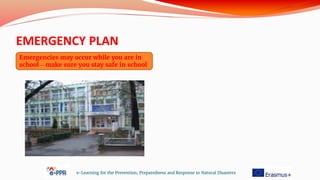
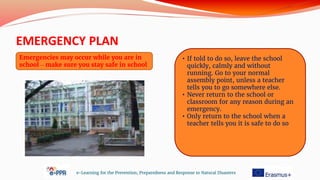
Emergencies may occur while you are in
school – make sure you stay safe in school
EMERGENCY PLAN
e-Learning for the Prevention, Preparedness and Response to Natural Disasters
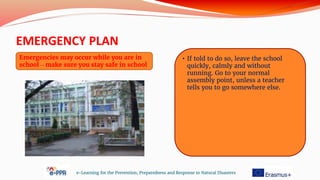
Emergencies may occur while you are in
school – make sure you stay safe in school
• If told to do so, leave the school
quickly, calmly and without
running. Go to your normal
assembly point, unless a teacher
tells you to go somewhere else.
EMERGENCY PLAN
e-Learning for the Prevention, Preparedness and Response to Natural Disasters
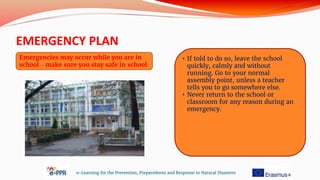
Emergencies may occur while you are in
school – make sure you stay safe in school
• If told to do so, leave the school
quickly, calmly and without
running. Go to your normal
assembly point, unless a teacher
tells you to go somewhere else.
• Never return to the school or
classroom for any reason during an
emergency.
EMERGENCY PLAN
e-Learning for the Prevention, Preparedness and Response to Natural Disasters
Emergencies may occur while you are in
school – make sure you stay safe in school
• If told to do so, leave the school
quickly, calmly and without
running. Go to your normal
assembly point, unless a teacher
tells you to go somewhere else.
• Never return to the school or
classroom for any reason during an
emergency.
• Only return to the school when a
teacher tells you it is safe to do so
EMERGENCY PLAN
e-Learning for the Prevention, Preparedness and Response to Natural Disasters
Emergencies may occur while you are in
school – make sure you stay safe in school
• If told to do so, leave the school
quickly, calmly and without
running. Go to your normal
assembly point, unless a teacher
tells you to go somewhere else.
• Never return to the school or
classroom for any reason during an
emergency.
• Only return to the school when a
teacher tells you it is safe to do so
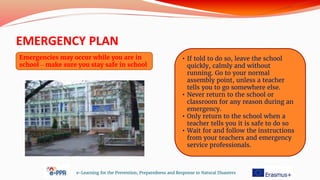
• Wait for and follow the instructions
from your teachers and emergency
service professionals.
What can you do to be prepared?
e-Learning for the Prevention, Preparedness and Response to Natural Disasters
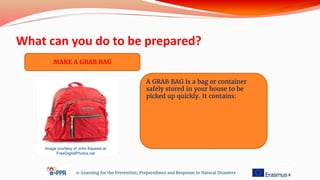
MAKE A GRAB BAG
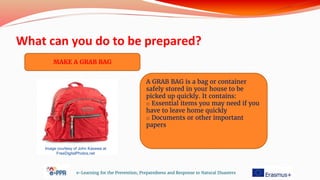
A GRAB BAG is a bag or container
safely stored in your house to be
picked up quickly. It contains:
Image courtesy of John Kasawa at
FreeDigitalPhotos.net
What can you do to be prepared?
e-Learning for the Prevention, Preparedness and Response to Natural Disasters
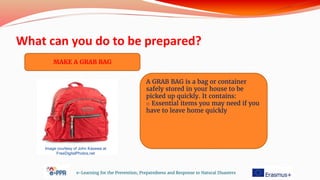
MAKE A GRAB BAG
A GRAB BAG is a bag or container
safely stored in your house to be
picked up quickly. It contains:
o Essential items you may need if you
have to leave home quickly
Image courtesy of John Kasawa at
FreeDigitalPhotos.net
What can you do to be prepared?
e-Learning for the Prevention, Preparedness and Response to Natural Disasters
MAKE A GRAB BAG
A GRAB BAG is a bag or container
safely stored in your house to be
picked up quickly. It contains:
o Essential items you may need if you
have to leave home quickly
o Documents or other important
papers
Image courtesy of John Kasawa at
FreeDigitalPhotos.net
What can you do to be prepared?
e-Learning for the Prevention, Preparedness and Response to Natural Disasters
MAKE A GRAB BAG
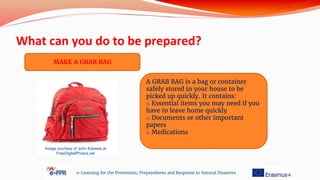
A GRAB BAG is a bag or container
safely stored in your house to be
picked up quickly. It contains:
o Essential items you may need if you
have to leave home quickly
o Documents or other important
papers
o Medications
Image courtesy of John Kasawa at
FreeDigitalPhotos.net
What can you do to be prepared?
e-Learning for the Prevention, Preparedness and Response to Natural Disasters
MAKE A GRAB BAG
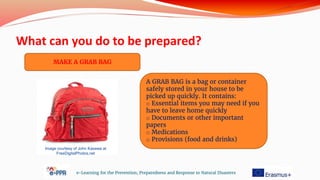
A GRAB BAG is a bag or container
safely stored in your house to be
picked up quickly. It contains:
o Essential items you may need if you
have to leave home quickly
o Documents or other important
papers
o Medications
o Provisions (food and drinks)
Image courtesy of John Kasawa at
FreeDigitalPhotos.net
What can you do to be prepared?
e-Learning for the Prevention, Preparedness and Response to Natural Disasters
Image courtesy of John Kasawa at
FreeDigitalPhotos.net
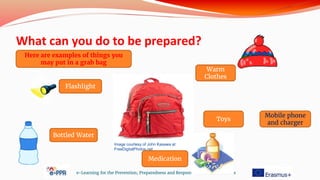
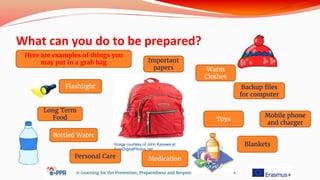
Here are examples of things you
may put in a grab bag
Flashlight
Bottled Water
Warm
Clothes
Toys
Medication
Mobile phone
and charger
What can you do to be prepared?
e-Learning for the Prevention, Preparedness and Response to Natural Disasters
Image courtesy of John Kasawa at
FreeDigitalPhotos.net
Here are examples of things you
may put in a grab bag
Flashlight
Long Term
Food
Bottled Water
Personal Care
Important
papers
Backup files
for computer
Warm
Clothes
Toys
Blankets
Medication
Mobile phone
and charger
Follow The Advice Of Adults And
Profesionals
e-Learning for the Prevention, Preparedness and Response to Natural Disasters
Follow The Advice Of Adults And Professionals
e-Learning for the Prevention, Preparedness and Response to Natural Disasters
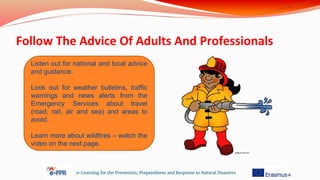
Listen out for national and local advice
and guidance.
Look out for weather bulletins, traffic
warnings and news alerts from the
Emergency Services about travel
(road, rail, air and sea) and areas to
avoid.
Learn more about wildfires – watch the
video on the next page.
Follow The Advice Of Adults And Professionals
e-Learning for the Prevention, Preparedness and Response to Natural Disasters
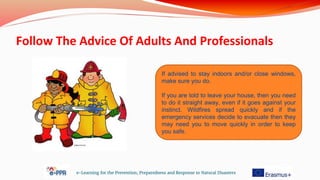
If advised to stay indoors and/or close windows,
make sure you do.
If you are told to leave your house, then you need
to do it straight away, even if it goes against your
instinct. Wildfires spread quickly and if the
emergency services decide to evacuate then they
may need you to move quickly in order to keep
you safe.
REMEMBER!
• A wildfire is a fire that spreads out of control. Wildfires can be
extremely dangerous and destructive. Always stay safe.
e-Learning for the Prevention, Preparedness and Response to Natural Disasters
REMEMBER!
• A wildfire is a fire that spreads out of control. Wildfires can be
extremely dangerous and destructive. Always stay safe.
• If you live in a wildfire risk area, make sure you know what to do
before a wildfire occurs. Make sure you and your family are
prepared.
e-Learning for the Prevention, Preparedness and Response to Natural Disasters
REMEMBER!
• A wildfire is a fire that spreads out of control. Wildfires can be
extremely dangerous and destructive. Always stay safe.
• If you live in a wildfire risk area, make sure you know what to do
before a wildfire occurs. Make sure you and your family are
prepared.
• Always follow the advice of adults and professionals.
e-Learning for the Prevention, Preparedness and Response to Natural Disasters
REMEMBER!
• A wildfire is a fire that spreads out of control. Wildfires can be
extremely dangerous and destructive. Always stay safe.
• If you live in a wildfire risk area, make sure you know what to do
before a wildfire occurs. Make sure you and your family are
prepared.
• Always follow the advice of adults and professionals.
• Take a look at the next module to find out what happens during
and after a wildfire.
e-Learning for the Prevention, Preparedness and Response to Natural Disasters
Copyright Statement
This educational resource has been produced by the partners of the e-PPR Project (e-Learning for the Prevention, Preparedness and
Response to Natural Disasters) with the support of the Erasmus+ programme.
Unless otherwise stated, this educational resource is licensed under a Creative Commons Attribution-ShareAlike 4.0 International
License. It is attributed to the partners of the e-PPR project. Further information can be found at www.e-ppr.eu
The authors are committed to respecting the intellectual property rights of others, and have taken all reasonable efforts to ensure that
the reproduction of content (text, pictures, etc.) has been done with the full consent of copyright holders and that all copyright holders
are acknowledged in such reproductions. If you feel that your copyright has not been fully respected, please contact us by email at
projectmanager@e-ppr.eu.
If you are going to use parts of the content with materials whose copyright holder(s) is/are not the authors, it is your responsibility to
make sure you do so, respecting the original holder’s copyrights.
This content is the sole responsibility of the project partners and can in no way be taken to reflect the views of the European Union.
e-Learning for the Prevention, Preparedness and Response to Natural Disasters
68

Secondary - Wildfires - Preparedness

  • 1.
    WILDFIRES PREPAREDNESS SECONDARY LEVEL e-Learning forthe Prevention, Preparedness and Response to Natural Disasters
  • 2.
    IN THIS LESSONYOU WILL LEARN ● Why is it important to be prepared? ● How to get information about on-going wildfires ● What can you do to be prepared for a wildfire? ● The importance of following the advice of adults and professionals e-Learning for the Prevention, Preparedness and Response to Natural Disasters
  • 3.
    WHY IS ITIMPORTANT TO BE PREPARED FOR WILDFIRES? e-Learning for the Prevention, Preparedness and Response to Natural Disasters
  • 4.
    WHY IS ITIMPORTANT TO BE PREPARED FOR WILDFIRES? o During wildfires, large areas may be covered with smoke making it difficult to see what is happening e-Learning for the Prevention, Preparedness and Response to Natural Disasters
  • 5.
    WHY IS ITIMPORTANT TO BE PREPARED FOR WILDFIRES? o During wildfires, large areas may be covered with smoke making it difficult to see what is happening o It may be dangerous to stay in particular areas e-Learning for the Prevention, Preparedness and Response to Natural Disasters
  • 6.
    WHY IS ITIMPORTANT TO BE PREPARED FOR WILDFIRES? o During wildfires, large areas may be covered with smoke making it difficult to see what is happening o It may be dangerous to stay in particular areas o You may have to leave your home quickly e-Learning for the Prevention, Preparedness and Response to Natural Disasters
  • 7.
    WHY IS ITIMPORTANT TO BE PREPARED FOR WILDFIRES? o During wildfires, large areas may be covered with smoke making it difficult to see what is happening o It may be dangerous to stay in particular areas o You may have to leave your home quickly o It is safer and easier to act if you know what you have to do e-Learning for the Prevention, Preparedness and Response to Natural Disasters
  • 8.
    How to getinformation about on- going wildfires e-Learning for the Prevention, Preparedness and Response to Natural Disasters
  • 9.
    How to getinformation about on-going wildfires ● From www.meteoalarm.eu e-Learning for the Prevention, Preparedness and Response to Natural Disasters www.meteoalarm.eu will provide the most relevant information needed to prepare for extreme weather that is expected anywhere in Europe, including the UK. The website will alert you to the possible occurrence of heavy rain with risk of flooding, severe thunderstorms, gale- force winds, heat waves, forest fires/wildfires, fog, snow or extreme cold with blizzards, avalanches or severe coastal tides. You will be able to see where in Europe the weather might become dangerous. www.meteoalarm.eu integrates all important severe weather information originating from the official National Public Weather Services across a large number of European countries. This information is presented in one place to make it easier to compare what is happening throughout Europe and identify countries and regions at risk of severe weather.
  • 10.
    ● From www.meteoalarm.eu e-Learningfor the Prevention, Preparedness and Response to Natural Disasters To find information specific to wildfires: select “forestfires” in the list of awareness types or look for the wildfire symbol next to your country How to get information about on-going wildfires
  • 11.
    ● From www.meteoalarm.eu e-Learningfor the Prevention, Preparedness and Response to Natural Disasters www.meteoalarm.eu is developed for EUMETNET, the Network of European Meteorological Services. This initiative is supported by WMO the World Meteorological Organization. How to get information about on-going wildfires?
  • 12.
    ● From www.meteoalarm.eu e-Learningfor the Prevention, Preparedness and Response to Natural Disasters The countries participating in www.meteoalarm.eu include: Austria, Bosnia-Herzegovina, Belgium, Bulgaria, Switzerland, Cyprus, Czech Republic, Germany, Denmark, Estonia, Spain, Finland, France, Greece, Croatia, Hungary, Ireland, Iceland, Italy, Luxemburg, Latvia, Former Yugoslav Republic of Macedonia, Malta, Montenegro, Netherlands, Norway, Poland, Portugal, Romania, Serbia, Sweden, Slovenia, Slovakia, United Kingdom. How to get information about on-going wildfires?
  • 13.
    ● FROM NATIONALMETEOROLOGICAL SERVICES e-Learning for the Prevention, Preparedness and Response to Natural Disasters In each country, the National Meteorological Services also provide information and alerts on severe weather, including wildfires. How to get information about on-going wildfires?
  • 14.
    ● FROM NATIONALMETEOROLOGICAL SERVICES e-Learning for the Prevention, Preparedness and Response to Natural Disasters In each country, the National Meteorological Services also provide information and alerts on severe weather, including wildfires. Check the weather forecasts to see if there are any weather warnings in place for wildfires How to get information about on-going wildfires?
  • 15.
    ● FROM NATIONALMETEOROLOGICAL SERVICES e-Learning for the Prevention, Preparedness and Response to Natural Disasters In each country, the National Meteorological Services also provide information and alerts on severe weather, including wildfires. Check the weather forecasts to see if there are any weather warnings in place for wildfires How to get information about on-going wildfires? UK FIRE SEVERITY INDEX You can also click here to check the UK Fire Severity Index (FSI). The FSI shows any areas of the country which are forecasted to experience conditions favourable for the ignition and spread of wildfires. Click here to read a factsheet about the FSI.
  • 16.
    COUNTRY NATIONAL METEOROLOGICALSERVICE and website link Austria Zentralanstalt für Meteorologie und Geodynamik (ZAMG):www.zamg.ac.at Belgium Institut Royal Météorologique de Belgique (IRM) / Koninklijk Meteorologisch Instituut van België (KMI) www.kmi.be Bulgaria Национален институт по метеорология и хидрология (INMH):www.meteo.bg Croatia Državni hidrometeorološki zavod (DHMZ):www.meteo.hr Czech Republic Český hydrometeorologický ústav (CHMI), Družicové Oddělení:www.chmi.cz Denmark Danmarks Meteorologiske Institut (DMI):www.dmi.dk Estonia Keskkonnaagentuur (KAUR):www.emhi.ee Finland Ilmatieteen laitos / Meteorologiska institutet (FMI):www.fmi.fi France Météo-France www.meteo.fr e-Learning for the Prevention, Preparedness and Response to Natural Disasters List of National Meteorological Sevices How to get information about on-going wildfires?
  • 17.
    COUNTRY NATIONAL METEOROLOGICALSERVICE and website link Germany Deutscher Wetterdienst (DWD) www.dwd.de Greece Εθνική Μετεωρολογική Υπηρεσία (HNMS):www.hnms.gr Hungary Országos Meteorológiai Szolgálat (OMSZ):www.met.hu Iceland Veðurstofa Íslands:www.vedur.is Ireland Met Éireann:www.met.ie Italy Ufficio Generale Spazio Aereo e Meteorologia (USAM) - Reparto Meteorologia www.meteoam.it/ Latvia Latvijas Vides, ģeoloģijas un meteoroloģijas aģentūra (LVGMA):www.meteo.lv Lithuania Lietuvos hidrometeorologijos tarnyba (LHS), prie Aplinkos ministerijos:www.meteo.lt Luxembourg Administration de la navigation aérienne:www.aeroport.public.lu Netherlands Koninklijk Nederlands Meteorologisch Instituut (KNMI) www.knmi.nl e-Learning for the Prevention, Preparedness and Response to Natural Disasters List of National Meteorological Sevices How to get information about on-going wildfires?
  • 18.
    How to getinformation about on-going wildfires? COUNTRY NATIONAL METEOROLOGICAL SERVICE and website link Norway Meteorologisk institutt (met.no):www.met.no Poland Instytut Meteorologii i Gospodarki Wodnej (IMGW):www.imgw.pl Portugal Instituto de Meteorologia (IM):www.meteo.pt Romania Administrația națională de meteorologie www.meteoromania.ro Serbia Republic Hydrometeorological Service of Serbia:www.hidmet.gov.rs Slovakia Slovenský hydrometeorologický ústav (SHMU):www.shmu.sk Slovenia Agencija Republike Slovenije za Okolje (ARSO):www.arso.gov.si Spain Agencia Estatal de Meteorología (AEMET), Ministerio de Agricultura, Alimentación y Medio Ambiente www.aemet.es Sweden Sveriges meteorologiska och hydrologiska institut (SMHI) www.smhi.se Switzerland MeteoSchweiz / MétéoSuisse / MeteoSvizzera www.meteoschweiz.ch United Kingdom Met Office www.metoffice.gov.uk e-Learning for the Prevention, Preparedness and Response to Natural Disasters List of National Meteorological Sevices
  • 19.
    e-Learning for thePrevention, Preparedness and Response to Natural Disasters RADIO How to get information about on-going wildfires?
  • 20.
    e-Learning for thePrevention, Preparedness and Response to Natural Disasters RADIO TV How to get information about on-going wildfires?
  • 21.
    e-Learning for thePrevention, Preparedness and Response to Natural Disasters RADIO Mobile Apps/Social Media TV How to get information about on-going wildfires?
  • 22.
    e-Learning for thePrevention, Preparedness and Response to Natural Disasters RADIO INTERNET Mobile Apps/Social Media TV How to get information about on-going wildfires?
  • 23.
    e-Learning for thePrevention, Preparedness and Response to Natural Disasters READ THE WEATHER FORECAST THE FORECAST WILL INCLUDE INFORMATION ABOUT WEATHER CHANGES AND WEATHER WARNINGS How to get information about on-going wildfires?
  • 24.
    What can youdo to be prepared? e-Learning for the Prevention, Preparedness and Response to Natural Disasters
  • 25.
    What can youdo to be prepared? e-Learning for the Prevention, Preparedness and Response to Natural Disasters In case of a emergency it is very important that everyone knows what to do. That’s why it is very important to have emergency plans at home, school and at places people work.
  • 26.
    What can youdo to be prepared? e-Learning for the Prevention, Preparedness and Response to Natural Disasters EMERGENCY PLAN An emergency plan is a plan of what to do during an emergency such as a storm, fire, flood and what to do before leaving your house, school if necessary. An emergency plan contains a list of the steps that need to be followed in order to stay safe and/or explain how to get to a place of safety.
  • 27.
    What can youdo to be prepared? e-Learning for the Prevention, Preparedness and Response to Natural Disasters AN EMERGENCY PLAN SHOULD CONTAIN: Each of these will now be explained.
  • 28.
    EMERGENCY PLAN e-Learning forthe Prevention, Preparedness and Response to Natural Disasters Who to contact and how
  • 29.
    EMERGENCY PLAN e-Learning forthe Prevention, Preparedness and Response to Natural Disasters • Know your home number and your parents telephone numbers Who to contact and how
  • 30.
    EMERGENCY PLAN e-Learning forthe Prevention, Preparedness and Response to Natural Disasters • Know your home number and your parents telephone numbers • Know where to meet and how to contact each other in an emergency Who to contact and how
  • 31.
    EMERGENCY PLAN e-Learning forthe Prevention, Preparedness and Response to Natural Disasters • Know your home number and your parents telephone numbers • Know where to meet and how to contact each other in an emergency • Make a list of the most important people you might need to contact in an emergency. For example, electricity and gas suppliers, water company, telephone provider, doctor, school, work, Floodline or similar, local council, home insurance provider, etc Who to contact and how
  • 32.
    EMERGENCY PLAN e-Learning forthe Prevention, Preparedness and Response to Natural Disasters What about your pets?
  • 33.
    EMERGENCY PLAN e-Learning forthe Prevention, Preparedness and Response to Natural Disasters What about your pets? CAN YOU TAKE YOUR PETS WITH YOU ?
  • 34.
    EMERGENCY PLAN e-Learning forthe Prevention, Preparedness and Response to Natural Disasters What about your pets? CAN YOU TAKE YOUR PETS WITH YOU ? HOW CAN YOU TAKE YOUR PETS WITH YOU?
  • 35.
    EMERGENCY PLAN e-Learning forthe Prevention, Preparedness and Response to Natural Disasters What about your pets? CAN YOU TAKE YOUR PETS WITH YOU ? HOW CAN YOU TAKE YOUR PETS WITH YOU? WHAT DO THEY NEED?
  • 36.
    EMERGENCY PLAN e-Learning forthe Prevention, Preparedness and Response to Natural Disasters What about your pets? CAN YOU TAKE YOUR PETS WITH YOU ? HOW CAN YOU TAKE YOUR PETS WITH YOU? WHAT DO THEY NEED? WHO WILL TAKE CARE OF THEM ?
  • 37.
    EMERGENCY PLAN e-Learning forthe Prevention, Preparedness and Response to Natural Disasters How to turn off electric, gas and water Ask you parents to show you: • Where to turn them off • How to turn them off • Also ask them when you should turn them off
  • 38.
    EMERGENCY PLAN e-Learning forthe Prevention, Preparedness and Response to Natural Disasters KNOW YOUR WAY OUT OF YOUR HOME IN CASE OF EMERGENCY
  • 39.
    EMERGENCY PLAN e-Learning forthe Prevention, Preparedness and Response to Natural Disasters KNOW YOUR WAY OUT OF YOUR HOME IN CASE OF EMERGENCY Practise finding your way out of your home. Could you do this in the dark or during smoke? Practise your escape route a number of times. It could save your life.
  • 40.
    EMERGENCY PLAN e-Learning forthe Prevention, Preparedness and Response to Natural Disasters KNOW YOUR WAY OUT OF YOUR HOME IN CASE OF EMERGENCY Practise finding your way out of your home. Could you do this in the dark or during smoke? Practise your escape route a number of times. It could save your life.
  • 41.
    EMERGENCY PLAN e-Learning forthe Prevention, Preparedness and Response to Natural Disasters KNOW YOUR WAY OUT OF YOUR HOME IN CASE OF EMERGENCY Image courtesy of John Kasawa at FreeDigitalPhotos.net Practise finding your way out of your home. Could you do this in the dark or during smoke? Practise your escape route a number of times. It could save your life. REMEMBER TO TAKE A GRAB BAG
  • 42.
    EMERGENCY PLAN e-Learning forthe Prevention, Preparedness and Response to Natural Disasters Check your insurance Ask your parents to check if your home insurance covers natural disasters including fires, floods, storms. Your parents should know the name and contact details of the insurance company and the insurance number. Source: Swedish Civil Contingencies Agency
  • 43.
    EMERGENCY PLAN e-Learning forthe Prevention, Preparedness and Response to Natural Disasters REMEMBER… 1. Make an emergency plan with your family
  • 44.
    EMERGENCY PLAN e-Learning forthe Prevention, Preparedness and Response to Natural Disasters REMEMBER… 1. Make an emergency plan with your family 2. Practise your plan so everyone knows what to do
  • 45.
    EMERGENCY PLAN e-Learning forthe Prevention, Preparedness and Response to Natural Disasters REMEMBER… 1. Make an emergency plan with your family 2. Practise your plan so everyone knows what to do 3. Practise leaving your home safely
  • 46.
    EMERGENCY PLAN e-Learning forthe Prevention, Preparedness and Response to Natural Disasters REMEMBER… 1. Make an emergency plan with your family 2. Practise your plan so everyone knows what to do 3. Practise leaving your home safely 4. Practise putting together a grab bag
  • 47.
    1. Make anemergency plan with your family EMERGENCY PLAN e-Learning for the Prevention, Preparedness and Response to Natural Disasters REMEMBER… 2. Practise your plan so everyone knows what to do 3. Practise leaving your home safely 4. Practise putting together a grab bag
  • 48.
    EMERGENCY PLAN e-Learning forthe Prevention, Preparedness and Response to Natural Disasters Emergencies may occur while you are in school – make sure you stay safe in school
  • 49.
    EMERGENCY PLAN e-Learning forthe Prevention, Preparedness and Response to Natural Disasters Emergencies may occur while you are in school – make sure you stay safe in school • If told to do so, leave the school quickly, calmly and without running. Go to your normal assembly point, unless a teacher tells you to go somewhere else.
  • 50.
    EMERGENCY PLAN e-Learning forthe Prevention, Preparedness and Response to Natural Disasters Emergencies may occur while you are in school – make sure you stay safe in school • If told to do so, leave the school quickly, calmly and without running. Go to your normal assembly point, unless a teacher tells you to go somewhere else. • Never return to the school or classroom for any reason during an emergency.
  • 51.
    EMERGENCY PLAN e-Learning forthe Prevention, Preparedness and Response to Natural Disasters Emergencies may occur while you are in school – make sure you stay safe in school • If told to do so, leave the school quickly, calmly and without running. Go to your normal assembly point, unless a teacher tells you to go somewhere else. • Never return to the school or classroom for any reason during an emergency. • Only return to the school when a teacher tells you it is safe to do so
  • 52.
    EMERGENCY PLAN e-Learning forthe Prevention, Preparedness and Response to Natural Disasters Emergencies may occur while you are in school – make sure you stay safe in school • If told to do so, leave the school quickly, calmly and without running. Go to your normal assembly point, unless a teacher tells you to go somewhere else. • Never return to the school or classroom for any reason during an emergency. • Only return to the school when a teacher tells you it is safe to do so • Wait for and follow the instructions from your teachers and emergency service professionals.
  • 53.
    What can youdo to be prepared? e-Learning for the Prevention, Preparedness and Response to Natural Disasters MAKE A GRAB BAG A GRAB BAG is a bag or container safely stored in your house to be picked up quickly. It contains: Image courtesy of John Kasawa at FreeDigitalPhotos.net
  • 54.
    What can youdo to be prepared? e-Learning for the Prevention, Preparedness and Response to Natural Disasters MAKE A GRAB BAG A GRAB BAG is a bag or container safely stored in your house to be picked up quickly. It contains: o Essential items you may need if you have to leave home quickly Image courtesy of John Kasawa at FreeDigitalPhotos.net
  • 55.
    What can youdo to be prepared? e-Learning for the Prevention, Preparedness and Response to Natural Disasters MAKE A GRAB BAG A GRAB BAG is a bag or container safely stored in your house to be picked up quickly. It contains: o Essential items you may need if you have to leave home quickly o Documents or other important papers Image courtesy of John Kasawa at FreeDigitalPhotos.net
  • 56.
    What can youdo to be prepared? e-Learning for the Prevention, Preparedness and Response to Natural Disasters MAKE A GRAB BAG A GRAB BAG is a bag or container safely stored in your house to be picked up quickly. It contains: o Essential items you may need if you have to leave home quickly o Documents or other important papers o Medications Image courtesy of John Kasawa at FreeDigitalPhotos.net
  • 57.
    What can youdo to be prepared? e-Learning for the Prevention, Preparedness and Response to Natural Disasters MAKE A GRAB BAG A GRAB BAG is a bag or container safely stored in your house to be picked up quickly. It contains: o Essential items you may need if you have to leave home quickly o Documents or other important papers o Medications o Provisions (food and drinks) Image courtesy of John Kasawa at FreeDigitalPhotos.net
  • 58.
    What can youdo to be prepared? e-Learning for the Prevention, Preparedness and Response to Natural Disasters Image courtesy of John Kasawa at FreeDigitalPhotos.net Here are examples of things you may put in a grab bag Flashlight Bottled Water Warm Clothes Toys Medication Mobile phone and charger
  • 59.
    What can youdo to be prepared? e-Learning for the Prevention, Preparedness and Response to Natural Disasters Image courtesy of John Kasawa at FreeDigitalPhotos.net Here are examples of things you may put in a grab bag Flashlight Long Term Food Bottled Water Personal Care Important papers Backup files for computer Warm Clothes Toys Blankets Medication Mobile phone and charger
  • 60.
    Follow The AdviceOf Adults And Profesionals e-Learning for the Prevention, Preparedness and Response to Natural Disasters
  • 61.
    Follow The AdviceOf Adults And Professionals e-Learning for the Prevention, Preparedness and Response to Natural Disasters Listen out for national and local advice and guidance. Look out for weather bulletins, traffic warnings and news alerts from the Emergency Services about travel (road, rail, air and sea) and areas to avoid. Learn more about wildfires – watch the video on the next page.
  • 62.
    Follow The AdviceOf Adults And Professionals e-Learning for the Prevention, Preparedness and Response to Natural Disasters If advised to stay indoors and/or close windows, make sure you do. If you are told to leave your house, then you need to do it straight away, even if it goes against your instinct. Wildfires spread quickly and if the emergency services decide to evacuate then they may need you to move quickly in order to keep you safe.
  • 63.
    REMEMBER! • A wildfireis a fire that spreads out of control. Wildfires can be extremely dangerous and destructive. Always stay safe. e-Learning for the Prevention, Preparedness and Response to Natural Disasters
  • 64.
    REMEMBER! • A wildfireis a fire that spreads out of control. Wildfires can be extremely dangerous and destructive. Always stay safe. • If you live in a wildfire risk area, make sure you know what to do before a wildfire occurs. Make sure you and your family are prepared. e-Learning for the Prevention, Preparedness and Response to Natural Disasters
  • 65.
    REMEMBER! • A wildfireis a fire that spreads out of control. Wildfires can be extremely dangerous and destructive. Always stay safe. • If you live in a wildfire risk area, make sure you know what to do before a wildfire occurs. Make sure you and your family are prepared. • Always follow the advice of adults and professionals. e-Learning for the Prevention, Preparedness and Response to Natural Disasters
  • 66.
    REMEMBER! • A wildfireis a fire that spreads out of control. Wildfires can be extremely dangerous and destructive. Always stay safe. • If you live in a wildfire risk area, make sure you know what to do before a wildfire occurs. Make sure you and your family are prepared. • Always follow the advice of adults and professionals. • Take a look at the next module to find out what happens during and after a wildfire. e-Learning for the Prevention, Preparedness and Response to Natural Disasters
  • 67.
    Copyright Statement This educationalresource has been produced by the partners of the e-PPR Project (e-Learning for the Prevention, Preparedness and Response to Natural Disasters) with the support of the Erasmus+ programme. Unless otherwise stated, this educational resource is licensed under a Creative Commons Attribution-ShareAlike 4.0 International License. It is attributed to the partners of the e-PPR project. Further information can be found at www.e-ppr.eu The authors are committed to respecting the intellectual property rights of others, and have taken all reasonable efforts to ensure that the reproduction of content (text, pictures, etc.) has been done with the full consent of copyright holders and that all copyright holders are acknowledged in such reproductions. If you feel that your copyright has not been fully respected, please contact us by email at projectmanager@e-ppr.eu. If you are going to use parts of the content with materials whose copyright holder(s) is/are not the authors, it is your responsibility to make sure you do so, respecting the original holder’s copyrights. This content is the sole responsibility of the project partners and can in no way be taken to reflect the views of the European Union. e-Learning for the Prevention, Preparedness and Response to Natural Disasters 68