CONCEPT OF
HEAT TRANSFER
Lecture 1
Heat Transfer
 Definition: Heat transfer is the process of transfer of
heat from high temperature system to a low
temperature system.
 In the thermodynamic system, heat transfer is the
movement of heat across the boundary of the system
due to temperature difference between the system and
surrounding.
 There are three modes of heat transfer :
 Conduction, convection and radiation.
 The process in which there is no transfer of heat
between the system and its surrounding is called as
adiabatic process.
Application :
 Evaporation : Heat is supplied in order to convert a
liquid into vapour. The liquid present in material is
evaporated with the help of heating to get a
concentrated product. E.g. preparation of vegetable
extracts.
 Distillation : Heat is supplied to liquid mixture for
converting the liquid into vapour so that individual
vapour components are condensed at another place.
 Drying : In the production of tablets, heat is passed
through a carrier gas over a bed of wet solid mass for
achieving drying.
 Crystallisation : Saturated solution is heated to bring
about supersaturation, which promotes the
crystallisation of drugs.
Cont..
 Sterilisation : For the sterilisation of
pharmaceuticals , autoclaves are used with steam
as a heating medium. Dry heat is used for the
sterilisation of glass apparatus and other
containers.
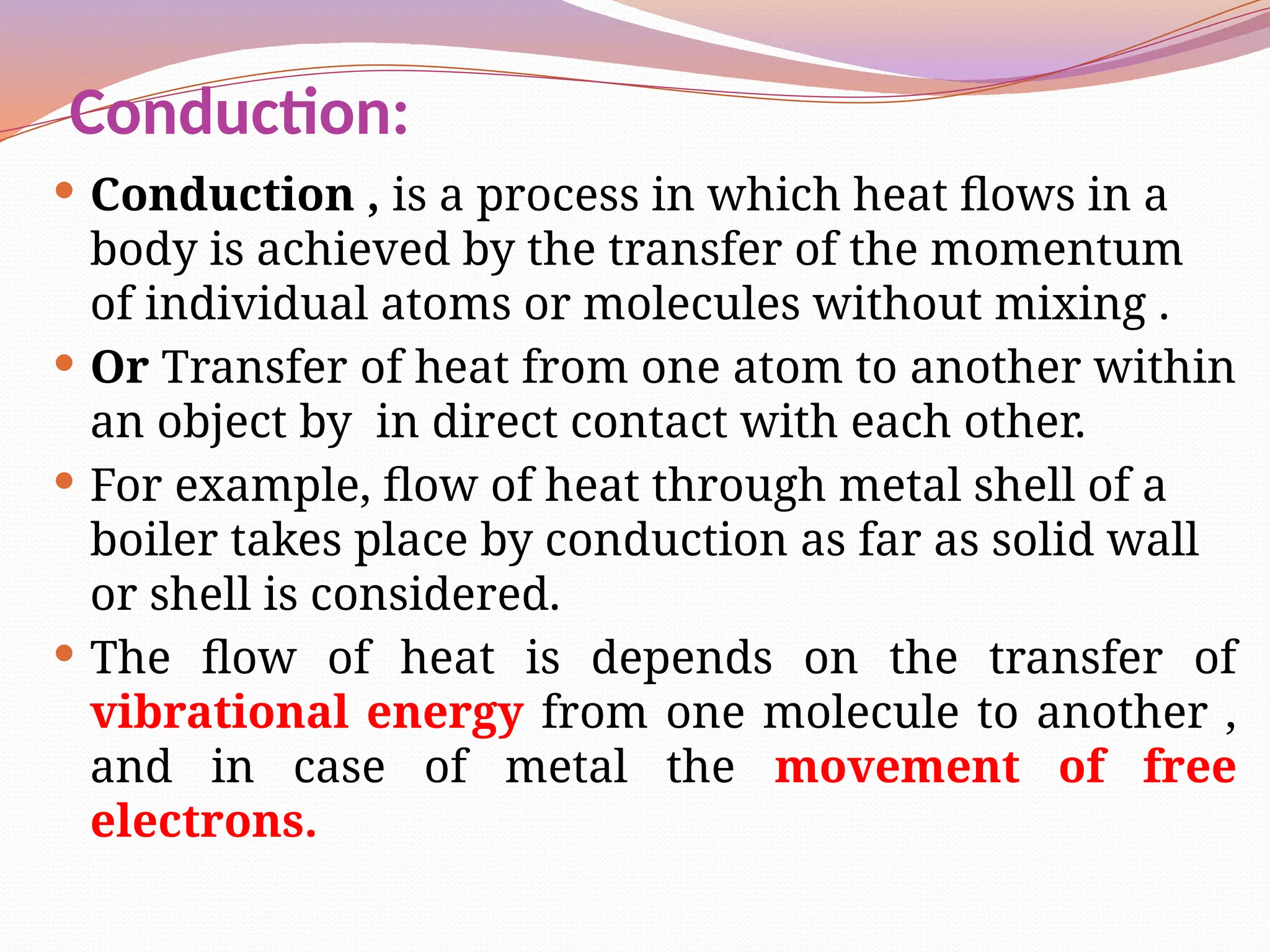
Mechanism of Heat Transfer
 Heat flows from a region of high temperature to a
region of low temperature. Heat may flow by one or
more of the three basic mechanisms.
 Conduction
 Convection
 Radiation
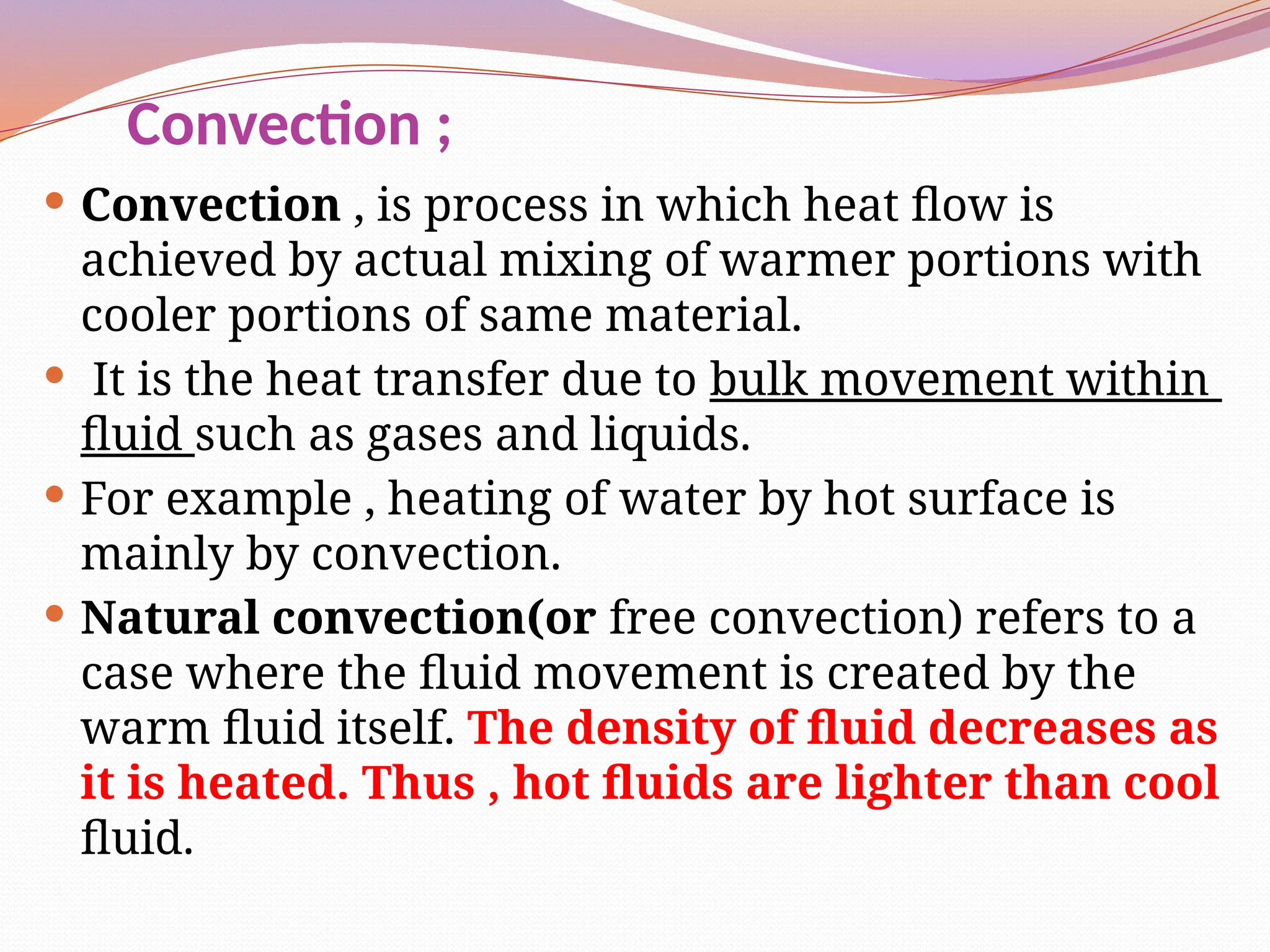
Conduction:
 Conduction , is a process in which heat flows in a
body is achieved by the transfer of the momentum
of individual atoms or molecules without mixing .
 Or Transfer of heat from one atom to another within
an object by in direct contact with each other.
 For example, flow of heat through metal shell of a
boiler takes place by conduction as far as solid wall
or shell is considered.
 The flow of heat is depends on the transfer of
vibrational energy from one molecule to another ,
and in case of metal the movement of free
electrons.
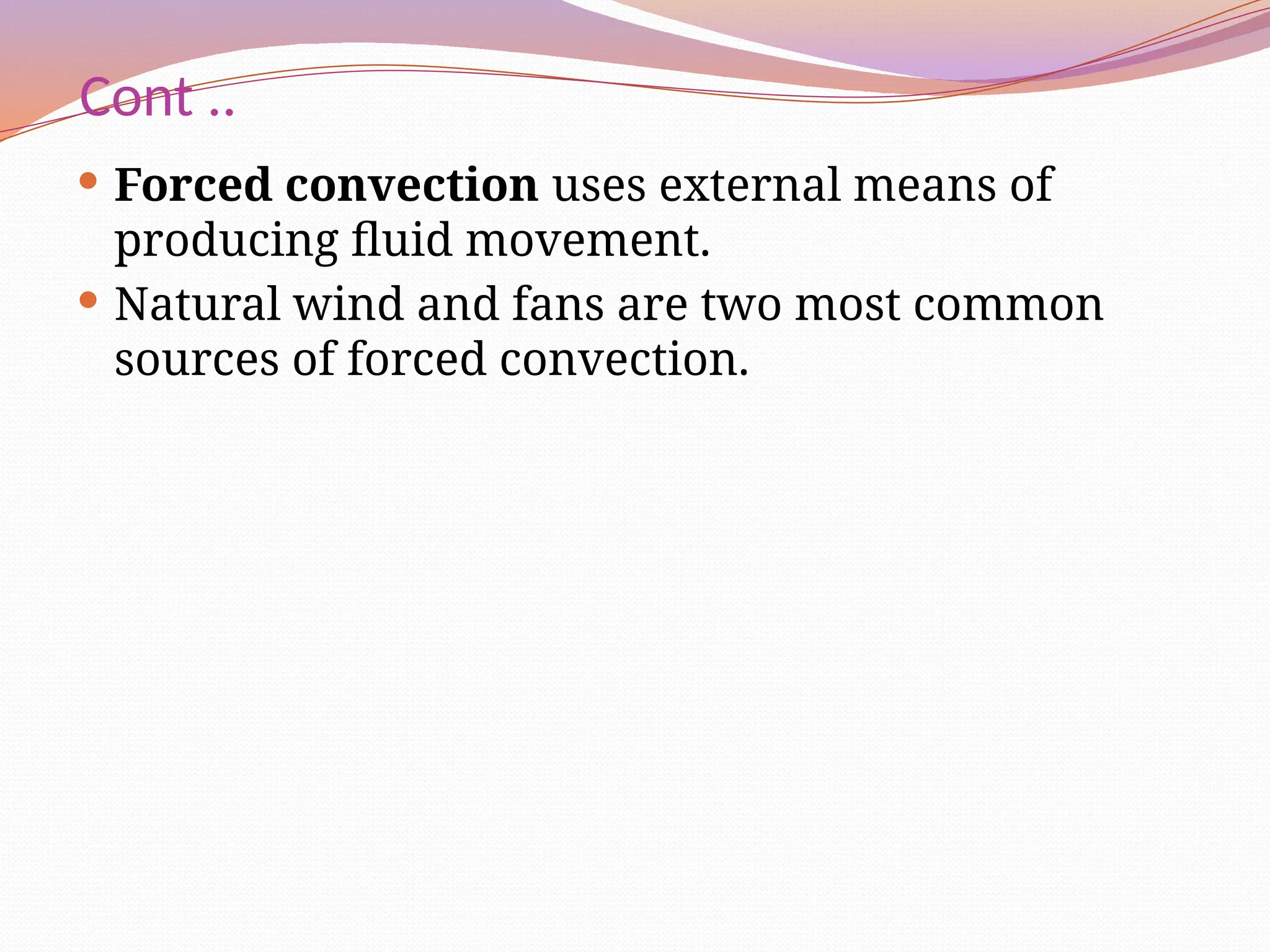
Convection ;
 Convection , is process in which heat flow is
achieved by actual mixing of warmer portions with
cooler portions of same material.
 It is the heat transfer due to bulk movement within
fluid such as gases and liquids.
 For example , heating of water by hot surface is
mainly by convection.
 Natural convection(or free convection) refers to a
case where the fluid movement is created by the
warm fluid itself. The density of fluid decreases as
it is heated. Thus , hot fluids are lighter than cool
fluid.
Cont ..
 Forced convection uses external means of
producing fluid movement.
 Natural wind and fans are two most common
sources of forced convection.
Radiation
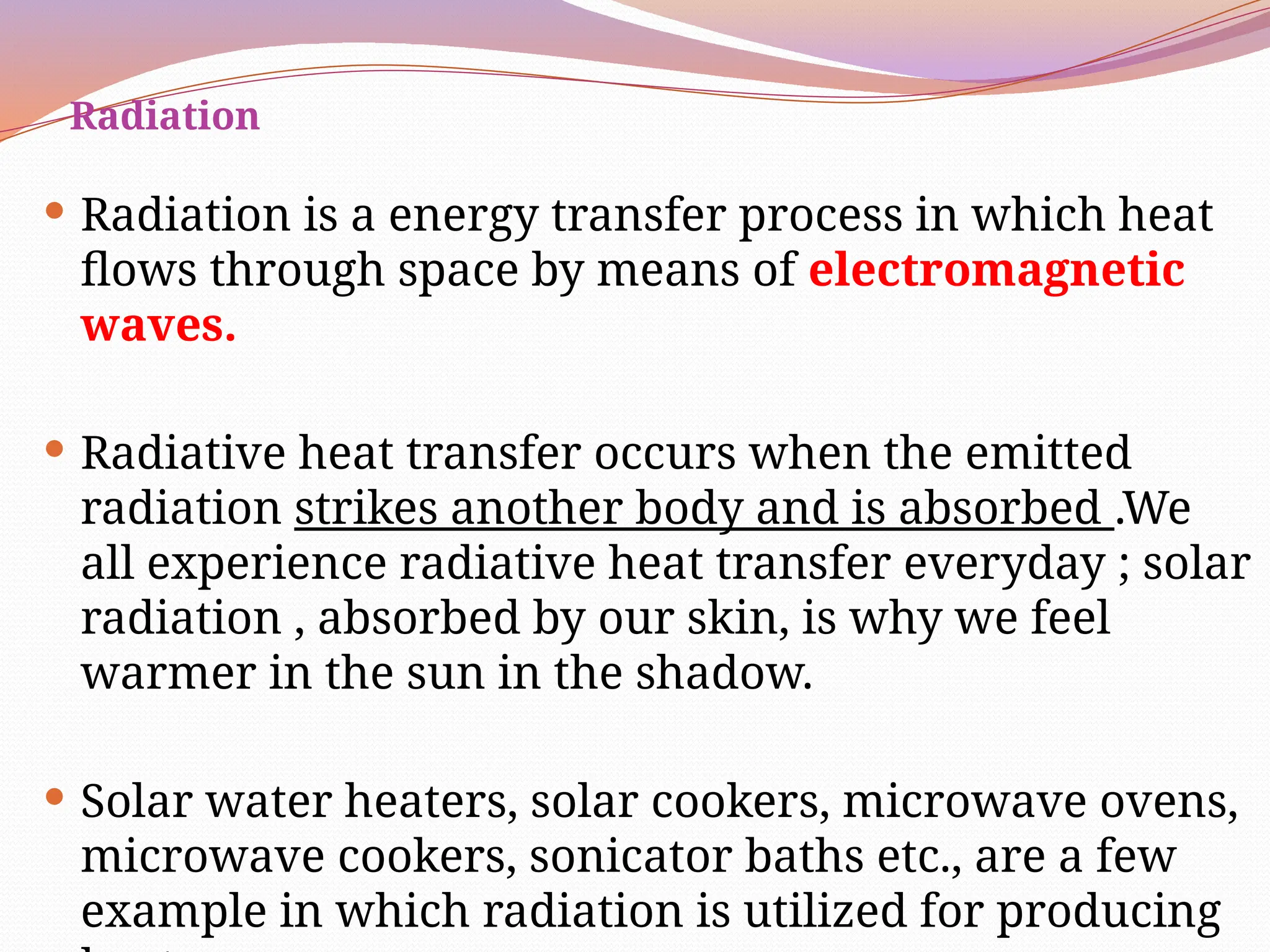
 Radiation is a energy transfer process in which heat
flows through space by means of electromagnetic
waves.
 Radiative heat transfer occurs when the emitted
radiation strikes another body and is absorbed .We
all experience radiative heat transfer everyday ; solar
radiation , absorbed by our skin, is why we feel
warmer in the sun in the shadow.
 Solar water heaters, solar cookers, microwave ovens,
microwave cookers, sonicator baths etc., are a few
example in which radiation is utilized for producing
Conduction
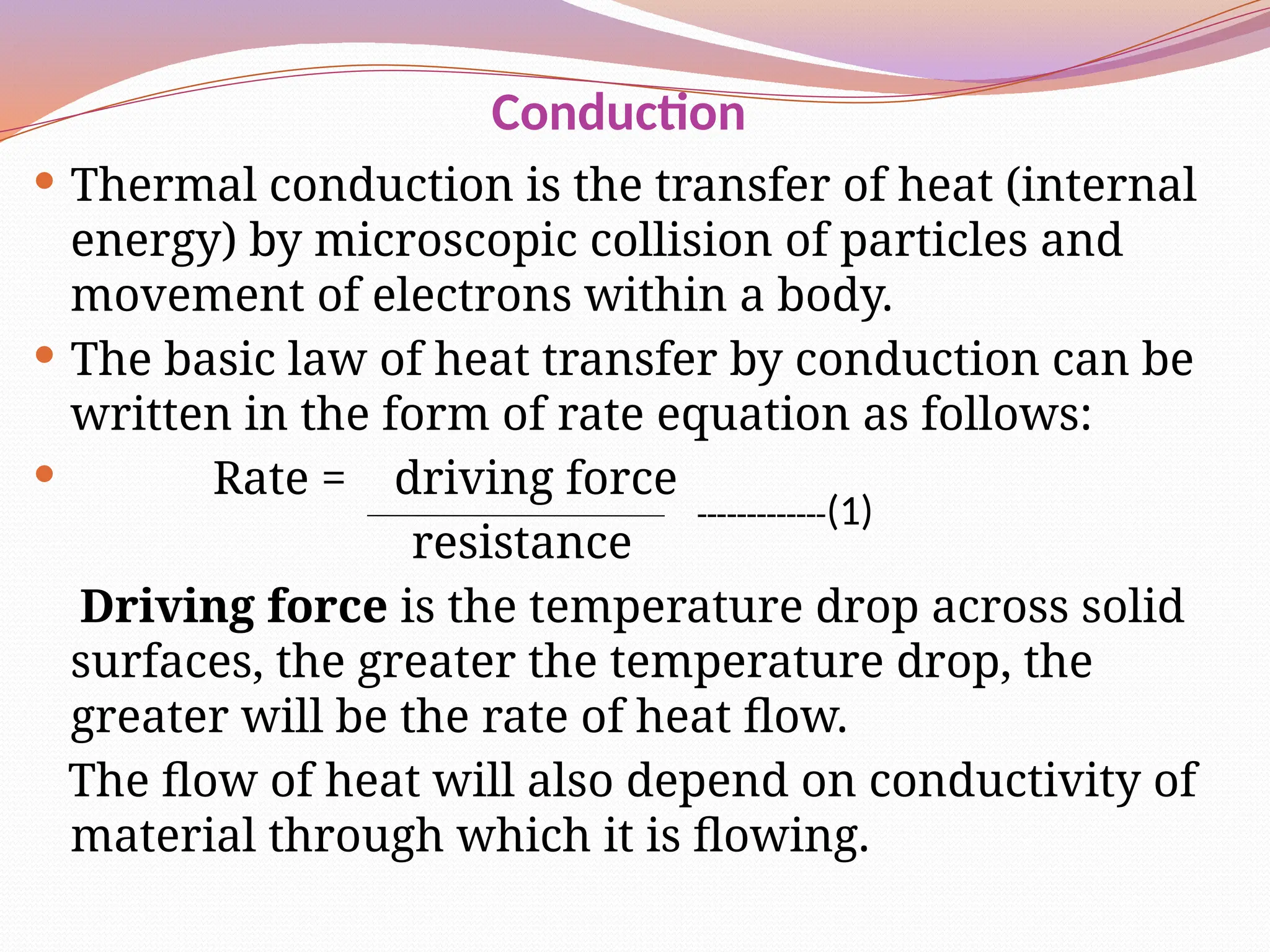
 Thermal conduction is the transfer of heat (internal
energy) by microscopic collision of particles and
movement of electrons within a body.
 The basic law of heat transfer by conduction can be
written in the form of rate equation as follows:
 Rate = driving force
resistance
Driving force is the temperature drop across solid
surfaces, the greater the temperature drop, the
greater will be the rate of heat flow.
The flow of heat will also depend on conductivity of
material through which it is flowing.
-------------(1)
Cont ..
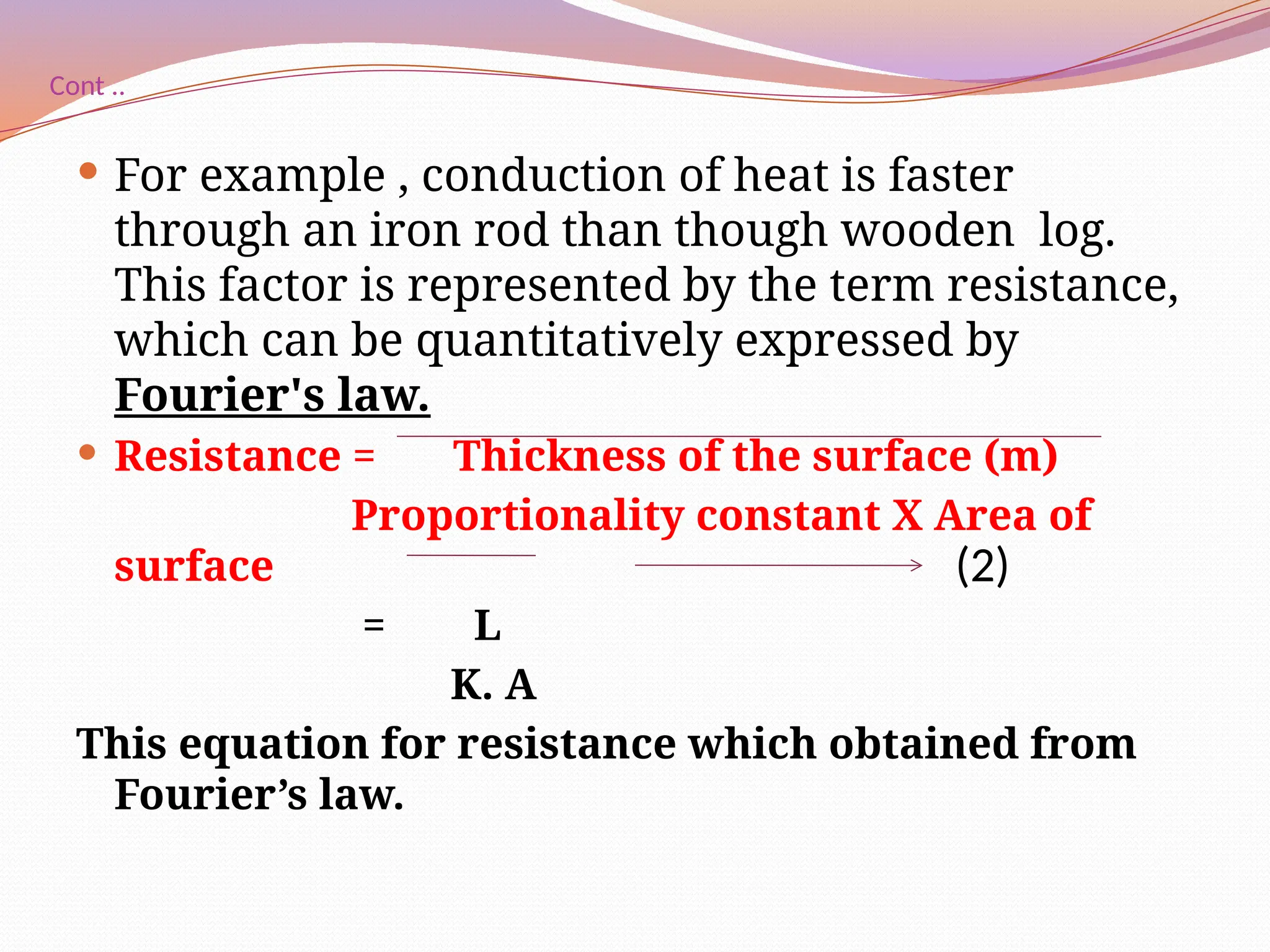
 For example , conduction of heat is faster
through an iron rod than though wooden log.
This factor is represented by the term resistance,
which can be quantitatively expressed by
Fourier's law.
 Resistance = Thickness of the surface (m)
Proportionality constant Χ Area of
surface
= L
K. A
This equation for resistance which obtained from
Fourier’s law.
(2)
Fourier’s law – Conduction of heat through Metal wall
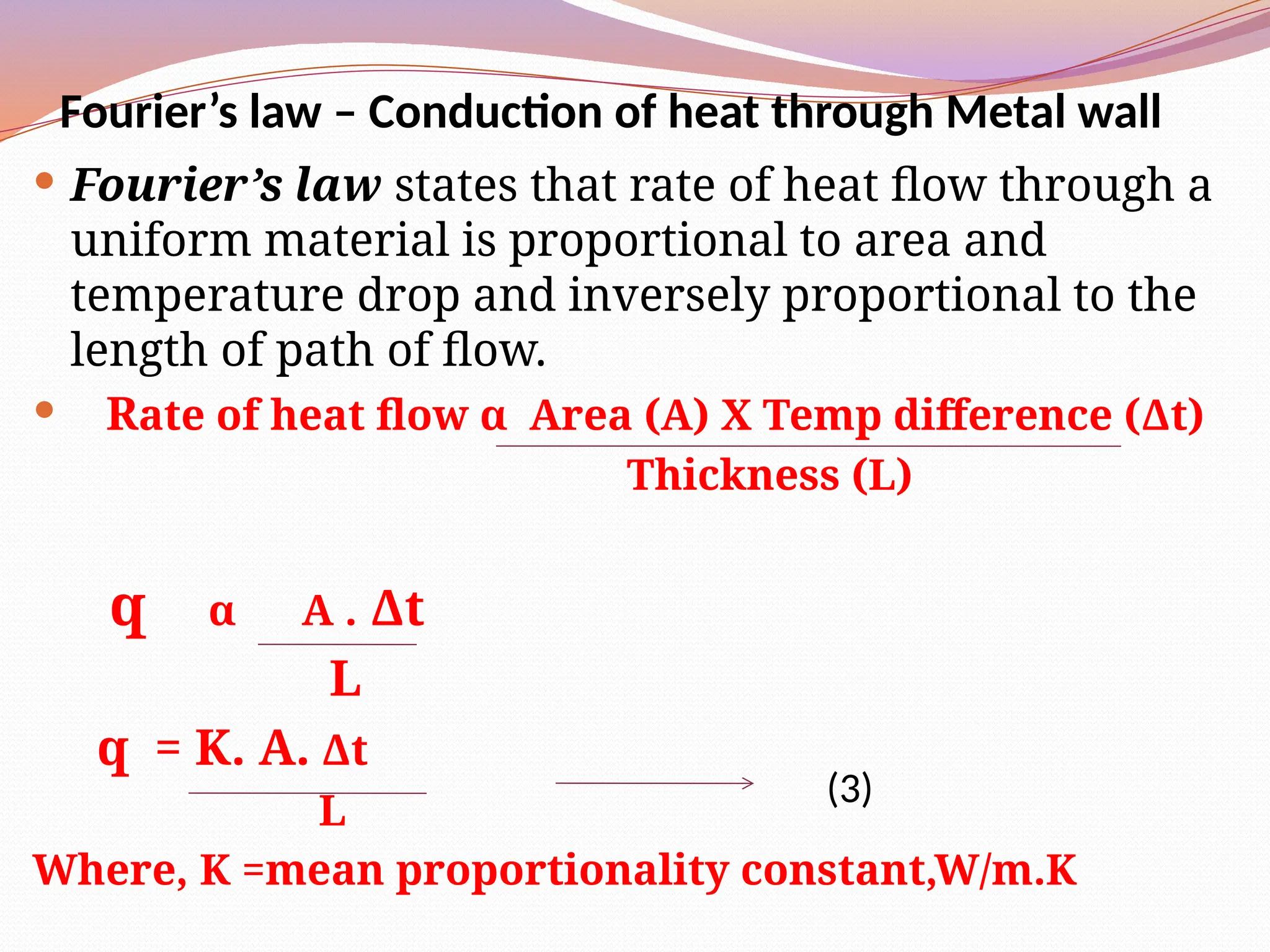
 Fourier’s law states that rate of heat flow through a
uniform material is proportional to area and
temperature drop and inversely proportional to the
length of path of flow.
 Rate of heat flow α Area (A) Χ Temp difference (Δt)
Thickness (L)
q α A . Δt
L
q = K. A. Δt
L
Where, K =mean proportionality constant,W/m.K
(3)
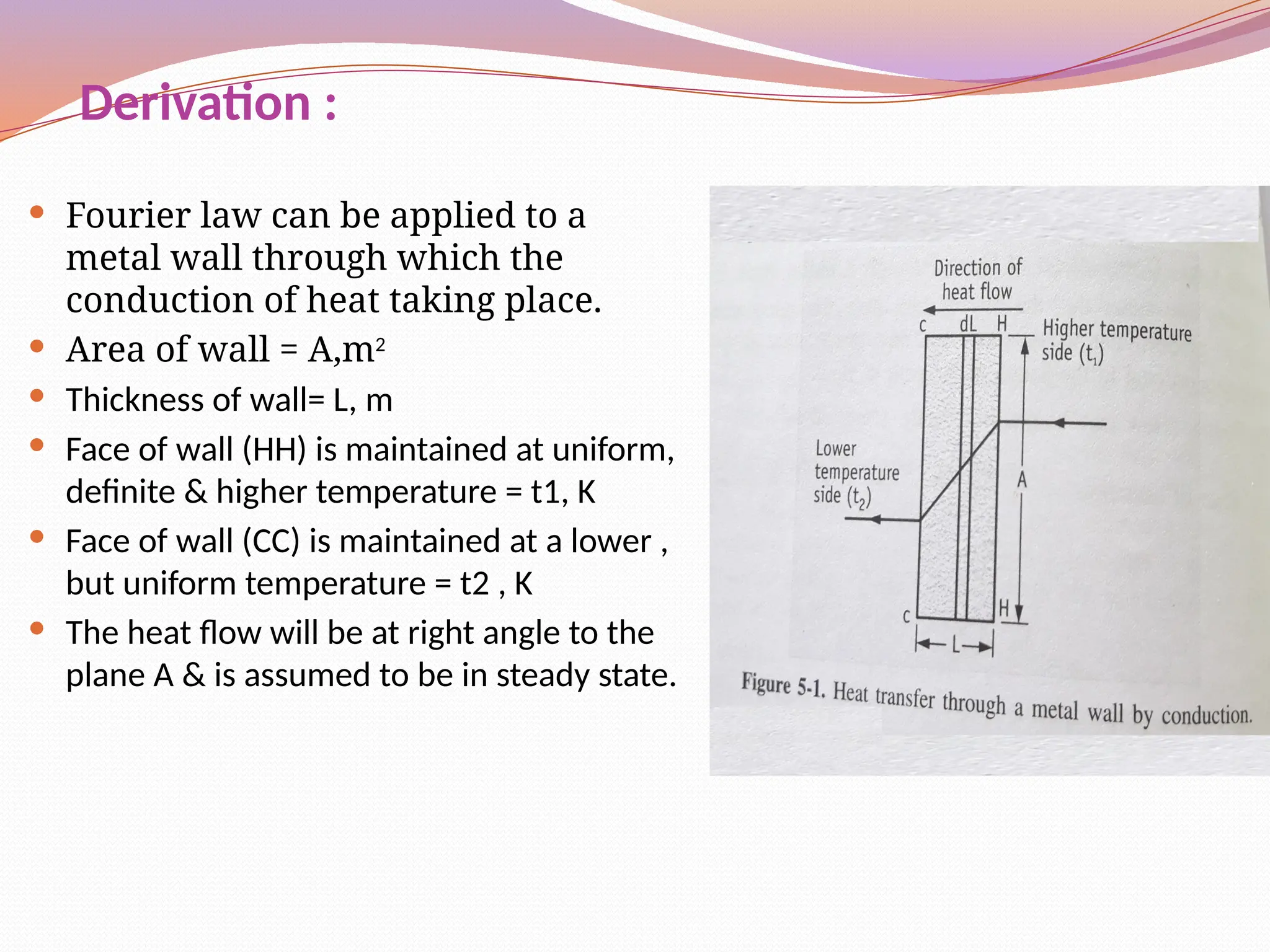
Derivation :
 Fourier law can be applied to a
metal wall through which the
conduction of heat taking place.
 Area of wall = A,m2
 Thickness of wall= L, m
 Face of wall (HH) is maintained at uniform,
definite & higher temperature = t1, K
 Face of wall (CC) is maintained at a lower ,
but uniform temperature = t2 , K
 The heat flow will be at right angle to the
plane A & is assumed to be in steady state.
Cont..
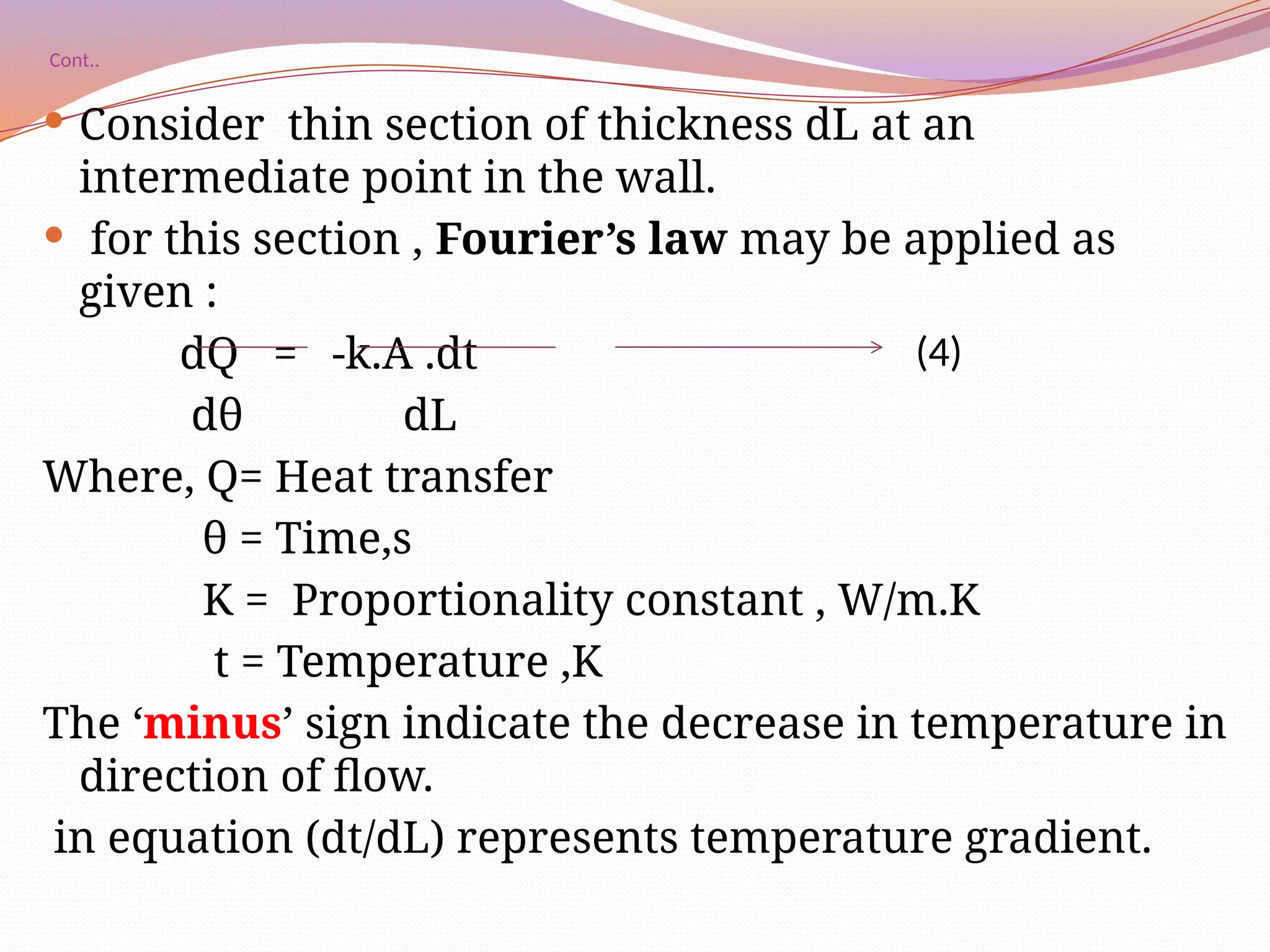
 Consider thin section of thickness dL at an
intermediate point in the wall.
 for this section , Fourier’s law may be applied as
given :
dQ = -k.A .dt
dθ dL
Where, Q= Heat transfer
θ = Time,s
K = Proportionality constant , W/m.K
t = Temperature ,K
The ‘minus’ sign indicate the decrease in temperature in
direction of flow.
in equation (dt/dL) represents temperature gradient.
(4)
Cont..
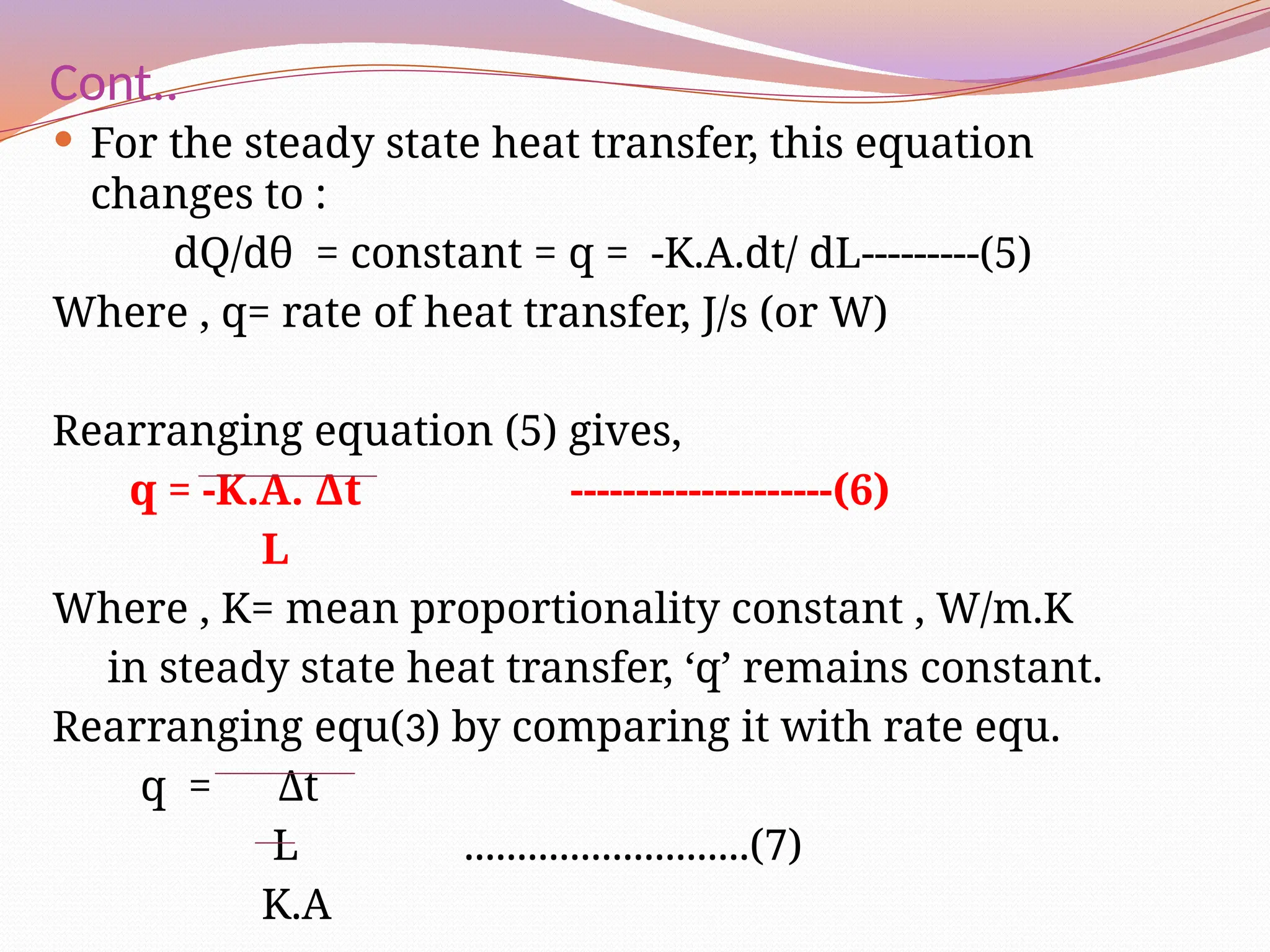
 For the steady state heat transfer, this equation
changes to :
dQ/dθ = constant = q = -K.A.dt/ dL---------(5)
Where , q= rate of heat transfer, J/s (or W)
Rearranging equation (5) gives,
q = -K.A. Δt --------------------(6)
L
Where , K= mean proportionality constant , W/m.K
in steady state heat transfer, ‘q’ remains constant.
Rearranging equ(3) by comparing it with rate equ.
q = Δt
L ...........................(7)
K.A
Cont..
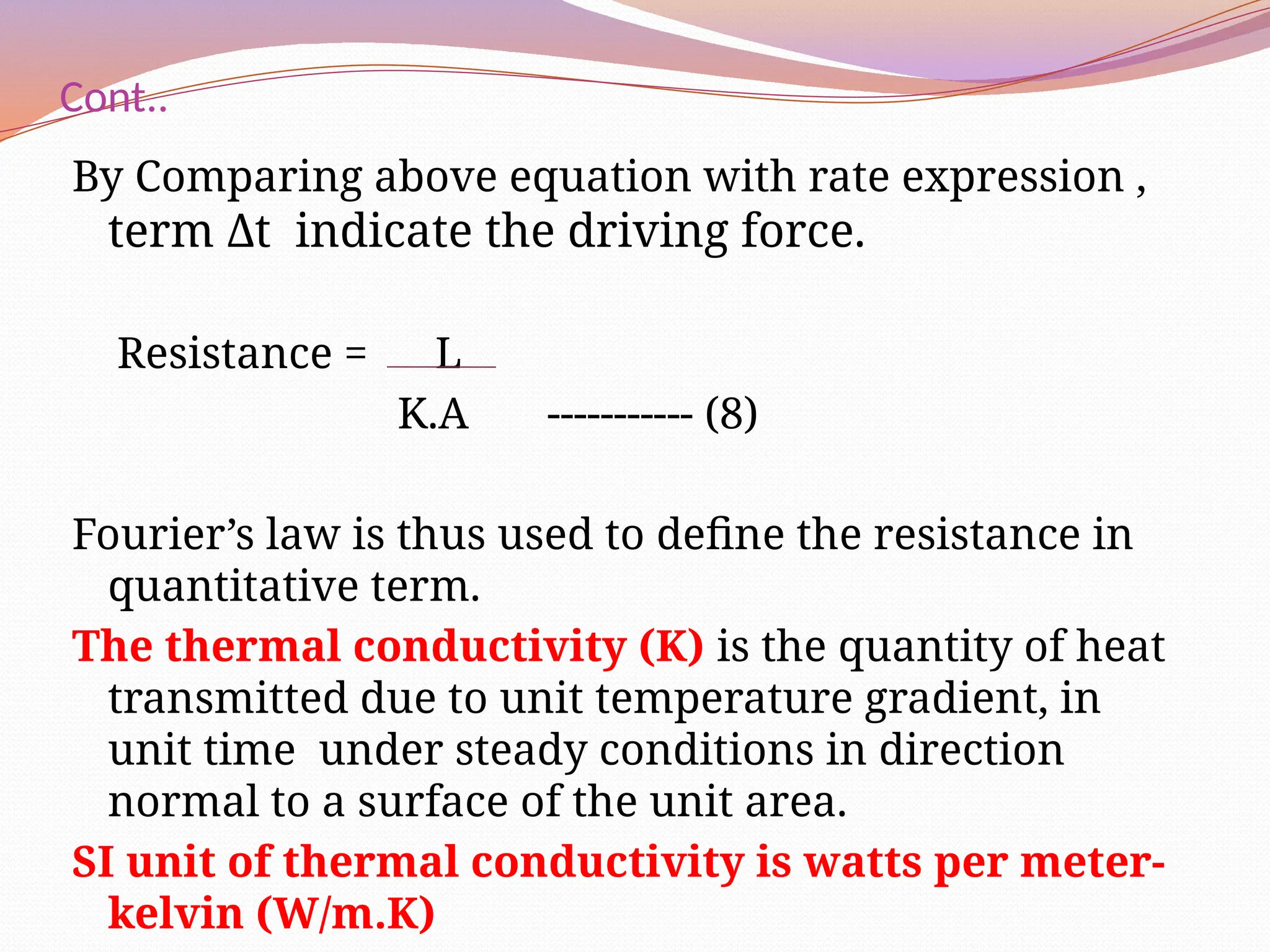
By Comparing above equation with rate expression ,
term Δt indicate the driving force.
Resistance = L
K.A ----------- (8)
Fourier’s law is thus used to define the resistance in
quantitative term.
The thermal conductivity (K) is the quantity of heat
transmitted due to unit temperature gradient, in
unit time under steady conditions in direction
normal to a surface of the unit area.
SI unit of thermal conductivity is watts per meter-
kelvin (W/m.K)
some basic mechanisms of concept of heat transfer

some basic mechanisms of concept of heat transfer

  • 1.
  • 2.
    Heat Transfer  Definition:Heat transfer is the process of transfer of heat from high temperature system to a low temperature system.  In the thermodynamic system, heat transfer is the movement of heat across the boundary of the system due to temperature difference between the system and surrounding.  There are three modes of heat transfer :  Conduction, convection and radiation.  The process in which there is no transfer of heat between the system and its surrounding is called as adiabatic process.
  • 3.
    Application :  Evaporation: Heat is supplied in order to convert a liquid into vapour. The liquid present in material is evaporated with the help of heating to get a concentrated product. E.g. preparation of vegetable extracts.  Distillation : Heat is supplied to liquid mixture for converting the liquid into vapour so that individual vapour components are condensed at another place.  Drying : In the production of tablets, heat is passed through a carrier gas over a bed of wet solid mass for achieving drying.  Crystallisation : Saturated solution is heated to bring about supersaturation, which promotes the crystallisation of drugs.
  • 4.
    Cont..  Sterilisation :For the sterilisation of pharmaceuticals , autoclaves are used with steam as a heating medium. Dry heat is used for the sterilisation of glass apparatus and other containers.
  • 5.
    Mechanism of HeatTransfer  Heat flows from a region of high temperature to a region of low temperature. Heat may flow by one or more of the three basic mechanisms.  Conduction  Convection  Radiation
  • 6.
    Conduction:  Conduction ,is a process in which heat flows in a body is achieved by the transfer of the momentum of individual atoms or molecules without mixing .  Or Transfer of heat from one atom to another within an object by in direct contact with each other.  For example, flow of heat through metal shell of a boiler takes place by conduction as far as solid wall or shell is considered.  The flow of heat is depends on the transfer of vibrational energy from one molecule to another , and in case of metal the movement of free electrons.
  • 7.
    Convection ;  Convection, is process in which heat flow is achieved by actual mixing of warmer portions with cooler portions of same material.  It is the heat transfer due to bulk movement within fluid such as gases and liquids.  For example , heating of water by hot surface is mainly by convection.  Natural convection(or free convection) refers to a case where the fluid movement is created by the warm fluid itself. The density of fluid decreases as it is heated. Thus , hot fluids are lighter than cool fluid.
  • 8.
    Cont ..  Forcedconvection uses external means of producing fluid movement.  Natural wind and fans are two most common sources of forced convection.
  • 9.
    Radiation  Radiation isa energy transfer process in which heat flows through space by means of electromagnetic waves.  Radiative heat transfer occurs when the emitted radiation strikes another body and is absorbed .We all experience radiative heat transfer everyday ; solar radiation , absorbed by our skin, is why we feel warmer in the sun in the shadow.  Solar water heaters, solar cookers, microwave ovens, microwave cookers, sonicator baths etc., are a few example in which radiation is utilized for producing
  • 10.
    Conduction  Thermal conductionis the transfer of heat (internal energy) by microscopic collision of particles and movement of electrons within a body.  The basic law of heat transfer by conduction can be written in the form of rate equation as follows:  Rate = driving force resistance Driving force is the temperature drop across solid surfaces, the greater the temperature drop, the greater will be the rate of heat flow. The flow of heat will also depend on conductivity of material through which it is flowing. -------------(1)
  • 11.
    Cont ..  Forexample , conduction of heat is faster through an iron rod than though wooden log. This factor is represented by the term resistance, which can be quantitatively expressed by Fourier's law.  Resistance = Thickness of the surface (m) Proportionality constant Χ Area of surface = L K. A This equation for resistance which obtained from Fourier’s law. (2)
  • 12.
    Fourier’s law –Conduction of heat through Metal wall  Fourier’s law states that rate of heat flow through a uniform material is proportional to area and temperature drop and inversely proportional to the length of path of flow.  Rate of heat flow α Area (A) Χ Temp difference (Δt) Thickness (L) q α A . Δt L q = K. A. Δt L Where, K =mean proportionality constant,W/m.K (3)
  • 13.
    Derivation :  Fourierlaw can be applied to a metal wall through which the conduction of heat taking place.  Area of wall = A,m2  Thickness of wall= L, m  Face of wall (HH) is maintained at uniform, definite & higher temperature = t1, K  Face of wall (CC) is maintained at a lower , but uniform temperature = t2 , K  The heat flow will be at right angle to the plane A & is assumed to be in steady state.
  • 14.
    Cont..  Consider thinsection of thickness dL at an intermediate point in the wall.  for this section , Fourier’s law may be applied as given : dQ = -k.A .dt dθ dL Where, Q= Heat transfer θ = Time,s K = Proportionality constant , W/m.K t = Temperature ,K The ‘minus’ sign indicate the decrease in temperature in direction of flow. in equation (dt/dL) represents temperature gradient. (4)
  • 15.
    Cont..  For thesteady state heat transfer, this equation changes to : dQ/dθ = constant = q = -K.A.dt/ dL---------(5) Where , q= rate of heat transfer, J/s (or W) Rearranging equation (5) gives, q = -K.A. Δt --------------------(6) L Where , K= mean proportionality constant , W/m.K in steady state heat transfer, ‘q’ remains constant. Rearranging equ(3) by comparing it with rate equ. q = Δt L ...........................(7) K.A
  • 16.
    Cont.. By Comparing aboveequation with rate expression , term Δt indicate the driving force. Resistance = L K.A ----------- (8) Fourier’s law is thus used to define the resistance in quantitative term. The thermal conductivity (K) is the quantity of heat transmitted due to unit temperature gradient, in unit time under steady conditions in direction normal to a surface of the unit area. SI unit of thermal conductivity is watts per meter- kelvin (W/m.K)