Subject: Renewable Energy Engineering
Topic: Wind Energy
Wind Energy
• All renewable energy (except tidal and geothermal power),
ultimately comes from the sun.
• The earth receives 1.74 x 10¹⁷ watts of power (per hour) from
the sun.
• About one or 2 percent of this energy is converted to wind
energy (which is about 50-100 times more than the energy
converted to biomass by all plants on earth).
• Wind is essentially air in motion, which carries with it kinetic
energy.
• The amount of energy contained in the wind at any given
instant is proportional to the wind speed at that instant.
Wind Energy
• Winds are influenced by the ground surface at altitudes up to
100 meters.
• Wind is slowed by the surface roughness and obstacles.
• A wind turbine obtains its power input by converting the force
of the wind into a torque (turning force) acting on the rotor
blades.
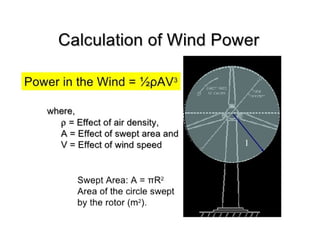
• The amount of energy which the wind transfers to the
rotor depends on the density of the air, the rotor area and
the wind speed.
Wind Energy
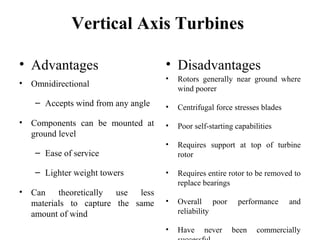
Vertical Axis Turbines
• Advantages
• Omnidirectional
– Accepts wind from any angle
• Components can be mounted at
ground level
– Ease of service
– Lighter weight towers
• Can theoretically use less
materials to capture the same
amount of wind
• Disadvantages
• Rotors generally near ground where
wind poorer
• Centrifugal force stresses blades
• Poor self-starting capabilities
• Requires support at top of turbine
rotor
• Requires entire rotor to be removed to
replace bearings
• Overall poor performance and
reliability
• Have never been commercially
Number of Blades
• Most common design is the three-bladed turbine. The most
important reason is the stability of the turbine. A rotor with an
odd number of rotor blades (and at least three blades) can be
considered to be similar to a disc when calculating the
dynamic properties of the machine.
• A rotor with an even number of blades will give stability
problems for a machine with a stiff structure. The reason is
that at the very moment when the uppermost blade bends
backwards, because it gets the maximum power from the
wind, the lowermost blade passes into the wind shade in front
of the tower.
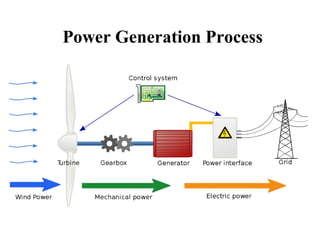
Power Generation Process
Advantages
• • The wind blows day and night, which allows
windmills to produce electricity throughout the day.
(Faster during the day)
• Wind power is available in ample amounts in all
coastal areas.
• The decreasing cost of wind power and the growing
interest in renewable energy sources should ensure
that wind power will become a viable energy source
worldwide.
• It does not produce any carbon dioxide.
Disadvantages
• Noise
• Capital cost of installing a wind turbine is very high.
• Land acquisition problems.
THANK YOU…

Renewable energy engineering

  • 1.
    Subject: Renewable EnergyEngineering Topic: Wind Energy
  • 2.
    Wind Energy • Allrenewable energy (except tidal and geothermal power), ultimately comes from the sun. • The earth receives 1.74 x 10¹⁷ watts of power (per hour) from the sun. • About one or 2 percent of this energy is converted to wind energy (which is about 50-100 times more than the energy converted to biomass by all plants on earth). • Wind is essentially air in motion, which carries with it kinetic energy. • The amount of energy contained in the wind at any given instant is proportional to the wind speed at that instant.
  • 3.
    Wind Energy • Windsare influenced by the ground surface at altitudes up to 100 meters. • Wind is slowed by the surface roughness and obstacles. • A wind turbine obtains its power input by converting the force of the wind into a torque (turning force) acting on the rotor blades. • The amount of energy which the wind transfers to the rotor depends on the density of the air, the rotor area and the wind speed.
  • 5.
  • 6.
    Vertical Axis Turbines •Advantages • Omnidirectional – Accepts wind from any angle • Components can be mounted at ground level – Ease of service – Lighter weight towers • Can theoretically use less materials to capture the same amount of wind • Disadvantages • Rotors generally near ground where wind poorer • Centrifugal force stresses blades • Poor self-starting capabilities • Requires support at top of turbine rotor • Requires entire rotor to be removed to replace bearings • Overall poor performance and reliability • Have never been commercially
  • 7.
    Number of Blades •Most common design is the three-bladed turbine. The most important reason is the stability of the turbine. A rotor with an odd number of rotor blades (and at least three blades) can be considered to be similar to a disc when calculating the dynamic properties of the machine. • A rotor with an even number of blades will give stability problems for a machine with a stiff structure. The reason is that at the very moment when the uppermost blade bends backwards, because it gets the maximum power from the wind, the lowermost blade passes into the wind shade in front of the tower.
  • 8.
  • 10.
    Advantages • • Thewind blows day and night, which allows windmills to produce electricity throughout the day. (Faster during the day) • Wind power is available in ample amounts in all coastal areas. • The decreasing cost of wind power and the growing interest in renewable energy sources should ensure that wind power will become a viable energy source worldwide. • It does not produce any carbon dioxide.
  • 11.
    Disadvantages • Noise • Capitalcost of installing a wind turbine is very high. • Land acquisition problems.
  • 12.