Heat Transfer
Course : Pharmaceutical Engineering (Theory)
Session : 2024-25
Course Code : BP304T
Semester : B. Pharm III semester
Presented by : Ms. Megha Tonk
Assistant Professor
CONTENTS
• Objectives
• Applications
• Heat transfer mechanisms
• Fourier’s law
• Heat transfer by conduction, convection & radiation.
• Heat interchangers & heat exchangers
Definition:
The definition of heat transfer in thermodynamic systems A temperature difference between the system and its surroundings causes heat to
move across the system's border.
Objectives
1. A wide range of applications can be performed using heat for industrial scale operations.
2. Energy used in industries is primarily provided by electricity and steam.
3. To avoid heat loss, it is necessary to know how heat is transferred.
4. Effective and economical designs are easier to achieve with knowledge of heat transfer.
Applications of Heat Transfer:
Heat transfer has numerous applications in the industry, the notable applications related to the pharmaceutical engineering are as
follows,
Crystallization:
It is an important process employed for the purification of pharmaceutical products.
Application of heat to a saturated solution of a substance brings supersaturation causing the crystallization of the substance.
Distillation:
In this process the liquid mixture is boiled and the mixture components are separated in the form of vapours and collected
separately.
For boiling the mixture, heat is used.
Drying:
It simply means removal of moisture or a solvent, which can be achieved by application of heat.
Evaporation:
In this pharmaceutical process heat is applied to a liquid to convert it into vapors which can be removed.
This process is used for concentrating the preparations particularly vegetable extracts
Sterilization.
It is the complete removal of microbes from any given object or substance.
Dry as well as wet forms of heat are employed to achieve sterilization of pharmaceuticals.
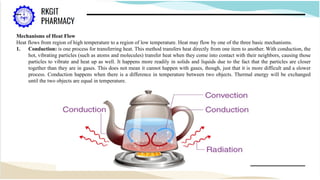
Mechanisms of Heat Flow
Heat flows from region of high temperature to a region of low temperature. Heat may flow by one of the three basic mechanisms.
1. Conduction: is one process for transferring heat. This method transfers heat directly from one item to another. With conduction, the
hot, vibrating particles (such as atoms and molecules) transfer heat when they come into contact with their neighbors, causing those
particles to vibrate and heat up as well. It happens more readily in solids and liquids due to the fact that the particles are closer
together than they are in gases. This does not mean it cannot happen with gases, though, just that it is more difficult and a slower
process. Conduction happens when there is a difference in temperature between two objects. Thermal energy will be exchanged
until the two objects are equal in temperature.
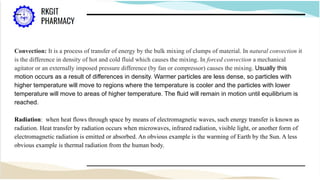
Convection: It is a process of transfer of energy by the bulk mixing of clumps of material. In natural convection it
is the difference in density of hot and cold fluid which causes the mixing. In forced convection a mechanical
agitator or an externally imposed pressure difference (by fan or compressor) causes the mixing. Usually this
motion occurs as a result of differences in density. Warmer particles are less dense, so particles with
higher temperature will move to regions where the temperature is cooler and the particles with lower
temperature will move to areas of higher temperature. The fluid will remain in motion until equilibrium is
reached.
Radiation: when heat flows through space by means of electromagnetic waves, such energy transfer is known as
radiation. Heat transfer by radiation occurs when microwaves, infrared radiation, visible light, or another form of
electromagnetic radiation is emitted or absorbed. An obvious example is the warming of Earth by the Sun. A less
obvious example is thermal radiation from the human body.
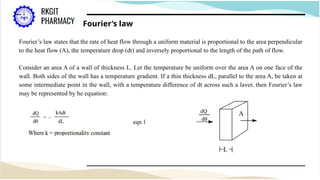
Fourier’s law
Fourier’s law states that the rate of heat flow through a uniform material is proportional to the area perpendicular
to the heat flow (A), the temperature drop (dt) and inversely proportional to the length of the path of flow.
Consider an area A of a wall of thickness L. Let the temperature be uniform over the area A on one face of the
wall. Both sides of the wall has a temperature gradient. If a thin thickness dL, parallel to the area A, be taken at
some intermediate point in the wall, with a temperature difference of dt across such a layer, then Fourier’s law
may be represented by he equation:
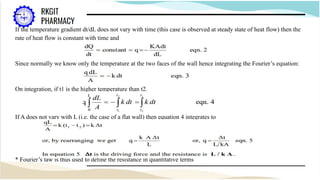
If the temperature gradient dt/dL does not vary with time (this case is observed at steady state of heat flow) then the
rate of heat flow is constant with time and
Since normally we know only the temperature at the two faces of the wall hence integrating the Fourier’s equation:
On integration, if t1 is the higher temperature than t2.
If A does not vary with L (i.e. the case of a flat wall) then equation 4 integrates to
* Fourier’s law is thus used to define the resistance in quantitative terms
Heat Exchangers and Heat Interchangers:
 Heat Interchanges: There are a variety of heat transfer solutions used by the chemical and
pharmaceutical industries. Liquids, gases, and solids can all be heated. Condensed steam or
heated fluids are used to heat these materials. Operations that involve heat transfer in pharmacy
include granulating, crystallizing, evaporating, and distilling starch paste. Industrial processes
involve transfer of heat energy in various ways. Through metal walls, heat exchangers are used
to transfer heat between one fluid (hot gas or steam) and another fluid (liquid). Using heat
exchangers, heat can be transferred from one liquid or gas to another through a metal wall.
 Heat exchangers are devices that transfer heat between two fluids without mixing them. The
fluids can be liquids, gases.
 Heat exchangers are used in a wide variety of industries, including power generation, chemical
processing, and food processing.
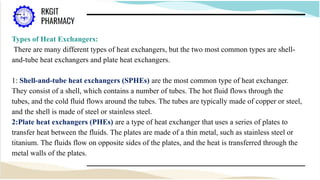
Types of Heat Exchangers:
There are many different types of heat exchangers, but the two most common types are shell-
and-tube heat exchangers and plate heat exchangers.
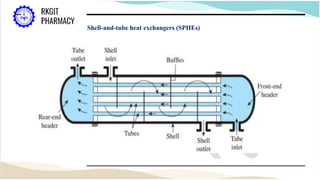
1: Shell-and-tube heat exchangers (SPHEs) are the most common type of heat exchanger.
They consist of a shell, which contains a number of tubes. The hot fluid flows through the
tubes, and the cold fluid flows around the tubes. The tubes are typically made of copper or steel,
and the shell is made of steel or stainless steel.
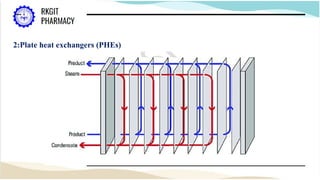
2:Plate heat exchangers (PHEs) are a type of heat exchanger that uses a series of plates to
transfer heat between the fluids. The plates are made of a thin metal, such as stainless steel or
titanium. The fluids flow on opposite sides of the plates, and the heat is transferred through the
metal walls of the plates.
Shell-and-tube heat exchangers (SPHEs)
2:Plate heat exchangers (PHEs)
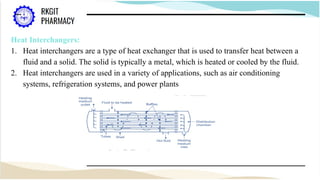
Heat Interchangers:
1. Heat interchangers are a type of heat exchanger that is used to transfer heat between a
fluid and a solid. The solid is typically a metal, which is heated or cooled by the fluid.
2. Heat interchangers are used in a variety of applications, such as air conditioning
systems, refrigeration systems, and power plants
Classification of Heat Exchangers:
Heat exchangers are classified according to the following criteria:
ā— Flow arrangement: The flow arrangement of the fluids can be parallel, counter flow, or
cross flow. In parallel flow, the fluids flow in the same direction. In counter flow, the fluids
flow in opposite directions. In cross flow, the fluids flow at right angles to each other.
ā— Number of passes: The number of passes refers to the number of times the fluids flow
through the heat exchanger. A single-pass heat exchanger has only one pass for each fluid. A
multipass heat exchanger has multiple passes for each fluid.
ā— Construction materials: The construction materials of a heat exchanger are determined
by the fluids that will be used in the exchanger. For example, if the fluids are corrosive, the
heat exchanger will need to be made of a corrosion-resistant material, such as stainless steel.

UNIT - 2 Heat Transfer (Pharm. Eng.).pptx

  • 1.
    Heat Transfer Course :Pharmaceutical Engineering (Theory) Session : 2024-25 Course Code : BP304T Semester : B. Pharm III semester Presented by : Ms. Megha Tonk Assistant Professor
  • 2.
    CONTENTS • Objectives • Applications •Heat transfer mechanisms • Fourier’s law • Heat transfer by conduction, convection & radiation. • Heat interchangers & heat exchangers
  • 3.
    Definition: The definition ofheat transfer in thermodynamic systems A temperature difference between the system and its surroundings causes heat to move across the system's border. Objectives 1. A wide range of applications can be performed using heat for industrial scale operations. 2. Energy used in industries is primarily provided by electricity and steam. 3. To avoid heat loss, it is necessary to know how heat is transferred. 4. Effective and economical designs are easier to achieve with knowledge of heat transfer.
  • 4.
    Applications of HeatTransfer: Heat transfer has numerous applications in the industry, the notable applications related to the pharmaceutical engineering are as follows, Crystallization: It is an important process employed for the purification of pharmaceutical products. Application of heat to a saturated solution of a substance brings supersaturation causing the crystallization of the substance. Distillation: In this process the liquid mixture is boiled and the mixture components are separated in the form of vapours and collected separately. For boiling the mixture, heat is used. Drying: It simply means removal of moisture or a solvent, which can be achieved by application of heat. Evaporation: In this pharmaceutical process heat is applied to a liquid to convert it into vapors which can be removed. This process is used for concentrating the preparations particularly vegetable extracts Sterilization. It is the complete removal of microbes from any given object or substance. Dry as well as wet forms of heat are employed to achieve sterilization of pharmaceuticals.
  • 5.
    Mechanisms of HeatFlow Heat flows from region of high temperature to a region of low temperature. Heat may flow by one of the three basic mechanisms. 1. Conduction: is one process for transferring heat. This method transfers heat directly from one item to another. With conduction, the hot, vibrating particles (such as atoms and molecules) transfer heat when they come into contact with their neighbors, causing those particles to vibrate and heat up as well. It happens more readily in solids and liquids due to the fact that the particles are closer together than they are in gases. This does not mean it cannot happen with gases, though, just that it is more difficult and a slower process. Conduction happens when there is a difference in temperature between two objects. Thermal energy will be exchanged until the two objects are equal in temperature.
  • 6.
    Convection: It isa process of transfer of energy by the bulk mixing of clumps of material. In natural convection it is the difference in density of hot and cold fluid which causes the mixing. In forced convection a mechanical agitator or an externally imposed pressure difference (by fan or compressor) causes the mixing. Usually this motion occurs as a result of differences in density. Warmer particles are less dense, so particles with higher temperature will move to regions where the temperature is cooler and the particles with lower temperature will move to areas of higher temperature. The fluid will remain in motion until equilibrium is reached. Radiation: when heat flows through space by means of electromagnetic waves, such energy transfer is known as radiation. Heat transfer by radiation occurs when microwaves, infrared radiation, visible light, or another form of electromagnetic radiation is emitted or absorbed. An obvious example is the warming of Earth by the Sun. A less obvious example is thermal radiation from the human body.
  • 7.
    Fourier’s law Fourier’s lawstates that the rate of heat flow through a uniform material is proportional to the area perpendicular to the heat flow (A), the temperature drop (dt) and inversely proportional to the length of the path of flow. Consider an area A of a wall of thickness L. Let the temperature be uniform over the area A on one face of the wall. Both sides of the wall has a temperature gradient. If a thin thickness dL, parallel to the area A, be taken at some intermediate point in the wall, with a temperature difference of dt across such a layer, then Fourier’s law may be represented by he equation:
  • 8.
    If the temperaturegradient dt/dL does not vary with time (this case is observed at steady state of heat flow) then the rate of heat flow is constant with time and Since normally we know only the temperature at the two faces of the wall hence integrating the Fourier’s equation: On integration, if t1 is the higher temperature than t2. If A does not vary with L (i.e. the case of a flat wall) then equation 4 integrates to * Fourier’s law is thus used to define the resistance in quantitative terms
  • 9.
    Heat Exchangers andHeat Interchangers:  Heat Interchanges: There are a variety of heat transfer solutions used by the chemical and pharmaceutical industries. Liquids, gases, and solids can all be heated. Condensed steam or heated fluids are used to heat these materials. Operations that involve heat transfer in pharmacy include granulating, crystallizing, evaporating, and distilling starch paste. Industrial processes involve transfer of heat energy in various ways. Through metal walls, heat exchangers are used to transfer heat between one fluid (hot gas or steam) and another fluid (liquid). Using heat exchangers, heat can be transferred from one liquid or gas to another through a metal wall.  Heat exchangers are devices that transfer heat between two fluids without mixing them. The fluids can be liquids, gases.  Heat exchangers are used in a wide variety of industries, including power generation, chemical processing, and food processing.
  • 10.
    Types of HeatExchangers: There are many different types of heat exchangers, but the two most common types are shell- and-tube heat exchangers and plate heat exchangers. 1: Shell-and-tube heat exchangers (SPHEs) are the most common type of heat exchanger. They consist of a shell, which contains a number of tubes. The hot fluid flows through the tubes, and the cold fluid flows around the tubes. The tubes are typically made of copper or steel, and the shell is made of steel or stainless steel. 2:Plate heat exchangers (PHEs) are a type of heat exchanger that uses a series of plates to transfer heat between the fluids. The plates are made of a thin metal, such as stainless steel or titanium. The fluids flow on opposite sides of the plates, and the heat is transferred through the metal walls of the plates.
  • 11.
  • 12.
  • 13.
    Heat Interchangers: 1. Heatinterchangers are a type of heat exchanger that is used to transfer heat between a fluid and a solid. The solid is typically a metal, which is heated or cooled by the fluid. 2. Heat interchangers are used in a variety of applications, such as air conditioning systems, refrigeration systems, and power plants
  • 14.
    Classification of HeatExchangers: Heat exchangers are classified according to the following criteria: ā— Flow arrangement: The flow arrangement of the fluids can be parallel, counter flow, or cross flow. In parallel flow, the fluids flow in the same direction. In counter flow, the fluids flow in opposite directions. In cross flow, the fluids flow at right angles to each other. ā— Number of passes: The number of passes refers to the number of times the fluids flow through the heat exchanger. A single-pass heat exchanger has only one pass for each fluid. A multipass heat exchanger has multiple passes for each fluid. ā— Construction materials: The construction materials of a heat exchanger are determined by the fluids that will be used in the exchanger. For example, if the fluids are corrosive, the heat exchanger will need to be made of a corrosion-resistant material, such as stainless steel.