Jai Narain VyasUniversity, New
Campus
DSEBOT8102T-C. STRESS PHYSIOLOGY-I
TOPIC:- HEAT SHOCK PROTEIN
DEPARTMENT OF BOTANY
SUBMMITED TO:-
Mr. Ramesh Kumar
SUBMMITED BY:-
Abhay Tanwar
2.
● Stress
1. Plantsinteract with not only climatic factors (such
as irradiation, temperature, and drought) but also
soil factors (such as salinity) and biotic factors
(such as herbivores and pathogens). All these
factors put the plant under interrelated stresses.
2. Plants could not change their sites to avoid such
stresses, but have different ways and
morphological adaptations to tolerate these
stresses.
3.
● Heat-shock proteins
1.Heat stress as well as other stresses can trigger some
mechanisms of defense such as the obvious gene
expression that was not expressed under “normal”
conditions.
2. The sudden changes in genotypic expression resulting
in an increase in the synthesis of protein groups.
These groups are called “heat-shock proteins” (Hsps),
“Stress-induced proteins” or “Stress proteins”.
4.
● Heat-shock proteins
1.Heat shock proteins (HSPs) are ubiquitous
proteins found in plant and animal cells.
2. They originally were described in relation to heat
shock (Ritossa, 1962) in Drosophila but are now
known to be induced by a wide variety of stresses,
including exposure to cold, UV light, wound healing,
tissue remodeling, or biotic stresses.
3. Synthesis of these proteins is energy costly.
5.
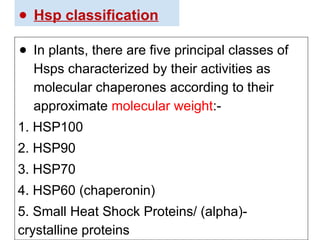
● Hsp classification
●In plants, there are five principal classes of
Hsps characterized by their activities as
molecular chaperones according to their
approximate molecular weight:-
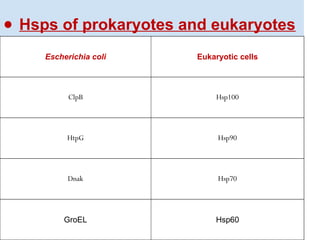
1. HSP100
2. HSP90
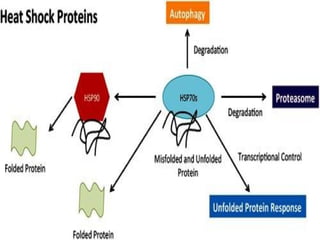
3. HSP70
4. HSP60 (chaperonin)
5. Small Heat Shock Proteins/ (alpha)-
crystalline proteins
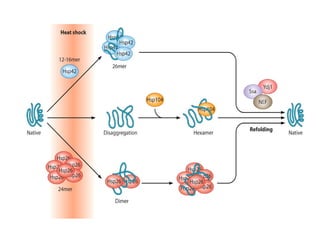
● sHsps
1. 8-24monomer.
2. Exhibit chaperone activity in vitro and thermoprotection
in vivo.
3. Produced at significant levels in cells under heat stress.
4. Most are heat inducible, but some are synthesized in
unstressed conditions-such as for cell development.
5. Activity is independent of ATP.
6. Degradation of proteins that have unsuitable folding by
ubiquitination.
10.
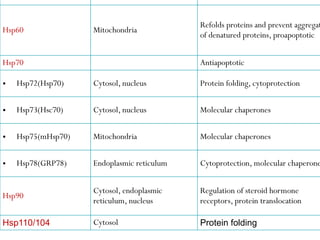
● Hsp60
1. Chapronins
2.14-16 monomer
3. ATP
4. Mediate the native folding of proteins
through cooperation of HSP70 and 60
5. Mediate folding and prevent
aggregation of proteins transported to
chloroplast and mitochondria.
11.
● Hsp 70
1.Monomer
2. ATP
3. Assists in protein transport into.
mitochondria and the endoplasmic reticulum
4. Protects PS II during photoinhibition.
5. Stabilizes proteins prior to complete folding.
6. Transports across membranes and
proteolysis.
13.
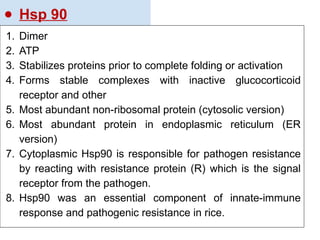
● Hsp 90
1.Dimer
2. ATP
3. Stabilizes proteins prior to complete folding or activation
4. Forms stable complexes with inactive glucocorticoid
receptor and other
5. Most abundant non-ribosomal protein (cytosolic version)
6. Most abundant protein in endoplasmic reticulum (ER
version)
7. Cytoplasmic Hsp90 is responsible for pathogen resistance
by reacting with resistance protein (R) which is the signal
receptor from the pathogen.
8. Hsp90 was an essential component of innate-immune
response and pathogenic resistance in rice.
14.
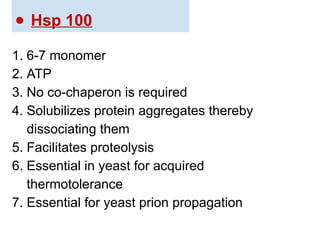
● Hsp 100
1.6-7 monomer
2. ATP
3. No co-chaperon is required
4. Solubilizes protein aggregates thereby
dissociating them
5. Facilitates proteolysis
6. Essential in yeast for acquired
thermotolerance
7. Essential for yeast prion propagation
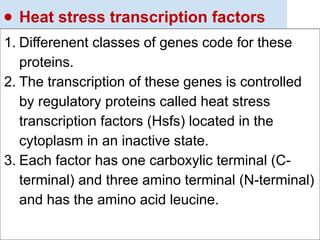
● Heat stresstranscription factors
1. Differenent classes of genes code for these
proteins.
2. The transcription of these genes is controlled
by regulatory proteins called heat stress
transcription factors (Hsfs) located in the
cytoplasm in an inactive state.
3. Each factor has one carboxylic terminal (C-
terminal) and three amino terminal (N-terminal)
and has the amino acid leucine.
● Conclusion
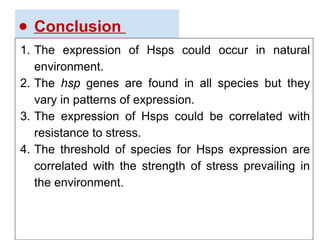
1. Theexpression of Hsps could occur in natural
environment.
2. The hsp genes are found in all species but they
vary in patterns of expression.
3. The expression of Hsps could be correlated with
resistance to stress.
4. The threshold of species for Hsps expression are
correlated with the strength of stress prevailing in
the environment.
19.
● References
1. Chang-JinPark and Young-Su Seo, Heat Shock
Proteins: A Review of the Molecular Chaperones for
Plant Immunity, Plant Pathol J. 2015 Dec; 31(4):
323–333.
2. Mohamed H.Al-Whaibi, Plant heat-shock proteins: A
mini review, Journal of King Saud University –
Science, Volume 23, Issue 2, April 2011, Pages 139-
150.
3. Class study material given by The RK Sir
4. https://www.ncbi.nlm.nih.gov/pubmed/18432918