
![Presently disease control is largely based on the use of fungicides, bactericides and
insecticides.
Most plant protection methods currently applied use toxic chemicals noxious to the
environment for pathogen and pest control. The hazardous effect of these chemicals or their
degradation products on the environment and human health strongly necessitates the search
for new, harmless means of disease control.
Induced resistance like SAR may diminish the use of toxic chemicals for disease control,
and thus could be proposed as an alternative, non-conventional, non-biocidal and
ecologically-friendly approach for plant protection and hence for sustainable agriculture.
The induced resistance can be defined as an increased expression of natural defense
mechanisms of plants against different pathogens provoked by external factors of various
types and manifested upon subsequent inoculation.
There are the three different forms of the induced resistance,
(1) Localized Acquired Resistance [LAR],
(2) Systemic Acquired Resistance [SAR],
(3) Induced Systemic Resistance [ISR].](https://image.slidesharecdn.com/sarppt-180710104140/85/SAR-ppt-4-320.jpg)
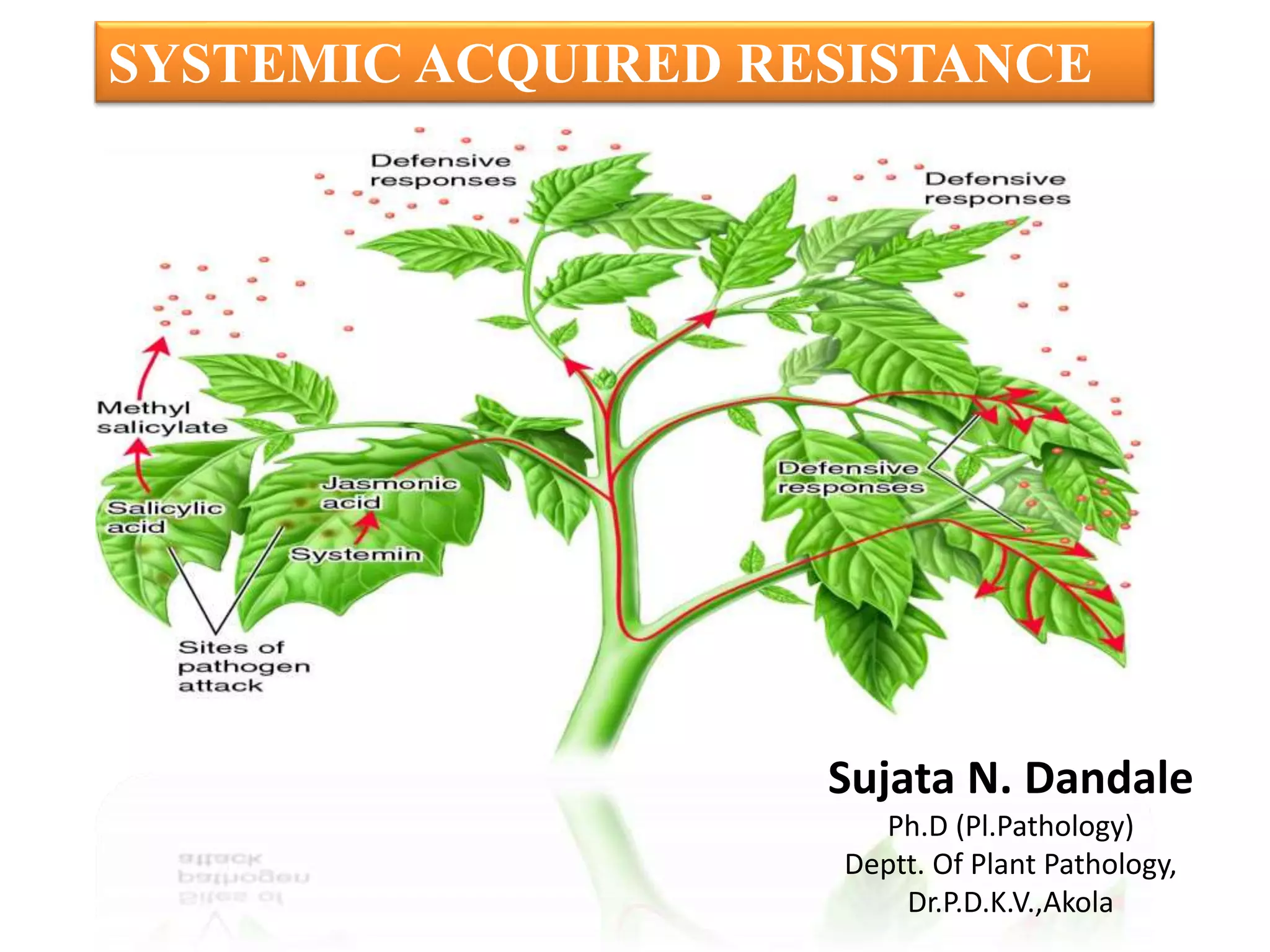
![The Systemic acquired resistance is a “whole - plant’’ resistance response that occurs
following an earlier localized exposure to a pathogen.
SAR is analogous to the innate immune system found in animals.
The resistance that developed in the distal, untreated portion of pathogen inoculated
plants is termed as systemic acquire.
Systemic acquired resistance (SAR) refers to a distinct signal transduction pathway
that plays an important role in the ability of plants to defend themselves against
pathogens. the formation of a necrotic lesion, either as a part of the hypersensitive
response (HR) or as a symptom of disease, the SAR pathway is activated.
SAR activation results in the development of a broad-spectrum, systemic resistance.
SAR can be distinguished from other disease resistance responses by both the spectrum
of pathogen protection and the associated changes in gene expression. Systemic means
throughout in plant tissues. It is non-specific secondary response.
Systemic Acquired Resistance [SAR]](https://image.slidesharecdn.com/sarppt-180710104140/85/SAR-ppt-5-320.jpg)
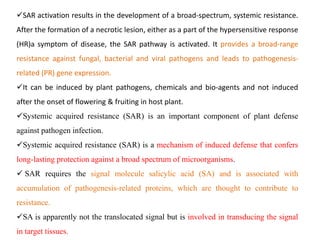

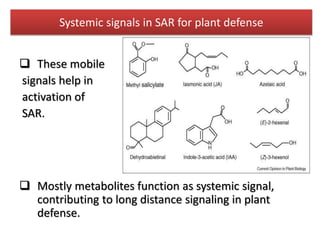
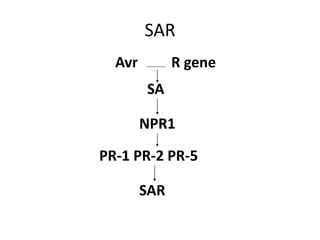
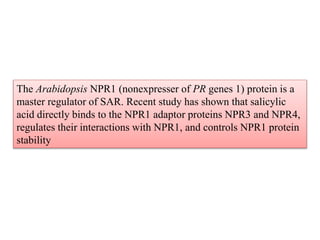
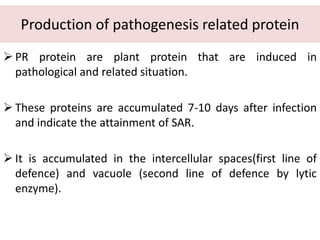
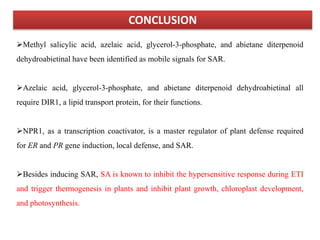


Systemic acquired resistance (SAR) is a whole-plant immune response that is activated upon localized infection by a pathogen. It provides long-lasting, broad-spectrum resistance against secondary infections. SAR involves the production of mobile signaling molecules like methyl salicylate, azelaic acid, and glycerol-3-phosphate in infected tissues that activate defenses in distant, uninfected tissues. This results in increased expression of pathogenesis-related proteins and other defenses. The NPR1 protein is a master regulator of the SAR response.


![Polymer [ बहुलक ] Chemistry Notes PDF - Irfanullah Mehar - JJ Sir Chemistry.pdf](https://cdn.slidesharecdn.com/ss_thumbnails/polymerchemistrynotespdf-irfanullahmehar-jjsirchemistry-260210172118-3f9b37f7-thumbnail.jpg?width=640&height=640&fit=bounds)


