Temperature
• The measure of how hot or cold
  something is
• Specifically – how fast the particles are
  moving, average kinetic energy
• Matter is made of atoms that are always
  moving, or they have kinetic energy
• The more kinetic energy, the higher the
  temperature
• Measuring temperature measures the average
  kinetic energy of an object
• Temperature is measured with a thermometer
• Thermal expansion – increase in the size of a
  substance in response to an increase in temp
  (as temp increases, particles move faster,
  spreading out)
• Because of thermal expansion, all materials can
  expand and shrink when temperature changes
• Mercury and alcohol are used in
  thermometers because they increase in
  size (expand) by constant amounts, stay
  liquid at high and low temperatures
• Fahrenheit
  – Boiling pt 212°
  – Freezing pt 32°
• Celsius
  – Boiling pt 100°
  – Freezing pt 0°
• Kelvin
  – Boiling pt 373
  – Freezing pt 273
• Lowest temp on Kelvin scale is 0 or
  absolute zero (-459°F), the temperature at
  which all molecules stop moving
• Heat – the energy transferred between
  objects that are at different temperatures
• Thermal energy – kinetic energy of a
  substances atoms
• Thermal energy is transferred from areas
  warmer to areas that are cooler until both
  are equal
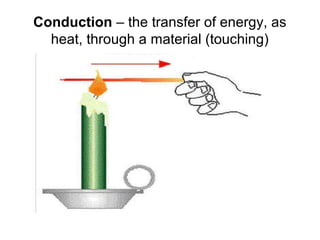
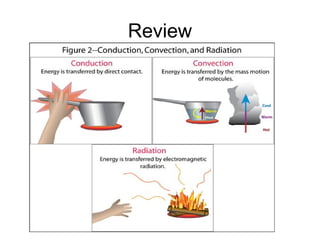
Conduction – the transfer of energy, as
  heat, through a material (touching)
Conductors and Insulators
• Materials that transfer heat are called
  thermal conductors
• Materials that do not transfer heat are
  called thermal insulators
• Examples:
  – Insulators: feathers, blankets, plastics
  – Conductors: metals
• Thermal conductivity is the rate at which a
  material conducts heat
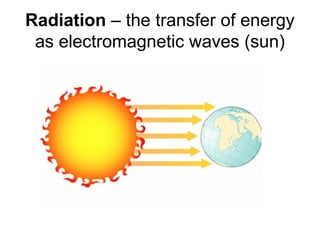
Radiation – the transfer of energy
 as electromagnetic waves (sun)
• Radiant energy from the sun heats earth
• Examples:
  – Fire
  – Radiator
  – Electric Oven
  – Electric stove
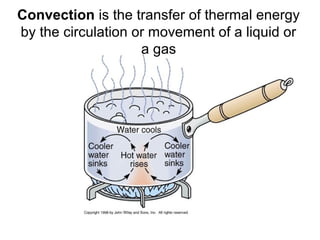
Convection is the transfer of thermal energy
by the circulation or movement of a liquid or
                    a gas
• Energy transfer can not be measured
  directly, instead it must be calculated
• Heat = joules (J)
• Specific heat = (J/Kg x ° C)
• Mass = Kg
• Temperature = ° C
• Formula to calculate heat:
  J = (J/Kg x ° C) x Kg x ° C
Review

Heat

  • 1.
    Temperature • The measureof how hot or cold something is • Specifically – how fast the particles are moving, average kinetic energy • Matter is made of atoms that are always moving, or they have kinetic energy • The more kinetic energy, the higher the temperature
  • 2.
    • Measuring temperaturemeasures the average kinetic energy of an object • Temperature is measured with a thermometer • Thermal expansion – increase in the size of a substance in response to an increase in temp (as temp increases, particles move faster, spreading out) • Because of thermal expansion, all materials can expand and shrink when temperature changes
  • 3.
    • Mercury andalcohol are used in thermometers because they increase in size (expand) by constant amounts, stay liquid at high and low temperatures • Fahrenheit – Boiling pt 212° – Freezing pt 32°
  • 4.
    • Celsius – Boiling pt 100° – Freezing pt 0° • Kelvin – Boiling pt 373 – Freezing pt 273 • Lowest temp on Kelvin scale is 0 or absolute zero (-459°F), the temperature at which all molecules stop moving
  • 5.
    • Heat –the energy transferred between objects that are at different temperatures • Thermal energy – kinetic energy of a substances atoms • Thermal energy is transferred from areas warmer to areas that are cooler until both are equal
  • 6.
    Conduction – thetransfer of energy, as heat, through a material (touching)
  • 7.
    Conductors and Insulators •Materials that transfer heat are called thermal conductors • Materials that do not transfer heat are called thermal insulators • Examples: – Insulators: feathers, blankets, plastics – Conductors: metals • Thermal conductivity is the rate at which a material conducts heat
  • 8.
    Radiation – thetransfer of energy as electromagnetic waves (sun)
  • 9.
    • Radiant energyfrom the sun heats earth • Examples: – Fire – Radiator – Electric Oven – Electric stove
  • 10.
    Convection is thetransfer of thermal energy by the circulation or movement of a liquid or a gas
  • 11.
    • Energy transfercan not be measured directly, instead it must be calculated • Heat = joules (J) • Specific heat = (J/Kg x ° C) • Mass = Kg • Temperature = ° C • Formula to calculate heat: J = (J/Kg x ° C) x Kg x ° C
  • 12.