Kerryanne Hunter
Aim
To provide an understanding of
the need to Calibrate
Thermometers in the food
industry
Objectives
State the reasons for calibrating a
thermometer
Demonstrate how to calibrate a
thermometer correctly
Identify the frequency of Calibration
What you should do if your
thermometer is not working correctly
So why bother?
Recommended by the Manufacturer
If you are involved with a court
proceeding
Due-diligence defences
Good Food Safety Practice
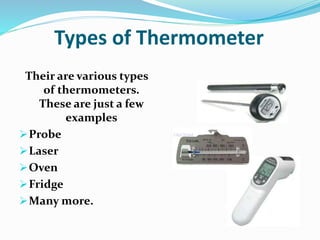
Types of Thermometer
Their are various types
of thermometers.
These are just a few
examples
Probe
Laser
Oven
Fridge
Many more.
What you will need
Probe thermometer
Containers x 2
Crushed Ice
Clean Tap Water
Boiling Water i.e. From a kettle
Probe Calibration Record Sheet
Calibration Step 1 of 3:
1. Fill a container with finely crushed ice, top with
clean tap water and stir well
2. Remove the thermometer from its case and slide
the stem into the crushed ice
3. Immerse the thermometer stem into the ice a
minimum of 2 inches for 30 seconds. The stem
should not touch the sides/bottom of the
container
4. If the temperature reading is +/-1°C, you are half
way to checking your thermometer is calibrated
correctly.
Calibration Step 2 of 3:
1. Fill the second container with boiling
water, from a freshly boiled kettle
2. Immerse the thermometer stem into the
boiling water a minimum of 2 inches for 30
seconds. The stem should not touch the
sides/bottom of the container
3. If the temperature reading is +99/101°C,
you have correctly calibrated your probe
thermometer.
Calibration Step 3 of 3:
The final step of any type of probe calibration
is to record your findings
By recording this information you are
 Complying with the manufactures
instructions and/or company policy
 If you are involved with a court proceeding
and/or due-diligence defences
 Its good Food Safety Practice
It’s Broke What should we do?
Check the battery
Check any wires
Check the display reader
Check step 1 & 2, with a different
thermometer
If it still isn’t working then you have
to return it to the manufacturer for
them to calibrate.
To Summarise
Why
How
When
What
How to Calibrate a Thermometer

How to Calibrate a Thermometer

  • 1.
  • 2.
    Aim To provide anunderstanding of the need to Calibrate Thermometers in the food industry
  • 3.
    Objectives State the reasonsfor calibrating a thermometer Demonstrate how to calibrate a thermometer correctly Identify the frequency of Calibration What you should do if your thermometer is not working correctly
  • 4.
    So why bother? Recommendedby the Manufacturer If you are involved with a court proceeding Due-diligence defences Good Food Safety Practice
  • 5.
    Types of Thermometer Theirare various types of thermometers. These are just a few examples Probe Laser Oven Fridge Many more.
  • 6.
    What you willneed Probe thermometer Containers x 2 Crushed Ice Clean Tap Water Boiling Water i.e. From a kettle Probe Calibration Record Sheet
  • 7.
    Calibration Step 1of 3: 1. Fill a container with finely crushed ice, top with clean tap water and stir well 2. Remove the thermometer from its case and slide the stem into the crushed ice 3. Immerse the thermometer stem into the ice a minimum of 2 inches for 30 seconds. The stem should not touch the sides/bottom of the container 4. If the temperature reading is +/-1°C, you are half way to checking your thermometer is calibrated correctly.
  • 8.
    Calibration Step 2of 3: 1. Fill the second container with boiling water, from a freshly boiled kettle 2. Immerse the thermometer stem into the boiling water a minimum of 2 inches for 30 seconds. The stem should not touch the sides/bottom of the container 3. If the temperature reading is +99/101°C, you have correctly calibrated your probe thermometer.
  • 9.
    Calibration Step 3of 3: The final step of any type of probe calibration is to record your findings By recording this information you are  Complying with the manufactures instructions and/or company policy  If you are involved with a court proceeding and/or due-diligence defences  Its good Food Safety Practice
  • 10.
    It’s Broke Whatshould we do? Check the battery Check any wires Check the display reader Check step 1 & 2, with a different thermometer If it still isn’t working then you have to return it to the manufacturer for them to calibrate.
  • 11.