Thermal Energy
Specific heat capacity The  specific heat capacity  of a substance is the amount of heat energy required to raise the temperature of the substance unit mass by a unit change in temperature.  The unit mass is usually 1kg, while the unit change in temperature is 1K or 1°C. The key formula is: Energy = specific heat capacity × mass × change in temperature
Specific heat capacity Calculate the following: How much energy is needed to increase the temperature of 500 g of lead from 20 ºC to 45 ºC? The specific heat capacity of lead is 128 J/kg/ºC.
Heat transfer Heat is transferred naturally from a substance with a higher temperature to a substance with a lower temperature.
Heat Transfer Complete the following definition using the words below: ___________ energy or heat is always transferred from a _________ place to a ___________ place. The amount of energy _____________ depends on how big the _______________ difference is cooler  thermal  transferred  hotter  temperature
Heat transfer Draw arrows to show the direction of  energy transfer:
Heat transfer Heat can be transferred in three ways. Conduction  - by a substance which does not move (solids). Convection  - by   substance which moves (liquids and gasses). Radiation  - infra-red radiation is exchanged between all substances.
Thermal conduction Heat can be transferred by conduction only in solids. If one end of a solid is heated, the particles of the solid gain  kinetic energy . This means that the particles…. Thermal conductors Substances which are GOOD at transferring heat are known as THERMAL CONDUCTORS, and substances which are BAD are know as THERMAL INSULATORS.
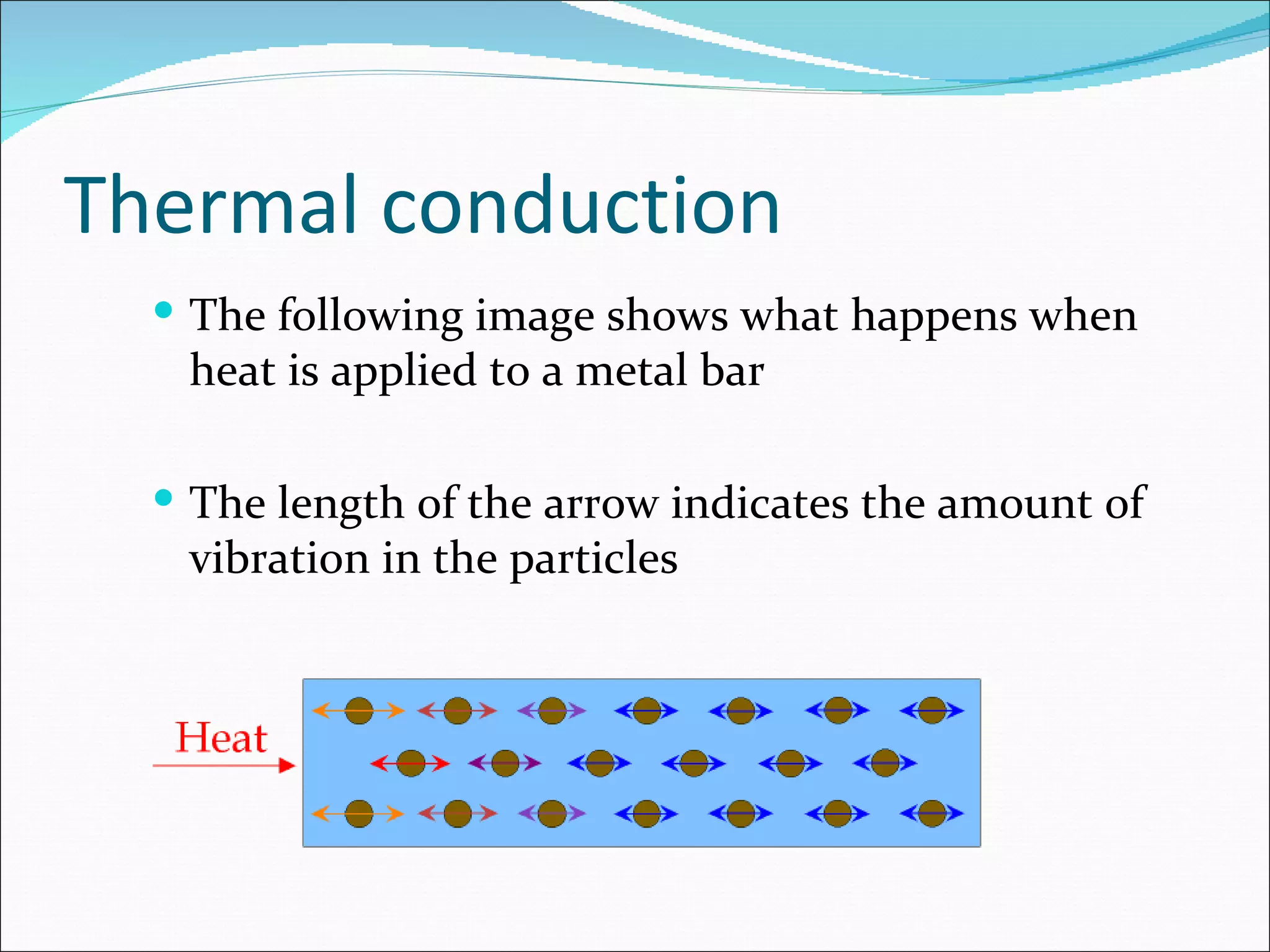
Thermal conduction In solids the particles (what particles?) are held together by strong forces of attraction The only way particles can move is to vibrate forwards and backwards When the solid is heated, the amount by which the particles vibrate is increased. (This is what is meant by saying that the particles of the solid have gained kinetic energy. The increase in energy (heat) is passed on to the next particle, which in turn starts to vibrate more.
Thermal conduction The following image shows what happens when heat is applied to a metal bar The length of the arrow indicates the amount of vibration in the particles

Heat transfer & Conduction

  • 1.
  • 2.
    Specific heat capacityThe  specific heat capacity  of a substance is the amount of heat energy required to raise the temperature of the substance unit mass by a unit change in temperature. The unit mass is usually 1kg, while the unit change in temperature is 1K or 1°C. The key formula is: Energy = specific heat capacity × mass × change in temperature
  • 3.
    Specific heat capacityCalculate the following: How much energy is needed to increase the temperature of 500 g of lead from 20 ºC to 45 ºC? The specific heat capacity of lead is 128 J/kg/ºC.
  • 4.
    Heat transfer Heat is transferred naturally froma substance with a higher temperature to a substance with a lower temperature.
  • 5.
    Heat Transfer Completethe following definition using the words below: ___________ energy or heat is always transferred from a _________ place to a ___________ place. The amount of energy _____________ depends on how big the _______________ difference is cooler thermal transferred hotter temperature
  • 6.
    Heat transfer Drawarrows to show the direction of energy transfer:
  • 7.
    Heat transfer Heat canbe transferred in three ways. Conduction  - by a substance which does not move (solids). Convection  - by  substance which moves (liquids and gasses). Radiation  - infra-red radiation is exchanged between all substances.
  • 8.
    Thermal conduction Heat canbe transferred by conduction only in solids. If one end of a solid is heated, the particles of the solid gain  kinetic energy . This means that the particles…. Thermal conductors Substances which are GOOD at transferring heat are known as THERMAL CONDUCTORS, and substances which are BAD are know as THERMAL INSULATORS.
  • 9.
    Thermal conduction Insolids the particles (what particles?) are held together by strong forces of attraction The only way particles can move is to vibrate forwards and backwards When the solid is heated, the amount by which the particles vibrate is increased. (This is what is meant by saying that the particles of the solid have gained kinetic energy. The increase in energy (heat) is passed on to the next particle, which in turn starts to vibrate more.
  • 10.
    Thermal conduction Thefollowing image shows what happens when heat is applied to a metal bar The length of the arrow indicates the amount of vibration in the particles