Matter and Volume
• Matter: anything that has mass and takes
  up space
• Volume: amount of space an objects
  occupies (characteristic of matter)
• No two objects can occupy the same
  space at the same time
• Meniscus: curved surface of any liquid in
  any container
• Lowest point of the meniscus is the
  accurate measurement of volume
Matter and Mass

• Mass: the amount of matter in an object
  (characteristic of matter)
• Mass of objects are the same no matter
  where the object is in the universe
• The only way to change mass is to change
  the amount of matter the object is made of
• Mass and weight are NOT THE SAME
• Weight: a measure of the gravitational
  force exerted on an object
• Gravitational force is depends on the
  objects mass and it’s relationship with a
  source of gravity
• The more mass, the more gravitational
  force, the more weight the object has
• Objects weight is determined by the force
  of gravity
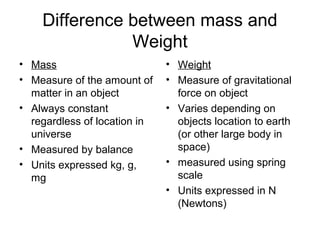
Difference between mass and
               Weight
• Mass                        • Weight
• Measure of the amount of    • Measure of gravitational
  matter in an object           force on object
• Always constant             • Varies depending on
  regardless of location in     objects location to earth
  universe                      (or other large body in
• Measured by balance           space)
• Units expressed kg, g,      • measured using spring
  mg                            scale
                              • Units expressed in N
                                (Newtons)
• Objects can have the same volume but
  very different masses thus the
  gravitational force would be greater
  causing greater weight
• Inertia: tendency of an object to resist a
  change in motion (Newton’s 1st Law of
  Motion)
• Objects at rest will remain at rest and
  objects in motion will remain in motion at a
  constant speed and direction unless act
  on by an outside force
• Mass is a measure of inertia
• The more mass an object has the harder
  to get it moving and the harder it is to stop
• Think train and car!!!

Chap 2 sec 1

  • 1.
    Matter and Volume •Matter: anything that has mass and takes up space • Volume: amount of space an objects occupies (characteristic of matter) • No two objects can occupy the same space at the same time
  • 2.
    • Meniscus: curvedsurface of any liquid in any container • Lowest point of the meniscus is the accurate measurement of volume
  • 3.
    Matter and Mass •Mass: the amount of matter in an object (characteristic of matter) • Mass of objects are the same no matter where the object is in the universe • The only way to change mass is to change the amount of matter the object is made of • Mass and weight are NOT THE SAME
  • 4.
    • Weight: ameasure of the gravitational force exerted on an object • Gravitational force is depends on the objects mass and it’s relationship with a source of gravity • The more mass, the more gravitational force, the more weight the object has • Objects weight is determined by the force of gravity
  • 5.
    Difference between massand Weight • Mass • Weight • Measure of the amount of • Measure of gravitational matter in an object force on object • Always constant • Varies depending on regardless of location in objects location to earth universe (or other large body in • Measured by balance space) • Units expressed kg, g, • measured using spring mg scale • Units expressed in N (Newtons)
  • 6.
    • Objects canhave the same volume but very different masses thus the gravitational force would be greater causing greater weight • Inertia: tendency of an object to resist a change in motion (Newton’s 1st Law of Motion)
  • 7.
    • Objects atrest will remain at rest and objects in motion will remain in motion at a constant speed and direction unless act on by an outside force • Mass is a measure of inertia • The more mass an object has the harder to get it moving and the harder it is to stop • Think train and car!!!