Normal and
abnormal Heart
sounds (Murmurs)
By Dr. Irtaza Rehman
(Author of The Extraordinary Life)
Learning Objectives
• To learn about the Normal heart sounds
• To learn about the Abnormal heart sounds
Normal Heart sounds
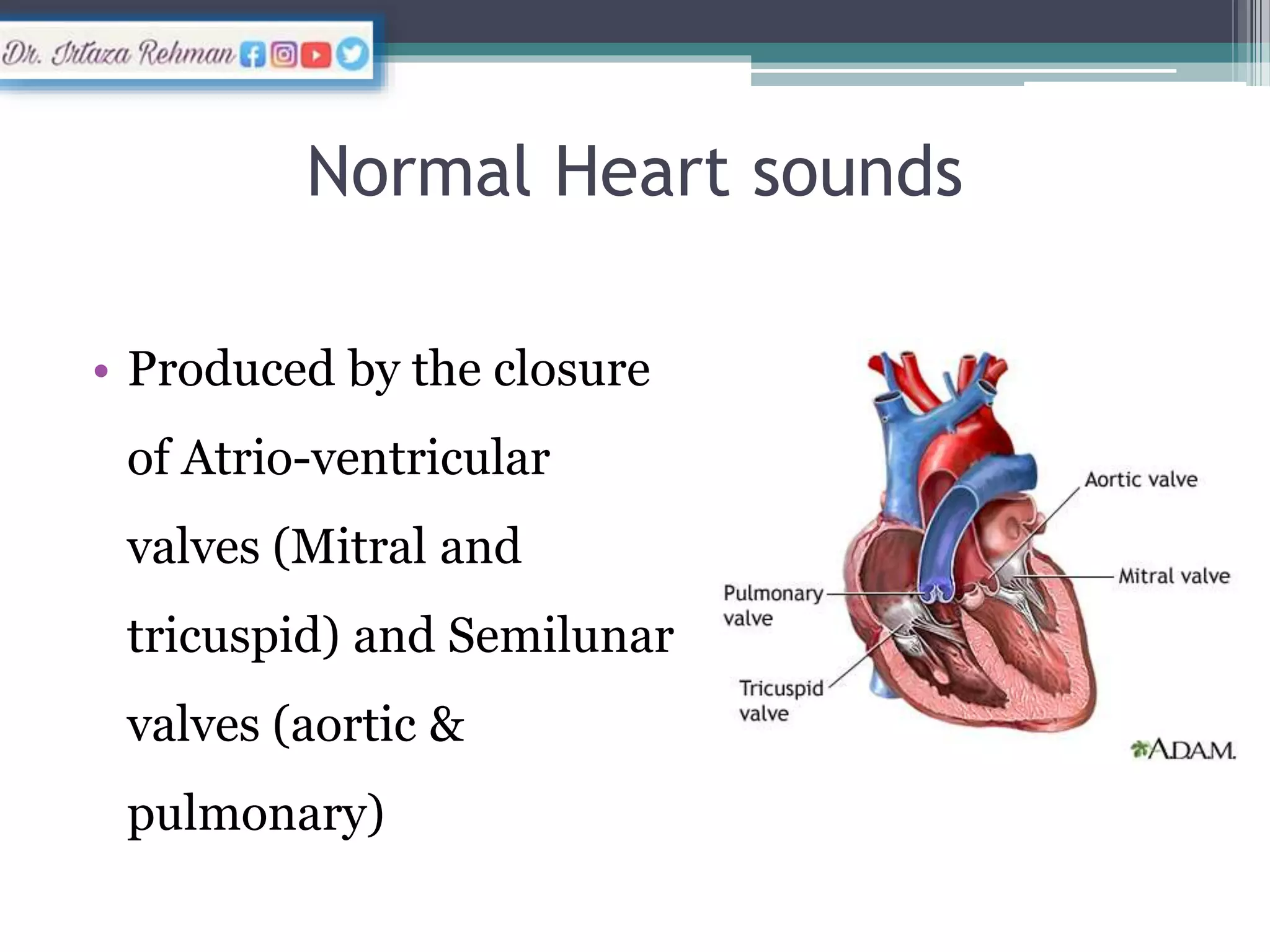
• Produced by the closure
of Atrio-ventricular
valves (Mitral and
tricuspid) and Semilunar
valves (aortic &
pulmonary)
Normal Heart sounds
Sites for Auscultation
Normal Heart sounds
Systole Systole Systole
Diastole Diastole
• S2: A2 (Aortic valve closure)
• Loud A2: Systemic Hypertension (High B.P will
create louder noise)
• Low A2: Systemic Hypotension, Aortic
regurgitation (destruction of valve tissue and
impairment of the valve closure mechanism)
Normal Heart sounds
• S2: P2 (Pulmonary valve closure)
• Loud P2: Pulmonary hypertension, ASD (Blood
shunting from left to right atrium  right
ventricle  Pulmonary artery  Loud P2)
• Low/soft P2: Pulmonary stenosis
Normal Heart sounds
• S1 splitting
• Normally T1 (Tricuspid closure) comes later
than M1 due to slightly earlier closure of Mitral
valve.
• But this splitting is very narrow, almost
negligible. May not be present at all.
• So normally there is no splitting in S1.
Normal Heart sounds
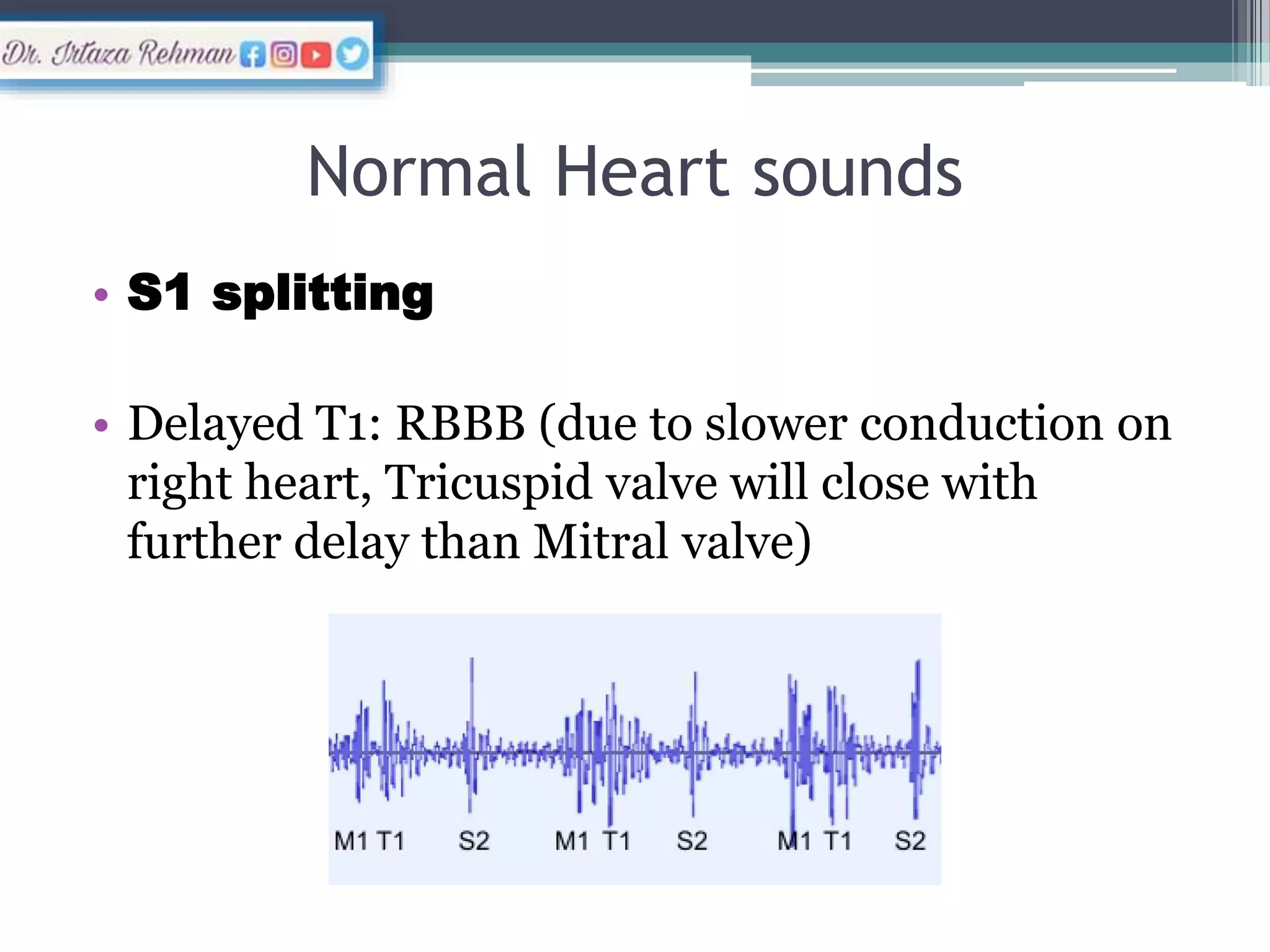
• S1 splitting
• Delayed T1: RBBB (due to slower conduction on
right heart, Tricuspid valve will close with
further delay than Mitral valve)
Normal Heart sounds
• S1 splitting
• Reverse splitting: LBBB, Severe MS (as mitral
valve will close with a delay after Pulmonary
valve in both condition). M1T1 pattern will be
reversed.
• T1  M1
Normal Heart sounds
• S2 splitting
• S2 is normally split
because the aortic valve (A2)
closes before the pulmonary
valve (P2)
• Split is more prominent in
inspiration.
Normal Heart sounds
• S2 splitting
• Wide splitting: splitting gets wide
and wider in inspiration. In RBBB,
Pulmonary stenosis ( late movt of
P.v)
• Fixed splitting: Equal delay in both
Ins & Exp. In ASD (Blood shunting
from left to right atrium  right
ventricle  Pulmonary artery 
Late closure of P.v)
• Paradoxical splitting: Aortic valve
moves slower. Aortic stenosis,
LBBB)
Normal Heart sounds
Third heart sound
• In early diastole
• Normally present in Kids,
Young adults, athletes,
pregnancy
• In older (congestive heart
failure)
Due to rapid
ventricular
filling during
diastole
Ventricular gallop
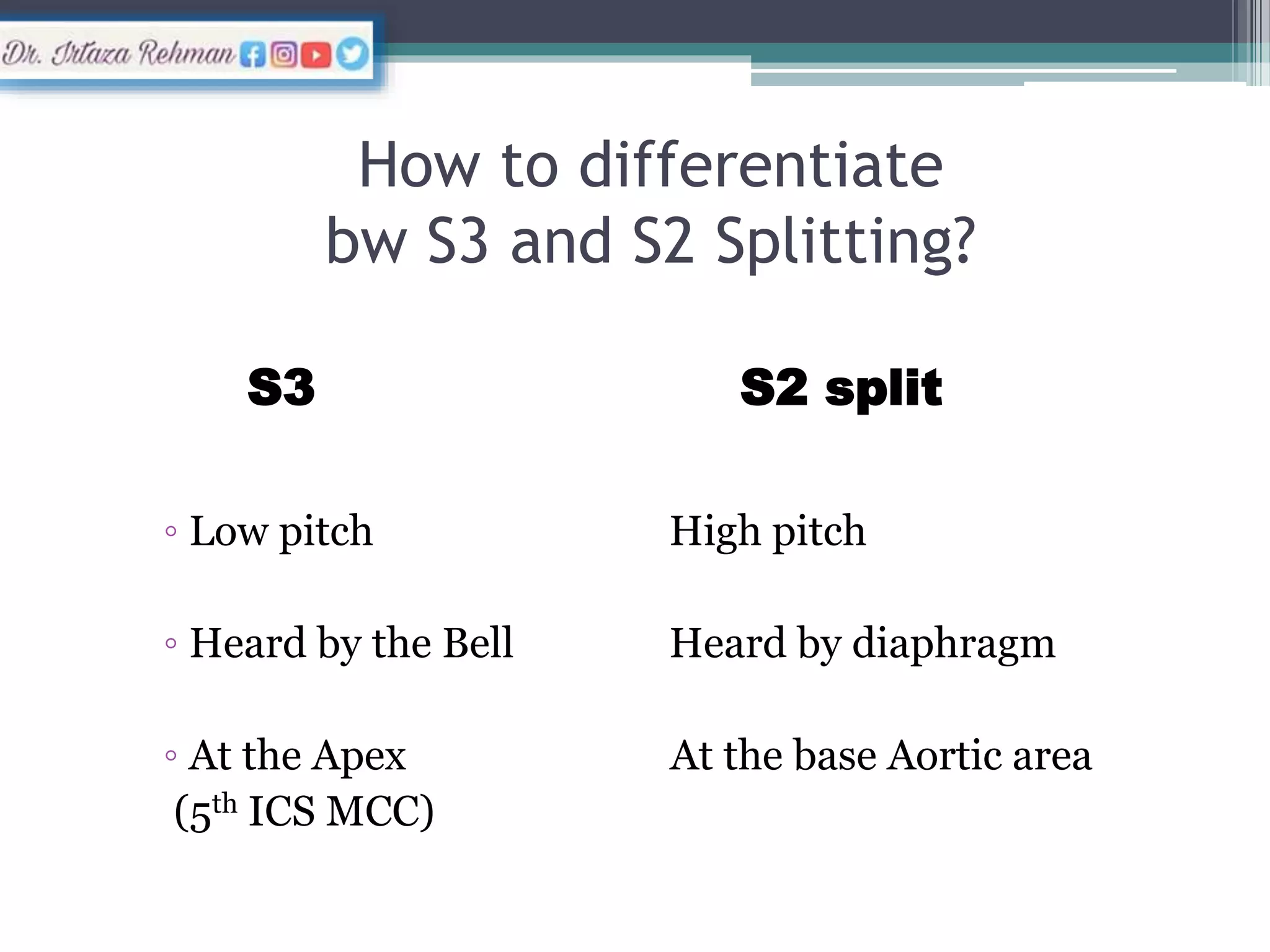
How to differentiate
bw S3 and S2 Splitting?
S3 S2 split
◦ Low pitch High pitch
◦ Heard by the Bell Heard by diaphragm
◦ At the Apex At the base Aortic area
(5th ICS MCC)
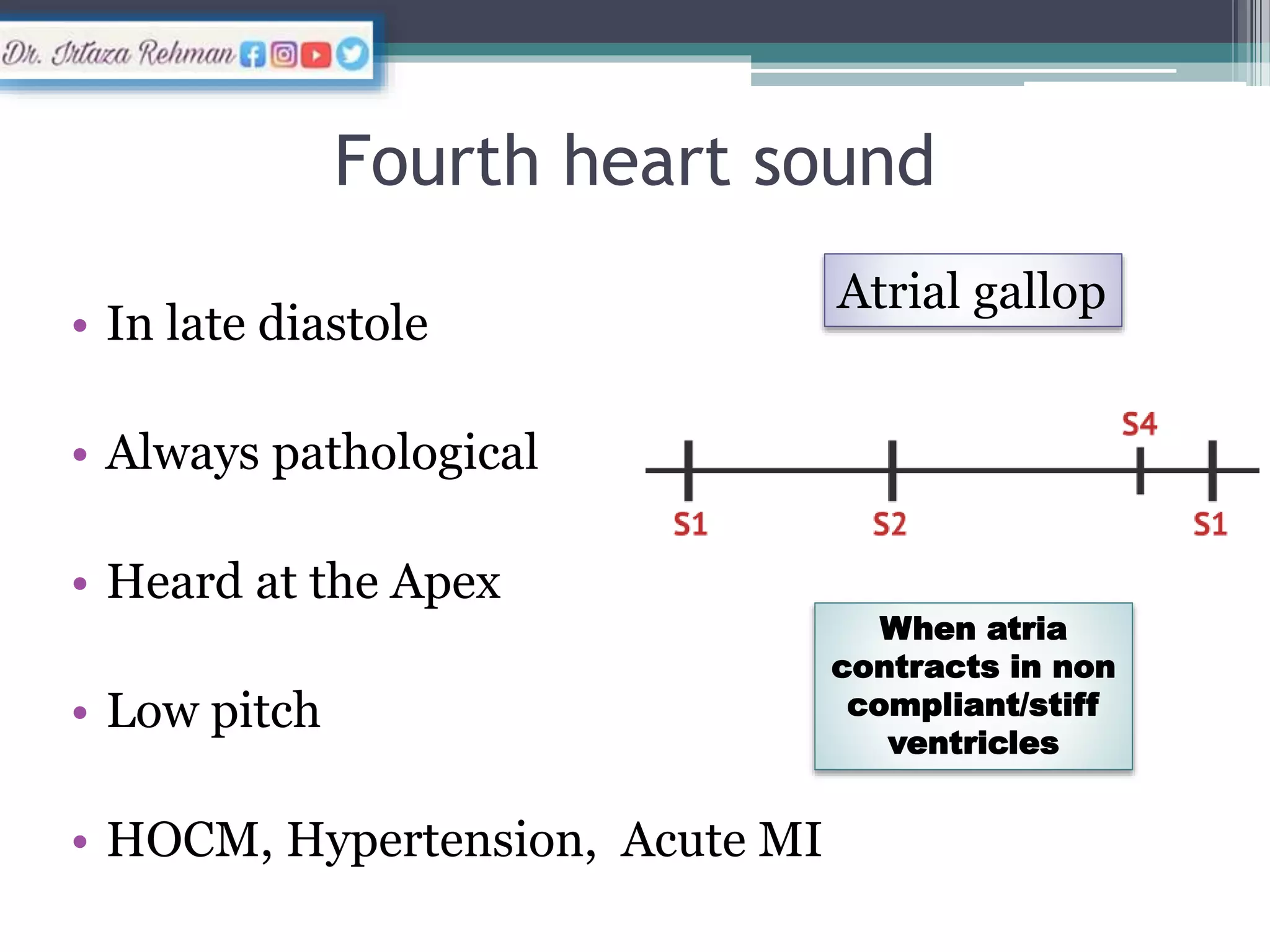
Fourth heart sound
• In late diastole
• Always pathological
• Heard at the Apex
• Low pitch
• HOCM, Hypertension, Acute MI
When atria
contracts in non
compliant/stiff
ventricles
Atrial gallop
Murmurs
• Murmurs are extra or unusual sounds made by
blood circulating through the heart's chambers
or valves, or through blood vessels near the
heart.
• Murmurs are produced due to any sort of turbulence
in normal blood flow across heart.
• Causes of turbulence:
i. Increase velocity of blood
ii. Decrease diameter (ASD, VSD) Decreased diameter will inc. the velocity.
iii. Incompetent valves ( Valvular heart diseases)
iv. Decrease viscosity of blood (Anemia)
v. Increase contractile strength of heart: Leads to hyperdynamic flow
(Exercise, Fever, Sepsis, Pregnancy etc)
Murmurs
Murmurs
HOW MURMURS CAN BE CLASSIFIED?
Murmurs can be classified according to their:
1. Location
2. Timing
3. Quality
4. Radiation
5. Intensity
Learn
To
Question
Repeatedly
&
Intelligently
Location of murmurs
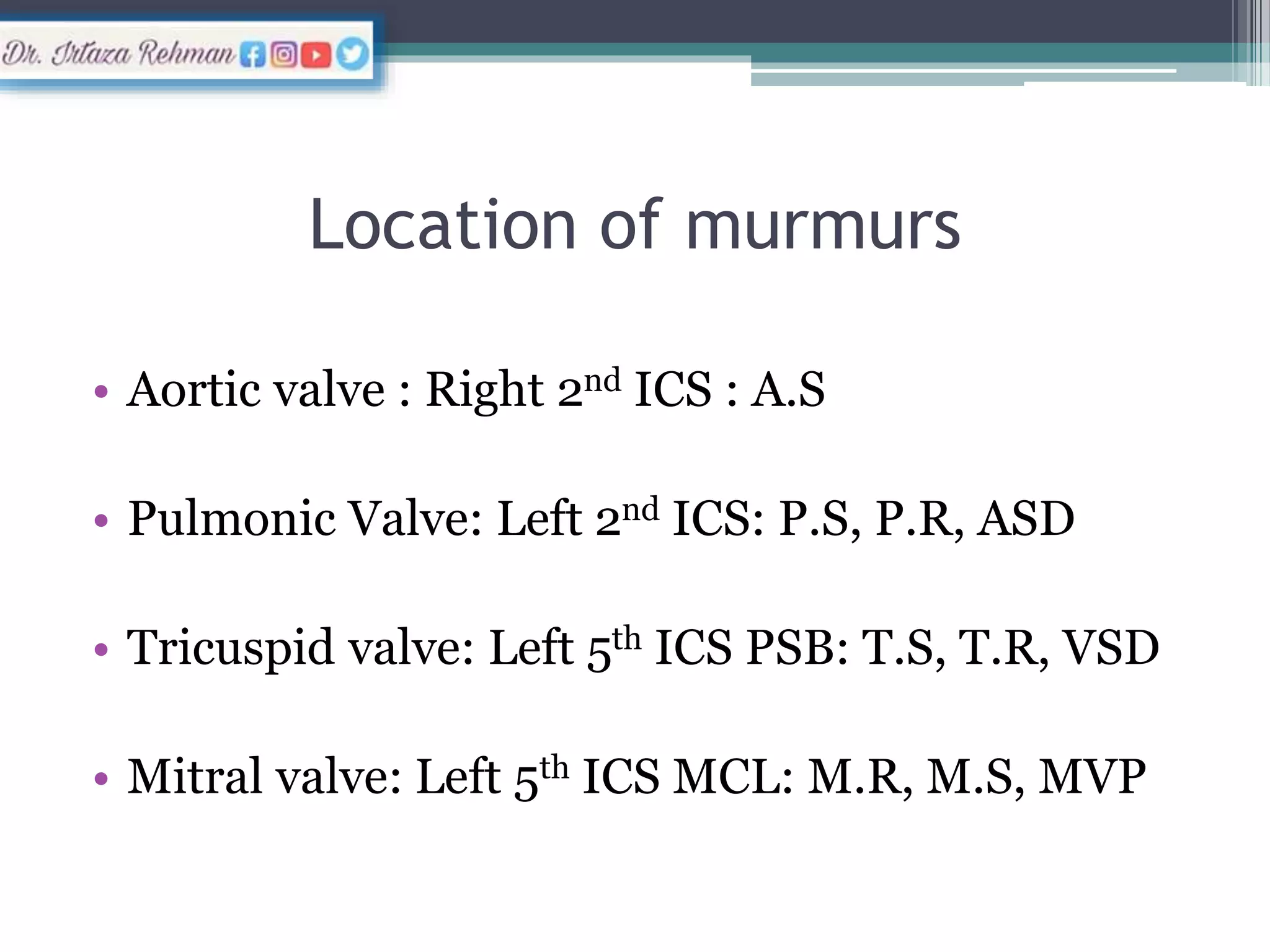
• Aortic valve : Right 2nd ICS : A.S
• Pulmonic Valve: Left 2nd ICS: P.S, P.R, ASD
• Tricuspid valve: Left 5th ICS PSB: T.S, T.R, VSD
• Mitral valve: Left 5th ICS MCL: M.R, M.S, MVP
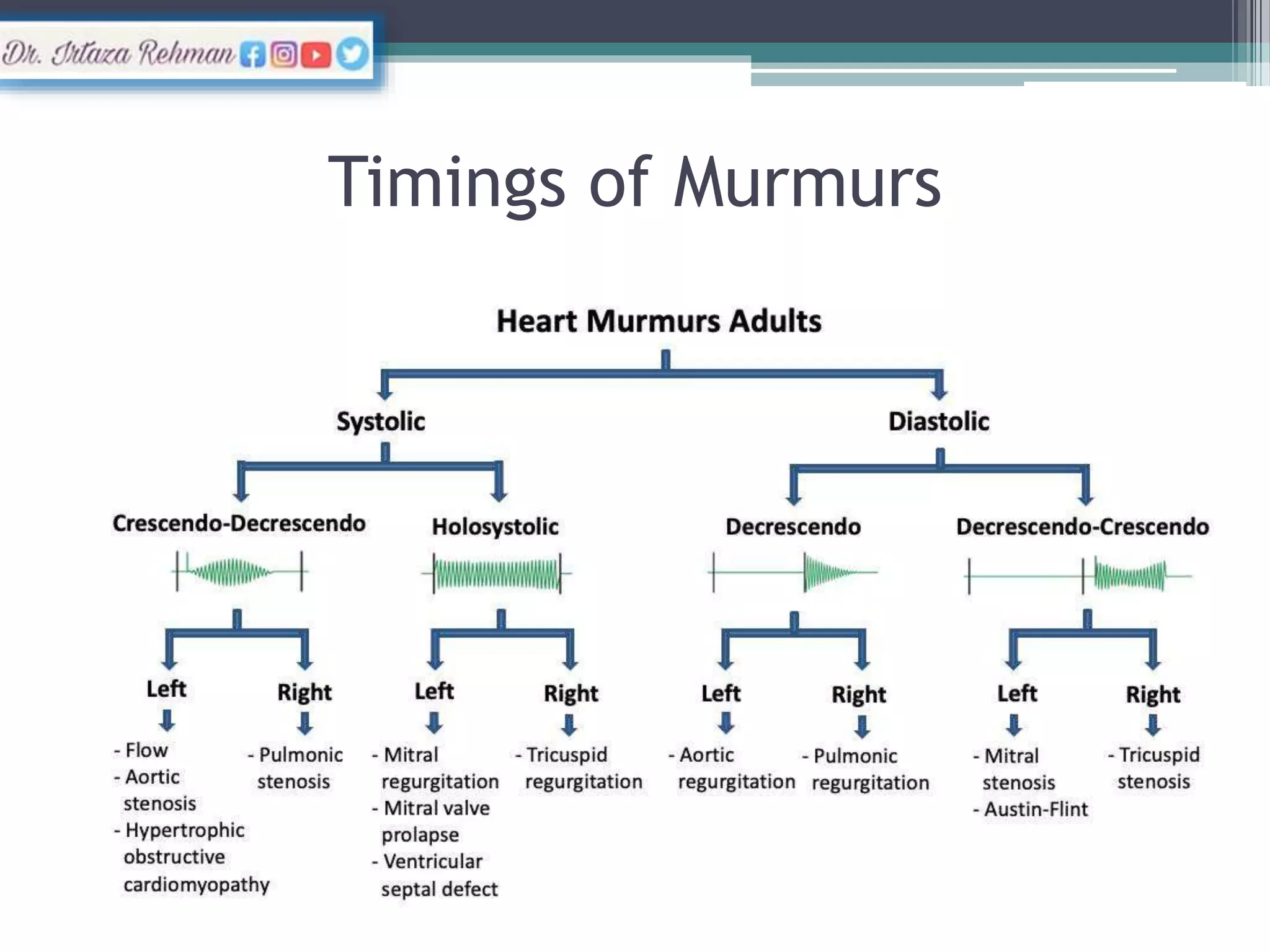
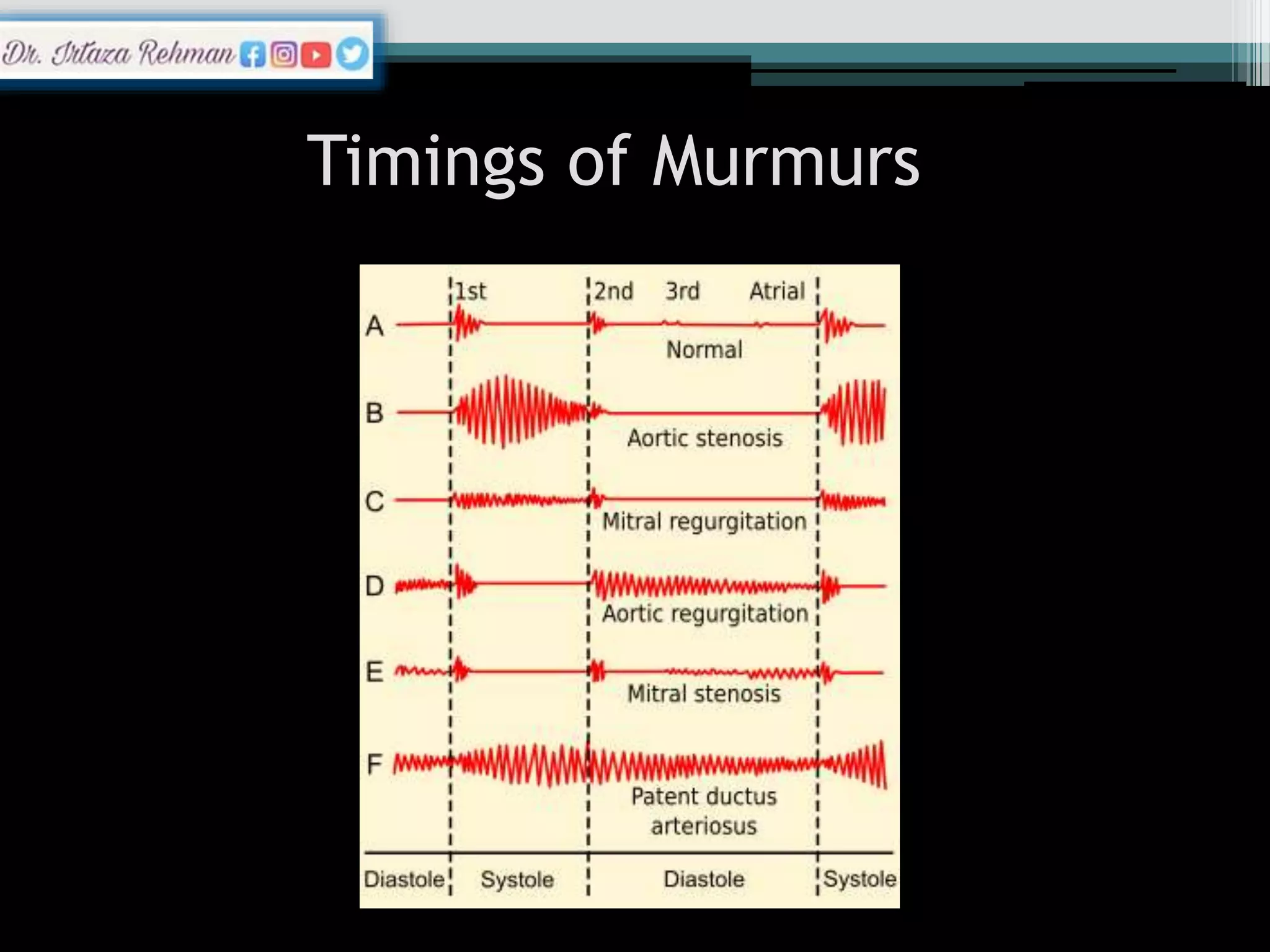
Timings of Murmurs
Timings of Murmurs
Timings of Murmurs
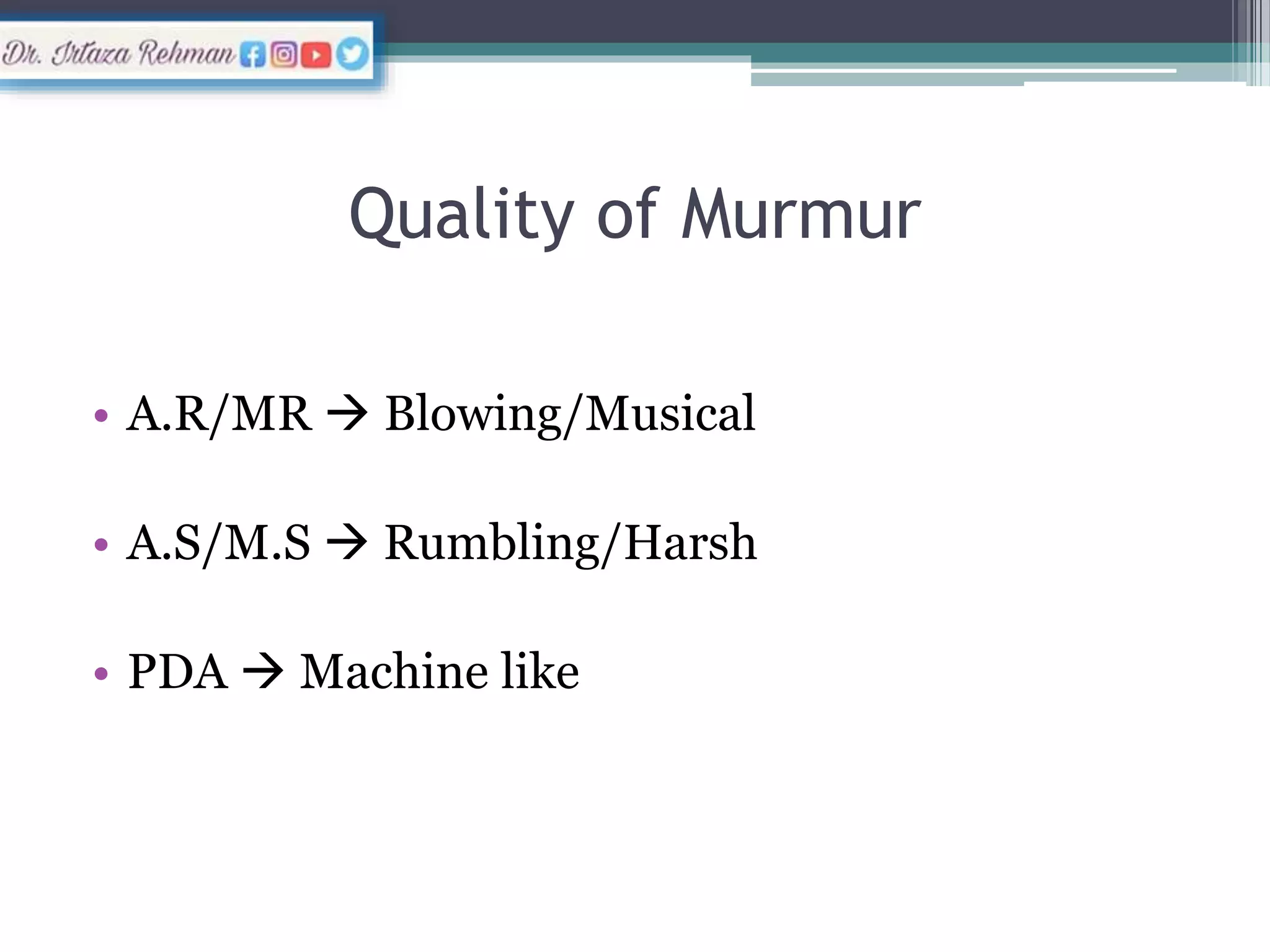
Quality of Murmur
• A.R/MR  Blowing/Musical
• A.S/M.S  Rumbling/Harsh
• PDA  Machine like
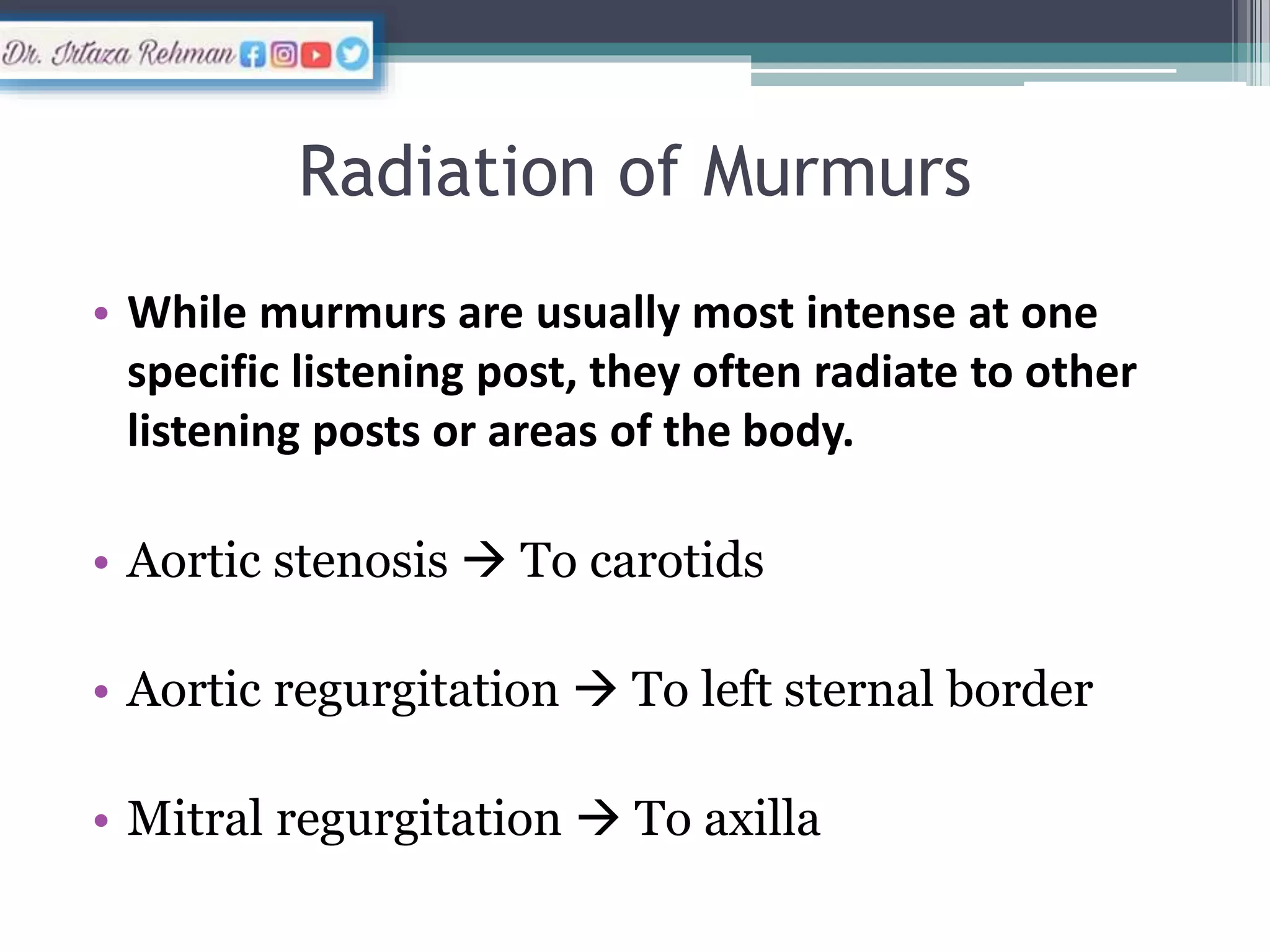
Radiation of Murmurs
• While murmurs are usually most intense at one
specific listening post, they often radiate to other
listening posts or areas of the body.
• Aortic stenosis  To carotids
• Aortic regurgitation  To left sternal border
• Mitral regurgitation  To axilla
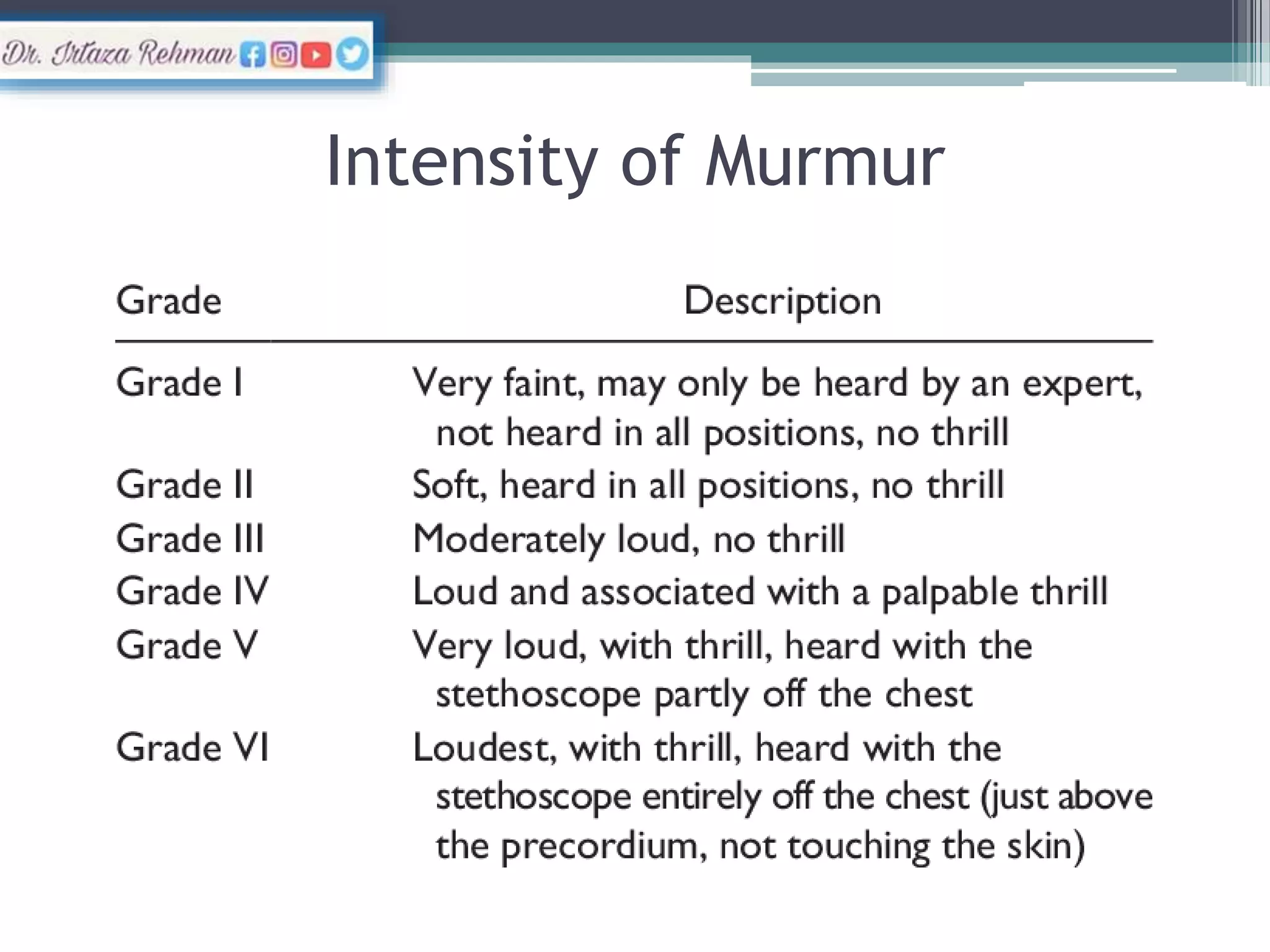
Intensity of Murmur
Terminology
• Regurgitation: Blood flow through a
structure normally closed during systole.
• Stenosis: Blood flow through an abnormally
narrowed structure/valve normally open in
systole.
Important Common murmurs
• Aortic stenosis:
• Ejection systolic/Early systolic murmur
• Crescendo-decrescendo
• Diamond shaped
• Harsh
• Aortic Regurgitation:
• Early diastolic
• Decrescendo
• Blowing
• Sharp S2
Important Common murmurs
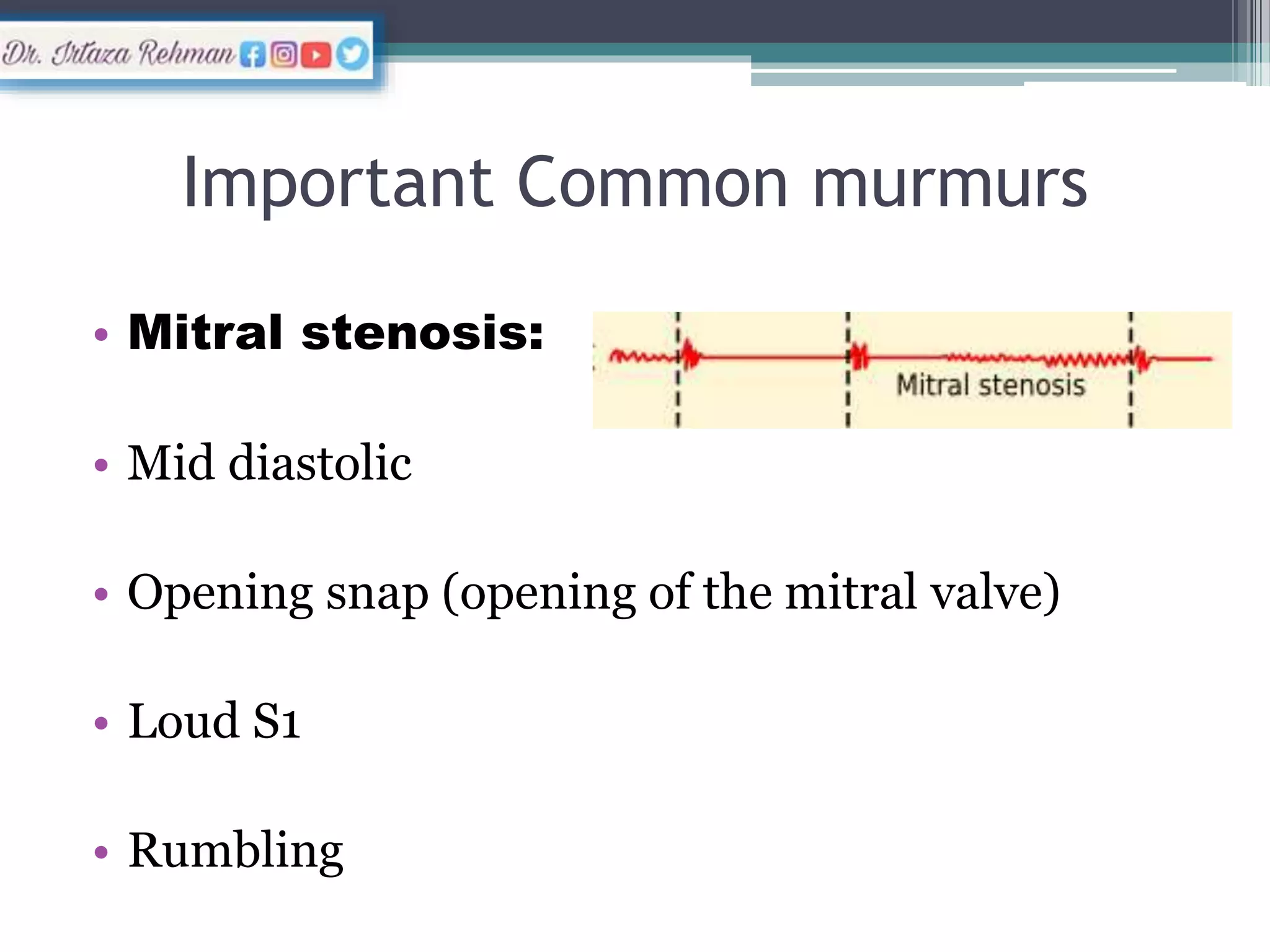
• Mitral stenosis:
• Mid diastolic
• Opening snap (opening of the mitral valve)
• Loud S1
• Rumbling
Important Common murmurs
Mitral stenosis
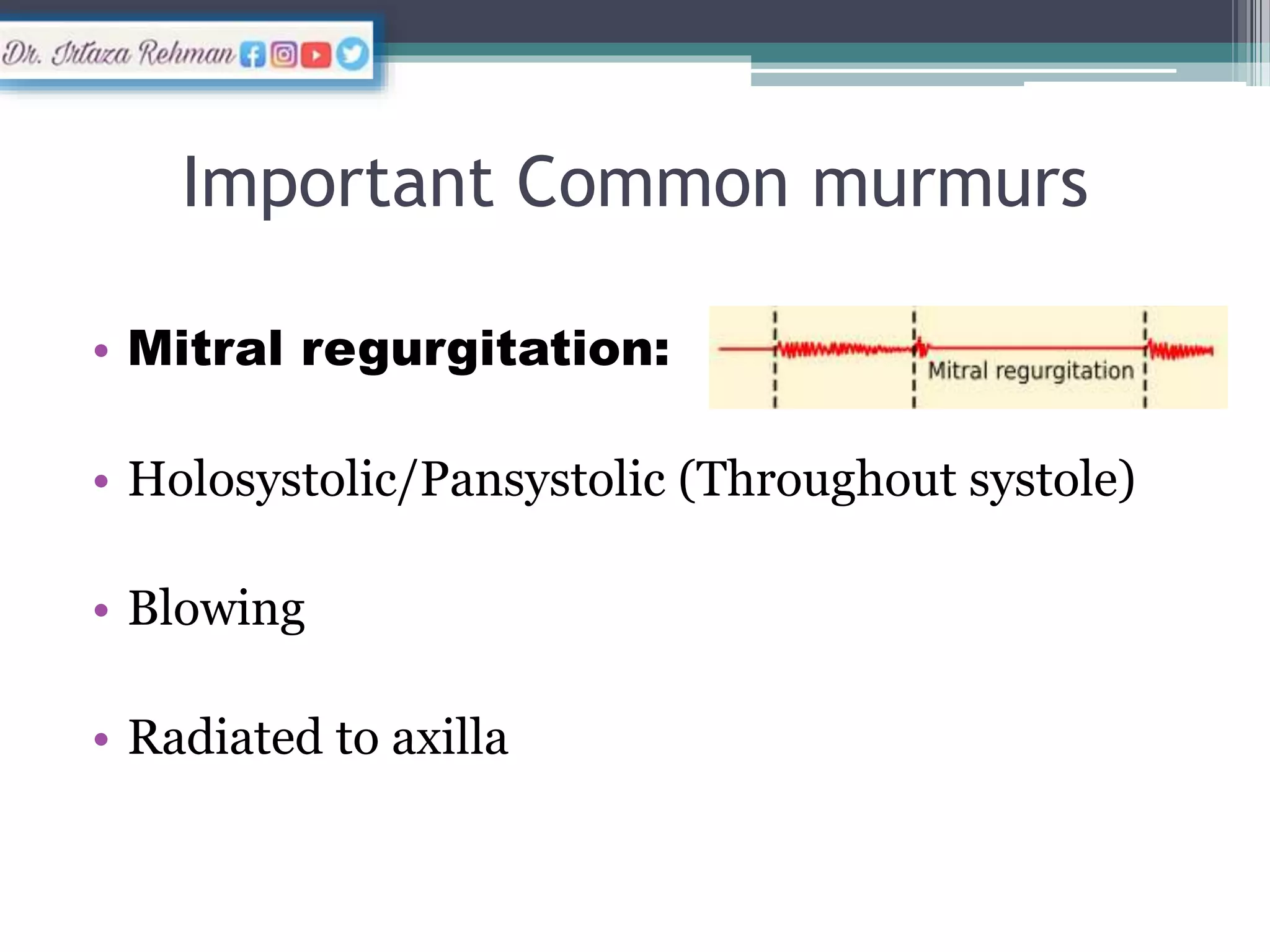
• Mitral regurgitation:
• Holosystolic/Pansystolic (Throughout systole)
• Blowing
• Radiated to axilla
Important Common murmurs
Jazakumullahu Khair ♥
(May ALLAH swt reward you with goodness)

Normal and abnormal Heart sounds (Murmurs).pptx

  • 1.
    Normal and abnormal Heart sounds(Murmurs) By Dr. Irtaza Rehman (Author of The Extraordinary Life)
  • 3.
    Learning Objectives • Tolearn about the Normal heart sounds • To learn about the Abnormal heart sounds
  • 4.
    Normal Heart sounds •Produced by the closure of Atrio-ventricular valves (Mitral and tricuspid) and Semilunar valves (aortic & pulmonary)
  • 5.
    Normal Heart sounds Sitesfor Auscultation
  • 7.
    Normal Heart sounds SystoleSystole Systole Diastole Diastole
  • 9.
    • S2: A2(Aortic valve closure) • Loud A2: Systemic Hypertension (High B.P will create louder noise) • Low A2: Systemic Hypotension, Aortic regurgitation (destruction of valve tissue and impairment of the valve closure mechanism) Normal Heart sounds
  • 10.
    • S2: P2(Pulmonary valve closure) • Loud P2: Pulmonary hypertension, ASD (Blood shunting from left to right atrium  right ventricle  Pulmonary artery  Loud P2) • Low/soft P2: Pulmonary stenosis Normal Heart sounds
  • 11.
    • S1 splitting •Normally T1 (Tricuspid closure) comes later than M1 due to slightly earlier closure of Mitral valve. • But this splitting is very narrow, almost negligible. May not be present at all. • So normally there is no splitting in S1. Normal Heart sounds
  • 12.
    • S1 splitting •Delayed T1: RBBB (due to slower conduction on right heart, Tricuspid valve will close with further delay than Mitral valve) Normal Heart sounds
  • 13.
    • S1 splitting •Reverse splitting: LBBB, Severe MS (as mitral valve will close with a delay after Pulmonary valve in both condition). M1T1 pattern will be reversed. • T1  M1 Normal Heart sounds
  • 14.
    • S2 splitting •S2 is normally split because the aortic valve (A2) closes before the pulmonary valve (P2) • Split is more prominent in inspiration. Normal Heart sounds
  • 15.
    • S2 splitting •Wide splitting: splitting gets wide and wider in inspiration. In RBBB, Pulmonary stenosis ( late movt of P.v) • Fixed splitting: Equal delay in both Ins & Exp. In ASD (Blood shunting from left to right atrium  right ventricle  Pulmonary artery  Late closure of P.v) • Paradoxical splitting: Aortic valve moves slower. Aortic stenosis, LBBB) Normal Heart sounds
  • 16.
    Third heart sound •In early diastole • Normally present in Kids, Young adults, athletes, pregnancy • In older (congestive heart failure) Due to rapid ventricular filling during diastole Ventricular gallop
  • 17.
    How to differentiate bwS3 and S2 Splitting? S3 S2 split ◦ Low pitch High pitch ◦ Heard by the Bell Heard by diaphragm ◦ At the Apex At the base Aortic area (5th ICS MCC)
  • 18.
    Fourth heart sound •In late diastole • Always pathological • Heard at the Apex • Low pitch • HOCM, Hypertension, Acute MI When atria contracts in non compliant/stiff ventricles Atrial gallop
  • 19.
    Murmurs • Murmurs areextra or unusual sounds made by blood circulating through the heart's chambers or valves, or through blood vessels near the heart.
  • 20.
    • Murmurs areproduced due to any sort of turbulence in normal blood flow across heart. • Causes of turbulence: i. Increase velocity of blood ii. Decrease diameter (ASD, VSD) Decreased diameter will inc. the velocity. iii. Incompetent valves ( Valvular heart diseases) iv. Decrease viscosity of blood (Anemia) v. Increase contractile strength of heart: Leads to hyperdynamic flow (Exercise, Fever, Sepsis, Pregnancy etc) Murmurs
  • 21.
    Murmurs HOW MURMURS CANBE CLASSIFIED? Murmurs can be classified according to their: 1. Location 2. Timing 3. Quality 4. Radiation 5. Intensity Learn To Question Repeatedly & Intelligently
  • 22.
    Location of murmurs •Aortic valve : Right 2nd ICS : A.S • Pulmonic Valve: Left 2nd ICS: P.S, P.R, ASD • Tricuspid valve: Left 5th ICS PSB: T.S, T.R, VSD • Mitral valve: Left 5th ICS MCL: M.R, M.S, MVP
  • 23.
  • 24.
  • 25.
  • 26.
    Quality of Murmur •A.R/MR  Blowing/Musical • A.S/M.S  Rumbling/Harsh • PDA  Machine like
  • 27.
    Radiation of Murmurs •While murmurs are usually most intense at one specific listening post, they often radiate to other listening posts or areas of the body. • Aortic stenosis  To carotids • Aortic regurgitation  To left sternal border • Mitral regurgitation  To axilla
  • 28.
  • 29.
    Terminology • Regurgitation: Bloodflow through a structure normally closed during systole. • Stenosis: Blood flow through an abnormally narrowed structure/valve normally open in systole.
  • 30.
    Important Common murmurs •Aortic stenosis: • Ejection systolic/Early systolic murmur • Crescendo-decrescendo • Diamond shaped • Harsh
  • 31.
    • Aortic Regurgitation: •Early diastolic • Decrescendo • Blowing • Sharp S2 Important Common murmurs
  • 32.
    • Mitral stenosis: •Mid diastolic • Opening snap (opening of the mitral valve) • Loud S1 • Rumbling Important Common murmurs
  • 33.
  • 34.
    • Mitral regurgitation: •Holosystolic/Pansystolic (Throughout systole) • Blowing • Radiated to axilla Important Common murmurs
  • 36.
    Jazakumullahu Khair ♥ (MayALLAH swt reward you with goodness)