HEART FAILURE IN CHILDHOOD
by Siti Sarah Nasution
1211356
CONTENTS
Physiology
Definition
Epidemiology
Etiology
Pathophysiology
Clinical Features
Investigations
Management
Differential Diagnosis
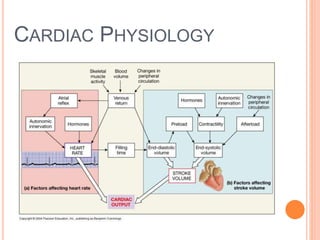
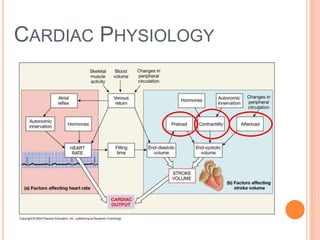
CARDIAC PHYSIOLOGY
CARDIAC PHYSIOLOGY
DEFINITION
Heart Failure occurs when the heart is
unable to deliver adequate cardiac output to meet
the metabolic needs of the body.
Nelson Textbook of Pediatrics, 19th Edition.
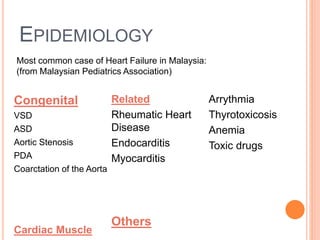
EPIDEMIOLOGY
Congenital
VSD
ASD
Aortic Stenosis
PDA
Coarctation of the Aorta
Cardiac Muscle
Related
Rheumatic Heart
Disease
Endocarditis
Myocarditis
Others
Arrythmia
Thyrotoxicosis
Anemia
Toxic drugs
Most common case of Heart Failure in Malaysia:
(from Malaysian Pediatrics Association)
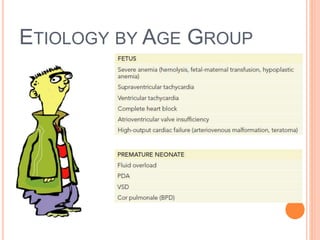
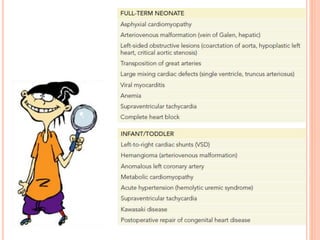
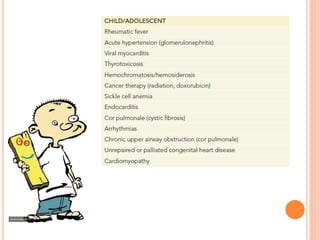
ETIOLOGY BY AGE GROUP
PATHOPHYSIOLOGY
FACTORS AFFECTING CARDIAC
PERFORMANCE:
 Preload
 Afterload
 Contractility
 Heart Rate
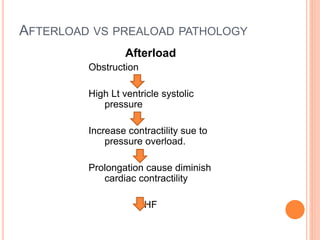
AFTERLOAD VS PREALOAD PATHOLOGY
Afterload
Obstruction
High Lt ventricle systolic
pressure
Increase contractility sue to
pressure overload.
Prolongation cause diminish
cardiac contractility
HF
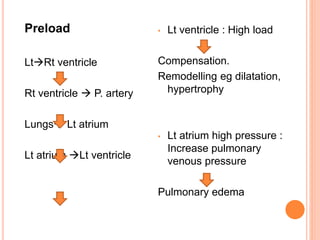
Preload
LtRt ventricle
Rt ventricle  P. artery
Lungs Lt atrium
Lt atrium Lt ventricle
• Lt ventricle : High load
Compensation.
Remodelling eg dilatation,
hypertrophy
• Lt atrium high pressure :
Increase pulmonary
venous pressure
Pulmonary edema
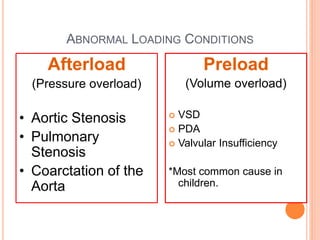
ABNORMAL LOADING CONDITIONS
Preload
(Volume overload)
 VSD
 PDA
 Valvular Insufficiency
*Most common cause in
children.
Afterload
(Pressure overload)
• Aortic Stenosis
• Pulmonary
Stenosis
• Coarctation of the
Aorta
Contractility :
 Normal : Frank-Starling Law – is the ability of the heart to change force
of contraction dependent on the change of preload.
 HF: Myocardium abnormalities either congenital or acquired. (Intrinsic
contractility compromised). Eg: myocarditis, cardiomyopathy, muscular
dystrophy.
Heart Rate :
 Eg: Tachyarrythmias shortens the diastolic time interval for ventricular
filling. Also affect the time for coronary perfusion.
LEFT, RIGHT AND BIVENTRICULAR HEART
FAILURE
1. Left-sided heart failure.
Reduce left ventricular output. High pressure in left atrial,
pulmonary vein. Pulmonary congestion.
2. Right-sided heart failure.
Reduce right ventricular output, for any given right atrium
pressure. Eg. Chronic lung disease.
3. Biventricular heart failure.
Secondary to the progression of the disease. Eg. Dilated
cardiomyopathy, ischemic heart disease.
Heart fails to keep pace with the hemodynamic demands.
Decrease myocardial performance. Myocardium metabolic
demand unmet.
Compensatory mechanism take place.
Initially compensated, at the end become decompensated.
Functional and structural disturbance of the heart
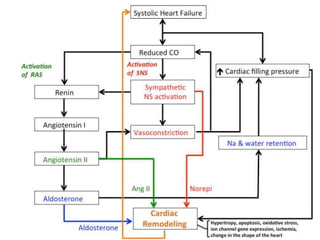
COMPENSATORY MECHANISM
1. Frank-Starling Mechanism
2. Neurohormonal System Activation
- RAAS
- Symphatoadrenal Axis
3. Myocardium Structural Changes
- Hypertrophy, apoptosis etc.
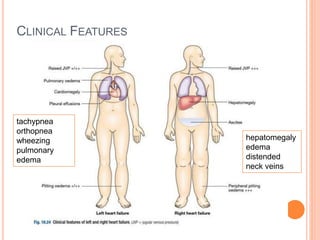
CLINICAL FEATURES
tachypnea
orthopnea
wheezing
pulmonary
edema
hepatomegaly
edema
distended
neck veins
Sign and Symptoms in Infancy
Symptoms
 Feeding difficulty : poor suck, prolonged time to feed, sweating during
feeding
 Recurrent chest infections
 Failure to thrive
Sign
 Resting tachypnoea, subcostal recession
 Tachycardia, poor peripheral pulses, poor peripheral perfusion
 Hyperactive praecordium, praecordial bulge
 Hepatomegaly
 Wheezing
In children, the sign and symptoms may be similar
with adults.
• Fatigue
• Effort intolerance
• Anorexia
• Abdominal pain
• Dyspnea
• Orthopnea
• Cough
• Edema (dependent part of body)
• Cardiomegaly
• JVP raised
Common sign of heart failure in adults eg.
Increase jugular venous pressure,
Leg edema,
Basal crackles
Are NOT usually found in chlidren.
INVESTIGATION
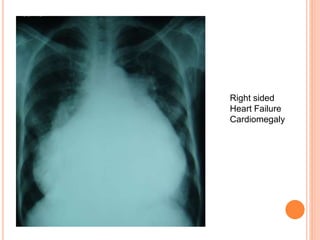
 Chest X-ray
-cardiomegaly
-pulmonary edema
 ECG
-chamber hypertrophy
-assess the cause of HF (Not diagnosis)
-evaluate rhythm disorder
- QRS morphologic n ST-T wave abnormalities =
myocardial inflammatory ds n pericardiatis
 Echocardiography
-assess ventricular function
-parameter :
 Children – fractional shortening
 Adult – ejection fraction
 Doppler Ultrasound
-estimate CO
-Assess cardiac function, wall motion abnormalities
 MRA (Magnetic Resonance Angiography)
-Lt Rt ventricle: function, volume, mass.
 Serum B-type Natriuretic Peptide (BNP)
-cardiac neurohormone released in response to
increased ventricular wall tension
-Increase in:
 Adult : CHF
 Children : HF (systolic dysfunction) & volume
overload (Lt-Rt shunt)
 Arterial Blood gases
-pH, PaO2, PaCO2 abnormalities checking.
Right sided
Heart Failure
Cardiomegaly
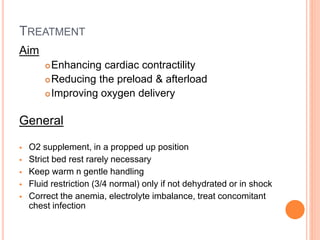
TREATMENT
Aim
Enhancing cardiac contractility
Reducing the preload & afterload
Improving oxygen delivery
General
 O2 supplement, in a propped up position
 Strict bed rest rarely necessary
 Keep warm n gentle handling
 Fluid restriction (3/4 normal) only if not dehydrated or in shock
 Correct the anemia, electrolyte imbalance, treat concomitant
chest infection
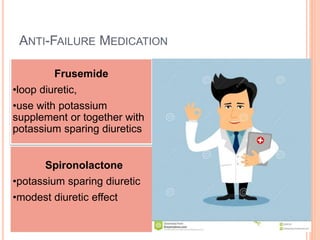
ANTI-FAILURE MEDICATION
Frusemide
•loop diuretic,
•use with potassium
supplement or together with
potassium sparing diuretics
Spironolactone
•potassium sparing diuretic
•modest diuretic effect
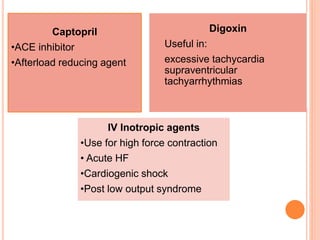
Captopril
•ACE inhibitor
•Afterload reducing agent
Digoxin
Useful in:
excessive tachycardia
supraventricular
tachyarrhythmias
IV Inotropic agents
•Use for high force contraction
• Acute HF
•Cardiogenic shock
•Post low output syndrome
SPECIFIC MANAGEMENT
 Etiology establishment
 Specific treatment for targeted etiology
 Congenital - Surgical or transcatheter treatment
 Heart block - Pacemaker
 Post infectious glomerulonephritis - Control BP
 Acute rheumatic carditis - High dose aspirin
DIFFERENTIAL DIAGNOSIS
 Acute Renal Failure
 Acute Respiratory Distress Syndrome
 Cirrhosis
 Emphysema
 Nephrotic Syndrome
 Pneumonia
 Pulmonary Edema
REFERENCES
 Nelson Textbook of Paediatrics, 19th edition.
 Nelson Essentials of Paediatrics, 7th edition.
 Paediatric Protocols for Malaysian Hospitals, 3rd
edition.
 Davidson’s Principles and Practice of Medicine, 21st
edition.

Heart failure in childhood

  • 1.
    HEART FAILURE INCHILDHOOD by Siti Sarah Nasution 1211356
  • 2.
  • 3.
  • 4.
  • 5.
    DEFINITION Heart Failure occurswhen the heart is unable to deliver adequate cardiac output to meet the metabolic needs of the body. Nelson Textbook of Pediatrics, 19th Edition.
  • 6.
    EPIDEMIOLOGY Congenital VSD ASD Aortic Stenosis PDA Coarctation ofthe Aorta Cardiac Muscle Related Rheumatic Heart Disease Endocarditis Myocarditis Others Arrythmia Thyrotoxicosis Anemia Toxic drugs Most common case of Heart Failure in Malaysia: (from Malaysian Pediatrics Association)
  • 7.
  • 10.
  • 11.
    FACTORS AFFECTING CARDIAC PERFORMANCE: Preload  Afterload  Contractility  Heart Rate
  • 12.
    AFTERLOAD VS PREALOADPATHOLOGY Afterload Obstruction High Lt ventricle systolic pressure Increase contractility sue to pressure overload. Prolongation cause diminish cardiac contractility HF
  • 13.
    Preload LtRt ventricle Rt ventricle P. artery Lungs Lt atrium Lt atrium Lt ventricle • Lt ventricle : High load Compensation. Remodelling eg dilatation, hypertrophy • Lt atrium high pressure : Increase pulmonary venous pressure Pulmonary edema
  • 14.
    ABNORMAL LOADING CONDITIONS Preload (Volumeoverload)  VSD  PDA  Valvular Insufficiency *Most common cause in children. Afterload (Pressure overload) • Aortic Stenosis • Pulmonary Stenosis • Coarctation of the Aorta
  • 15.
    Contractility :  Normal: Frank-Starling Law – is the ability of the heart to change force of contraction dependent on the change of preload.  HF: Myocardium abnormalities either congenital or acquired. (Intrinsic contractility compromised). Eg: myocarditis, cardiomyopathy, muscular dystrophy. Heart Rate :  Eg: Tachyarrythmias shortens the diastolic time interval for ventricular filling. Also affect the time for coronary perfusion.
  • 16.
    LEFT, RIGHT ANDBIVENTRICULAR HEART FAILURE 1. Left-sided heart failure. Reduce left ventricular output. High pressure in left atrial, pulmonary vein. Pulmonary congestion. 2. Right-sided heart failure. Reduce right ventricular output, for any given right atrium pressure. Eg. Chronic lung disease. 3. Biventricular heart failure. Secondary to the progression of the disease. Eg. Dilated cardiomyopathy, ischemic heart disease.
  • 17.
    Heart fails tokeep pace with the hemodynamic demands. Decrease myocardial performance. Myocardium metabolic demand unmet. Compensatory mechanism take place. Initially compensated, at the end become decompensated. Functional and structural disturbance of the heart
  • 18.
    COMPENSATORY MECHANISM 1. Frank-StarlingMechanism 2. Neurohormonal System Activation - RAAS - Symphatoadrenal Axis 3. Myocardium Structural Changes - Hypertrophy, apoptosis etc.
  • 20.
  • 21.
    Sign and Symptomsin Infancy Symptoms  Feeding difficulty : poor suck, prolonged time to feed, sweating during feeding  Recurrent chest infections  Failure to thrive Sign  Resting tachypnoea, subcostal recession  Tachycardia, poor peripheral pulses, poor peripheral perfusion  Hyperactive praecordium, praecordial bulge  Hepatomegaly  Wheezing
  • 22.
    In children, thesign and symptoms may be similar with adults. • Fatigue • Effort intolerance • Anorexia • Abdominal pain • Dyspnea • Orthopnea • Cough • Edema (dependent part of body) • Cardiomegaly • JVP raised
  • 23.
    Common sign ofheart failure in adults eg. Increase jugular venous pressure, Leg edema, Basal crackles Are NOT usually found in chlidren.
  • 24.
    INVESTIGATION  Chest X-ray -cardiomegaly -pulmonaryedema  ECG -chamber hypertrophy -assess the cause of HF (Not diagnosis) -evaluate rhythm disorder - QRS morphologic n ST-T wave abnormalities = myocardial inflammatory ds n pericardiatis
  • 25.
     Echocardiography -assess ventricularfunction -parameter :  Children – fractional shortening  Adult – ejection fraction  Doppler Ultrasound -estimate CO -Assess cardiac function, wall motion abnormalities  MRA (Magnetic Resonance Angiography) -Lt Rt ventricle: function, volume, mass.
  • 26.
     Serum B-typeNatriuretic Peptide (BNP) -cardiac neurohormone released in response to increased ventricular wall tension -Increase in:  Adult : CHF  Children : HF (systolic dysfunction) & volume overload (Lt-Rt shunt)  Arterial Blood gases -pH, PaO2, PaCO2 abnormalities checking.
  • 27.
  • 28.
    TREATMENT Aim Enhancing cardiac contractility Reducingthe preload & afterload Improving oxygen delivery General  O2 supplement, in a propped up position  Strict bed rest rarely necessary  Keep warm n gentle handling  Fluid restriction (3/4 normal) only if not dehydrated or in shock  Correct the anemia, electrolyte imbalance, treat concomitant chest infection
  • 29.
    ANTI-FAILURE MEDICATION Frusemide •loop diuretic, •usewith potassium supplement or together with potassium sparing diuretics Spironolactone •potassium sparing diuretic •modest diuretic effect
  • 30.
    Captopril •ACE inhibitor •Afterload reducingagent Digoxin Useful in: excessive tachycardia supraventricular tachyarrhythmias IV Inotropic agents •Use for high force contraction • Acute HF •Cardiogenic shock •Post low output syndrome
  • 31.
    SPECIFIC MANAGEMENT  Etiologyestablishment  Specific treatment for targeted etiology  Congenital - Surgical or transcatheter treatment  Heart block - Pacemaker  Post infectious glomerulonephritis - Control BP  Acute rheumatic carditis - High dose aspirin
  • 32.
    DIFFERENTIAL DIAGNOSIS  AcuteRenal Failure  Acute Respiratory Distress Syndrome  Cirrhosis  Emphysema  Nephrotic Syndrome  Pneumonia  Pulmonary Edema
  • 33.
    REFERENCES  Nelson Textbookof Paediatrics, 19th edition.  Nelson Essentials of Paediatrics, 7th edition.  Paediatric Protocols for Malaysian Hospitals, 3rd edition.  Davidson’s Principles and Practice of Medicine, 21st edition.

Editor's Notes

  • #25 QRS morphologic n ST-T wave abnormalities = myocardial inflammatory ds n pericardiatis