Physical Assessment Acute Care Nursing Program 2005
Outline Assessment Process Respiratory Assessment Cardiac Assessment Neurological Assessment Abdominal Assessment Neurovascular Assessment
Assessment Process Inspection  Palpation Percussion Auscultation Gather information – base line Record trends
Respiratory Assessment Inspection  Palpation Percussion Auscultation
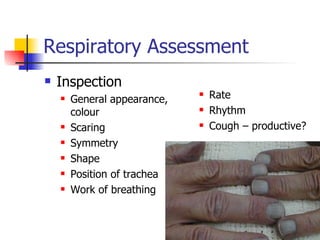
Respiratory Assessment Inspection General appearance, colour Scaring Symmetry Shape Position of trachea Work of breathing Rate Rhythm Cough – productive?
Respiratory Assessment Palpation Chest excursion Tactile and vocal fremitus
 
Respiratory Assessment Percussion Normal – resonant, hollow sound Solid - dull Percussion is done in the intercostal spaces Percussion is done both on the posterior chest and lateral chest
 
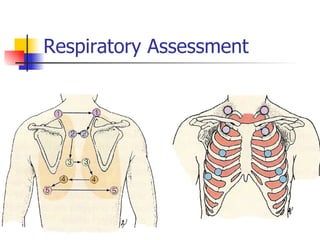
Respiratory Assessment Auscultation Systematic approach Note adventitious (extra) Crackles Wheeze Friction rub
Respiratory Assessment
Cardiac Assessment Inspection Palpation (Percussion) Auscultation
Cardiac Assessment Inspection JVP Oedema Colour
Cardiac Assessment Palpation Pulse Oedema Capillary refill Blood pressure
Cardiac Assessment Auscultation Normal  S1  S2 Abnormal  S2 split S3 S4
 
Cardiac Assessment
Neurological Assessment Glasgow Coma Scale Cranial Nerves
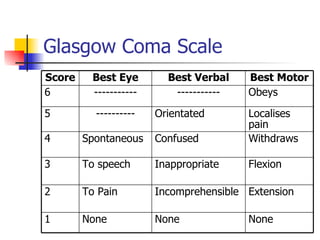
Glasgow Coma Scale Assess neurological status Assessment of best response Eyes Verbal Motor
Glasgow Coma Scale None None None 1 Extension Incomprehensible To Pain  2 Flexion Inappropriate To speech 3 Withdraws Confused Spontaneous 4 Localises pain Orientated ---------- 5 Obeys ----------- ----------- 6 Best Motor Best Verbal Best Eye Score
Cranial Nerves 12 cranial nerves 3 rd  – 12 th  within brainstem  (Midbrain, Pons, Medulla)
Cranial Nerve Function: Sensory  Smell Assessment: Recognition of odor I Olfactory
Cranial Nerve Function: Sensory  Information from the retina Assessment: Visual acuity II Optic
Cranial Nerve Function: Motor  Four of the six extra-ocular muscles Assessment: Response to light Moves eye Elevates upper eyelid III Oculomotor
Cranial Nerve Function: Motor Controls the oblique eye muscle Assessment: Moves eye right, left, up and down IV Trochlear
Cranial Nerve Function: Mixed Three sensory Corneal Reflex One motor Assessment: Normal facial sensation Blinks Clenches teeth V Trigeminal
Cranial Nerve Function: Motor  Lateral rectus muscle of eye Assessment: Moves eye laterally VI Abducens
Cranial Nerve Function: Mixed  Sensory Tongue Motor Eyelids Assessment: Elevates eyebrows Puffs checks Recognizes tastes VII Facial
Cranial Nerve Function: Sensory  Hearing Assessment: Whisper in each ear VIII Vestibulocochlear
Cranial Nerve Function: Mixed  Sensory Taste buds Motor Gag reflex Assessment: Taste testing Test gag IX Glossopharyngeal
Cranial Nerve Function: Mixed  Motor branches to the pharyngeal and laryngeal muscles Viscera of the thorax and abdomen Assessment: Same as IX X Vagus
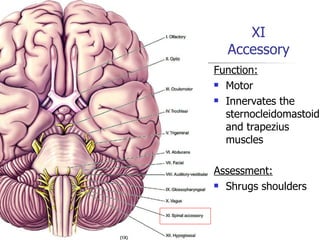
Cranial Nerve Function: Motor Innervates the sternocleidomastoid and trapezius muscles Assessment: Shrugs shoulders XI Accessory
Cranial Nerve Function: Motor Tongue muscles Assessment: Sticks out tongue XII Hypoglossal
Abdominal Assessment  Inspection Auscultation Percussion Palpation
 
 
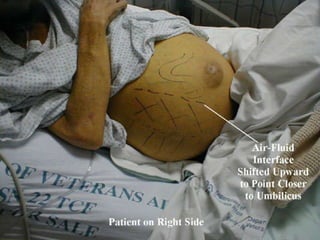
Abdominal Assessment  Inspection Asymmetry Engorged veins  Intestinal movements Lesions Scars Swelling
 
Abdominal Assessment  Auscultation Systematic  Bowel sounds
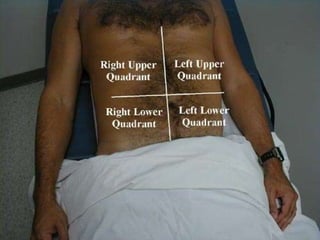
Abdominal Assessment  Percussion All four quadrants Tympanic- air filled structures  Dull – solid structures Bowel Liver Bladder
 
 
Abdominal Assessment  Palpation Light and Deep Tenderness, guarding, rigidity Define organs Kehr’s sign McBurney’s point Murphy’s sign
Neurovascular Assessment Colour Temperature Capillary Refill Peripheral Pulses Swelling  Movement Sensation
References A Practical guide to clinical assessment  http://medicine.ucsd.edu/clinicalmed/ Smith SF, Duell DJ & Martin BC, 2005,  Clinical Nursing Skills ,  Prentice Hall, New Jersey.

Physical assessment

Editor's Notes

  • #4 Inspection: Observe the patient of skin colour and texture; check for lesions, scars of hair disruption Palpation: Information by using hands and finger to palpate. A light or deep palpation depending on the area being palpated. Used to assess organ position, size and consistency, fluid accumulation, pain and masses. Percussion: Produces sound waves by using the fingers as a hammer. Vibration is produced by the impact of the fingers striking against underlying tissue. Sound or tone is usually determined by the body area or organ percussed. Auscultation: Listening using a stethoscope. Place stethoscope on bare skin to listen for the characteristics of sound waves. The bell of the stethoscope is used to detect low-pitch sounds, the diaphragm to detect high-pitched sounds. Notice vibrations in intensity, pitch, duration and quality.
  • #15 Pulse – pulse deficit listen to apex and feel radial – if there is a difference this indicates a pulse deficit
  • #16 S1 – tricuspid and mitral valve closure S2 – pulmonic and aortic valve closure
  • #18 S2 split – A2 = aortic valve closure, P2 = pulmonic valve closure. On inspiration, venous return to the heart is impeded and pulmonic valve closure is delayed resulting in a split sound. Can be normal in some people. Get patient to hold breath to hear this better S3 – left ventricular failure: and is caused by blood from the left atrium slamming into an already overfilled ventricle during early diastolic filling S4 - left ventricular hypertrophy: blood trying to enter a stiff, non-compliant left ventricle during atrial contraction
  • #23 Recognition of an odour such as coffee or toothpaste
  • #24 Ability to read newsprint
  • #25 Motor nerve: controls four out of the six extra-ocular muscles, raise eyelids and controls the constrictor pupillar and ciliary muscles of the eyeball.
  • #27 Assessment: Clenches teeth with no lateral jaw deviation
  • #29 Recognises tastes such as sugar salt
  • #34 Ability to stick tongue out in a midline without deviation
  • #38 Cullen's sign – bluish colour around the umbilicus seen in hemorrhagic pancreases Grey turner’s sign – bruising in the flanks associated with retroperitoneal bleeding.
  • #39 Caput Medusae – head of medusa a mythical snake-haired person. Associated with
  • #40 Start in (L) lilac fossa region Bowel sounds – timing, frequency, etc… Renal arteries – bruits, abnormal pathological flow of blood resulting in a swishing sound or murmur. Note timings such as, occurrence with other cycles and location. All are specific
  • #41 Liver, start high on ribs and work down Bladder – only when full, otherwise is small within pelvis
  • #42 Liver, start high on ribs and work down Bladder – only when full, otherwise is small within pelvis
  • #43 Liver, start high on ribs and work down Bladder – only when full, otherwise is small within pelvis
  • #44 Kehr’s sign – referred pain to shoulder in splenic injury (occurs in approx 50% of cases) McBuney’s point – located 1/3 distacnce from the anterior superior iliac spine to the umbilicus. Tenderness associated with appendicitis Murphy's sign – on inspiration, pain associated with palpation of the RUQ, indicative of choecystitis.