


1
PowerPointPowerPoint Presentation byPresentation by
Gail B. WrightGail B. Wright
Professor Emeritus of AccountingProfessor Emeritus of Accounting
Bryant UniversityBryant University
© Copyright 2007 Thomson South-Western, a part of The
Thomson Corporation. Thomson, the Star Logo, and
South-Western are trademarks used herein under license.
MANAGEMENT
ACCOUNTING
8th
EDITION
BY
HANSEN & MOWEN
1 INTRODUCTION
15 QUALITY COSTS & PRODUCTIVITY
2
LEARNING GOALS
After studying this
chapter, you should be
able to:
LEARNING OBJECTIVESLEARNING OBJECTIVES
3
1. Identify & describe the 4 types of quality
costs.
2. Prepare a quality cost report; differentiate
between acceptable quality level & total
quality control.
3. Tell why quality cost information is needed &
show how it is used.
4. Explain what productivity is; calculate the
impact of productivity changes on profits.
LEARNING OBJECTIVESLEARNING OBJECTIVES
Click the button to skip
Questions to Think About
4
QUESTIONS TO THINK ABOUT:
Ladd Lighting Corporation
Why has the measurement of
productivity & quality become
so important?
5
QUESTIONS TO THINK ABOUT:
Ladd Lighting Corporation
What are quality costs?
6
QUESTIONS TO THINK ABOUT:
Ladd Lighting Corporation
What kinds of quality cost
reports should be prepared by
the Accounting Department?
7
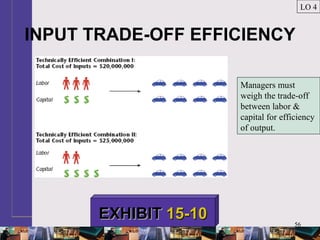
QUESTIONS TO THINK ABOUT:
Ladd Lighting Corporation
What is meant by “productivity?”
8
1
Identify & describe
the 4 types of quality
costs.
LEARNING OBJECTIVELEARNING OBJECTIVE
9
QUALITY
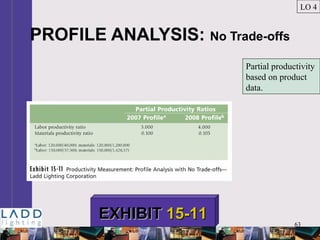
Russell Walsh of Ladd Lighting recognizes
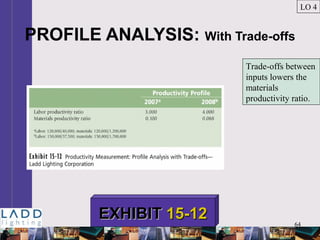
that quality improvement can increase
profitability by:
 Increasing customer demand
 Decreasing costs
LO 1
10
WEIGHING COSTS & BENEFITS
Managers need to know what quality costs
are & how they change over time
Costs of quality
Studies suggest that cost of quality production
might be as much as 20% – 30% of sales
Benefits of quality
Competitive dimension
LO 1
11
QUALITY PRODUCT,
SERVICE: Definition
QUALITY PRODUCT,
SERVICE: Definition
Is one that meets or exceeds
customer expectations.
LO 1
12
DIMENSIONS OF QUALITY: 1
Performance: how consistently a product
functions
Aesthetics: appearance of tangible products,
facilities, communication materials
Serviceability: ease of maintaining, repairing
product
Features of quality design: characteristics that
differentiate between similar products
LO 1
Continued
13
DIMENSIONS OF QUALITY: 2
Reliability: probability that product, service
will perform intended function for specified
length of time
Durability: length of time a product functions
Quality of conformance: measure of how a
product meets its specifications
Fitness for use: suitability of product for
advertised functions
LO 1
14
DEFECTIVE PRODUCT:
Definition
DEFECTIVE PRODUCT:
Definition
Is one that does not conform to
specifications. Zero defects is
the goal.
LO 1
15
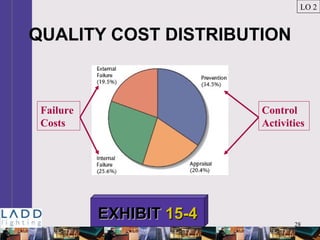
What are costs of quality?
Costs that exist because poor
quality does or may exist:
• Control activities to prevent,
detect poor quality.
• Failure activities are responses to
poor quality.
LO 1
16
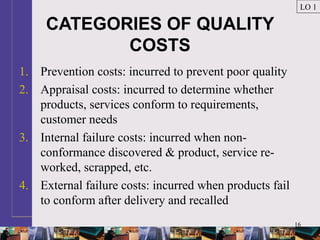
CATEGORIES OF QUALITY
COSTS
1. Prevention costs: incurred to prevent poor quality
2. Appraisal costs: incurred to determine whether
products, services conform to requirements,
customer needs
3. Internal failure costs: incurred when non-
conformance discovered & product, service re-
worked, scrapped, etc.
4. External failure costs: incurred when products fail
to conform after delivery and recalled
LO 1
17
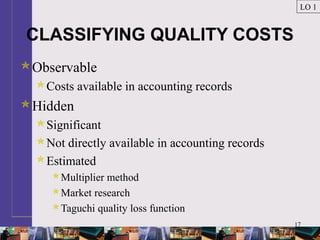
CLASSIFYING QUALITY COSTS
Observable
Costs available in accounting records
Hidden
Significant
Not directly available in accounting records
Estimated
Multiplier method
Market research
Taguchi quality loss function
LO 1
18
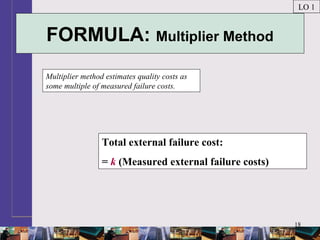
FORMULA: Multiplier Method
Multiplier method estimates quality costs as
some multiple of measured failure costs.
LO 1
Total external failure cost:
= k (Measured external failure costs)
19
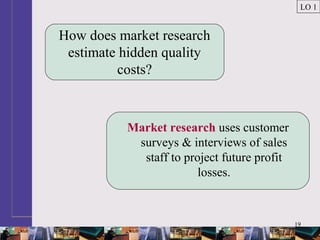
How does market research
estimate hidden quality
costs?
Market research uses customer
surveys & interviews of sales
staff to project future profit
losses.
LO 1
20
SPECIFICATION LIMIT: DefinitionSPECIFICATION LIMIT: Definition
In traditional quality model,
defines the area of acceptable
quality around the target value.
LO 1
21
What assumption does the
Taguchi quality loss
function make?
Taguchi quality loss function
assumes that variations from
target value of quality
characteristic causes hidden
quality costs regardless of
specification limits.
LO 1
22
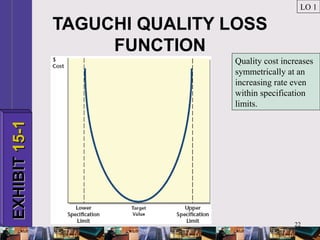
TAGUCHI QUALITY LOSS
FUNCTION
LO 1
EXHIBITEXHIBIT15-115-1
Quality cost increases
symmetrically at an
increasing rate even
within specification
limits.
23
FORMULA: Taguchi Function
Taguchi quality loss function estimates hidden
costs of poor quality.
LO 1
[Quality loss * Actual value of quality
characteristic] L(y)
= a proportional constant multiplier of
external cost failure structure * (difference
between actual and target value squared)
L(y) = k(y-T)2
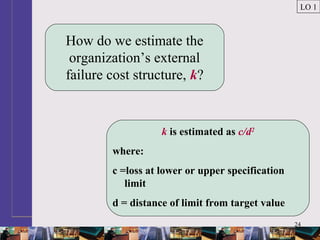
24
How do we estimate the
organization’s external
failure cost structure, k?
k is estimated as c/d2
where:
c =loss at lower or upper specification
limit
d = distance of limit from target value
LO 1
25
2
Prepare a quality cost
report; differentiate
between acceptable
quality level & total
quality control.
LEARNING OBJECTIVELEARNING OBJECTIVE
26
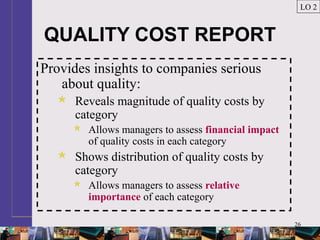
QUALITY COST REPORT
Provides insights to companies serious
about quality:
 Reveals magnitude of quality costs by
category
 Allows managers to assess financial impact
of quality costs in each category
 Shows distribution of quality costs by
category
 Allows managers to assess relative
importance of each category
LO 2
27
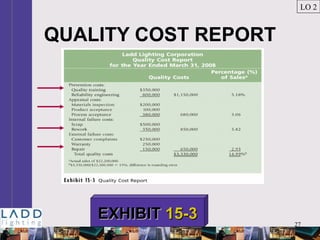
QUALITY COST REPORT
LO 2
EXHIBITEXHIBIT 15-315-3
28
QUALITY COST DISTRIBUTION
LO 2
EXHIBITEXHIBIT 15-415-4
Failure
Costs
Control
Activities
29
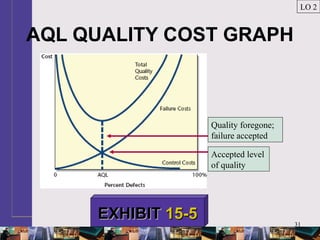
ACCEPTABLE QUALITY
LEVEL (AQL): Definition
ACCEPTABLE QUALITY
LEVEL (AQL): Definition
Is the optimal balance
between control costs &
failure costs.
LO 2
30
Is there a problem with the
ACL (traditional) view of
quality?
AQL encouraged lower quality
levels by accepting production
of a given number of defective
units.
LO 2
31
AQL QUALITY COST GRAPH
LO 2
EXHIBITEXHIBIT 15-515-5
Accepted level
of quality
Quality foregone;
failure accepted
32
ZERO DEFECTS MODEL:
Definition
ZERO DEFECTS MODEL:
Definition
Claims that it is cost
beneficial to reduce non-
conforming units to zero.
LO 2
33
Is there a problem with the
zero defects model?
Zero defects model understates
quality costs & the potential for
savings from efforts to improve
quality.
LO 2
34
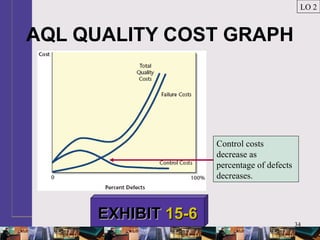
AQL QUALITY COST GRAPH
LO 2
EXHIBITEXHIBIT 15-615-6
Control costs
decrease as
percentage of defects
decreases.
35
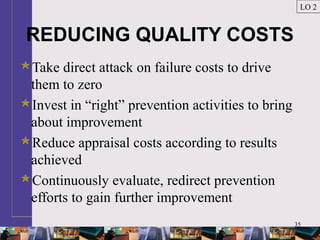
REDUCING QUALITY COSTS
Take direct attack on failure costs to drive
them to zero
Invest in “right” prevention activities to bring
about improvement
Reduce appraisal costs according to results
achieved
Continuously evaluate, redirect prevention
efforts to gain further improvement
LO 2
36
What is the strategy for
reducing costs based on?
The strategy is based on the premise
that a) there is a root cause for each
failure, b) causes are preventable,
and c) prevention is always cheaper.
LO 2
37
ABM & OPTIMAL QUALITY
COSTS
ABM classifies costs as value-added &
non-value-added and recommends
non-value-added costs be eliminated.
 Value-added quality costs
 Prevention activities, when performed
efficiently
 Non-value-added quality costs
 Appraisal costs
 Failure costs (both internal & external)
LO 2
38
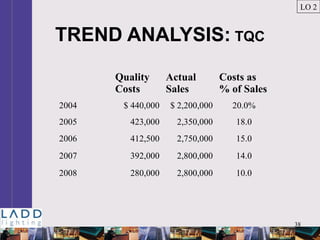
TREND ANALYSIS: TQC
Quality
Costs
Actual
Sales
Costs as
% of Sales
2004 $ 440,000 $ 2,200,000 20.0%
2005 423,000 2,350,000 18.0
2006 412,500 2,750,000 15.0
2007 392,000 2,800,000 14.0
2008 280,000 2,800,000 10.0
LO 2
39
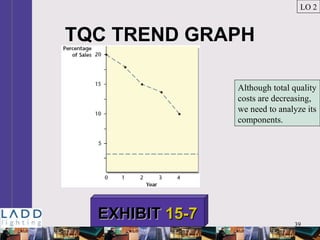
TQC TREND GRAPH
LO 2
EXHIBITEXHIBIT 15-715-7
Although total quality
costs are decreasing,
we need to analyze its
components.
40
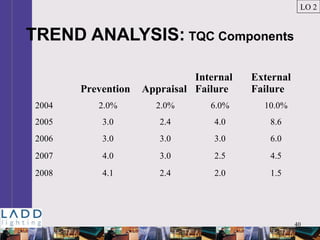
TREND ANALYSIS: TQC Components
Prevention Appraisal
Internal
Failure
External
Failure
2004 2.0% 2.0% 6.0% 10.0%
2005 3.0 2.4 4.0 8.6
2006 3.0 3.0 3.0 6.0
2007 4.0 3.0 2.5 4.5
2008 4.1 2.4 2.0 1.5
LO 2
41
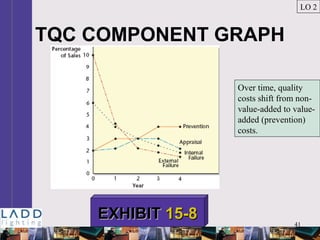
TQC COMPONENT GRAPH
LO 2
EXHIBITEXHIBIT 15-815-8
Over time, quality
costs shift from non-
value-added to value-
added (prevention)
costs.
42
3
Tell why quality cost
information is needed
& show how it is
used.
LEARNING OBJECTIVELEARNING OBJECTIVE
43
What are principal
objectives of reporting
quality costs?
Principal objectives are to
improve & facilitate a)
managerial planning, b) control,
and c) decision making.
LO 3
44
STRATEGIC PRICING: BackgroundSTRATEGIC PRICING: Background
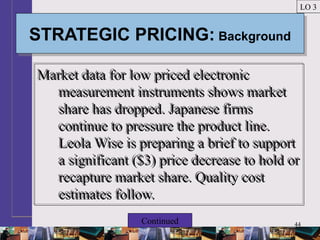
Market data for low priced electronic
measurement instruments shows market
share has dropped. Japanese firms
continue to pressure the product line.
Leola Wise is preparing a brief to support
a significant ($3) price decrease to hold or
recapture market share. Quality cost
estimates follow.
Market data for low priced electronic
measurement instruments shows market
share has dropped. Japanese firms
continue to pressure the product line.
Leola Wise is preparing a brief to support
a significant ($3) price decrease to hold or
recapture market share. Quality cost
estimates follow.
LO 3
Continued
45
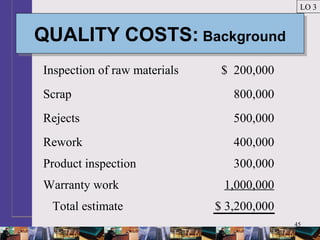
QUALITY COSTS: BackgroundQUALITY COSTS: Background
LO 3
Inspection of raw materials $ 200,000
Scrap 800,000
Rejects 500,000
Rework 400,000
Product inspection 300,000
Warranty work 1,000,000
Total estimate $ 3,200,000
46
ELECTRONIC INSTRUMENTS:
Price Reduction Analysis
ELECTRONIC INSTRUMENTS:
Price Reduction Analysis
LO 3
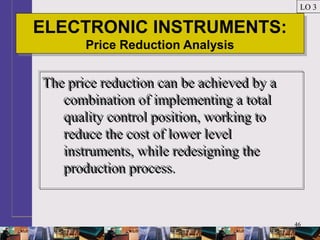
The price reduction can be achieved by a
combination of implementing a total
quality control position, working to
reduce the cost of lower level
instruments, while redesigning the
production process.
The price reduction can be achieved by a
combination of implementing a total
quality control position, working to
reduce the cost of lower level
instruments, while redesigning the
production process.
47
NEW PRODUCT ANALYSIS:
Background
NEW PRODUCT ANALYSIS:
Background
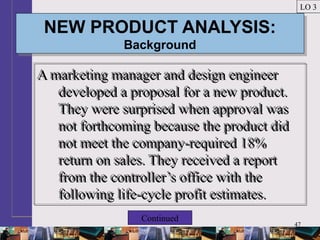
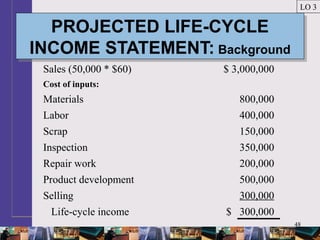
A marketing manager and design engineer
developed a proposal for a new product.
They were surprised when approval was
not forthcoming because the product did
not meet the company-required 18%
return on sales. They received a report
from the controller’s office with the
following life-cycle profit estimates.
A marketing manager and design engineer
developed a proposal for a new product.
They were surprised when approval was
not forthcoming because the product did
not meet the company-required 18%
return on sales. They received a report
from the controller’s office with the
following life-cycle profit estimates.
LO 3
Continued
48
PROJECTED LIFE-CYCLE
INCOME STATEMENT: Background
PROJECTED LIFE-CYCLE
INCOME STATEMENT: Background
LO 3
Sales (50,000 * $60) $ 3,000,000
Cost of inputs:
Materials 800,000
Labor 400,000
Scrap 150,000
Inspection 350,000
Repair work 200,000
Product development 500,000
Selling 300,000
Life-cycle income $ 300,000
49
NEW PRODUCT: Life-Cycle Profit
Analysis
NEW PRODUCT: Life-Cycle Profit
Analysis
LO 3
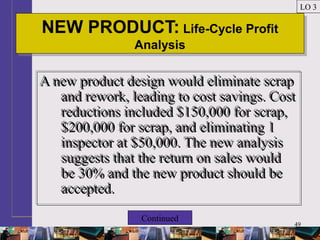
A new product design would eliminate scrap
and rework, leading to cost savings. Cost
reductions included $150,000 for scrap,
$200,000 for scrap, and eliminating 1
inspector at $50,000. The new analysis
suggests that the return on sales would
be 30% and the new product should be
accepted.
A new product design would eliminate scrap
and rework, leading to cost savings. Cost
reductions included $150,000 for scrap,
$200,000 for scrap, and eliminating 1
inspector at $50,000. The new analysis
suggests that the return on sales would
be 30% and the new product should be
accepted.
Continued
50
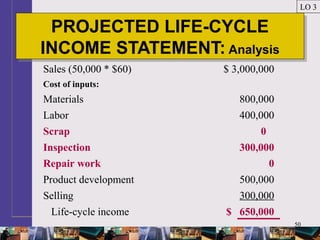
PROJECTED LIFE-CYCLE
INCOME STATEMENT: Analysis
PROJECTED LIFE-CYCLE
INCOME STATEMENT: Analysis
LO 3
Sales (50,000 * $60) $ 3,000,000
Cost of inputs:
Materials 800,000
Labor 400,000
Scrap 0
Inspection 300,000
Repair work 0
Product development 500,000
Selling 300,000
Life-cycle income $ 650,000
51
4
Explain what
productivity is;
calculate the impact of
productivity changes
on profits.
LEARNING OBJECTIVELEARNING OBJECTIVE
52
TOTAL PRODUCTIVE
EFFICIENCY
When concerned with productive efficiency,
2 conditions must be satisfied:
 Technical efficiency: For any mix of inputs
that will produce a given output, no more of
any 1 input is used than necessary to produce
the output
 Input trade-off efficiency: Given the mixes
that satisfy the first condition, the least
costly mix is chosen.
LO 4
53
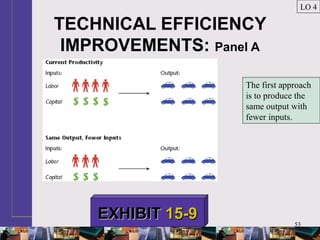
TECHNICAL EFFICIENCY
IMPROVEMENTS: Panel A
LO 4
EXHIBITEXHIBIT 15-915-9
The first approach
is to produce the
same output with
fewer inputs.
54
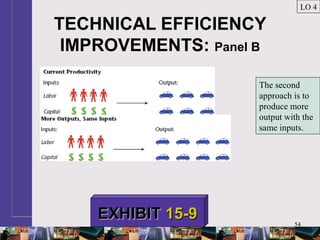
TECHNICAL EFFICIENCY
IMPROVEMENTS: Panel B
LO 4
EXHIBITEXHIBIT 15-915-9
The second
approach is to
produce more
output with the
same inputs.
55
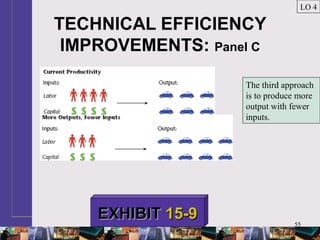
TECHNICAL EFFICIENCY
IMPROVEMENTS: Panel C
LO 4
EXHIBITEXHIBIT 15-915-9
The third approach
is to produce more
output with fewer
inputs.
56
INPUT TRADE-OFF EFFICIENCY
LO 4
EXHIBITEXHIBIT 15-1015-10
Managers must
weigh the trade-off
between labor &
capital for efficiency
of output.
57
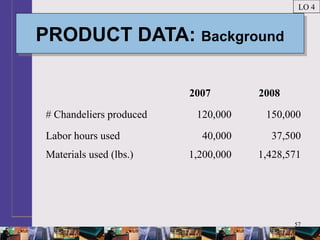
PRODUCT DATA: BackgroundPRODUCT DATA: Background
LO 4
2007 2008
# Chandeliers produced 120,000 150,000
Labor hours used 40,000 37,500
Materials used (lbs.) 1,200,000 1,428,571
58
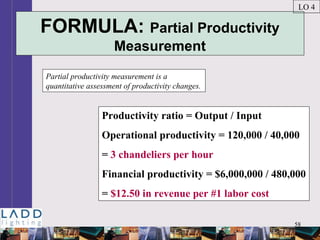
FORMULA: Partial Productivity
Measurement
Partial productivity measurement is a
quantitative assessment of productivity changes.
LO 4
Productivity ratio = Output / Input
Operational productivity = 120,000 / 40,000
= 3 chandeliers per hour
Financial productivity = $6,000,000 / 480,000
= $12.50 in revenue per #1 labor cost
59
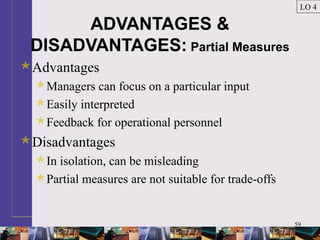
ADVANTAGES &
DISADVANTAGES: Partial Measures
Advantages
Managers can focus on a particular input
Easily interpreted
Feedback for operational personnel
Disadvantages
In isolation, can be misleading
Partial measures are not suitable for trade-offs
LO 4
60
PARTIAL MEASURES: AnalysisPARTIAL MEASURES: Analysis
LO 4
Conclusions that can be drawn about partial
measures:
 Existence of trade-offs mandates total
measure of productivity for assessing merits
of productivity decisions
 Because of possibility of trade-offs,
financial productivity must be measured
Conclusions that can be drawn about partial
measures:
 Existence of trade-offs mandates total
measure of productivity for assessing merits
of productivity decisions
 Because of possibility of trade-offs,
financial productivity must be measured
61
TOTAL PRODUCTIVITY
MEASUREMENT: Definition
TOTAL PRODUCTIVITY
MEASUREMENT: Definition
Is measuring productivity for
all inputs simultaneously.
LO 4
62
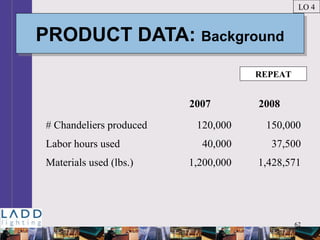
PRODUCT DATA: BackgroundPRODUCT DATA: Background
LO 4
2007 2008
# Chandeliers produced 120,000 150,000
Labor hours used 40,000 37,500
Materials used (lbs.) 1,200,000 1,428,571
REPEAT
63
PROFILE ANALYSIS: No Trade-offs
LO 4
EXHIBITEXHIBIT 15-1115-11
Partial productivity
based on product
data.
64
PROFILE ANALYSIS: With Trade-offs
LO 4
EXHIBITEXHIBIT 15-1215-12
Trade-offs between
inputs lowers the
materials
productivity ratio.
65
PROFIT-LINKED PRODUCTIVITY
MEASUREMENT: Definition
PROFIT-LINKED PRODUCTIVITY
MEASUREMENT: Definition
Is measuring the amount of
profit change attributable to
productivity change.
LO 4
66
PROFIT-LINKAGE RULE:
Definition
PROFIT-LINKAGE RULE:
Definition
States that productivity change is
the difference between
[Cost of inputs without
productivity change – cost of
inputs actually used].
LO 4
67
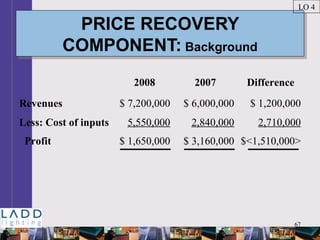
PRICE RECOVERY
COMPONENT: Background
PRICE RECOVERY
COMPONENT: Background
LO 4
2008 2007 Difference
Revenues $ 7,200,000 $ 6,000,000 $ 1,200,000
Less: Cost of inputs 5,550,000 2,840,000 2,710,000
Profit $ 1,650,000 $ 3,160,000 $<1,510,000>
68
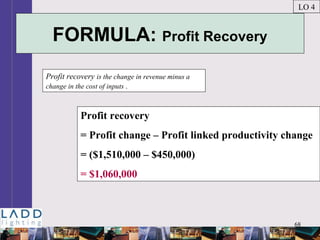
FORMULA: Profit Recovery
Profit recovery is the change in revenue minus a
change in the cost of inputs .
LO 4
Profit recovery
= Profit change – Profit linked productivity change
= ($1,510,000 – $450,000)
= $1,060,000
69
GAINSHARING: DefinitionGAINSHARING: Definition
Is providing to a company’s
entire workforce cash
incentives that are keyed to
quality & productivity gains
LO 4
70
THE ENDTHE END
CHAPTER 15

Hansen aise im ch15

  • 1.
    1 PowerPointPowerPoint Presentation byPresentationby Gail B. WrightGail B. Wright Professor Emeritus of AccountingProfessor Emeritus of Accounting Bryant UniversityBryant University © Copyright 2007 Thomson South-Western, a part of The Thomson Corporation. Thomson, the Star Logo, and South-Western are trademarks used herein under license. MANAGEMENT ACCOUNTING 8th EDITION BY HANSEN & MOWEN 1 INTRODUCTION 15 QUALITY COSTS & PRODUCTIVITY
  • 2.
    2 LEARNING GOALS After studyingthis chapter, you should be able to: LEARNING OBJECTIVESLEARNING OBJECTIVES
  • 3.
    3 1. Identify &describe the 4 types of quality costs. 2. Prepare a quality cost report; differentiate between acceptable quality level & total quality control. 3. Tell why quality cost information is needed & show how it is used. 4. Explain what productivity is; calculate the impact of productivity changes on profits. LEARNING OBJECTIVESLEARNING OBJECTIVES Click the button to skip Questions to Think About
  • 4.
    4 QUESTIONS TO THINKABOUT: Ladd Lighting Corporation Why has the measurement of productivity & quality become so important?
  • 5.
    5 QUESTIONS TO THINKABOUT: Ladd Lighting Corporation What are quality costs?
  • 6.
    6 QUESTIONS TO THINKABOUT: Ladd Lighting Corporation What kinds of quality cost reports should be prepared by the Accounting Department?
  • 7.
    7 QUESTIONS TO THINKABOUT: Ladd Lighting Corporation What is meant by “productivity?”
  • 8.
    8 1 Identify & describe the4 types of quality costs. LEARNING OBJECTIVELEARNING OBJECTIVE
  • 9.
    9 QUALITY Russell Walsh ofLadd Lighting recognizes that quality improvement can increase profitability by:  Increasing customer demand  Decreasing costs LO 1
  • 10.
    10 WEIGHING COSTS &BENEFITS Managers need to know what quality costs are & how they change over time Costs of quality Studies suggest that cost of quality production might be as much as 20% – 30% of sales Benefits of quality Competitive dimension LO 1
  • 11.
    11 QUALITY PRODUCT, SERVICE: Definition QUALITYPRODUCT, SERVICE: Definition Is one that meets or exceeds customer expectations. LO 1
  • 12.
    12 DIMENSIONS OF QUALITY:1 Performance: how consistently a product functions Aesthetics: appearance of tangible products, facilities, communication materials Serviceability: ease of maintaining, repairing product Features of quality design: characteristics that differentiate between similar products LO 1 Continued
  • 13.
    13 DIMENSIONS OF QUALITY:2 Reliability: probability that product, service will perform intended function for specified length of time Durability: length of time a product functions Quality of conformance: measure of how a product meets its specifications Fitness for use: suitability of product for advertised functions LO 1
  • 14.
    14 DEFECTIVE PRODUCT: Definition DEFECTIVE PRODUCT: Definition Isone that does not conform to specifications. Zero defects is the goal. LO 1
  • 15.
    15 What are costsof quality? Costs that exist because poor quality does or may exist: • Control activities to prevent, detect poor quality. • Failure activities are responses to poor quality. LO 1
  • 16.
    16 CATEGORIES OF QUALITY COSTS 1.Prevention costs: incurred to prevent poor quality 2. Appraisal costs: incurred to determine whether products, services conform to requirements, customer needs 3. Internal failure costs: incurred when non- conformance discovered & product, service re- worked, scrapped, etc. 4. External failure costs: incurred when products fail to conform after delivery and recalled LO 1
  • 17.
    17 CLASSIFYING QUALITY COSTS Observable Costsavailable in accounting records Hidden Significant Not directly available in accounting records Estimated Multiplier method Market research Taguchi quality loss function LO 1
  • 18.
    18 FORMULA: Multiplier Method Multipliermethod estimates quality costs as some multiple of measured failure costs. LO 1 Total external failure cost: = k (Measured external failure costs)
  • 19.
    19 How does marketresearch estimate hidden quality costs? Market research uses customer surveys & interviews of sales staff to project future profit losses. LO 1
  • 20.
    20 SPECIFICATION LIMIT: DefinitionSPECIFICATIONLIMIT: Definition In traditional quality model, defines the area of acceptable quality around the target value. LO 1
  • 21.
    21 What assumption doesthe Taguchi quality loss function make? Taguchi quality loss function assumes that variations from target value of quality characteristic causes hidden quality costs regardless of specification limits. LO 1
  • 22.
    22 TAGUCHI QUALITY LOSS FUNCTION LO1 EXHIBITEXHIBIT15-115-1 Quality cost increases symmetrically at an increasing rate even within specification limits.
  • 23.
    23 FORMULA: Taguchi Function Taguchiquality loss function estimates hidden costs of poor quality. LO 1 [Quality loss * Actual value of quality characteristic] L(y) = a proportional constant multiplier of external cost failure structure * (difference between actual and target value squared) L(y) = k(y-T)2
  • 24.
    24 How do weestimate the organization’s external failure cost structure, k? k is estimated as c/d2 where: c =loss at lower or upper specification limit d = distance of limit from target value LO 1
  • 25.
    25 2 Prepare a qualitycost report; differentiate between acceptable quality level & total quality control. LEARNING OBJECTIVELEARNING OBJECTIVE
  • 26.
    26 QUALITY COST REPORT Providesinsights to companies serious about quality:  Reveals magnitude of quality costs by category  Allows managers to assess financial impact of quality costs in each category  Shows distribution of quality costs by category  Allows managers to assess relative importance of each category LO 2
  • 27.
    27 QUALITY COST REPORT LO2 EXHIBITEXHIBIT 15-315-3
  • 28.
    28 QUALITY COST DISTRIBUTION LO2 EXHIBITEXHIBIT 15-415-4 Failure Costs Control Activities
  • 29.
    29 ACCEPTABLE QUALITY LEVEL (AQL):Definition ACCEPTABLE QUALITY LEVEL (AQL): Definition Is the optimal balance between control costs & failure costs. LO 2
  • 30.
    30 Is there aproblem with the ACL (traditional) view of quality? AQL encouraged lower quality levels by accepting production of a given number of defective units. LO 2
  • 31.
    31 AQL QUALITY COSTGRAPH LO 2 EXHIBITEXHIBIT 15-515-5 Accepted level of quality Quality foregone; failure accepted
  • 32.
    32 ZERO DEFECTS MODEL: Definition ZERODEFECTS MODEL: Definition Claims that it is cost beneficial to reduce non- conforming units to zero. LO 2
  • 33.
    33 Is there aproblem with the zero defects model? Zero defects model understates quality costs & the potential for savings from efforts to improve quality. LO 2
  • 34.
    34 AQL QUALITY COSTGRAPH LO 2 EXHIBITEXHIBIT 15-615-6 Control costs decrease as percentage of defects decreases.
  • 35.
    35 REDUCING QUALITY COSTS Takedirect attack on failure costs to drive them to zero Invest in “right” prevention activities to bring about improvement Reduce appraisal costs according to results achieved Continuously evaluate, redirect prevention efforts to gain further improvement LO 2
  • 36.
    36 What is thestrategy for reducing costs based on? The strategy is based on the premise that a) there is a root cause for each failure, b) causes are preventable, and c) prevention is always cheaper. LO 2
  • 37.
    37 ABM & OPTIMALQUALITY COSTS ABM classifies costs as value-added & non-value-added and recommends non-value-added costs be eliminated.  Value-added quality costs  Prevention activities, when performed efficiently  Non-value-added quality costs  Appraisal costs  Failure costs (both internal & external) LO 2
  • 38.
    38 TREND ANALYSIS: TQC Quality Costs Actual Sales Costsas % of Sales 2004 $ 440,000 $ 2,200,000 20.0% 2005 423,000 2,350,000 18.0 2006 412,500 2,750,000 15.0 2007 392,000 2,800,000 14.0 2008 280,000 2,800,000 10.0 LO 2
  • 39.
    39 TQC TREND GRAPH LO2 EXHIBITEXHIBIT 15-715-7 Although total quality costs are decreasing, we need to analyze its components.
  • 40.
    40 TREND ANALYSIS: TQCComponents Prevention Appraisal Internal Failure External Failure 2004 2.0% 2.0% 6.0% 10.0% 2005 3.0 2.4 4.0 8.6 2006 3.0 3.0 3.0 6.0 2007 4.0 3.0 2.5 4.5 2008 4.1 2.4 2.0 1.5 LO 2
  • 41.
    41 TQC COMPONENT GRAPH LO2 EXHIBITEXHIBIT 15-815-8 Over time, quality costs shift from non- value-added to value- added (prevention) costs.
  • 42.
    42 3 Tell why qualitycost information is needed & show how it is used. LEARNING OBJECTIVELEARNING OBJECTIVE
  • 43.
    43 What are principal objectivesof reporting quality costs? Principal objectives are to improve & facilitate a) managerial planning, b) control, and c) decision making. LO 3
  • 44.
    44 STRATEGIC PRICING: BackgroundSTRATEGICPRICING: Background Market data for low priced electronic measurement instruments shows market share has dropped. Japanese firms continue to pressure the product line. Leola Wise is preparing a brief to support a significant ($3) price decrease to hold or recapture market share. Quality cost estimates follow. Market data for low priced electronic measurement instruments shows market share has dropped. Japanese firms continue to pressure the product line. Leola Wise is preparing a brief to support a significant ($3) price decrease to hold or recapture market share. Quality cost estimates follow. LO 3 Continued
  • 45.
    45 QUALITY COSTS: BackgroundQUALITYCOSTS: Background LO 3 Inspection of raw materials $ 200,000 Scrap 800,000 Rejects 500,000 Rework 400,000 Product inspection 300,000 Warranty work 1,000,000 Total estimate $ 3,200,000
  • 46.
    46 ELECTRONIC INSTRUMENTS: Price ReductionAnalysis ELECTRONIC INSTRUMENTS: Price Reduction Analysis LO 3 The price reduction can be achieved by a combination of implementing a total quality control position, working to reduce the cost of lower level instruments, while redesigning the production process. The price reduction can be achieved by a combination of implementing a total quality control position, working to reduce the cost of lower level instruments, while redesigning the production process.
  • 47.
    47 NEW PRODUCT ANALYSIS: Background NEWPRODUCT ANALYSIS: Background A marketing manager and design engineer developed a proposal for a new product. They were surprised when approval was not forthcoming because the product did not meet the company-required 18% return on sales. They received a report from the controller’s office with the following life-cycle profit estimates. A marketing manager and design engineer developed a proposal for a new product. They were surprised when approval was not forthcoming because the product did not meet the company-required 18% return on sales. They received a report from the controller’s office with the following life-cycle profit estimates. LO 3 Continued
  • 48.
    48 PROJECTED LIFE-CYCLE INCOME STATEMENT:Background PROJECTED LIFE-CYCLE INCOME STATEMENT: Background LO 3 Sales (50,000 * $60) $ 3,000,000 Cost of inputs: Materials 800,000 Labor 400,000 Scrap 150,000 Inspection 350,000 Repair work 200,000 Product development 500,000 Selling 300,000 Life-cycle income $ 300,000
  • 49.
    49 NEW PRODUCT: Life-CycleProfit Analysis NEW PRODUCT: Life-Cycle Profit Analysis LO 3 A new product design would eliminate scrap and rework, leading to cost savings. Cost reductions included $150,000 for scrap, $200,000 for scrap, and eliminating 1 inspector at $50,000. The new analysis suggests that the return on sales would be 30% and the new product should be accepted. A new product design would eliminate scrap and rework, leading to cost savings. Cost reductions included $150,000 for scrap, $200,000 for scrap, and eliminating 1 inspector at $50,000. The new analysis suggests that the return on sales would be 30% and the new product should be accepted. Continued
  • 50.
    50 PROJECTED LIFE-CYCLE INCOME STATEMENT:Analysis PROJECTED LIFE-CYCLE INCOME STATEMENT: Analysis LO 3 Sales (50,000 * $60) $ 3,000,000 Cost of inputs: Materials 800,000 Labor 400,000 Scrap 0 Inspection 300,000 Repair work 0 Product development 500,000 Selling 300,000 Life-cycle income $ 650,000
  • 51.
    51 4 Explain what productivity is; calculatethe impact of productivity changes on profits. LEARNING OBJECTIVELEARNING OBJECTIVE
  • 52.
    52 TOTAL PRODUCTIVE EFFICIENCY When concernedwith productive efficiency, 2 conditions must be satisfied:  Technical efficiency: For any mix of inputs that will produce a given output, no more of any 1 input is used than necessary to produce the output  Input trade-off efficiency: Given the mixes that satisfy the first condition, the least costly mix is chosen. LO 4
  • 53.
    53 TECHNICAL EFFICIENCY IMPROVEMENTS: PanelA LO 4 EXHIBITEXHIBIT 15-915-9 The first approach is to produce the same output with fewer inputs.
  • 54.
    54 TECHNICAL EFFICIENCY IMPROVEMENTS: PanelB LO 4 EXHIBITEXHIBIT 15-915-9 The second approach is to produce more output with the same inputs.
  • 55.
    55 TECHNICAL EFFICIENCY IMPROVEMENTS: PanelC LO 4 EXHIBITEXHIBIT 15-915-9 The third approach is to produce more output with fewer inputs.
  • 56.
    56 INPUT TRADE-OFF EFFICIENCY LO4 EXHIBITEXHIBIT 15-1015-10 Managers must weigh the trade-off between labor & capital for efficiency of output.
  • 57.
    57 PRODUCT DATA: BackgroundPRODUCTDATA: Background LO 4 2007 2008 # Chandeliers produced 120,000 150,000 Labor hours used 40,000 37,500 Materials used (lbs.) 1,200,000 1,428,571
  • 58.
    58 FORMULA: Partial Productivity Measurement Partialproductivity measurement is a quantitative assessment of productivity changes. LO 4 Productivity ratio = Output / Input Operational productivity = 120,000 / 40,000 = 3 chandeliers per hour Financial productivity = $6,000,000 / 480,000 = $12.50 in revenue per #1 labor cost
  • 59.
    59 ADVANTAGES & DISADVANTAGES: PartialMeasures Advantages Managers can focus on a particular input Easily interpreted Feedback for operational personnel Disadvantages In isolation, can be misleading Partial measures are not suitable for trade-offs LO 4
  • 60.
    60 PARTIAL MEASURES: AnalysisPARTIALMEASURES: Analysis LO 4 Conclusions that can be drawn about partial measures:  Existence of trade-offs mandates total measure of productivity for assessing merits of productivity decisions  Because of possibility of trade-offs, financial productivity must be measured Conclusions that can be drawn about partial measures:  Existence of trade-offs mandates total measure of productivity for assessing merits of productivity decisions  Because of possibility of trade-offs, financial productivity must be measured
  • 61.
    61 TOTAL PRODUCTIVITY MEASUREMENT: Definition TOTALPRODUCTIVITY MEASUREMENT: Definition Is measuring productivity for all inputs simultaneously. LO 4
  • 62.
    62 PRODUCT DATA: BackgroundPRODUCTDATA: Background LO 4 2007 2008 # Chandeliers produced 120,000 150,000 Labor hours used 40,000 37,500 Materials used (lbs.) 1,200,000 1,428,571 REPEAT
  • 63.
    63 PROFILE ANALYSIS: NoTrade-offs LO 4 EXHIBITEXHIBIT 15-1115-11 Partial productivity based on product data.
  • 64.
    64 PROFILE ANALYSIS: WithTrade-offs LO 4 EXHIBITEXHIBIT 15-1215-12 Trade-offs between inputs lowers the materials productivity ratio.
  • 65.
    65 PROFIT-LINKED PRODUCTIVITY MEASUREMENT: Definition PROFIT-LINKEDPRODUCTIVITY MEASUREMENT: Definition Is measuring the amount of profit change attributable to productivity change. LO 4
  • 66.
    66 PROFIT-LINKAGE RULE: Definition PROFIT-LINKAGE RULE: Definition Statesthat productivity change is the difference between [Cost of inputs without productivity change – cost of inputs actually used]. LO 4
  • 67.
    67 PRICE RECOVERY COMPONENT: Background PRICERECOVERY COMPONENT: Background LO 4 2008 2007 Difference Revenues $ 7,200,000 $ 6,000,000 $ 1,200,000 Less: Cost of inputs 5,550,000 2,840,000 2,710,000 Profit $ 1,650,000 $ 3,160,000 $<1,510,000>
  • 68.
    68 FORMULA: Profit Recovery Profitrecovery is the change in revenue minus a change in the cost of inputs . LO 4 Profit recovery = Profit change – Profit linked productivity change = ($1,510,000 – $450,000) = $1,060,000
  • 69.
    69 GAINSHARING: DefinitionGAINSHARING: Definition Isproviding to a company’s entire workforce cash incentives that are keyed to quality & productivity gains LO 4
  • 70.