

1
PowerPointPowerPoint Presentation byPresentation by
Gail B. WrightGail B. Wright
Professor Emeritus of AccountingProfessor Emeritus of Accounting
Bryant UniversityBryant University
© Copyright 2007 Thomson South-Western, a part of The
Thomson Corporation. Thomson, the Star Logo, and
South-Western are trademarks used herein under license.
MANAGEMENT
ACCOUNTING
8th
EDITION
BY
HANSEN & MOWEN
4 ACTIVITY-BASED PRODUCT COSTING
2
LEARNING GOALS
After studying this
chapter, you should be
able to:
LEARNING OBJECTIVESLEARNING OBJECTIVES
3
1. Discuss the importance of unit costs.
2. Describe functional-based costing
approaches.
3. Tell why functional-based costing
approaches may produce distorted costs.
LEARNING OBJECTIVESLEARNING OBJECTIVES
Continued
4
4. Explain how an activity-based costing
system works for product costing.
5. Explain how the number of activity rates
can be reduced.
LEARNING OBJECTIVESLEARNING OBJECTIVES
Click the button to skip
Questions to Think About
5
QUESTIONS TO THINK ABOUT:
SpringBanc
What are product costs?
6
QUESTIONS TO THINK ABOUT:
SpringBanc
What role do product costs play
in bids?
7
QUESTIONS TO THINK ABOUT:
SpringBanc
What is meant by a traditional
functional-based costing system?
Why might it cause distortions in
product costs?
8
QUESTIONS TO THINK ABOUT:
SpringBanc
Assuming SpringBanc’s
problems are founded in the
way costs are assigned to
products, what can SpringBanc
do to solve the problem?
9
1 Discuss the importance
of unit costs.
LEARNING OBJECTIVELEARNING OBJECTIVE
10
UNIT COST: DefinitionUNIT COST: Definition
Unit cost is the total cost
associated with the units
produced divided by the # of units
produced.
(Total cost) / (# units produced)
LO 1
11
What is meant by “total cost”?
Total cost refers to production
costs: direct materials, direct
labor, manufacturing overhead.
LO 1
12
How do we measure the costs
to be assigned?
Production costs we assign may
be actual or estimated costs.
LO 1
13
How do we assign costs to a
product?
Production costs are assigned by
1 of 2 methods: functional-
based or activity-based costing.
LO 1
14
UNIT COSTS
Affect
Bids submitted for special products
Development, introduction of new products
Decisions to
Make or buy a product or service
Accept or reject a special order
Keep or drop a product or service
LO 1
15
UNIT COST INFORMATION
May be produced by
Actual direct materials, direct labor, overhead
Normal costing
Uses actual costs for direct materials & direct labor but
overhead is assigned at predetermined rates
LO 1
Predetermined rate =
Budgeted cost / Estimated activity usage
16
2 Describe functional-
based costing
approaches.
LEARNING OBJECTIVELEARNING OBJECTIVE
17
How are functional-based
costs assigned?
Direct materials & labor are
assigned by direct tracing.
Overhead is assigned by driver
tracing & allocation.
LO 2
18
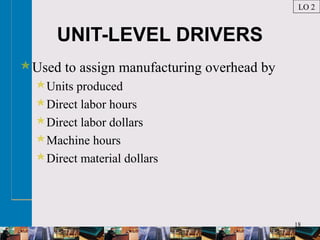
UNIT-LEVEL DRIVERS
Used to assign manufacturing overhead by
Units produced
Direct labor hours
Direct labor dollars
Machine hours
Direct material dollars
LO 2
19
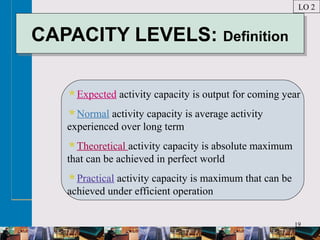
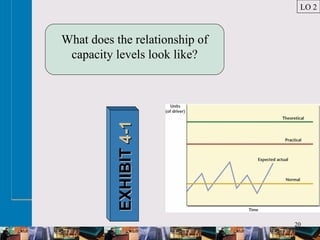
CAPACITY LEVELS: DefinitionCAPACITY LEVELS: Definition
Expected activity capacity is output for coming year
Normal activity capacity is average activity
experienced over long term
Theoretical activity capacity is absolute maximum
that can be achieved in perfect world
Practical activity capacity is maximum that can be
achieved under efficient operation
LO 2
20
What does the relationship of
capacity levels look like?
LO 2
EXHIBITEXHIBIT4-14-1
21
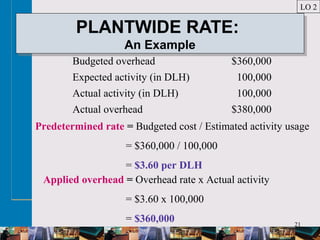
PLANTWIDE RATE:
An Example
PLANTWIDE RATE:
An Example
Budgeted overhead $360,000
Expected activity (in DLH) 100,000
Actual activity (in DLH) 100,000
Actual overhead $380,000
Predetermined rate = Budgeted cost / Estimated activity usage
= $360,000 / 100,000
= $3.60 per DLH
Applied overhead = Overhead rate x Actual activity
= $3.60 x 100,000
= $360,000
LO 2
22
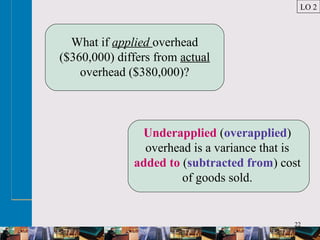
What if applied overhead
($360,000) differs from actual
overhead ($380,000)?
Underapplied (overapplied)
overhead is a variance that is
added to (subtracted from) cost
of goods sold.
LO 2
23
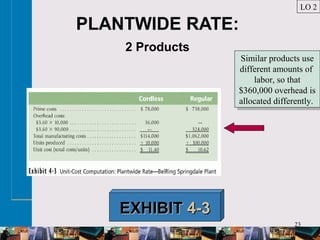
PLANTWIDE RATE:
2 Products
EXHIBITEXHIBIT 4-34-3
Similar products use
different amounts of
labor, so that
$360,000 overhead is
allocated differently.
Similar products use
different amounts of
labor, so that
$360,000 overhead is
allocated differently.
LO 2
24
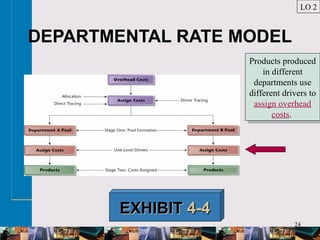
DEPARTMENTAL RATE MODEL
EXHIBITEXHIBIT 4-44-4
LO 2
Products produced
in different
departments use
different drivers to
assign overhead
costs.
Products produced
in different
departments use
different drivers to
assign overhead
costs.
25
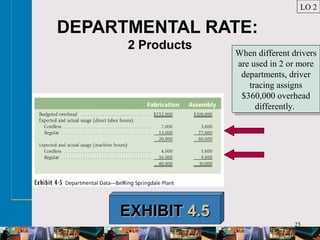
DEPARTMENTAL RATE:
2 Products
EXHIBITEXHIBIT 4.54.5
When different drivers
are used in 2 or more
departments, driver
tracing assigns
$360,000 overhead
differently.
When different drivers
are used in 2 or more
departments, driver
tracing assigns
$360,000 overhead
differently.
LO 2
26
3
Tell why functional-
based costing approaches
may produce distorted
costs.
LEARNING OBJECTIVELEARNING OBJECTIVE
27
How does a company know if
its functional-based costing is
producing distorted costs?
There are many symptoms of
distorted costs, such as profit
margins that are difficult to
explain.
LO 3
28
CREATING DISTORTIONS
When a unit-level approach is used to
assign non-unit-level costs
(overhead), cost information can be
distorted.
When a unit-level approach is used to
assign non-unit-level costs
(overhead), cost information can be
distorted.
LO 3
29
NON-UNIT-LEVEL ACTIVITY
DRIVER: Definition
NON-UNIT-LEVEL ACTIVITY
DRIVER: Definition
Factors that measure consumption
of non-unit-level activities by
product & can distort product
costs.
LO 3
30
PRODUCT DIVERSITY: DefinitionPRODUCT DIVERSITY: Definition
Products consume overhead
activities in systematically
different proportions.
LO 3
31
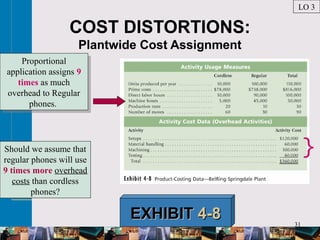
COST DISTORTIONS:
Plantwide Cost Assignment
EXHIBITEXHIBIT 4-84-8
Proportional
application assigns 9
times as much
overhead to Regular
phones.
Proportional
application assigns 9
times as much
overhead to Regular
phones.
LO 3
}Should we assume that
regular phones will use
9 times more overhead
costs than cordless
phones?
32
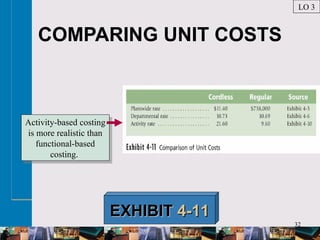
COMPARING UNIT COSTS
EXHIBITEXHIBIT 4-114-11
Activity-based costing
is more realistic than
functional-based
costing.
Activity-based costing
is more realistic than
functional-based
costing.
LO 3
33
4
Explain how an activity-
based costing system
works for product
costing.
LEARNING OBJECTIVELEARNING OBJECTIVE
34
How do you identify activities
& their attributes?
Use a key set of interview
questions and record the
answers.
LO 4
35
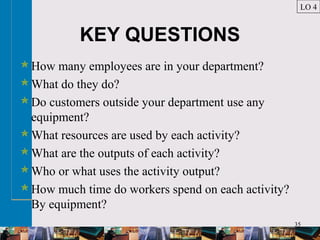
KEY QUESTIONS
How many employees are in your department?
What do they do?
Do customers outside your department use any
equipment?
What resources are used by each activity?
What are the outputs of each activity?
Who or what uses the activity output?
How much time do workers spend on each activity?
By equipment?
LO 4
36
RESOURCE DRIVER: DefinitionRESOURCE DRIVER: Definition
Factors that measure the
consumption of resources by
activities.
LO 4
37
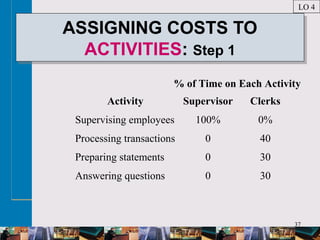
ASSIGNING COSTS TO
ACTIVITIES: Step 1
ASSIGNING COSTS TO
ACTIVITIES: Step 1
Activity Supervisor Clerks
Supervising employees 100% 0%
Processing transactions 0 40
Preparing statements 0 30
Answering questions 0 30
% of Time on Each Activity
LO 4
38
ASSIGNING COSTS TO
ACTIVITIES: Step 2
ASSIGNING COSTS TO
ACTIVITIES: Step 2
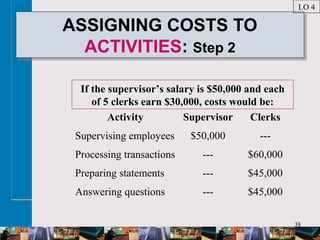
Activity Supervisor Clerks
Supervising employees $50,000 ---
Processing transactions --- $60,000
Preparing statements --- $45,000
Answering questions --- $45,000
If the supervisor’s salary is $50,000 and each
of 5 clerks earn $30,000, costs would be:
LO 4
39
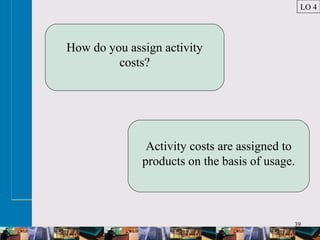
How do you assign activity
costs?
Activity costs are assigned to
products on the basis of usage.
LO 4
40
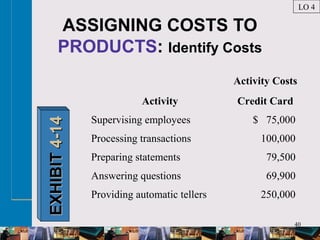
ASSIGNING COSTS TO
PRODUCTS: Identify Costs
Activity Credit Card
Supervising employees $ 75,000
Processing transactions 100,000
Preparing statements 79,500
Answering questions 69,900
Providing automatic tellers 250,000
Activity Costs
LO 4
EXHIBITEXHIBIT4-144-14
41
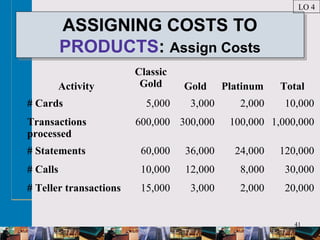
ASSIGNING COSTS TO
PRODUCTS: Assign Costs
ASSIGNING COSTS TO
PRODUCTS: Assign Costs
Activity
Classic
Gold Gold Platinum Total
# Cards 5,000 3,000 2,000 10,000
Transactions
processed
600,000 300,000 100,000 1,000,000
# Statements 60,000 36,000 24,000 120,000
# Calls 10,000 12,000 8,000 30,000
# Teller transactions 15,000 3,000 2,000 20,000
LO 4
42
CLASSIFICATION OF ACTIVITIES
Product costs can be assigned at a)
unit level, 2) batch level, 3) product
level (as in this example) or 4) facility
level.
Product costs can be assigned at a)
unit level, 2) batch level, 3) product
level (as in this example) or 4) facility
level.
LO 4
43
5
Explain how the number
of activity rates can be
reduced.
LEARNING OBJECTIVELEARNING OBJECTIVE
44
ACTIVITY BASED COST SYSTEM
Reduce size, complexity by reducing rates
Using consumption ratios
By approximating ABC
LO 5
45
COMPARING SYSTEMS
Functional-based system
Overhead uses only unit-based activity drivers or
Splits overhead into fixed and variable and
allocates overhead based on the appropriate unit-
level rate
Activity-based system
Improves product costing by
Looking at cause & effect
Recognizing that some fixed overhead varies in
proportion to changes other than production volume
LO 5
46
THE ENDTHE END
CHAPTER 4

Hansen aise im ch04

  • 1.
    1 PowerPointPowerPoint Presentation byPresentationby Gail B. WrightGail B. Wright Professor Emeritus of AccountingProfessor Emeritus of Accounting Bryant UniversityBryant University © Copyright 2007 Thomson South-Western, a part of The Thomson Corporation. Thomson, the Star Logo, and South-Western are trademarks used herein under license. MANAGEMENT ACCOUNTING 8th EDITION BY HANSEN & MOWEN 4 ACTIVITY-BASED PRODUCT COSTING
  • 2.
    2 LEARNING GOALS After studyingthis chapter, you should be able to: LEARNING OBJECTIVESLEARNING OBJECTIVES
  • 3.
    3 1. Discuss theimportance of unit costs. 2. Describe functional-based costing approaches. 3. Tell why functional-based costing approaches may produce distorted costs. LEARNING OBJECTIVESLEARNING OBJECTIVES Continued
  • 4.
    4 4. Explain howan activity-based costing system works for product costing. 5. Explain how the number of activity rates can be reduced. LEARNING OBJECTIVESLEARNING OBJECTIVES Click the button to skip Questions to Think About
  • 5.
    5 QUESTIONS TO THINKABOUT: SpringBanc What are product costs?
  • 6.
    6 QUESTIONS TO THINKABOUT: SpringBanc What role do product costs play in bids?
  • 7.
    7 QUESTIONS TO THINKABOUT: SpringBanc What is meant by a traditional functional-based costing system? Why might it cause distortions in product costs?
  • 8.
    8 QUESTIONS TO THINKABOUT: SpringBanc Assuming SpringBanc’s problems are founded in the way costs are assigned to products, what can SpringBanc do to solve the problem?
  • 9.
    9 1 Discuss theimportance of unit costs. LEARNING OBJECTIVELEARNING OBJECTIVE
  • 10.
    10 UNIT COST: DefinitionUNITCOST: Definition Unit cost is the total cost associated with the units produced divided by the # of units produced. (Total cost) / (# units produced) LO 1
  • 11.
    11 What is meantby “total cost”? Total cost refers to production costs: direct materials, direct labor, manufacturing overhead. LO 1
  • 12.
    12 How do wemeasure the costs to be assigned? Production costs we assign may be actual or estimated costs. LO 1
  • 13.
    13 How do weassign costs to a product? Production costs are assigned by 1 of 2 methods: functional- based or activity-based costing. LO 1
  • 14.
    14 UNIT COSTS Affect Bids submittedfor special products Development, introduction of new products Decisions to Make or buy a product or service Accept or reject a special order Keep or drop a product or service LO 1
  • 15.
    15 UNIT COST INFORMATION Maybe produced by Actual direct materials, direct labor, overhead Normal costing Uses actual costs for direct materials & direct labor but overhead is assigned at predetermined rates LO 1 Predetermined rate = Budgeted cost / Estimated activity usage
  • 16.
    16 2 Describe functional- basedcosting approaches. LEARNING OBJECTIVELEARNING OBJECTIVE
  • 17.
    17 How are functional-based costsassigned? Direct materials & labor are assigned by direct tracing. Overhead is assigned by driver tracing & allocation. LO 2
  • 18.
    18 UNIT-LEVEL DRIVERS Used toassign manufacturing overhead by Units produced Direct labor hours Direct labor dollars Machine hours Direct material dollars LO 2
  • 19.
    19 CAPACITY LEVELS: DefinitionCAPACITYLEVELS: Definition Expected activity capacity is output for coming year Normal activity capacity is average activity experienced over long term Theoretical activity capacity is absolute maximum that can be achieved in perfect world Practical activity capacity is maximum that can be achieved under efficient operation LO 2
  • 20.
    20 What does therelationship of capacity levels look like? LO 2 EXHIBITEXHIBIT4-14-1
  • 21.
    21 PLANTWIDE RATE: An Example PLANTWIDERATE: An Example Budgeted overhead $360,000 Expected activity (in DLH) 100,000 Actual activity (in DLH) 100,000 Actual overhead $380,000 Predetermined rate = Budgeted cost / Estimated activity usage = $360,000 / 100,000 = $3.60 per DLH Applied overhead = Overhead rate x Actual activity = $3.60 x 100,000 = $360,000 LO 2
  • 22.
    22 What if appliedoverhead ($360,000) differs from actual overhead ($380,000)? Underapplied (overapplied) overhead is a variance that is added to (subtracted from) cost of goods sold. LO 2
  • 23.
    23 PLANTWIDE RATE: 2 Products EXHIBITEXHIBIT4-34-3 Similar products use different amounts of labor, so that $360,000 overhead is allocated differently. Similar products use different amounts of labor, so that $360,000 overhead is allocated differently. LO 2
  • 24.
    24 DEPARTMENTAL RATE MODEL EXHIBITEXHIBIT4-44-4 LO 2 Products produced in different departments use different drivers to assign overhead costs. Products produced in different departments use different drivers to assign overhead costs.
  • 25.
    25 DEPARTMENTAL RATE: 2 Products EXHIBITEXHIBIT4.54.5 When different drivers are used in 2 or more departments, driver tracing assigns $360,000 overhead differently. When different drivers are used in 2 or more departments, driver tracing assigns $360,000 overhead differently. LO 2
  • 26.
    26 3 Tell why functional- basedcosting approaches may produce distorted costs. LEARNING OBJECTIVELEARNING OBJECTIVE
  • 27.
    27 How does acompany know if its functional-based costing is producing distorted costs? There are many symptoms of distorted costs, such as profit margins that are difficult to explain. LO 3
  • 28.
    28 CREATING DISTORTIONS When aunit-level approach is used to assign non-unit-level costs (overhead), cost information can be distorted. When a unit-level approach is used to assign non-unit-level costs (overhead), cost information can be distorted. LO 3
  • 29.
    29 NON-UNIT-LEVEL ACTIVITY DRIVER: Definition NON-UNIT-LEVELACTIVITY DRIVER: Definition Factors that measure consumption of non-unit-level activities by product & can distort product costs. LO 3
  • 30.
    30 PRODUCT DIVERSITY: DefinitionPRODUCTDIVERSITY: Definition Products consume overhead activities in systematically different proportions. LO 3
  • 31.
    31 COST DISTORTIONS: Plantwide CostAssignment EXHIBITEXHIBIT 4-84-8 Proportional application assigns 9 times as much overhead to Regular phones. Proportional application assigns 9 times as much overhead to Regular phones. LO 3 }Should we assume that regular phones will use 9 times more overhead costs than cordless phones?
  • 32.
    32 COMPARING UNIT COSTS EXHIBITEXHIBIT4-114-11 Activity-based costing is more realistic than functional-based costing. Activity-based costing is more realistic than functional-based costing. LO 3
  • 33.
    33 4 Explain how anactivity- based costing system works for product costing. LEARNING OBJECTIVELEARNING OBJECTIVE
  • 34.
    34 How do youidentify activities & their attributes? Use a key set of interview questions and record the answers. LO 4
  • 35.
    35 KEY QUESTIONS How manyemployees are in your department? What do they do? Do customers outside your department use any equipment? What resources are used by each activity? What are the outputs of each activity? Who or what uses the activity output? How much time do workers spend on each activity? By equipment? LO 4
  • 36.
    36 RESOURCE DRIVER: DefinitionRESOURCEDRIVER: Definition Factors that measure the consumption of resources by activities. LO 4
  • 37.
    37 ASSIGNING COSTS TO ACTIVITIES:Step 1 ASSIGNING COSTS TO ACTIVITIES: Step 1 Activity Supervisor Clerks Supervising employees 100% 0% Processing transactions 0 40 Preparing statements 0 30 Answering questions 0 30 % of Time on Each Activity LO 4
  • 38.
    38 ASSIGNING COSTS TO ACTIVITIES:Step 2 ASSIGNING COSTS TO ACTIVITIES: Step 2 Activity Supervisor Clerks Supervising employees $50,000 --- Processing transactions --- $60,000 Preparing statements --- $45,000 Answering questions --- $45,000 If the supervisor’s salary is $50,000 and each of 5 clerks earn $30,000, costs would be: LO 4
  • 39.
    39 How do youassign activity costs? Activity costs are assigned to products on the basis of usage. LO 4
  • 40.
    40 ASSIGNING COSTS TO PRODUCTS:Identify Costs Activity Credit Card Supervising employees $ 75,000 Processing transactions 100,000 Preparing statements 79,500 Answering questions 69,900 Providing automatic tellers 250,000 Activity Costs LO 4 EXHIBITEXHIBIT4-144-14
  • 41.
    41 ASSIGNING COSTS TO PRODUCTS:Assign Costs ASSIGNING COSTS TO PRODUCTS: Assign Costs Activity Classic Gold Gold Platinum Total # Cards 5,000 3,000 2,000 10,000 Transactions processed 600,000 300,000 100,000 1,000,000 # Statements 60,000 36,000 24,000 120,000 # Calls 10,000 12,000 8,000 30,000 # Teller transactions 15,000 3,000 2,000 20,000 LO 4
  • 42.
    42 CLASSIFICATION OF ACTIVITIES Productcosts can be assigned at a) unit level, 2) batch level, 3) product level (as in this example) or 4) facility level. Product costs can be assigned at a) unit level, 2) batch level, 3) product level (as in this example) or 4) facility level. LO 4
  • 43.
    43 5 Explain how thenumber of activity rates can be reduced. LEARNING OBJECTIVELEARNING OBJECTIVE
  • 44.
    44 ACTIVITY BASED COSTSYSTEM Reduce size, complexity by reducing rates Using consumption ratios By approximating ABC LO 5
  • 45.
    45 COMPARING SYSTEMS Functional-based system Overheaduses only unit-based activity drivers or Splits overhead into fixed and variable and allocates overhead based on the appropriate unit- level rate Activity-based system Improves product costing by Looking at cause & effect Recognizing that some fixed overhead varies in proportion to changes other than production volume LO 5
  • 46.