Chapter 8
Implementing Quality Concepts
Cost Accounting
Traditions and Innovations
Barfield, Raiborn, Kinney
Learning Objectives (1 of 3)
• Explain why the emphasis on quality in
business is unlikely to decline
• List ways to define and evaluate quality
• Define the characteristics of product quality
and service quality
• Explain how benchmarking is used to
improve quality
Learning Objectives (2 of 3)
• Describe the role of Total Quality Management
• List the types of quality costs and how these
costs are related
• Explain how to measure the costs of quality
• Clarify the need for both a management
accounting system and a financial accounting
system
Learning Objectives (3 of 3)
• Demonstrate how cost management
systems provide support for quality
initiatives
• Explain how quality can become a part of
an organization’s culture
Quality
• The sum of all of the characteristics of a
product or service that influence its ability
to meet the stated or implied needs of the
person acquiring it
– Must be viewed from the user’s perspective
– Relates to both performance and value
Productivity
The quantity of output generated from the
amount of input
Production View of Quality
• Increase productivity by reducing non-value-
added activities
– do not store slow-moving inventory
– reduce unnecessary material moves
– reduce unscheduled production interruptions
– increase supplier quality/reduce inspections
• have suppliers inspect before shipping
– reduce the need to reprocess, rework, replace, repair
• fit machinery for mistake-proof operations
– have employees monitor and be responsible for own
output (Statistical Process Control)
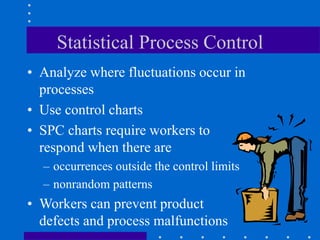
Statistical Process Control
• Analyze where fluctuations occur in
processes
• Use control charts
• SPC charts require workers to
respond when there are
– occurrences outside the control limits
– nonrandom patterns
• Workers can prevent product
defects and process malfunctions
Consumer View of Quality
Product or service meets and satisfies all
specified needs
Characteristics of Product Quality
• Objective
– Performance
– Features
– Reliability
– Conformance
– Durability
– Serviceability
• Subjective
– Aesthetics
– Perceived quality
Characteristics of Service Quality
Reliability
Assurance
Tangibles
Empathy
Responsiveness
First
Class
First
Class
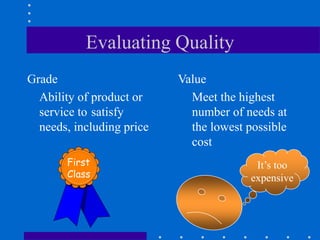
Evaluating Quality
Grade
Ability of product or
service to satisfy
needs, including price
Value
Meet the highest
number of needs at
the lowest possible
cost
First
Class
It’s too
expensive
Benchmarking
Investigate, compare, evaluate
own products, processes, services
against
competitors or “best of breed”
Benchmarking
Results benchmarking
• Focus on competitors
• Reverse engineering
– Focus on
product/service
specifications and
performance results
• Determines “best in
class”
Process benchmarking
• Noncompetitor
benchmarking
extremely valuable
• “Best- in- (specific
characteristic)”
– flexible manufacturing
– equipment maintenance
– worker training
– distributions and
logistics
Steps in Benchmarking
• Determine area for
improvement
• Select characteristic to
measure quality
• Identify “best-in-
class” companies
• Ask for cooperation
from “best-in-class”
company
• Collect information
• Analyze the “negative
gap”
• Make improvements
• Strive for continuous
improvement
The Quality System
• Moves from after-the-fact inspection to
proactive quality assurance
• Emphasizes
– prevention
– continuous improvement
– building quality into process or product
• Measures quality
• Encourages teamwork and employee
involvement
Product/Service Improvement
• Identify value-adding customers
• Identify customer wants
– quality
– value
– “good” service
interaction between customer and
organizational employees
Types of Quality Costs
• Cost of Compliance
– Preventive costs - prevent product defects
– Appraisal costs - monitor and compensate when
prevention fails
• Cost of Noncompliance
– Failure costs
• Internal losses - scrap, rework
• External losses - warranty work, customer
complaint departments, litigation, product recalls
Quality Costs
• Reduce appraisal and prevention costs by
increased spending on prevention
• Improvements in quality often result in
– lower total cost
– improved productivity
The Quality Goal
• Meet the purchaser’s stated or implied
quality needs
• Provide confidence that quality level is
achieved and sustained
– to provider’s management
– to customer
Malcolm Baldrige National Quality
Award
• Focuses on
– Management systems
– Processes
– Consumer satisfaction
– Business results
• Types of entrants
– Manufacturing
– Service
– Small business
– Education
– Health care
Represents Excellence
Measuring the Cost of Quality
• Determine where to spend dollars on quality
prevention
– Pareto Analysis
• Track the costs of quality
– change chart of accounts or coding system
• Develop a quality reporting system
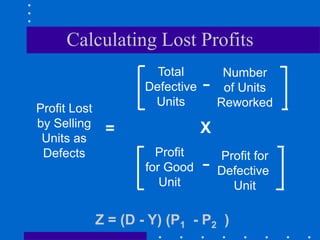
Calculating Lost Profits
Profit Lost
by Selling
Units as
Defects
Total
Defective
Units
Number
of Units
Reworked
Profit
for Good
Unit
Profit for
Defective
Unit
=
Z = (D - Y) (P1 - P2 )
X
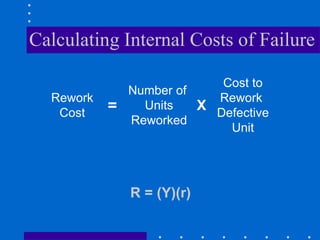
Calculating Internal Costs of Failure
Rework
Cost
Number of
Units
Reworked
Cost to
Rework
Defective
Unit
= X
R = (Y)(r)
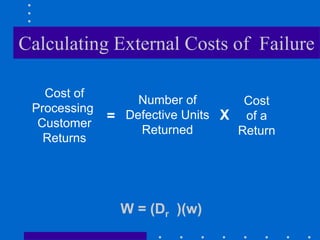
Calculating External Costs of Failure
Cost of
Processing
Customer
Returns
Number of
Defective Units
Returned
Cost
of a
Return
= X
W = (Dr )(w)
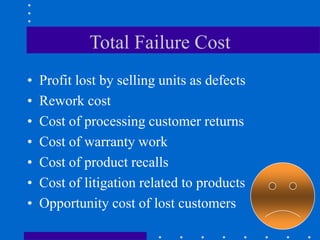
Total Failure Cost
• Profit lost by selling units as defects
• Rework cost
• Cost of processing customer returns
• Cost of warranty work
• Cost of product recalls
• Cost of litigation related to products
• Opportunity cost of lost customers
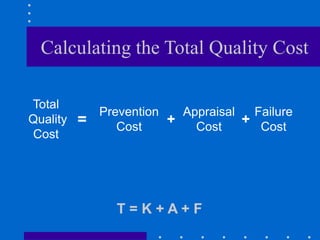
Calculating the Total Quality Cost
T = K + A + F
Total
Quality
Cost
Prevention
Cost
Appraisal
Cost
Failure
Cost
= + +
Strategic Cost Management
• Use of management accounting information
to
– set and communicate organizational strategies
– establish, implement, assess the methods to
accomplish the strategies
– assess the achievement of strategies
Includes reporting information on quality
goals and objectives
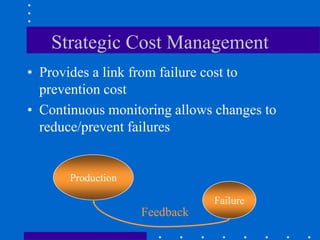
Strategic Cost Management
• Provides a link from failure cost to
prevention cost
• Continuous monitoring allows changes to
reduce/prevent failures
Production
Failure
Feedback
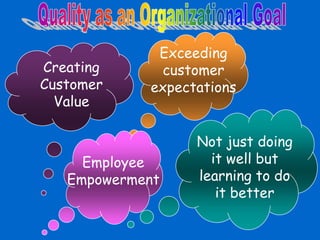
Not just doing
it well but
learning to do
it better
Exceeding
customer
expectations
Employee
Empowerment
Creating
Customer
Value
Questions
• What is quality?
• What is benchmarking? How can
benchmarking be used to improve quality?
• What are the different ways to measure the
costs of quality?

Implementing Quality Concepts

  • 1.
    Chapter 8 Implementing QualityConcepts Cost Accounting Traditions and Innovations Barfield, Raiborn, Kinney
  • 2.
    Learning Objectives (1of 3) • Explain why the emphasis on quality in business is unlikely to decline • List ways to define and evaluate quality • Define the characteristics of product quality and service quality • Explain how benchmarking is used to improve quality
  • 3.
    Learning Objectives (2of 3) • Describe the role of Total Quality Management • List the types of quality costs and how these costs are related • Explain how to measure the costs of quality • Clarify the need for both a management accounting system and a financial accounting system
  • 4.
    Learning Objectives (3of 3) • Demonstrate how cost management systems provide support for quality initiatives • Explain how quality can become a part of an organization’s culture
  • 5.
    Quality • The sumof all of the characteristics of a product or service that influence its ability to meet the stated or implied needs of the person acquiring it – Must be viewed from the user’s perspective – Relates to both performance and value
  • 6.
    Productivity The quantity ofoutput generated from the amount of input
  • 7.
    Production View ofQuality • Increase productivity by reducing non-value- added activities – do not store slow-moving inventory – reduce unnecessary material moves – reduce unscheduled production interruptions – increase supplier quality/reduce inspections • have suppliers inspect before shipping – reduce the need to reprocess, rework, replace, repair • fit machinery for mistake-proof operations – have employees monitor and be responsible for own output (Statistical Process Control)
  • 8.
    Statistical Process Control •Analyze where fluctuations occur in processes • Use control charts • SPC charts require workers to respond when there are – occurrences outside the control limits – nonrandom patterns • Workers can prevent product defects and process malfunctions
  • 9.
    Consumer View ofQuality Product or service meets and satisfies all specified needs
  • 10.
    Characteristics of ProductQuality • Objective – Performance – Features – Reliability – Conformance – Durability – Serviceability • Subjective – Aesthetics – Perceived quality
  • 11.
    Characteristics of ServiceQuality Reliability Assurance Tangibles Empathy Responsiveness First Class First Class
  • 12.
    Evaluating Quality Grade Ability ofproduct or service to satisfy needs, including price Value Meet the highest number of needs at the lowest possible cost First Class It’s too expensive
  • 13.
    Benchmarking Investigate, compare, evaluate ownproducts, processes, services against competitors or “best of breed”
  • 14.
    Benchmarking Results benchmarking • Focuson competitors • Reverse engineering – Focus on product/service specifications and performance results • Determines “best in class” Process benchmarking • Noncompetitor benchmarking extremely valuable • “Best- in- (specific characteristic)” – flexible manufacturing – equipment maintenance – worker training – distributions and logistics
  • 15.
    Steps in Benchmarking •Determine area for improvement • Select characteristic to measure quality • Identify “best-in- class” companies • Ask for cooperation from “best-in-class” company • Collect information • Analyze the “negative gap” • Make improvements • Strive for continuous improvement
  • 16.
    The Quality System •Moves from after-the-fact inspection to proactive quality assurance • Emphasizes – prevention – continuous improvement – building quality into process or product • Measures quality • Encourages teamwork and employee involvement
  • 17.
    Product/Service Improvement • Identifyvalue-adding customers • Identify customer wants – quality – value – “good” service interaction between customer and organizational employees
  • 18.
    Types of QualityCosts • Cost of Compliance – Preventive costs - prevent product defects – Appraisal costs - monitor and compensate when prevention fails • Cost of Noncompliance – Failure costs • Internal losses - scrap, rework • External losses - warranty work, customer complaint departments, litigation, product recalls
  • 19.
    Quality Costs • Reduceappraisal and prevention costs by increased spending on prevention • Improvements in quality often result in – lower total cost – improved productivity
  • 20.
    The Quality Goal •Meet the purchaser’s stated or implied quality needs • Provide confidence that quality level is achieved and sustained – to provider’s management – to customer
  • 21.
    Malcolm Baldrige NationalQuality Award • Focuses on – Management systems – Processes – Consumer satisfaction – Business results • Types of entrants – Manufacturing – Service – Small business – Education – Health care Represents Excellence
  • 22.
    Measuring the Costof Quality • Determine where to spend dollars on quality prevention – Pareto Analysis • Track the costs of quality – change chart of accounts or coding system • Develop a quality reporting system
  • 23.
    Calculating Lost Profits ProfitLost by Selling Units as Defects Total Defective Units Number of Units Reworked Profit for Good Unit Profit for Defective Unit = Z = (D - Y) (P1 - P2 ) X
  • 24.
    Calculating Internal Costsof Failure Rework Cost Number of Units Reworked Cost to Rework Defective Unit = X R = (Y)(r)
  • 25.
    Calculating External Costsof Failure Cost of Processing Customer Returns Number of Defective Units Returned Cost of a Return = X W = (Dr )(w)
  • 26.
    Total Failure Cost •Profit lost by selling units as defects • Rework cost • Cost of processing customer returns • Cost of warranty work • Cost of product recalls • Cost of litigation related to products • Opportunity cost of lost customers
  • 27.
    Calculating the TotalQuality Cost T = K + A + F Total Quality Cost Prevention Cost Appraisal Cost Failure Cost = + +
  • 28.
    Strategic Cost Management •Use of management accounting information to – set and communicate organizational strategies – establish, implement, assess the methods to accomplish the strategies – assess the achievement of strategies Includes reporting information on quality goals and objectives
  • 29.
    Strategic Cost Management •Provides a link from failure cost to prevention cost • Continuous monitoring allows changes to reduce/prevent failures Production Failure Feedback
  • 30.
    Not just doing itwell but learning to do it better Exceeding customer expectations Employee Empowerment Creating Customer Value
  • 31.
    Questions • What isquality? • What is benchmarking? How can benchmarking be used to improve quality? • What are the different ways to measure the costs of quality?