Presenters
Nikhil Kumar
Rajesh Piryani
South Asian University
1
 Introduction
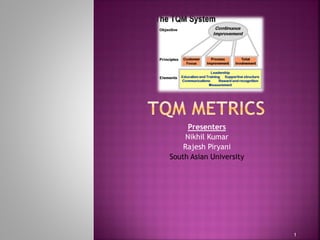
 Three Basic Principles
 Customer Satisfaction
 Quality Costing
 Benchmarking
 Leadership and Quality Motivation
2
 Literature on software industry indicates that software firms start
focusing on TQM since 1990 as the best managerial philosophy of
building self capacity and producing software with high quality, and to be
able to compete locally and internationally (Kan 1995).
 The challenges in Quality Technology and Management are increasing
yearly.
 In the 1990s, all organizations faced the issues of improving product and
service quality and enhance innovation.
 The discipline of quality has evolved and expanded rapidly from
inspection to company-wide quality management.
3
 Three basic principles of TQM must be considered in order to achieve
excellence in software development.
 Making Improvement : every person and every team has a common system for
solving problems.
 Satisfying Customers : Every team in every department follows a common
system for working together to satisfy customers, employ new tools to
indentify customers needs and requirements.
 Advancing the Organizations : Every manager and every team share a
common understanding of their organization’s goals and strategies.
4
 Study conducted by Kan and Baisli (1994), aimed to discuss quality of
software in the context of TQM, the most important elements that
researchers studied are the following:
 Customer Focus in software Development
 Process Improvement
 Human Side of quality that includes factors such as total participation,
management commitment and leadership, employee-empowerment and other
social and cultural factors.
 Focus on data, measurement, and model in software development.
5
6
7
8
9
 Many studies suggested that enhancing customer satisfaction is the bottom
line of business success:
 Ever-increasing market competition
 Only way to retain the Customers
 To expand market share
 To gain more profit
 To enhance/ improve product satisfaction level
 eg. 90% to 95%
 Studies show that it is five times more costly to recruit a new customer than it
is to keep an old customer:
 Why is it costly?
10
 It is fact that dissatisfied customers tell
 7 to 20 people about their experiences
 While satisfied customers tell
 Only 3 to 5 people
11
12
 Total customer satisfaction is the primary quality issue.
 Customers are the only people who can determine total customer satisfaction.
 To achieve total customer satisfaction, the organization must know the
customer, itself, its product, and its competition
13
14
15
• Quality costs are real and estimated at:
– 25% of costs in manufacturing
– 35% of costs in service industry
• Quality costs can be categorised to enable better understanding
16
 Quality is to continuously satisfy customers’ expectations
 Total quality – to achieve quality at low cost
 TQM –to achieve total quality through everybody’s participation
 Concept of total quality
 Sum of failure costs, inspection/appraisal costs and prevention costs
 Failure costs- Internal failure cost, external failure costs
 In relation to TQM-level of quality improved by quality management cost,
consist of
 Preventive Quality Cost – Prevent Quality defects and problems cropping up.
 Aim of preventive activities – find and control the causes of quality defects and problems
 Inspection/ Appraisal Cost- Aim is to find defects which have already occurred.
17
 Cost of Quality is recognised as a major tool used to quantify the
qualitative improvements of an organisation during the TQM
Implementation Process.
18
 Both Preventive and Appraisal Costs are known as the Costs of
Conformance.
 i.e. : The cost of doing things right the first time.
 Both Internal and External Failure Costs are known as the Costs of
Non-Conformance.
 i.e. : The cost incurred as a result of things not being done right the first time.
19
 Quality planning costs
 costs of developing and
implementing quality management
program
 Product-design costs
 costs of designing products with
quality characteristics
 Process costs
 costs expended to make sure
productive process conforms to
quality specifications
 Training costs
 costs of developing and putting on
quality training programs for employees
and management
 Information costs
 costs of acquiring and maintaining data
related to quality, and development of
reports on quality performance
20
 Application screening
 Capability studies
 Controlled storage
 Design review
 Equipment maintenance & repair
 Field testing
 Fixture design and fabrication
 Forecasting
 Housekeeping
 Job descriptions
 Market analysis
 Pilot projects
 Procedure writing
 Prototype testing
 Procedure reviews
 Quality incentives
 Safety reviews
 Time and motion studies
 Survey
 Quality training
 salesperson evaluation and selection
 Personnel reviews
21
 Inspection and testing
 costs of testing and inspecting materials, parts, and product at various stages and
at the end of a process
 Test equipment costs
 costs of maintaining equipment used in testing quality characteristics of products
 Operator costs
 costs of time spent by operators to gather data for testing product quality, to make
equipment adjustments to maintain quality, and to stop work to assess quality
22
 Audit
 Document checking
 Diagram checking
 Equipment calibration
 Final inspection
 In-process inspection
 Laboratory test
 Personnel testing
 Procedure testing
 Prototype inspection
 Receiving inspection
 Shipping inspection
23
 Scrap costs
 costs of poor-quality
products that must be
discarded, including
labor, material, and
indirect costs
 Rework costs
 costs of fixing defective
products to conform to
quality specifications
 Process failure costs
 costs of determining why
production process is
producing poor-quality
products
 Process downtime
costs
 costs of shutting down
productive process to fix
problem
 Price-downgrading
costs
 costs of discounting poor-
quality products—that is,
selling products as
“seconds”
24
 Customer complaint costs
 costs of investigating and satisfactorily
responding to a customer complaint resulting
from a poor-quality product
 Product return costs
 costs of handling and replacing poor-quality
products returned by customer
 Warranty claims costs
 costs of complying with product warranties
 Product liability costs
 litigation costs resulting from
product liability and customer
injury
 Lost sales costs
 costs incurred because customers
are dissatisfied with poor quality
products and do not make
additional purchases
25
26
Preventing Poor Quality (Comparison)
Failure Costs
• Internal
• External
Failure Costs
Repair Costs
Repair Costs
Appraisal Costs
Appraisal Costs
Prevention Costs
Prevention Costs
$
Before Quality
Cost
Alignment
After Quality
Cost
Alignment
Benefit
27
Customers will seek
out the highest quality
product.
Improved quality that exceeds
customer expectations will
generate more revenues that
exceed the cost of quality.
Therefore,
quality is
“free”.
28
W. Edwards Deming proposed that
improving quality reduces cost and
improves profitability.
Quality can be and should be
improved continuously.
Quality
TotalRevenues&Costs
Revenues
Cost
Max Profit
Max Quality
29
Profit is maximized at the
optimum quality level.
The optimum quality level is always achieved
before maximum attainable profit is reached.
Quality
TotalRevenues&Costs
Revenues
Cost
Max Profit
Optimum Quality
30
 The traditional method is to record costs as they arise (e.g. wage costs,
material etc.)or are thought to arise (e.g. depreciations).
 The method is as follows.
 Let Pjt stand for the ordinary financial result of company j at time t, and
 let Pjt/Nj stand for the ordinary financial result per employee.
 Nj denotes the number of employees, converted to full-time employees, in company j.
 Assume also that there are m comparable firms competing in the same
industry/market.
 Now let the m competing firms be ranked as follows:
 P1t/N1<P2t/N2<…<Pmt/Nm
 Based on this ranking, the lower limit of company j’s total quality costs at
time t can now be calculated:
 Cjt=(Pmt/Nm–Pjt/Nj)×Nj=(Nj /Nm)×Pmt–Pjt (14.2)
 The limit is a lower limit in the short term.
31
 We call this lower limit because the method build on the comparison
with the best company i.e
 the company which has achieved the highest profits per employee.
 This company is used as a benchmark for the other firms being
compared, a consequence of this approach being that its lower limit of
quality costs is zero.
32
33
 There is famous quotation:
 We can not become what we want to be by remaining what we are. Shift from
the original status is the key for success.
 So,
 If a company is loosing the market (or) customers, the company has to realize
that somebody is doing well ahead.
 So it is necessary to find out the ways to get their competitor’s level and have
to beat them to retain the market and customers.
 Benchmarking is ideal tool to achieve this.
34
 Benchmarking is a systematic and continuous measurement process;
 A process of continuously measuring and comparing an organization’s
business processes against business process leaders anywhere in the
world to gain information which will help the organization take action
to improve its performance.
35
What is our
Performance level?
How do we do it?
What are others’
Performance levels?
How did they get there?
Breakthrough
Performance
Creative
Adaptation
36
P-Plan, D-Do, C-Check, A-Act
37
 Plan
 Managers must evaluate the current process
 make plans based on any problems they find
 document all current procedures, collect data, and identify problems.
 Do
 During the implementation process managers should document all
changes made and collect data for evaluation.
 Study
 The third step is to study the data collected in the previous phase.
 The data are evaluated to see whether the plan is achieving the goals
established in the plan phase.
 Act
 to act on the basis of the results of the 3 phases.
 The best way to accomplish this is to communicate the results to other
members in the company and then implement the new procedure if it
has been successful.
 the next step is to plan again. After we have acted.
CONTINUE EVALUATING THE PROCESS, PLANNING, AND REPEATING THE
CYCLE AGAIN.
38
 Decide what to benchmark
 Understand current performance
 Plan
 Study others
 Learn from the data
 Use the findings
39
 Decide what to benchmark
 Think about the critical success factors and the mission.
 Which processes are causing the most trouble?
 Which processes contribute most to customer satisfaction and which are not
performing up to expectations?
 What are the competitive pressures impacting the organization the most?
 What processes have the most potential for differentiating our organization from
the competition?
40
 Critical Success Factors (CSFs) Are the Key Indicators That Inform
Us That a Particular Task, Activity, Process, Event, Function,
Service or Endeavour Is Successful
 CSF’s Are a Feature of All Levels of Business Activity; From the
Company As a Whole Down to the Activities of Individuals in It
41
Adopt, Adapt, and Advance: A well-designed performance measurement and
benchmark system is essential, but there are other critical success factors:
 Senior management support;
 Benchmarking training for the project team;
 Useful information technology systems;
 Cultural practices that encourage learning;
 Resource dedication - especially in the form of time, funding, and useful
equipment.
42
43
 People are the key to quality.
 If their actions and reactions become quality related,
 then expensive failures and the accumulation of hidden costs may be reduced
to an acceptable minimum or even prevented altogether.
 Total Quality is a holistic concept which requires quality motivation of
all people in an organization towards a common goal.
 People alone are the creators of quality- People Makes Quality.
 Belief:
 People are well motivated then they can overcome any difficulties they
experience in solving their problem.
44
 Clear Leadership and vision are considered to be the most important
critical success factors of TQM.
 Quality Motivation and Suggestion for improvement
 In the TQM leadership model the aim of the Act phase is to create an
environment which motivates people for quality and which encourages them to
participate in making suggestions about quality improvement.
45
46
47
This is a signal of increasing competition from the developing
countries.
48
 Some people believes that there is no basis for motivation
 Because its only the frame of mind of an individual
 It is true that – to deal with people’s minds and treat them fairly in order to
motivate them,
 Nevertheless its difficult to believe that there is no basis for the development
of motivation theory.
49
50
51
 Books
 Fundamentals of Total Quality Management- By Jens J.Dahlgaard
 Total Quality Management in Software Development Process
 Eldon Y. Li, California Polytechnic State University, USA
 A core value model for implementing total quality management in small
organisations
 By Jonas Hansson and Bengt Klefsjo¨
52
Tqm metrics

Tqm metrics

  • 1.
  • 2.
     Introduction  ThreeBasic Principles  Customer Satisfaction  Quality Costing  Benchmarking  Leadership and Quality Motivation 2
  • 3.
     Literature onsoftware industry indicates that software firms start focusing on TQM since 1990 as the best managerial philosophy of building self capacity and producing software with high quality, and to be able to compete locally and internationally (Kan 1995).  The challenges in Quality Technology and Management are increasing yearly.  In the 1990s, all organizations faced the issues of improving product and service quality and enhance innovation.  The discipline of quality has evolved and expanded rapidly from inspection to company-wide quality management. 3
  • 4.
     Three basicprinciples of TQM must be considered in order to achieve excellence in software development.  Making Improvement : every person and every team has a common system for solving problems.  Satisfying Customers : Every team in every department follows a common system for working together to satisfy customers, employ new tools to indentify customers needs and requirements.  Advancing the Organizations : Every manager and every team share a common understanding of their organization’s goals and strategies. 4
  • 5.
     Study conductedby Kan and Baisli (1994), aimed to discuss quality of software in the context of TQM, the most important elements that researchers studied are the following:  Customer Focus in software Development  Process Improvement  Human Side of quality that includes factors such as total participation, management commitment and leadership, employee-empowerment and other social and cultural factors.  Focus on data, measurement, and model in software development. 5
  • 6.
  • 7.
  • 8.
  • 9.
  • 10.
     Many studiessuggested that enhancing customer satisfaction is the bottom line of business success:  Ever-increasing market competition  Only way to retain the Customers  To expand market share  To gain more profit  To enhance/ improve product satisfaction level  eg. 90% to 95%  Studies show that it is five times more costly to recruit a new customer than it is to keep an old customer:  Why is it costly? 10
  • 11.
     It isfact that dissatisfied customers tell  7 to 20 people about their experiences  While satisfied customers tell  Only 3 to 5 people 11
  • 12.
  • 13.
     Total customersatisfaction is the primary quality issue.  Customers are the only people who can determine total customer satisfaction.  To achieve total customer satisfaction, the organization must know the customer, itself, its product, and its competition 13
  • 14.
  • 15.
  • 16.
    • Quality costsare real and estimated at: – 25% of costs in manufacturing – 35% of costs in service industry • Quality costs can be categorised to enable better understanding 16
  • 17.
     Quality isto continuously satisfy customers’ expectations  Total quality – to achieve quality at low cost  TQM –to achieve total quality through everybody’s participation  Concept of total quality  Sum of failure costs, inspection/appraisal costs and prevention costs  Failure costs- Internal failure cost, external failure costs  In relation to TQM-level of quality improved by quality management cost, consist of  Preventive Quality Cost – Prevent Quality defects and problems cropping up.  Aim of preventive activities – find and control the causes of quality defects and problems  Inspection/ Appraisal Cost- Aim is to find defects which have already occurred. 17
  • 18.
     Cost ofQuality is recognised as a major tool used to quantify the qualitative improvements of an organisation during the TQM Implementation Process. 18
  • 19.
     Both Preventiveand Appraisal Costs are known as the Costs of Conformance.  i.e. : The cost of doing things right the first time.  Both Internal and External Failure Costs are known as the Costs of Non-Conformance.  i.e. : The cost incurred as a result of things not being done right the first time. 19
  • 20.
     Quality planningcosts  costs of developing and implementing quality management program  Product-design costs  costs of designing products with quality characteristics  Process costs  costs expended to make sure productive process conforms to quality specifications  Training costs  costs of developing and putting on quality training programs for employees and management  Information costs  costs of acquiring and maintaining data related to quality, and development of reports on quality performance 20
  • 21.
     Application screening Capability studies  Controlled storage  Design review  Equipment maintenance & repair  Field testing  Fixture design and fabrication  Forecasting  Housekeeping  Job descriptions  Market analysis  Pilot projects  Procedure writing  Prototype testing  Procedure reviews  Quality incentives  Safety reviews  Time and motion studies  Survey  Quality training  salesperson evaluation and selection  Personnel reviews 21
  • 22.
     Inspection andtesting  costs of testing and inspecting materials, parts, and product at various stages and at the end of a process  Test equipment costs  costs of maintaining equipment used in testing quality characteristics of products  Operator costs  costs of time spent by operators to gather data for testing product quality, to make equipment adjustments to maintain quality, and to stop work to assess quality 22
  • 23.
     Audit  Documentchecking  Diagram checking  Equipment calibration  Final inspection  In-process inspection  Laboratory test  Personnel testing  Procedure testing  Prototype inspection  Receiving inspection  Shipping inspection 23
  • 24.
     Scrap costs costs of poor-quality products that must be discarded, including labor, material, and indirect costs  Rework costs  costs of fixing defective products to conform to quality specifications  Process failure costs  costs of determining why production process is producing poor-quality products  Process downtime costs  costs of shutting down productive process to fix problem  Price-downgrading costs  costs of discounting poor- quality products—that is, selling products as “seconds” 24
  • 25.
     Customer complaintcosts  costs of investigating and satisfactorily responding to a customer complaint resulting from a poor-quality product  Product return costs  costs of handling and replacing poor-quality products returned by customer  Warranty claims costs  costs of complying with product warranties  Product liability costs  litigation costs resulting from product liability and customer injury  Lost sales costs  costs incurred because customers are dissatisfied with poor quality products and do not make additional purchases 25
  • 26.
  • 27.
    Preventing Poor Quality(Comparison) Failure Costs • Internal • External Failure Costs Repair Costs Repair Costs Appraisal Costs Appraisal Costs Prevention Costs Prevention Costs $ Before Quality Cost Alignment After Quality Cost Alignment Benefit 27
  • 28.
    Customers will seek outthe highest quality product. Improved quality that exceeds customer expectations will generate more revenues that exceed the cost of quality. Therefore, quality is “free”. 28
  • 29.
    W. Edwards Demingproposed that improving quality reduces cost and improves profitability. Quality can be and should be improved continuously. Quality TotalRevenues&Costs Revenues Cost Max Profit Max Quality 29
  • 30.
    Profit is maximizedat the optimum quality level. The optimum quality level is always achieved before maximum attainable profit is reached. Quality TotalRevenues&Costs Revenues Cost Max Profit Optimum Quality 30
  • 31.
     The traditionalmethod is to record costs as they arise (e.g. wage costs, material etc.)or are thought to arise (e.g. depreciations).  The method is as follows.  Let Pjt stand for the ordinary financial result of company j at time t, and  let Pjt/Nj stand for the ordinary financial result per employee.  Nj denotes the number of employees, converted to full-time employees, in company j.  Assume also that there are m comparable firms competing in the same industry/market.  Now let the m competing firms be ranked as follows:  P1t/N1<P2t/N2<…<Pmt/Nm  Based on this ranking, the lower limit of company j’s total quality costs at time t can now be calculated:  Cjt=(Pmt/Nm–Pjt/Nj)×Nj=(Nj /Nm)×Pmt–Pjt (14.2)  The limit is a lower limit in the short term. 31
  • 32.
     We callthis lower limit because the method build on the comparison with the best company i.e  the company which has achieved the highest profits per employee.  This company is used as a benchmark for the other firms being compared, a consequence of this approach being that its lower limit of quality costs is zero. 32
  • 33.
  • 34.
     There isfamous quotation:  We can not become what we want to be by remaining what we are. Shift from the original status is the key for success.  So,  If a company is loosing the market (or) customers, the company has to realize that somebody is doing well ahead.  So it is necessary to find out the ways to get their competitor’s level and have to beat them to retain the market and customers.  Benchmarking is ideal tool to achieve this. 34
  • 35.
     Benchmarking isa systematic and continuous measurement process;  A process of continuously measuring and comparing an organization’s business processes against business process leaders anywhere in the world to gain information which will help the organization take action to improve its performance. 35
  • 36.
    What is our Performancelevel? How do we do it? What are others’ Performance levels? How did they get there? Breakthrough Performance Creative Adaptation 36
  • 37.
  • 38.
     Plan  Managersmust evaluate the current process  make plans based on any problems they find  document all current procedures, collect data, and identify problems.  Do  During the implementation process managers should document all changes made and collect data for evaluation.  Study  The third step is to study the data collected in the previous phase.  The data are evaluated to see whether the plan is achieving the goals established in the plan phase.  Act  to act on the basis of the results of the 3 phases.  The best way to accomplish this is to communicate the results to other members in the company and then implement the new procedure if it has been successful.  the next step is to plan again. After we have acted. CONTINUE EVALUATING THE PROCESS, PLANNING, AND REPEATING THE CYCLE AGAIN. 38
  • 39.
     Decide whatto benchmark  Understand current performance  Plan  Study others  Learn from the data  Use the findings 39
  • 40.
     Decide whatto benchmark  Think about the critical success factors and the mission.  Which processes are causing the most trouble?  Which processes contribute most to customer satisfaction and which are not performing up to expectations?  What are the competitive pressures impacting the organization the most?  What processes have the most potential for differentiating our organization from the competition? 40
  • 41.
     Critical SuccessFactors (CSFs) Are the Key Indicators That Inform Us That a Particular Task, Activity, Process, Event, Function, Service or Endeavour Is Successful  CSF’s Are a Feature of All Levels of Business Activity; From the Company As a Whole Down to the Activities of Individuals in It 41
  • 42.
    Adopt, Adapt, andAdvance: A well-designed performance measurement and benchmark system is essential, but there are other critical success factors:  Senior management support;  Benchmarking training for the project team;  Useful information technology systems;  Cultural practices that encourage learning;  Resource dedication - especially in the form of time, funding, and useful equipment. 42
  • 43.
  • 44.
     People arethe key to quality.  If their actions and reactions become quality related,  then expensive failures and the accumulation of hidden costs may be reduced to an acceptable minimum or even prevented altogether.  Total Quality is a holistic concept which requires quality motivation of all people in an organization towards a common goal.  People alone are the creators of quality- People Makes Quality.  Belief:  People are well motivated then they can overcome any difficulties they experience in solving their problem. 44
  • 45.
     Clear Leadershipand vision are considered to be the most important critical success factors of TQM.  Quality Motivation and Suggestion for improvement  In the TQM leadership model the aim of the Act phase is to create an environment which motivates people for quality and which encourages them to participate in making suggestions about quality improvement. 45
  • 46.
  • 47.
    47 This is asignal of increasing competition from the developing countries.
  • 48.
  • 49.
     Some peoplebelieves that there is no basis for motivation  Because its only the frame of mind of an individual  It is true that – to deal with people’s minds and treat them fairly in order to motivate them,  Nevertheless its difficult to believe that there is no basis for the development of motivation theory. 49
  • 50.
  • 51.
  • 52.
     Books  Fundamentalsof Total Quality Management- By Jens J.Dahlgaard  Total Quality Management in Software Development Process  Eldon Y. Li, California Polytechnic State University, USA  A core value model for implementing total quality management in small organisations  By Jonas Hansson and Bengt Klefsjo¨ 52