
1
PowerPointPowerPoint Presentation byPresentation by
Gail B. WrightGail B. Wright
Professor Emeritus of AccountingProfessor Emeritus of Accounting
Bryant UniversityBryant University
© Copyright 2007 Thomson South-Western, a part of The
Thomson Corporation. Thomson, the Star Logo, and
South-Western are trademarks used herein under license.
MANAGEMENT
ACCOUNTING
8th
EDITION
BY
HANSEN & MOWEN
11 COST-VOLUME-PROFIT ANALYSIS
2
LEARNING GOALS
After studying this
chapter, you should be
able to:
LEARNING OBJECTIVESLEARNING OBJECTIVES
3
1. Determine the number of units sold to break
even or earn a targeted profit.
2. Calculate the amount of revenue required to
break even or earn a targeted profit.
3. Apply cost-volume-profit analysis in a
multiple-product setting.
LEARNING OBJECTIVESLEARNING OBJECTIVES
Continued
4
4. Prepare a profit-volume graph & a cost-
volume-profit graph, and explain the
meaning of each.
5. Explain the impact of risk, uncertainty, &
changing variables on cost-volume-profit
analysis.
6. Discuss the impact of activity-based costing
on cost-volume-profit analysis.
LEARNING OBJECTIVESLEARNING OBJECTIVES
Click the button to skip
Questions to Think About
5
QUESTIONS TO THINK ABOUT:
McFarland’s Fine Foods
What kinds of variable & fixed
costs do you think Janet will
incur?
6
QUESTIONS TO THINK ABOUT:
McFarland’s Fine Foods
Given Bob’s initial assessment that
variable costs are higher than the
price, what is wrong with Janet’s
though that selling more is the way
to go?
7
QUESTIONS TO THINK ABOUT:
McFarland’s Fine Foods
How important is break-even
analysis to a firm? Do you
suppose that large companies do
break-even analysis as well as
small companies?
8
QUESTIONS TO THINK ABOUT:
McFarland’s Fine Foods
Why is the concept of breaking
even important? Doesn’t Janet want
to make a profit? If Janet doesn’t
know what price to charge, how
could she get a better idea?
9
1
Determine the number of
units sold to break even
or earn a targeted profit.
LEARNING OBJECTIVELEARNING OBJECTIVE
10
COST-VOLUME-PROFIT (CVP)
CVP expresses:
# units that must be sold to break even
Impact of a given reduction in fixed costs on
break-even point
Impact of an increase in price on profit
Sensitivity analysis of impact of various price or
cost levels on profit
LO 1
11
BREAK-EVEN POINT: DefinitionBREAK-EVEN POINT: Definition
Is the point where total revenue
equals total cost; the point of
zero profit.
LO 1
12
UNIT: Examples
Examples of unit of measurement
Procter & Gamble: bar of Ivory soap
McFarland: jar of salsa
Southwest Air Lines
Passenger mile
One-way trip
LO 1
13
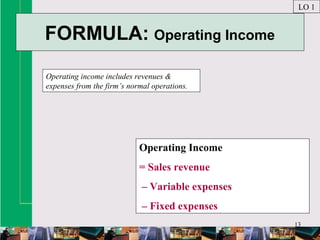
FORMULA: Operating Income
Operating income includes revenues &
expenses from the firm’s normal operations.
LO 1
Operating Income
= Sales revenue
– Variable expenses
– Fixed expenses
14
NET INCOME: DefinitionNET INCOME: Definition
Is operating income minus
income taxes.
LO 1
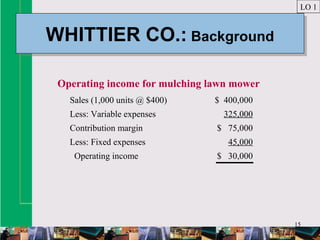
15
WHITTIER CO.: BackgroundWHITTIER CO.: Background
LO 1
Sales (1,000 units @ $400) $ 400,000
Less: Variable expenses 325,000
Contribution margin $ 75,000
Less: Fixed expenses 45,000
Operating income $ 30,000
Operating income for mulching lawn mower
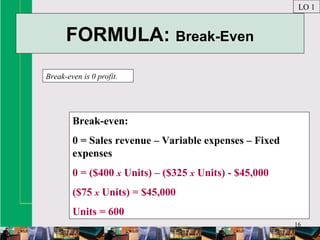
16
Break-even is 0 profit.
LO 1
Break-even:
0 = Sales revenue – Variable expenses – Fixed
expenses
0 = ($400 x Units) – ($325 x Units) - $45,000
($75 x Units) = $45,000
Units = 600
FORMULA: Break-Even
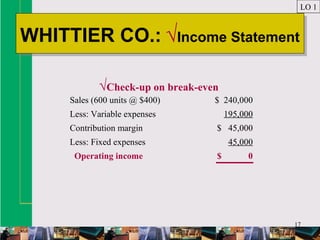
17
WHITTIER CO.: √Income StatementWHITTIER CO.: √Income Statement
LO 1
Sales (600 units @ $400) $ 240,000
Less: Variable expenses 195,000
Contribution margin $ 45,000
Less: Fixed expenses 45,000
Operating income $ 0
√Check-up on break-even
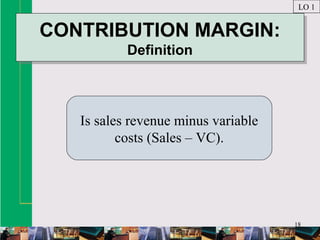
18
CONTRIBUTION MARGIN:
Definition
CONTRIBUTION MARGIN:
Definition
Is sales revenue minus variable
costs (Sales – VC).
LO 1
19
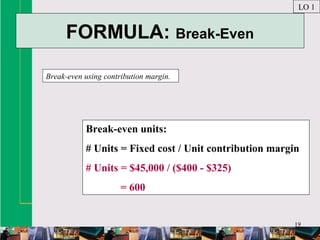
FORMULA: Break-Even
Break-even using contribution margin.
LO 1
Break-even units:
# Units = Fixed cost / Unit contribution margin
# Units = $45,000 / ($400 - $325)
= 600
20
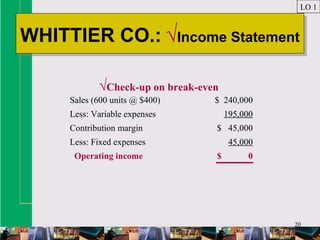
WHITTIER CO.: √Income StatementWHITTIER CO.: √Income Statement
LO 1
Sales (600 units @ $400) $ 240,000
Less: Variable expenses 195,000
Contribution margin $ 45,000
Less: Fixed expenses 45,000
Operating income $ 0
√Check-up on break-even
21
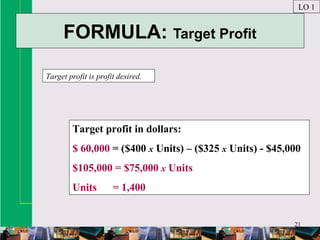
FORMULA: Target Profit
Target profit is profit desired.
LO 1
Target profit in dollars:
$ 60,000 = ($400 x Units) – ($325 x Units) - $45,000
$105,000 = $75,000 x Units
Units = 1,400
22
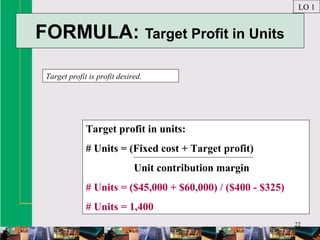
FORMULA: Target Profit in Units
Target profit is profit desired.
LO 1
Target profit in units:
# Units = (Fixed cost + Target profit)
Unit contribution margin
# Units = ($45,000 + $60,000) / ($400 - $325)
# Units = 1,400
23
WHITTIER CO.: √Income StatementWHITTIER CO.: √Income Statement
LO 1
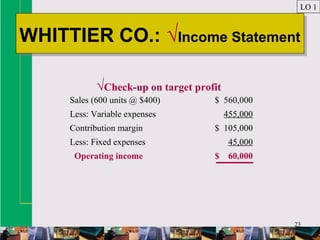
Sales (600 units @ $400) $ 560,000
Less: Variable expenses 455,000
Contribution margin $ 105,000
Less: Fixed expenses 45,000
Operating income $ 60,000
√Check-up on target profit
24
Can we calculate target
profit by another way than
dollars & units?
Yes! Target income can be
calculated as a percent of
revenue.
LO 1
25
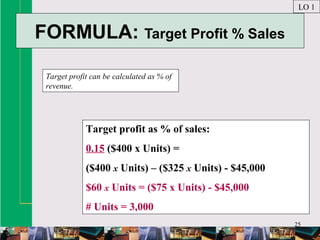
FORMULA: Target Profit % Sales
Target profit can be calculated as % of
revenue.
LO 1
Target profit as % of sales:
0.15 ($400 x Units) =
($400 x Units) – ($325 x Units) - $45,000
$60 x Units = ($75 x Units) - $45,000
# Units = 3,000
26
Can we calculate units
required to produce after
tax target profits?
Yes! First, calculate the level of
operating profit, then translate
into number of units.
LO 1
27
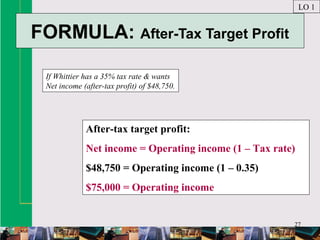
FORMULA: After-Tax Target Profit
If Whittier has a 35% tax rate & wants
Net income (after-tax profit) of $48,750.
LO 1
After-tax target profit:
Net income = Operating income (1 – Tax rate)
$48,750 = Operating income (1 – 0.35)
$75,000 = Operating income
28
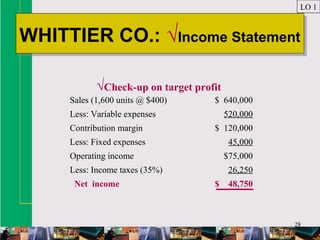
WHITTIER CO.: √Income StatementWHITTIER CO.: √Income Statement
LO 1
Sales (1,600 units @ $400) $ 640,000
Less: Variable expenses 520,000
Contribution margin $ 120,000
Less: Fixed expenses 45,000
Operating income $75,000
Less: Income taxes (35%) 26,250
Net income $ 48,750
√Check-up on target profit
29
2
Calculate the amount of
revenue required to
break even or earn a
targeted profit.
LEARNING OBJECTIVELEARNING OBJECTIVE
30
VARIABLE COST RATIO:
Definition
VARIABLE COST RATIO:
Definition
Is the proportion of each sales
dollar used to cover variable
costs.
LO 2
31
CONTRIBUTION MARGIN RATIO:
Definition
CONTRIBUTION MARGIN RATIO:
Definition
Is the proportion of each sales
dollar available to cover fixed
costs & provide profit.
LO 2
32
Where do fixed costs fit
in?
Fixed costs can equal CM
(break-even), or be less than
CM (profit) or more than CM
(loss).
LO 2
33
WHITTIER CO.: BackgroundWHITTIER CO.: Background
LO 2
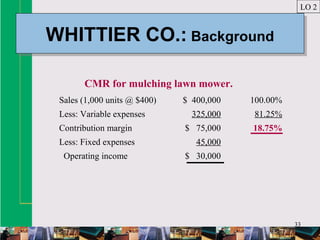
Sales (1,000 units @ $400) $ 400,000 100.00%
Less: Variable expenses 325,000 81.25%
Contribution margin $ 75,000 18.75%
Less: Fixed expenses 45,000
Operating income $ 30,000
CMR for mulching lawn mower.
34
FORMULA: Break-Even CMR
Contribution margin ratio (CMR)
makes calculation easier.
LO 2
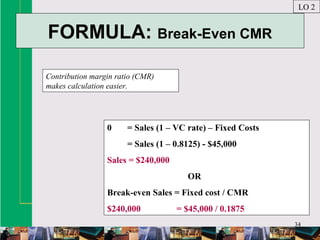
0 = Sales (1 – VC rate) – Fixed Costs
= Sales (1 – 0.8125) - $45,000
Sales = $240,000
OR
Break-even Sales = Fixed cost / CMR
$240,000 = $45,000 / 0.1875
35
3
Apply cost-volume-
profit analysis in a
multiple-product setting.
LEARNING OBJECTIVELEARNING OBJECTIVE
36
Can we use CVP if
Whittier has more than 1
product?
Yes. But we have to add direct
fixed expenses into the
analysis.
LO 3
37
DIRECT FIXED EXPENSES:
Definition
DIRECT FIXED EXPENSES:
Definition
Are fixed costs that can be
traced to each product and
would be avoided if the product
did not exist.
LO 3
38
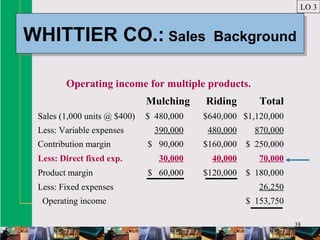
WHITTIER CO.: Sales BackgroundWHITTIER CO.: Sales Background
LO 3
Mulching Riding Total
Sales (1,000 units @ $400) $ 480,000 $640,000 $1,120,000
Less: Variable expenses 390,000 480,000 870,000
Contribution margin $ 90,000 $160,000 $ 250,000
Less: Direct fixed exp. 30,000 40,000 70,000
Product margin $ 60,000 $120,000 $ 180,000
Less: Fixed expenses 26,250
Operating income $ 153,750
Operating income for multiple products.
39
SALES MIX: DefinitionSALES MIX: Definition
Is the relative
combination of products
being sold.
LO 3
40
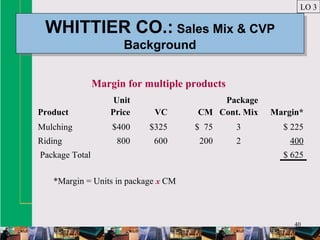
WHITTIER CO.: Sales Mix & CVP
Background
WHITTIER CO.: Sales Mix & CVP
Background
LO 3
Product
Unit
Price VC CM
Package
Cont. Mix Margin*
Mulching $400 $325 $ 75 3 $ 225
Riding 800 600 200 2 400
Package Total $ 625
Margin for multiple products
*Margin = Units in package x CM
41
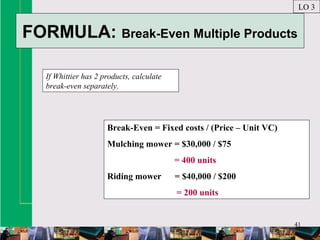
FORMULA: Break-Even Multiple Products
If Whittier has 2 products, calculate
break-even separately.
LO 3
Break-Even = Fixed costs / (Price – Unit VC)
Mulching mower = $30,000 / $75
= 400 units
Riding mower = $40,000 / $200
= 200 units
42
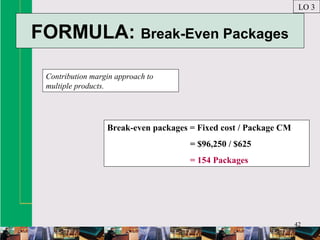
FORMULA: Break-Even Packages
Contribution margin approach to
multiple products.
LO 3
Break-even packages = Fixed cost / Package CM
= $96,250 / $625
= 154 Packages
43
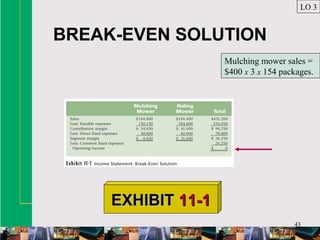
BREAK-EVEN SOLUTION
LO 3
EXHIBITEXHIBIT 11-111-1
Mulching mower sales =
$400 x 3 x 154 packages.
44
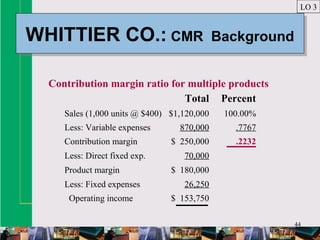
WHITTIER CO.: CMR BackgroundWHITTIER CO.: CMR Background
LO 3
Total Percent
Sales (1,000 units @ $400) $1,120,000 100.00%
Less: Variable expenses 870,000 .7767
Contribution margin $ 250,000 .2232
Less: Direct fixed exp. 70,000
Product margin $ 180,000
Less: Fixed expenses 26,250
Operating income $ 153,750
Contribution margin ratio for multiple products
45
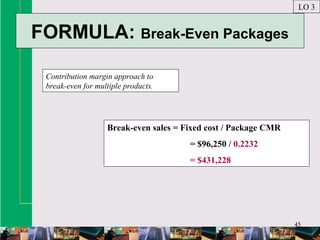
FORMULA: Break-Even Packages
Contribution margin approach to
break-even for multiple products.
LO 3
Break-even sales = Fixed cost / Package CMR
= $96,250 / 0.2232
= $431,228
46
4
Prepare a profit-volume
graph & a cost-volume-
profit graph, and explain
the meaning of each.
LEARNING OBJECTIVELEARNING OBJECTIVE
47
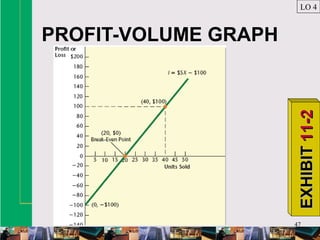
PROFIT-VOLUME GRAPH
LO 4
EXHIBITEXHIBIT11-211-2
48
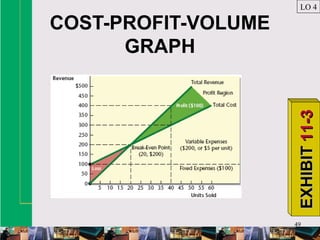
What happens when cost is
added to a profit-volume
graph?
The new graph clearly shows
areas of profit & loss.
LO 4
49
COST-PROFIT-VOLUME
GRAPH
LO 4
EXHIBITEXHIBIT11-311-3
50
ASSUMPTIONS OF CVP
CVP analysis assumes
Linear revenue & cost functions
Price, total fixed costs, & unit variable costs can
be accurately identified & remain constant over the
relevant range
What is produced is sold
Sales mix is known
Selling prices & costs are known with certainty
LO 4
51
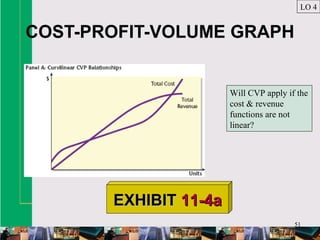
COST-PROFIT-VOLUME GRAPH
LO 4
Will CVP apply if the
cost & revenue
functions are not
linear?
EXHIBITEXHIBIT 11-4a11-4a
52
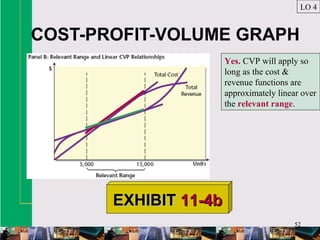
LO 4
EXHIBITEXHIBIT 11-4b11-4b
COST-PROFIT-VOLUME GRAPH
Yes. CVP will apply so
long as the cost &
revenue functions are
approximately linear over
the relevant range.
53
5
Explain the impact of
risk, uncertainty, &
changing variables on
cost-volume-profit
analysis.
LEARNING OBJECTIVELEARNING OBJECTIVE
54
What can Whittier do to
increase sales of mulching
mowers?
Sales can be increased by some
combination of increased
advertising and decreased
prices.
LO 5
55
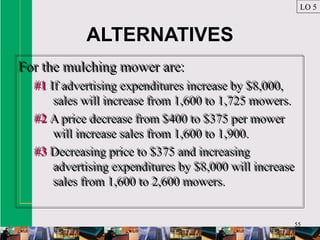
ALTERNATIVES
For the mulching mower are:
#1 If advertising expenditures increase by $8,000,
sales will increase from 1,600 to 1,725 mowers.
#2 A price decrease from $400 to $375 per mower
will increase sales from 1,600 to 1,900.
#3 Decreasing price to $375 and increasing
advertising expenditures by $8,000 will increase
sales from 1,600 to 2,600 mowers.
For the mulching mower are:
#1 If advertising expenditures increase by $8,000,
sales will increase from 1,600 to 1,725 mowers.
#2 A price decrease from $400 to $375 per mower
will increase sales from 1,600 to 1,900.
#3 Decreasing price to $375 and increasing
advertising expenditures by $8,000 will increase
sales from 1,600 to 2,600 mowers.
LO 5
56
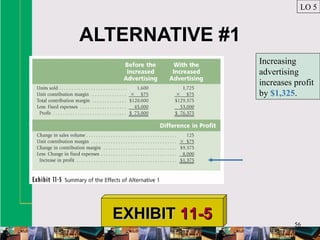
ALTERNATIVE #1
LO 5
EXHIBITEXHIBIT 11-511-5
Increasing
advertising
increases profit
by $1,325.
57
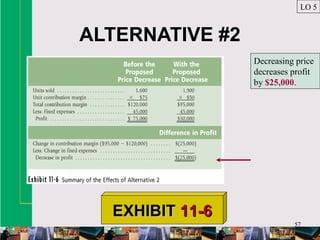
ALTERNATIVE #2
LO 5
EXHIBITEXHIBIT 11-611-6
Decreasing price
decreases profit
by $25,000.
58
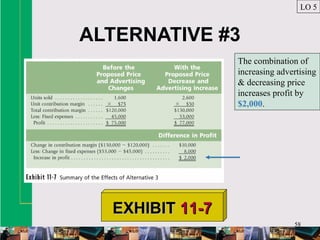
ALTERNATIVE #3
LO 5
EXHIBITEXHIBIT 11-711-7
The combination of
increasing advertising
& decreasing price
increases profit by
$2,000.
59
How should Whittier use
the results of analysis in
the 3 alternatives?
Whittier should consider its
choice in the context of Risk &
Uncertainty.
LO 5
60
RISK & UNCERTAINTY
For Whittier, risk includes the fact that prices and
costs can not be predicted with certainty. Risk
assumes that the distributions of the variables
in question are known (i.e., we know how
sales will react in response to changes in price
or cost). Under uncertainty, these distributions
are not known.
For Whittier, risk includes the fact that prices and
costs can not be predicted with certainty. Risk
assumes that the distributions of the variables
in question are known (i.e., we know how
sales will react in response to changes in price
or cost). Under uncertainty, these distributions
are not known.
LO 5
61
What should Whittier
consider in addressing risk
& uncertainty?
Whittier should consider its margin
of safety, operating leverage, and
sensitivity analysis to CVP.
LO 5
62
MARGIN OF SAFETY: DefinitionMARGIN OF SAFETY: Definition
Is the difference between break-
even volume or sales and
expected volume or sales.
LO 5
63
OPERATING LEVERAGE:
Definition
OPERATING LEVERAGE:
Definition
Is the use of fixed costs (e.g.,
automated system) to extract
higher percentage changes in
profits.
LO 5
64
SENSITIVITY ANALYSIS:
Definition
SENSITIVITY ANALYSIS:
Definition
Is the use of “what if” to
examine the impact of changes
in underlying assumptions on
operating results.
LO 5
65
SENSITIVITY ANALYSIS
LO 5
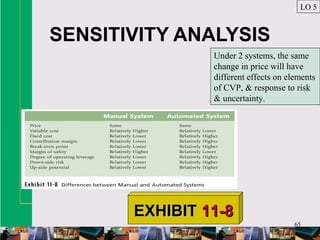
EXHIBITEXHIBIT 11-811-8
Under 2 systems, the same
change in price will have
different effects on elements
of CVP, & response to risk
& uncertainty.
66
6
Discuss the impact of
activity-based costing on
cost-volume-profit
analysis.
LEARNING OBJECTIVELEARNING OBJECTIVE
67
ABC & CVP
ABC divides costs into unit-based &
non-unit-based categories. CVP
has to adjust its formulas to
incorporate this division.
ABC divides costs into unit-based &
non-unit-based categories. CVP
has to adjust its formulas to
incorporate this division.
LO 6
68
FORMULA: ABC & CVP
ABC breaks CVP up into unit variable
costs & other non-unit level costs.
LO 6
Break-even =
[Fixed cost + (Unit VC x # Units)
+ (Setup cost x # Setups)
+ Engineering cost x # Engineering hours)] ÷
(Price – Unit variable cost)
69
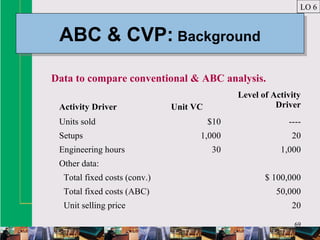
ABC & CVP: BackgroundABC & CVP: Background
LO 6
Activity Driver Unit VC
Level of Activity
Driver
Units sold $10 ----
Setups 1,000 20
Engineering hours 30 1,000
Other data:
Total fixed costs (conv.) $ 100,000
Total fixed costs (ABC) 50,000
Unit selling price 20
Data to compare conventional & ABC analysis.
70
FORMULA: Conventional CVP
LO 6
# Units
= [Targeted income + Conventional fixed cost ] ÷
(Price – Unit variable cost)
= ($20,000 + $100,000) ÷ ($20 - $10)
= 12,000 Units
71
FORMULA: ABC CVP
LO 6
# Units
= [Targeted income + ABC Fixed cost +
(Setup cost x # Setups) +
(Engineering cost x # Engineering hours)] ÷
(Price – Unit variable cost)
= ($20,000 + $50,000 + ($1,000 x 20) + ($30 x 1,000)] ÷ ($20 - $10)
= 12,000 Units
72
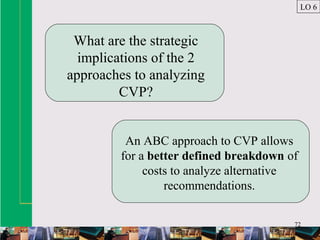
What are the strategic
implications of the 2
approaches to analyzing
CVP?
An ABC approach to CVP allows
for a better defined breakdown of
costs to analyze alternative
recommendations.
LO 6
73
THE ENDTHE END
CHAPTER 11

Hansen aise im ch11

  • 1.
    1 PowerPointPowerPoint Presentation byPresentationby Gail B. WrightGail B. Wright Professor Emeritus of AccountingProfessor Emeritus of Accounting Bryant UniversityBryant University © Copyright 2007 Thomson South-Western, a part of The Thomson Corporation. Thomson, the Star Logo, and South-Western are trademarks used herein under license. MANAGEMENT ACCOUNTING 8th EDITION BY HANSEN & MOWEN 11 COST-VOLUME-PROFIT ANALYSIS
  • 2.
    2 LEARNING GOALS After studyingthis chapter, you should be able to: LEARNING OBJECTIVESLEARNING OBJECTIVES
  • 3.
    3 1. Determine thenumber of units sold to break even or earn a targeted profit. 2. Calculate the amount of revenue required to break even or earn a targeted profit. 3. Apply cost-volume-profit analysis in a multiple-product setting. LEARNING OBJECTIVESLEARNING OBJECTIVES Continued
  • 4.
    4 4. Prepare aprofit-volume graph & a cost- volume-profit graph, and explain the meaning of each. 5. Explain the impact of risk, uncertainty, & changing variables on cost-volume-profit analysis. 6. Discuss the impact of activity-based costing on cost-volume-profit analysis. LEARNING OBJECTIVESLEARNING OBJECTIVES Click the button to skip Questions to Think About
  • 5.
    5 QUESTIONS TO THINKABOUT: McFarland’s Fine Foods What kinds of variable & fixed costs do you think Janet will incur?
  • 6.
    6 QUESTIONS TO THINKABOUT: McFarland’s Fine Foods Given Bob’s initial assessment that variable costs are higher than the price, what is wrong with Janet’s though that selling more is the way to go?
  • 7.
    7 QUESTIONS TO THINKABOUT: McFarland’s Fine Foods How important is break-even analysis to a firm? Do you suppose that large companies do break-even analysis as well as small companies?
  • 8.
    8 QUESTIONS TO THINKABOUT: McFarland’s Fine Foods Why is the concept of breaking even important? Doesn’t Janet want to make a profit? If Janet doesn’t know what price to charge, how could she get a better idea?
  • 9.
    9 1 Determine the numberof units sold to break even or earn a targeted profit. LEARNING OBJECTIVELEARNING OBJECTIVE
  • 10.
    10 COST-VOLUME-PROFIT (CVP) CVP expresses: #units that must be sold to break even Impact of a given reduction in fixed costs on break-even point Impact of an increase in price on profit Sensitivity analysis of impact of various price or cost levels on profit LO 1
  • 11.
    11 BREAK-EVEN POINT: DefinitionBREAK-EVENPOINT: Definition Is the point where total revenue equals total cost; the point of zero profit. LO 1
  • 12.
    12 UNIT: Examples Examples ofunit of measurement Procter & Gamble: bar of Ivory soap McFarland: jar of salsa Southwest Air Lines Passenger mile One-way trip LO 1
  • 13.
    13 FORMULA: Operating Income Operatingincome includes revenues & expenses from the firm’s normal operations. LO 1 Operating Income = Sales revenue – Variable expenses – Fixed expenses
  • 14.
    14 NET INCOME: DefinitionNETINCOME: Definition Is operating income minus income taxes. LO 1
  • 15.
    15 WHITTIER CO.: BackgroundWHITTIERCO.: Background LO 1 Sales (1,000 units @ $400) $ 400,000 Less: Variable expenses 325,000 Contribution margin $ 75,000 Less: Fixed expenses 45,000 Operating income $ 30,000 Operating income for mulching lawn mower
  • 16.
    16 Break-even is 0profit. LO 1 Break-even: 0 = Sales revenue – Variable expenses – Fixed expenses 0 = ($400 x Units) – ($325 x Units) - $45,000 ($75 x Units) = $45,000 Units = 600 FORMULA: Break-Even
  • 17.
    17 WHITTIER CO.: √IncomeStatementWHITTIER CO.: √Income Statement LO 1 Sales (600 units @ $400) $ 240,000 Less: Variable expenses 195,000 Contribution margin $ 45,000 Less: Fixed expenses 45,000 Operating income $ 0 √Check-up on break-even
  • 18.
    18 CONTRIBUTION MARGIN: Definition CONTRIBUTION MARGIN: Definition Issales revenue minus variable costs (Sales – VC). LO 1
  • 19.
    19 FORMULA: Break-Even Break-even usingcontribution margin. LO 1 Break-even units: # Units = Fixed cost / Unit contribution margin # Units = $45,000 / ($400 - $325) = 600
  • 20.
    20 WHITTIER CO.: √IncomeStatementWHITTIER CO.: √Income Statement LO 1 Sales (600 units @ $400) $ 240,000 Less: Variable expenses 195,000 Contribution margin $ 45,000 Less: Fixed expenses 45,000 Operating income $ 0 √Check-up on break-even
  • 21.
    21 FORMULA: Target Profit Targetprofit is profit desired. LO 1 Target profit in dollars: $ 60,000 = ($400 x Units) – ($325 x Units) - $45,000 $105,000 = $75,000 x Units Units = 1,400
  • 22.
    22 FORMULA: Target Profitin Units Target profit is profit desired. LO 1 Target profit in units: # Units = (Fixed cost + Target profit) Unit contribution margin # Units = ($45,000 + $60,000) / ($400 - $325) # Units = 1,400
  • 23.
    23 WHITTIER CO.: √IncomeStatementWHITTIER CO.: √Income Statement LO 1 Sales (600 units @ $400) $ 560,000 Less: Variable expenses 455,000 Contribution margin $ 105,000 Less: Fixed expenses 45,000 Operating income $ 60,000 √Check-up on target profit
  • 24.
    24 Can we calculatetarget profit by another way than dollars & units? Yes! Target income can be calculated as a percent of revenue. LO 1
  • 25.
    25 FORMULA: Target Profit% Sales Target profit can be calculated as % of revenue. LO 1 Target profit as % of sales: 0.15 ($400 x Units) = ($400 x Units) – ($325 x Units) - $45,000 $60 x Units = ($75 x Units) - $45,000 # Units = 3,000
  • 26.
    26 Can we calculateunits required to produce after tax target profits? Yes! First, calculate the level of operating profit, then translate into number of units. LO 1
  • 27.
    27 FORMULA: After-Tax TargetProfit If Whittier has a 35% tax rate & wants Net income (after-tax profit) of $48,750. LO 1 After-tax target profit: Net income = Operating income (1 – Tax rate) $48,750 = Operating income (1 – 0.35) $75,000 = Operating income
  • 28.
    28 WHITTIER CO.: √IncomeStatementWHITTIER CO.: √Income Statement LO 1 Sales (1,600 units @ $400) $ 640,000 Less: Variable expenses 520,000 Contribution margin $ 120,000 Less: Fixed expenses 45,000 Operating income $75,000 Less: Income taxes (35%) 26,250 Net income $ 48,750 √Check-up on target profit
  • 29.
    29 2 Calculate the amountof revenue required to break even or earn a targeted profit. LEARNING OBJECTIVELEARNING OBJECTIVE
  • 30.
    30 VARIABLE COST RATIO: Definition VARIABLECOST RATIO: Definition Is the proportion of each sales dollar used to cover variable costs. LO 2
  • 31.
    31 CONTRIBUTION MARGIN RATIO: Definition CONTRIBUTIONMARGIN RATIO: Definition Is the proportion of each sales dollar available to cover fixed costs & provide profit. LO 2
  • 32.
    32 Where do fixedcosts fit in? Fixed costs can equal CM (break-even), or be less than CM (profit) or more than CM (loss). LO 2
  • 33.
    33 WHITTIER CO.: BackgroundWHITTIERCO.: Background LO 2 Sales (1,000 units @ $400) $ 400,000 100.00% Less: Variable expenses 325,000 81.25% Contribution margin $ 75,000 18.75% Less: Fixed expenses 45,000 Operating income $ 30,000 CMR for mulching lawn mower.
  • 34.
    34 FORMULA: Break-Even CMR Contributionmargin ratio (CMR) makes calculation easier. LO 2 0 = Sales (1 – VC rate) – Fixed Costs = Sales (1 – 0.8125) - $45,000 Sales = $240,000 OR Break-even Sales = Fixed cost / CMR $240,000 = $45,000 / 0.1875
  • 35.
    35 3 Apply cost-volume- profit analysisin a multiple-product setting. LEARNING OBJECTIVELEARNING OBJECTIVE
  • 36.
    36 Can we useCVP if Whittier has more than 1 product? Yes. But we have to add direct fixed expenses into the analysis. LO 3
  • 37.
    37 DIRECT FIXED EXPENSES: Definition DIRECTFIXED EXPENSES: Definition Are fixed costs that can be traced to each product and would be avoided if the product did not exist. LO 3
  • 38.
    38 WHITTIER CO.: SalesBackgroundWHITTIER CO.: Sales Background LO 3 Mulching Riding Total Sales (1,000 units @ $400) $ 480,000 $640,000 $1,120,000 Less: Variable expenses 390,000 480,000 870,000 Contribution margin $ 90,000 $160,000 $ 250,000 Less: Direct fixed exp. 30,000 40,000 70,000 Product margin $ 60,000 $120,000 $ 180,000 Less: Fixed expenses 26,250 Operating income $ 153,750 Operating income for multiple products.
  • 39.
    39 SALES MIX: DefinitionSALESMIX: Definition Is the relative combination of products being sold. LO 3
  • 40.
    40 WHITTIER CO.: SalesMix & CVP Background WHITTIER CO.: Sales Mix & CVP Background LO 3 Product Unit Price VC CM Package Cont. Mix Margin* Mulching $400 $325 $ 75 3 $ 225 Riding 800 600 200 2 400 Package Total $ 625 Margin for multiple products *Margin = Units in package x CM
  • 41.
    41 FORMULA: Break-Even MultipleProducts If Whittier has 2 products, calculate break-even separately. LO 3 Break-Even = Fixed costs / (Price – Unit VC) Mulching mower = $30,000 / $75 = 400 units Riding mower = $40,000 / $200 = 200 units
  • 42.
    42 FORMULA: Break-Even Packages Contributionmargin approach to multiple products. LO 3 Break-even packages = Fixed cost / Package CM = $96,250 / $625 = 154 Packages
  • 43.
    43 BREAK-EVEN SOLUTION LO 3 EXHIBITEXHIBIT11-111-1 Mulching mower sales = $400 x 3 x 154 packages.
  • 44.
    44 WHITTIER CO.: CMRBackgroundWHITTIER CO.: CMR Background LO 3 Total Percent Sales (1,000 units @ $400) $1,120,000 100.00% Less: Variable expenses 870,000 .7767 Contribution margin $ 250,000 .2232 Less: Direct fixed exp. 70,000 Product margin $ 180,000 Less: Fixed expenses 26,250 Operating income $ 153,750 Contribution margin ratio for multiple products
  • 45.
    45 FORMULA: Break-Even Packages Contributionmargin approach to break-even for multiple products. LO 3 Break-even sales = Fixed cost / Package CMR = $96,250 / 0.2232 = $431,228
  • 46.
    46 4 Prepare a profit-volume graph& a cost-volume- profit graph, and explain the meaning of each. LEARNING OBJECTIVELEARNING OBJECTIVE
  • 47.
  • 48.
    48 What happens whencost is added to a profit-volume graph? The new graph clearly shows areas of profit & loss. LO 4
  • 49.
  • 50.
    50 ASSUMPTIONS OF CVP CVPanalysis assumes Linear revenue & cost functions Price, total fixed costs, & unit variable costs can be accurately identified & remain constant over the relevant range What is produced is sold Sales mix is known Selling prices & costs are known with certainty LO 4
  • 51.
    51 COST-PROFIT-VOLUME GRAPH LO 4 WillCVP apply if the cost & revenue functions are not linear? EXHIBITEXHIBIT 11-4a11-4a
  • 52.
    52 LO 4 EXHIBITEXHIBIT 11-4b11-4b COST-PROFIT-VOLUMEGRAPH Yes. CVP will apply so long as the cost & revenue functions are approximately linear over the relevant range.
  • 53.
    53 5 Explain the impactof risk, uncertainty, & changing variables on cost-volume-profit analysis. LEARNING OBJECTIVELEARNING OBJECTIVE
  • 54.
    54 What can Whittierdo to increase sales of mulching mowers? Sales can be increased by some combination of increased advertising and decreased prices. LO 5
  • 55.
    55 ALTERNATIVES For the mulchingmower are: #1 If advertising expenditures increase by $8,000, sales will increase from 1,600 to 1,725 mowers. #2 A price decrease from $400 to $375 per mower will increase sales from 1,600 to 1,900. #3 Decreasing price to $375 and increasing advertising expenditures by $8,000 will increase sales from 1,600 to 2,600 mowers. For the mulching mower are: #1 If advertising expenditures increase by $8,000, sales will increase from 1,600 to 1,725 mowers. #2 A price decrease from $400 to $375 per mower will increase sales from 1,600 to 1,900. #3 Decreasing price to $375 and increasing advertising expenditures by $8,000 will increase sales from 1,600 to 2,600 mowers. LO 5
  • 56.
    56 ALTERNATIVE #1 LO 5 EXHIBITEXHIBIT11-511-5 Increasing advertising increases profit by $1,325.
  • 57.
    57 ALTERNATIVE #2 LO 5 EXHIBITEXHIBIT11-611-6 Decreasing price decreases profit by $25,000.
  • 58.
    58 ALTERNATIVE #3 LO 5 EXHIBITEXHIBIT11-711-7 The combination of increasing advertising & decreasing price increases profit by $2,000.
  • 59.
    59 How should Whittieruse the results of analysis in the 3 alternatives? Whittier should consider its choice in the context of Risk & Uncertainty. LO 5
  • 60.
    60 RISK & UNCERTAINTY ForWhittier, risk includes the fact that prices and costs can not be predicted with certainty. Risk assumes that the distributions of the variables in question are known (i.e., we know how sales will react in response to changes in price or cost). Under uncertainty, these distributions are not known. For Whittier, risk includes the fact that prices and costs can not be predicted with certainty. Risk assumes that the distributions of the variables in question are known (i.e., we know how sales will react in response to changes in price or cost). Under uncertainty, these distributions are not known. LO 5
  • 61.
    61 What should Whittier considerin addressing risk & uncertainty? Whittier should consider its margin of safety, operating leverage, and sensitivity analysis to CVP. LO 5
  • 62.
    62 MARGIN OF SAFETY:DefinitionMARGIN OF SAFETY: Definition Is the difference between break- even volume or sales and expected volume or sales. LO 5
  • 63.
    63 OPERATING LEVERAGE: Definition OPERATING LEVERAGE: Definition Isthe use of fixed costs (e.g., automated system) to extract higher percentage changes in profits. LO 5
  • 64.
    64 SENSITIVITY ANALYSIS: Definition SENSITIVITY ANALYSIS: Definition Isthe use of “what if” to examine the impact of changes in underlying assumptions on operating results. LO 5
  • 65.
    65 SENSITIVITY ANALYSIS LO 5 EXHIBITEXHIBIT11-811-8 Under 2 systems, the same change in price will have different effects on elements of CVP, & response to risk & uncertainty.
  • 66.
    66 6 Discuss the impactof activity-based costing on cost-volume-profit analysis. LEARNING OBJECTIVELEARNING OBJECTIVE
  • 67.
    67 ABC & CVP ABCdivides costs into unit-based & non-unit-based categories. CVP has to adjust its formulas to incorporate this division. ABC divides costs into unit-based & non-unit-based categories. CVP has to adjust its formulas to incorporate this division. LO 6
  • 68.
    68 FORMULA: ABC &CVP ABC breaks CVP up into unit variable costs & other non-unit level costs. LO 6 Break-even = [Fixed cost + (Unit VC x # Units) + (Setup cost x # Setups) + Engineering cost x # Engineering hours)] ÷ (Price – Unit variable cost)
  • 69.
    69 ABC & CVP:BackgroundABC & CVP: Background LO 6 Activity Driver Unit VC Level of Activity Driver Units sold $10 ---- Setups 1,000 20 Engineering hours 30 1,000 Other data: Total fixed costs (conv.) $ 100,000 Total fixed costs (ABC) 50,000 Unit selling price 20 Data to compare conventional & ABC analysis.
  • 70.
    70 FORMULA: Conventional CVP LO6 # Units = [Targeted income + Conventional fixed cost ] ÷ (Price – Unit variable cost) = ($20,000 + $100,000) ÷ ($20 - $10) = 12,000 Units
  • 71.
    71 FORMULA: ABC CVP LO6 # Units = [Targeted income + ABC Fixed cost + (Setup cost x # Setups) + (Engineering cost x # Engineering hours)] ÷ (Price – Unit variable cost) = ($20,000 + $50,000 + ($1,000 x 20) + ($30 x 1,000)] ÷ ($20 - $10) = 12,000 Units
  • 72.
    72 What are thestrategic implications of the 2 approaches to analyzing CVP? An ABC approach to CVP allows for a better defined breakdown of costs to analyze alternative recommendations. LO 6
  • 73.