


1
PowerPointPowerPoint Presentation byPresentation by
Gail B. WrightGail B. Wright
Professor Emeritus of AccountingProfessor Emeritus of Accounting
Bryant UniversityBryant University
© Copyright 2007 Thomson South-Western, a part of The
Thomson Corporation. Thomson, the Star Logo, and
South-Western are trademarks used herein under license.
MANAGEMENT
ACCOUNTING
8th
EDITION
BY
HANSEN & MOWEN
10 SEGMENTED REPORTING
2
LEARNING GOALS
After studying this
chapter, you should be
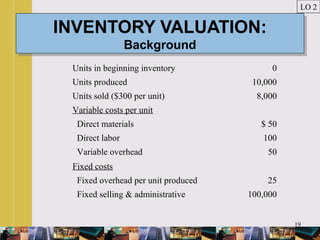
able to:
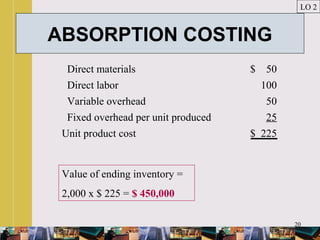
LEARNING OBJECTIVESLEARNING OBJECTIVES
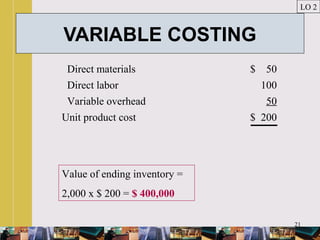
3
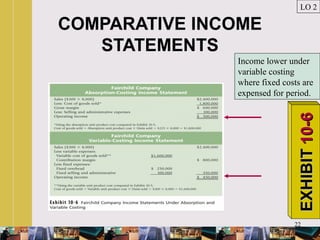
1. Explain how & why firms choose to
decentralize.
2. Explain the difference between absorption
& variable costing, & prepare segmented
income statements.
3. Compute & explain return on investment
(ROI).
LEARNING OBJECTIVESLEARNING OBJECTIVES
Continued
4
4. Compute & explain residual income &
economic value added (EVA).
5. Explain the role of transfer pricing in a
decentralized firm.
LEARNING OBJECTIVESLEARNING OBJECTIVES
Click the button to skip
Questions to Think About
5
QUESTIONS TO THINK ABOUT:
Galactic-Media Inc.
Why do firms calculate
income? What information
does it provide?
6
QUESTIONS TO THINK ABOUT:
Galactic-Media Inc.
What costs go into
inventory? How can they
affect income?
7
QUESTIONS TO THINK ABOUT:
Galactic-Media Inc.
What is GAAP, & how does it
affect the income statement of
the Medical Supplies Division?
8
QUESTIONS TO THINK ABOUT:
Galactic-Media Inc.
What do you suppose Kathy’s
chances are for getting the vice
president to consider evaluating
her performance on the basis of
variable, instead of absorption,
costing?
9
1
Explain how & why
firms choose to
decentralize.
LEARNING OBJECTIVELEARNING OBJECTIVE
10
What is a responsibility
accounting system?
A responsibility accounting
system measures the results of
responsibility centers according to
information managers need to
operate their centers.
LO 1
11
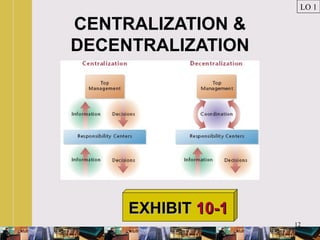
How do centralized and
decentralized firms differ?
In centralized firms, decision
making occurs at top levels,
implementation at lower levels.
Decentralized firms allow lower-
level managers to make and
implement decisions.
LO 1
12
CENTRALIZATION &
DECENTRALIZATION
LO 1
EXHIBITEXHIBIT 10-110-1
13
REASONS FOR
DECENTRALIZATION
Firms decide to decentralize:
For ease of gathering, using local information
To focus central management
To train & motivate segment managers,
To enhance competition & expose segments to
market forces
LO 1
14
DIVISIONS IN DECENTRALIZED
FIRM
Decentralization achieved by creating divisions
by
Type of goods & services
Geographic lines
Type of responsibility given to divisional manager
LO 1
15
RESPONSIBILITY CENTER:
Definition
RESPONSIBILITY CENTER:
Definition
Is a segment of the business
whose manager is accountable
for specified sets of activities.
LO 1
16
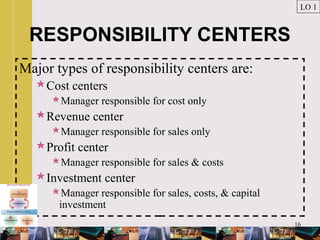
RESPONSIBILITY CENTERS
Major types of responsibility centers are:
Cost centers
Manager responsible for cost only
Revenue center
Manager responsible for sales only
Profit center
Manager responsible for sales & costs
Investment center
Manager responsible for sales, costs, & capital
investment
LO 1
17
2
Explain the difference
between absorption &
variable costing, &
prepare segmented
income statements.
LEARNING OBJECTIVELEARNING OBJECTIVE
18
What are 2 ways to
calculate income & how
do they differ?
2 ways to calculate income are by
absorption costing & variable
costing.
They differ in the treatment of fixed
factory overhead.
LO 2
19
INVENTORY VALUATION:
Background
INVENTORY VALUATION:
Background
LO 2
Units in beginning inventory 0
Units produced 10,000
Units sold ($300 per unit) 8,000
Variable costs per unit
Direct materials $ 50
Direct labor 100
Variable overhead 50
Fixed costs
Fixed overhead per unit produced 25
Fixed selling & administrative 100,000
20
ABSORPTION COSTING
LO 2
Direct materials $ 50
Direct labor 100
Variable overhead 50
Fixed overhead per unit produced 25
Unit product cost $ 225
Value of ending inventory =
2,000 x $ 225 = $ 450,000
21
VARIABLE COSTING
LO 2
Direct materials $ 50
Direct labor 100
Variable overhead 50
Unit product cost $ 200
Value of ending inventory =
2,000 x $ 200 = $ 400,000
22
COMPARATIVE INCOME
STATEMENTS
LO 2
EXHIBITEXHIBIT10-610-6
Income lower under
variable costing
where fixed costs are
expensed for period.
23
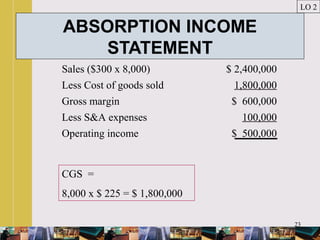
ABSORPTION INCOME
STATEMENT
LO 2
Sales ($300 x 8,000) $ 2,400,000
Less Cost of goods sold 1,800,000
Gross margin $ 600,000
Less S&A expenses 100,000
Operating income $ 500,000
CGS =
8,000 x $ 225 = $ 1,800,000
24
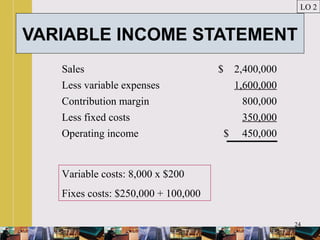
VARIABLE INCOME STATEMENT
LO 2
Sales $ 2,400,000
Less variable expenses 1,600,000
Contribution margin 800,000
Less fixed costs 350,000
Operating income $ 450,000
Variable costs: 8,000 x $200
Fixes costs: $250,000 + 100,000
25
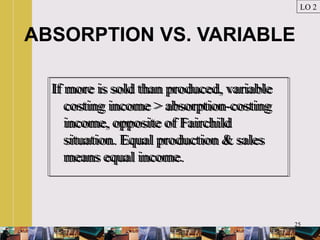
ABSORPTION VS. VARIABLE
If more is sold than produced, variable
costing income > absorption-costing
income, opposite of Fairchild
situation. Equal production & sales
means equal income.
If more is sold than produced, variable
costing income > absorption-costing
income, opposite of Fairchild
situation. Equal production & sales
means equal income.
LO 2
26
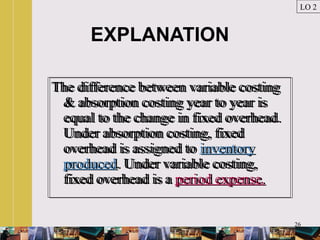
EXPLANATION
The difference between variable costing
& absorption costing year to year is
equal to the change in fixed overhead.
Under absorption costing, fixed
overhead is assigned to inventory
produced. Under variable costing,
fixed overhead is a period expense.
The difference between variable costing
& absorption costing year to year is
equal to the change in fixed overhead.
Under absorption costing, fixed
overhead is assigned to inventory
produced. Under variable costing,
fixed overhead is a period expense.
LO 2
27
How do variable &
absorption costing affect
performance evaluation?
Variable costing ensures that direct
relationship between sales & income
holds whereas absorption costing
does not.
LO 2
28
SEGMENT: DefinitionSEGMENT: Definition
Is a subunit of a company of
sufficient importance to warrant
performance reports.
LO 2
29
DIRECT FIXED EXPENSES:
Definition
DIRECT FIXED EXPENSES:
Definition
Are fixed expenses directly
traceable to a segment &
therefore, avoidable. If segment
eliminated, so are expenses.
LO 2
30
COMMON FIXED EXPENSES:
Definition
COMMON FIXED EXPENSES:
Definition
Are jointly caused by 2 or more
segments. These expenses
persist even if 1 segment is
eliminated.
LO 2
31
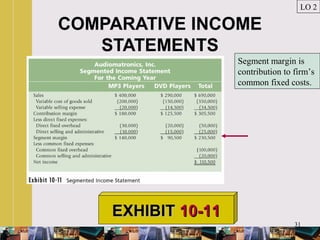
COMPARATIVE INCOME
STATEMENTS
LO 2
EXHIBITEXHIBIT 10-1110-11
Segment margin is
contribution to firm’s
common fixed costs.
32
3
Compute & explain
return on investment
(ROI).
LEARNING OBJECTIVELEARNING OBJECTIVE
33
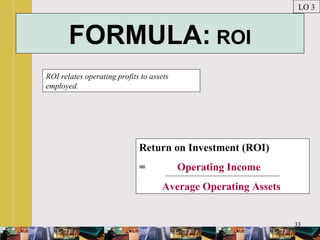
FORMULA: ROI
ROI relates operating profits to assets
employed.
LO 3
Return on Investment (ROI)
= Operating Income
Average Operating Assets
34
What is operating income?
What are operating assets?
Operating income is earnings before
interest & taxes.
Operating assets are assets acquired
to generate operate income.
LO 3
35
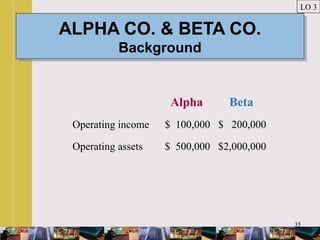
ALPHA CO. & BETA CO.
Background
ALPHA CO. & BETA CO.
Background
LO 3
Alpha Beta
Operating income $ 100,000 $ 200,000
Operating assets $ 500,000 $2,000,000
36
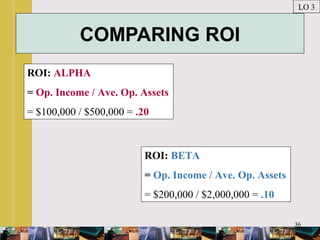
COMPARING ROI
LO 3
ROI: ALPHA
= Op. Income / Ave. Op. Assets
= $100,000 / $500,000 = .20
ROI: BETA
= Op. Income / Ave. Op. Assets
= $200,000 / $2,000,000 = .10
37
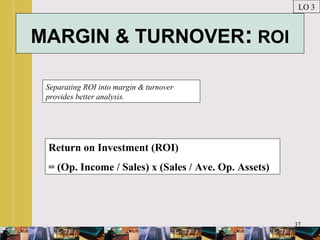
MARGIN & TURNOVER: ROI
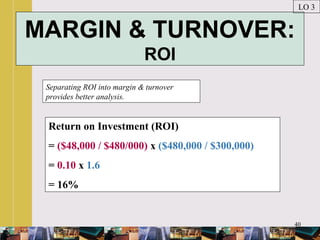
Separating ROI into margin & turnover
provides better analysis.
LO 3
Return on Investment (ROI)
= (Op. Income / Sales) x (Sales / Ave. Op. Assets)
38
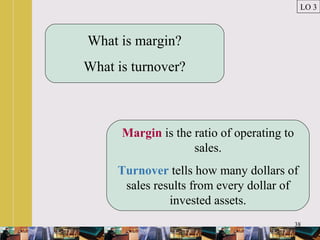
What is margin?
What is turnover?
Margin is the ratio of operating to
sales.
Turnover tells how many dollars of
sales results from every dollar of
invested assets.
LO 3
39
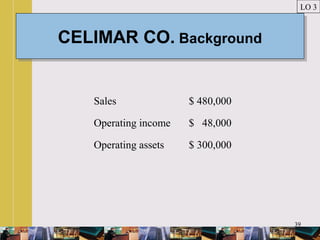
CELIMAR CO. BackgroundCELIMAR CO. Background
LO 3
Sales $ 480,000
Operating income $ 48,000
Operating assets $ 300,000
40
MARGIN & TURNOVER:
ROI
Separating ROI into margin & turnover
provides better analysis.
LO 3
Return on Investment (ROI)
= ($48,000 / $480/000) x ($480,000 / $300,000)
= 0.10 x 1.6
= 16%
41
EXPLANATION: ROI
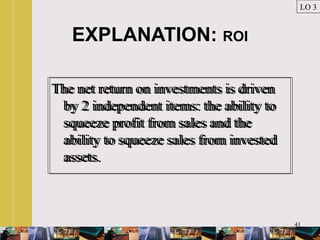
The net return on investments is driven
by 2 independent items: the ability to
squeeze profit from sales and the
ability to squeeze sales from invested
assets.
The net return on investments is driven
by 2 independent items: the ability to
squeeze profit from sales and the
ability to squeeze sales from invested
assets.
LO 3
42
ADVANTAGES OF ROI
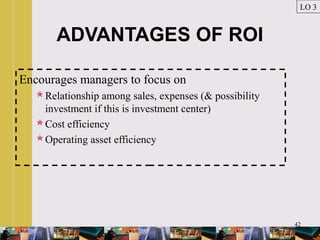
Encourages managers to focus on
Relationship among sales, expenses (& possibility
investment if this is investment center)
Cost efficiency
Operating asset efficiency
LO 3
43
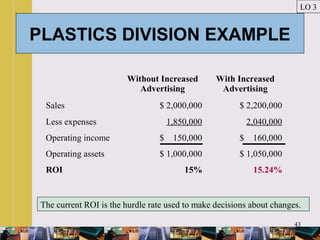
PLASTICS DIVISION EXAMPLE
LO 3
Without Increased
Advertising
With Increased
Advertising
Sales $ 2,000,000 $ 2,200,000
Less expenses 1,850,000 2,040,000
Operating income $ 150,000 $ 160,000
Operating assets $ 1,000,000 $ 1,050,000
ROI 15% 15.24%
The current ROI is the hurdle rate used to make decisions about changes.
44
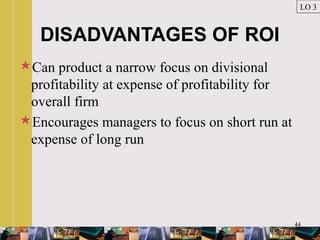
DISADVANTAGES OF ROI
Can product a narrow focus on divisional
profitability at expense of profitability for
overall firm
Encourages managers to focus on short run at
expense of long run
LO 3
45
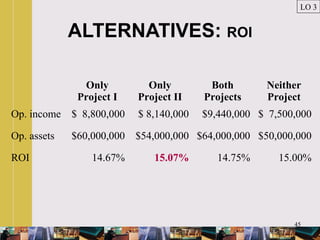
ALTERNATIVES: ROI
LO 3
Only
Project I
Only
Project II
Both
Projects
Neither
Project
Op. income $ 8,800,000 $ 8,140,000 $9,440,000 $ 7,500,000
Op. assets $60,000,000 $54,000,000 $64,000,000 $50,000,000
ROI 14.67% 15.07% 14.75% 15.00%
46
4
Compute & explain
residual income &
economic value added
(EVA).
LEARNING OBJECTIVELEARNING OBJECTIVE
47
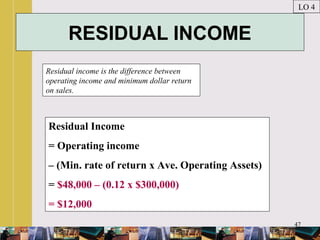
RESIDUAL INCOME
Residual income is the difference between
operating income and minimum dollar return
on sales.
LO 4
Residual Income
= Operating income
– (Min. rate of return x Ave. Operating Assets)
= $48,000 – (0.12 x $300,000)
= $12,000
48
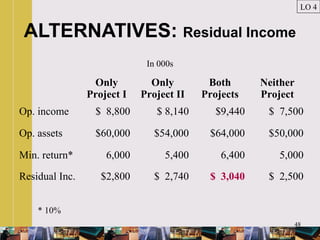
ALTERNATIVES: Residual Income
LO 4
Only
Project I
Only
Project II
Both
Projects
Neither
Project
Op. income $ 8,800 $ 8,140 $9,440 $ 7,500
Op. assets $60,000 $54,000 $64,000 $50,000
Min. return* 6,000 5,400 6,400 5,000
Residual Inc. $2,800 $ 2,740 $ 3,040 $ 2,500
In 000s
* 10%
49
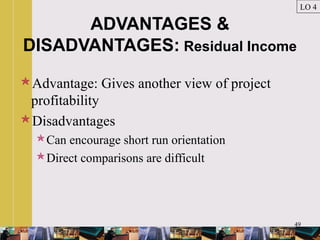
ADVANTAGES &
DISADVANTAGES: Residual Income
Advantage: Gives another view of project
profitability
Disadvantages
Can encourage short run orientation
Direct comparisons are difficult
LO 4
50
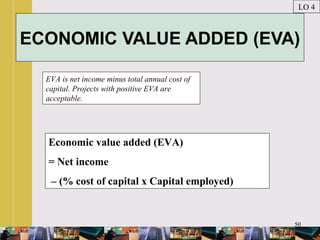
ECONOMIC VALUE ADDED (EVA)
EVA is net income minus total annual cost of
capital. Projects with positive EVA are
acceptable.
LO 4
Economic value added (EVA)
= Net income
– (% cost of capital x Capital employed)
51
5
Explain the role of
transfer pricing in a
decentralized firm.
LEARNING OBJECTIVELEARNING OBJECTIVE
52
TRANSFER PRICING: DefinitionTRANSFER PRICING: Definition
Is the price charged for a
component by the selling
division to the buying division
of the same company.
LO 5
53
What are the minimum &
maximum transfer prices?
The minimum transfer price would
leave the selling division not worse off
and the maximum would leave the
buying division no worse off than if
sold (acquire) externally.
LO 5
54
TRANSFER PRICE: Choices
Market price
Best choice if there is a competitive outside
market
Cost-Based price
When there is not good outside price
Negotiated price
Useful with there are market imperfections
LO 5
55
THE ENDTHE END
CHAPTER 10

Hansen aise im ch10

  • 1.
    1 PowerPointPowerPoint Presentation byPresentationby Gail B. WrightGail B. Wright Professor Emeritus of AccountingProfessor Emeritus of Accounting Bryant UniversityBryant University © Copyright 2007 Thomson South-Western, a part of The Thomson Corporation. Thomson, the Star Logo, and South-Western are trademarks used herein under license. MANAGEMENT ACCOUNTING 8th EDITION BY HANSEN & MOWEN 10 SEGMENTED REPORTING
  • 2.
    2 LEARNING GOALS After studyingthis chapter, you should be able to: LEARNING OBJECTIVESLEARNING OBJECTIVES
  • 3.
    3 1. Explain how& why firms choose to decentralize. 2. Explain the difference between absorption & variable costing, & prepare segmented income statements. 3. Compute & explain return on investment (ROI). LEARNING OBJECTIVESLEARNING OBJECTIVES Continued
  • 4.
    4 4. Compute &explain residual income & economic value added (EVA). 5. Explain the role of transfer pricing in a decentralized firm. LEARNING OBJECTIVESLEARNING OBJECTIVES Click the button to skip Questions to Think About
  • 5.
    5 QUESTIONS TO THINKABOUT: Galactic-Media Inc. Why do firms calculate income? What information does it provide?
  • 6.
    6 QUESTIONS TO THINKABOUT: Galactic-Media Inc. What costs go into inventory? How can they affect income?
  • 7.
    7 QUESTIONS TO THINKABOUT: Galactic-Media Inc. What is GAAP, & how does it affect the income statement of the Medical Supplies Division?
  • 8.
    8 QUESTIONS TO THINKABOUT: Galactic-Media Inc. What do you suppose Kathy’s chances are for getting the vice president to consider evaluating her performance on the basis of variable, instead of absorption, costing?
  • 9.
    9 1 Explain how &why firms choose to decentralize. LEARNING OBJECTIVELEARNING OBJECTIVE
  • 10.
    10 What is aresponsibility accounting system? A responsibility accounting system measures the results of responsibility centers according to information managers need to operate their centers. LO 1
  • 11.
    11 How do centralizedand decentralized firms differ? In centralized firms, decision making occurs at top levels, implementation at lower levels. Decentralized firms allow lower- level managers to make and implement decisions. LO 1
  • 12.
  • 13.
    13 REASONS FOR DECENTRALIZATION Firms decideto decentralize: For ease of gathering, using local information To focus central management To train & motivate segment managers, To enhance competition & expose segments to market forces LO 1
  • 14.
    14 DIVISIONS IN DECENTRALIZED FIRM Decentralizationachieved by creating divisions by Type of goods & services Geographic lines Type of responsibility given to divisional manager LO 1
  • 15.
    15 RESPONSIBILITY CENTER: Definition RESPONSIBILITY CENTER: Definition Isa segment of the business whose manager is accountable for specified sets of activities. LO 1
  • 16.
    16 RESPONSIBILITY CENTERS Major typesof responsibility centers are: Cost centers Manager responsible for cost only Revenue center Manager responsible for sales only Profit center Manager responsible for sales & costs Investment center Manager responsible for sales, costs, & capital investment LO 1
  • 17.
    17 2 Explain the difference betweenabsorption & variable costing, & prepare segmented income statements. LEARNING OBJECTIVELEARNING OBJECTIVE
  • 18.
    18 What are 2ways to calculate income & how do they differ? 2 ways to calculate income are by absorption costing & variable costing. They differ in the treatment of fixed factory overhead. LO 2
  • 19.
    19 INVENTORY VALUATION: Background INVENTORY VALUATION: Background LO2 Units in beginning inventory 0 Units produced 10,000 Units sold ($300 per unit) 8,000 Variable costs per unit Direct materials $ 50 Direct labor 100 Variable overhead 50 Fixed costs Fixed overhead per unit produced 25 Fixed selling & administrative 100,000
  • 20.
    20 ABSORPTION COSTING LO 2 Directmaterials $ 50 Direct labor 100 Variable overhead 50 Fixed overhead per unit produced 25 Unit product cost $ 225 Value of ending inventory = 2,000 x $ 225 = $ 450,000
  • 21.
    21 VARIABLE COSTING LO 2 Directmaterials $ 50 Direct labor 100 Variable overhead 50 Unit product cost $ 200 Value of ending inventory = 2,000 x $ 200 = $ 400,000
  • 22.
    22 COMPARATIVE INCOME STATEMENTS LO 2 EXHIBITEXHIBIT10-610-6 Incomelower under variable costing where fixed costs are expensed for period.
  • 23.
    23 ABSORPTION INCOME STATEMENT LO 2 Sales($300 x 8,000) $ 2,400,000 Less Cost of goods sold 1,800,000 Gross margin $ 600,000 Less S&A expenses 100,000 Operating income $ 500,000 CGS = 8,000 x $ 225 = $ 1,800,000
  • 24.
    24 VARIABLE INCOME STATEMENT LO2 Sales $ 2,400,000 Less variable expenses 1,600,000 Contribution margin 800,000 Less fixed costs 350,000 Operating income $ 450,000 Variable costs: 8,000 x $200 Fixes costs: $250,000 + 100,000
  • 25.
    25 ABSORPTION VS. VARIABLE Ifmore is sold than produced, variable costing income > absorption-costing income, opposite of Fairchild situation. Equal production & sales means equal income. If more is sold than produced, variable costing income > absorption-costing income, opposite of Fairchild situation. Equal production & sales means equal income. LO 2
  • 26.
    26 EXPLANATION The difference betweenvariable costing & absorption costing year to year is equal to the change in fixed overhead. Under absorption costing, fixed overhead is assigned to inventory produced. Under variable costing, fixed overhead is a period expense. The difference between variable costing & absorption costing year to year is equal to the change in fixed overhead. Under absorption costing, fixed overhead is assigned to inventory produced. Under variable costing, fixed overhead is a period expense. LO 2
  • 27.
    27 How do variable& absorption costing affect performance evaluation? Variable costing ensures that direct relationship between sales & income holds whereas absorption costing does not. LO 2
  • 28.
    28 SEGMENT: DefinitionSEGMENT: Definition Isa subunit of a company of sufficient importance to warrant performance reports. LO 2
  • 29.
    29 DIRECT FIXED EXPENSES: Definition DIRECTFIXED EXPENSES: Definition Are fixed expenses directly traceable to a segment & therefore, avoidable. If segment eliminated, so are expenses. LO 2
  • 30.
    30 COMMON FIXED EXPENSES: Definition COMMONFIXED EXPENSES: Definition Are jointly caused by 2 or more segments. These expenses persist even if 1 segment is eliminated. LO 2
  • 31.
    31 COMPARATIVE INCOME STATEMENTS LO 2 EXHIBITEXHIBIT10-1110-11 Segment margin is contribution to firm’s common fixed costs.
  • 32.
    32 3 Compute & explain returnon investment (ROI). LEARNING OBJECTIVELEARNING OBJECTIVE
  • 33.
    33 FORMULA: ROI ROI relatesoperating profits to assets employed. LO 3 Return on Investment (ROI) = Operating Income Average Operating Assets
  • 34.
    34 What is operatingincome? What are operating assets? Operating income is earnings before interest & taxes. Operating assets are assets acquired to generate operate income. LO 3
  • 35.
    35 ALPHA CO. &BETA CO. Background ALPHA CO. & BETA CO. Background LO 3 Alpha Beta Operating income $ 100,000 $ 200,000 Operating assets $ 500,000 $2,000,000
  • 36.
    36 COMPARING ROI LO 3 ROI:ALPHA = Op. Income / Ave. Op. Assets = $100,000 / $500,000 = .20 ROI: BETA = Op. Income / Ave. Op. Assets = $200,000 / $2,000,000 = .10
  • 37.
    37 MARGIN & TURNOVER:ROI Separating ROI into margin & turnover provides better analysis. LO 3 Return on Investment (ROI) = (Op. Income / Sales) x (Sales / Ave. Op. Assets)
  • 38.
    38 What is margin? Whatis turnover? Margin is the ratio of operating to sales. Turnover tells how many dollars of sales results from every dollar of invested assets. LO 3
  • 39.
    39 CELIMAR CO. BackgroundCELIMARCO. Background LO 3 Sales $ 480,000 Operating income $ 48,000 Operating assets $ 300,000
  • 40.
    40 MARGIN & TURNOVER: ROI SeparatingROI into margin & turnover provides better analysis. LO 3 Return on Investment (ROI) = ($48,000 / $480/000) x ($480,000 / $300,000) = 0.10 x 1.6 = 16%
  • 41.
    41 EXPLANATION: ROI The netreturn on investments is driven by 2 independent items: the ability to squeeze profit from sales and the ability to squeeze sales from invested assets. The net return on investments is driven by 2 independent items: the ability to squeeze profit from sales and the ability to squeeze sales from invested assets. LO 3
  • 42.
    42 ADVANTAGES OF ROI Encouragesmanagers to focus on Relationship among sales, expenses (& possibility investment if this is investment center) Cost efficiency Operating asset efficiency LO 3
  • 43.
    43 PLASTICS DIVISION EXAMPLE LO3 Without Increased Advertising With Increased Advertising Sales $ 2,000,000 $ 2,200,000 Less expenses 1,850,000 2,040,000 Operating income $ 150,000 $ 160,000 Operating assets $ 1,000,000 $ 1,050,000 ROI 15% 15.24% The current ROI is the hurdle rate used to make decisions about changes.
  • 44.
    44 DISADVANTAGES OF ROI Canproduct a narrow focus on divisional profitability at expense of profitability for overall firm Encourages managers to focus on short run at expense of long run LO 3
  • 45.
    45 ALTERNATIVES: ROI LO 3 Only ProjectI Only Project II Both Projects Neither Project Op. income $ 8,800,000 $ 8,140,000 $9,440,000 $ 7,500,000 Op. assets $60,000,000 $54,000,000 $64,000,000 $50,000,000 ROI 14.67% 15.07% 14.75% 15.00%
  • 46.
    46 4 Compute & explain residualincome & economic value added (EVA). LEARNING OBJECTIVELEARNING OBJECTIVE
  • 47.
    47 RESIDUAL INCOME Residual incomeis the difference between operating income and minimum dollar return on sales. LO 4 Residual Income = Operating income – (Min. rate of return x Ave. Operating Assets) = $48,000 – (0.12 x $300,000) = $12,000
  • 48.
    48 ALTERNATIVES: Residual Income LO4 Only Project I Only Project II Both Projects Neither Project Op. income $ 8,800 $ 8,140 $9,440 $ 7,500 Op. assets $60,000 $54,000 $64,000 $50,000 Min. return* 6,000 5,400 6,400 5,000 Residual Inc. $2,800 $ 2,740 $ 3,040 $ 2,500 In 000s * 10%
  • 49.
    49 ADVANTAGES & DISADVANTAGES: ResidualIncome Advantage: Gives another view of project profitability Disadvantages Can encourage short run orientation Direct comparisons are difficult LO 4
  • 50.
    50 ECONOMIC VALUE ADDED(EVA) EVA is net income minus total annual cost of capital. Projects with positive EVA are acceptable. LO 4 Economic value added (EVA) = Net income – (% cost of capital x Capital employed)
  • 51.
    51 5 Explain the roleof transfer pricing in a decentralized firm. LEARNING OBJECTIVELEARNING OBJECTIVE
  • 52.
    52 TRANSFER PRICING: DefinitionTRANSFERPRICING: Definition Is the price charged for a component by the selling division to the buying division of the same company. LO 5
  • 53.
    53 What are theminimum & maximum transfer prices? The minimum transfer price would leave the selling division not worse off and the maximum would leave the buying division no worse off than if sold (acquire) externally. LO 5
  • 54.
    54 TRANSFER PRICE: Choices Marketprice Best choice if there is a competitive outside market Cost-Based price When there is not good outside price Negotiated price Useful with there are market imperfections LO 5
  • 55.