5 Moments for Hand
Hygiene
Based on the 'My 5 moments for Hand Hygiene', URL: http://www.who.int/gpsc/5may/background/5moments/en/index.html © World Health Organization 2009. All rights reserved.
Session objective
Introduce the concept of micro-organism
transmission
Identify the 5 Moments
Define the 5 Moments for Hand Hygiene and
related terminology
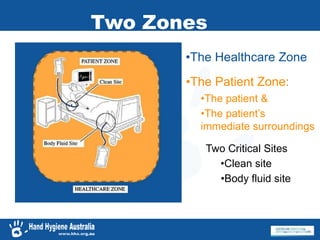
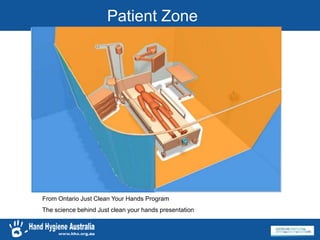
Two Zones
•The Patient Zone:
•The patient’s
immediate surroundings
•The patient &
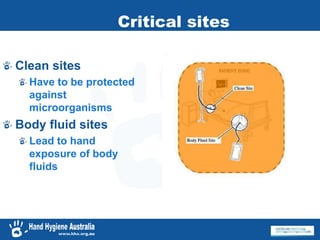
Two Critical Sites
•Clean site
•Body fluid site
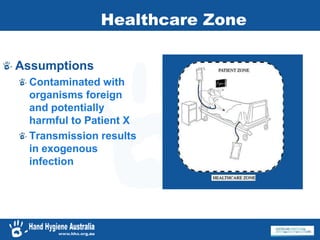
•The Healthcare Zone•The Healthcare Zone
From Ontario Just Clean Your Hands Program
The science behind Just clean your hands presentation
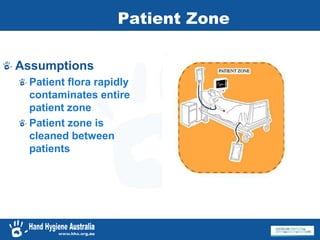
Patient Zone
Patient Zone
Assumptions
Patient flora rapidly
contaminates entire
patient zone
Patient zone is
cleaned between
patients
Healthcare Zone
Assumptions
Contaminated with
organisms foreign
and potentially
harmful to Patient X
Transmission results
in exogenous
infection
Critical sites
Clean sites
Have to be protected
against
microorganisms
Body fluid sites
Lead to hand
exposure of body
fluids
The facts
Colonised or infected patients represent the main
reservoir for healthcare associated microorganisms
Environment in the healthcare facility contains a
wide variety of different healthcare-associated
micro-organisms and represents a secondary source
for transmission to patients
The immediate patient environment becomes
colonised by the patient flora
The facts
Most transmission of microorganisms results in
colonisation, not infection
Most HCAIs, however, are of an endogenous nature,
and due to micro-organisms already colonising the
patient before the onset of infection
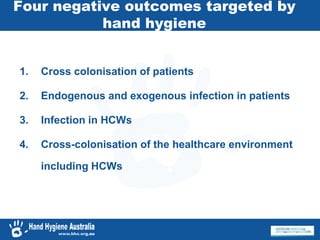
Four negative outcomes targeted by
hand hygiene
1. Cross colonisation of patients
2. Endogenous and exogenous infection in patients
3. Infection in HCWs
4. Cross-colonisation of the healthcare environment
including HCWs
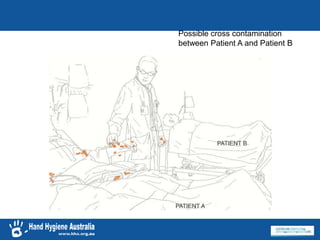
Possible cross contamination
between Patient A and Patient B
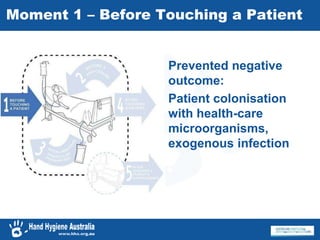
Moment 1 – Before Touching a Patient
Prevented negative
outcome:
Patient colonisation
with health-care
microorganisms,
exogenous infection
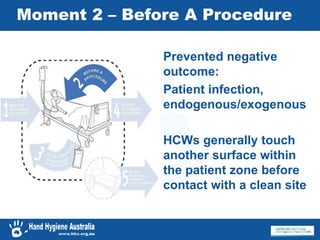
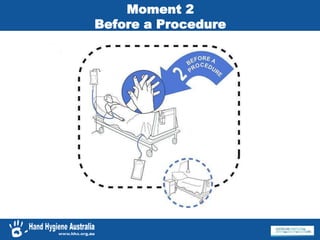
Moment 2 – Before A Procedure
Prevented negative
outcome:
Patient infection,
endogenous/exogenous
HCWs generally touch
another surface within
the patient zone before
contact with a clean site
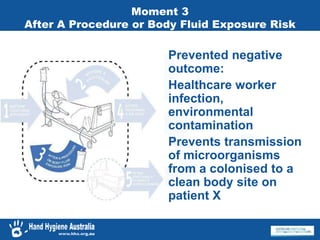
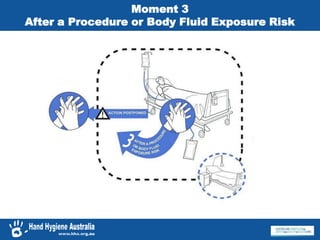
Moment 3
After A Procedure or Body Fluid Exposure Risk
Prevented negative
outcome:
Healthcare worker
infection,
environmental
contamination
Prevents transmission
of microorganisms
from a colonised to a
clean body site on
patient X
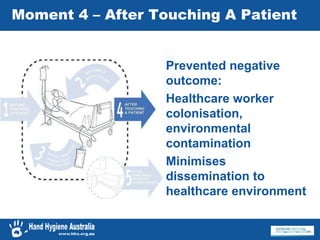
Moment 4 – After Touching A Patient
Prevented negative
outcome:
Healthcare worker
colonisation,
environmental
contamination
Minimises
dissemination to
healthcare environment
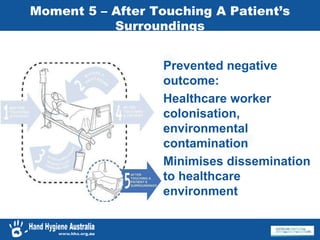
Moment 5 – After Touching A Patient’s
Surroundings
Prevented negative
outcome:
Healthcare worker
colonisation,
environmental
contamination
Minimises dissemination
to healthcare
environment
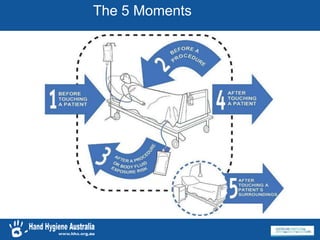
The 5 Moments
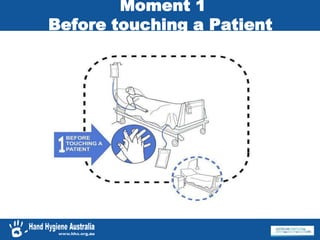
Moment 1
Before touching a Patient
Touching a Patient
Patient
Refers to any part of the patient,
their clothes, or any medical
device that is connected to the
patient
If the patient were to get out of bed
and walk off – what would still be
attached to them?
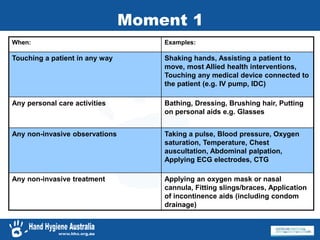
Moment 1
When: Examples:
Touching a patient in any way Shaking hands, Assisting a patient to
move, most Allied health interventions,
Touching any medical device connected to
the patient (e.g. IV pump, IDC)
Any personal care activities Bathing, Dressing, Brushing hair, Putting
on personal aids e.g. Glasses
Any non-invasive observations Taking a pulse, Blood pressure, Oxygen
saturation, Temperature, Chest
auscultation, Abdominal palpation,
Applying ECG electrodes, CTG
Any non-invasive treatment Applying an oxygen mask or nasal
cannula, Fitting slings/braces, Application
of incontinence aids (including condom
drainage)
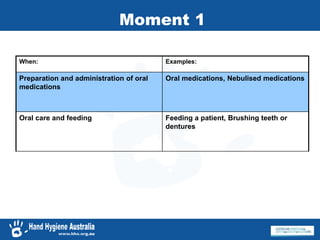
Moment 1
When: Examples:
Preparation and administration of oral
medications
Oral medications, Nebulised medications
Oral care and feeding Feeding a patient, Brushing teeth or
dentures
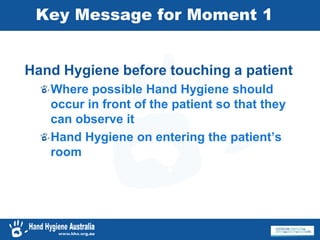
Key Message for Moment 1
Hand Hygiene before touching a patient
Where possible Hand Hygiene should
occur in front of the patient so that they
can observe it
Hand Hygiene on entering the patient’s
room
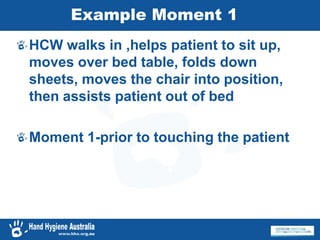
Example Moment 1
HCW walks in ,helps patient to sit up,
moves over bed table, folds down
sheets, moves the chair into position,
then assists patient out of bed
Moment 1-prior to touching the patient
Moment 2
Before a Procedure
Procedure
Is an act of care for a patient where
there is a risk of direct introduction
of a pathogen into the patient’s
body.
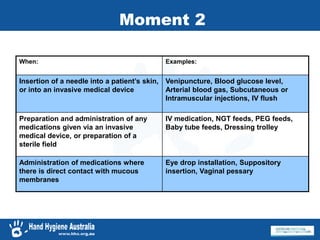
Moment 2
When: Examples:
Insertion of a needle into a patient’s skin,
or into an invasive medical device
Venipuncture, Blood glucose level,
Arterial blood gas, Subcutaneous or
Intramuscular injections, IV flush
Preparation and administration of any
medications given via an invasive
medical device, or preparation of a
sterile field
IV medication, NGT feeds, PEG feeds,
Baby tube feeds, Dressing trolley
Administration of medications where
there is direct contact with mucous
membranes
Eye drop installation, Suppository
insertion, Vaginal pessary
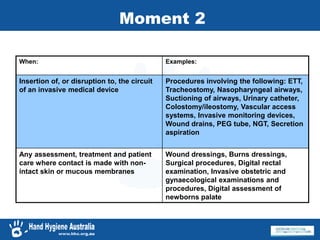
Moment 2
When: Examples:
Insertion of, or disruption to, the circuit
of an invasive medical device
Procedures involving the following: ETT,
Tracheostomy, Nasopharyngeal airways,
Suctioning of airways, Urinary catheter,
Colostomy/ileostomy, Vascular access
systems, Invasive monitoring devices,
Wound drains, PEG tube, NGT, Secretion
aspiration
Any assessment, treatment and patient
care where contact is made with non-
intact skin or mucous membranes
Wound dressings, Burns dressings,
Surgical procedures, Digital rectal
examination, Invasive obstetric and
gynaecological examinations and
procedures, Digital assessment of
newborns palate
Key Message for Moment 2
Hand Hygiene immediately prior to a
procedure
Once Hand Hygiene has been done, nothing
else in the patient’s environment should be
touched prior to the procedure starting
Example: Moment 2
HCW replaces an empty IV fluid bag
with a new IV fluid bag
Moment 2 – prior to disconnecting the IV
line
Moment 3
After a Procedure or Body Fluid Exposure Risk
Any situation where contact with body
fluids may occur. Such contact may pose
a contamination risk to either the HCW or
the environment
Body Fluid Exposure Risk
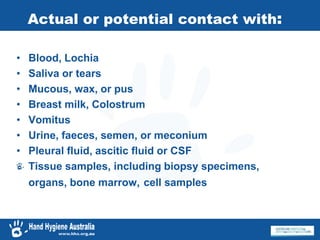
Actual or potential contact with:
• Blood, Lochia
• Saliva or tears
• Mucous, wax, or pus
• Breast milk, Colostrum
• Vomitus
• Urine, faeces, semen, or meconium
• Pleural fluid, ascitic fluid or CSF
Tissue samples, including biopsy specimens,
organs, bone marrow, cell samples
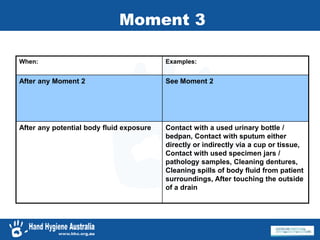
Moment 3
When: Examples:
After any Moment 2 See Moment 2
After any potential body fluid exposure Contact with a used urinary bottle /
bedpan, Contact with sputum either
directly or indirectly via a cup or tissue,
Contact with used specimen jars /
pathology samples, Cleaning dentures,
Cleaning spills of body fluid from patient
surroundings, After touching the outside
of a drain
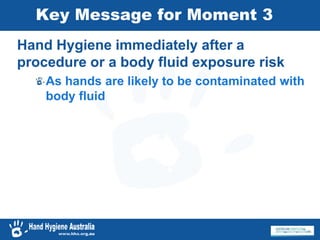
Key Message for Moment 3
Hand Hygiene immediately after a
procedure or a body fluid exposure risk
As hands are likely to be contaminated with
body fluid
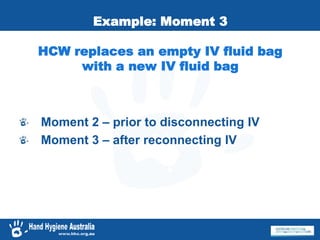
Example: Moment 3
HCW replaces an empty IV fluid bag
with a new IV fluid bag
Moment 2 – prior to disconnecting IV
Moment 3 – after reconnecting IV
Example: Moment 3
HCW walks into the room,
empties IDC drainage bag,
disposes of urine in pan room
Moment 2 – before opening IDC
Moment 3 – after disposing of urine (exposure
risk)
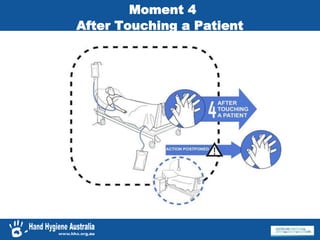
Moment 4
After Touching a Patient
Key Message for Moment 4
Hand Hygiene after touching a patient
This completes the basic message of Hand
Hygiene before you enter the patient room,
and before you leave the patient room
Example: Moment 4
HCW walks in,
helps the patient to sit up,
folds down the sheets,
moves the chair into position,
then gets the patient out of bed,
then leaves the room
Moment 1 – prior to touching patient
Moment 4 – after touching the patient
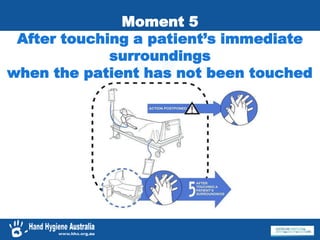
Moment 5
After touching a patient’s immediate
surroundings
when the patient has not been touched
Immediate Patient Surroundings
A space temporarily dedicated to an
individual patient for that patient’s
stay
Includes:
Patient furniture and personal belongings
Medical equipment – BP machine, monitor
Medical chart
Anything touched by HCW while caring for that
patient
Moment 5
When: Examples:
After touching the patient’s immediate
surroundings when the patient has not
been touched
Patient surroundings include: Bed,
Bedrails, Linen, Table, Bedside chart,
Bedside locker, Call bell/TV remote
control, Light switches, Personal
belongings, Chair, Foot stool, Monkey
bar
Key Message for Moment 5
Hand hygiene after touching the patient’s
surroundings when the patient has not
been touched
Example: Moment 5
HCW walks into patient room,
moves the over bed table closer to the
patient,
then leaves
Moment 5 – after touching the patient
surroundings (without touching the patient)
If patient had been touched, then this would
have been recorded as:
Moment 1 and Moment 4

5 Moments for Hand Hygiene

  • 1.
    5 Moments forHand Hygiene Based on the 'My 5 moments for Hand Hygiene', URL: http://www.who.int/gpsc/5may/background/5moments/en/index.html © World Health Organization 2009. All rights reserved.
  • 2.
    Session objective Introduce theconcept of micro-organism transmission Identify the 5 Moments Define the 5 Moments for Hand Hygiene and related terminology
  • 3.
    Two Zones •The PatientZone: •The patient’s immediate surroundings •The patient & Two Critical Sites •Clean site •Body fluid site •The Healthcare Zone•The Healthcare Zone
  • 4.
    From Ontario JustClean Your Hands Program The science behind Just clean your hands presentation Patient Zone
  • 5.
    Patient Zone Assumptions Patient florarapidly contaminates entire patient zone Patient zone is cleaned between patients
  • 6.
    Healthcare Zone Assumptions Contaminated with organismsforeign and potentially harmful to Patient X Transmission results in exogenous infection
  • 7.
    Critical sites Clean sites Haveto be protected against microorganisms Body fluid sites Lead to hand exposure of body fluids
  • 8.
    The facts Colonised orinfected patients represent the main reservoir for healthcare associated microorganisms Environment in the healthcare facility contains a wide variety of different healthcare-associated micro-organisms and represents a secondary source for transmission to patients The immediate patient environment becomes colonised by the patient flora
  • 9.
    The facts Most transmissionof microorganisms results in colonisation, not infection Most HCAIs, however, are of an endogenous nature, and due to micro-organisms already colonising the patient before the onset of infection
  • 10.
    Four negative outcomestargeted by hand hygiene 1. Cross colonisation of patients 2. Endogenous and exogenous infection in patients 3. Infection in HCWs 4. Cross-colonisation of the healthcare environment including HCWs
  • 11.
    Possible cross contamination betweenPatient A and Patient B
  • 12.
    Moment 1 –Before Touching a Patient Prevented negative outcome: Patient colonisation with health-care microorganisms, exogenous infection
  • 13.
    Moment 2 –Before A Procedure Prevented negative outcome: Patient infection, endogenous/exogenous HCWs generally touch another surface within the patient zone before contact with a clean site
  • 14.
    Moment 3 After AProcedure or Body Fluid Exposure Risk Prevented negative outcome: Healthcare worker infection, environmental contamination Prevents transmission of microorganisms from a colonised to a clean body site on patient X
  • 15.
    Moment 4 –After Touching A Patient Prevented negative outcome: Healthcare worker colonisation, environmental contamination Minimises dissemination to healthcare environment
  • 16.
    Moment 5 –After Touching A Patient’s Surroundings Prevented negative outcome: Healthcare worker colonisation, environmental contamination Minimises dissemination to healthcare environment
  • 17.
  • 18.
    Moment 1 Before touchinga Patient Touching a Patient
  • 19.
    Patient Refers to anypart of the patient, their clothes, or any medical device that is connected to the patient If the patient were to get out of bed and walk off – what would still be attached to them?
  • 20.
    Moment 1 When: Examples: Touchinga patient in any way Shaking hands, Assisting a patient to move, most Allied health interventions, Touching any medical device connected to the patient (e.g. IV pump, IDC) Any personal care activities Bathing, Dressing, Brushing hair, Putting on personal aids e.g. Glasses Any non-invasive observations Taking a pulse, Blood pressure, Oxygen saturation, Temperature, Chest auscultation, Abdominal palpation, Applying ECG electrodes, CTG Any non-invasive treatment Applying an oxygen mask or nasal cannula, Fitting slings/braces, Application of incontinence aids (including condom drainage)
  • 21.
    Moment 1 When: Examples: Preparationand administration of oral medications Oral medications, Nebulised medications Oral care and feeding Feeding a patient, Brushing teeth or dentures
  • 22.
    Key Message forMoment 1 Hand Hygiene before touching a patient Where possible Hand Hygiene should occur in front of the patient so that they can observe it Hand Hygiene on entering the patient’s room
  • 23.
    Example Moment 1 HCWwalks in ,helps patient to sit up, moves over bed table, folds down sheets, moves the chair into position, then assists patient out of bed Moment 1-prior to touching the patient
  • 24.
  • 25.
    Procedure Is an actof care for a patient where there is a risk of direct introduction of a pathogen into the patient’s body.
  • 26.
    Moment 2 When: Examples: Insertionof a needle into a patient’s skin, or into an invasive medical device Venipuncture, Blood glucose level, Arterial blood gas, Subcutaneous or Intramuscular injections, IV flush Preparation and administration of any medications given via an invasive medical device, or preparation of a sterile field IV medication, NGT feeds, PEG feeds, Baby tube feeds, Dressing trolley Administration of medications where there is direct contact with mucous membranes Eye drop installation, Suppository insertion, Vaginal pessary
  • 27.
    Moment 2 When: Examples: Insertionof, or disruption to, the circuit of an invasive medical device Procedures involving the following: ETT, Tracheostomy, Nasopharyngeal airways, Suctioning of airways, Urinary catheter, Colostomy/ileostomy, Vascular access systems, Invasive monitoring devices, Wound drains, PEG tube, NGT, Secretion aspiration Any assessment, treatment and patient care where contact is made with non- intact skin or mucous membranes Wound dressings, Burns dressings, Surgical procedures, Digital rectal examination, Invasive obstetric and gynaecological examinations and procedures, Digital assessment of newborns palate
  • 28.
    Key Message forMoment 2 Hand Hygiene immediately prior to a procedure Once Hand Hygiene has been done, nothing else in the patient’s environment should be touched prior to the procedure starting
  • 29.
    Example: Moment 2 HCWreplaces an empty IV fluid bag with a new IV fluid bag Moment 2 – prior to disconnecting the IV line
  • 30.
    Moment 3 After aProcedure or Body Fluid Exposure Risk
  • 31.
    Any situation wherecontact with body fluids may occur. Such contact may pose a contamination risk to either the HCW or the environment Body Fluid Exposure Risk
  • 32.
    Actual or potentialcontact with: • Blood, Lochia • Saliva or tears • Mucous, wax, or pus • Breast milk, Colostrum • Vomitus • Urine, faeces, semen, or meconium • Pleural fluid, ascitic fluid or CSF Tissue samples, including biopsy specimens, organs, bone marrow, cell samples
  • 33.
    Moment 3 When: Examples: Afterany Moment 2 See Moment 2 After any potential body fluid exposure Contact with a used urinary bottle / bedpan, Contact with sputum either directly or indirectly via a cup or tissue, Contact with used specimen jars / pathology samples, Cleaning dentures, Cleaning spills of body fluid from patient surroundings, After touching the outside of a drain
  • 34.
    Key Message forMoment 3 Hand Hygiene immediately after a procedure or a body fluid exposure risk As hands are likely to be contaminated with body fluid
  • 35.
    Example: Moment 3 HCWreplaces an empty IV fluid bag with a new IV fluid bag Moment 2 – prior to disconnecting IV Moment 3 – after reconnecting IV
  • 36.
    Example: Moment 3 HCWwalks into the room, empties IDC drainage bag, disposes of urine in pan room Moment 2 – before opening IDC Moment 3 – after disposing of urine (exposure risk)
  • 37.
  • 38.
    Key Message forMoment 4 Hand Hygiene after touching a patient This completes the basic message of Hand Hygiene before you enter the patient room, and before you leave the patient room
  • 39.
    Example: Moment 4 HCWwalks in, helps the patient to sit up, folds down the sheets, moves the chair into position, then gets the patient out of bed, then leaves the room Moment 1 – prior to touching patient Moment 4 – after touching the patient
  • 40.
    Moment 5 After touchinga patient’s immediate surroundings when the patient has not been touched
  • 41.
    Immediate Patient Surroundings Aspace temporarily dedicated to an individual patient for that patient’s stay Includes: Patient furniture and personal belongings Medical equipment – BP machine, monitor Medical chart Anything touched by HCW while caring for that patient
  • 42.
    Moment 5 When: Examples: Aftertouching the patient’s immediate surroundings when the patient has not been touched Patient surroundings include: Bed, Bedrails, Linen, Table, Bedside chart, Bedside locker, Call bell/TV remote control, Light switches, Personal belongings, Chair, Foot stool, Monkey bar
  • 43.
    Key Message forMoment 5 Hand hygiene after touching the patient’s surroundings when the patient has not been touched
  • 44.
    Example: Moment 5 HCWwalks into patient room, moves the over bed table closer to the patient, then leaves Moment 5 – after touching the patient surroundings (without touching the patient) If patient had been touched, then this would have been recorded as: Moment 1 and Moment 4