REAL POWER- FREQUENCY CONTROL
Dr.R.Muthukumar, ASP /EEE
4/5/2022
Power System Operation and Control
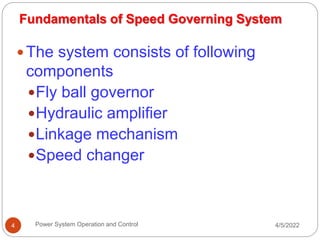
1
Basics of speed governing mechanism
and modeling - speed-load
characteristics – load sharing between
two synchronous machines in parallel -
control area concept - LFC control of a
single-area system - static and dynamic
analysis of uncontrolled and controlled
cases - two-area system – modeling -
static analysis of uncontrolled case - tie
line with frequency bias control - state
variable model - integration of economic
dispatch control with LFC. 4/5/2022
Power System Operation and Control
2
Speed changer
Lower
Raiser
XA
XB
XC
XD
XE
Speed Governor
Pilot valve
High pressure
oil
To Turbine
Steam
Steam valve
Main piston
Hydraulic amplifier
l1
l2 l3
l4
Fundamentals of Speed Governing System
4/5/2022
Power System Operation and Control
3
Fundamentals of Speed Governing System
4/5/2022
Power System Operation and Control
4
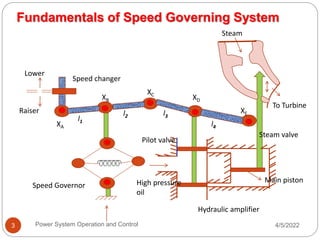
The system consists of following
components
Fly ball governor
Hydraulic amplifier
Linkage mechanism
Speed changer
4/5/2022
Power System Operation and Control
5
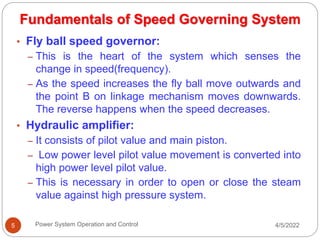
• Fly ball speed governor:
– This is the heart of the system which senses the
change in speed(frequency).
– As the speed increases the fly ball move outwards and
the point B on linkage mechanism moves downwards.
The reverse happens when the speed decreases.
• Hydraulic amplifier:
– It consists of pilot value and main piston.
– Low power level pilot value movement is converted into
high power level pilot value.
– This is necessary in order to open or close the steam
value against high pressure system.
Fundamentals of Speed Governing System
4/5/2022
Power System Operation and Control
6
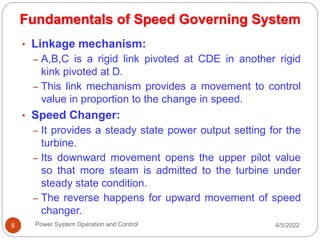
• Linkage mechanism:
– A,B,C is a rigid link pivoted at CDE in another rigid
kink pivoted at D.
– This link mechanism provides a movement to control
value in proportion to the change in speed.
• Speed Changer:
– It provides a steady state power output setting for the
turbine.
– Its downward movement opens the upper pilot value
so that more steam is admitted to the turbine under
steady state condition.
– The reverse happens for upward movement of speed
changer.
Fundamentals of Speed Governing System
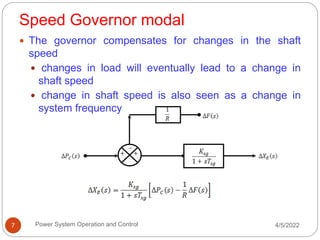
Speed Governor modal
4/5/2022
Power System Operation and Control
7
 The governor compensates for changes in the shaft
speed
 changes in load will eventually lead to a change in
shaft speed
 change in shaft speed is also seen as a change in
system frequency
Turbine model
4/5/2022
Power System Operation and Control
8
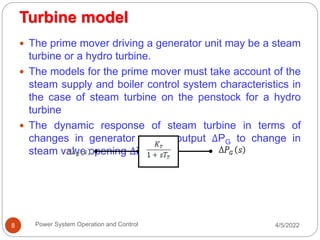
 The prime mover driving a generator unit may be a steam
turbine or a hydro turbine.
 The models for the prime mover must take account of the
steam supply and boiler control system characteristics in
the case of steam turbine on the penstock for a hydro
turbine
 The dynamic response of steam turbine in terms of
changes in generator power output ΔPG to change in
steam valve opening ΔXE
model
4/5/2022
Power System Operation and Control
9
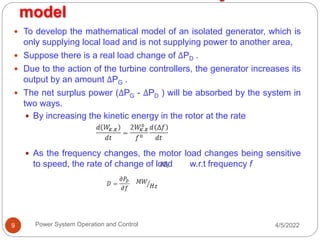
 To develop the mathematical model of an isolated generator, which is
only supplying local load and is not supplying power to another area,
 Suppose there is a real load change of ΔPD .
 Due to the action of the turbine controllers, the generator increases its
output by an amount ΔPG .
 The net surplus power (ΔPG - ΔPD ) will be absorbed by the system in
two ways.
 By increasing the kinetic energy in the rotor at the rate
 As the frequency changes, the motor load changes being sensitive
to speed, the rate of change of load w.r.t frequency f
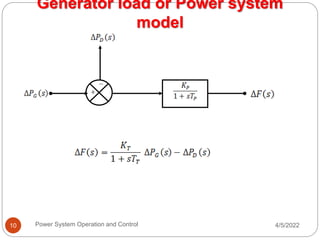
Generator load or Power system
model
4/5/2022
Power System Operation and Control
10
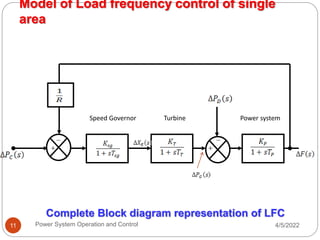
Model of Load frequency control of single
area
4/5/2022
Power System Operation and Control
11
Complete Block diagram representation of LFC
Speed Governor Turbine Power system
Speed-Load characteristics
4/5/2022
Power System Operation and Control
12
 The isochronous governors cannot be used when there
are two or more units connected to the same system since
each generator would have to precisely the same speed
setting.
 For stable load sharing between two or more units
operating in parallel, the governors are provided with a
characteristics so that the speed drops as the load in
increased.
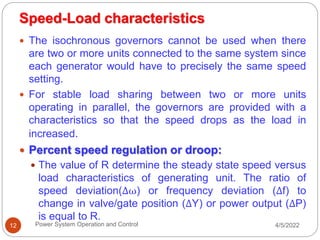
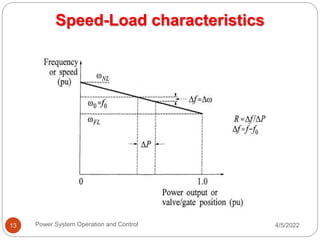
 Percent speed regulation or droop:
 The value of R determine the steady state speed versus
load characteristics of generating unit. The ratio of
speed deviation(Δω) or frequency deviation (Δf) to
change in valve/gate position (ΔY) or power output (ΔP)
is equal to R.
Speed-Load characteristics
4/5/2022
Power System Operation and Control
13
4/5/2022
Power System Operation and Control
14
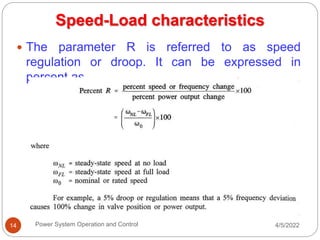
 The parameter R is referred to as speed
regulation or droop. It can be expressed in
percent as
Speed-Load characteristics
Load sharing between two synchronous machine in
parallel
4/5/2022
Power System Operation and Control
15
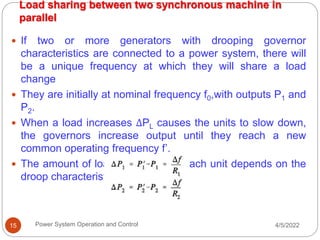
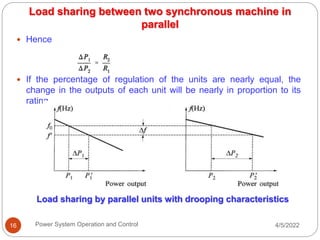
 If two or more generators with drooping governor
characteristics are connected to a power system, there will
be a unique frequency at which they will share a load
change
 They are initially at nominal frequency f0,with outputs P1 and
P2.
 When a load increases ΔPL causes the units to slow down,
the governors increase output until they reach a new
common operating frequency f’.
 The amount of load picked up by each unit depends on the
droop characteristics:
4/5/2022
Power System Operation and Control
16
 Hence
 If the percentage of regulation of the units are nearly equal, the
change in the outputs of each unit will be nearly in proportion to its
rating
Load sharing between two synchronous machine in
parallel
Load sharing by parallel units with drooping characteristics
Control Area
4/5/2022
Power System Operation and Control
17
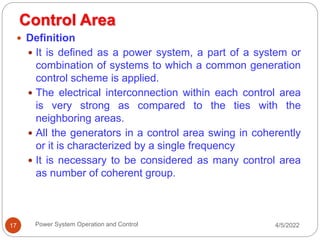
 Definition
 It is defined as a power system, a part of a system or
combination of systems to which a common generation
control scheme is applied.
 The electrical interconnection within each control area
is very strong as compared to the ties with the
neighboring areas.
 All the generators in a control area swing in coherently
or it is characterized by a single frequency
 It is necessary to be considered as many control area
as number of coherent group.
4/5/2022
Power System Operation and Control
18
 AGC problem of a large interconnected power
system has been studied by dividing a whole
system into a number of control areas.
 In normal steady state operation, each control
area of a power system should try to compensate
for those demand in power.
 Simultaneously, each control area of a power
system should help to maintain the frequency and
voltage profile of the overall systems.
Control Area
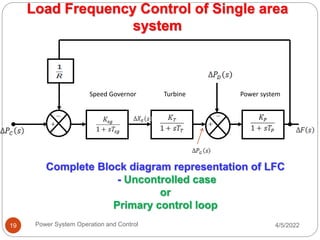
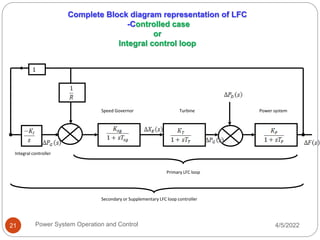
Complete Block diagram representation of LFC
- Uncontrolled case
or
Primary control loop
Speed Governor Turbine Power system
Load Frequency Control of Single area
system
4/5/2022
Power System Operation and Control
19
4/5/2022
Power System Operation and Control
20
Speed Governor Turbine Power system
Integral controller
Primary LFC loop
Secondary or Supplementary LFC loop controller
1
Complete Block diagram representation of LFC
-Controlled case
or
Integral control loop
4/5/2022
Power System Operation and Control
21
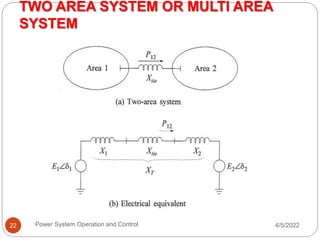
TWO AREA SYSTEM OR MULTI AREA
SYSTEM
4/5/2022
Power System Operation and Control
22
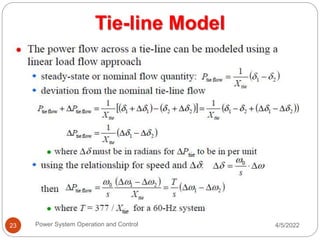
Tie-line Model
4/5/2022
Power System Operation and Control
23
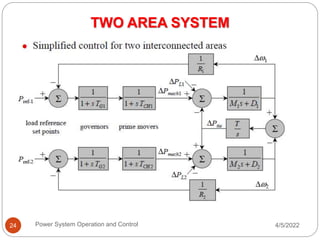
TWO AREA SYSTEM
4/5/2022
Power System Operation and Control
24
4/5/2022
Power System Operation and Control
25
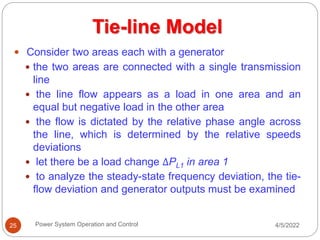
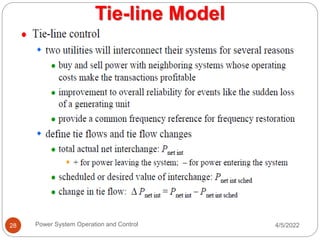
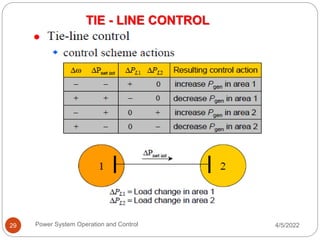
 Consider two areas each with a generator
 the two areas are connected with a single transmission
line
 the line flow appears as a load in one area and an
equal but negative load in the other area
 the flow is dictated by the relative phase angle across
the line, which is determined by the relative speeds
deviations
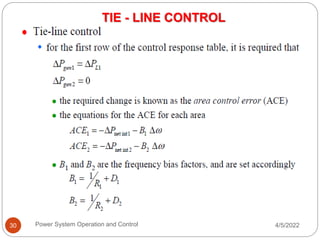
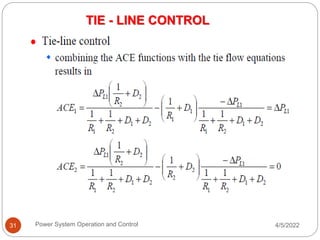
 let there be a load change ΔPL1 in area 1
 to analyze the steady-state frequency deviation, the tie-
flow deviation and generator outputs must be examined
Tie-line Model
Tie-line Model
4/5/2022
Power System Operation and Control
26
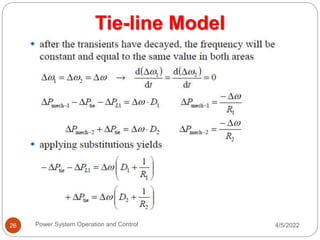
Tie-line Model
4/5/2022
Power System Operation and Control
27
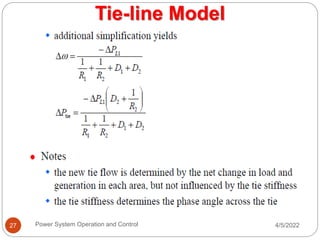
Tie-line Model
4/5/2022
Power System Operation and Control
28
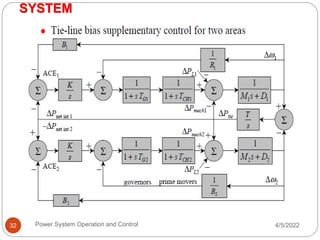
TIE - LINE CONTROL
4/5/2022
Power System Operation and Control
29
TIE - LINE CONTROL
4/5/2022
Power System Operation and Control
30
TIE - LINE CONTROL
4/5/2022
Power System Operation and Control
31
SYSTEM
4/5/2022
Power System Operation and Control
32
4/5/2022
Power System Operation and Control
33

Unit 2-1

  • 1.
    REAL POWER- FREQUENCYCONTROL Dr.R.Muthukumar, ASP /EEE 4/5/2022 Power System Operation and Control 1
  • 2.
    Basics of speedgoverning mechanism and modeling - speed-load characteristics – load sharing between two synchronous machines in parallel - control area concept - LFC control of a single-area system - static and dynamic analysis of uncontrolled and controlled cases - two-area system – modeling - static analysis of uncontrolled case - tie line with frequency bias control - state variable model - integration of economic dispatch control with LFC. 4/5/2022 Power System Operation and Control 2
  • 3.
    Speed changer Lower Raiser XA XB XC XD XE Speed Governor Pilotvalve High pressure oil To Turbine Steam Steam valve Main piston Hydraulic amplifier l1 l2 l3 l4 Fundamentals of Speed Governing System 4/5/2022 Power System Operation and Control 3
  • 4.
    Fundamentals of SpeedGoverning System 4/5/2022 Power System Operation and Control 4 The system consists of following components Fly ball governor Hydraulic amplifier Linkage mechanism Speed changer
  • 5.
    4/5/2022 Power System Operationand Control 5 • Fly ball speed governor: – This is the heart of the system which senses the change in speed(frequency). – As the speed increases the fly ball move outwards and the point B on linkage mechanism moves downwards. The reverse happens when the speed decreases. • Hydraulic amplifier: – It consists of pilot value and main piston. – Low power level pilot value movement is converted into high power level pilot value. – This is necessary in order to open or close the steam value against high pressure system. Fundamentals of Speed Governing System
  • 6.
    4/5/2022 Power System Operationand Control 6 • Linkage mechanism: – A,B,C is a rigid link pivoted at CDE in another rigid kink pivoted at D. – This link mechanism provides a movement to control value in proportion to the change in speed. • Speed Changer: – It provides a steady state power output setting for the turbine. – Its downward movement opens the upper pilot value so that more steam is admitted to the turbine under steady state condition. – The reverse happens for upward movement of speed changer. Fundamentals of Speed Governing System
  • 7.
    Speed Governor modal 4/5/2022 PowerSystem Operation and Control 7  The governor compensates for changes in the shaft speed  changes in load will eventually lead to a change in shaft speed  change in shaft speed is also seen as a change in system frequency
  • 8.
    Turbine model 4/5/2022 Power SystemOperation and Control 8  The prime mover driving a generator unit may be a steam turbine or a hydro turbine.  The models for the prime mover must take account of the steam supply and boiler control system characteristics in the case of steam turbine on the penstock for a hydro turbine  The dynamic response of steam turbine in terms of changes in generator power output ΔPG to change in steam valve opening ΔXE
  • 9.
    model 4/5/2022 Power System Operationand Control 9  To develop the mathematical model of an isolated generator, which is only supplying local load and is not supplying power to another area,  Suppose there is a real load change of ΔPD .  Due to the action of the turbine controllers, the generator increases its output by an amount ΔPG .  The net surplus power (ΔPG - ΔPD ) will be absorbed by the system in two ways.  By increasing the kinetic energy in the rotor at the rate  As the frequency changes, the motor load changes being sensitive to speed, the rate of change of load w.r.t frequency f
  • 10.
    Generator load orPower system model 4/5/2022 Power System Operation and Control 10
  • 11.
    Model of Loadfrequency control of single area 4/5/2022 Power System Operation and Control 11 Complete Block diagram representation of LFC Speed Governor Turbine Power system
  • 12.
    Speed-Load characteristics 4/5/2022 Power SystemOperation and Control 12  The isochronous governors cannot be used when there are two or more units connected to the same system since each generator would have to precisely the same speed setting.  For stable load sharing between two or more units operating in parallel, the governors are provided with a characteristics so that the speed drops as the load in increased.  Percent speed regulation or droop:  The value of R determine the steady state speed versus load characteristics of generating unit. The ratio of speed deviation(Δω) or frequency deviation (Δf) to change in valve/gate position (ΔY) or power output (ΔP) is equal to R.
  • 13.
  • 14.
    4/5/2022 Power System Operationand Control 14  The parameter R is referred to as speed regulation or droop. It can be expressed in percent as Speed-Load characteristics
  • 15.
    Load sharing betweentwo synchronous machine in parallel 4/5/2022 Power System Operation and Control 15  If two or more generators with drooping governor characteristics are connected to a power system, there will be a unique frequency at which they will share a load change  They are initially at nominal frequency f0,with outputs P1 and P2.  When a load increases ΔPL causes the units to slow down, the governors increase output until they reach a new common operating frequency f’.  The amount of load picked up by each unit depends on the droop characteristics:
  • 16.
    4/5/2022 Power System Operationand Control 16  Hence  If the percentage of regulation of the units are nearly equal, the change in the outputs of each unit will be nearly in proportion to its rating Load sharing between two synchronous machine in parallel Load sharing by parallel units with drooping characteristics
  • 17.
    Control Area 4/5/2022 Power SystemOperation and Control 17  Definition  It is defined as a power system, a part of a system or combination of systems to which a common generation control scheme is applied.  The electrical interconnection within each control area is very strong as compared to the ties with the neighboring areas.  All the generators in a control area swing in coherently or it is characterized by a single frequency  It is necessary to be considered as many control area as number of coherent group.
  • 18.
    4/5/2022 Power System Operationand Control 18  AGC problem of a large interconnected power system has been studied by dividing a whole system into a number of control areas.  In normal steady state operation, each control area of a power system should try to compensate for those demand in power.  Simultaneously, each control area of a power system should help to maintain the frequency and voltage profile of the overall systems. Control Area
  • 19.
    Complete Block diagramrepresentation of LFC - Uncontrolled case or Primary control loop Speed Governor Turbine Power system Load Frequency Control of Single area system 4/5/2022 Power System Operation and Control 19
  • 20.
  • 21.
    Speed Governor TurbinePower system Integral controller Primary LFC loop Secondary or Supplementary LFC loop controller 1 Complete Block diagram representation of LFC -Controlled case or Integral control loop 4/5/2022 Power System Operation and Control 21
  • 22.
    TWO AREA SYSTEMOR MULTI AREA SYSTEM 4/5/2022 Power System Operation and Control 22
  • 23.
    Tie-line Model 4/5/2022 Power SystemOperation and Control 23
  • 24.
    TWO AREA SYSTEM 4/5/2022 PowerSystem Operation and Control 24
  • 25.
    4/5/2022 Power System Operationand Control 25  Consider two areas each with a generator  the two areas are connected with a single transmission line  the line flow appears as a load in one area and an equal but negative load in the other area  the flow is dictated by the relative phase angle across the line, which is determined by the relative speeds deviations  let there be a load change ΔPL1 in area 1  to analyze the steady-state frequency deviation, the tie- flow deviation and generator outputs must be examined Tie-line Model
  • 26.
    Tie-line Model 4/5/2022 Power SystemOperation and Control 26
  • 27.
    Tie-line Model 4/5/2022 Power SystemOperation and Control 27
  • 28.
    Tie-line Model 4/5/2022 Power SystemOperation and Control 28
  • 29.
    TIE - LINECONTROL 4/5/2022 Power System Operation and Control 29
  • 30.
    TIE - LINECONTROL 4/5/2022 Power System Operation and Control 30
  • 31.
    TIE - LINECONTROL 4/5/2022 Power System Operation and Control 31
  • 32.
  • 33.