Cocci

Gram Positive cocci
Gram Negative cocci


                      Ver 2011-1
Gram Negative cocci:
• Neisseriaceae - only   • produces “cytochrome
  aerobic family           oxidase” - Oxidase
• Genus Neisseria,         Test
  Kingella, Eikenella,   • N. gonnorhea
  Simonsiella &            (gonococcus ) -
  Allysiella               venereal disease
• diplococci             • N. meningitidis
• exhibits “twitching”     (meningococcus) -
  type of movement         meningitis
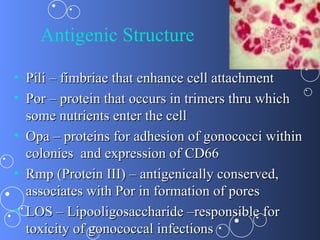
Antigenic Structure

• Pili – fimbriae that enhance cell attachment
• Por – protein that occurs in trimers thru which
  some nutrients enter the cell
• Opa – proteins for adhesion of gonococci within
  colonies and expression of CD66
• Rmp (Protein III) – antigenically conserved,
  associates with Por in formation of pores
• LOS – Lipooligosaccharide –responsible for
  toxicity of gonococcal infections
• Neisseria gonorrhoeae is
  a fastidious organism
  requiring growth factors
  which are present in
  hemolyzed blood cells.
  Thayer-Martin chocolate
  agar plates have VCN
  antibiotics which prevent
  growth of most organisms
  while supporting N.
  gonorrhoeae growth
• As a group, the Neisseria species are non-
  sporulating, non-flagellated, gram
  negative diplococci (a distinct bean shape
  arranged in pairs) that may or may not have
  a capsule and/or pili that facilitate
  attachment to mucus membranes. They are
  sensitive to cold, desiccation, light, and
  acidity; most require complex enriched
  media (e.g., chocolate agar, or modified
  Thayer-Martin media) and high O2.
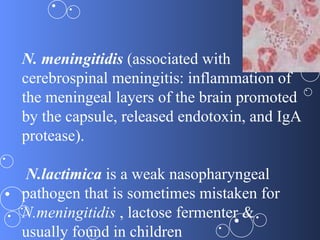
N. meningitidis (associated with
cerebrospinal meningitis: inflammation of
the meningeal layers of the brain promoted
by the capsule, released endotoxin, and IgA
protease).

 N.lactimica is a weak nasopharyngeal
pathogen that is sometimes mistaken for
N.meningitidis , lactose fermenter &
usually found in children
Moraxella catarrhalis
• Previously named Branhamella catarrhalis
  & before that Neisseria catarrhalis.
• Found in 40-50% of normal school children
• May cause bronchitis, pneumonia, sinusitis,
  otitis media and conjunctivitis
• Concerned as a cause of infection for
  immunocompromised patients
Gram negative cocci :
• Veillonellaceae -      • found in the
  only anaerobic           gastrointestinal tracts
  family                   of animals, but
• genus Veillonella,       Veillonella are found
  Acidaminococcus,         in considerable
  Megasphaera              numbers within the
• forms pairs or short     oral cavity
  chains but smaller     • mostly non-pathogenic
  than Neisseria
Gram + cocci -
         Peptostreptococcus
• Gram + coccus of variable size and shape
  found on the skin and as part of the normal
  flora of mucous membrane
• Formerly called peptococcus
• Frequently found in mixed infections due to
  normal flora
• Occassionally, cultures from breast, brain,
  or pulmonary infections
Gram positive cocci :
• Micrococcus-
  – obligate aerobes found
    in water & soil
  – pigmented types
  – morphologically
    similar to
    staphylococcus
  – unlike streptococcus
    acid is produced thru
    aerobic oxidation &
    not fermentation
Staphylococcus

  can be both aerobic & anaerobic
  found primarily in mammalian
  skin & anterior nares
  most important strain : S.aureus,
  epidermidis & saprophyticus
  S. aureus secretes enterotoxin
  which causes food poisoning
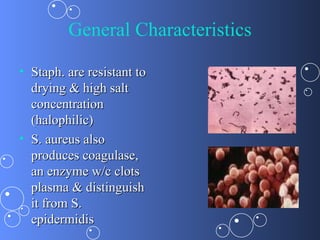
General Characteristics

• Staph. are resistant to
  drying & high salt
  concentration
  (halophilic)
• S. aureus also
  produces coagulase,
  an enzyme w/c clots
  plasma & distinguish
  it from S.
  epidermidis
Morphology & Identification:
• Spherical about 1um in diameter arranged
  in irregular clusters
• Can occur singly, pairs, tetrads and chains
  in liquid culture
• Develop rapid resistance to many
  antimicrobial agents & present difficult
  therapeutic problems
• Contains around 35 species
Culture
• Grow readily on most medium
• Young culture stain strongly gram +, on
  ageing become gram negative
• Non-motile, non-spore forming
• Lysed with penicillin
• Grows in BAP with resistance to nafcillin
• Exhibits “coagglutination” , some strains
  are encapsulated
Streptococcus
   - appear in chains of varying
   length
   - grow in the presence or
   absence of air
   - several species are
   indigenous in animals & man
   found in skin, oral cavity,
   respiratory tract
- some specie also found in plants & dairy
products
-classified by Lancefield from Group A to H,
K-U based on a group specific carbohydrate
known as C substance in the cell envelope
and determined by an amino sugar
Classification of strep is based on
•   Colony morphology & reaction to blood agar
•   Serologic specificity of cell wall/antigens
•   Biochemical reactions & resistance to factors
•   Ecologic features
Typing usually done for Groups
          A, B, C, F & G
• Strep A – rhamnose N-acetylglucosamine
• Strep B – rhamnose glucosamine
  polysaccharide
• Strep C – rhamnose N-acetylgalactosamine
• Strep D – glycerol techoic acid
Characteristic of medically
    significant strep:
                                                     Disease
       Name              Group      Hemolysis

S. Pyogenes          A           Beta           Pharyngitis
S. Agalactiae        B           Beta           Meningitis
S. Dysgalactiae      C,G         Beta           Similar to A
E. Faecalis          D           Alpha          UTI.
                                                Endocarditis
S. Bovis             D           Gamma          Endocardits,
                                                colon
S. Anginosus         F           Alpha, beta    Brain abscess
Viridans group       NONE        Alpha          Dental caries
S. Pneumoniae        NONE        Alpha          Pneumonia
Peptostreptococcus   NONE        Alpha          Abscesses
Antigenic structure & toxins:
•   M Protein – major virulence factor of Strep A
•   T substance – acid labile, heat labile
•   Nucleoproteins – P substance
•   Streptokinase – Fibrinolysin
•   Streptodornase – depolymerizes DNA
•   Hyaluronidase – splits hyaluronic acid
•   Pyrogenic Exotoxins – Exotoxins A, B, C
•   Hemolysins - Streptolysin O & S
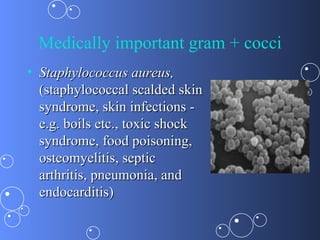
Medically important gram + cocci
• Staphylococcus aureus,
  (staphylococcal scalded skin
  syndrome, skin infections -
  e.g. boils etc., toxic shock
  syndrome, food poisoning,
  osteomyelitis, septic
  arthritis, pneumonia, and
  endocarditis)
• Staphylococcus epidermidis
  (artificial valve
  endocarditis, catheter and
  shunt infections, prosthetic
  infections)
• Staphylococcus
  saprophyticus, (urinary
  tract infection in young
  sexually active females
• Streptococcus
  pyogenes (Lancefield
  group A) (pharyngitis,
  scarlet fever, toxic
  shock syndrome, skin
  infections, post
  infectious sequelae -
  rheumatic fever and
  glomerulonephritis
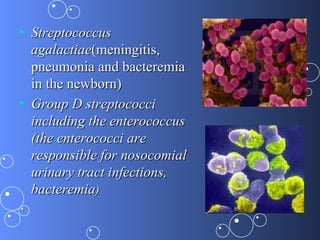
• Streptococcus
  agalactiae(meningitis,
  pneumonia and bacteremia
  in the newborn)
• Group D streptococci
  including the enterococcus
  (the enterococci are
  responsible for nosocomial
  urinary tract infections,
  bacteremia)
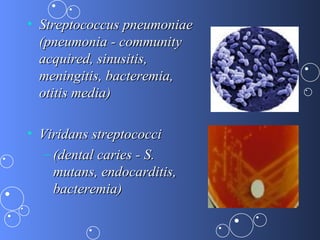
• Streptococcus pneumoniae
  (pneumonia - community
  acquired, sinusitis,
  meningitis, bacteremia,
  otitis media)

• Viridans streptococci
  – (dental caries - S.
    mutans, endocarditis,
    bacteremia)
Diseases attributable to invasion
     by S pyogenes, B-hemolytic
        Group A Streptococcus
•   Erypelas
•   Cellulitis
•   Necrotizing Fasciitis
•   Puerperal Fever
•   Bactermia/Sepsis
Properties that help distinquish
      between Staphylococcus and
      Streptococcus/Enterococcus
•   Catalase activity
•   Coagulase Activity
•   Novobiocin
•   Hemolysis
    – Alpha (Bile solubility & Optochin), Beta &
      Gamma
• Bacitracin sensitivity– inhibits cell wall
  synthesis

Module 6a cocci

  • 1.
    Cocci Gram Positive cocci GramNegative cocci Ver 2011-1
  • 2.
    Gram Negative cocci: •Neisseriaceae - only • produces “cytochrome aerobic family oxidase” - Oxidase • Genus Neisseria, Test Kingella, Eikenella, • N. gonnorhea Simonsiella & (gonococcus ) - Allysiella venereal disease • diplococci • N. meningitidis • exhibits “twitching” (meningococcus) - type of movement meningitis
  • 3.
    Antigenic Structure • Pili– fimbriae that enhance cell attachment • Por – protein that occurs in trimers thru which some nutrients enter the cell • Opa – proteins for adhesion of gonococci within colonies and expression of CD66 • Rmp (Protein III) – antigenically conserved, associates with Por in formation of pores • LOS – Lipooligosaccharide –responsible for toxicity of gonococcal infections
  • 4.
    • Neisseria gonorrhoeaeis a fastidious organism requiring growth factors which are present in hemolyzed blood cells. Thayer-Martin chocolate agar plates have VCN antibiotics which prevent growth of most organisms while supporting N. gonorrhoeae growth
  • 5.
    • As agroup, the Neisseria species are non- sporulating, non-flagellated, gram negative diplococci (a distinct bean shape arranged in pairs) that may or may not have a capsule and/or pili that facilitate attachment to mucus membranes. They are sensitive to cold, desiccation, light, and acidity; most require complex enriched media (e.g., chocolate agar, or modified Thayer-Martin media) and high O2.
  • 6.
    N. meningitidis (associatedwith cerebrospinal meningitis: inflammation of the meningeal layers of the brain promoted by the capsule, released endotoxin, and IgA protease). N.lactimica is a weak nasopharyngeal pathogen that is sometimes mistaken for N.meningitidis , lactose fermenter & usually found in children
  • 7.
    Moraxella catarrhalis • Previouslynamed Branhamella catarrhalis & before that Neisseria catarrhalis. • Found in 40-50% of normal school children • May cause bronchitis, pneumonia, sinusitis, otitis media and conjunctivitis • Concerned as a cause of infection for immunocompromised patients
  • 9.
    Gram negative cocci: • Veillonellaceae - • found in the only anaerobic gastrointestinal tracts family of animals, but • genus Veillonella, Veillonella are found Acidaminococcus, in considerable Megasphaera numbers within the • forms pairs or short oral cavity chains but smaller • mostly non-pathogenic than Neisseria
  • 11.
    Gram + cocci- Peptostreptococcus • Gram + coccus of variable size and shape found on the skin and as part of the normal flora of mucous membrane • Formerly called peptococcus • Frequently found in mixed infections due to normal flora • Occassionally, cultures from breast, brain, or pulmonary infections
  • 12.
    Gram positive cocci: • Micrococcus- – obligate aerobes found in water & soil – pigmented types – morphologically similar to staphylococcus – unlike streptococcus acid is produced thru aerobic oxidation & not fermentation
  • 13.
    Staphylococcus canbe both aerobic & anaerobic found primarily in mammalian skin & anterior nares most important strain : S.aureus, epidermidis & saprophyticus S. aureus secretes enterotoxin which causes food poisoning
  • 14.
    General Characteristics • Staph.are resistant to drying & high salt concentration (halophilic) • S. aureus also produces coagulase, an enzyme w/c clots plasma & distinguish it from S. epidermidis
  • 15.
    Morphology & Identification: •Spherical about 1um in diameter arranged in irregular clusters • Can occur singly, pairs, tetrads and chains in liquid culture • Develop rapid resistance to many antimicrobial agents & present difficult therapeutic problems • Contains around 35 species
  • 16.
    Culture • Grow readilyon most medium • Young culture stain strongly gram +, on ageing become gram negative • Non-motile, non-spore forming • Lysed with penicillin • Grows in BAP with resistance to nafcillin • Exhibits “coagglutination” , some strains are encapsulated
  • 17.
    Streptococcus - appear in chains of varying length - grow in the presence or absence of air - several species are indigenous in animals & man found in skin, oral cavity, respiratory tract
  • 18.
    - some speciealso found in plants & dairy products -classified by Lancefield from Group A to H, K-U based on a group specific carbohydrate known as C substance in the cell envelope and determined by an amino sugar
  • 19.
    Classification of strepis based on • Colony morphology & reaction to blood agar • Serologic specificity of cell wall/antigens • Biochemical reactions & resistance to factors • Ecologic features
  • 20.
    Typing usually donefor Groups A, B, C, F & G • Strep A – rhamnose N-acetylglucosamine • Strep B – rhamnose glucosamine polysaccharide • Strep C – rhamnose N-acetylgalactosamine • Strep D – glycerol techoic acid
  • 21.
    Characteristic of medically significant strep: Disease Name Group Hemolysis S. Pyogenes A Beta Pharyngitis S. Agalactiae B Beta Meningitis S. Dysgalactiae C,G Beta Similar to A E. Faecalis D Alpha UTI. Endocarditis S. Bovis D Gamma Endocardits, colon S. Anginosus F Alpha, beta Brain abscess Viridans group NONE Alpha Dental caries S. Pneumoniae NONE Alpha Pneumonia Peptostreptococcus NONE Alpha Abscesses
  • 22.
    Antigenic structure &toxins: • M Protein – major virulence factor of Strep A • T substance – acid labile, heat labile • Nucleoproteins – P substance • Streptokinase – Fibrinolysin • Streptodornase – depolymerizes DNA • Hyaluronidase – splits hyaluronic acid • Pyrogenic Exotoxins – Exotoxins A, B, C • Hemolysins - Streptolysin O & S
  • 23.
    Medically important gram+ cocci • Staphylococcus aureus, (staphylococcal scalded skin syndrome, skin infections - e.g. boils etc., toxic shock syndrome, food poisoning, osteomyelitis, septic arthritis, pneumonia, and endocarditis)
  • 24.
    • Staphylococcus epidermidis (artificial valve endocarditis, catheter and shunt infections, prosthetic infections) • Staphylococcus saprophyticus, (urinary tract infection in young sexually active females
  • 25.
    • Streptococcus pyogenes (Lancefield group A) (pharyngitis, scarlet fever, toxic shock syndrome, skin infections, post infectious sequelae - rheumatic fever and glomerulonephritis
  • 26.
    • Streptococcus agalactiae(meningitis, pneumonia and bacteremia in the newborn) • Group D streptococci including the enterococcus (the enterococci are responsible for nosocomial urinary tract infections, bacteremia)
  • 27.
    • Streptococcus pneumoniae (pneumonia - community acquired, sinusitis, meningitis, bacteremia, otitis media) • Viridans streptococci – (dental caries - S. mutans, endocarditis, bacteremia)
  • 28.
    Diseases attributable toinvasion by S pyogenes, B-hemolytic Group A Streptococcus • Erypelas • Cellulitis • Necrotizing Fasciitis • Puerperal Fever • Bactermia/Sepsis
  • 29.
    Properties that helpdistinquish between Staphylococcus and Streptococcus/Enterococcus • Catalase activity • Coagulase Activity • Novobiocin • Hemolysis – Alpha (Bile solubility & Optochin), Beta & Gamma • Bacitracin sensitivity– inhibits cell wall synthesis