PLANT PROTECTION
DR CHITHRA. M
 PLANT PROTECTION
BIOLOGICAL
PHYSICALAND MECHANICAL
CHEMICAL
BIOPESTICIDE
BIOLOGICAL
Biological pest control is the method of pest control using the
natural enemies of pests, such as their parasites, pathogens and
predators. In this method, the natural enemies are multiplied and
released to the field by artificial means to fight the pests.
Biological control method involves three main steps, namely
inoculation, augmentation and conservation.
a) Inoculation
This is the selection of the predator, parasite or pathogen and its
subsequent introduction to the desired target area, where it is
absent. As far as possible, the selected species should be free from
parasitic or pathogenic infection. Care should be taken to ensure
that the enemy thus selected possesses the following characters:
(i) it should be adaptable to the environmental conditions of the
new locality or target area
(ii) it should be specific to a host and should be able to multiply at
a fast rate
(iii) it should have high host-searching ability and should be quick
in action against the host.
b) Augmentation
This is the mass rearing of the enemy of the pest species and its
subsequent release at an appropriate time to areas where it
may be present only in small numbers. It is better to rear it in
laboratories and to increase its number before releasing it to
the pest-affected field. If only a few numbers are released to the
field, their multiplication will take a long time and by that time
the pest population will become too large to overcome. Hence,
augmentation is very important in biological control.
c) Conservation of natural enemies
This is the protection of the enemy from its own
predators and pathogens. When a natural enemy of the
pest population is introduced to a field, care should be
taken to protect it from its own predators or pathogens.
The parasites and pathogens of insect pests are more
susceptible to pesticide action than the pests.
So, in case of biological pest control, use of chemical
insecticides has to be avoided, or the dosage and
frequency of their application have to be minimised
during the period in which the natural enemies are
active.
Otherwise, the chemical insecticides may kill the natural
enemies also and the biological control will become a
failure. The ecological conditions in the area, where the
crop is grown and the natural enemies are released, must
be monitored periodically.
II. Mechanical control
This is the procedure in which members of the pest
species are trapped or killed by mechanical means, or
are prevented from gaining access to the host plants by
making barriers. Mechanical pest control has only
limited application, though it is effective under certain
circumstances. It is very effective in the initial stage of
infestation of some insect pests, such as aphids, jassids,
scale insects, etc. It can give spectacular results, if
carried out as an organized campaign over a larger
area.
The common procedures involved in mechanical pest control are the
following
(i) Killing of the eggs, larvae and other inactive stages of the pests after
handpicking, net collection, etc.
(ii) Collection and destruction of the pests using traps and trenches.
(iii) Destruction of the affected plants and plant parts together with the
pests.
(iv) Spiking of stem-borers in their bore holes.
(v) Banding of fruit trees with grease or other banding materials to stop or
entangle and kill crawling pests.
(vi) Shaking of trees to dislodge and kill the pests.
(vii) Flooding of the infested fields after harvest to drown
the soil inhabiting larvae, pupae and adults of pests.
(viii) Pest-proof packing of stored products.
(ix) Covering of fruits and vegetables.
(x) Mechanical exclusion of pests using special barriers
which will block the pests from reaching the crop.
Handpicking of adults, egg masses, larvae or nymphs is
sometimes possible.
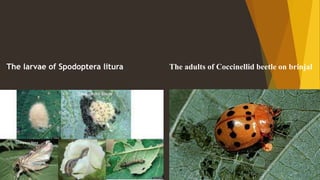
For example, the egg masses of the rice stem borer, the ground
nut red hairy caterpillar, the larvae of Spodoptera litura, the
adults of Coccinellid beetle on brinjal, etc. can easily be
handpicked and killed. The moringa hairy caterpillar, which
collects on the tree trunk, can be burnt by fire flame. Adults of
rhinoceros beetle are hooked out from the coconut crowns by
iron hook and then killed.
The egg masses of the
rice stem borer
The larvae of Spodoptera litura The adults of Coccinellid beetle on brinjal
Barriers are often made to prevent the pest attack.
Paper and tin collars are placed around tobacco
plant to protect it from cutworms. Tin bands are
fixed over coconut trees to prevent rat attack. The
groundnut red hairy caterpillar and rice army
worms are prevented from migrating to
neighbouring fields by digging trenches around the
field
III. Physical control
This involves the deliberate modification of some physical factors
to slow down the growth of pest population or to minimise or
prevent pest infestation. Some of the physical methods of pest
control are the following:
(i) Use of drie-die: 'Drie - die' is a material formed of a highly
porous silica gel. Its application causes the excessive loss of
moisture from the body of insects, ultimately resulting in their
death. In the USA it is used effectively against the pests of stored
grains.
(ii) Use of lethal temperatures, both high and low:
This is effective in controlling pests. High frequency radio waves
generate a temperature of about 80°C and it is employed to kill
granary weevils and flour beetles.
(iii) Use of ionizing radiations to kill insect pests or to induce
sterility; male insects can be made sterile by exposing them to
gamma radiation.
(iv) Blowing of refrigerated air through stored grains to maintain a
very low temperature and to kill the pests.
(v) Use of light traps to attract, catch and kill nocturnal insects.
(vi) Use of colour traps for attracting, collecting and killing some
diurnal insects.
IV. Chemical control
Chemical pest control is the controlling of pests using toxic
chemicals, called pesticides. Chemicals are often used in both
preventive and curative methods of pest control. These chemicals
either kill the pests by their toxic and lethal effects, or alter their
behaviour, induce sterility in them, or impair their metabolism
and development by their other effects. A broad-spectrum
pesticide, that can kill all living organisms, is called a biocide.
Generally, narrow-spectrum pesticides, that attack only specific
types of pests, are preferred in agricultural pest control.
Pesticides are of two major groups, synthetic pesticides and
naturally occurringbiopecticides.
Synthetic pesticies
These are the chemical pesticides, manufactured
commercially using industrial technology. Based
on the nature of their application, chemical
pesticides can be grouped under the following four
categories.
(i) Attractants : Substances which can attract pests
without contact.
(ii) Repellents : Substances which can repel the pest from
some distance.
(iii) Deterrents : Substances which suppress the instincts
and behaviour of pests
(iv) Auxiliary substances : Substances that are mixed
with insecticides to boost up the action of the latter.
Methods of pesticide application
Pesticides may be applied to plants, plant produces, or the growing
medium, according to the need. The general ways in which pesticides
are used are the following:
1. Foliar application - Pesticides may be applied to plant foliage in
the form of a liquid or dust (powder).
2. Soil treatment - Soil may be fumigated (by treating with volatile
chemicals) to control nematodes and other soil-borne diseases.
Sometimes, various formulations, such as granules or dusts, may be
applied.
3. Seed treatment - Planting materials (e.g., seeds, bulbs,
corms and tubers) may be treated with a pesticide to
control soil-borne diseases that cause seed decay or
damping off of young seedlings.
Biopesticides are the organic pesticides obtained or
prepared from living organisms. They are harmless
to beneficial plants, but control the growth of
harmful pests.
There are two major groups of biopesticides, namely
pesticides of animal orgin, and those of plant origin.
(i) Biopesticides of animal origin
There are only very few pesticides of animal origin. The most
important one of this type is the toxic substance extracted from the
marine annelids Lumbrineris heteropoda and Lumbrineris
brevicirra. This extract is called Neristoxin (dimethylamino
dithiolane) and is an effective pesticide.
(ii) Biopesticides of plant originOrganic pesticides of plant origin
are generally called "botanicals". They are extracted from plants.
Nicotine and nicotinoid alkaloids, pyrethrum, rotenone, the
extracts from the various parts of neem tree, turpentine, phenols
and other aromatic oils from conifers, etc. are effective and well kn
insecticides of plant origin.
Some common preparations of biopesticides
Tobacco decoction, Neem seed emulsion, Kiriyath
emulsion etc. are some of the common
formulations of bio-pesticides.
Leaf eating worms, scale insects, brown hopper,
etc. are controlled by spraying these biopesticides.
Tobacco decoction
Tobacco decoction can be used against whitefly. Tobacco decoction
contains nicotine which serves as a contact pesticide to control
horticultural pests. Required materials
Tobacco wastes - 1 Kg Soap powder - 100 gms
Preparation: Boil 1 Kg tobacco waste in 10lts of water for 30
minutes. Add soap powder. Make the decoction cool and filter it
through a thin cloth. Add 1000 Its of water to the above decoction. It
is sufficient for 1 acre and apply it in the evening time.
Precaution: Tie a cloth across nose or wear a nose mask while
making the decoction. Cover the entire body while spraying. Apply
only once on a crop, otherwise friendly insects may die. Never store
the decoction.
Neem oil emulsion
Dissolve 60 g detergent flakes in 0.5 litre of water and then add one litre neem
oil in it. This can be mixed with 10 times its quantity of water and can be
sprayed. It can control fruit borer caterpillous
Kiriyath emulsion
Crush and squeeze the essence of tender stem and leaves of kiriyath plant.
Dissolve 60 gm of washing soap in one litre Kiriyath essence. This can be
dilute with 10 times its quantity of water and mix with garlic essence. This
emulsion can be sprayed to control white flies.
Neem seed essence
50 gm of neem seed powder wrap up in a piece of cloth
and tie it up. Soak this cloth pack in 1 litre of water for
12 hours. Keep on squeezing the cloth pack and make
the liquid more and more thick. Dilute the liquid and
spray. It can be used to control several pests.
THANK YOU

PLANT PROTECTION.pptx

  • 1.
  • 2.
     PLANT PROTECTION BIOLOGICAL PHYSICALANDMECHANICAL CHEMICAL BIOPESTICIDE
  • 3.
    BIOLOGICAL Biological pest controlis the method of pest control using the natural enemies of pests, such as their parasites, pathogens and predators. In this method, the natural enemies are multiplied and released to the field by artificial means to fight the pests. Biological control method involves three main steps, namely inoculation, augmentation and conservation.
  • 4.
    a) Inoculation This isthe selection of the predator, parasite or pathogen and its subsequent introduction to the desired target area, where it is absent. As far as possible, the selected species should be free from parasitic or pathogenic infection. Care should be taken to ensure that the enemy thus selected possesses the following characters: (i) it should be adaptable to the environmental conditions of the new locality or target area (ii) it should be specific to a host and should be able to multiply at a fast rate (iii) it should have high host-searching ability and should be quick in action against the host.
  • 5.
    b) Augmentation This isthe mass rearing of the enemy of the pest species and its subsequent release at an appropriate time to areas where it may be present only in small numbers. It is better to rear it in laboratories and to increase its number before releasing it to the pest-affected field. If only a few numbers are released to the field, their multiplication will take a long time and by that time the pest population will become too large to overcome. Hence, augmentation is very important in biological control.
  • 6.
    c) Conservation ofnatural enemies This is the protection of the enemy from its own predators and pathogens. When a natural enemy of the pest population is introduced to a field, care should be taken to protect it from its own predators or pathogens. The parasites and pathogens of insect pests are more susceptible to pesticide action than the pests.
  • 7.
    So, in caseof biological pest control, use of chemical insecticides has to be avoided, or the dosage and frequency of their application have to be minimised during the period in which the natural enemies are active. Otherwise, the chemical insecticides may kill the natural enemies also and the biological control will become a failure. The ecological conditions in the area, where the crop is grown and the natural enemies are released, must be monitored periodically.
  • 8.
    II. Mechanical control Thisis the procedure in which members of the pest species are trapped or killed by mechanical means, or are prevented from gaining access to the host plants by making barriers. Mechanical pest control has only limited application, though it is effective under certain circumstances. It is very effective in the initial stage of infestation of some insect pests, such as aphids, jassids, scale insects, etc. It can give spectacular results, if carried out as an organized campaign over a larger area.
  • 9.
    The common proceduresinvolved in mechanical pest control are the following (i) Killing of the eggs, larvae and other inactive stages of the pests after handpicking, net collection, etc. (ii) Collection and destruction of the pests using traps and trenches. (iii) Destruction of the affected plants and plant parts together with the pests. (iv) Spiking of stem-borers in their bore holes. (v) Banding of fruit trees with grease or other banding materials to stop or entangle and kill crawling pests.
  • 10.
    (vi) Shaking oftrees to dislodge and kill the pests. (vii) Flooding of the infested fields after harvest to drown the soil inhabiting larvae, pupae and adults of pests. (viii) Pest-proof packing of stored products. (ix) Covering of fruits and vegetables. (x) Mechanical exclusion of pests using special barriers which will block the pests from reaching the crop.
  • 11.
    Handpicking of adults,egg masses, larvae or nymphs is sometimes possible. For example, the egg masses of the rice stem borer, the ground nut red hairy caterpillar, the larvae of Spodoptera litura, the adults of Coccinellid beetle on brinjal, etc. can easily be handpicked and killed. The moringa hairy caterpillar, which collects on the tree trunk, can be burnt by fire flame. Adults of rhinoceros beetle are hooked out from the coconut crowns by iron hook and then killed.
  • 12.
    The egg massesof the rice stem borer
  • 13.
    The larvae ofSpodoptera litura The adults of Coccinellid beetle on brinjal
  • 14.
    Barriers are oftenmade to prevent the pest attack. Paper and tin collars are placed around tobacco plant to protect it from cutworms. Tin bands are fixed over coconut trees to prevent rat attack. The groundnut red hairy caterpillar and rice army worms are prevented from migrating to neighbouring fields by digging trenches around the field
  • 15.
    III. Physical control Thisinvolves the deliberate modification of some physical factors to slow down the growth of pest population or to minimise or prevent pest infestation. Some of the physical methods of pest control are the following: (i) Use of drie-die: 'Drie - die' is a material formed of a highly porous silica gel. Its application causes the excessive loss of moisture from the body of insects, ultimately resulting in their death. In the USA it is used effectively against the pests of stored grains.
  • 16.
    (ii) Use oflethal temperatures, both high and low: This is effective in controlling pests. High frequency radio waves generate a temperature of about 80°C and it is employed to kill granary weevils and flour beetles. (iii) Use of ionizing radiations to kill insect pests or to induce sterility; male insects can be made sterile by exposing them to gamma radiation. (iv) Blowing of refrigerated air through stored grains to maintain a very low temperature and to kill the pests. (v) Use of light traps to attract, catch and kill nocturnal insects. (vi) Use of colour traps for attracting, collecting and killing some diurnal insects.
  • 17.
    IV. Chemical control Chemicalpest control is the controlling of pests using toxic chemicals, called pesticides. Chemicals are often used in both preventive and curative methods of pest control. These chemicals either kill the pests by their toxic and lethal effects, or alter their behaviour, induce sterility in them, or impair their metabolism and development by their other effects. A broad-spectrum pesticide, that can kill all living organisms, is called a biocide. Generally, narrow-spectrum pesticides, that attack only specific types of pests, are preferred in agricultural pest control. Pesticides are of two major groups, synthetic pesticides and naturally occurringbiopecticides.
  • 18.
    Synthetic pesticies These arethe chemical pesticides, manufactured commercially using industrial technology. Based on the nature of their application, chemical pesticides can be grouped under the following four categories. (i) Attractants : Substances which can attract pests without contact.
  • 19.
    (ii) Repellents :Substances which can repel the pest from some distance. (iii) Deterrents : Substances which suppress the instincts and behaviour of pests (iv) Auxiliary substances : Substances that are mixed with insecticides to boost up the action of the latter.
  • 20.
    Methods of pesticideapplication Pesticides may be applied to plants, plant produces, or the growing medium, according to the need. The general ways in which pesticides are used are the following: 1. Foliar application - Pesticides may be applied to plant foliage in the form of a liquid or dust (powder). 2. Soil treatment - Soil may be fumigated (by treating with volatile chemicals) to control nematodes and other soil-borne diseases. Sometimes, various formulations, such as granules or dusts, may be applied.
  • 21.
    3. Seed treatment- Planting materials (e.g., seeds, bulbs, corms and tubers) may be treated with a pesticide to control soil-borne diseases that cause seed decay or damping off of young seedlings.
  • 22.
    Biopesticides are theorganic pesticides obtained or prepared from living organisms. They are harmless to beneficial plants, but control the growth of harmful pests. There are two major groups of biopesticides, namely pesticides of animal orgin, and those of plant origin.
  • 23.
    (i) Biopesticides ofanimal origin There are only very few pesticides of animal origin. The most important one of this type is the toxic substance extracted from the marine annelids Lumbrineris heteropoda and Lumbrineris brevicirra. This extract is called Neristoxin (dimethylamino dithiolane) and is an effective pesticide. (ii) Biopesticides of plant originOrganic pesticides of plant origin are generally called "botanicals". They are extracted from plants. Nicotine and nicotinoid alkaloids, pyrethrum, rotenone, the extracts from the various parts of neem tree, turpentine, phenols and other aromatic oils from conifers, etc. are effective and well kn insecticides of plant origin.
  • 24.
    Some common preparationsof biopesticides Tobacco decoction, Neem seed emulsion, Kiriyath emulsion etc. are some of the common formulations of bio-pesticides. Leaf eating worms, scale insects, brown hopper, etc. are controlled by spraying these biopesticides.
  • 25.
    Tobacco decoction Tobacco decoctioncan be used against whitefly. Tobacco decoction contains nicotine which serves as a contact pesticide to control horticultural pests. Required materials Tobacco wastes - 1 Kg Soap powder - 100 gms Preparation: Boil 1 Kg tobacco waste in 10lts of water for 30 minutes. Add soap powder. Make the decoction cool and filter it through a thin cloth. Add 1000 Its of water to the above decoction. It is sufficient for 1 acre and apply it in the evening time. Precaution: Tie a cloth across nose or wear a nose mask while making the decoction. Cover the entire body while spraying. Apply only once on a crop, otherwise friendly insects may die. Never store the decoction.
  • 26.
    Neem oil emulsion Dissolve60 g detergent flakes in 0.5 litre of water and then add one litre neem oil in it. This can be mixed with 10 times its quantity of water and can be sprayed. It can control fruit borer caterpillous Kiriyath emulsion Crush and squeeze the essence of tender stem and leaves of kiriyath plant. Dissolve 60 gm of washing soap in one litre Kiriyath essence. This can be dilute with 10 times its quantity of water and mix with garlic essence. This emulsion can be sprayed to control white flies.
  • 27.
    Neem seed essence 50gm of neem seed powder wrap up in a piece of cloth and tie it up. Soak this cloth pack in 1 litre of water for 12 hours. Keep on squeezing the cloth pack and make the liquid more and more thick. Dilute the liquid and spray. It can be used to control several pests.
  • 28.