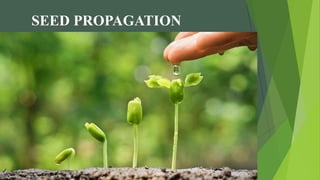
SEED PROPAGATION
DR CHITHRA M
SEED PROPAGATION
Seed propagation, or sexual propagation, is the plant
propagation through seed production.
It requires two parents and involves meiotic cell division,
gametic fusion and genetic recombination.
The progeny, formed by seed propagation, would be
genetically different from the parents. So, seed propagation
brings about genetic variation in populations.
The seeds produced by flowering plants can be used for
sexual propagation.
These seeds vary in size and other characteristics, and
this variation determines how much useful they can be
for propagation.
Each seed contains a dormant miniature plant which
can be nurtured to life by providing the necessary
conditions.
Propagation of horticultural plants by seeds is more
convenient than vegetative propagation, because seeds
are smaller than vegetative propagules and are easy to
handle and store.
Seed propagation can be easily mechanized on a
commercial level.
Seed propagation has played a crucial role in the
growth of horticulture industry.
Horticulture sector is now actively engaged in plant
improvement programmes through advanced
breeding techniques.
This is primarily meant for making the existing cultivars
more desirable with high disease resistance, greater
endurance to climatic extremes and environmental stresses,
high adaptability to changing conditions, early flowering,
maximum yield, and so on.
The seeds produced by these programmes are tested for their
purity and viability. The selected seeds are then released for
field propagation. Farmers can get super-quality seeds from
growers and reputed seed-dealers.
Major aspects of seed propagation
Human-engineered seed propagation is a multifaceted
programme.
Its major aspects include (i) seed production (ii) seed certification
(iii) analysis of seed quality (iv) assessment of seed viability
(v) lifting or removal of seed dormancy (vi) requirements for
seed germination (vii) seed treatment (viii) infusion (ix) seeding
methods (x) seed-sowing (xi) post-sowing or after-sowing care
(xii) fertilizer application (xiii) hardening of seedlings and (xiv)
transplantation of seedlings.
(i) Seed production
Seed is a mature ovule. Seed propagation begins with seed
production which, in turn, follows pollination, pollen
germination and fertilization. Fertilization involves triple
fusion and it results in a diploid zygote and a triploid central
cell within the embryo sac. Fertilization is followed by the
maturation of the ovule, zygote and the central cell, to form a
seed. The zygote then develops to an embryo. The central cell
undergoes repeated multiplication and forms the endosperm.
(ii) Seed certification
Seed certification is the stage-by-stage multiplication
and categorization of seeds, before they are made
available to ordinary growers.
Based on it, four classes of seeds can be recognized,
namely breeder seed, foundation seed, registered
seed and certified seed.
(a) Breeder seed: This is the small amount of seed,
produced and released by the breeder as the
source of foundation seed.
(b) Foundation seed: The large quantity of seed
stock, produced from the breeder seed and
monitored for genetic purity and identity. Usually,
foundation seed stock is produced as a part of
agricultural research.
(c) Registered seed: This is the foundation seed,
distributed to registered seed growers for further
multiplication for distribution. Registered seed is
normally grown for the production of certified seed.
(d) Certified seed: This is the progeny of registered
seed, certified by a competent and approved
certifying agency and then distributed to farmers for
field propagation.
SEED QUALITY TESTS
Certified seed-growers have to conduct seed analysis for
assessing the quality and desirability of the seed.
 GERMINATION TEST
 COLD TEST
 TETRAZOLIUM TEST
 PURITY TEST
(a) Germination test
This test involves the growing of a reasonably large sample of
seeds under moist and warm conditions for germination.
The number of seeds which germinated and produced
normal healthy seedlings and the number of seeds which did
not germinate are recorded.
A higher proportion of germinated seeds indicates that the
seeds are superior in quality.
(a) Germination test
This test involves the growing of a reasonably large sample of
seeds under moist and warm conditions for germination.
The number of seeds which germinated and produced
normal healthy seedlings and the number of seeds which did
not germinate are recorded.
A higher proportion of germinated seeds indicates that the
seeds are superior in quality.
(b) Cold test
This is the quality test in which seeds are exposed to a cold
temperature (below 10°C), before their germination under
warm conditions.
A higher proportion of germinated seeds indicates the
better quality of seeds
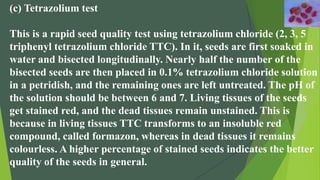
(c) Tetrazolium test
This is a rapid seed quality test using tetrazolium chloride (2, 3, 5
triphenyl tetrazolium chloride TTC). In it, seeds are first soaked in
water and bisected longitudinally. Nearly half the number of the
bisected seeds are then placed in 0.1% tetrazolium chloride solution
in a petridish, and the remaining ones are left untreated. The pH of
the solution should be between 6 and 7. Living tissues of the seeds
get stained red, and the dead tissues remain unstained. This is
because in living tissues TTC transforms to an insoluble red
compound, called formazon, whereas in dead tissues it remains
colourless. A higher percentage of stained seeds indicates the better
quality of the seeds in general.
(d) Purity test
Seed purity is the percentage or proportion by weight of
the desired seed in a sample, in relation to unwanted
weed seeds and undesirable inert materials. In other
words, it is the condition in which the desired seed, or
"pure seed", is free from weed seeds and other
unwanted debris materials in a sample. So, analysis of
seed purity provides information about the presence or
absence of unwanted materials in the seed sample.
Seed purity analysis takes into account six major parameters,
namely (i) percentage of seed germination (ii) percentage of pure
seeds in the sample (iii) percentage of live pure seeds (iv)
percentage of other crop seeds (v) percentage of weed seeds and (vi)
percentage of inert materials, such as pebbles, sand grains, soil,
pieces of wood, empty seeds, broken seeds, chaff, etc. Higher
percentage of pure seeds, or higher percentage of seed germination,
is an index of seed purity. So also, the higher the percentage of pure
seeds in general, and live pure seeds in particular, the higher would
be the purity of the seed sample and the superior would be its
qualities. Conversely, higher percentage of other crop seeds, weed
seeds and inert materials indicates lower purity and inferior
quality of the seed sample.
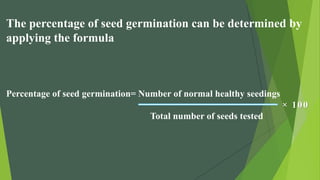
The percentage of seed germination can be determined by
applying the formula
Percentage of seed germination= Number of normal healthy seedings
× 100
Total number of seeds tested
In a simple seed purity test, a working seed sample is
taken for testing.
It is weighed and visually and manually sorted out into
four groups, namely pure seeds, seeds of other crops,
weed seeds and undesirable inert materials.
Each group is then weighed separately and its percentage
in the sample by weight is determined.
If the weight of the pure seeds is much higher than the
combined weight of the other groups, the seed sample can
be considered higher in purity.
Seed treatment
Seeds are customarily treated by artificial methods for
promoting germination, and also for protecting them
against pathogens.
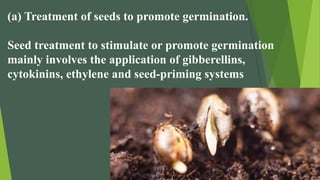
(a) Treatment of seeds to promote germination.
Seed treatment to stimulate or promote germination
mainly involves the application of gibberellins,
cytokinins, ethylene and seed-priming systems
1. Treatment with gibberellins
Gibberellins comprise a group of plant hormones that have significant
role in seed physiology. Of all the natural gibberellins in plants,
gibberellic acid (GA₂) is the most widely used one for exogenous
applications. Treatment with GA, helps many seeds to overcome
physiological dormancy. Also, it stimulates the germination of those
seeds with dormant embryos. In seed-testing laboratories, the
germination medium is usually moistened with 500 mg/l GA₂. At
concentrations above 800 mg/l, addition of a buffer solution is
recommended. K-salt formulation of GA, is readily water-soluble. For
large seeds, a 12-hour long soaking in 500 to 1000 mg/l GA3, is
recommended.
2. Treatment with cytokinins
Cytokinins are the natural growth hormones which can counter
the effects of germination inhibitors and stimulate the
germination of some kinds of seeds. For practical application, a
commercial preparation, called kinetin (N-furfurylamino purine),
is first dissolved in a small amount of HCl and then diluted with
water. In higher plants, the synthetic cytokinin BAP (6-benzyl
amino purine) is more active than kinetin. Cytokinins are
effective in promoting germination when they are applied in
combination with gibberellic acid and ethylene-producing
compounds
3. Treatment with ethylene
Ethylene is a gaseous plant hormone which is active
in breaking the dormancy of seeds and buds.
Commercial ethylene-generating chemicals, such as
ethephon (ethrel), are available for application.
4. Treatment with seed priming systems (SPS)
Priming system, also known as osmo-conditioning system, is the
system which promotes the hydration of seeds and thereby initiates
the pre-germination metabolic activities. At the same time, it
prevents the actual emergence of the radicle. After treatment with
SPS, the seeds are dried and then sowed by usual methods. Control is
applied through (i) soaking the seeds at 15 to 20°C in aerated
solutions of high osmotic strengths for 7 to 21 days, (ii) rinsing the
seeds with distilled water, and (iii) air-drying the seeds at 25°C and
then storing until use.
The principal compounds used to control the hydration of
seeds are 20 to 30 percent polyethylene glycol (PEG) and
various salt solutions, such as KNO3, K₂HPO4, NaCl, etc.
This procedure promotes emergence under field conditions,
shortens the time of emergence, and overcomes certain
environmental constraints in the field, including cold injury.
Seeds with SPS can be stored for only limited periods of
time before seed viability drops considerably.
Essential conditions for successful plant propagation
Light, water, oxygen, and temperature are essential conditions
for seed germination.
Its growth depends on many factors, including water, minerals,
and nutrients.
Water and oxygen are absorbed by the seed through its seed
coat when it is exposed to the right conditions.
Plant Material Selection:
Choose healthy, disease-free, and pest-free plant
material for propagation. Quality plant material is
crucial for successful propagation.
1. Propagation Method:
Select the appropriate propagation method for
the plant species. Common methods include seed
propagation, cutting propagation, division,
layering, and grafting.
2. Timing:
Timing is essential. Different plant species and
methods have specific times of the year that
are best for propagation. Consider seasonal
factors like temperature, light, and moisture.
3. Environmental Conditions:
a. Temperature: Maintain the correct temperature for
the plant's growth and development. This can vary
from species to species.
b. Humidity: Provide the right level of humidity to
prevent desiccation of cuttings or seeds.
c. Light: Ensure that the plant receives the
appropriate amount of light, whether it's full sun,
partial shade, or low light, depending on the species.
 Seeds require sufficient moisture and oxygen and
favourable temperature and light for germination.
Moisture is necessary for the enzymatic breakdown of
food reserves to initiate germination. At the same
time, excessive moisture may cause rotting and other
diseases.
 Germination, in most cases, is an aerobic process
and so it essentially requires sufficient oxygen.
Seeds planted very deep in the soil, and also is
water-logged soil, fail to germinate due to low
oxygen concentration. So, seed beds must always
be well drained and sufficiently exposed to air for
good aeration.
 Temperature controls the rate of biochemical reactions
and thereby regulates seed germination. For some
seeds, especially winter seeds, low temperature is
required to break down abscisic acid and other
germination inhibitors for breaking seed dormancy.
For warm season crops, high temperature is required
to enhance the levels of endogenous gibberellins for
germination. For tropical plants, a temperature range
between 25°C and 35°C is ideal for germination.
 Light is not essential for germination in most cases.
Many horticultural plants, such as some herbaceous
flowering plants, some vegetables and some grasses,
require light for seed germination. So, their seeds
have to be placed in shallow beds for germination.
On the other hand, light inhibits germination in
some others. So, their seeds have to be placed in
deeper soil for germination, or have to be covered
with dark materials in the nursery.
4. Substrate/Propagation Medium:
Use a suitable propagation medium for planting
seeds or rooting cuttings. It should have good
aeration, drainage, and moisture retention
properties.
5. Watering:
Water the plant material correctly. Overwatering or
underwatering can both be detrimental. Water quality
is also important; avoid water with high salt or
chemical content.
6. Watering:
Water the plant material correctly. Overwatering
or underwatering can both be detrimental. Water
quality is also important; avoid water with high salt
or chemical content.
7. Nutrition:
Provide the necessary nutrients for the young plants.
Some propagation media may require added nutrients,
while others may not. Fertilize according to the specific
needs of the plant.
8. Hygiene and Disease Management:
Keep propagation tools and equipment clean and
sanitized to prevent the spread of diseases. If diseases
are detected, take appropriate measures to control
them.
9. Protection from Pests: Protect the young plants from
pests that can damage or kill them. Use appropriate pest
control measures as needed.
10. Hormone Treatments: Some plants benefit from
hormone treatments to stimulate root development in
cuttings. Use rooting hormones as recommended for the
specific species.
11.Monitoring and Adjustments: Regularly monitor the progress of your
propagation and make adjustments as needed. This may include adjusting
watering, temperature, or other factors based on the plant's response.
12. Hardening Off: When plants have developed roots and are ready to be
moved to a permanent location, they often need a period of hardening off,
where they are gradually exposed to outdoor conditions to acclimate them to
their new environment.
13. Labeling: Properly label your propagated plants, including the species or
variety and the date of propagation. This ensures you can keep track of their
progress.
14. Patience and Persistence: Propagation can sometimes take time, and not
all attempts will be successful. Be patient and persistent in your efforts.
Raising of seed beds
Raising seed beds is an essential step in horticulture
and agriculture, as it provides an optimal
environment for germinating seeds and nurturing
young seedlings before transplanting them into the
field or garden.
Purpose of Seed Beds:
Seed beds provide a controlled environment for
germinating seeds and growing young plants.
They protect seedlings from adverse weather conditions
and pests.
Seed beds ensure uniform growth and improve the
survival rate of seedlings.
Site Selection:
Choose a well-drained location with good sunlight exposure.
Ensure easy access for watering and management.
Preparing the Seed Bed:
Clear the area of weeds, debris, and rocks.
Level the surface to create an even bed.
Incorporate organic matter or compost to improve soil
fertility.
Seed Bed Types:
Raised Seed Beds: Elevated beds improve drainage and
reduce waterlogging.
Flat Seed Beds: Suitable for crops that prefer a level
surface.
Sowing Seeds:
Follow recommended spacing and depth for the specific
plant species.
Label rows or sections for easy identification.
Use quality, disease-free seeds.
Watering:
Keep the seed bed consistently moist but not waterlogged.
Use a fine spray or sprinkler system to avoid disrupting
seeds.
Shading:
Provide shading for delicate seedlings to prevent scorching
by direct sunlight.
Gradually reduce shade as seedlings grow.
Protection from Pests:
Use netting or row covers to protect seedlings from birds
and insects. Apply organic or chemical treatments as needed.
Thinning:
Thin out overcrowded seedlings to ensure proper spacing
and good air circulation.
Transplant thinned seedlings if they are healthy.
Fertilization:
Apply a balanced, water-soluble fertilizer as recommended
for the specific crop.
Avoid over-fertilization, which can damage seedlings.
Weeding:
Regularly remove weeds from the seed bed to prevent
competition for nutrients and space.
Transplanting:
When seedlings have reached the appropriate size and
have developed strong roots, transplant them to their final
growing location.
Crop Rotation:
After harvesting, avoid replanting the same crop in the seed
bed to prevent soil depletion and disease buildup.
Cleaning and Sanitizing:
After each use, clean and sanitize seed trays, tools, and
equipment to prevent the spread of diseases.
TRANSPLANTING TECHNIQUES
Seedlings may be transplanted from the nursery bed to the field. If
the seedlings are for sale, they are first transplanted to containers,
such as pots or cavity seedling trays, and then nurtured to
marketable size. In the second stage, they are again transplanted to
the field by the gardener or grower. In any case, seedlings should be
transplanted only after the first true leaves have developed.
Seedlings are fragile and must be handled with care. Instead of
pulling them out from the soil, a trowel or hand fork may be used to
dig them up. Watering the plants before transplanting makes the
operation easier. Seedlings should have some soil around the roots
for easy re-establishment.
Seedlings are placed in holes in the receiving medium. Once in
place, soil is added and gently patted down around the base of
the stem. After transplanting, the plants should be watered.
Freshly transplanted seedlings need time to establish themselves
and to resume normal activities. Their roots will not
immediately conduct moisture as they do in pots. Hence, the
plants are under moisture stress. Transplantation in the mid-
noon worsens this danger. Seedlings should be transplanted
either in the evening, or in the late afternoon, so that they may
get enough time to recover before the next day's noon
temperature.
If seedlings are sufficiently grown, seed-bed should be soaked
in water 1 or 2 hours before pulling the seedlings. This is to
avoid the breaking or injury of the roots that are firmly fixed
in the soil. Seedlings are lifted along with their roots, with the
help of a trowel or any other short and flat implement. Then,
they are separated and planted in places (flower-beds or pots)
where they have to grow permanently. Seedlings need to be
watered immediately and protected against direct sun for a
day or two. The distance between two seedlings varies,
depending on the species.
The seedlings of trees and shrubs, raised from seed stock,
are first transferred to the soil that is packed in small,
loosely woven bamboo baskets. Then, they are allowed to
grow. Later, the whole basket is placed in a pit, dug for
the plant and finally covered with soil. Alternatively,
special earthen pots with proper drainage holes are used
for raising seedlings individually. The pots are broken
before transplantation. Polythene covers or bags are also
used to raise seedlings of most shrubs and trees. These
covers are removed before planting in the permanent site.
THANK YOU

SEED PROPAGATION.pptx

  • 1.
  • 2.
    SEED PROPAGATION Seed propagation,or sexual propagation, is the plant propagation through seed production. It requires two parents and involves meiotic cell division, gametic fusion and genetic recombination. The progeny, formed by seed propagation, would be genetically different from the parents. So, seed propagation brings about genetic variation in populations.
  • 3.
    The seeds producedby flowering plants can be used for sexual propagation. These seeds vary in size and other characteristics, and this variation determines how much useful they can be for propagation. Each seed contains a dormant miniature plant which can be nurtured to life by providing the necessary conditions. Propagation of horticultural plants by seeds is more convenient than vegetative propagation, because seeds are smaller than vegetative propagules and are easy to handle and store.
  • 4.
    Seed propagation canbe easily mechanized on a commercial level. Seed propagation has played a crucial role in the growth of horticulture industry. Horticulture sector is now actively engaged in plant improvement programmes through advanced breeding techniques.
  • 5.
    This is primarilymeant for making the existing cultivars more desirable with high disease resistance, greater endurance to climatic extremes and environmental stresses, high adaptability to changing conditions, early flowering, maximum yield, and so on. The seeds produced by these programmes are tested for their purity and viability. The selected seeds are then released for field propagation. Farmers can get super-quality seeds from growers and reputed seed-dealers.
  • 6.
    Major aspects ofseed propagation Human-engineered seed propagation is a multifaceted programme. Its major aspects include (i) seed production (ii) seed certification (iii) analysis of seed quality (iv) assessment of seed viability (v) lifting or removal of seed dormancy (vi) requirements for seed germination (vii) seed treatment (viii) infusion (ix) seeding methods (x) seed-sowing (xi) post-sowing or after-sowing care (xii) fertilizer application (xiii) hardening of seedlings and (xiv) transplantation of seedlings.
  • 7.
    (i) Seed production Seedis a mature ovule. Seed propagation begins with seed production which, in turn, follows pollination, pollen germination and fertilization. Fertilization involves triple fusion and it results in a diploid zygote and a triploid central cell within the embryo sac. Fertilization is followed by the maturation of the ovule, zygote and the central cell, to form a seed. The zygote then develops to an embryo. The central cell undergoes repeated multiplication and forms the endosperm.
  • 8.
    (ii) Seed certification Seedcertification is the stage-by-stage multiplication and categorization of seeds, before they are made available to ordinary growers. Based on it, four classes of seeds can be recognized, namely breeder seed, foundation seed, registered seed and certified seed.
  • 9.
    (a) Breeder seed:This is the small amount of seed, produced and released by the breeder as the source of foundation seed. (b) Foundation seed: The large quantity of seed stock, produced from the breeder seed and monitored for genetic purity and identity. Usually, foundation seed stock is produced as a part of agricultural research.
  • 10.
    (c) Registered seed:This is the foundation seed, distributed to registered seed growers for further multiplication for distribution. Registered seed is normally grown for the production of certified seed. (d) Certified seed: This is the progeny of registered seed, certified by a competent and approved certifying agency and then distributed to farmers for field propagation.
  • 11.
    SEED QUALITY TESTS Certifiedseed-growers have to conduct seed analysis for assessing the quality and desirability of the seed.  GERMINATION TEST  COLD TEST  TETRAZOLIUM TEST  PURITY TEST
  • 12.
    (a) Germination test Thistest involves the growing of a reasonably large sample of seeds under moist and warm conditions for germination. The number of seeds which germinated and produced normal healthy seedlings and the number of seeds which did not germinate are recorded. A higher proportion of germinated seeds indicates that the seeds are superior in quality.
  • 13.
    (a) Germination test Thistest involves the growing of a reasonably large sample of seeds under moist and warm conditions for germination. The number of seeds which germinated and produced normal healthy seedlings and the number of seeds which did not germinate are recorded. A higher proportion of germinated seeds indicates that the seeds are superior in quality.
  • 14.
    (b) Cold test Thisis the quality test in which seeds are exposed to a cold temperature (below 10°C), before their germination under warm conditions. A higher proportion of germinated seeds indicates the better quality of seeds
  • 15.
    (c) Tetrazolium test Thisis a rapid seed quality test using tetrazolium chloride (2, 3, 5 triphenyl tetrazolium chloride TTC). In it, seeds are first soaked in water and bisected longitudinally. Nearly half the number of the bisected seeds are then placed in 0.1% tetrazolium chloride solution in a petridish, and the remaining ones are left untreated. The pH of the solution should be between 6 and 7. Living tissues of the seeds get stained red, and the dead tissues remain unstained. This is because in living tissues TTC transforms to an insoluble red compound, called formazon, whereas in dead tissues it remains colourless. A higher percentage of stained seeds indicates the better quality of the seeds in general.
  • 16.
    (d) Purity test Seedpurity is the percentage or proportion by weight of the desired seed in a sample, in relation to unwanted weed seeds and undesirable inert materials. In other words, it is the condition in which the desired seed, or "pure seed", is free from weed seeds and other unwanted debris materials in a sample. So, analysis of seed purity provides information about the presence or absence of unwanted materials in the seed sample.
  • 17.
    Seed purity analysistakes into account six major parameters, namely (i) percentage of seed germination (ii) percentage of pure seeds in the sample (iii) percentage of live pure seeds (iv) percentage of other crop seeds (v) percentage of weed seeds and (vi) percentage of inert materials, such as pebbles, sand grains, soil, pieces of wood, empty seeds, broken seeds, chaff, etc. Higher percentage of pure seeds, or higher percentage of seed germination, is an index of seed purity. So also, the higher the percentage of pure seeds in general, and live pure seeds in particular, the higher would be the purity of the seed sample and the superior would be its qualities. Conversely, higher percentage of other crop seeds, weed seeds and inert materials indicates lower purity and inferior quality of the seed sample.
  • 18.
    The percentage ofseed germination can be determined by applying the formula Percentage of seed germination= Number of normal healthy seedings × 100 Total number of seeds tested
  • 19.
    In a simpleseed purity test, a working seed sample is taken for testing. It is weighed and visually and manually sorted out into four groups, namely pure seeds, seeds of other crops, weed seeds and undesirable inert materials. Each group is then weighed separately and its percentage in the sample by weight is determined. If the weight of the pure seeds is much higher than the combined weight of the other groups, the seed sample can be considered higher in purity.
  • 20.
    Seed treatment Seeds arecustomarily treated by artificial methods for promoting germination, and also for protecting them against pathogens.
  • 21.
    (a) Treatment ofseeds to promote germination. Seed treatment to stimulate or promote germination mainly involves the application of gibberellins, cytokinins, ethylene and seed-priming systems
  • 22.
    1. Treatment withgibberellins Gibberellins comprise a group of plant hormones that have significant role in seed physiology. Of all the natural gibberellins in plants, gibberellic acid (GA₂) is the most widely used one for exogenous applications. Treatment with GA, helps many seeds to overcome physiological dormancy. Also, it stimulates the germination of those seeds with dormant embryos. In seed-testing laboratories, the germination medium is usually moistened with 500 mg/l GA₂. At concentrations above 800 mg/l, addition of a buffer solution is recommended. K-salt formulation of GA, is readily water-soluble. For large seeds, a 12-hour long soaking in 500 to 1000 mg/l GA3, is recommended.
  • 23.
    2. Treatment withcytokinins Cytokinins are the natural growth hormones which can counter the effects of germination inhibitors and stimulate the germination of some kinds of seeds. For practical application, a commercial preparation, called kinetin (N-furfurylamino purine), is first dissolved in a small amount of HCl and then diluted with water. In higher plants, the synthetic cytokinin BAP (6-benzyl amino purine) is more active than kinetin. Cytokinins are effective in promoting germination when they are applied in combination with gibberellic acid and ethylene-producing compounds
  • 24.
    3. Treatment withethylene Ethylene is a gaseous plant hormone which is active in breaking the dormancy of seeds and buds. Commercial ethylene-generating chemicals, such as ethephon (ethrel), are available for application.
  • 25.
    4. Treatment withseed priming systems (SPS) Priming system, also known as osmo-conditioning system, is the system which promotes the hydration of seeds and thereby initiates the pre-germination metabolic activities. At the same time, it prevents the actual emergence of the radicle. After treatment with SPS, the seeds are dried and then sowed by usual methods. Control is applied through (i) soaking the seeds at 15 to 20°C in aerated solutions of high osmotic strengths for 7 to 21 days, (ii) rinsing the seeds with distilled water, and (iii) air-drying the seeds at 25°C and then storing until use.
  • 26.
    The principal compoundsused to control the hydration of seeds are 20 to 30 percent polyethylene glycol (PEG) and various salt solutions, such as KNO3, K₂HPO4, NaCl, etc. This procedure promotes emergence under field conditions, shortens the time of emergence, and overcomes certain environmental constraints in the field, including cold injury. Seeds with SPS can be stored for only limited periods of time before seed viability drops considerably.
  • 27.
    Essential conditions forsuccessful plant propagation Light, water, oxygen, and temperature are essential conditions for seed germination. Its growth depends on many factors, including water, minerals, and nutrients. Water and oxygen are absorbed by the seed through its seed coat when it is exposed to the right conditions.
  • 28.
    Plant Material Selection: Choosehealthy, disease-free, and pest-free plant material for propagation. Quality plant material is crucial for successful propagation.
  • 29.
    1. Propagation Method: Selectthe appropriate propagation method for the plant species. Common methods include seed propagation, cutting propagation, division, layering, and grafting.
  • 30.
    2. Timing: Timing isessential. Different plant species and methods have specific times of the year that are best for propagation. Consider seasonal factors like temperature, light, and moisture.
  • 31.
    3. Environmental Conditions: a.Temperature: Maintain the correct temperature for the plant's growth and development. This can vary from species to species. b. Humidity: Provide the right level of humidity to prevent desiccation of cuttings or seeds. c. Light: Ensure that the plant receives the appropriate amount of light, whether it's full sun, partial shade, or low light, depending on the species.
  • 32.
     Seeds requiresufficient moisture and oxygen and favourable temperature and light for germination. Moisture is necessary for the enzymatic breakdown of food reserves to initiate germination. At the same time, excessive moisture may cause rotting and other diseases.
  • 33.
     Germination, inmost cases, is an aerobic process and so it essentially requires sufficient oxygen. Seeds planted very deep in the soil, and also is water-logged soil, fail to germinate due to low oxygen concentration. So, seed beds must always be well drained and sufficiently exposed to air for good aeration.
  • 34.
     Temperature controlsthe rate of biochemical reactions and thereby regulates seed germination. For some seeds, especially winter seeds, low temperature is required to break down abscisic acid and other germination inhibitors for breaking seed dormancy. For warm season crops, high temperature is required to enhance the levels of endogenous gibberellins for germination. For tropical plants, a temperature range between 25°C and 35°C is ideal for germination.
  • 35.
     Light isnot essential for germination in most cases. Many horticultural plants, such as some herbaceous flowering plants, some vegetables and some grasses, require light for seed germination. So, their seeds have to be placed in shallow beds for germination. On the other hand, light inhibits germination in some others. So, their seeds have to be placed in deeper soil for germination, or have to be covered with dark materials in the nursery.
  • 36.
    4. Substrate/Propagation Medium: Usea suitable propagation medium for planting seeds or rooting cuttings. It should have good aeration, drainage, and moisture retention properties.
  • 37.
    5. Watering: Water theplant material correctly. Overwatering or underwatering can both be detrimental. Water quality is also important; avoid water with high salt or chemical content.
  • 38.
    6. Watering: Water theplant material correctly. Overwatering or underwatering can both be detrimental. Water quality is also important; avoid water with high salt or chemical content.
  • 39.
    7. Nutrition: Provide thenecessary nutrients for the young plants. Some propagation media may require added nutrients, while others may not. Fertilize according to the specific needs of the plant.
  • 40.
    8. Hygiene andDisease Management: Keep propagation tools and equipment clean and sanitized to prevent the spread of diseases. If diseases are detected, take appropriate measures to control them.
  • 41.
    9. Protection fromPests: Protect the young plants from pests that can damage or kill them. Use appropriate pest control measures as needed. 10. Hormone Treatments: Some plants benefit from hormone treatments to stimulate root development in cuttings. Use rooting hormones as recommended for the specific species.
  • 42.
    11.Monitoring and Adjustments:Regularly monitor the progress of your propagation and make adjustments as needed. This may include adjusting watering, temperature, or other factors based on the plant's response. 12. Hardening Off: When plants have developed roots and are ready to be moved to a permanent location, they often need a period of hardening off, where they are gradually exposed to outdoor conditions to acclimate them to their new environment. 13. Labeling: Properly label your propagated plants, including the species or variety and the date of propagation. This ensures you can keep track of their progress. 14. Patience and Persistence: Propagation can sometimes take time, and not all attempts will be successful. Be patient and persistent in your efforts.
  • 43.
    Raising of seedbeds Raising seed beds is an essential step in horticulture and agriculture, as it provides an optimal environment for germinating seeds and nurturing young seedlings before transplanting them into the field or garden.
  • 44.
    Purpose of SeedBeds: Seed beds provide a controlled environment for germinating seeds and growing young plants. They protect seedlings from adverse weather conditions and pests. Seed beds ensure uniform growth and improve the survival rate of seedlings.
  • 45.
    Site Selection: Choose awell-drained location with good sunlight exposure. Ensure easy access for watering and management. Preparing the Seed Bed: Clear the area of weeds, debris, and rocks. Level the surface to create an even bed. Incorporate organic matter or compost to improve soil fertility.
  • 46.
    Seed Bed Types: RaisedSeed Beds: Elevated beds improve drainage and reduce waterlogging. Flat Seed Beds: Suitable for crops that prefer a level surface. Sowing Seeds: Follow recommended spacing and depth for the specific plant species. Label rows or sections for easy identification. Use quality, disease-free seeds.
  • 47.
    Watering: Keep the seedbed consistently moist but not waterlogged. Use a fine spray or sprinkler system to avoid disrupting seeds. Shading: Provide shading for delicate seedlings to prevent scorching by direct sunlight. Gradually reduce shade as seedlings grow.
  • 48.
    Protection from Pests: Usenetting or row covers to protect seedlings from birds and insects. Apply organic or chemical treatments as needed. Thinning: Thin out overcrowded seedlings to ensure proper spacing and good air circulation. Transplant thinned seedlings if they are healthy. Fertilization: Apply a balanced, water-soluble fertilizer as recommended for the specific crop. Avoid over-fertilization, which can damage seedlings.
  • 49.
    Weeding: Regularly remove weedsfrom the seed bed to prevent competition for nutrients and space. Transplanting: When seedlings have reached the appropriate size and have developed strong roots, transplant them to their final growing location.
  • 50.
    Crop Rotation: After harvesting,avoid replanting the same crop in the seed bed to prevent soil depletion and disease buildup. Cleaning and Sanitizing: After each use, clean and sanitize seed trays, tools, and equipment to prevent the spread of diseases.
  • 51.
    TRANSPLANTING TECHNIQUES Seedlings maybe transplanted from the nursery bed to the field. If the seedlings are for sale, they are first transplanted to containers, such as pots or cavity seedling trays, and then nurtured to marketable size. In the second stage, they are again transplanted to the field by the gardener or grower. In any case, seedlings should be transplanted only after the first true leaves have developed. Seedlings are fragile and must be handled with care. Instead of pulling them out from the soil, a trowel or hand fork may be used to dig them up. Watering the plants before transplanting makes the operation easier. Seedlings should have some soil around the roots for easy re-establishment.
  • 52.
    Seedlings are placedin holes in the receiving medium. Once in place, soil is added and gently patted down around the base of the stem. After transplanting, the plants should be watered. Freshly transplanted seedlings need time to establish themselves and to resume normal activities. Their roots will not immediately conduct moisture as they do in pots. Hence, the plants are under moisture stress. Transplantation in the mid- noon worsens this danger. Seedlings should be transplanted either in the evening, or in the late afternoon, so that they may get enough time to recover before the next day's noon temperature.
  • 53.
    If seedlings aresufficiently grown, seed-bed should be soaked in water 1 or 2 hours before pulling the seedlings. This is to avoid the breaking or injury of the roots that are firmly fixed in the soil. Seedlings are lifted along with their roots, with the help of a trowel or any other short and flat implement. Then, they are separated and planted in places (flower-beds or pots) where they have to grow permanently. Seedlings need to be watered immediately and protected against direct sun for a day or two. The distance between two seedlings varies, depending on the species.
  • 54.
    The seedlings oftrees and shrubs, raised from seed stock, are first transferred to the soil that is packed in small, loosely woven bamboo baskets. Then, they are allowed to grow. Later, the whole basket is placed in a pit, dug for the plant and finally covered with soil. Alternatively, special earthen pots with proper drainage holes are used for raising seedlings individually. The pots are broken before transplantation. Polythene covers or bags are also used to raise seedlings of most shrubs and trees. These covers are removed before planting in the permanent site.
  • 55.