Jennifer Evans
Assistant Director ELA
St. Clair County RESA
Evans.jennifer@sccresa.org
http://www.protopage.com/evans.jennifer#Untitled/Home
WHAT IS BALANCED LITERACY?


Work with a partner and develop a list of
what you believe balanced literacy is.
WHAT IS A BALANCED-LITERACY PROGRAM?
An approach for teaching literacy that is widely used in classrooms.
A comprehensive, differentiated approach to reading and writing
instruction.
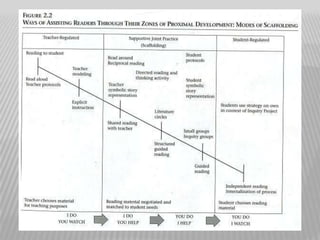
A Balanced-Literacy Program “combines explicit instruction, guided
practice, collaborative learning, and independent reading and writing”
(Tompkins, 2010) on a daily basis.

Teachers differentiate instruction based on student needs.

Balanced literacy incorporates all reading approaches realizing students
need to use multiple strategies to become proficient readers.
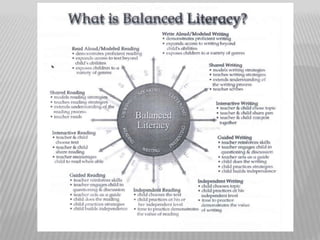
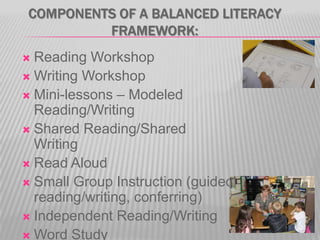
COMPONENTS OF A BALANCED LITERACY
FRAMEWORK:
Reading Workshop
 Writing Workshop
 Mini-lessons – Modeled
Reading/Writing
 Shared Reading/Shared
Writing
 Read Aloud
 Small Group Instruction (guided
reading/writing, conferring)
 Independent Reading/Writing
 Word Study

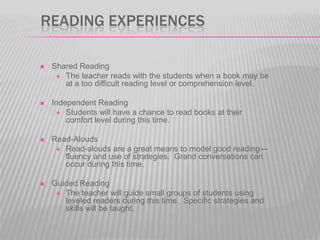
READING EXPERIENCES


Shared Reading
 The teacher reads with the students when a book may be
at a too difficult reading level or comprehension level.



Independent Reading
 Students will have a chance to read books at their
comfort level during this time.



Read-Alouds
 Read-alouds are a great means to model good reading—
fluency and use of strategies. Grand conversations can
occur during this time.



Guided Reading
 The teacher will guide small groups of students using
leveled readers during this time. Specific strategies and
skills will be taught.
THE COMPONENTS OF BALANCED LITERACY



http://www.youtube.com/watch?v=8nhZ7g09
55Q
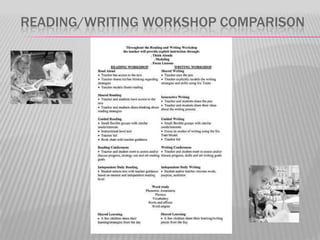
READING/WRITING WORKSHOP COMPARISON
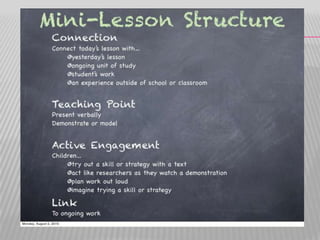
MINILESSON VIDEO


http://www.scholastic.com/teachers/top_teac
hing/2009/10/reading-workshop
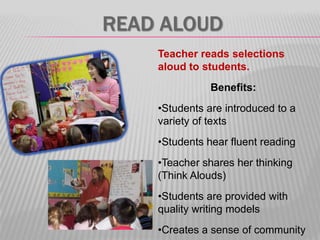
READ ALOUD
Teacher reads selections
aloud to students.
Benefits:
•Students are introduced to a
variety of texts
•Students hear fluent reading
•Teacher shares her thinking
(Think Alouds)
•Students are provided with
quality writing models
•Creates a sense of community
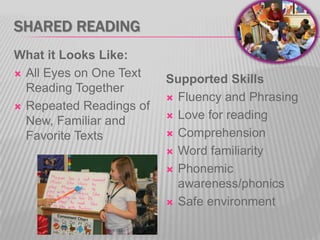
SHARED READING
What it Looks Like:
 All Eyes on One Text
Reading Together
 Repeated Readings of
New, Familiar and
Favorite Texts

Supported Skills
 Fluency and Phrasing
 Love for reading
 Comprehension
 Word familiarity
 Phonemic
awareness/phonics
 Safe environment
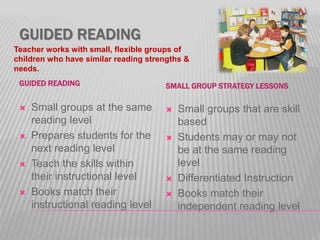
GUIDED READING
Teacher works with small, flexible groups of
children who have similar reading strengths &
needs.
GUIDED READING








Small groups at the same
reading level
Prepares students for the
next reading level
Teach the skills within
their instructional level
Books match their
instructional reading level

SMALL GROUP STRATEGY LESSONS








Small groups that are skill
based
Students may or may not
be at the same reading
level
Differentiated Instruction
Books match their
independent reading level
COMPARISON OF TRADITIONAL AND
GUIDED READING GROUPS


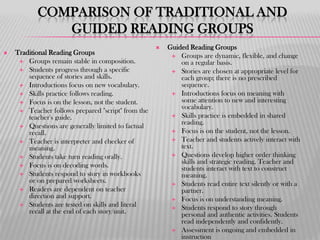
Traditional Reading Groups
 Groups remain stable in composition.
 Students progress through a specific
sequence of stories and skills.
 Introductions focus on new vocabulary.
 Skills practice follows reading.
 Focus is on the lesson, not the student.
 Teacher follows prepared "script" from the
teacher's guide.
 Questions are generally limited to factual
recall.
 Teacher is interpreter and checker of
meaning.
 Students take turn reading orally.
 Focus is on decoding words.
 Students respond to story in workbooks
or on prepared worksheets.
 Readers are dependent on teacher
direction and support.
 Students are tested on skills and literal
recall at the end of each story/unit.



Guided Reading Groups
 Groups are dynamic, flexible, and change
on a regular basis.
 Stories are chosen at appropriate level for
each group; there is no prescribed
sequence.
 Introductions focus on meaning with
some attention to new and interesting
vocabulary.
 Skills practice is embedded in shared
reading.
 Focus is on the student, not the lesson.
 Teacher and students actively interact with
text.
 Questions develop higher order thinking
skills and strategic reading. Teacher and
students interact with text to construct
meaning.
 Students read entire text silently or with a
partner.
 Focus is on understanding meaning.
 Students respond to story through
personal and authentic activities. Students
read independently and confidently.
 Assessment is ongoing and embedded in
instruction
“JUST RIGHT” BOOKS
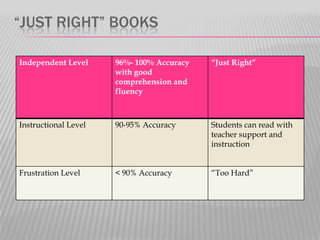
Independent Level

96%- 100% Accuracy
with good
comprehension and
fluency

“Just Right”

Instructional Level

90-95% Accuracy

Students can read with
teacher support and
instruction

Frustration Level

< 90% Accuracy

“Too Hard”
INDEPENDENT READING



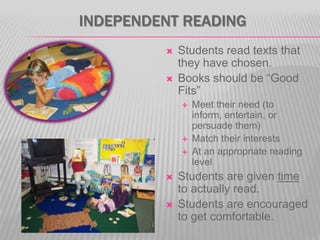
Students read texts that
they have chosen.
Books should be ―Good
Fits‖








Meet their need (to
inform, entertain, or
persuade them)
Match their interests
At an appropriate reading
level

Students are given time
to actually read.
Students are encouraged
to get comfortable.
CONFERRING
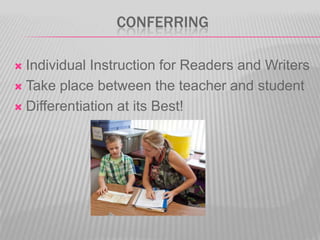
Individual Instruction for Readers and Writers
 Take place between the teacher and student
 Differentiation at its Best!

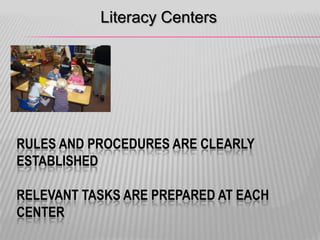
Literacy Centers

RULES AND PROCEDURES ARE CLEARLY
ESTABLISHED

RELEVANT TASKS ARE PREPARED AT EACH
CENTER
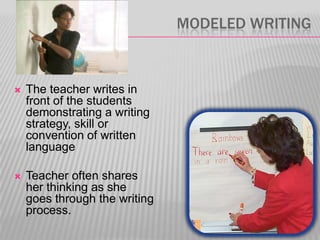
MODELED WRITING



The teacher writes in
front of the students
demonstrating a writing
strategy, skill or
convention of written
language



Teacher often shares
her thinking as she
goes through the writing
process.
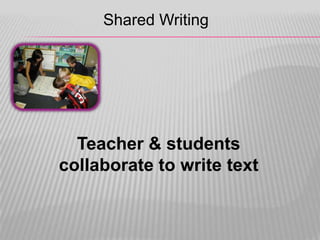
Shared Writing

Teacher & students
collaborate to write text
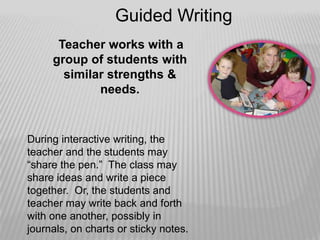
Guided Writing
Teacher works with a
group of students with
similar strengths &
needs.

During interactive writing, the
teacher and the students may
―share the pen.‖ The class may
share ideas and write a piece
together. Or, the students and
teacher may write back and forth
with one another, possibly in
journals, on charts or sticky notes.
INDEPENDENT WRITING






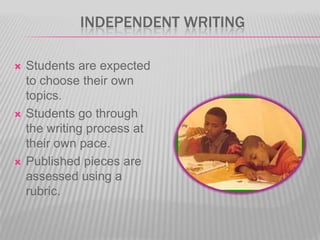
Students are expected
to choose their own
topics.
Students go through
the writing process at
their own pace.
Published pieces are
assessed using a
rubric.
WRITEWELL FOLLOWS WRITER’S WORKSHOP


http://sccresa.org/toolsforschools/curriculumtools/
writewell/introductiontowritewell/writewell3rdgrad
e/
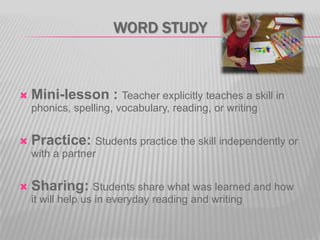
WORD STUDY



Mini-lesson : Teacher explicitly teaches a skill in
phonics, spelling, vocabulary, reading, or writing



Practice: Students practice the skill independently or
with a partner



Sharing: Students share what was learned and how
it will help us in everyday reading and writing
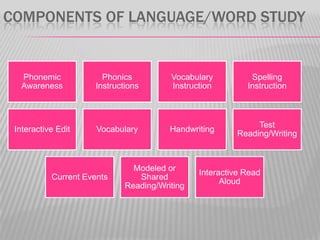
COMPONENTS OF LANGUAGE/WORD STUDY

Phonemic
Awareness

Phonics
Instructions

Vocabulary
Instruction

Spelling
Instruction

Interactive Edit

Vocabulary

Handwriting

Test
Reading/Writing

Current Events

Modeled or
Shared
Reading/Writing

Interactive Read
Aloud
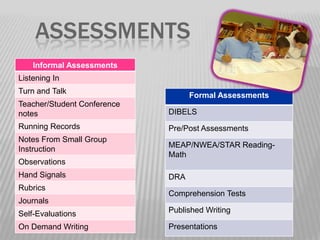
ASSESSMENTS
Informal Assessments
Listening In
Turn and Talk

Formal Assessments

Teacher/Student Conference
notes

DIBELS

Running Records

Pre/Post Assessments

Notes From Small Group
Instruction
Observations
Hand Signals
Rubrics
Journals

MEAP/NWEA/STAR ReadingMath
DRA

Comprehension Tests

Self-Evaluations

Published Writing

On Demand Writing

Presentations
RUBRICS

Rubrics are often used to
evaluate students’ academic
achievement and growth.
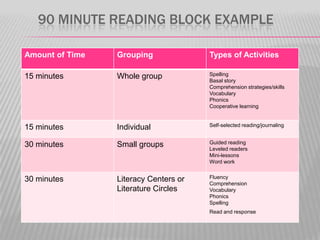
90 MINUTE READING BLOCK EXAMPLE
Amount of Time

Grouping

Types of Activities

15 minutes

Whole group

Spelling
Basal story
Comprehension strategies/skills
Vocabulary
Phonics
Cooperative learning

15 minutes

Individual

Self-selected reading/journaling

30 minutes

Small groups

Guided reading
Leveled readers
Mini-lessons
Word work

30 minutes

Literacy Centers or
Literature Circles

Fluency
Comprehension
Vocabulary
Phonics
Spelling
Read and response
Time
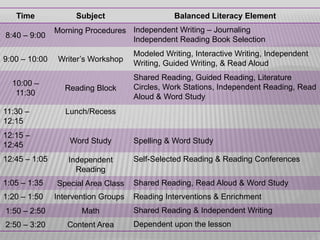
8:40 – 9:00
9:00 – 10:00
10:00 –
11:30
11:30 –
12:15
12:15 –
12:45

Subject

Balanced Literacy Element

Morning Procedures Independent Writing – Journaling
Independent Reading Book Selection
Writer’s Workshop

Reading Block

Modeled Writing, Interactive Writing, Independent
Writing, Guided Writing, & Read Aloud
Shared Reading, Guided Reading, Literature
Circles, Work Stations, Independent Reading, Read
Aloud & Word Study

Lunch/Recess

Word Study

Spelling & Word Study

12:45 – 1:05

Independent
Reading

Self-Selected Reading & Reading Conferences

1:05 – 1:35

Special Area Class

1:20 – 1:50

Intervention Groups

1:50 – 2:50

Math

2:50 – 3:20

Content Area

Shared Reading, Read Aloud & Word Study
Reading Interventions & Enrichment
Shared Reading & Independent Writing

Dependent upon the lesson
TYPES OF GROUPS
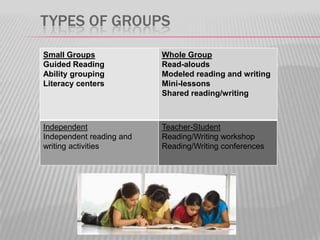
Small Groups
Guided Reading
Ability grouping
Literacy centers

Whole Group
Read-alouds
Modeled reading and writing
Mini-lessons
Shared reading/writing

Independent
Independent reading and
writing activities

Teacher-Student
Reading/Writing workshop
Reading/Writing conferences
TEACHER’S ROLE
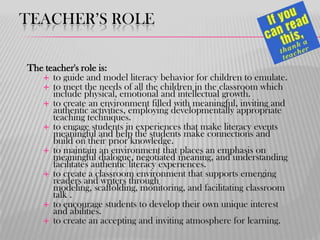
The teacher's role is:
 to guide and model literacy behavior for children to emulate.
 to meet the needs of all the children in the classroom which
include physical, emotional and intellectual growth.
 to create an environment filled with meaningful, inviting and
authentic activities, employing developmentally appropriate
teaching techniques.
 to engage students in experiences that make literacy events
meaningful and help the students make connections and
build on their prior knowledge.
 to maintain an environment that places an emphasis on
meaningful dialogue, negotiated meaning, and understanding
facilitates authentic literacy experiences.
 to create a classroom environment that supports emerging
readers and writers through
modeling, scaffolding, monitoring, and facilitating classroom
talk .
 to encourage students to develop their own unique interest
and abilities.
 to create an accepting and inviting atmosphere for learning.
ELA LOOK-FORS
QUESTIONS?

Balanced literacy evans crull 2013

  • 1.
    Jennifer Evans Assistant DirectorELA St. Clair County RESA Evans.jennifer@sccresa.org http://www.protopage.com/evans.jennifer#Untitled/Home
  • 4.
    WHAT IS BALANCEDLITERACY?  Work with a partner and develop a list of what you believe balanced literacy is.
  • 5.
    WHAT IS ABALANCED-LITERACY PROGRAM? An approach for teaching literacy that is widely used in classrooms. A comprehensive, differentiated approach to reading and writing instruction. A Balanced-Literacy Program “combines explicit instruction, guided practice, collaborative learning, and independent reading and writing” (Tompkins, 2010) on a daily basis. Teachers differentiate instruction based on student needs. Balanced literacy incorporates all reading approaches realizing students need to use multiple strategies to become proficient readers.
  • 7.
    COMPONENTS OF ABALANCED LITERACY FRAMEWORK: Reading Workshop  Writing Workshop  Mini-lessons – Modeled Reading/Writing  Shared Reading/Shared Writing  Read Aloud  Small Group Instruction (guided reading/writing, conferring)  Independent Reading/Writing  Word Study 
  • 8.
    READING EXPERIENCES  Shared Reading The teacher reads with the students when a book may be at a too difficult reading level or comprehension level.  Independent Reading  Students will have a chance to read books at their comfort level during this time.  Read-Alouds  Read-alouds are a great means to model good reading— fluency and use of strategies. Grand conversations can occur during this time.  Guided Reading  The teacher will guide small groups of students using leveled readers during this time. Specific strategies and skills will be taught.
  • 9.
    THE COMPONENTS OFBALANCED LITERACY  http://www.youtube.com/watch?v=8nhZ7g09 55Q
  • 10.
  • 12.
  • 13.
    READ ALOUD Teacher readsselections aloud to students. Benefits: •Students are introduced to a variety of texts •Students hear fluent reading •Teacher shares her thinking (Think Alouds) •Students are provided with quality writing models •Creates a sense of community
  • 14.
    SHARED READING What itLooks Like:  All Eyes on One Text Reading Together  Repeated Readings of New, Familiar and Favorite Texts Supported Skills  Fluency and Phrasing  Love for reading  Comprehension  Word familiarity  Phonemic awareness/phonics  Safe environment
  • 15.
    GUIDED READING Teacher workswith small, flexible groups of children who have similar reading strengths & needs. GUIDED READING     Small groups at the same reading level Prepares students for the next reading level Teach the skills within their instructional level Books match their instructional reading level SMALL GROUP STRATEGY LESSONS     Small groups that are skill based Students may or may not be at the same reading level Differentiated Instruction Books match their independent reading level
  • 16.
    COMPARISON OF TRADITIONALAND GUIDED READING GROUPS  Traditional Reading Groups  Groups remain stable in composition.  Students progress through a specific sequence of stories and skills.  Introductions focus on new vocabulary.  Skills practice follows reading.  Focus is on the lesson, not the student.  Teacher follows prepared "script" from the teacher's guide.  Questions are generally limited to factual recall.  Teacher is interpreter and checker of meaning.  Students take turn reading orally.  Focus is on decoding words.  Students respond to story in workbooks or on prepared worksheets.  Readers are dependent on teacher direction and support.  Students are tested on skills and literal recall at the end of each story/unit.  Guided Reading Groups  Groups are dynamic, flexible, and change on a regular basis.  Stories are chosen at appropriate level for each group; there is no prescribed sequence.  Introductions focus on meaning with some attention to new and interesting vocabulary.  Skills practice is embedded in shared reading.  Focus is on the student, not the lesson.  Teacher and students actively interact with text.  Questions develop higher order thinking skills and strategic reading. Teacher and students interact with text to construct meaning.  Students read entire text silently or with a partner.  Focus is on understanding meaning.  Students respond to story through personal and authentic activities. Students read independently and confidently.  Assessment is ongoing and embedded in instruction
  • 17.
    “JUST RIGHT” BOOKS IndependentLevel 96%- 100% Accuracy with good comprehension and fluency “Just Right” Instructional Level 90-95% Accuracy Students can read with teacher support and instruction Frustration Level < 90% Accuracy “Too Hard”
  • 18.
    INDEPENDENT READING   Students readtexts that they have chosen. Books should be ―Good Fits‖      Meet their need (to inform, entertain, or persuade them) Match their interests At an appropriate reading level Students are given time to actually read. Students are encouraged to get comfortable.
  • 19.
    CONFERRING Individual Instruction forReaders and Writers  Take place between the teacher and student  Differentiation at its Best! 
  • 20.
    Literacy Centers RULES ANDPROCEDURES ARE CLEARLY ESTABLISHED RELEVANT TASKS ARE PREPARED AT EACH CENTER
  • 21.
    MODELED WRITING  The teacherwrites in front of the students demonstrating a writing strategy, skill or convention of written language  Teacher often shares her thinking as she goes through the writing process.
  • 22.
    Shared Writing Teacher &students collaborate to write text
  • 23.
    Guided Writing Teacher workswith a group of students with similar strengths & needs. During interactive writing, the teacher and the students may ―share the pen.‖ The class may share ideas and write a piece together. Or, the students and teacher may write back and forth with one another, possibly in journals, on charts or sticky notes.
  • 24.
    INDEPENDENT WRITING    Students areexpected to choose their own topics. Students go through the writing process at their own pace. Published pieces are assessed using a rubric.
  • 25.
    WRITEWELL FOLLOWS WRITER’SWORKSHOP  http://sccresa.org/toolsforschools/curriculumtools/ writewell/introductiontowritewell/writewell3rdgrad e/
  • 26.
    WORD STUDY  Mini-lesson :Teacher explicitly teaches a skill in phonics, spelling, vocabulary, reading, or writing  Practice: Students practice the skill independently or with a partner  Sharing: Students share what was learned and how it will help us in everyday reading and writing
  • 27.
    COMPONENTS OF LANGUAGE/WORDSTUDY Phonemic Awareness Phonics Instructions Vocabulary Instruction Spelling Instruction Interactive Edit Vocabulary Handwriting Test Reading/Writing Current Events Modeled or Shared Reading/Writing Interactive Read Aloud
  • 28.
    ASSESSMENTS Informal Assessments Listening In Turnand Talk Formal Assessments Teacher/Student Conference notes DIBELS Running Records Pre/Post Assessments Notes From Small Group Instruction Observations Hand Signals Rubrics Journals MEAP/NWEA/STAR ReadingMath DRA Comprehension Tests Self-Evaluations Published Writing On Demand Writing Presentations
  • 29.
    RUBRICS Rubrics are oftenused to evaluate students’ academic achievement and growth.
  • 30.
    90 MINUTE READINGBLOCK EXAMPLE Amount of Time Grouping Types of Activities 15 minutes Whole group Spelling Basal story Comprehension strategies/skills Vocabulary Phonics Cooperative learning 15 minutes Individual Self-selected reading/journaling 30 minutes Small groups Guided reading Leveled readers Mini-lessons Word work 30 minutes Literacy Centers or Literature Circles Fluency Comprehension Vocabulary Phonics Spelling Read and response
  • 31.
    Time 8:40 – 9:00 9:00– 10:00 10:00 – 11:30 11:30 – 12:15 12:15 – 12:45 Subject Balanced Literacy Element Morning Procedures Independent Writing – Journaling Independent Reading Book Selection Writer’s Workshop Reading Block Modeled Writing, Interactive Writing, Independent Writing, Guided Writing, & Read Aloud Shared Reading, Guided Reading, Literature Circles, Work Stations, Independent Reading, Read Aloud & Word Study Lunch/Recess Word Study Spelling & Word Study 12:45 – 1:05 Independent Reading Self-Selected Reading & Reading Conferences 1:05 – 1:35 Special Area Class 1:20 – 1:50 Intervention Groups 1:50 – 2:50 Math 2:50 – 3:20 Content Area Shared Reading, Read Aloud & Word Study Reading Interventions & Enrichment Shared Reading & Independent Writing Dependent upon the lesson
  • 32.
    TYPES OF GROUPS SmallGroups Guided Reading Ability grouping Literacy centers Whole Group Read-alouds Modeled reading and writing Mini-lessons Shared reading/writing Independent Independent reading and writing activities Teacher-Student Reading/Writing workshop Reading/Writing conferences
  • 33.
    TEACHER’S ROLE The teacher'srole is:  to guide and model literacy behavior for children to emulate.  to meet the needs of all the children in the classroom which include physical, emotional and intellectual growth.  to create an environment filled with meaningful, inviting and authentic activities, employing developmentally appropriate teaching techniques.  to engage students in experiences that make literacy events meaningful and help the students make connections and build on their prior knowledge.  to maintain an environment that places an emphasis on meaningful dialogue, negotiated meaning, and understanding facilitates authentic literacy experiences.  to create a classroom environment that supports emerging readers and writers through modeling, scaffolding, monitoring, and facilitating classroom talk .  to encourage students to develop their own unique interest and abilities.  to create an accepting and inviting atmosphere for learning.
  • 34.
  • 36.

Editor's Notes

  • #6 In a balanced-literacy approach, students will have authentic opportunities to use strategies and skills in reading and writing.
  • #14 “Reading aloud to students is another way to demonstrate how much you value reading, and it also becomes an opportunity to teach students about the rewards that reading brings” (Graves, 59). Readalouds occur throughout the day within a balanced literacy program. During read aloud time, the students gather on the whole group carpet area while a text is read aloud. Read alouds provide time for new genres, cultures, themes, and social issues to be introduced. If read alouds are thoughtfully selected, they can be used to teach reading strategies and vocabulary. According to Teaching Reading in the 21st Century, “What you choose to read aloud can serve to entice students to broaden the scope of their reading interests” (Graves, 59). During read alouds, the students are granted a glimpse inside the teacher’s head when think alouds are used. During the reading, the teacher may pause and share what she is thinking. This serves as a model for the students so that they are aware that real readers have a constant conversation running in their heads. Read alouds are also beneficial in providing a model of quality writing. During writer’s workshop, we often refer to mentor texts to help us improve our writing. By having some trusty texts, students will be able to model their writing after their favorite authors. Lastly, read alouds create a sense of community. “The social nature of reading in the company of others can become a powerful motivating force, encouraging students to read, to read with understanding, and to share their ideas with others. When students have the opportunity to talk with one another about what they read, they come to realize that there are many ways to understand and respond to a text, and they also have the opportunity to enlarge their understanding and repertoire of responses by listening to the responses of others.” (Graves, 60)
  • #15 We rely heavily on this instructional approach in kdg and first grade, when students are emergent readers and are learning how texts work and stories go.
  • #19  Having time to actually read for pleasure is essential if a child is to become a real reader. During independent reading time, students read texts of their own choosing. The teacher should be knowledgeable about current literature and should be able to assist the students in selecting “good fit” books. At the beginning of the school year, and as needed throughout the year), students need to be taught how to select “good fit” books. During independent reading, the classroom teacher may conference with individual readers. During a reading conference, the teacher checks in to see how the student is doing, teaches a strategy, and a praise point. The teacher may listen to the student’s reading and then give one strategy that the student may use. Or perhaps the teacher will help the student select a “good fit” book. After the teacher shares a strategy, she should give a praise point and then move on to another student. These conferences allow for the teacher to assess the students reading progress and to see which students need help with what. By providing time for the students to actually read, the teacher is showing the student that she values reading. “Anderson, Wilson, and Fielding (1998) discovered that among the fifth-grade students they studies, 50 percent read 4 minutes a day or less; 30 percent, 2 minutes a day or less, and 10 percent not at all” (Graves, 59). If students are to become better readers, they need to be given time to actually read!
  • #22  We all know the importance of modeling reading. It is just as important to model for the students the qualities of good writers. Modeled writing generally occurs more often in the primary classrooms as the students are beginning to develop as writers. In upper grade classrooms, the teacher may choose to model specific craft or convention lessons. All students may not need the modeled writing lesson, so the teacher may pull just a small group for the writing lesson. Modeled writing generally occurs within Writer’s Workshop time, but it may also occur in content areas also.
  • #24  Guided writing generally occurs during Writer’s Workshop. When the rest of the class is working independently on their pieces, the teacher may pull a small needs-based group and teach them a specific writing strategy. The teacher informally assesses the students during the writing conference and then uses that information to guide the guided writing group. Interactive writing can take many forms with the classroom. Within the classroom, the students are expected to journal. Often the teacher responds to the child in the journal. If a piece is too personal, the student may choose not to share the piece with the teacher. Interactive writing also occurs when the class writes a piece of writing together. The students and the teacher may “share the pen” and contribute sections of the text. If journals are being used, it is important for the teacher to, “Read and comment on the journal as often as possible” (Graves, 375).
  • #25  Within the balanced literacy approach, independent writing takes up the majority of the Writer’s Workshop approach. Students are expected
  • #27 The Fountas and Pinnell word study is a collection of minilessons that enable teachers to help children attend to and learn about how words work. The lessons are to be connected with word solving in reading and writing across the curriculum. Children learn to solve words on the run, while reading for meaning and writing to communicate. This is a comprehensive word study program that focuses on letter/sound relationships, spelling patterns, High frequency words, word meaning, word structure, and word solving actions.
  • #29  Students are often informally assessed on their reading and writing development. The informal assessments allow for the teacher to quickly decide which students need remediation, more practice or enrichment with specific skills and strategies. Teachers may informally assess their students by simply listening in as the students are talking with their peers. High level questioning should be used to guide student conversations. Teachers may informally assess the students reading and writing development by utilizing journals. The journals allow a quick peek into the students’ heads and show the students’ strengths and weaknesses. Formal assessment are also used within the classroom. Many of the formal assessments are mandated by the school district or state. The formal assessments are used to guide my instruction. Students will earn their grades by earning points. Many of the scores will come from rubrics. Rubrics are sent home on a biweekly basis so you know how your child is doing in the classroom. Students will be evaluated on the quality and quality of reading journals, reading logs, written responses, active participation during discussions, published pieces of writing, comprehension tests, and quantity of writing produced during Writer’s Workshop.
  • #31 This is just a model of what a normal day may look like. However, when doing a class novel, the timing may change.
  • #32  Literacy development consumes a large portion of the school day. In order for students to grow into real readers and writers, they need to be provided with ample time to hone their skills. Reading and writing elements are employed in every subject area throughout the day. For example, while the students are in gym class, they may read the rules to a new game or match terms to the correct lines on the basketball court (Free Throw Line card would be placed on the actual free throw line).
  • #33 I will use different groupings throughout the day in order to meet the students’ needs.