Introduction to the Four Blocks
Approach to Literacy in Special
       Needs Classrooms
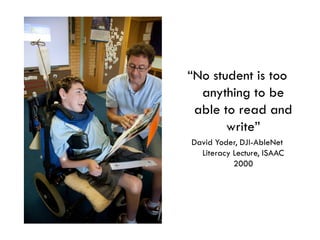
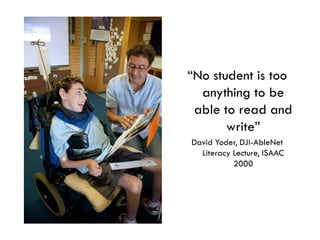
“No student is too
  anything to be
 able to read and
       write”
David Yoder, DJI-AbleNet
  Literacy Lecture, ISAAC
           2000
Our National Literacy Plan
“Ensuring all students gain at least a minimum
acceptable standard in literacy and numeracy
      is critical in overcoming educational
disadvantage. This means that gaining literacy
 and numeracy skills is a central equity issue in
                 education today.”
                   (DEST, 2005)
Accommodating Struggles
      physical demands
      cognitive demands
       sensory demands
   communication demands
     experience demands
        affect demands
So how do we teach literacy for all our
          diverse students?
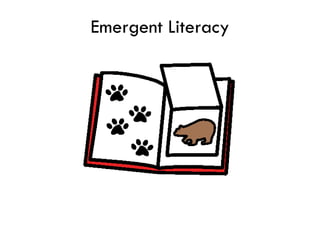
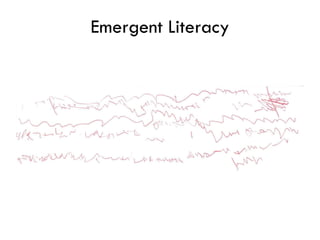
Emergent Literacy
Traditional view of Literacy
• Emphasises “readiness”;
• Literacy is learned in a predetermined
  sequential manner that is linear, additive, and
  unitary;
• Literacy learning is school-based;
• Literacy learning requires mastery of certain
  prerequisite skills;
• Some children will never learn to read.
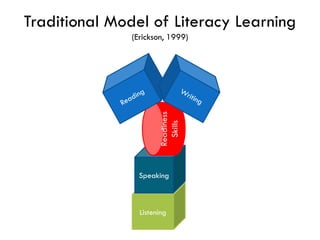
Traditional Model of Literacy Learning
               (Erickson, 1999)


                       Readiness
                 SpeakingSkills


                 Listening
Current/Emergent View of Literacy
• Literacy development is constructive, interactive,
  recursive, and emergent;
• Literacy development is a process that begins
  at birth and perhaps before;
• Emergent literacy is “…the reading and writing
  behaviours that precede and develop into
  conventional literacy”;
• Emergent literacy is appropriate for all
  children.
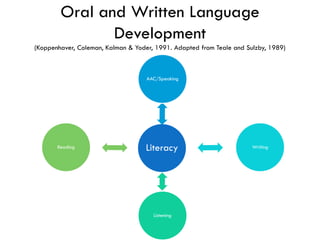
Oral and Written Language
               Development
(Koppenhaver, Coleman, Kalman & Yoder, 1991. Adapted from Teale and Sulzby, 1989)


                                    AAC/Speaking


       Reading                     Literacy                           Writing


                                      Listening
Emergent Literacy
• Emergent literacy behaviours are fleeting and
  variable depending on text, task and
  environment;
• The functions of print are as integral to literacy
  as the forms.
Emergent Literacy
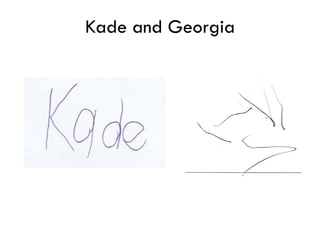
Kade and Georgia
Emergent Literacy Intervention
• Happens in the pre-school years for most
  children;
• Incidental learning and teaching about letters,
  words, literacy concepts;
• Children with phonological awareness at the
  beginning of school may not have had good
  emergent literacy input.
Emergent Literacy and Children with
                Disabilities
•   Light et al (1994), Frame (2000);
•   Passive interaction pattern;
•   Larger number of new books;
•   Fewer repeated readings;
•   Less time spent on literacy activities.
Emergent Literacy Intervention
• Some school aged children need emergent
  literacy experiences before they can develop
  conventional literacy;
• Lots of simple books being read to them;
• Chances to scribble with the alphabet;
• Good literacy environment and models;
• Need to make sure student gets exposed to
  reading AND writing AND word intervention.
Emergent Literacy
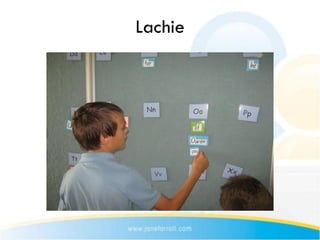
• Give every student a “pencil”!
• Provide a literacy rich environment;
• Ensure links between environment and print are
  constantly reinforced;
• Alphabet books;
• Phonological awareness activities, particularly
  for students with Complex Communication
  Needs (CCN).
Emergent Literacy
“Written language activities and
experiences should not be withheld
 while speech, language, motor or
 other skill(s) develop to arbitrary,
        prerequisite levels.”
         Koppenhaver and Erickson (2000)
Conventional Literacy
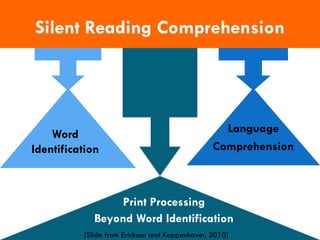
Silent Reading Comprehension


    Word                                          Language
Identification                                  Comprehension


                  Print Processing
             Beyond Word Identification
          (Slide from Erickson and Koppenhaver, 2010)
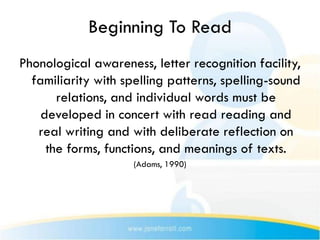
Beginning To Read
Phonological awareness, letter recognition facility,
  familiarity with spelling patterns, spelling-sound
       relations, and individual words must be
    developed in concert with read reading and
   real writing and with deliberate reflection on
     the forms, functions, and meanings of texts.
                     (Adams, 1990)
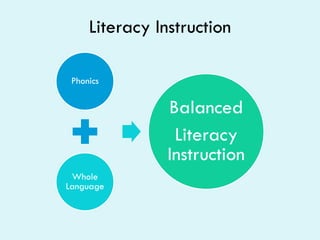
Literacy Instruction

 Phonics


                Balanced
                 Literacy
                Instruction
 Whole
Language
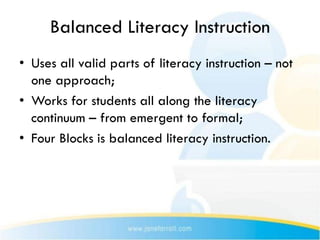
Balanced Literacy Instruction
• Uses all valid parts of literacy instruction – not
  one approach;
• Works for students all along the literacy
  continuum – from emergent to formal;
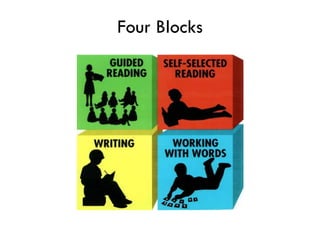
• Four Blocks is balanced literacy instruction.
Four Blocks
Four Blocks
• Created by Patricia Cunningham and Dorothy
  Hall;
• www.fourblocks.com;
• Four Blocks in Special Ed wiki
  https://fourblock.wikispaces.com/.
Four Blocks
• Centre for Literacy and Disability Studies,
  North Carolina
  http://www.med.unc.edu/ahs/clds;
• Big thank-you to them for teaching me about
  Four Blocks, sharing their resources and being
  awesome!
• Have a good look at their resources section.
If All Children Are To
   Learn, All Teachers
 Must Teach Everything
(Koppenhaver, Erickson & Clendon, 2008)
Technology To Support the Four Blocks
But remember.....


ICT = It Can’t Teach
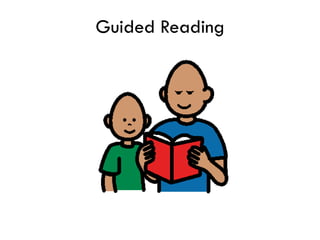
Guided Reading
Guided Reading
• Primary purposes are to assist students to:
  – Understand that reading involves thinking and
    meaning-making;
  – Become more strategic in their own reading.
• Must use a wide variety of books and other
  print materials.
• NOT listening comprehension.
Purposes for Reading
• Need to set a purpose every time you do
  guided reading;
• If you don’t set a purpose students think they
  have to remember everything – or become
  passive;
• Purpose needs to be broad enough to motivate
  processing of entire text.
Guided Reading
• 1 book per week;
• Different purpose each day;
• Build confidence;
• Some students will participate in the repeated
  readings or in setting purposes as they become
  more skilled;
• Help students become independent.
5 part Guided Reading
• Before reading:
   1. Build or activate background knowledge
   2. Purpose “Read so that you can”
• During reading:
   3. Read/listen
• After reading:
   4. Task directly related to the purpose
   5. Feedback/Discussion (typically woven into follow-up)
      • What makes you say that? How do you know? Why do you think so?
      • Help students gain cognitive clarity so they can be successful again
        or next time
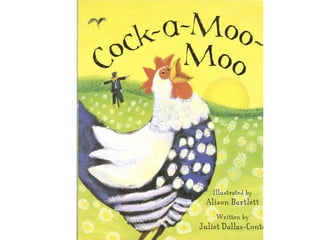
Cock-A-Moo-Moo
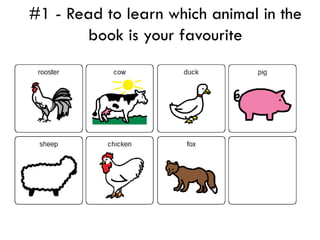
1. Read to learn which animal in the book is your
   favourite (before reading, list the animals in
   the book)
#1 - Read to learn which animal in the
       book is your favourite
Participation for students with CCN
• If they have a comprehensive communication
  system (egg PODD) then they can use that to
  participate across the day;
• If they don’t then we need to provide ways for
  them to participate;
• AND we need to work towards getting them a
  comprehensive communication system.
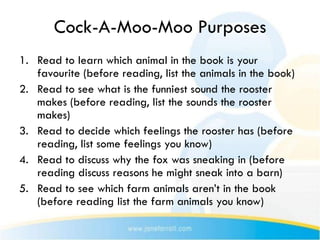
Cock-A-Moo-Moo Purposes
1. Read to learn which animal in the book is your
   favourite (before reading, list the animals in the book)
2. Read to see what is the funniest sound the rooster
   makes (before reading, list the sounds the rooster
   makes)
3. Read to decide which feelings the rooster has (before
   reading, list some feelings you know)
4. Read to discuss why the fox was sneaking in (before
   reading discuss reasons he might sneak into a barn)
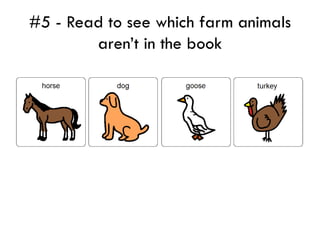
5. Read to see which farm animals aren’t in the book
   (before reading list the farm animals you know)
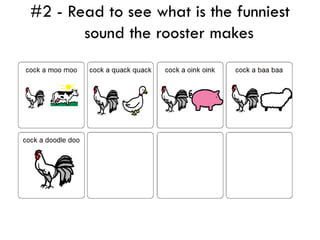
#2 - Read to see what is the funniest
       sound the rooster makes
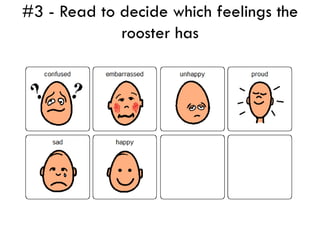
#3 - Read to decide which feelings the
             rooster has
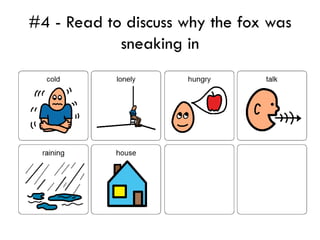
#4 - Read to discuss why the fox was
            sneaking in
#5 - Read to see which farm animals
        aren’t in the book
Repetition with Variety
To learn a skill and generalise it across contexts,
 instruction must provide repetition of the skills in
                  a variety of ways
Variety
• Variety of purposes;
• Variety of approaches;
• Variety of texts;
Variety of texts
• Commercial books;
• Fiction and non-fiction;
• Language Experience/custom texts;
• Created texts about class/individual
  experiences;
• Personal alphabet books;
• TarHeel Reader books.
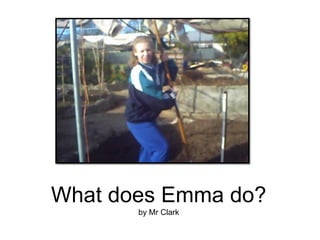
What does Emma do?
       by Mr Clark
Guided Reading Books
• Those you already have (class and library);
• Information from the www;
• Created books on topics of interest in
  PowerPoint, Clicker 5, Boardmaker Studio;
• TarHeel Reader;
• Start-to-Finish books.
• Guided Reading packs at
  http://www.janefarrall.com/html/guided.html
Picture, Symbols and Text
• Symbols appear to improve access to
  literacy..... But do they really?
Why no picture-supported text when
          teaching reading?
• Pictographs can be distracting for developing readers
  who may pay more attention to the pictures than the
  text they are learning to read/decode
• After a review of literature Hatch (2009) found “the
  outcomes of several research studies that investigated
  the use of pictures to support the development of word
  identification in readers with and without disabilities
  indicated that children learned more words in fewer
  trials when words were presented alone than when
  paired with pictures (Pufpaff, Blischak & Lloyd, 2000;
  Samuels, 1967; Samuels et al, 1974)
Why are pictographs distracting?
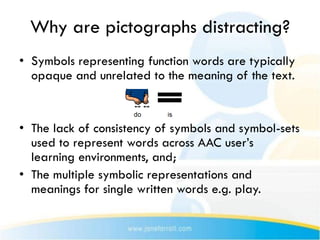
• Symbols representing function words are typically
  opaque and unrelated to the meaning of the text.


• The lack of consistency of symbols and symbol-sets
  used to represent words across AAC user’s
  learning environments, and;
• The multiple symbolic representations and
  meanings for single written words e.g. play.
When should we use symbols?
• To support COMMUNICATION
  – All day, every day
  – During reading instruction
  – During writing instruction
• To support behaviour and self-regulation
  – Visual supports
  – Visual schedules
Self-Selected Reading
• Primary purposes are to assist students to:
   – Understand why they might want to learn;
   – Become automatic in skill application;
   – Choose to read after they learn how.
• It isn’t self-directed if you don’t choose it
  yourself;
• You can’t get good at it if it is too difficult.
Self-Selected Reading
• How do we create in our classrooms the
  conditions that lead students to a love of
  reading?
• How do we provide our students with successful
  practice that will make them fluent readers?
Self-Selected Reading
• Most receptive vocabulary growth occurs
  through exposure to written language rather
  than direct instruction
• Reading volume is the prime contributor to
  vocabulary growth
  – True for poor readers and good readers
Self-Selected Reading
• Help students to:
   – Understand why they might want to learn to read
   – Become automatic in skill application
   – Choose to read after they learn how
• It isn’t self directed if you don’t chose it yourself
• You can’t get good at it if it is too difficult
Self-Selected Reading for Students with
              Disabilities
• Need to make books accessible to ALL students
• Many children with disabilities have fewer
  opportunities to practice than their peers and
  when they do they are often passive
  participants (Koppenhaver and Yoder, 1992)
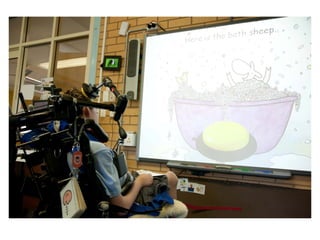
Electronic Accessible Books
• Accessible books allow students to do
  independent reading
• Talking books also give them the option for
  support from the computer if needed
Encourage Repeated Reading
• Easy texts
• Read the same passage in guided reading for
  several days for a different purpose each day
• Pair older readers up with young reading
  buddies to validate reading of “baby books”
Self-Selected Reading Resources
• Commercial books
• Custom books
• TarHeel Reader books
• Other digital storybook website e.g. Starfall,
  MeeGenius
• Digital storybook apps on iPads
Re-Creating Picture Books
• One of the most common Accessible Books are
  re-created standard picture books
• These let students of all abilities read these
  books independently
• Also lets us modify the books to suit individual
  students – make the text bigger for students
  with vision difficulties, simplify the presentation
  style for students who are visually distractible,
  etc
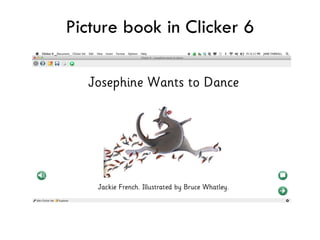
Picture book in Clicker 6
Creating Custom Books
• Books with familiar photos can be more
  meaningful and motivating for many children
• You can make older content with simple text
• Students can get involved in book creation
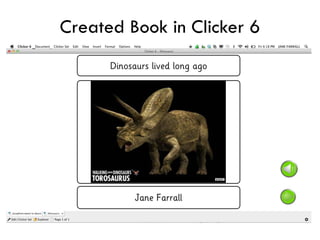
Created Book in Clicker 6
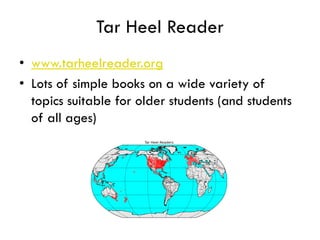
Tar Heel Reader
• www.tarheelreader.org
• Lots of simple books on a wide variety of
  topics suitable for older students (and students
  of all ages)
Writing
Writing
• Students who write become better readers,
  writers and thinkers
• Writing without standards
• Learn in classroom writing communities:
  – Write for real reasons
  – See others do so
  – Interact with peers and teachers about written
    content, use and form
Writing
• Writing consists of a large number of sub-skills
• These include:
   – Ideas, language, spelling, sensory motor skills, word
     identification, word generation, etc
• Many of these skills, especially operational skills, need
  to be automatic before a writer becomes fluent
• Need to address both:
   – The development of skills for writing
   – Meeting current requirements for writing (record school
     work, demonstrate knowledge, write to friends, etc.)
                                  From Erickson and Koppenhaver, 2000
Writing and Reading
• Without a pencil writing doesn’t improve
• Without writing, reading development will be
  limited
• If a student doesn’t have a pencil, you need to
  find one!
“Pencils”
• Without a pencil writing doesn’t improve
• Without writing, reading development will be
  limited
• If a student doesn’t have a pencil, you need to
  find one
Writing and Emergent Literacy
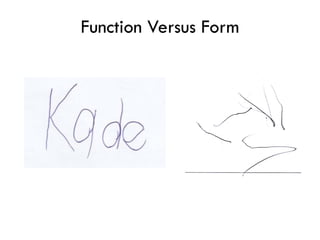
• The function of literacy is as important as the
  form
• Students need to understand why writing is
  important
Function Versus Form
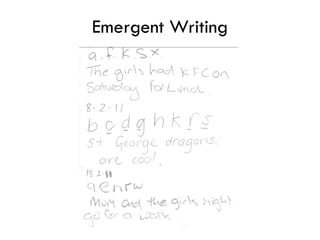
Emergent Writing
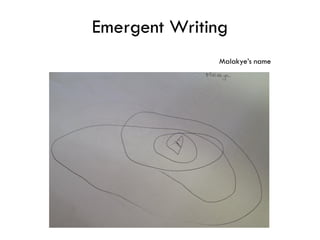
Emergent Writing
              Malakye’s name
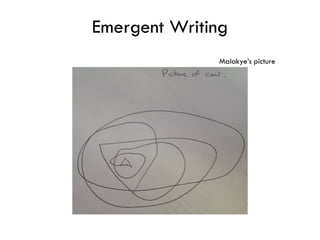
Emergent Writing
              Malakye’s picture
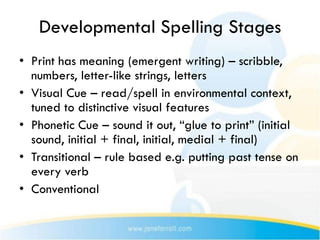
Developmental Spelling Stages
• Print has meaning (emergent writing) – scribble,
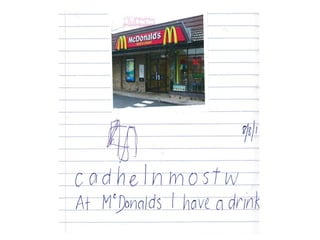
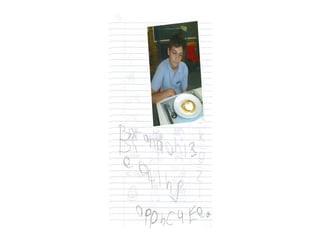
  numbers, letter-like strings, letters
• Visual Cue – read/spell in environmental context,
  tuned to distinctive visual features
• Phonetic Cue – sound it out, “glue to print” (initial
  sound, initial + final, initial, medial + final)
• Transitional – rule based e.g. putting past tense on
  every verb
• Conventional
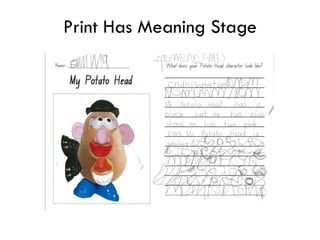
Print Has Meaning Stage
Print Has Meaning Intervention
• Must learn that print has communicative function
  – Point out environmental print
  – Create language experience texts
  – Use Big Books and point to text as you read
  – Use predictable books and pattern books
• Provide daily opportunities to write for real
  reasons
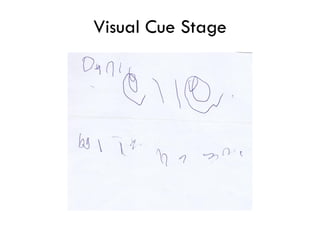
Visual Cue Stage
Visual Cue Intervention
• Must learning that letters and sounds are
  systematically related
  – Use patterned, rhymed text to foster phonological
    awareness
  – Encourage invented spelling
  – Informal phonics instruction (there’s a B like in your
    name Bob)
  – Use voice output during writing activities
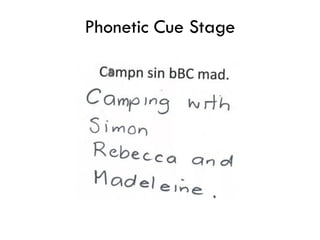
Phonetic Cue Stage
Phonetic Cue Stage
• Tyrone – typed his name perfectly

• Brum Tyrone Nan baefg – then typed this

• Tyrone told me that this says that Brum, Tyrone
  and Nan are friends, using his page set on
  Proloquo2Go.
Phonetic Cue Intervention
• Must learn automatic application of decoding
  strategies and develop large sight vocabulary
  – Read, write, listen across tasks and texts
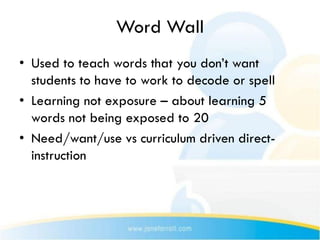
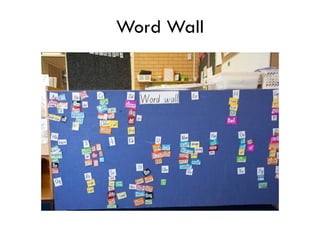
  – Use words on the wall
  – Begin using word prediction as soon as student can
    pick first letter or the word represented
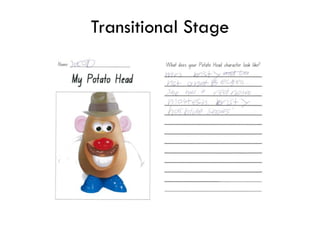
Transitional Stage
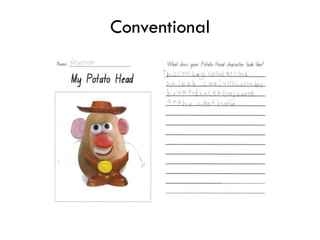
Conventional
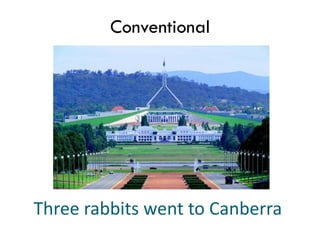
Conventional


Three rabbits went to Canberra
Personal Connection

The power of starting from the things children
                love the most!
Writing Intervention
• Inherently multilevel and individualised
• Typically chaotic in classroom context
• Goals: creating skills, experiences and interest
  to help children write well and use writing to
  accomplish their own purposes
• Plan volume of writing versus quality of writing,
  number of pieces versus length of pieces
Models
• Present the form to teach the form
Sentence Combining
• Direct instruction in producing more complex
  syntactic structures
• Give students sets of two or more sentences to
  combine into one
  – E.g. The box is heavy
  – The box is big
  – The box is full
Scales
• Also called rubrics – providing example of
  good writing on a specific area e.g. here’s a
  piece of writing with good action verbs. Now
  you write one.
Inquiry
• Pose a problem
• Compile data as a group
• Write about it as individuals
Free Writing
• Also called “Can’t stop writing”
• Writing without standards (ie not even
  teaching)
• Big Paper Writing
Writing Intervention
• Focused mini-lessons on various aspects of the
  writing process e.g. brainstorming
• These happen daily for the majority of the
  writing time
Writing Mini-Lessons
• Examples are:
  – Using a spell checker
  – Capitalising the first word of every sentence
  – Brainstorming
  – Revision (thinking like your audience)
  – Poetry forms
  – Using mind mapping
Writing for Students with Disabilities
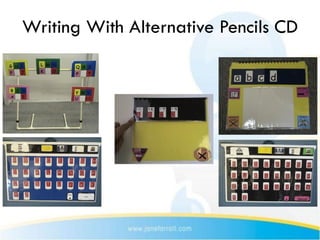
• ALL students must be provided with a pencil
  before they can start writing
Writing With Alternative Pencils CD
Some Options for Production Difficulties
• Talking Word Processor
• Word Prediction
  – On computer
  – In communication software