URETHRAL INJURIES-
INITIAL MANAGEMENT
Dept of Urology
Govt Royapettah Hospital and Kilpauk Medical College
Chennai 1
Moderators:
Professors:
• Prof. Dr. G. Sivasankar, M.S., M.Ch.,
• Prof. Dr. A. Senthilvel, M.S., M.Ch.,
Asst Professors:
• Dr. J. Sivabalan, M.S., M.Ch.,
• Dr. R. Bhargavi, M.S., M.Ch.,
• Dr. S. Raju, M.S., M.Ch.,
• Dr. K. Muthurathinam, M.S., M.Ch.,
• Dr. D. Tamilselvan, M.S., M.Ch.,
• Dr. K. Senthilkumar, M.S., M.Ch.
Dept Of Urology, KMC and GRH,
Chennai
2
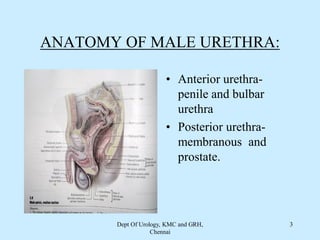
ANATOMY OF MALE URETHRA:
• Anterior urethra-
penile and bulbar
urethra
• Posterior urethra-
membranous and
prostate.
Dept Of Urology, KMC and GRH,
Chennai
3
ANATOMY OF FEMALE URETHRA:
Dept Of Urology, KMC and GRH,
Chennai
4
TYPES OF URETHRAL
INJURIES
• Anterior urethral injuries.
• Posterior urethral injuries.
Dept Of Urology, KMC and GRH,
Chennai
5
Anterior Urethral Injuries.
• Commonly involves Bulbar Urethra.
• Causes –
1. Straddle injuries.
2. Direct blow to the perineum.
3. Penetrating injuries.
4. Cycling accidents.
5. Gymnasium accidents.
6. Road traffic accidents.
7. Crush injuries.
Dept Of Urology, KMC and GRH,
Chennai
6
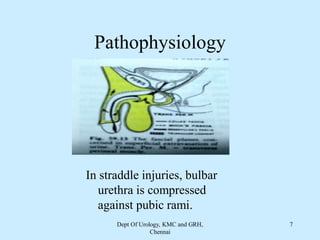
Pathophysiology
In straddle injuries, bulbar
urethra is compressed
against pubic rami.
Dept Of Urology, KMC and GRH,
Chennai
7
Clinical features:-
Classic TRIAD:
1. Blood at urethral meatus
2. Distended bladder
3. Perineal haematoma.
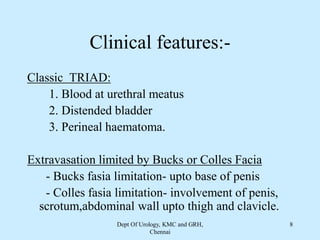
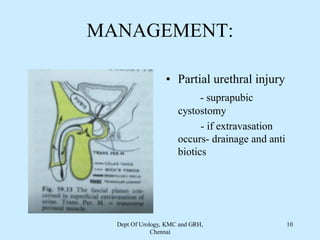
Extravasation limited by Bucks or Colles Facia
- Bucks fasia limitation- upto base of penis
- Colles fasia limitation- involvement of penis,
scrotum,abdominal wall upto thigh and clavicle.
Dept Of Urology, KMC and GRH,
Chennai
8
INVESTIGATIONS:
• Retrograde Urethrogram
- 10 – 20 ml of water soluble contrast
- flouroscopic guidance ideal.
- extravasation seen at the site of injury.
• Diagnostic catheterization
- should not be attempted
- may convert partial into complete tear.
- infect perineal haematoma
- increase prostatic bleeding.
Dept Of Urology, KMC and GRH,
Chennai
9
MANAGEMENT:
• Partial urethral injury
- suprapubic
cystostomy
- if extravasation
occurs- drainage and anti
biotics
Dept Of Urology, KMC and GRH,
Chennai
10
• Complete Urethral Transection
Management options:
a . Immediate urethral repair:
Indication - Concomitant penile fracture.
- Penetrating injuries in stable patient
- Associated rectal injuries.
Surgical technique
-Midline perineal Incision
-Drainage perineal hematoma..
-Debridement of urethral margins.
-Mobilisation of urethra.
-Tension free spatulated anastomosis.
with 16 F silicone catheter.
Dept Of Urology, KMC and GRH,
Chennai
11
b.SPC and delayed repair:
- Most advised method of management
- Delayed repair afterwards.
Dept Of Urology, KMC and GRH,
Chennai
12
POSTERIOR URETHRAL
INJURIES
 90 % Posterior urethral injuries usually due to
pelvic fractures.
 But only 10% of pelvic fractures are associated
with urethral injuries.
 Prostato-membranous junctional injuries-
common.
Dept Of Urology, KMC and GRH,
Chennai
13
PATHOPHYSIOLOGY
• Opposing forces between
prostatic and membranous
urethra.
Dept Of Urology, KMC and GRH,
Chennai
14
CLINICAL FEATURES
CLASSIC TRIAD:
-BLOOD AT URETHRAL MEATUS
-DISTENDED BLADDER
-PERINEAL HEMATOMA
High riding prostate.
Boggy mass in the pelvis.
Dept Of Urology, KMC and GRH,
Chennai
15
DIAGNOSIS
• Retrograde urethrogram - Extravasation of contrast
• IVU-To evaluate upper tracts & bladder, since10% association with
bladder injuries.
• Urethral injuries are classified according to retrograde urethrogram.
Type1 - Urethra stretched, but intact.
TypeII - Disruption proximal to UG Diaphragm.
TypeIII - Combined disruption proximal and distal to
UG diaphragm
Type IV - Bladder neck injury with extention in to urethra..
Dept Of Urology, KMC and GRH,
Chennai
16
Dept Of Urology, KMC and GRH,
Chennai
17
MANAGEMENT;
• INITIAL MANAGEMENT:
Hemodynamic stability
Associated injuries
In multiple injuries the order of priorities are :
1.Airway
2.Treatement of shock.
3.Treatment of associated injuries like
a.Cerebral
b.Thoracic
c.Abdominal organs including kidney.
d.Orthopaedic
e.Urologic
In acute phase just above all other injuries take precedence over the
urethra but the patient survives the urethral injury can cause him the
greatest disability. Dept Of Urology, KMC and GRH,
Chennai
18
MANAGEMENT (contd)
• Primary re-alignment:
Indications- Associated bladder neck injuries
-Vascular injuries
- Rectal injuries
Surgical technique:
Urethral re-alignment with catheters
- midline incision
- bladder opened
- 16 F foleys catheter passed via urethra and retrieved
through retropubic space.
- Catheter passed from internal meatus and retrieved
through retropubic space.
- Both catheters tied and rail roaded. SPC catheter kept.
Dept Of Urology, KMC and GRH,
Chennai
19
Railroad by interlocking sounds
are given up because of
associated injuries to the
surrounding tissues.
Dept Of Urology, KMC and GRH,
Chennai
20
DIRECT (OPEN primary re-alignment):
 Open repair by removing pelvic haematoma,
dissecting and tissue suturing the severed urethra
under vision.
 Not followed nowadays because of complications
a. Impotence
b. Incontinence
c. Stricture formation
d. Operative blood loss
Dept Of Urology, KMC and GRH,
Chennai
21
INDIRECT (Endoscopic primary re-
alignment) :
- Present definiton.
- Urethral gap bridged by urethral catheter to
promote urethral healing.
Advantages:
Less complications.
Shortens the length of the stricture
Eases subsequent urethroplasty
- Impotence
- Anejacualtion
- Incontinence are not worsened.
Dept Of Urology, KMC and GRH,
Chennai
22
TECHNIQUE
• Midline incision
• Open cystotomy
• Direct urethral catheterisation
• Ante-grade flexible cystoscopy and guide wire passed to
urethral meatus.
• Retrograde urethral catheterisation with 16 Fr foley
catheter.
• SPC for 6 weeks.
Dept Of Urology, KMC and GRH,
Chennai
23
DELAYED REPAIR
• SPC followed by delayed or secondary repair after
3 – 6 months.
- At present most accepted procedure.
- Less blood loss and infection
- Reduced post-op stricture.
- Less impotence and incontinence.
Dept Of Urology, KMC and GRH,
Chennai
24
MANAGEMENT
• SPC alone-
96% develops urethral stricture, which require posterior urethroplasty.
• SPC + Initial Primary Re-alignment
Heals without stricture
Heals with mild stricture [Dilatation + O.I.U]
Eases Subsequent urethroplasty.
• SPC followed by delayed or secondary repair after 3 – 6 months.
Dept Of Urology, KMC and GRH,
Chennai
25
Female Urethral Injuries
• Rare
• Accompanied by bony
pelvic disruption
• Injury to bladder neck
& vagina
• Common in young
girls
Dept Of Urology, KMC and GRH,
Chennai
26
MANAGEMENT
• Immediate reconstruction of bladder neck
• Repair of all vaginal lacerations
• Retropubic repair with urethral catheter
stenting & SPC
• Urethrovaginal fistula – secondary closure
Dept Of Urology, KMC and GRH,
Chennai
27
• AUG
• No diagnostic Catheterisation
• SPC diversion & Delayed endoscopic repair
Dept Of Urology, KMC and GRH,
Chennai
28
Dept Of Urology, KMC and GRH,
Chennai
29

Gu trauma- urethra- initial management

  • 1.
    URETHRAL INJURIES- INITIAL MANAGEMENT Deptof Urology Govt Royapettah Hospital and Kilpauk Medical College Chennai 1
  • 2.
    Moderators: Professors: • Prof. Dr.G. Sivasankar, M.S., M.Ch., • Prof. Dr. A. Senthilvel, M.S., M.Ch., Asst Professors: • Dr. J. Sivabalan, M.S., M.Ch., • Dr. R. Bhargavi, M.S., M.Ch., • Dr. S. Raju, M.S., M.Ch., • Dr. K. Muthurathinam, M.S., M.Ch., • Dr. D. Tamilselvan, M.S., M.Ch., • Dr. K. Senthilkumar, M.S., M.Ch. Dept Of Urology, KMC and GRH, Chennai 2
  • 3.
    ANATOMY OF MALEURETHRA: • Anterior urethra- penile and bulbar urethra • Posterior urethra- membranous and prostate. Dept Of Urology, KMC and GRH, Chennai 3
  • 4.
    ANATOMY OF FEMALEURETHRA: Dept Of Urology, KMC and GRH, Chennai 4
  • 5.
    TYPES OF URETHRAL INJURIES •Anterior urethral injuries. • Posterior urethral injuries. Dept Of Urology, KMC and GRH, Chennai 5
  • 6.
    Anterior Urethral Injuries. •Commonly involves Bulbar Urethra. • Causes – 1. Straddle injuries. 2. Direct blow to the perineum. 3. Penetrating injuries. 4. Cycling accidents. 5. Gymnasium accidents. 6. Road traffic accidents. 7. Crush injuries. Dept Of Urology, KMC and GRH, Chennai 6
  • 7.
    Pathophysiology In straddle injuries,bulbar urethra is compressed against pubic rami. Dept Of Urology, KMC and GRH, Chennai 7
  • 8.
    Clinical features:- Classic TRIAD: 1.Blood at urethral meatus 2. Distended bladder 3. Perineal haematoma. Extravasation limited by Bucks or Colles Facia - Bucks fasia limitation- upto base of penis - Colles fasia limitation- involvement of penis, scrotum,abdominal wall upto thigh and clavicle. Dept Of Urology, KMC and GRH, Chennai 8
  • 9.
    INVESTIGATIONS: • Retrograde Urethrogram -10 – 20 ml of water soluble contrast - flouroscopic guidance ideal. - extravasation seen at the site of injury. • Diagnostic catheterization - should not be attempted - may convert partial into complete tear. - infect perineal haematoma - increase prostatic bleeding. Dept Of Urology, KMC and GRH, Chennai 9
  • 10.
    MANAGEMENT: • Partial urethralinjury - suprapubic cystostomy - if extravasation occurs- drainage and anti biotics Dept Of Urology, KMC and GRH, Chennai 10
  • 11.
    • Complete UrethralTransection Management options: a . Immediate urethral repair: Indication - Concomitant penile fracture. - Penetrating injuries in stable patient - Associated rectal injuries. Surgical technique -Midline perineal Incision -Drainage perineal hematoma.. -Debridement of urethral margins. -Mobilisation of urethra. -Tension free spatulated anastomosis. with 16 F silicone catheter. Dept Of Urology, KMC and GRH, Chennai 11
  • 12.
    b.SPC and delayedrepair: - Most advised method of management - Delayed repair afterwards. Dept Of Urology, KMC and GRH, Chennai 12
  • 13.
    POSTERIOR URETHRAL INJURIES  90% Posterior urethral injuries usually due to pelvic fractures.  But only 10% of pelvic fractures are associated with urethral injuries.  Prostato-membranous junctional injuries- common. Dept Of Urology, KMC and GRH, Chennai 13
  • 14.
    PATHOPHYSIOLOGY • Opposing forcesbetween prostatic and membranous urethra. Dept Of Urology, KMC and GRH, Chennai 14
  • 15.
    CLINICAL FEATURES CLASSIC TRIAD: -BLOODAT URETHRAL MEATUS -DISTENDED BLADDER -PERINEAL HEMATOMA High riding prostate. Boggy mass in the pelvis. Dept Of Urology, KMC and GRH, Chennai 15
  • 16.
    DIAGNOSIS • Retrograde urethrogram- Extravasation of contrast • IVU-To evaluate upper tracts & bladder, since10% association with bladder injuries. • Urethral injuries are classified according to retrograde urethrogram. Type1 - Urethra stretched, but intact. TypeII - Disruption proximal to UG Diaphragm. TypeIII - Combined disruption proximal and distal to UG diaphragm Type IV - Bladder neck injury with extention in to urethra.. Dept Of Urology, KMC and GRH, Chennai 16
  • 17.
    Dept Of Urology,KMC and GRH, Chennai 17
  • 18.
    MANAGEMENT; • INITIAL MANAGEMENT: Hemodynamicstability Associated injuries In multiple injuries the order of priorities are : 1.Airway 2.Treatement of shock. 3.Treatment of associated injuries like a.Cerebral b.Thoracic c.Abdominal organs including kidney. d.Orthopaedic e.Urologic In acute phase just above all other injuries take precedence over the urethra but the patient survives the urethral injury can cause him the greatest disability. Dept Of Urology, KMC and GRH, Chennai 18
  • 19.
    MANAGEMENT (contd) • Primaryre-alignment: Indications- Associated bladder neck injuries -Vascular injuries - Rectal injuries Surgical technique: Urethral re-alignment with catheters - midline incision - bladder opened - 16 F foleys catheter passed via urethra and retrieved through retropubic space. - Catheter passed from internal meatus and retrieved through retropubic space. - Both catheters tied and rail roaded. SPC catheter kept. Dept Of Urology, KMC and GRH, Chennai 19
  • 20.
    Railroad by interlockingsounds are given up because of associated injuries to the surrounding tissues. Dept Of Urology, KMC and GRH, Chennai 20
  • 21.
    DIRECT (OPEN primaryre-alignment):  Open repair by removing pelvic haematoma, dissecting and tissue suturing the severed urethra under vision.  Not followed nowadays because of complications a. Impotence b. Incontinence c. Stricture formation d. Operative blood loss Dept Of Urology, KMC and GRH, Chennai 21
  • 22.
    INDIRECT (Endoscopic primaryre- alignment) : - Present definiton. - Urethral gap bridged by urethral catheter to promote urethral healing. Advantages: Less complications. Shortens the length of the stricture Eases subsequent urethroplasty - Impotence - Anejacualtion - Incontinence are not worsened. Dept Of Urology, KMC and GRH, Chennai 22
  • 23.
    TECHNIQUE • Midline incision •Open cystotomy • Direct urethral catheterisation • Ante-grade flexible cystoscopy and guide wire passed to urethral meatus. • Retrograde urethral catheterisation with 16 Fr foley catheter. • SPC for 6 weeks. Dept Of Urology, KMC and GRH, Chennai 23
  • 24.
    DELAYED REPAIR • SPCfollowed by delayed or secondary repair after 3 – 6 months. - At present most accepted procedure. - Less blood loss and infection - Reduced post-op stricture. - Less impotence and incontinence. Dept Of Urology, KMC and GRH, Chennai 24
  • 25.
    MANAGEMENT • SPC alone- 96%develops urethral stricture, which require posterior urethroplasty. • SPC + Initial Primary Re-alignment Heals without stricture Heals with mild stricture [Dilatation + O.I.U] Eases Subsequent urethroplasty. • SPC followed by delayed or secondary repair after 3 – 6 months. Dept Of Urology, KMC and GRH, Chennai 25
  • 26.
    Female Urethral Injuries •Rare • Accompanied by bony pelvic disruption • Injury to bladder neck & vagina • Common in young girls Dept Of Urology, KMC and GRH, Chennai 26
  • 27.
    MANAGEMENT • Immediate reconstructionof bladder neck • Repair of all vaginal lacerations • Retropubic repair with urethral catheter stenting & SPC • Urethrovaginal fistula – secondary closure Dept Of Urology, KMC and GRH, Chennai 27
  • 28.
    • AUG • Nodiagnostic Catheterisation • SPC diversion & Delayed endoscopic repair Dept Of Urology, KMC and GRH, Chennai 28
  • 29.
    Dept Of Urology,KMC and GRH, Chennai 29