
Dr Awaneesh Katiyar
Senior Resident
Trauma Surgery and Critical Care
AIIMS Rishikesh
Approach to the Patients with
Urethral Trauma
1
Overview
Case based approach to Urethral Trauma
• Clinical presentation
• Introduction, clinical signs and symptoms
• Clinical diagnosis
• Classification and Investigations
• Management of PFUDD - Emergency/ Definitive management (primary/ delayed / deferred)
2
Case
A 25 years male patient, met with road traffic injury
• Patient was driving bike (30km/hr), hit a tractor - he fell on the ground and bike
overturn hip on the patient and rescued by bystanders.
• Patient arrived – within 1hr of trauma.
• On Arrival – P 112, BP 101/64, SpO2 98% at room air
• Airway- patent, shouting for hip pain
• Breathing – RR 24/min, CCT- negative, Bilateral air- entry equal
• Circulation – Tachycardia, with Normal BP, FAST-Negative , PCT – Positive
No long bone fracture, No external bleeding
3
• Disability – GCS- 15/15, Pupil B/L NSNR, No Focal Neurological deficit.
• History (AMPLE):
• No Allergy no the any drug.
• Patient did not received – primary care from other hospital
• No Past Medical history
• Last meal – 2 hours before
• Small pit on the road- leads to collision between the tractor and bike (LMV)
4
Primary Management and Secondary Survey
As per ATLS protocol
• Put on O2 Mask at 6/min
• 1liter warm RL – infused.
• Analgesics, anti-emetics given.
• Pelvis binder - after examination of pelvis
5
Life or Limb threatening injuries- should be addresses first
Secondary Survey
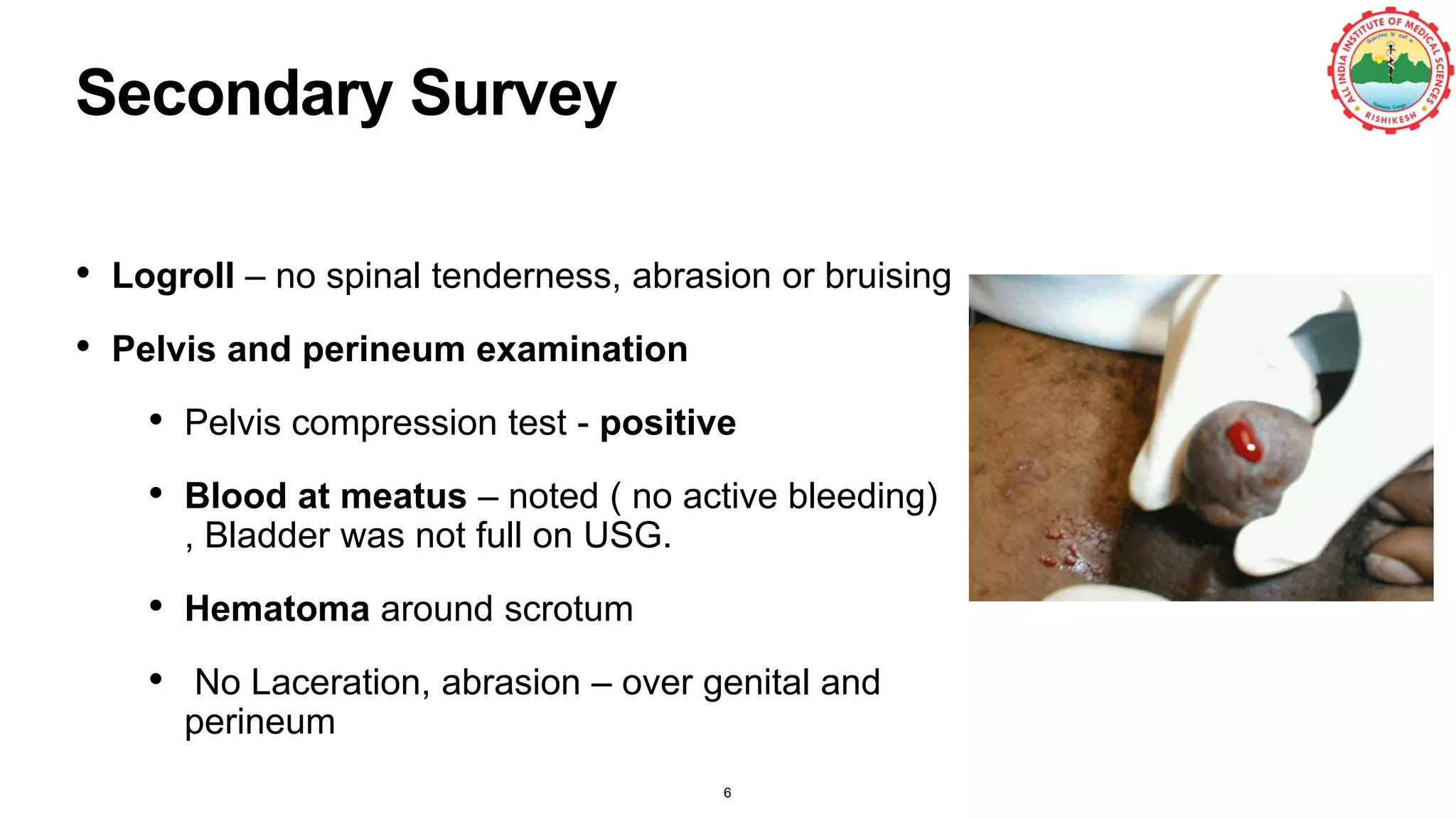
• Logroll – no spinal tenderness, abrasion or bruising
• Pelvis and perineum examination
• Pelvis compression test - positive
• Blood at meatus – noted ( no active bleeding)
, Bladder was not full on USG.
• Hematoma around scrotum
• No Laceration, abrasion – over genital and
perineum
6
Digital Rectal Examination
• No visible bleeding from outside
• Anal tone – normal
• Rectal mucosa – integrity maintained
• Prostate – high riding, mobile
• Coccyx – fixed
• Non-blood staining of finger.
7
Clinical diagnosis??
Pelvis fracture with suspected urethral injury
8
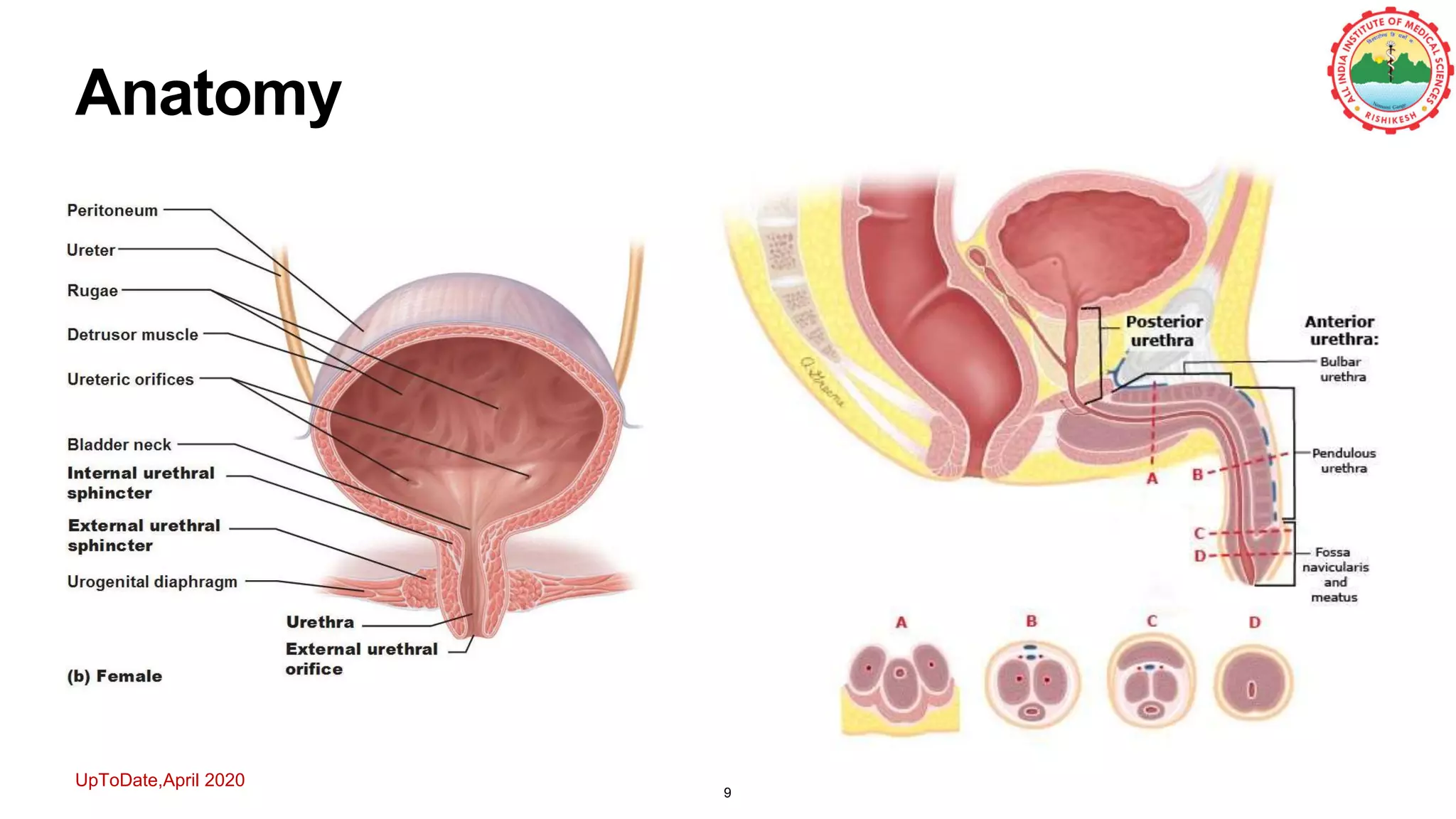
Anatomy
9
UpToDate,April 2020
Introduction
• 10% - Pelvis fracture - Urethral Injury (bulbomembranous)
• 72% posterior urethra)
• 20% urethral injury – associated with bladder injury.
• Anterior urethral injuries are - 33%
• Straddle injuries are common.
• Female – urethral injuries <6% in RTI
Ingram MD, Watson SG, Skippage PL, Patel U. Urethral injuries after pelvic trauma: evaluation with urethrography. Radiographics. 2008 Oct;28(6):1631-43.
10
Introduction
• Female urethral injury – 75% associated with vaginal , 33% with rectum injury
• High grade of pelvis fracture (Rami) associated with - urethral injury
• Posterior or lateral fracture - almost 0% urethral injury
• Isolated Injury to penis, scrotum, perineum – Anterior urethra
UpToDate April 2020
Ingram MD, Watson SG, Skippage PL, Patel U. Urethral injuries after pelvic trauma: evaluation with urethrography. Radiographics. 2008 Oct;28(6):1631-43.
11
Clinical Approach
Initial Assessment and Management
Suspected urethral injury
1. Perineal/ scrotal
hematoma
2. Blood at meatus
3. Unable to micturate
4. DRE- high prostate
5. Wound in vicinity to
urethra
1. RTI associated pelvis
fracture
2. Direct blow to the
perineum- straddle
3. Penile fracture
4. Penetrating injury
ExaminationHistory
life or limb-threatening injury
12
Types of Urethral Injury
Anterior Vs Posterior
1. Anterior ( Bulbous and penile)
• Direct blow
• Straddle
• Instrumental
• Penile fracture
2. Posterior (membranous and prostatic)
• Associated with pelvis fracture
• Penetrating injury
13
Clinical Signs and Symptoms
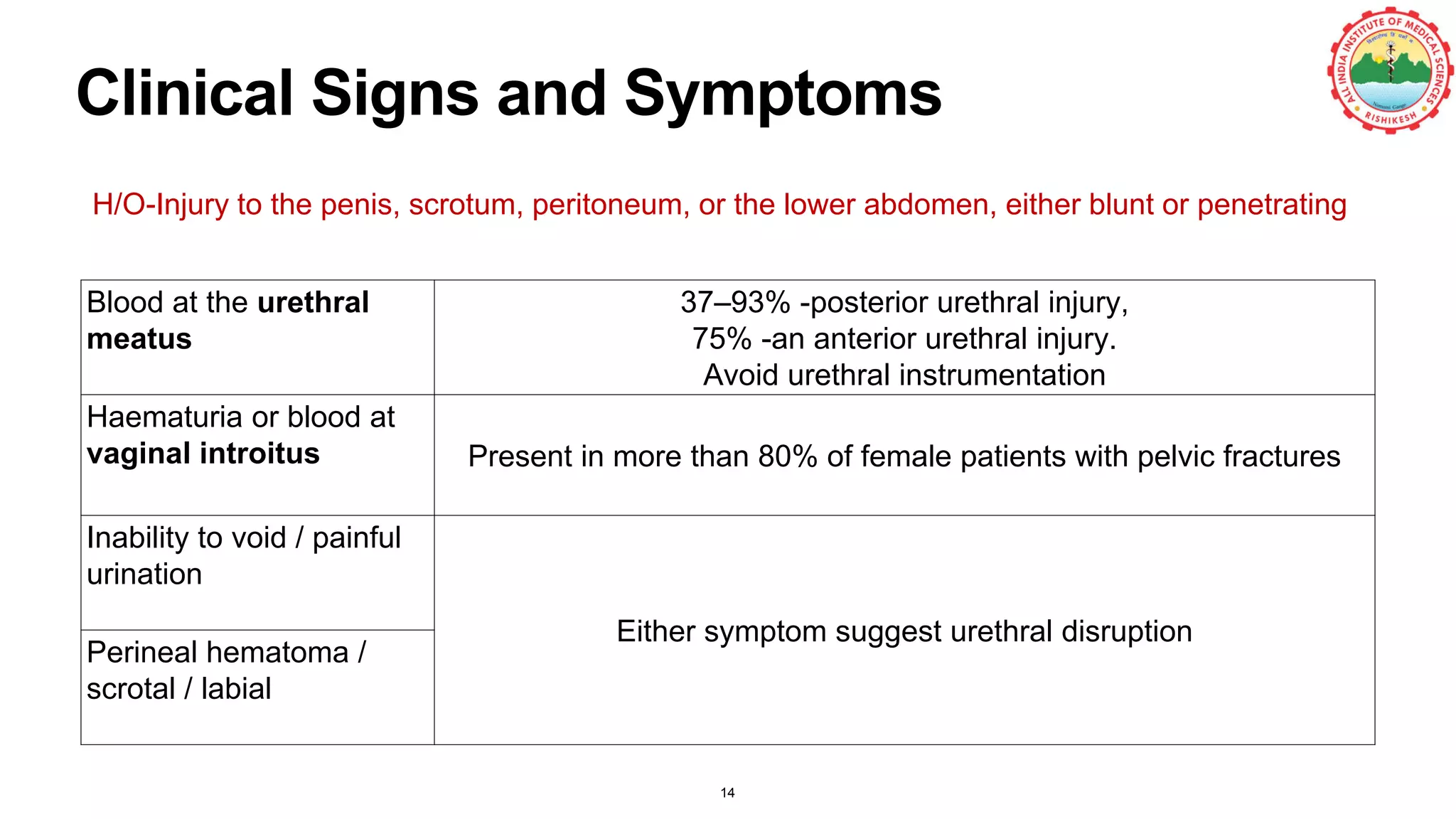
H/O-Injury to the penis, scrotum, peritoneum, or the lower abdomen, either blunt or penetrating
Blood at the urethral
meatus
37–93% -posterior urethral injury,
75% -an anterior urethral injury.
Avoid urethral instrumentation
Haematuria or blood at
vaginal introitus Present in more than 80% of female patients with pelvic fractures
Inability to void / painful
urination
Either symptom suggest urethral disruption
Perineal hematoma /
scrotal / labial
14
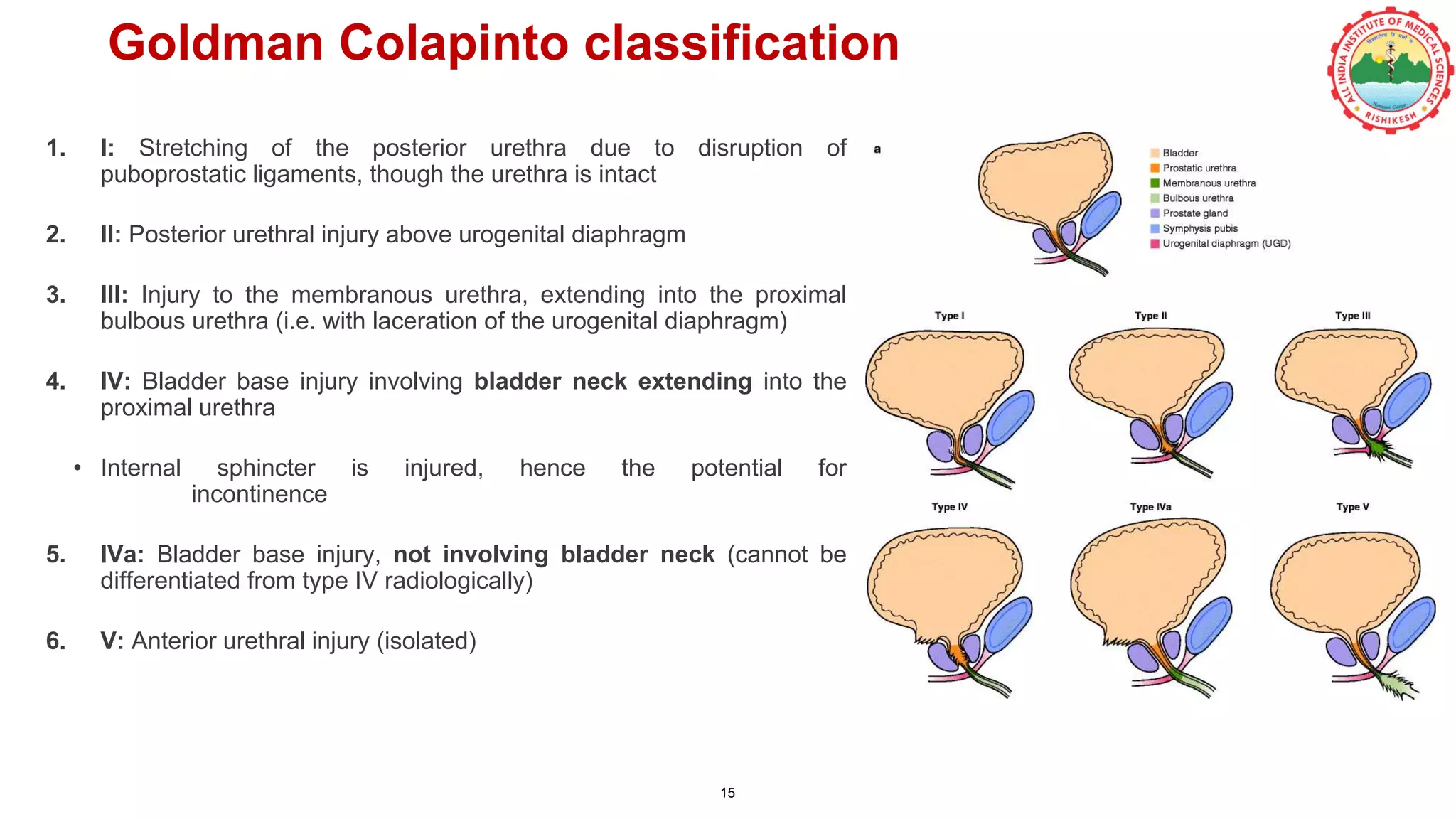
1. I: Stretching of the posterior urethra due to disruption of
puboprostatic ligaments, though the urethra is intact
2. II: Posterior urethral injury above urogenital diaphragm
3. III: Injury to the membranous urethra, extending into the proximal
bulbous urethra (i.e. with laceration of the urogenital diaphragm)
4. IV: Bladder base injury involving bladder neck extending into the
proximal urethra
• Internal sphincter is injured, hence the potential for
incontinence
5. IVa: Bladder base injury, not involving bladder neck (cannot be
differentiated from type IV radiologically)
6. V: Anterior urethral injury (isolated)
Goldman Colapinto classification
15
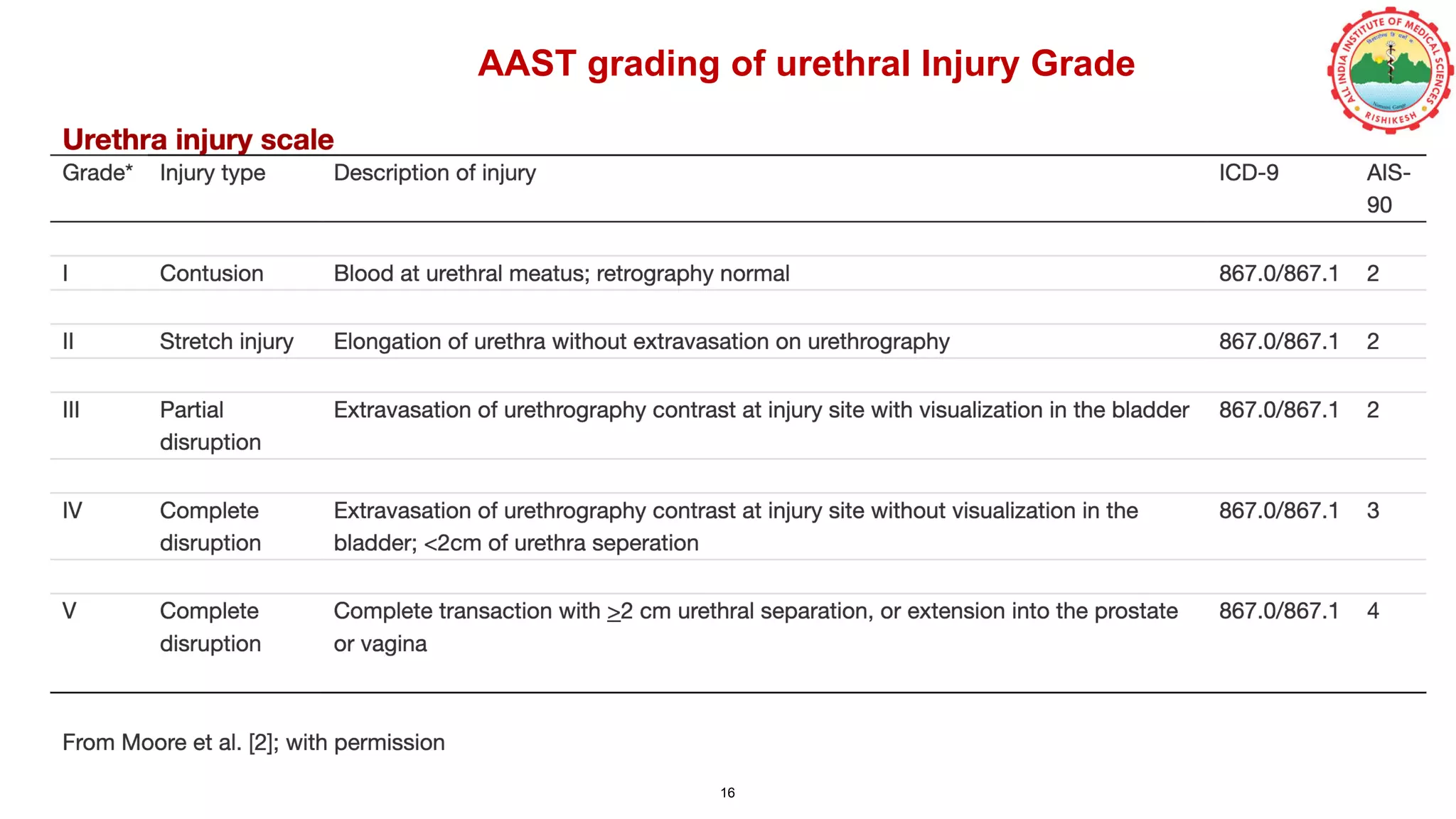
AAST grading of urethral Injury Grade
16
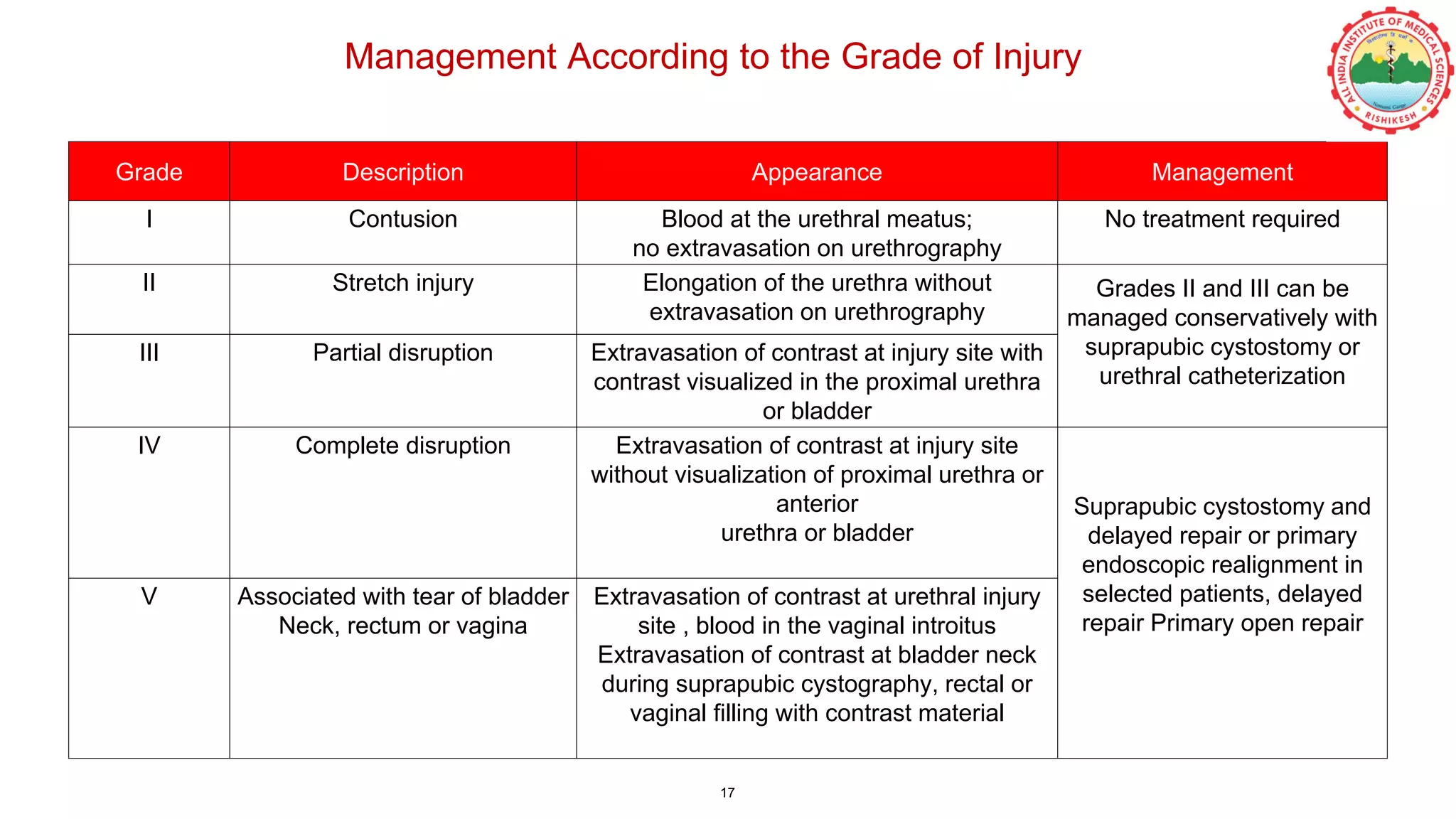
Grade Description Appearance Management
I Contusion Blood at the urethral meatus;
no extravasation on urethrography
No treatment required
II Stretch injury Elongation of the urethra without
extravasation on urethrography
Grades II and III can be
managed conservatively with
suprapubic cystostomy or
urethral catheterization
III Partial disruption Extravasation of contrast at injury site with
contrast visualized in the proximal urethra
or bladder
IV Complete disruption Extravasation of contrast at injury site
without visualization of proximal urethra or
anterior
urethra or bladder
Suprapubic cystostomy and
delayed repair or primary
endoscopic realignment in
selected patients, delayed
repair Primary open repair
V Associated with tear of bladder
Neck, rectum or vagina
Extravasation of contrast at urethral injury
site , blood in the vaginal introitus
Extravasation of contrast at bladder neck
during suprapubic cystography, rectal or
vaginal filling with contrast material
Management According to the Grade of Injury
17
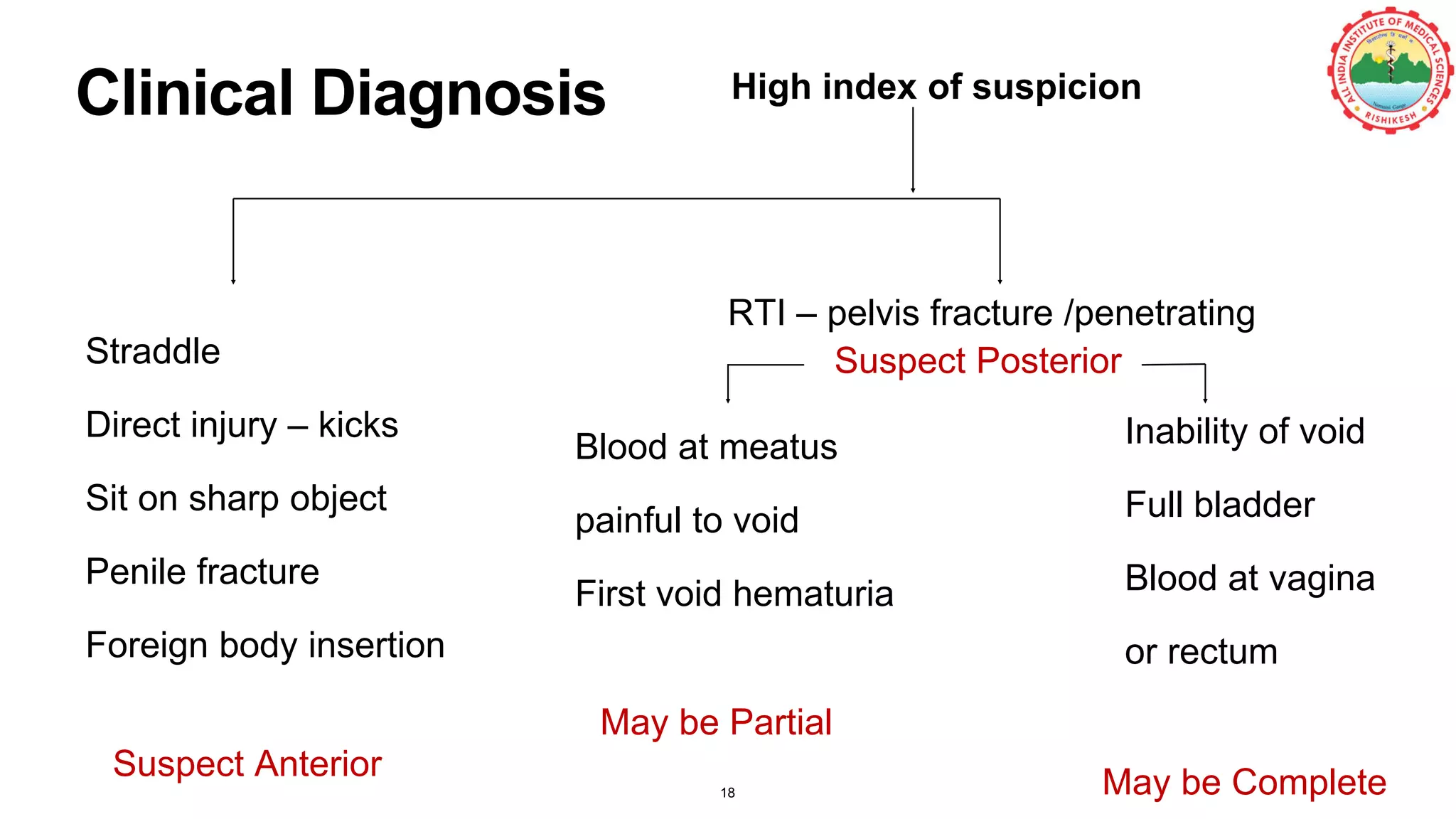
Clinical Diagnosis
Blood at meatus
painful to void
First void hematuria
Inability of void
Full bladder
Blood at vagina
or rectum
Straddle
Direct injury – kicks
Sit on sharp object
Penile fracture
Foreign body insertion
High index of suspicion
RTI – pelvis fracture /penetrating
Suspect Posterior
Suspect Anterior
May be Partial
May be Complete18
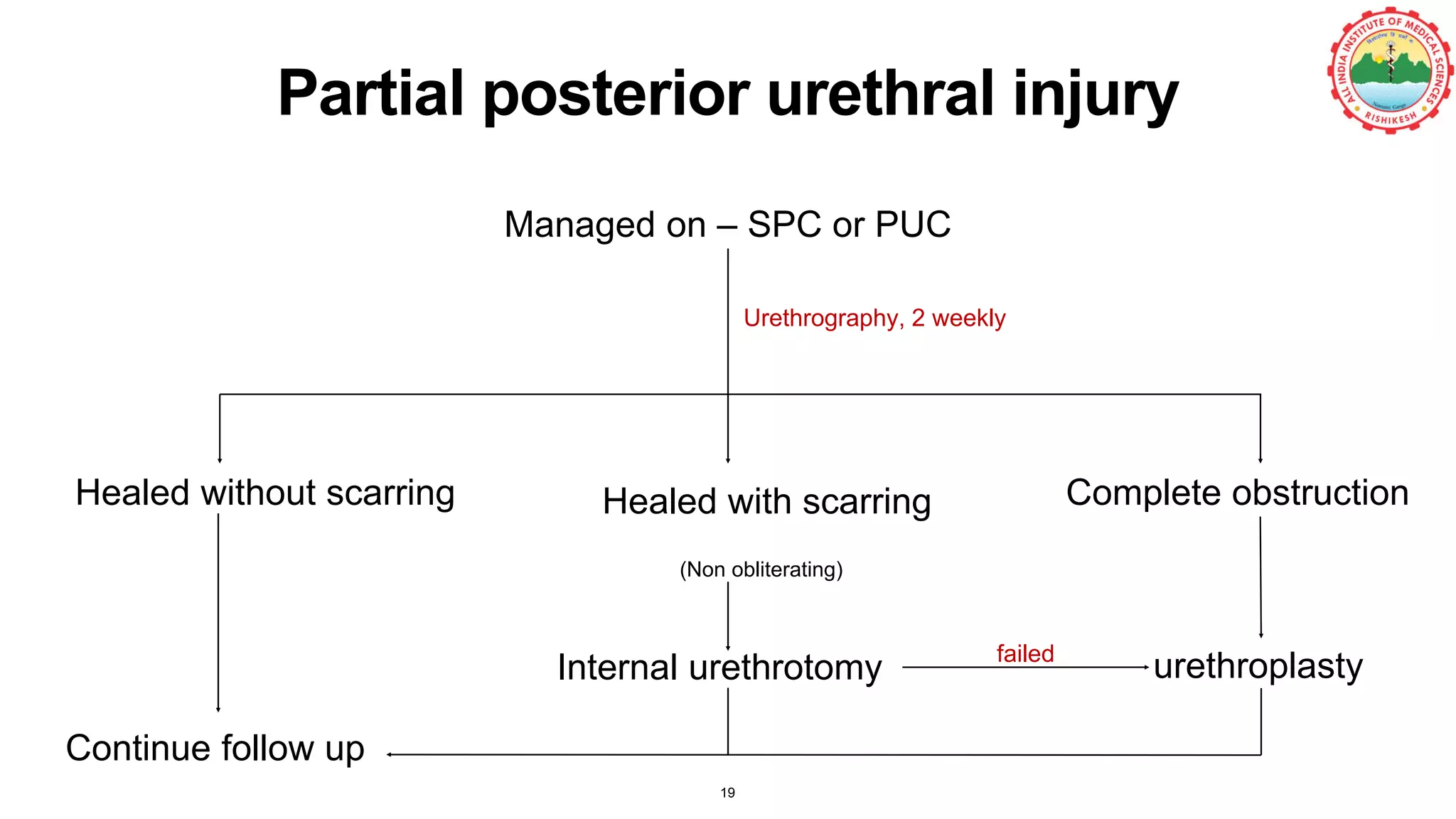
Partial posterior urethral injury
Urethrography, 2 weekly
Managed on – SPC or PUC
Healed without scarring Healed with scarring
(Non obliterating)
Complete obstruction
Continue follow up
Internal urethrotomy urethroplastyfailed
19
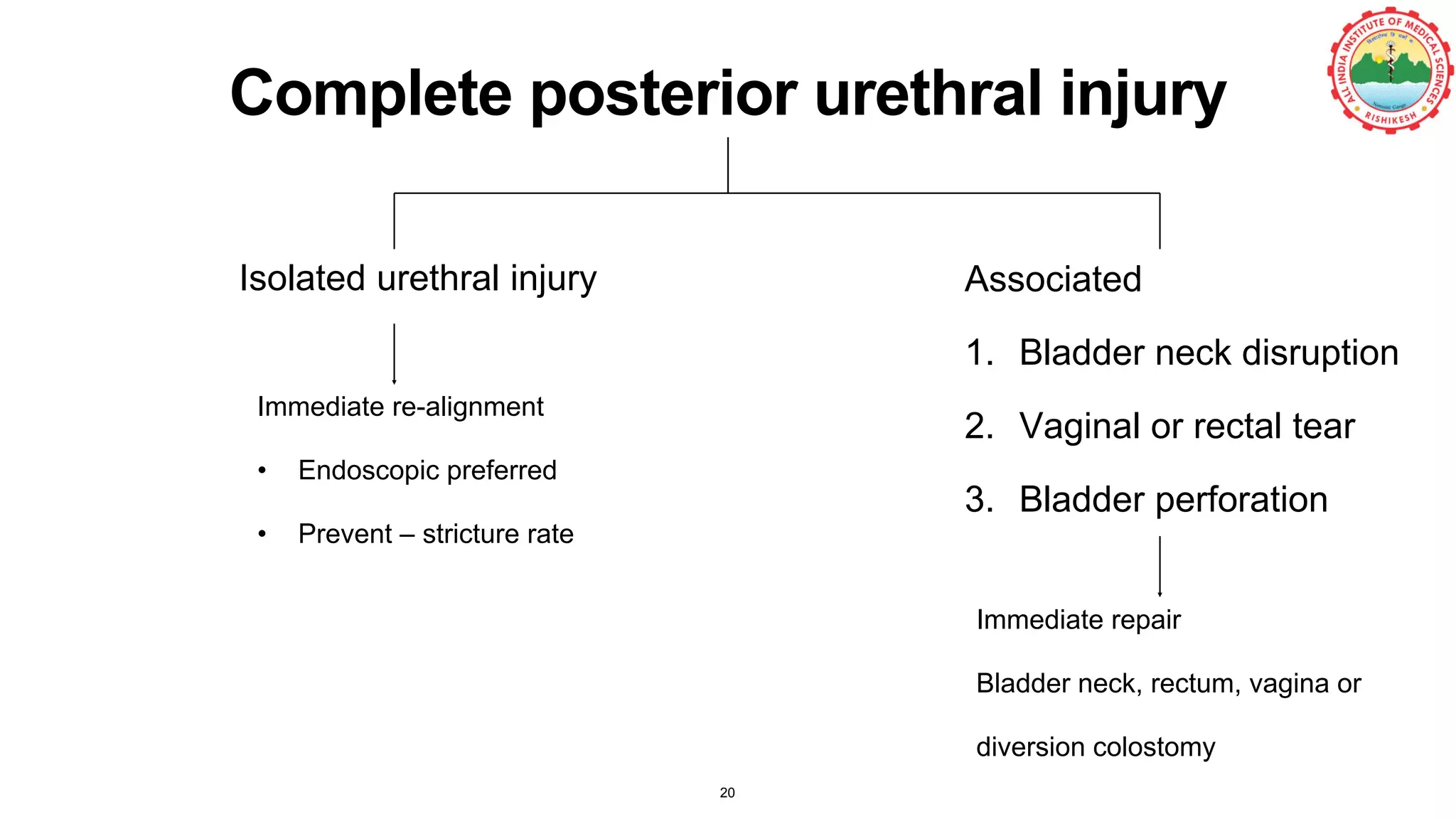
Complete posterior urethral injury
Isolated urethral injury Associated
1. Bladder neck disruption
2. Vaginal or rectal tear
3. Bladder perforation
Immediate re-alignment
• Endoscopic preferred
• Prevent – stricture rate
Immediate repair
Bladder neck, rectum, vagina or
diversion colostomy
20
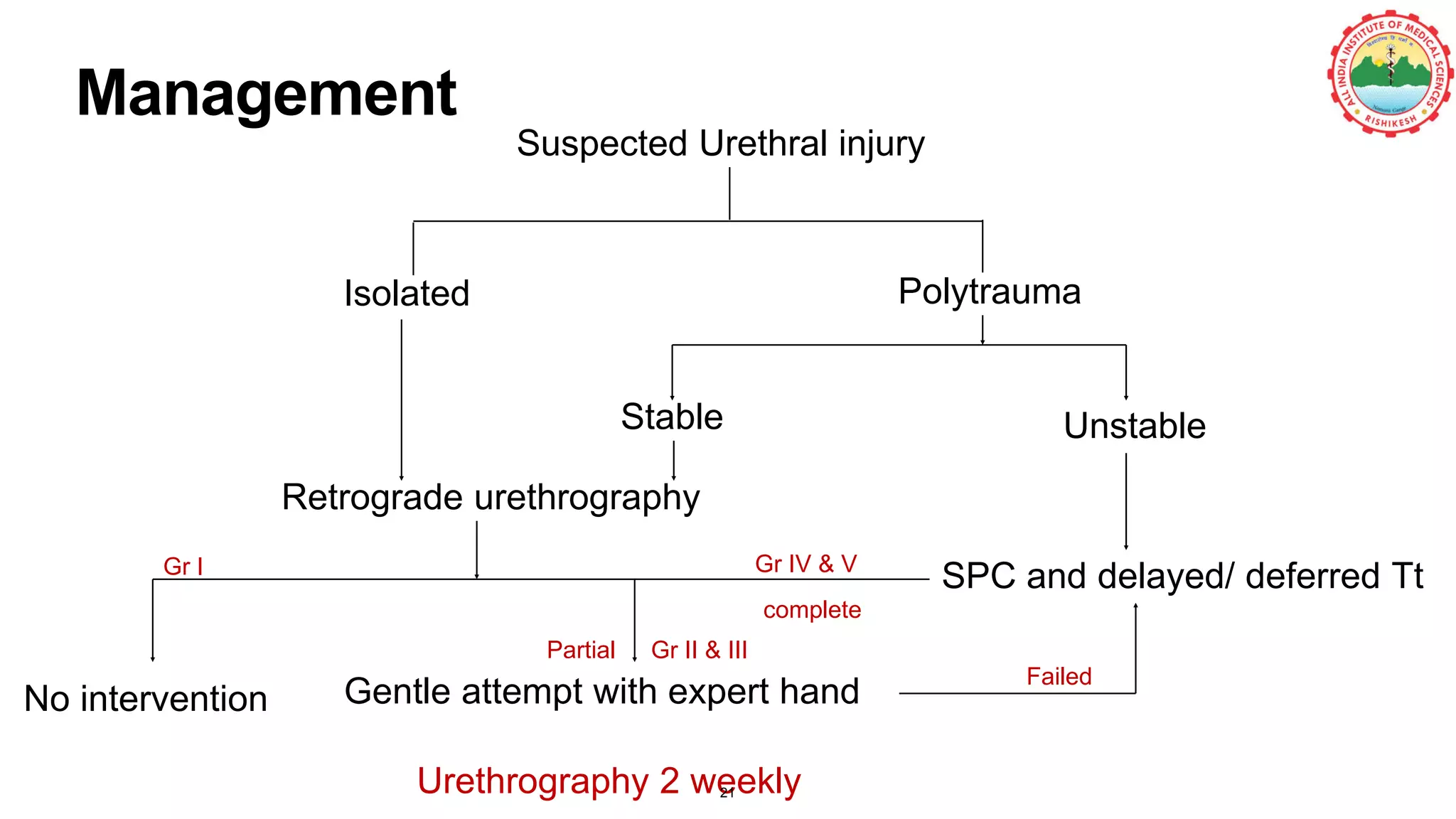
Management
Suspected Urethral injury
Isolated Polytrauma
Stable Unstable
Retrograde urethrography
No intervention Gentle attempt with expert hand
SPC and delayed/ deferred TtGr I
Gr II & III
Gr IV & V
Failed
Urethrography 2 weekly
Partial
complete
21
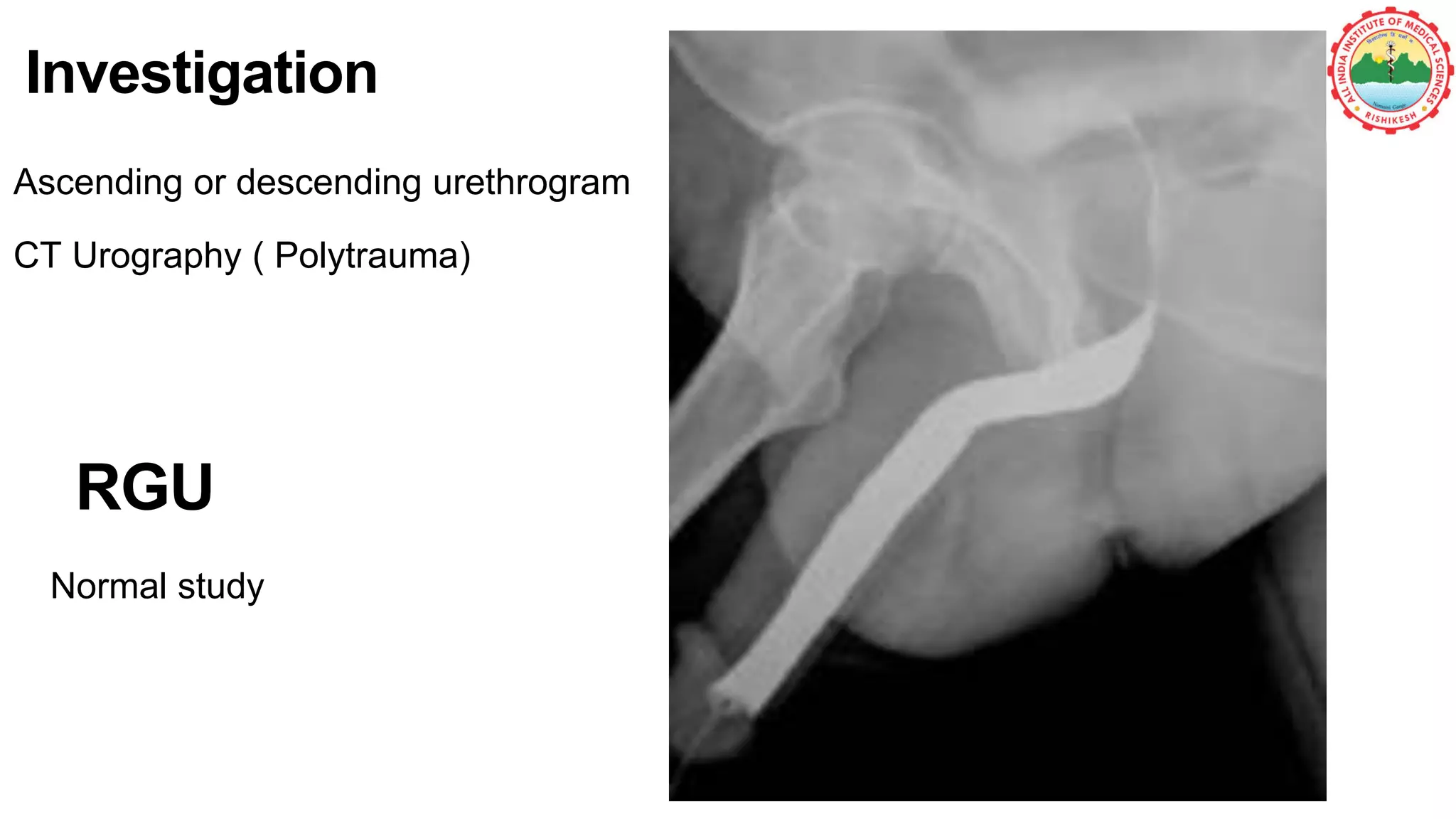
Normal study
RGU
22
Investigation
Ascending or descending urethrogram
CT Urography ( Polytrauma)
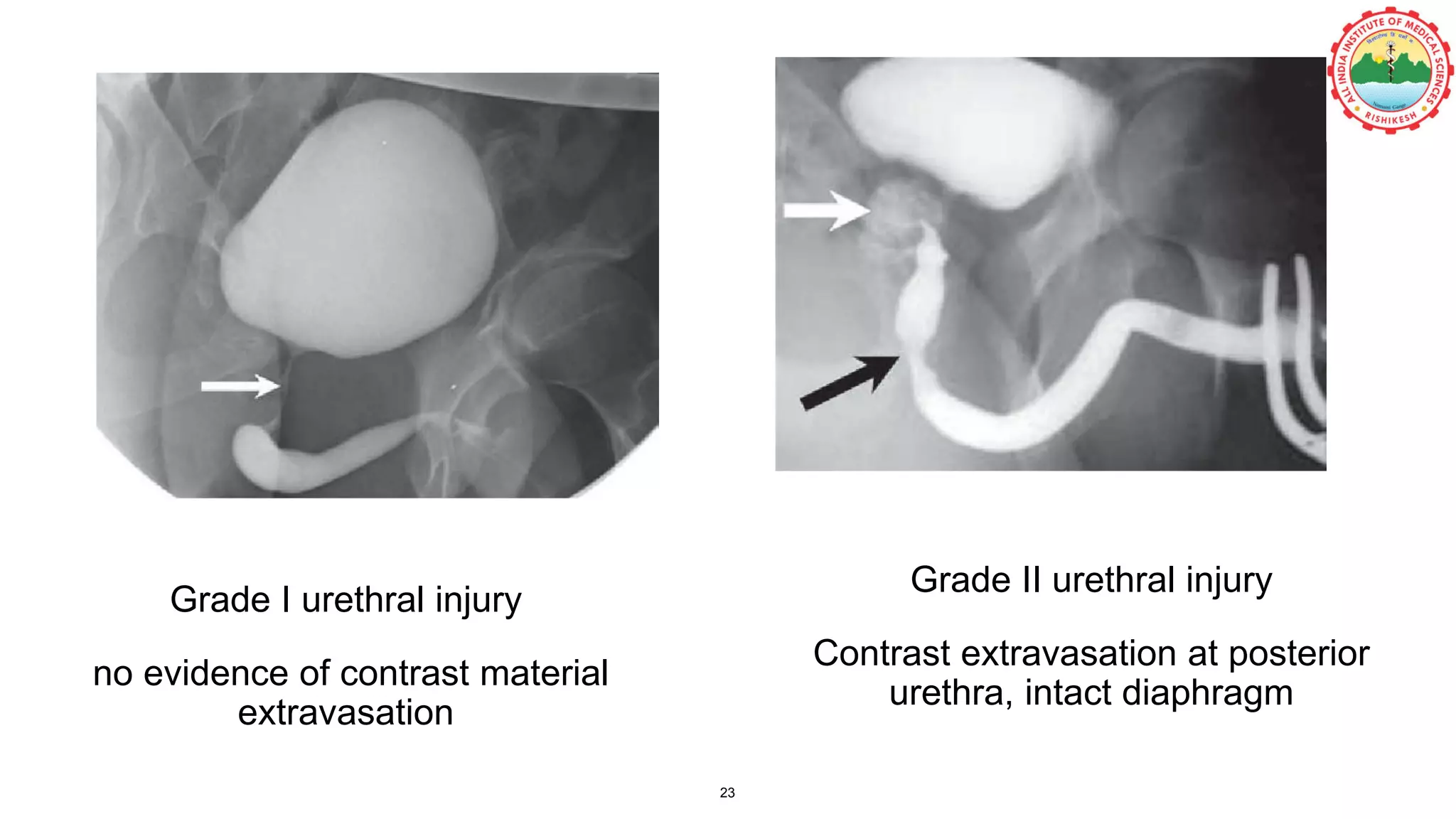
Grade II urethral injury
Contrast extravasation at posterior
urethra, intact diaphragm
Grade I urethral injury
no evidence of contrast material
extravasation
23
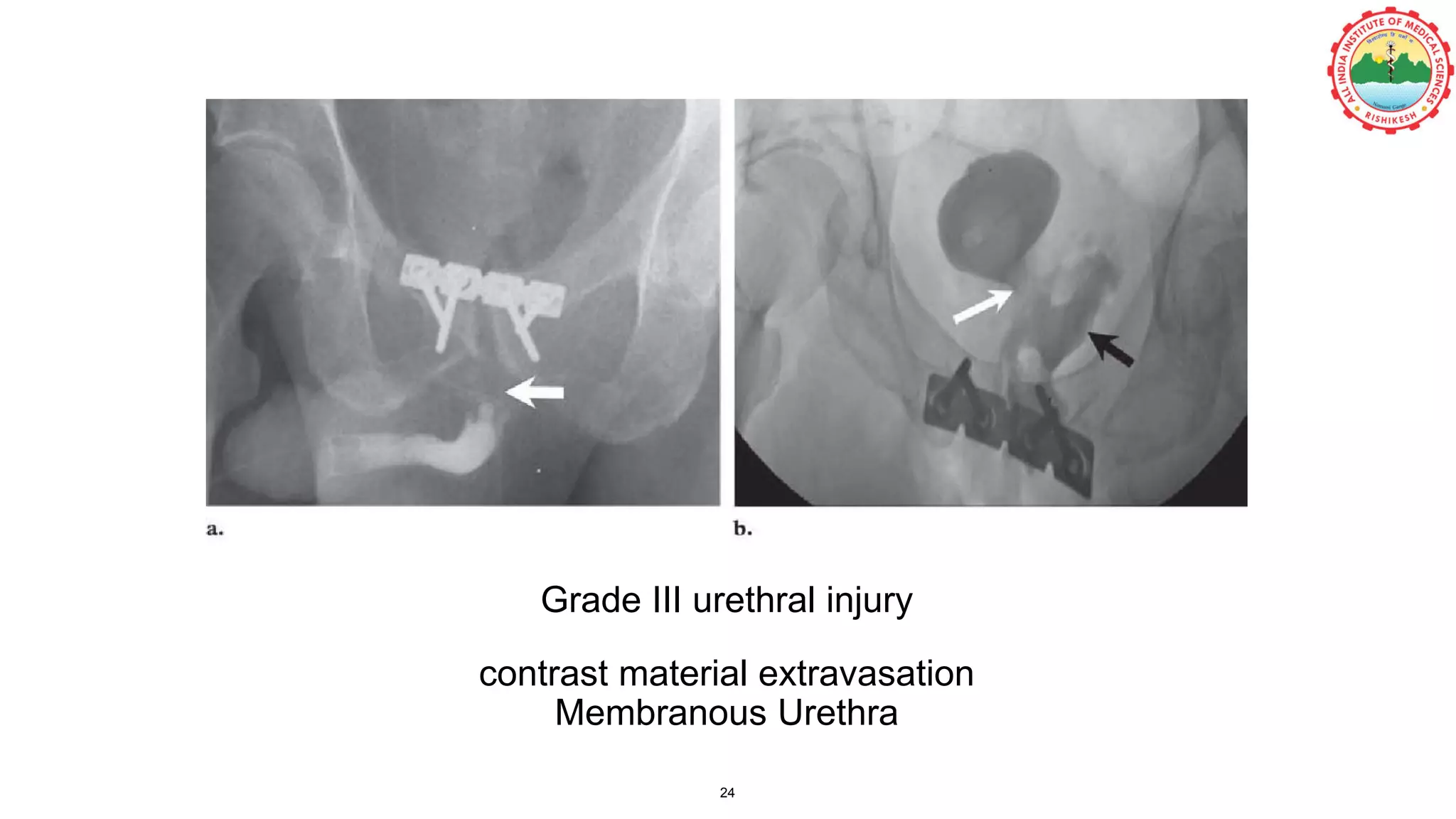
Grade III urethral injury
contrast material extravasation
Membranous Urethra
24
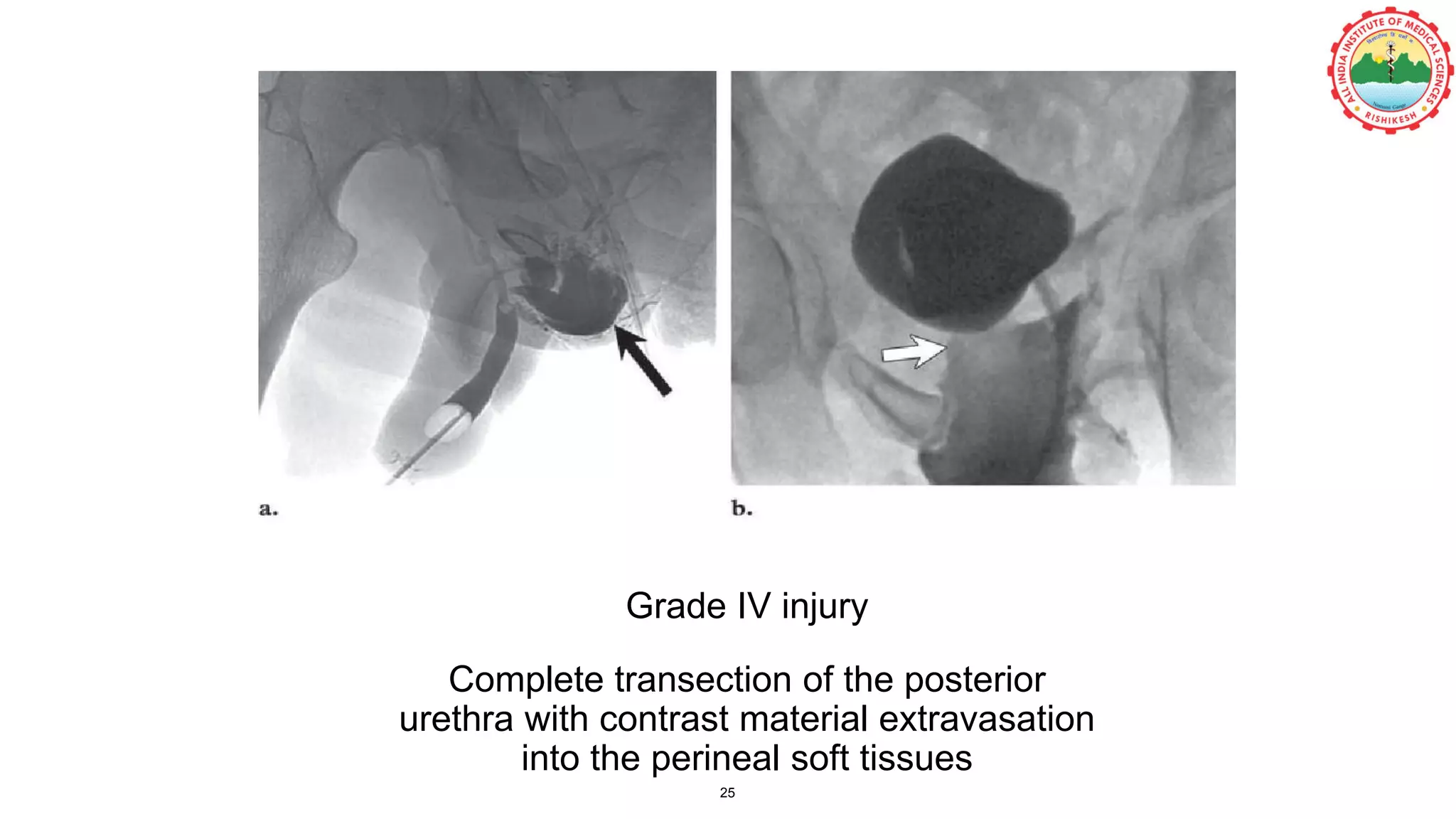
Grade IV injury
Complete transection of the posterior
urethra with contrast material extravasation
into the perineal soft tissues
25
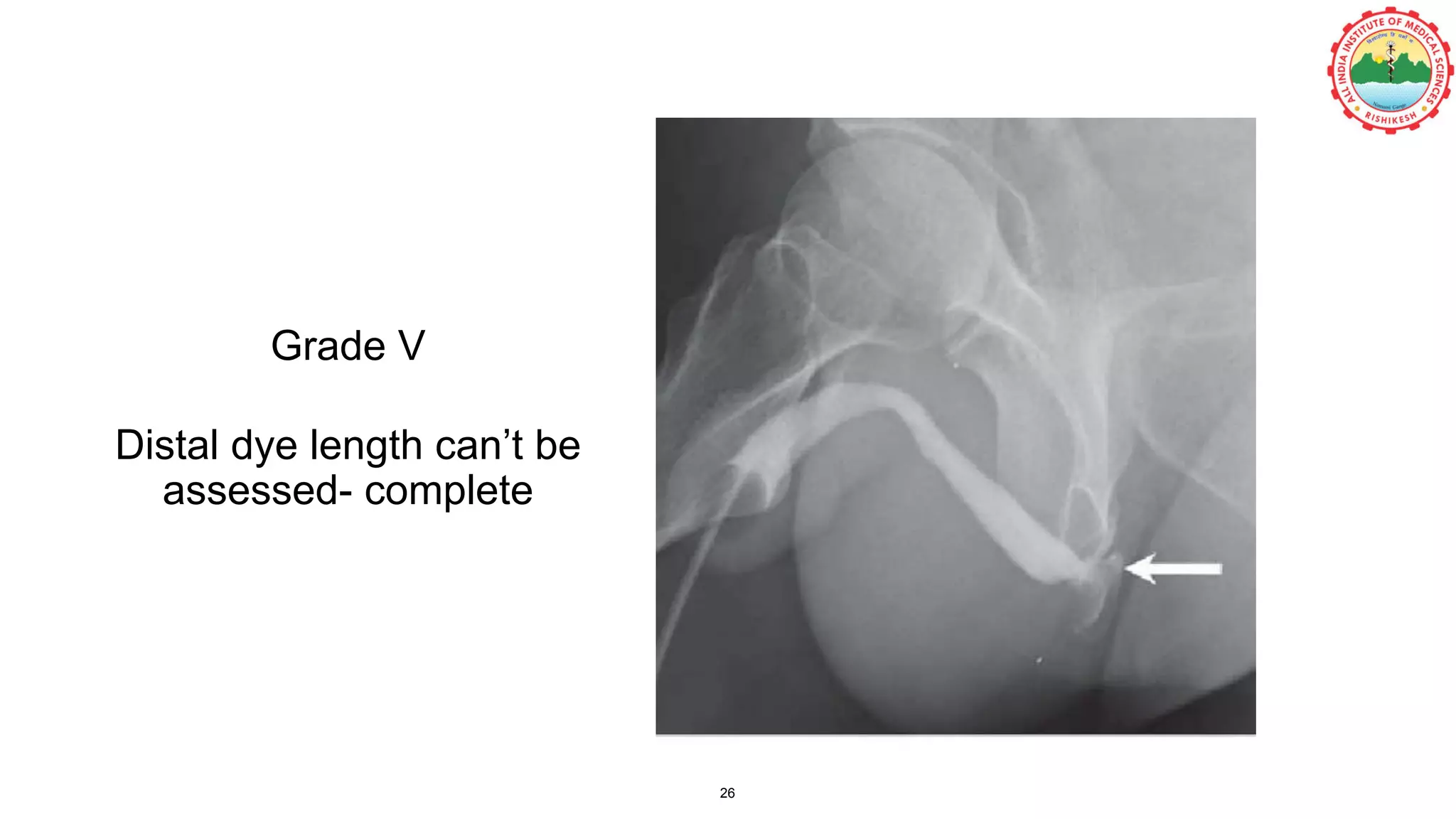
Grade V
Distal dye length can’t be
assessed- complete
26
27
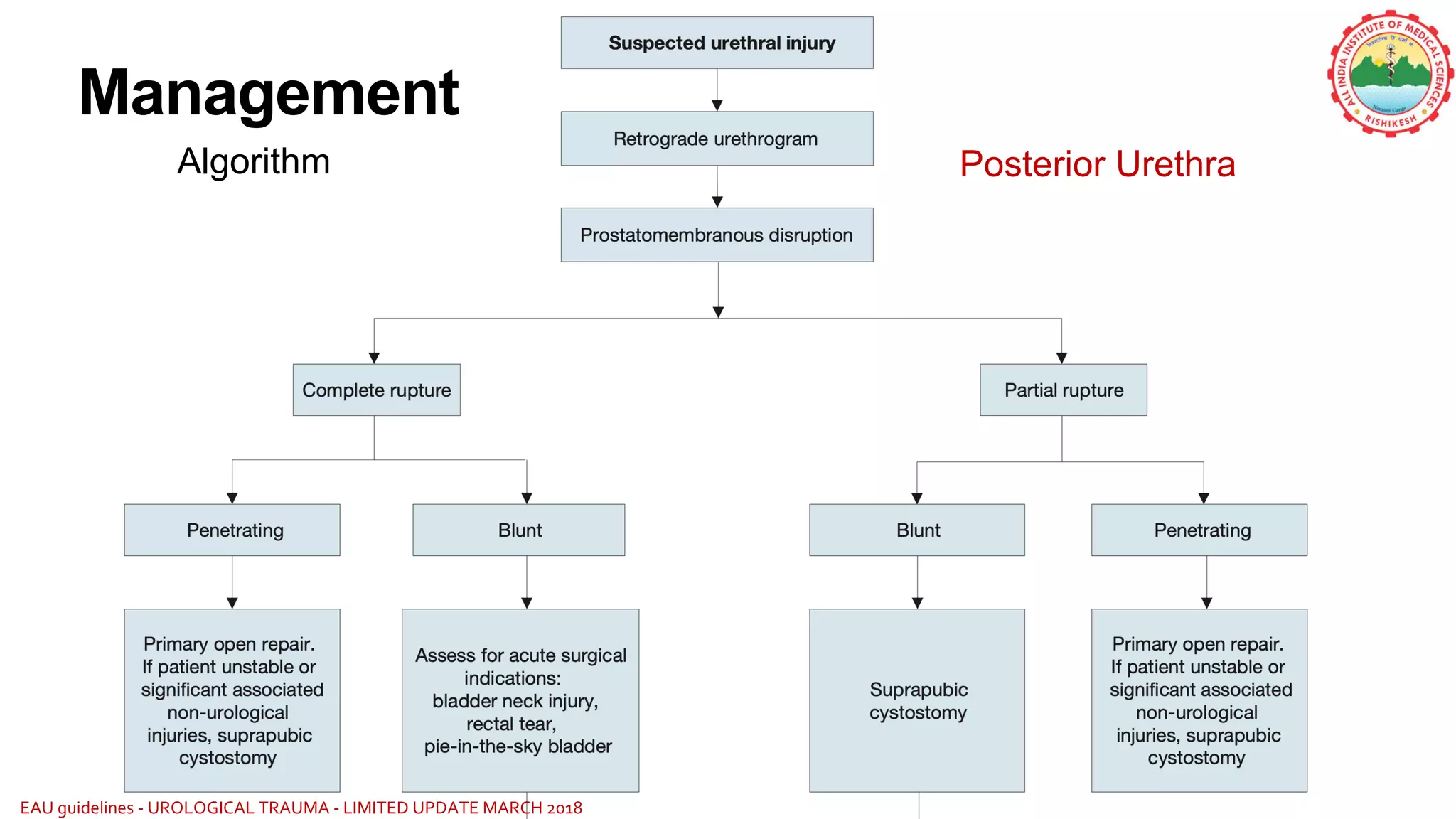
Management
EAU guidelines - UROLOGICAL TRAUMA - LIMITED UPDATE MARCH 2018
Algorithm Posterior Urethra
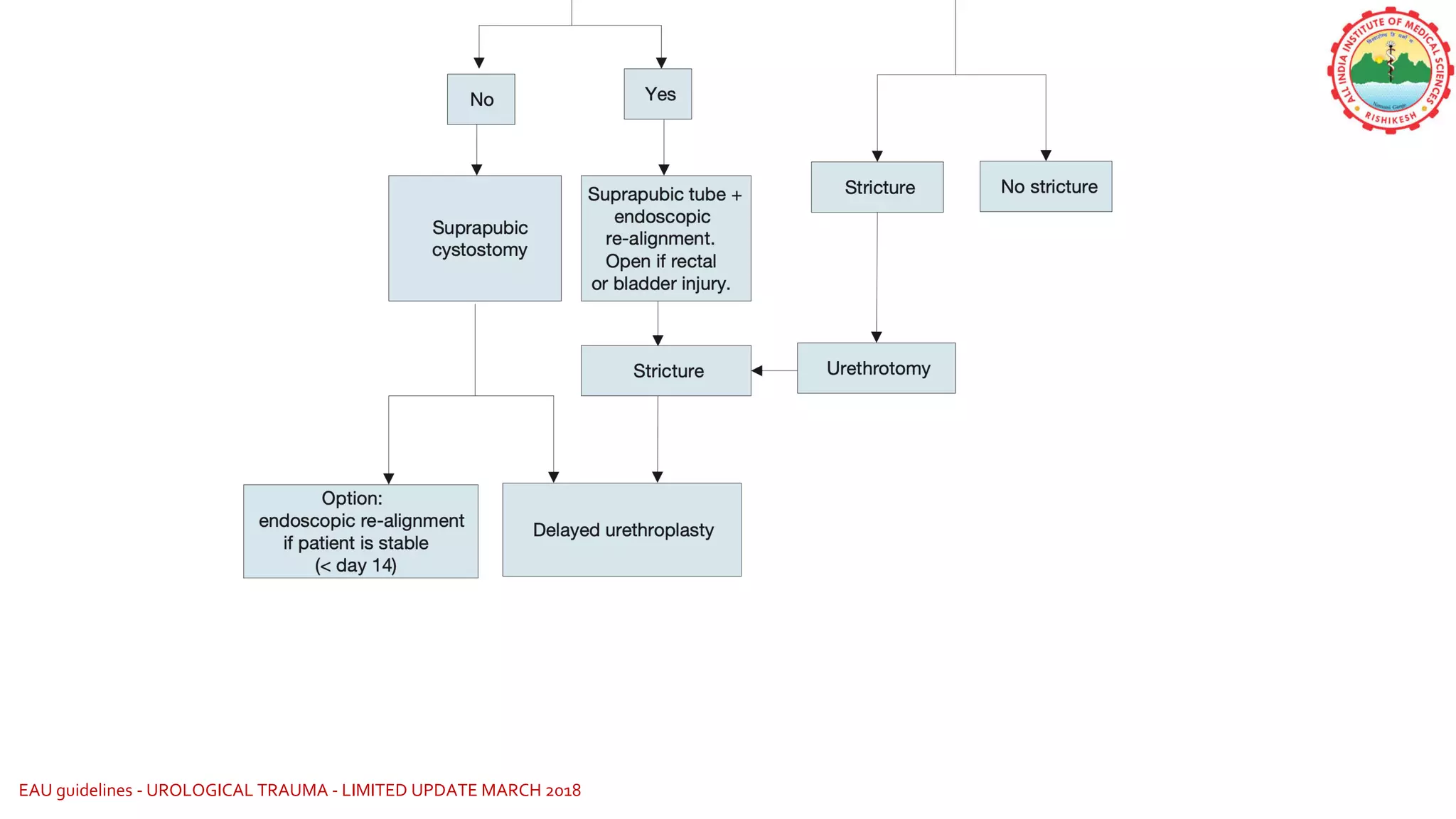
28EAU guidelines - UROLOGICAL TRAUMA - LIMITED UPDATE MARCH 2018
29
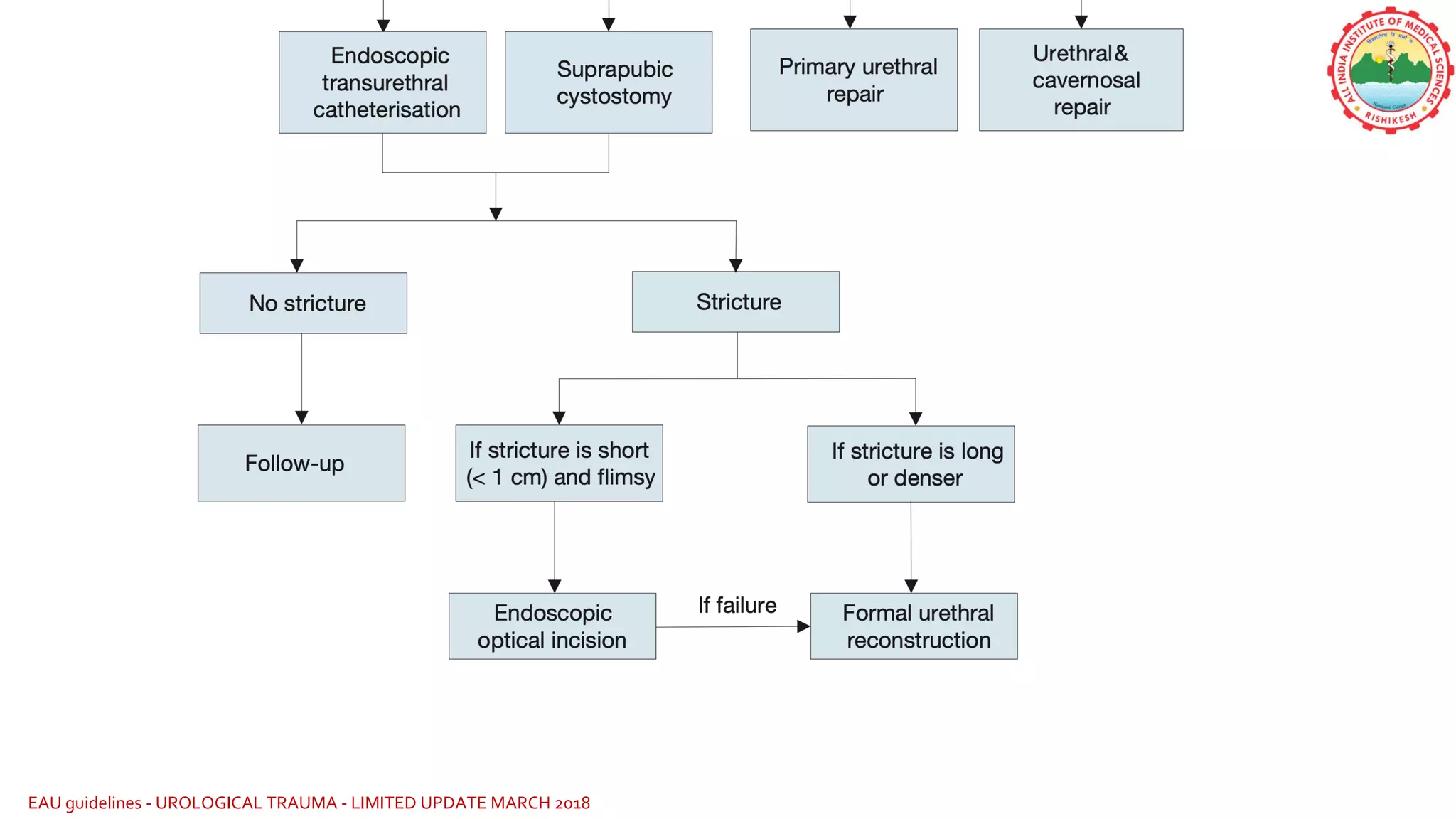
EAU guidelines - UROLOGICAL TRAUMA - LIMITED UPDATE MARCH 2018
Anterior Urethra
30
EAU guidelines - UROLOGICAL TRAUMA - LIMITED UPDATE MARCH 2018
31
EAU guidelines - UROLOGICAL TRAUMA - LIMITED UPDATE MARCH 2018
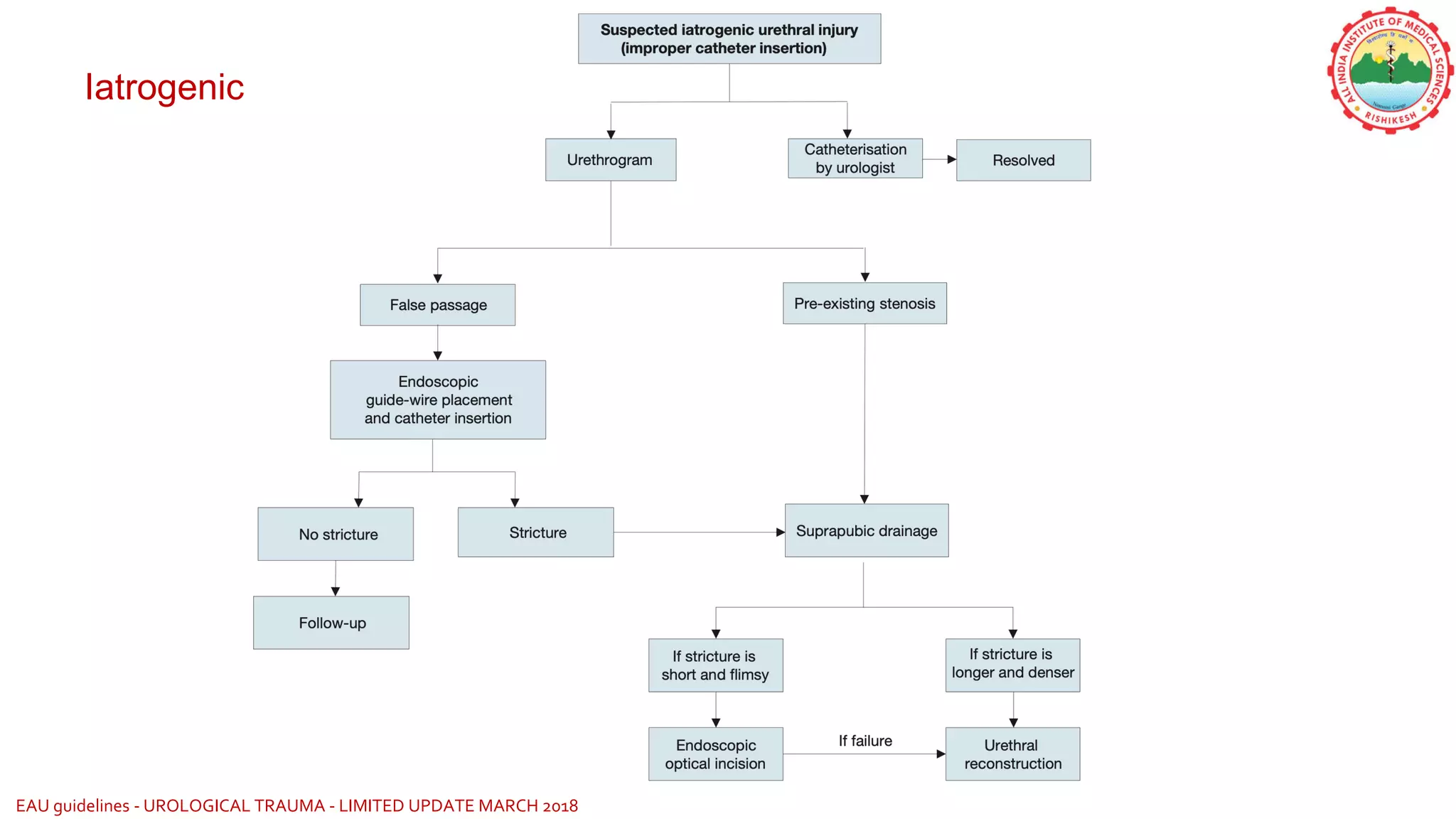
Iatrogenic
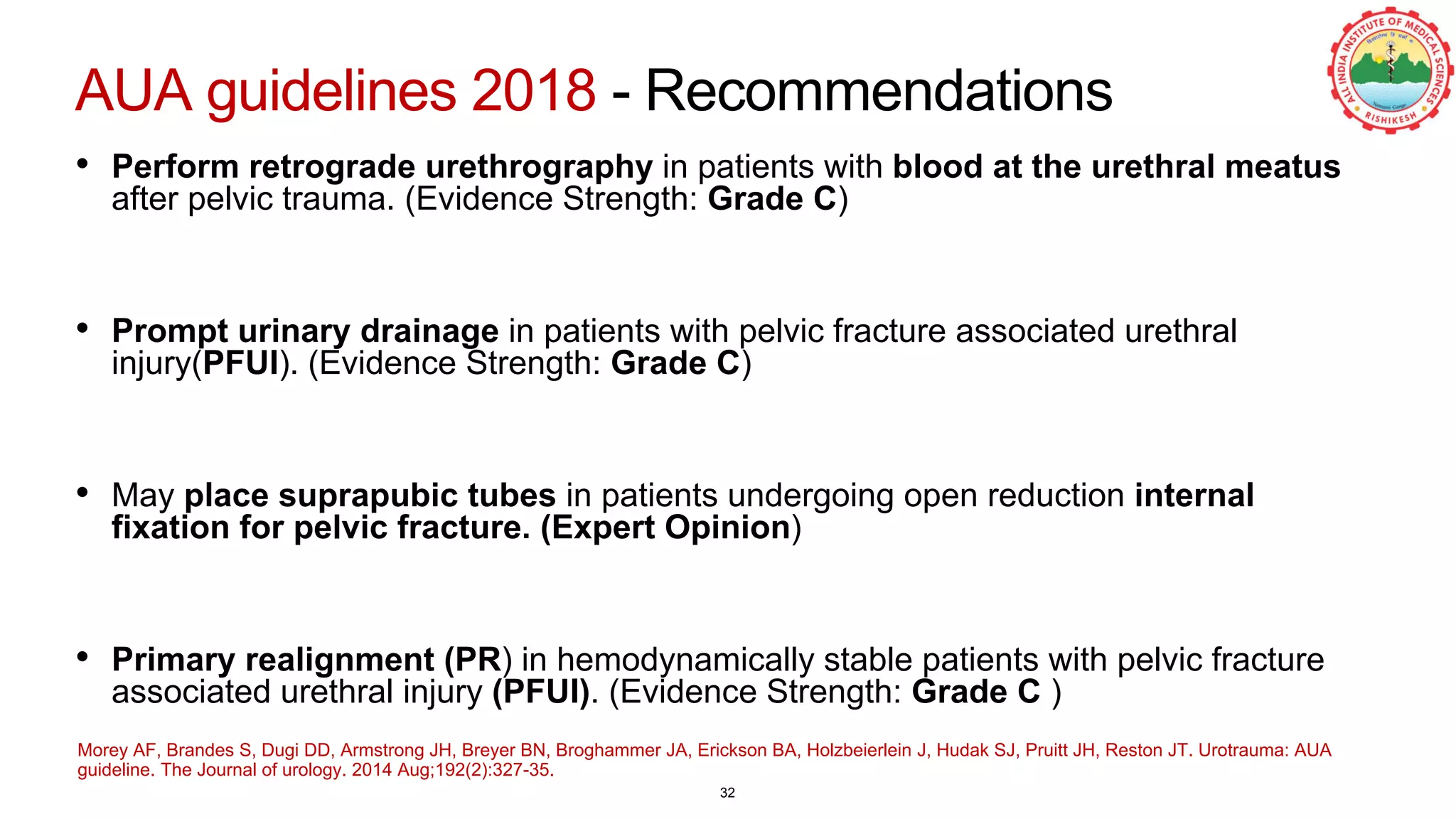
AUA guidelines 2018 - Recommendations
• Perform retrograde urethrography in patients with blood at the urethral meatus
after pelvic trauma. (Evidence Strength: Grade C)
• Prompt urinary drainage in patients with pelvic fracture associated urethral
injury(PFUI). (Evidence Strength: Grade C)
• May place suprapubic tubes in patients undergoing open reduction internal
fixation for pelvic fracture. (Expert Opinion)
• Primary realignment (PR) in hemodynamically stable patients with pelvic fracture
associated urethral injury (PFUI). (Evidence Strength: Grade C )
Morey AF, Brandes S, Dugi DD, Armstrong JH, Breyer BN, Broghammer JA, Erickson BA, Holzbeierlein J, Hudak SJ, Pruitt JH, Reston JT. Urotrauma: AUA
guideline. The Journal of urology. 2014 Aug;192(2):327-35.
32
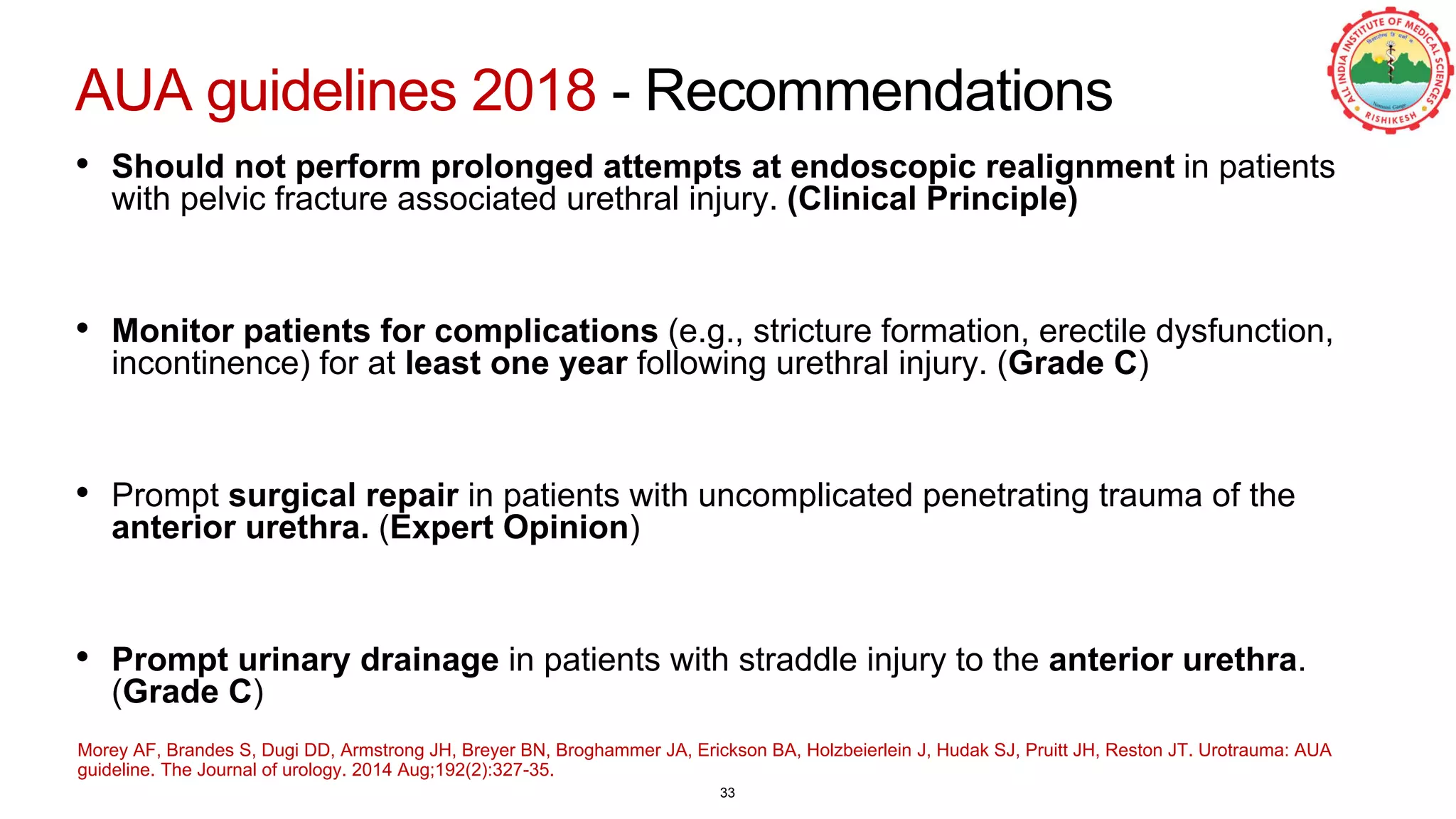
AUA guidelines 2018 - Recommendations
• Should not perform prolonged attempts at endoscopic realignment in patients
with pelvic fracture associated urethral injury. (Clinical Principle)
• Monitor patients for complications (e.g., stricture formation, erectile dysfunction,
incontinence) for at least one year following urethral injury. (Grade C)
• Prompt surgical repair in patients with uncomplicated penetrating trauma of the
anterior urethra. (Expert Opinion)
• Prompt urinary drainage in patients with straddle injury to the anterior urethra.
(Grade C)
Morey AF, Brandes S, Dugi DD, Armstrong JH, Breyer BN, Broghammer JA, Erickson BA, Holzbeierlein J, Hudak SJ, Pruitt JH, Reston JT. Urotrauma: AUA
guideline. The Journal of urology. 2014 Aug;192(2):327-35.
33
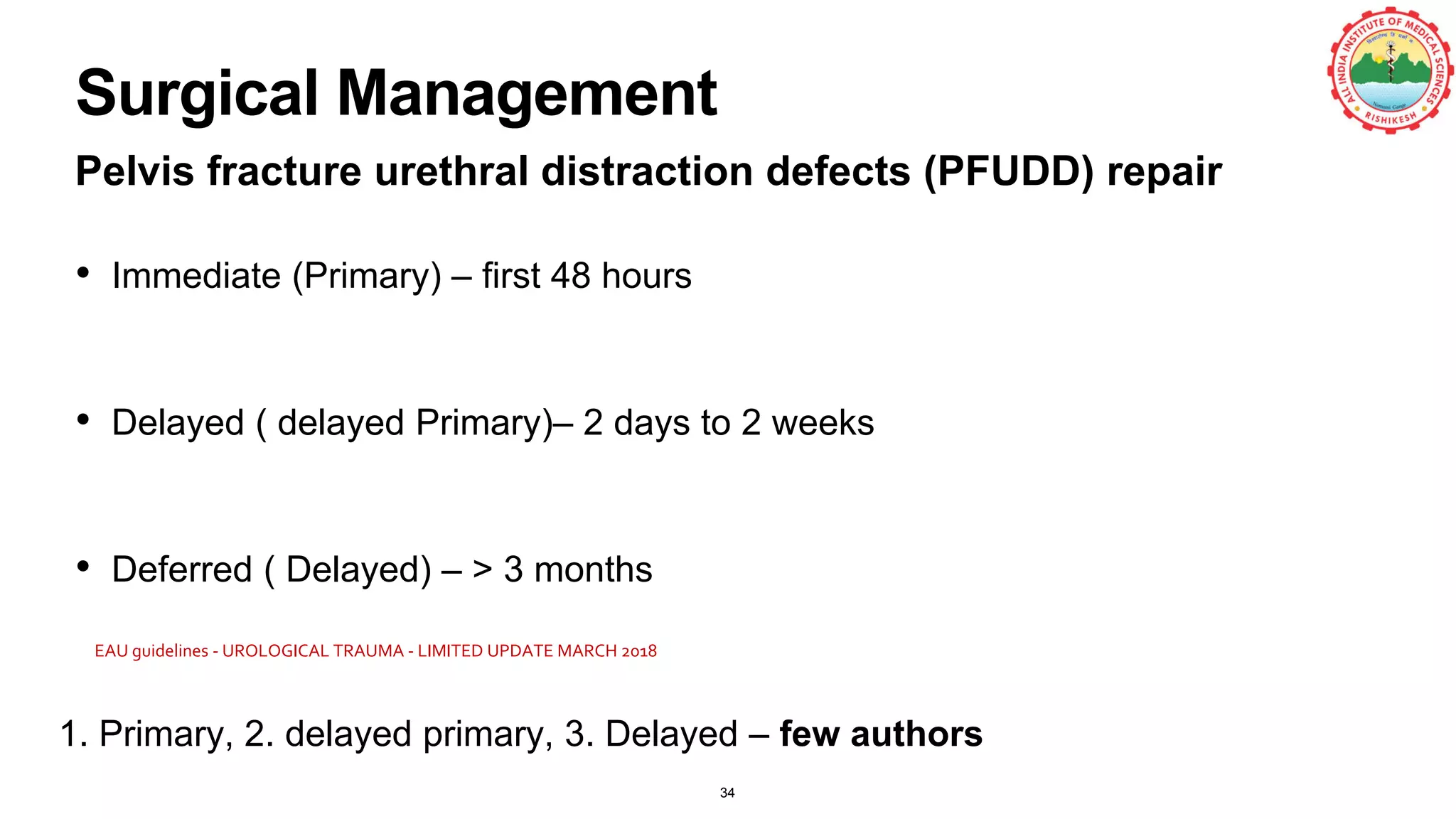
Surgical Management
Pelvis fracture urethral distraction defects (PFUDD) repair
• Immediate (Primary) – first 48 hours
• Delayed ( delayed Primary)– 2 days to 2 weeks
• Deferred ( Delayed) – > 3 months
34
1. Primary, 2. delayed primary, 3. Delayed – few authors
EAU guidelines - UROLOGICAL TRAUMA - LIMITED UPDATE MARCH 2018
Immediate management
Suspicion of urethral trauma
• Stabilize the patient – as per ATLS protocol
• Primary survey and initial management
Suspected Urethral Injury
Stable
Unstable SPC
Resuscitation
Ascending urethrogram (descending if possible)
CT Urography 35
Urinary diversion
1. Shock
2. Painful urinary retention – polytrauma
3. Extravasation of urine
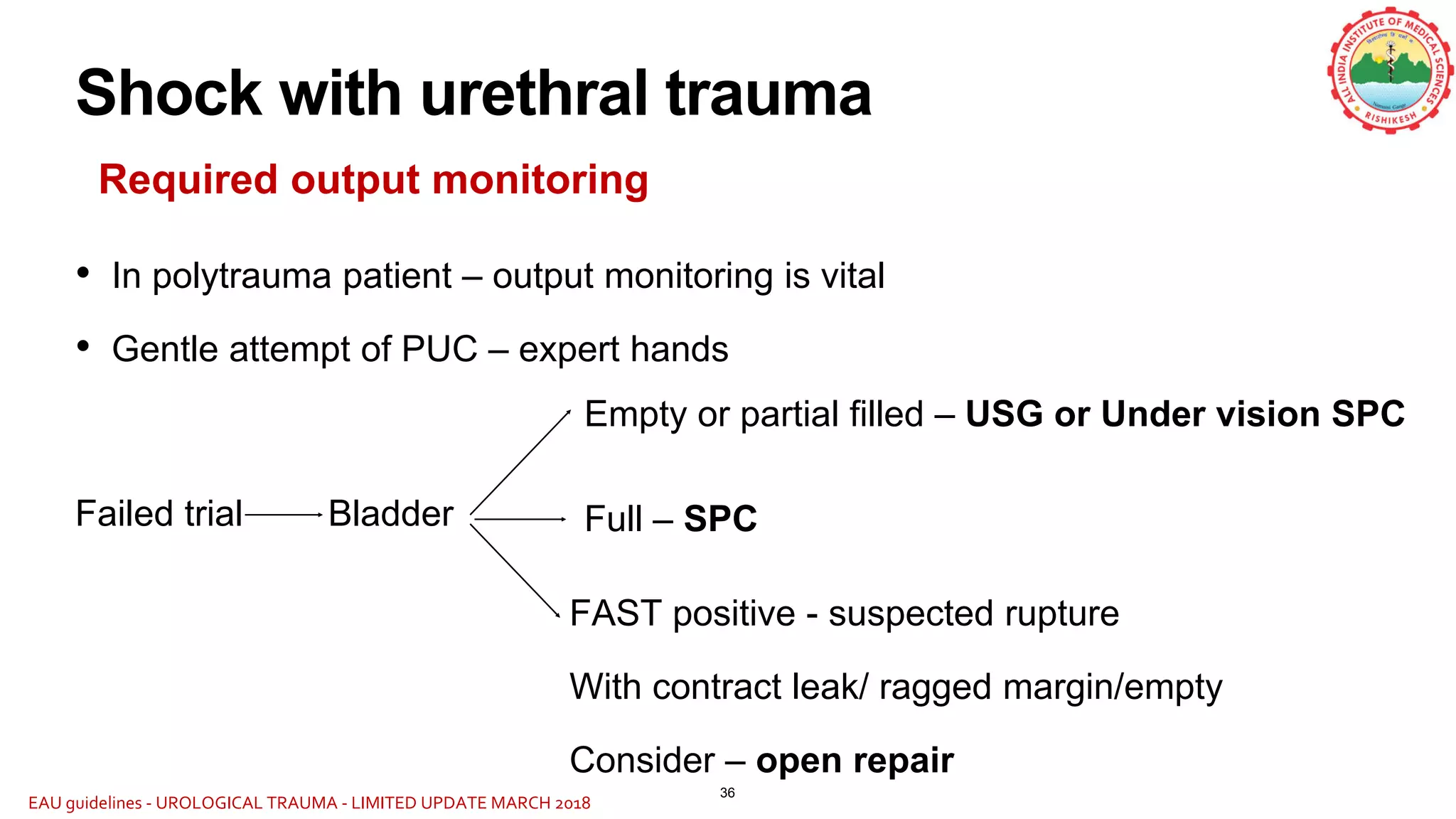
Shock with urethral trauma
Required output monitoring
• In polytrauma patient – output monitoring is vital
• Gentle attempt of PUC – expert hands
Failed trial Bladder Full – SPC
Empty or partial filled – USG or Under vision SPC
FAST positive - suspected rupture
With contract leak/ ragged margin/empty
Consider – open repair
36
EAU guidelines - UROLOGICAL TRAUMA - LIMITED UPDATE MARCH 2018
Immediate realignment
Passage of catheter – along the defect
• Flexible / rigid endoscopes with Biplanar fluoroscopy
• Interlocking sounds or magnetic catheters
• Endoscopic re-alignment – preferred
• Retrograde( P/U) and antegrade(S/P)
• Catheter kept for – (4- 8) weeks
• Open re-alignment – considered as suture anastomosis between prostatic
apex and membranous urethra – form of immediate urethroplasty.
37EAU guidelines - UROLOGICAL TRAUMA - LIMITED UPDATE MARCH 2018
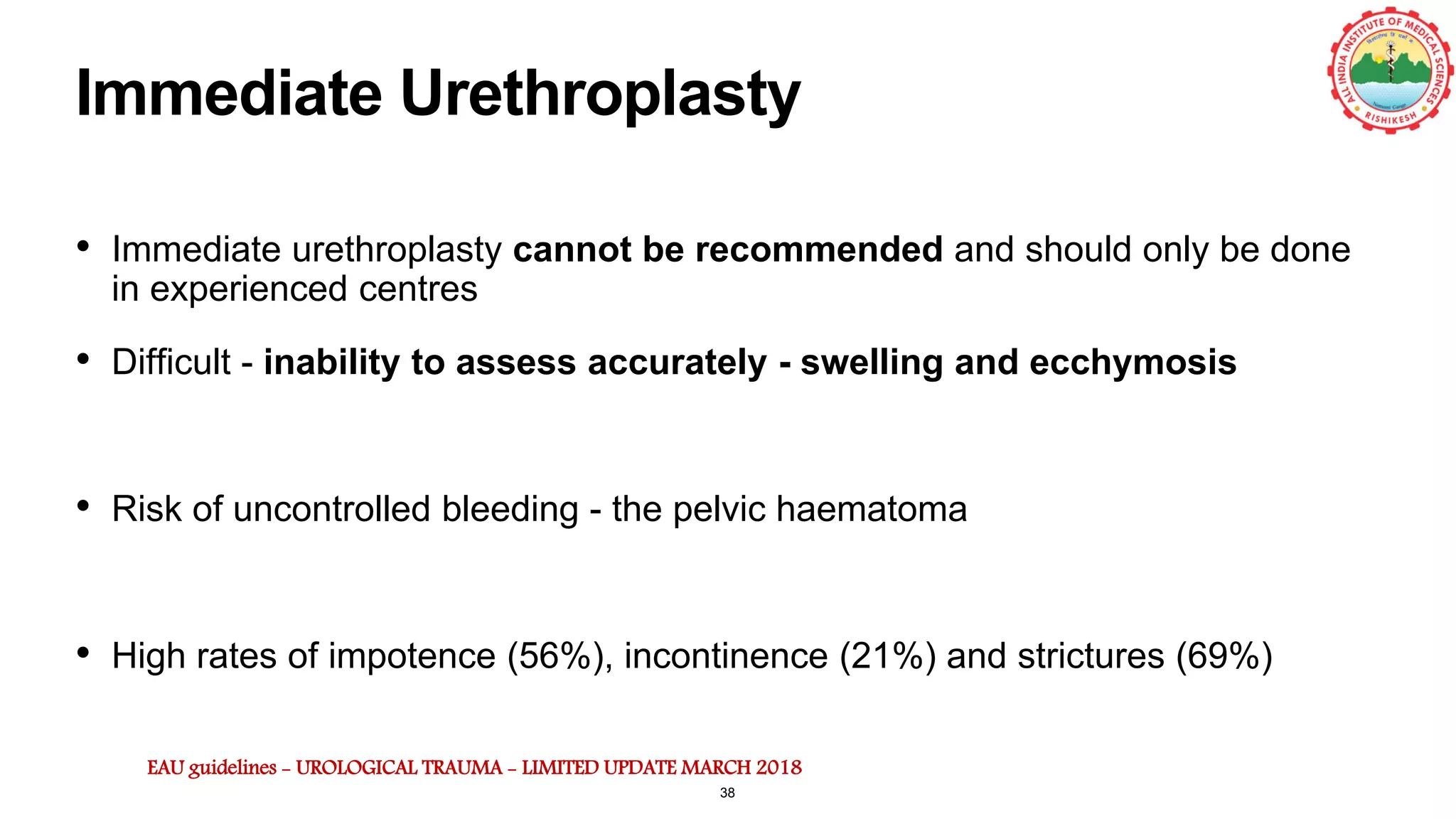
Immediate Urethroplasty
• Immediate urethroplasty cannot be recommended and should only be done
in experienced centres
• Difficult - inability to assess accurately - swelling and ecchymosis
• Risk of uncontrolled bleeding - the pelvic haematoma
• High rates of impotence (56%), incontinence (21%) and strictures (69%)
EAU guidelines - UROLOGICAL TRAUMA - LIMITED UPDATE MARCH 2018
38
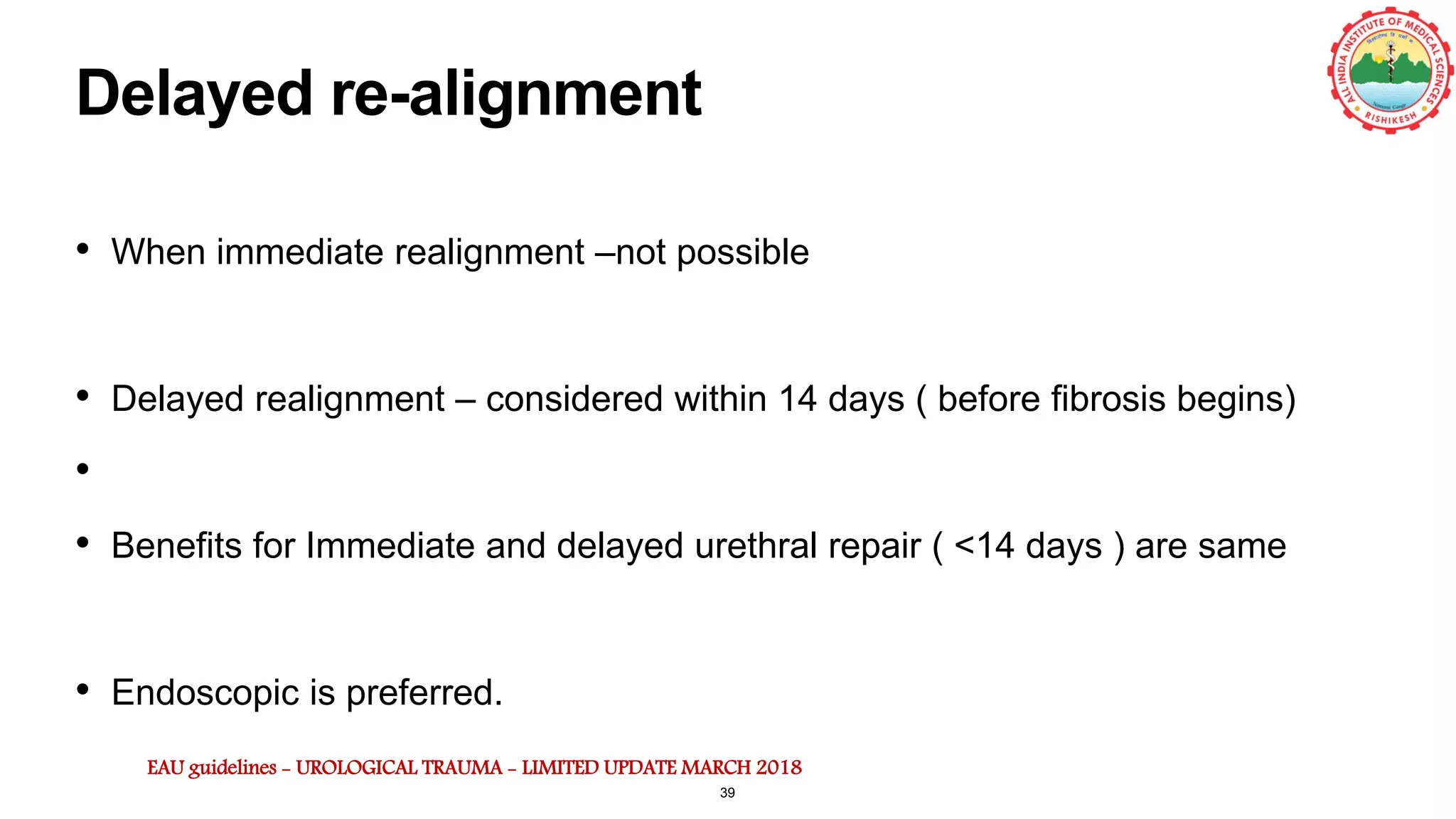
Delayed re-alignment
• When immediate realignment –not possible
• Delayed realignment – considered within 14 days ( before fibrosis begins)
•
• Benefits for Immediate and delayed urethral repair ( <14 days ) are same
• Endoscopic is preferred.
EAU guidelines - UROLOGICAL TRAUMA - LIMITED UPDATE MARCH 2018
39
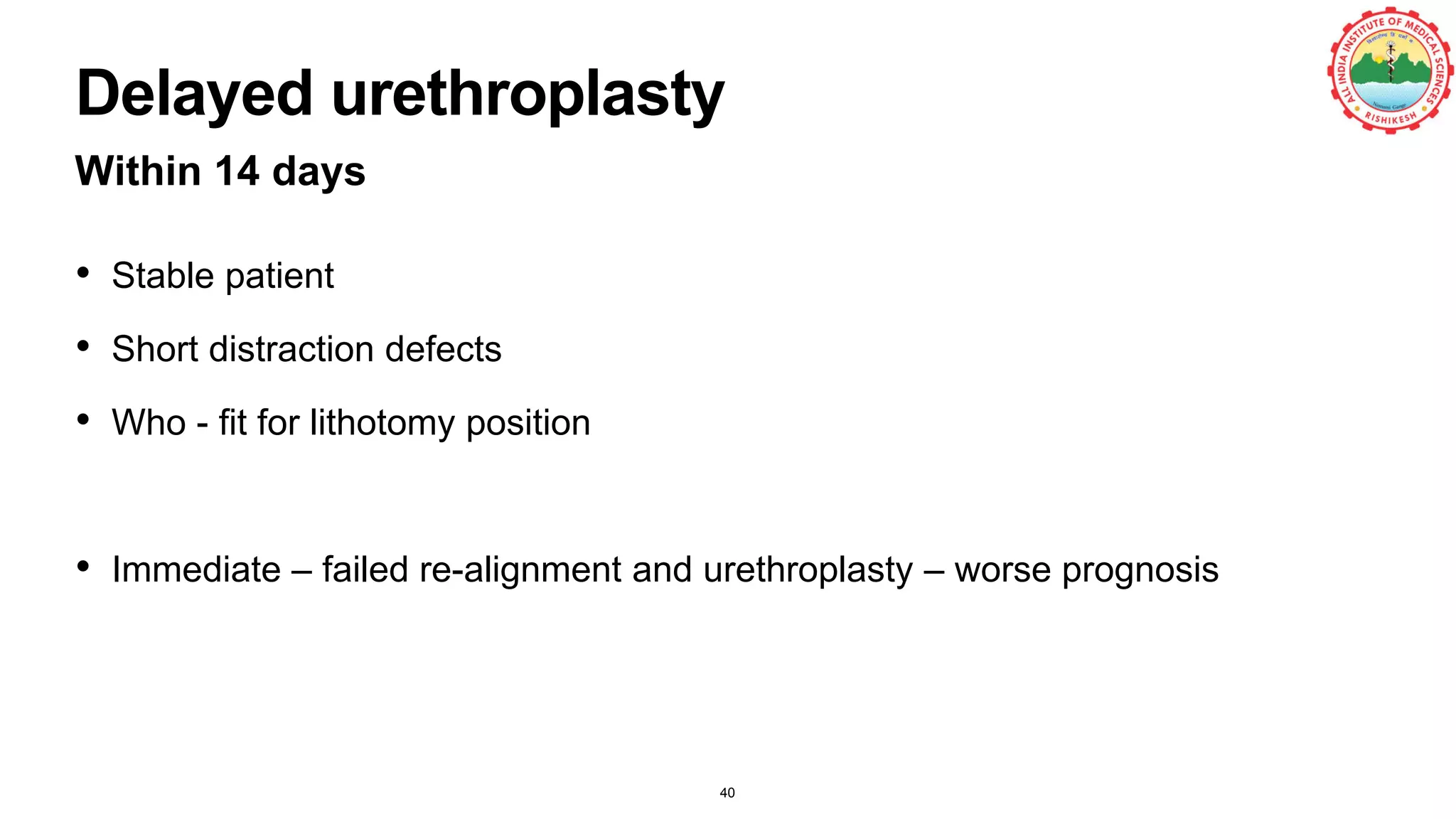
Delayed urethroplasty
Within 14 days
• Stable patient
• Short distraction defects
• Who - fit for lithotomy position
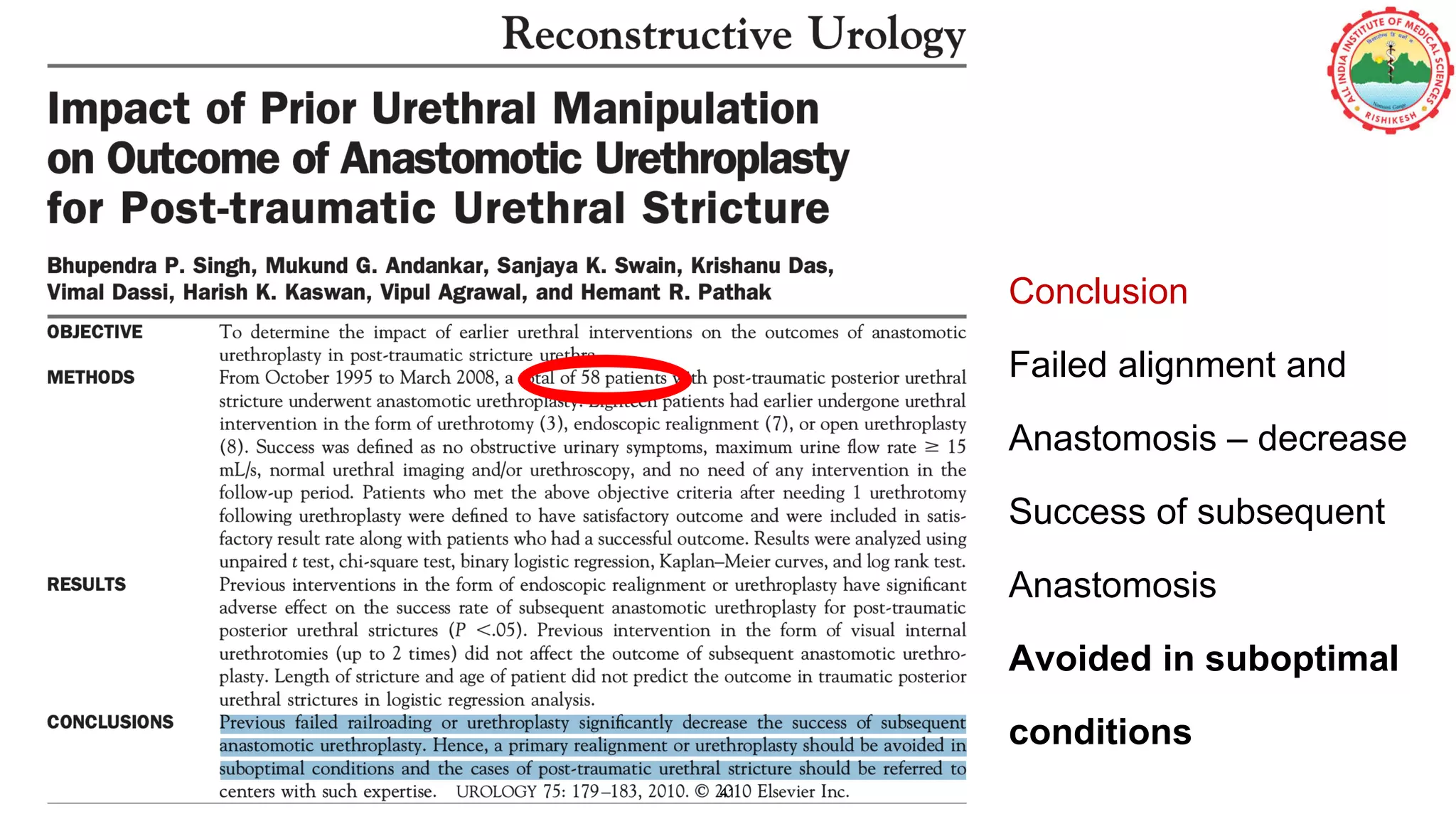
• Immediate – failed re-alignment and urethroplasty – worse prognosis
40
Conclusion
Failed alignment and
Anastomosis – decrease
Success of subsequent
Anastomosis
Avoided in suboptimal
conditions
41
Deferred urethroplasty
After 3 months of initial urinary diversion
• Pelvic haematoma - resolved,
• Prostate descended - more normal position,
• Scar tissue - stabilised
• Stable - the lithotomy position
• Most posterior urethral distraction defects are short and can be treated using a
perineal anastomotic repair.
• Key objective - achieve a tension-free anastomosis between two healthy
urethral ends
42
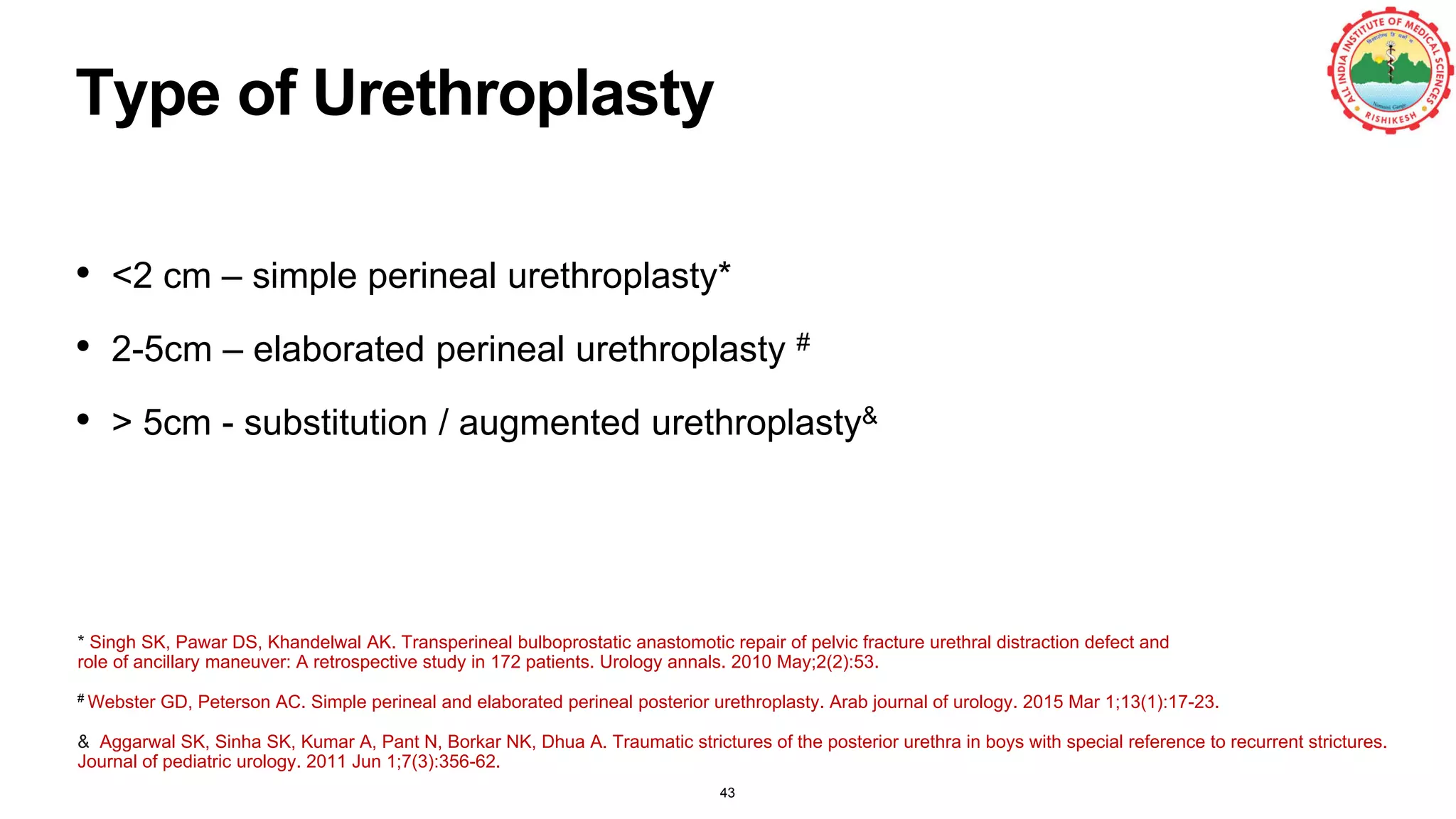
Type of Urethroplasty
• <2 cm – simple perineal urethroplasty*
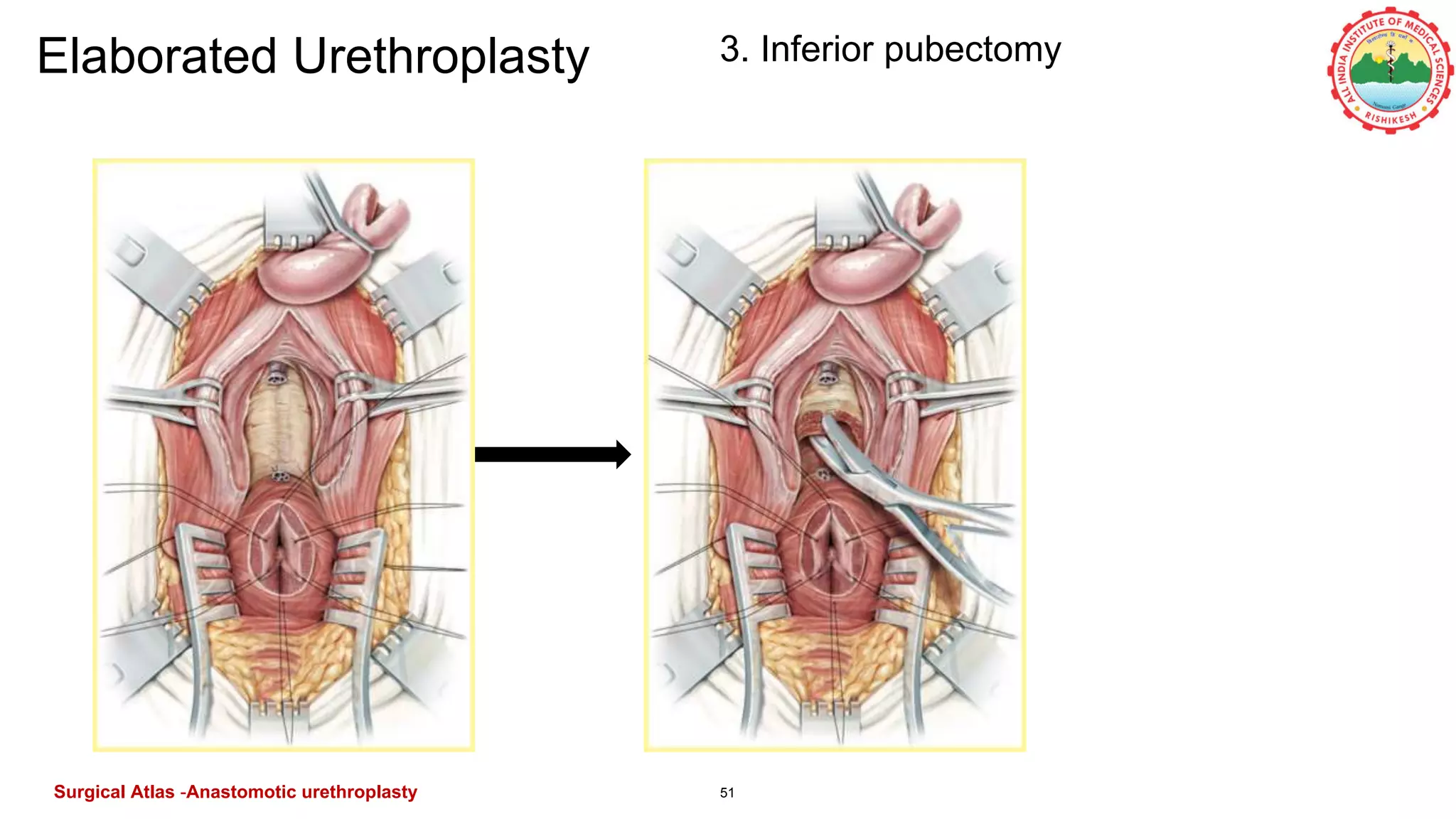
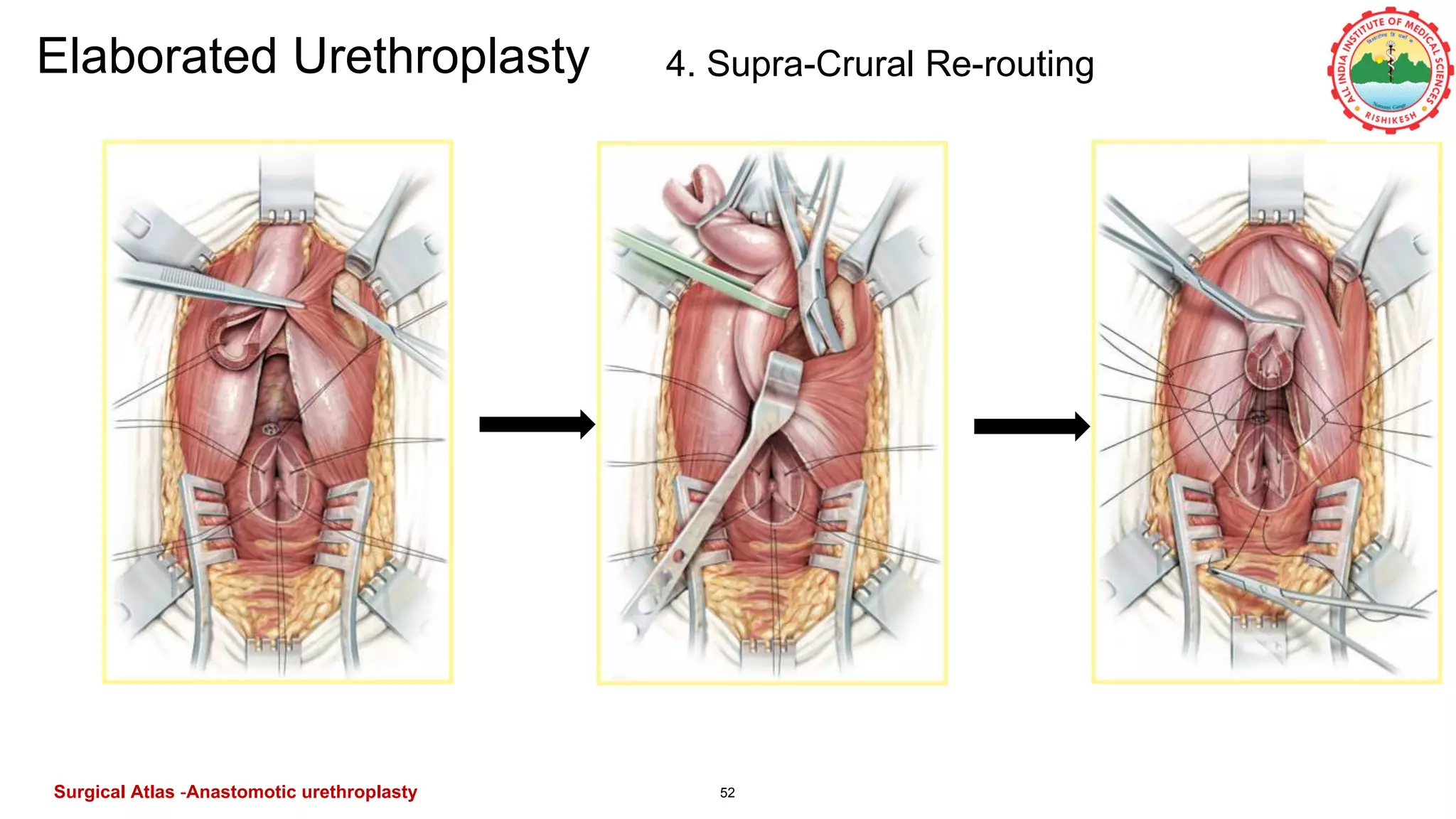
• 2-5cm – elaborated perineal urethroplasty #
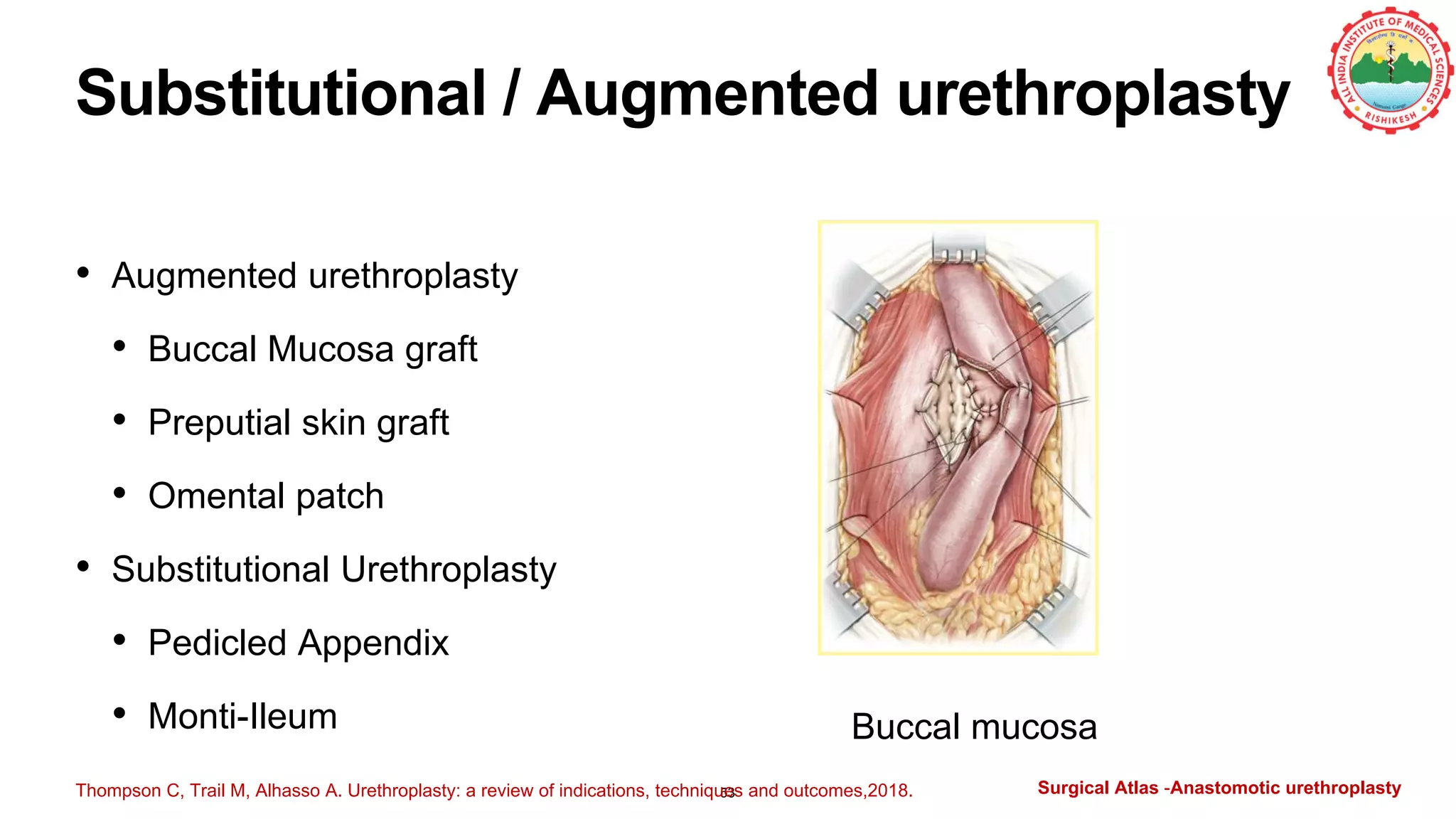
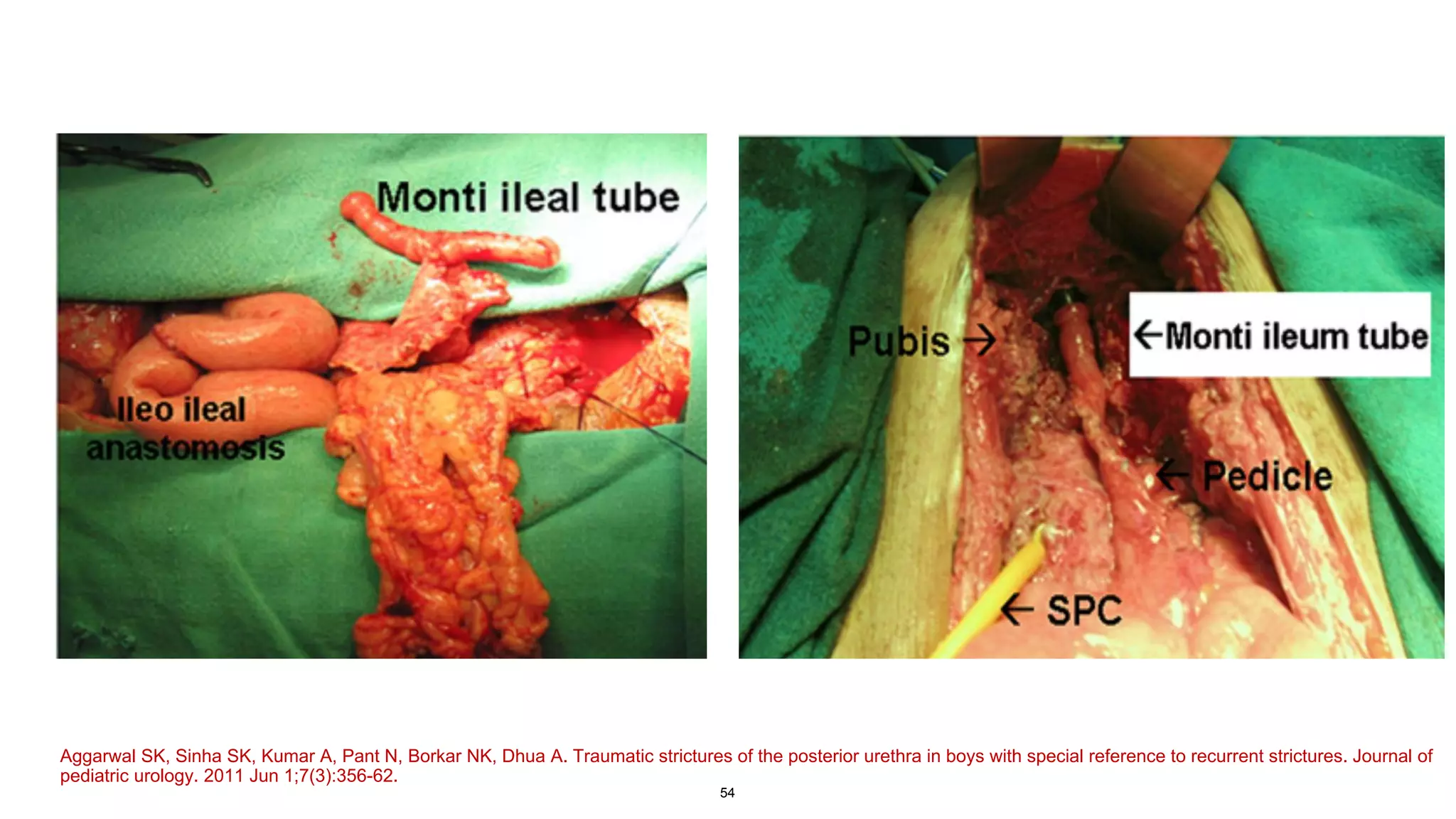
• > 5cm - substitution / augmented urethroplasty&
43
& Aggarwal SK, Sinha SK, Kumar A, Pant N, Borkar NK, Dhua A. Traumatic strictures of the posterior urethra in boys with special reference to recurrent strictures.
Journal of pediatric urology. 2011 Jun 1;7(3):356-62.
# Webster GD, Peterson AC. Simple perineal and elaborated perineal posterior urethroplasty. Arab journal of urology. 2015 Mar 1;13(1):17-23.
* Singh SK, Pawar DS, Khandelwal AK. Transperineal bulboprostatic anastomotic repair of pelvic fracture urethral distraction defect and
role of ancillary maneuver: A retrospective study in 172 patients. Urology annals. 2010 May;2(2):53.
44
Exaggerated lithotomy position
Position
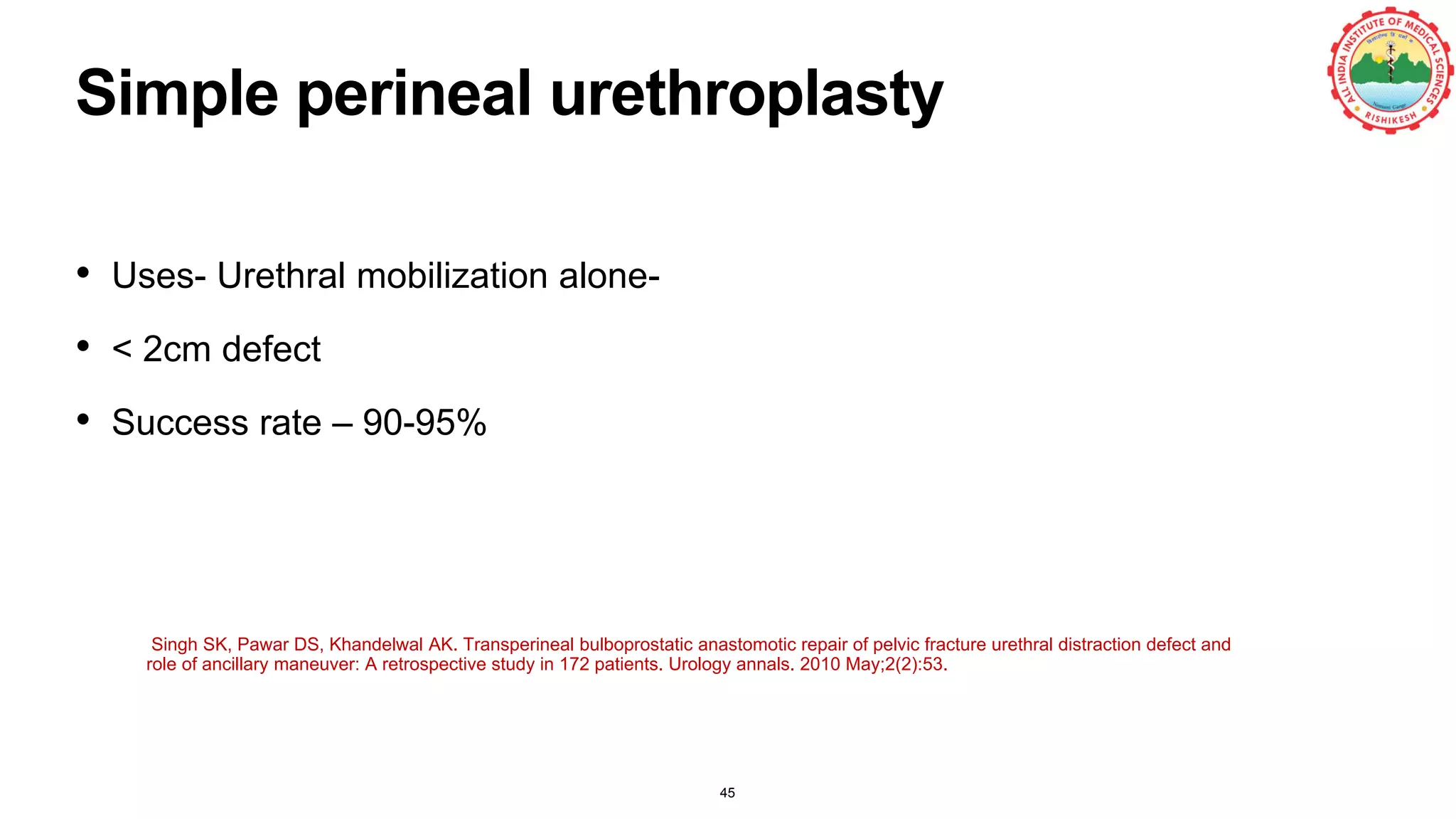
Simple perineal urethroplasty
45
• Uses- Urethral mobilization alone-
• < 2cm defect
• Success rate – 90-95%
Singh SK, Pawar DS, Khandelwal AK. Transperineal bulboprostatic anastomotic repair of pelvic fracture urethral distraction defect and
role of ancillary maneuver: A retrospective study in 172 patients. Urology annals. 2010 May;2(2):53.
46
Simple perineal
urethroplasty
Y- shaped or vertical
Elaborated perineal urethroplasty
elaborating procedures
47
1. Bulbo-urethral mobilisation
2. Corporal body separation
3. Inferior wedge pubectomy
4. Supra-crural urethral re-routing
• Webster -Perineal approach
• Turner-Warwick (Perineo- Abdominal
Progressive Approach)
• Waterhouse Approach - pubectomy
Webster GD, Peterson AC. Simple perineal and elaborated perineal posterior urethroplasty. Arab journal of urology. 2015 Mar 1;13(1):17-23.
Length gain - in elaboration
3cm – Bulbo-urethral mobilisation
2cm - Corporal body separation
2cm - Inferior wedge pubectomy
2cm - Supra-crural urethral re-routing
48
End to End Anastomosis
4-5 cm defect – membranous urethra
or bulbar urethra
2-3 cm defect – penile urethra
7-9cm can also be repair – Associated with increased failure rate, Results are better with experienced hands
Webster GD, Peterson AC. Simple perineal and elaborated perineal posterior urethroplasty. Arab journal of urology. 2015 Mar 1;13(1):17-23.
Singh SK, Pawar DS, Khandelwal AK. Transperineal bulboprostatic anastomotic repair of pelvic fracture urethral distraction defect and
role of ancillary maneuver: A retrospective study in 172 patients. Urology annals. 2010 May;2(2):53.
49
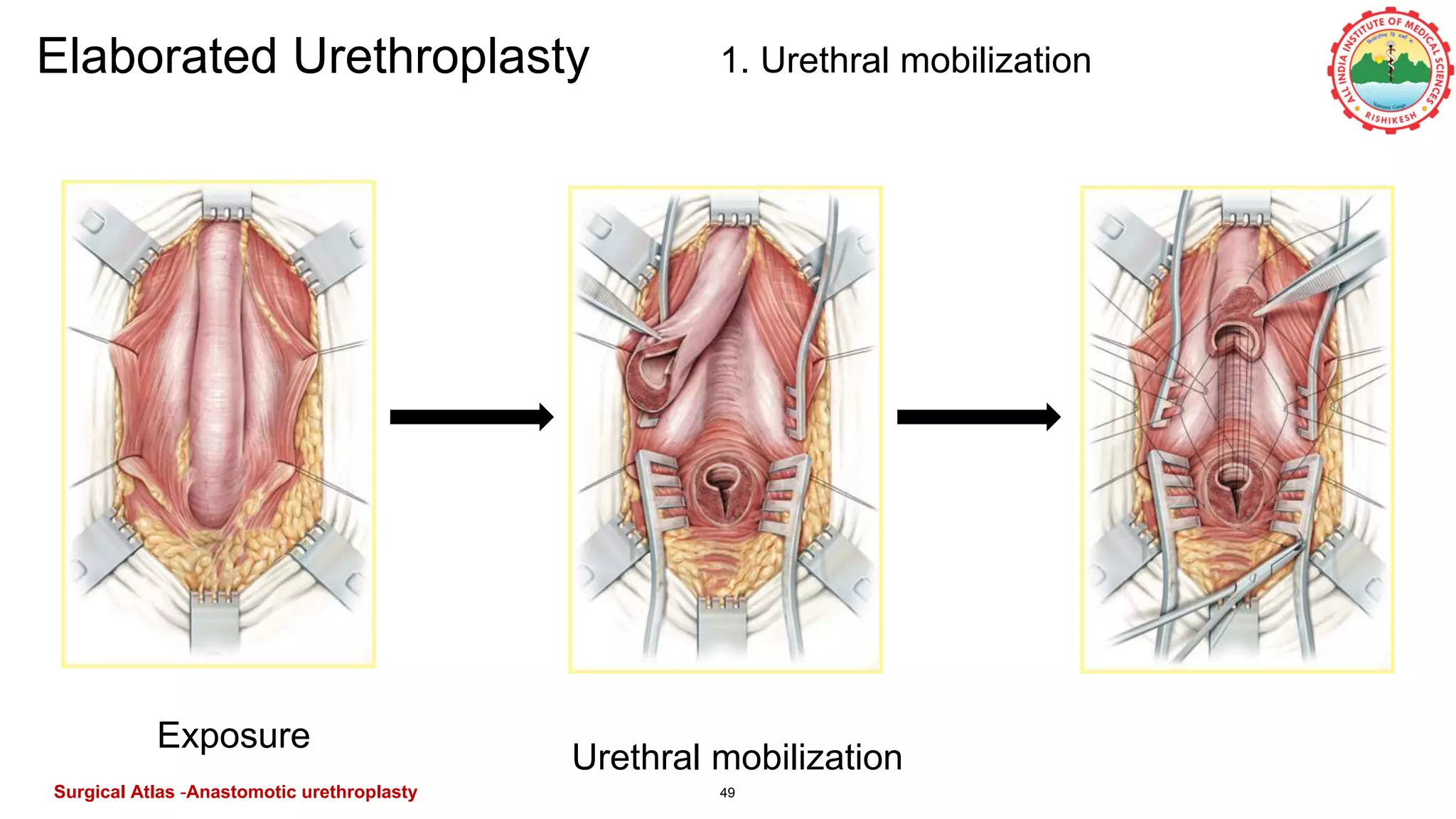
Elaborated Urethroplasty
Exposure
1. Urethral mobilization
Urethral mobilization
Surgical Atlas -Anastomotic urethroplasty
50
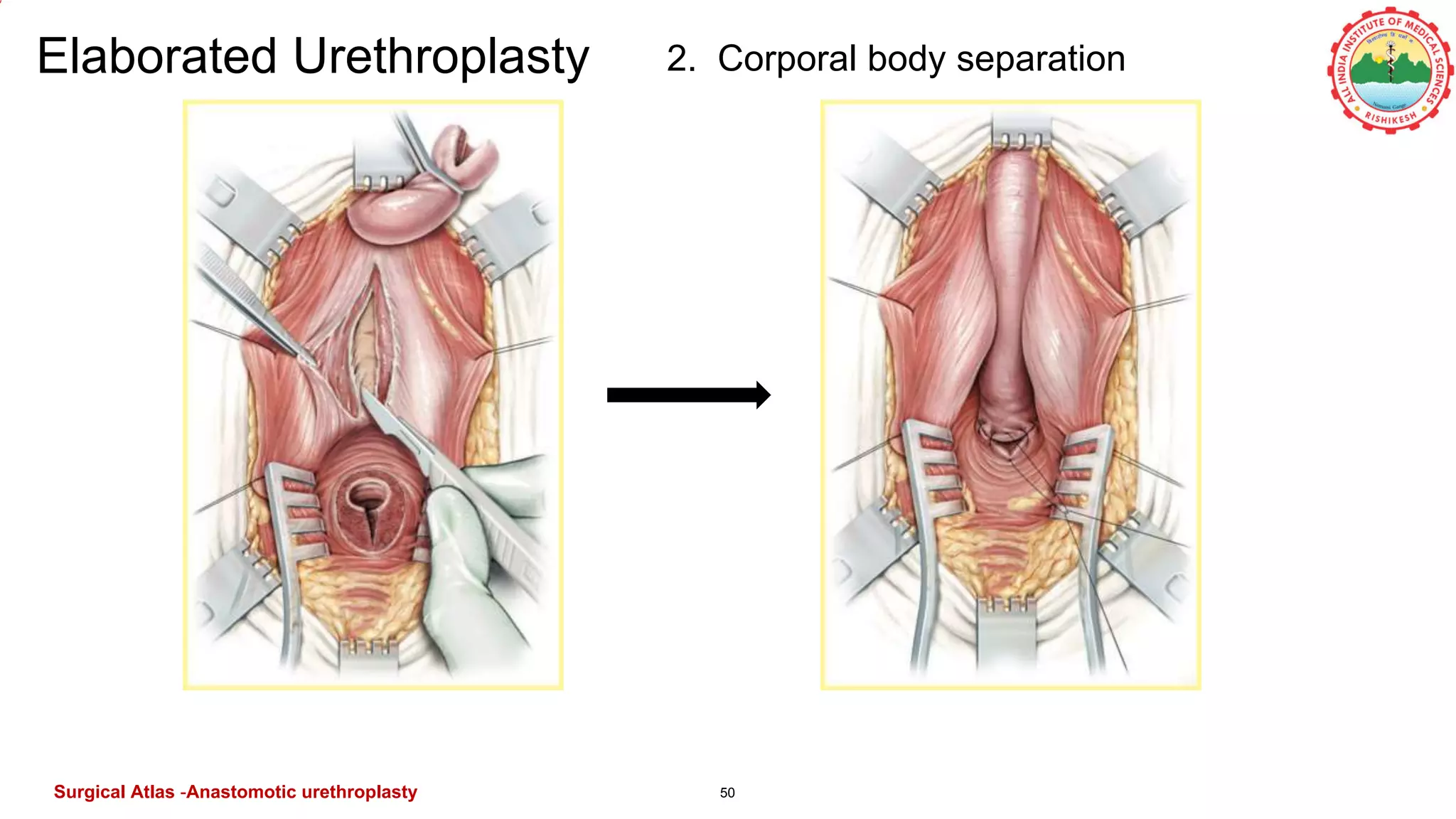
Elaborated Urethroplasty 2. Corporal body separation
Surgical Atlas -Anastomotic urethroplasty
51
Elaborated Urethroplasty 3. Inferior pubectomy
Surgical Atlas -Anastomotic urethroplasty
52
Elaborated Urethroplasty 4. Supra-Crural Re-routing
Surgical Atlas -Anastomotic urethroplasty
Substitutional / Augmented urethroplasty
53
• Augmented urethroplasty
• Buccal Mucosa graft
• Preputial skin graft
• Omental patch
• Substitutional Urethroplasty
• Pedicled Appendix
• Monti-Ileum Buccal mucosa
Thompson C, Trail M, Alhasso A. Urethroplasty: a review of indications, techniques and outcomes,2018. Surgical Atlas -Anastomotic urethroplasty
54
Aggarwal SK, Sinha SK, Kumar A, Pant N, Borkar NK, Dhua A. Traumatic strictures of the posterior urethra in boys with special reference to recurrent strictures. Journal of
pediatric urology. 2011 Jun 1;7(3):356-62.
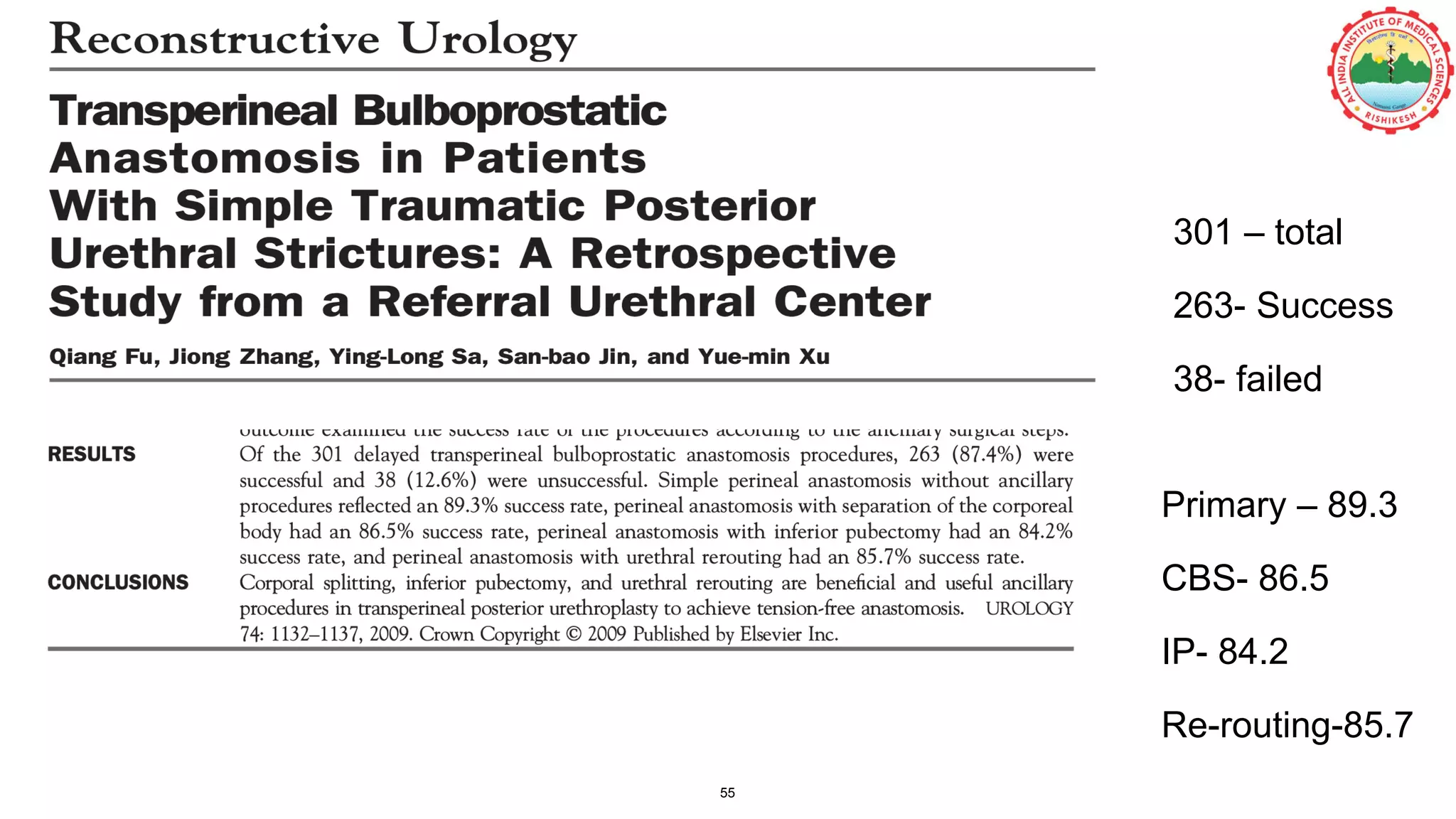
55
301 – total
263- Success
38- failed
Primary – 89.3
CBS- 86.5
IP- 84.2
Re-routing-85.7
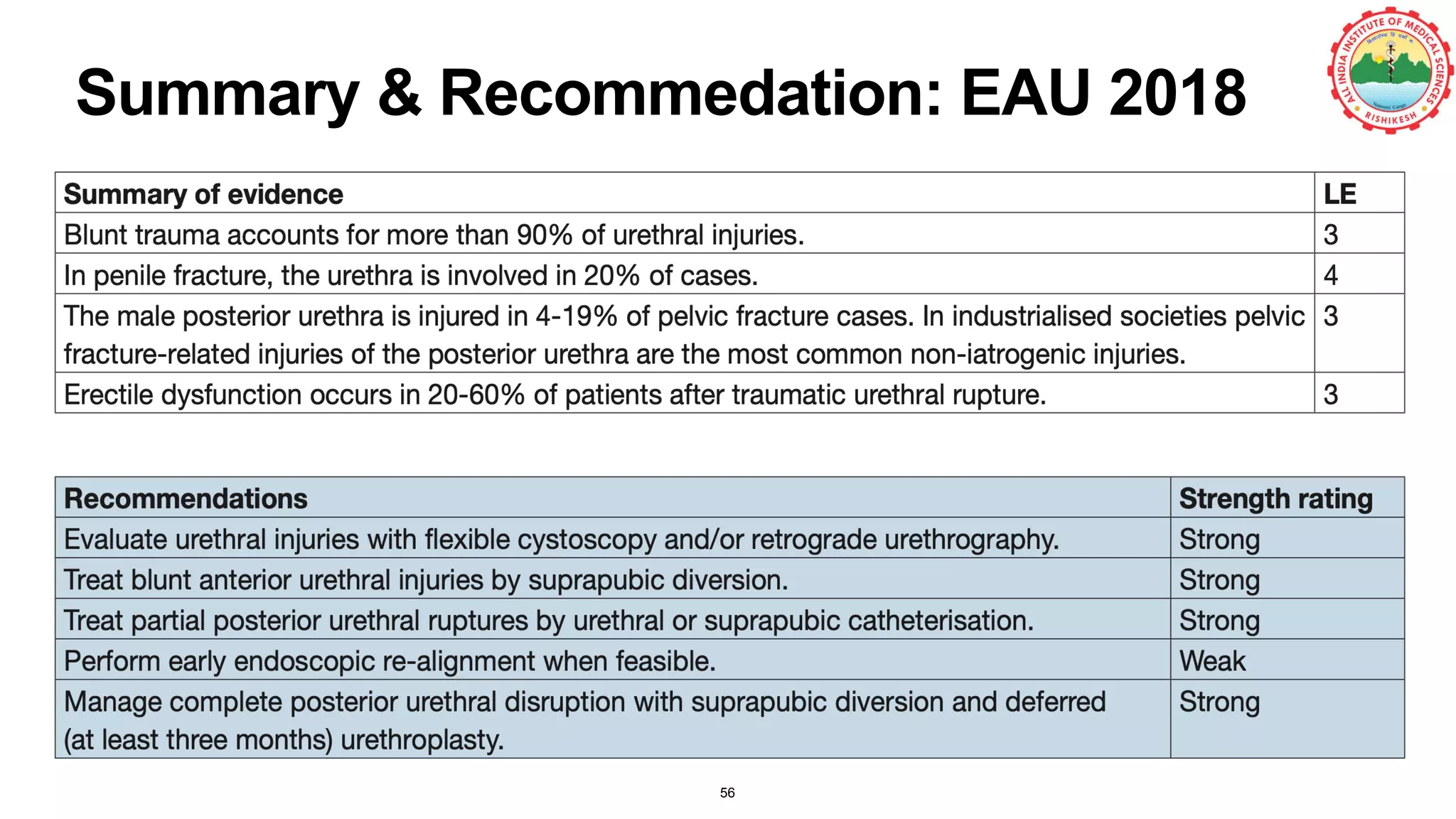
Summary & Recommedation: EAU 2018
56
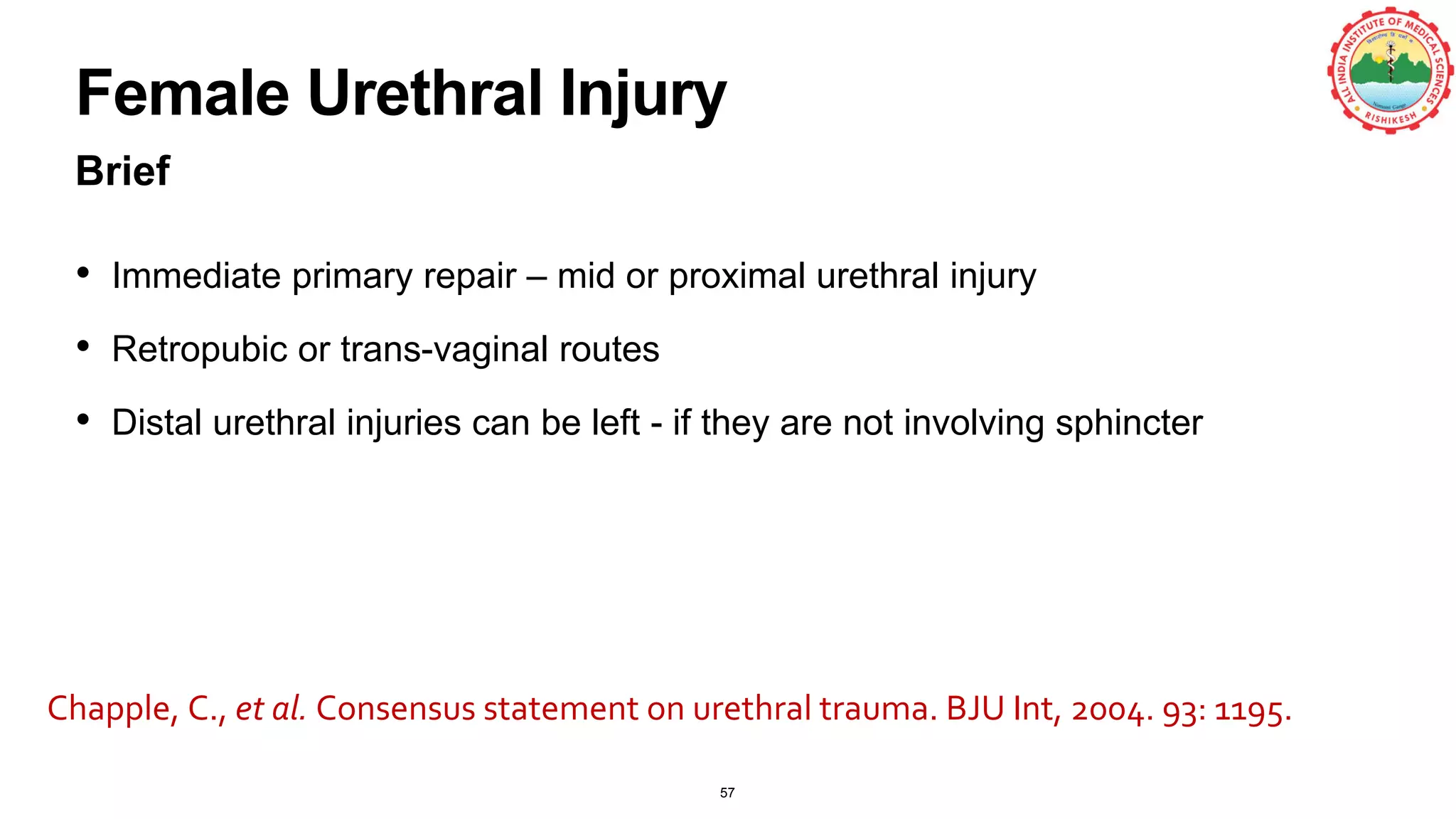
Female Urethral Injury
Brief
• Immediate primary repair – mid or proximal urethral injury
• Retropubic or trans-vaginal routes
• Distal urethral injuries can be left - if they are not involving sphincter
57
Chapple, C., et al. Consensus statement on urethral trauma. BJU Int, 2004. 93: 1195.
58
Thank You

Approach to the patient with Urethral Trauma

  • 1.
    Dr Awaneesh Katiyar SeniorResident Trauma Surgery and Critical Care AIIMS Rishikesh Approach to the Patients with Urethral Trauma 1
  • 2.
    Overview Case based approachto Urethral Trauma • Clinical presentation • Introduction, clinical signs and symptoms • Clinical diagnosis • Classification and Investigations • Management of PFUDD - Emergency/ Definitive management (primary/ delayed / deferred) 2
  • 3.
    Case A 25 yearsmale patient, met with road traffic injury • Patient was driving bike (30km/hr), hit a tractor - he fell on the ground and bike overturn hip on the patient and rescued by bystanders. • Patient arrived – within 1hr of trauma. • On Arrival – P 112, BP 101/64, SpO2 98% at room air • Airway- patent, shouting for hip pain • Breathing – RR 24/min, CCT- negative, Bilateral air- entry equal • Circulation – Tachycardia, with Normal BP, FAST-Negative , PCT – Positive No long bone fracture, No external bleeding 3
  • 4.
    • Disability –GCS- 15/15, Pupil B/L NSNR, No Focal Neurological deficit. • History (AMPLE): • No Allergy no the any drug. • Patient did not received – primary care from other hospital • No Past Medical history • Last meal – 2 hours before • Small pit on the road- leads to collision between the tractor and bike (LMV) 4
  • 5.
    Primary Management andSecondary Survey As per ATLS protocol • Put on O2 Mask at 6/min • 1liter warm RL – infused. • Analgesics, anti-emetics given. • Pelvis binder - after examination of pelvis 5 Life or Limb threatening injuries- should be addresses first
  • 6.
    Secondary Survey • Logroll– no spinal tenderness, abrasion or bruising • Pelvis and perineum examination • Pelvis compression test - positive • Blood at meatus – noted ( no active bleeding) , Bladder was not full on USG. • Hematoma around scrotum • No Laceration, abrasion – over genital and perineum 6
  • 7.
    Digital Rectal Examination •No visible bleeding from outside • Anal tone – normal • Rectal mucosa – integrity maintained • Prostate – high riding, mobile • Coccyx – fixed • Non-blood staining of finger. 7
  • 8.
    Clinical diagnosis?? Pelvis fracturewith suspected urethral injury 8
  • 9.
  • 10.
    Introduction • 10% -Pelvis fracture - Urethral Injury (bulbomembranous) • 72% posterior urethra) • 20% urethral injury – associated with bladder injury. • Anterior urethral injuries are - 33% • Straddle injuries are common. • Female – urethral injuries <6% in RTI Ingram MD, Watson SG, Skippage PL, Patel U. Urethral injuries after pelvic trauma: evaluation with urethrography. Radiographics. 2008 Oct;28(6):1631-43. 10
  • 11.
    Introduction • Female urethralinjury – 75% associated with vaginal , 33% with rectum injury • High grade of pelvis fracture (Rami) associated with - urethral injury • Posterior or lateral fracture - almost 0% urethral injury • Isolated Injury to penis, scrotum, perineum – Anterior urethra UpToDate April 2020 Ingram MD, Watson SG, Skippage PL, Patel U. Urethral injuries after pelvic trauma: evaluation with urethrography. Radiographics. 2008 Oct;28(6):1631-43. 11
  • 12.
    Clinical Approach Initial Assessmentand Management Suspected urethral injury 1. Perineal/ scrotal hematoma 2. Blood at meatus 3. Unable to micturate 4. DRE- high prostate 5. Wound in vicinity to urethra 1. RTI associated pelvis fracture 2. Direct blow to the perineum- straddle 3. Penile fracture 4. Penetrating injury ExaminationHistory life or limb-threatening injury 12
  • 13.
    Types of UrethralInjury Anterior Vs Posterior 1. Anterior ( Bulbous and penile) • Direct blow • Straddle • Instrumental • Penile fracture 2. Posterior (membranous and prostatic) • Associated with pelvis fracture • Penetrating injury 13
  • 14.
    Clinical Signs andSymptoms H/O-Injury to the penis, scrotum, peritoneum, or the lower abdomen, either blunt or penetrating Blood at the urethral meatus 37–93% -posterior urethral injury, 75% -an anterior urethral injury. Avoid urethral instrumentation Haematuria or blood at vaginal introitus Present in more than 80% of female patients with pelvic fractures Inability to void / painful urination Either symptom suggest urethral disruption Perineal hematoma / scrotal / labial 14
  • 15.
    1. I: Stretchingof the posterior urethra due to disruption of puboprostatic ligaments, though the urethra is intact 2. II: Posterior urethral injury above urogenital diaphragm 3. III: Injury to the membranous urethra, extending into the proximal bulbous urethra (i.e. with laceration of the urogenital diaphragm) 4. IV: Bladder base injury involving bladder neck extending into the proximal urethra • Internal sphincter is injured, hence the potential for incontinence 5. IVa: Bladder base injury, not involving bladder neck (cannot be differentiated from type IV radiologically) 6. V: Anterior urethral injury (isolated) Goldman Colapinto classification 15
  • 16.
    AAST grading ofurethral Injury Grade 16
  • 17.
    Grade Description AppearanceManagement I Contusion Blood at the urethral meatus; no extravasation on urethrography No treatment required II Stretch injury Elongation of the urethra without extravasation on urethrography Grades II and III can be managed conservatively with suprapubic cystostomy or urethral catheterization III Partial disruption Extravasation of contrast at injury site with contrast visualized in the proximal urethra or bladder IV Complete disruption Extravasation of contrast at injury site without visualization of proximal urethra or anterior urethra or bladder Suprapubic cystostomy and delayed repair or primary endoscopic realignment in selected patients, delayed repair Primary open repair V Associated with tear of bladder Neck, rectum or vagina Extravasation of contrast at urethral injury site , blood in the vaginal introitus Extravasation of contrast at bladder neck during suprapubic cystography, rectal or vaginal filling with contrast material Management According to the Grade of Injury 17
  • 18.
    Clinical Diagnosis Blood atmeatus painful to void First void hematuria Inability of void Full bladder Blood at vagina or rectum Straddle Direct injury – kicks Sit on sharp object Penile fracture Foreign body insertion High index of suspicion RTI – pelvis fracture /penetrating Suspect Posterior Suspect Anterior May be Partial May be Complete18
  • 19.
    Partial posterior urethralinjury Urethrography, 2 weekly Managed on – SPC or PUC Healed without scarring Healed with scarring (Non obliterating) Complete obstruction Continue follow up Internal urethrotomy urethroplastyfailed 19
  • 20.
    Complete posterior urethralinjury Isolated urethral injury Associated 1. Bladder neck disruption 2. Vaginal or rectal tear 3. Bladder perforation Immediate re-alignment • Endoscopic preferred • Prevent – stricture rate Immediate repair Bladder neck, rectum, vagina or diversion colostomy 20
  • 21.
    Management Suspected Urethral injury IsolatedPolytrauma Stable Unstable Retrograde urethrography No intervention Gentle attempt with expert hand SPC and delayed/ deferred TtGr I Gr II & III Gr IV & V Failed Urethrography 2 weekly Partial complete 21
  • 22.
    Normal study RGU 22 Investigation Ascending ordescending urethrogram CT Urography ( Polytrauma)
  • 23.
    Grade II urethralinjury Contrast extravasation at posterior urethra, intact diaphragm Grade I urethral injury no evidence of contrast material extravasation 23
  • 24.
    Grade III urethralinjury contrast material extravasation Membranous Urethra 24
  • 25.
    Grade IV injury Completetransection of the posterior urethra with contrast material extravasation into the perineal soft tissues 25
  • 26.
    Grade V Distal dyelength can’t be assessed- complete 26
  • 27.
    27 Management EAU guidelines -UROLOGICAL TRAUMA - LIMITED UPDATE MARCH 2018 Algorithm Posterior Urethra
  • 28.
    28EAU guidelines -UROLOGICAL TRAUMA - LIMITED UPDATE MARCH 2018
  • 29.
    29 EAU guidelines -UROLOGICAL TRAUMA - LIMITED UPDATE MARCH 2018 Anterior Urethra
  • 30.
    30 EAU guidelines -UROLOGICAL TRAUMA - LIMITED UPDATE MARCH 2018
  • 31.
    31 EAU guidelines -UROLOGICAL TRAUMA - LIMITED UPDATE MARCH 2018 Iatrogenic
  • 32.
    AUA guidelines 2018- Recommendations • Perform retrograde urethrography in patients with blood at the urethral meatus after pelvic trauma. (Evidence Strength: Grade C) • Prompt urinary drainage in patients with pelvic fracture associated urethral injury(PFUI). (Evidence Strength: Grade C) • May place suprapubic tubes in patients undergoing open reduction internal fixation for pelvic fracture. (Expert Opinion) • Primary realignment (PR) in hemodynamically stable patients with pelvic fracture associated urethral injury (PFUI). (Evidence Strength: Grade C ) Morey AF, Brandes S, Dugi DD, Armstrong JH, Breyer BN, Broghammer JA, Erickson BA, Holzbeierlein J, Hudak SJ, Pruitt JH, Reston JT. Urotrauma: AUA guideline. The Journal of urology. 2014 Aug;192(2):327-35. 32
  • 33.
    AUA guidelines 2018- Recommendations • Should not perform prolonged attempts at endoscopic realignment in patients with pelvic fracture associated urethral injury. (Clinical Principle) • Monitor patients for complications (e.g., stricture formation, erectile dysfunction, incontinence) for at least one year following urethral injury. (Grade C) • Prompt surgical repair in patients with uncomplicated penetrating trauma of the anterior urethra. (Expert Opinion) • Prompt urinary drainage in patients with straddle injury to the anterior urethra. (Grade C) Morey AF, Brandes S, Dugi DD, Armstrong JH, Breyer BN, Broghammer JA, Erickson BA, Holzbeierlein J, Hudak SJ, Pruitt JH, Reston JT. Urotrauma: AUA guideline. The Journal of urology. 2014 Aug;192(2):327-35. 33
  • 34.
    Surgical Management Pelvis fractureurethral distraction defects (PFUDD) repair • Immediate (Primary) – first 48 hours • Delayed ( delayed Primary)– 2 days to 2 weeks • Deferred ( Delayed) – > 3 months 34 1. Primary, 2. delayed primary, 3. Delayed – few authors EAU guidelines - UROLOGICAL TRAUMA - LIMITED UPDATE MARCH 2018
  • 35.
    Immediate management Suspicion ofurethral trauma • Stabilize the patient – as per ATLS protocol • Primary survey and initial management Suspected Urethral Injury Stable Unstable SPC Resuscitation Ascending urethrogram (descending if possible) CT Urography 35 Urinary diversion 1. Shock 2. Painful urinary retention – polytrauma 3. Extravasation of urine
  • 36.
    Shock with urethraltrauma Required output monitoring • In polytrauma patient – output monitoring is vital • Gentle attempt of PUC – expert hands Failed trial Bladder Full – SPC Empty or partial filled – USG or Under vision SPC FAST positive - suspected rupture With contract leak/ ragged margin/empty Consider – open repair 36 EAU guidelines - UROLOGICAL TRAUMA - LIMITED UPDATE MARCH 2018
  • 37.
    Immediate realignment Passage ofcatheter – along the defect • Flexible / rigid endoscopes with Biplanar fluoroscopy • Interlocking sounds or magnetic catheters • Endoscopic re-alignment – preferred • Retrograde( P/U) and antegrade(S/P) • Catheter kept for – (4- 8) weeks • Open re-alignment – considered as suture anastomosis between prostatic apex and membranous urethra – form of immediate urethroplasty. 37EAU guidelines - UROLOGICAL TRAUMA - LIMITED UPDATE MARCH 2018
  • 38.
    Immediate Urethroplasty • Immediateurethroplasty cannot be recommended and should only be done in experienced centres • Difficult - inability to assess accurately - swelling and ecchymosis • Risk of uncontrolled bleeding - the pelvic haematoma • High rates of impotence (56%), incontinence (21%) and strictures (69%) EAU guidelines - UROLOGICAL TRAUMA - LIMITED UPDATE MARCH 2018 38
  • 39.
    Delayed re-alignment • Whenimmediate realignment –not possible • Delayed realignment – considered within 14 days ( before fibrosis begins) • • Benefits for Immediate and delayed urethral repair ( <14 days ) are same • Endoscopic is preferred. EAU guidelines - UROLOGICAL TRAUMA - LIMITED UPDATE MARCH 2018 39
  • 40.
    Delayed urethroplasty Within 14days • Stable patient • Short distraction defects • Who - fit for lithotomy position • Immediate – failed re-alignment and urethroplasty – worse prognosis 40
  • 41.
    Conclusion Failed alignment and Anastomosis– decrease Success of subsequent Anastomosis Avoided in suboptimal conditions 41
  • 42.
    Deferred urethroplasty After 3months of initial urinary diversion • Pelvic haematoma - resolved, • Prostate descended - more normal position, • Scar tissue - stabilised • Stable - the lithotomy position • Most posterior urethral distraction defects are short and can be treated using a perineal anastomotic repair. • Key objective - achieve a tension-free anastomosis between two healthy urethral ends 42
  • 43.
    Type of Urethroplasty •<2 cm – simple perineal urethroplasty* • 2-5cm – elaborated perineal urethroplasty # • > 5cm - substitution / augmented urethroplasty& 43 & Aggarwal SK, Sinha SK, Kumar A, Pant N, Borkar NK, Dhua A. Traumatic strictures of the posterior urethra in boys with special reference to recurrent strictures. Journal of pediatric urology. 2011 Jun 1;7(3):356-62. # Webster GD, Peterson AC. Simple perineal and elaborated perineal posterior urethroplasty. Arab journal of urology. 2015 Mar 1;13(1):17-23. * Singh SK, Pawar DS, Khandelwal AK. Transperineal bulboprostatic anastomotic repair of pelvic fracture urethral distraction defect and role of ancillary maneuver: A retrospective study in 172 patients. Urology annals. 2010 May;2(2):53.
  • 44.
  • 45.
    Simple perineal urethroplasty 45 •Uses- Urethral mobilization alone- • < 2cm defect • Success rate – 90-95% Singh SK, Pawar DS, Khandelwal AK. Transperineal bulboprostatic anastomotic repair of pelvic fracture urethral distraction defect and role of ancillary maneuver: A retrospective study in 172 patients. Urology annals. 2010 May;2(2):53.
  • 46.
  • 47.
    Elaborated perineal urethroplasty elaboratingprocedures 47 1. Bulbo-urethral mobilisation 2. Corporal body separation 3. Inferior wedge pubectomy 4. Supra-crural urethral re-routing • Webster -Perineal approach • Turner-Warwick (Perineo- Abdominal Progressive Approach) • Waterhouse Approach - pubectomy Webster GD, Peterson AC. Simple perineal and elaborated perineal posterior urethroplasty. Arab journal of urology. 2015 Mar 1;13(1):17-23.
  • 48.
    Length gain -in elaboration 3cm – Bulbo-urethral mobilisation 2cm - Corporal body separation 2cm - Inferior wedge pubectomy 2cm - Supra-crural urethral re-routing 48 End to End Anastomosis 4-5 cm defect – membranous urethra or bulbar urethra 2-3 cm defect – penile urethra 7-9cm can also be repair – Associated with increased failure rate, Results are better with experienced hands Webster GD, Peterson AC. Simple perineal and elaborated perineal posterior urethroplasty. Arab journal of urology. 2015 Mar 1;13(1):17-23. Singh SK, Pawar DS, Khandelwal AK. Transperineal bulboprostatic anastomotic repair of pelvic fracture urethral distraction defect and role of ancillary maneuver: A retrospective study in 172 patients. Urology annals. 2010 May;2(2):53.
  • 49.
    49 Elaborated Urethroplasty Exposure 1. Urethralmobilization Urethral mobilization Surgical Atlas -Anastomotic urethroplasty
  • 50.
    50 Elaborated Urethroplasty 2.Corporal body separation Surgical Atlas -Anastomotic urethroplasty
  • 51.
    51 Elaborated Urethroplasty 3.Inferior pubectomy Surgical Atlas -Anastomotic urethroplasty
  • 52.
    52 Elaborated Urethroplasty 4.Supra-Crural Re-routing Surgical Atlas -Anastomotic urethroplasty
  • 53.
    Substitutional / Augmentedurethroplasty 53 • Augmented urethroplasty • Buccal Mucosa graft • Preputial skin graft • Omental patch • Substitutional Urethroplasty • Pedicled Appendix • Monti-Ileum Buccal mucosa Thompson C, Trail M, Alhasso A. Urethroplasty: a review of indications, techniques and outcomes,2018. Surgical Atlas -Anastomotic urethroplasty
  • 54.
    54 Aggarwal SK, SinhaSK, Kumar A, Pant N, Borkar NK, Dhua A. Traumatic strictures of the posterior urethra in boys with special reference to recurrent strictures. Journal of pediatric urology. 2011 Jun 1;7(3):356-62.
  • 55.
    55 301 – total 263-Success 38- failed Primary – 89.3 CBS- 86.5 IP- 84.2 Re-routing-85.7
  • 56.
  • 57.
    Female Urethral Injury Brief •Immediate primary repair – mid or proximal urethral injury • Retropubic or trans-vaginal routes • Distal urethral injuries can be left - if they are not involving sphincter 57 Chapple, C., et al. Consensus statement on urethral trauma. BJU Int, 2004. 93: 1195.
  • 58.

Editor's Notes

  • #10 Length of urethra, parts of urethra
  • #11 Incidences of urethral injury
  • #27 Add – explanation