AMU School Of Medicine
By: Ephrem F. (MD)
GROWTH AND DEVELOPMENT
OBJECTIVES
 Define growth and development
 To discuss on the normal patterns of growth and development at
different age groups
 To discuss on how to assess growth and development
 To discuss on the factors affecting growth and development
7/27/2023
2
DEFINITIONS
 Growth: is an increase in size of the body and its various organs
from simple to complex, from its earliest stage to maturity.
 Development: implies an increase in skill and complexity of
function.
7/27/2023
3
NORMAL GROWTH PATTERNS
 The rate of growth in the first year of life is the most rapid one,
tripling his birth weight and increasing his length by 50% .
 The increase in the head circumference is also one of the rapid rates
in his entire life which is 12cm
7/27/2023
4
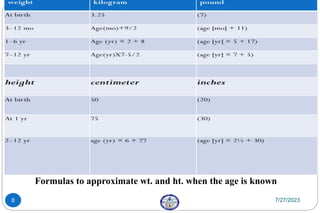
WEIGHT
 Average birth wt is said to be abt 3.25 kg
 New born loses up to 10% of body wt in the first week and regains
the birth wt at the 10’th day of life.
 For the first 3 months the infant gains about 30 gm per day.
 Then gains about 40 gm per month for the rest of the first year.
 The infant doubles his birth wt. at 5 months and triples it at 1 yr.
7/27/2023
5
WEIGHT
 At 1yr is 3 times birth weight
 At 2yrs is 4 times Birth weight
 At 3yrs is 5 times the birth weight
 At 5yrs is 6 times the birth weight
 At 10yrs is 10 times the birth weight
7/27/2023
6
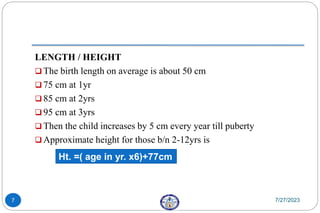
LENGTH / HEIGHT
 The birth length on average is about 50 cm
 75 cm at 1yr
 85 cm at 2yrs
 95 cm at 3yrs
 Then the child increases by 5 cm every year till puberty
 Approximate height for those b/n 2-12yrs is
Ht. =( age in yr. x6)+77cm
7/27/2023
7
Ht. =( age in yr. x6)+77cm
Formulas to approximate wt. and ht. when the age is known
7/27/2023
8
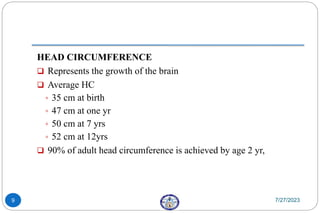
HEAD CIRCUMFERENCE
 Represents the growth of the brain
 Average HC
◦ 35 cm at birth
◦ 47 cm at one yr
◦ 50 cm at 7 yrs
◦ 52 cm at 12yrs
 90% of adult head circumference is achieved by age 2 yr,
7/27/2023
9
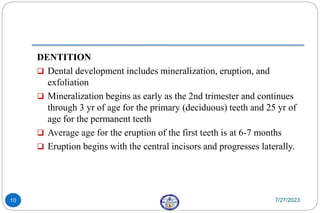
DENTITION
 Dental development includes mineralization, eruption, and
exfoliation
 Mineralization begins as early as the 2nd trimester and continues
through 3 yr of age for the primary (deciduous) teeth and 25 yr of
age for the permanent teeth
 Average age for the eruption of the first teeth is at 6-7 months
 Eruption begins with the central incisors and progresses laterally.
7/27/2023
10
 The rest of the milk teeth appear at a rate of one teeth per month
 By 2&half to 3 yrs the child has the 20 milk teeth
 At 6yrs exfoliation of milk teeth begins and continue up to 12 yrs.
 Delayed eruption of tooth as late as 13 months is normal
7/27/2023
11
FACTORS AFFECTING GROWTH AND
DEVELOPMENT
 Genetic/biologic factors
 Neuro hormonal factors
 Nutritional factors
 Psychological factors
 Social factors
7/27/2023
12
GENETIC FACTORS
 The growth of a child is a result of complex interactions of genetic
and environmental factors.
 As a result of multiple genetic differences, certain people are taller
than others.
7/27/2023
13
NEURO HORMONAL FACTORS
 It has been suggested that there may be a growth center in the brain
that keeps the child in his or her genetically determined growth
curve.
7/27/2023
14
HORMONAL INFLUENCE
 Most of the endocrine glands influence growth significantly either
by promoting protein synthesis, regulating substrate supply, or
enhancing the effect of other hormones on specific organs.
 Hormones with a great influence on growth are: growth hormone,
somatomedines, insulin, thyroid hormone, and sex hormones.
7/27/2023
15
NUTRITION
 Adequate food to provide substrate for energy and synthesis of
proteins is essential for normal growth.
 Illnesses which interfere with nutritional intake or compete for it
delays growth and dev’t.
7/27/2023
16
ASSESSMENT OF GROWTH AND
DEVELOPMENT
 Important for early detection of deviation in child’s pattern of
growth and development, and to take appropriate action.
 The most powerful tool in growth assessment is the growth chart
which provides most of the information needed to assess growth.
 The standard charts are based on the data collected from 1963
to1975 by the National Centers for Health Statistics (NCHS).
 The new standard chart prepared by CDC also provides body mass
index (BMI) curves through age 2yrs to 20yrs, facilitating
identification of obesity.
7/27/2023
17
 Separate charts are provided for boys and girls.
 Each chart is composed of seven percentile curves, which indicate
the percentages of children at a given age on the X-axis whose
measured values fall below the corresponding value on the Y-axis.
 The normal values for age are represented between the fifth and
ninety-fifth percentiles, and the fiftieth percentile represents the
median (standard) value.
 In children under 5 years old an additional chart (Harvard standard)
is used to measure weight for age as percentages of the median or
standard value in the NCHS curve.
7/27/2023
18
 The data are presented in 5 standard gender-specific charts:
(1) weight for age;
(2) height/length for age;
(3) head circumference for age;
(4) weight for height/ length; and
(5) BMI for age, for children over 2 yr of age
7/27/2023
19
WEIGHT FOR AGE
 Children falling below the 5th centile of NCHS or below the 80% of
Harvard Standard are labelled as malnourished.
7/27/2023
20
HEIGHT/ LENGTH FOR AGE
 A height for age that is below normal shows stunting and indicates
chronic states of malnutrition.
7/27/2023
21
WEIGHT FOR HEIGHT
 Getting an accurate age may be a problem in countries like
Ethiopia, where the majority of people are from rural areas and
illiterate.
 Weight for height measurements can overcome this problem.
 Those with weight for height falling below the normal are labeled
as wasted (acute malnutrition).
7/27/2023
22
HEAD CIRCUMFERENCE FOR AGE
 Values below the -3 standard deviation (SD) are labelled as
microcephaly and above +3 SD as macrocephaly.
7/27/2023
23
Mid-upper arm circumference (MUAC)
 This indicates acute malnutrition and values less than normal are
labeled as wasting.
 For children 6 month to 5yrs:
<11cm is severe wasting
11-12.5cm is moderate wasting
12.5- 13.5 is mild wasting
>13.5cm is normal
 Not used in children less than 6 months.
7/27/2023
24
 There are four components of developmental Assessment
1. Gross motor development
2. Fine motor development (manipulation)
3. Cognition and social skill development
4. Language development
 Development follows in a predictive manner i.e,central to
peripheral , proximal to distal, and cephal to caudal.
7/27/2023
25
ASSESSMENT OF DEVELOPMENT
Gross motor development
 Denotes a neuromuscular development including posture,
independent mobilities, progresses from head control when the
child is sitting alone to standing, walking and running.
7/27/2023
26
Fine motor development
 Fine motor development denotes the ability of the child to reach
for, grasp and manipulate objects.
7/27/2023
27
Cognition and social skill
 These include social smile, watching a mirror, waving goodbye,
general alertness, and curiosity about the surrounding.
7/27/2023
28
Language
 Development of speech.
7/27/2023
29
Infancy
 Gross motor: lift their heads with good control at 3 months, sit
independently at 6 months without support , crawl at 8 months,
stand and start to walk at 1 year.
7/27/2023
30
 Fine motor: at 3-4 months babies can grasp objects, at 5-6 months
they can transfer objects from hand to hand, at 9 months they can
achieve a thumb-finger grasp, and at around 12 months they start to
scribble.
 Cognition and social skills: at 6-8 weeks babies start to smile in
response to faces or voices, at 4 months they laugh, at 6-8 months
they develop stranger anxiety.
 Language: during their first 6 months babies pronounce vowels; at
7 months they start to voice consonants, at age 12 months they start
saying ‘mama’ & ‘dada .
7/27/2023
31
Toddlerhood
 In this period the growth rate slows down compared to infancy.
 Gross motor: toddlers start to walk independently between the age
of 12 to 15 months; at 18 months, they can run stiffly and walk
upstairs with one hand held, at 24 months they can run well.
 Fine motor: at 15 month toddlers can make a line with crayon and
insert pellet in a bottle; at 18 month they can imitate a vertical
stroke, and at 24 months they can imitate a horizontal stroke.
7/27/2023
32
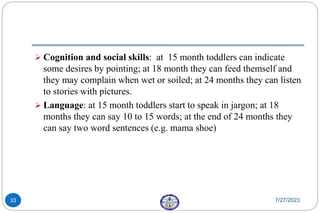
 Cognition and social skills: at 15 month toddlers can indicate
some desires by pointing; at 18 month they can feed themself and
they may complain when wet or soiled; at 24 months they can listen
to stories with pictures.
 Language: at 15 month toddlers start to speak in jargon; at 18
months they can say 10 to 15 words; at the end of 24 months they
can say two word sentences (e.g. mama shoe)
7/27/2023
33
Pre school years
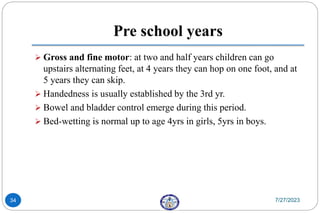
 Gross and fine motor: at two and half years children can go
upstairs alternating feet, at 4 years they can hop on one foot, and at
5 years they can skip.
 Handedness is usually established by the 3rd yr.
 Bowel and bladder control emerge during this period.
 Bed-wetting is normal up to age 4yrs in girls, 5yrs in boys.
7/27/2023
34
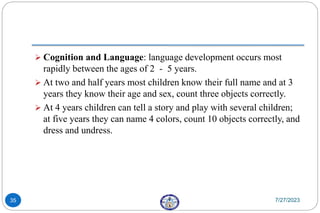
 Cognition and Language: language development occurs most
rapidly between the ages of 2 - 5 years.
 At two and half years most children know their full name and at 3
years they know their age and sex, count three objects correctly.
 At 4 years children can tell a story and play with several children;
at five years they can name 4 colors, count 10 objects correctly, and
dress and undress.
7/27/2023
35
School age
 Motor: able to perform complex movements such as dancing.
 Cognition and language: children start thinking in concrete logical
operations.
7/27/2023
36
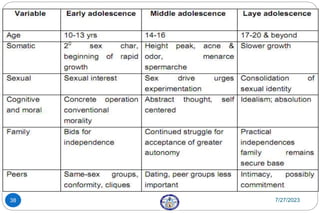
Adolescence
 Children undergo rapid changes in body size, shape, physiology,
and psychology and social functioning.
 It proceeds in three phases; early, middle,& late adolescence.
 Each phase has its own characteristics
 The common changes that occur during each phase are described in
the following table.
7/27/2023
37
7/27/2023
38
Sexual maturity rating for adolescence assessment,
males
7/27/2023
39
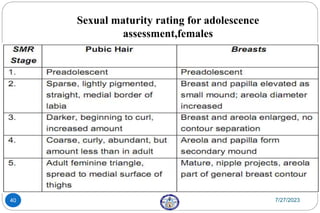
Sexual maturity rating for adolescence
assessment,females
7/27/2023
40
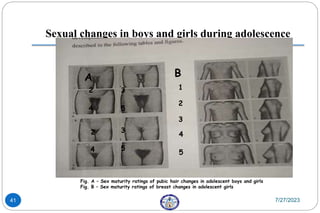
Sexual changes in boys and girls during adolescence
Fig. A – Sex maturity ratings of pubic hair changes in adolescent boys and girls
Fig. B – Sex maturity ratings of breast changes in adolescent girls
A B
2 3
4 5
2 3
4 5
1
2
3
4
5
7/27/2023
41
 In the girls, the first visible sign of puberty is the appearance of
breast buds, between 8 and 12 yr of age.
 Menses typically begins at median age of 12 yr; (9–16 yr.)
 In boys, the first visible sign of puberty is testicular enlargement,
beginning as early as 9½ yr. followed by penile growth.
7/27/2023
42
THANK YOU!
43 7/27/2023

G & D for HO students GROWTH AND DEVELOPMENT.ppt

  • 1.
    AMU School OfMedicine By: Ephrem F. (MD) GROWTH AND DEVELOPMENT
  • 2.
    OBJECTIVES  Define growthand development  To discuss on the normal patterns of growth and development at different age groups  To discuss on how to assess growth and development  To discuss on the factors affecting growth and development 7/27/2023 2
  • 3.
    DEFINITIONS  Growth: isan increase in size of the body and its various organs from simple to complex, from its earliest stage to maturity.  Development: implies an increase in skill and complexity of function. 7/27/2023 3
  • 4.
    NORMAL GROWTH PATTERNS The rate of growth in the first year of life is the most rapid one, tripling his birth weight and increasing his length by 50% .  The increase in the head circumference is also one of the rapid rates in his entire life which is 12cm 7/27/2023 4
  • 5.
    WEIGHT  Average birthwt is said to be abt 3.25 kg  New born loses up to 10% of body wt in the first week and regains the birth wt at the 10’th day of life.  For the first 3 months the infant gains about 30 gm per day.  Then gains about 40 gm per month for the rest of the first year.  The infant doubles his birth wt. at 5 months and triples it at 1 yr. 7/27/2023 5
  • 6.
    WEIGHT  At 1yris 3 times birth weight  At 2yrs is 4 times Birth weight  At 3yrs is 5 times the birth weight  At 5yrs is 6 times the birth weight  At 10yrs is 10 times the birth weight 7/27/2023 6
  • 7.
    LENGTH / HEIGHT The birth length on average is about 50 cm  75 cm at 1yr  85 cm at 2yrs  95 cm at 3yrs  Then the child increases by 5 cm every year till puberty  Approximate height for those b/n 2-12yrs is Ht. =( age in yr. x6)+77cm 7/27/2023 7 Ht. =( age in yr. x6)+77cm
  • 8.
    Formulas to approximatewt. and ht. when the age is known 7/27/2023 8
  • 9.
    HEAD CIRCUMFERENCE  Representsthe growth of the brain  Average HC ◦ 35 cm at birth ◦ 47 cm at one yr ◦ 50 cm at 7 yrs ◦ 52 cm at 12yrs  90% of adult head circumference is achieved by age 2 yr, 7/27/2023 9
  • 10.
    DENTITION  Dental developmentincludes mineralization, eruption, and exfoliation  Mineralization begins as early as the 2nd trimester and continues through 3 yr of age for the primary (deciduous) teeth and 25 yr of age for the permanent teeth  Average age for the eruption of the first teeth is at 6-7 months  Eruption begins with the central incisors and progresses laterally. 7/27/2023 10
  • 11.
     The restof the milk teeth appear at a rate of one teeth per month  By 2&half to 3 yrs the child has the 20 milk teeth  At 6yrs exfoliation of milk teeth begins and continue up to 12 yrs.  Delayed eruption of tooth as late as 13 months is normal 7/27/2023 11
  • 12.
    FACTORS AFFECTING GROWTHAND DEVELOPMENT  Genetic/biologic factors  Neuro hormonal factors  Nutritional factors  Psychological factors  Social factors 7/27/2023 12
  • 13.
    GENETIC FACTORS  Thegrowth of a child is a result of complex interactions of genetic and environmental factors.  As a result of multiple genetic differences, certain people are taller than others. 7/27/2023 13
  • 14.
    NEURO HORMONAL FACTORS It has been suggested that there may be a growth center in the brain that keeps the child in his or her genetically determined growth curve. 7/27/2023 14
  • 15.
    HORMONAL INFLUENCE  Mostof the endocrine glands influence growth significantly either by promoting protein synthesis, regulating substrate supply, or enhancing the effect of other hormones on specific organs.  Hormones with a great influence on growth are: growth hormone, somatomedines, insulin, thyroid hormone, and sex hormones. 7/27/2023 15
  • 16.
    NUTRITION  Adequate foodto provide substrate for energy and synthesis of proteins is essential for normal growth.  Illnesses which interfere with nutritional intake or compete for it delays growth and dev’t. 7/27/2023 16
  • 17.
    ASSESSMENT OF GROWTHAND DEVELOPMENT  Important for early detection of deviation in child’s pattern of growth and development, and to take appropriate action.  The most powerful tool in growth assessment is the growth chart which provides most of the information needed to assess growth.  The standard charts are based on the data collected from 1963 to1975 by the National Centers for Health Statistics (NCHS).  The new standard chart prepared by CDC also provides body mass index (BMI) curves through age 2yrs to 20yrs, facilitating identification of obesity. 7/27/2023 17
  • 18.
     Separate chartsare provided for boys and girls.  Each chart is composed of seven percentile curves, which indicate the percentages of children at a given age on the X-axis whose measured values fall below the corresponding value on the Y-axis.  The normal values for age are represented between the fifth and ninety-fifth percentiles, and the fiftieth percentile represents the median (standard) value.  In children under 5 years old an additional chart (Harvard standard) is used to measure weight for age as percentages of the median or standard value in the NCHS curve. 7/27/2023 18
  • 19.
     The dataare presented in 5 standard gender-specific charts: (1) weight for age; (2) height/length for age; (3) head circumference for age; (4) weight for height/ length; and (5) BMI for age, for children over 2 yr of age 7/27/2023 19
  • 20.
    WEIGHT FOR AGE Children falling below the 5th centile of NCHS or below the 80% of Harvard Standard are labelled as malnourished. 7/27/2023 20
  • 21.
    HEIGHT/ LENGTH FORAGE  A height for age that is below normal shows stunting and indicates chronic states of malnutrition. 7/27/2023 21
  • 22.
    WEIGHT FOR HEIGHT Getting an accurate age may be a problem in countries like Ethiopia, where the majority of people are from rural areas and illiterate.  Weight for height measurements can overcome this problem.  Those with weight for height falling below the normal are labeled as wasted (acute malnutrition). 7/27/2023 22
  • 23.
    HEAD CIRCUMFERENCE FORAGE  Values below the -3 standard deviation (SD) are labelled as microcephaly and above +3 SD as macrocephaly. 7/27/2023 23
  • 24.
    Mid-upper arm circumference(MUAC)  This indicates acute malnutrition and values less than normal are labeled as wasting.  For children 6 month to 5yrs: <11cm is severe wasting 11-12.5cm is moderate wasting 12.5- 13.5 is mild wasting >13.5cm is normal  Not used in children less than 6 months. 7/27/2023 24
  • 25.
     There arefour components of developmental Assessment 1. Gross motor development 2. Fine motor development (manipulation) 3. Cognition and social skill development 4. Language development  Development follows in a predictive manner i.e,central to peripheral , proximal to distal, and cephal to caudal. 7/27/2023 25 ASSESSMENT OF DEVELOPMENT
  • 26.
    Gross motor development Denotes a neuromuscular development including posture, independent mobilities, progresses from head control when the child is sitting alone to standing, walking and running. 7/27/2023 26
  • 27.
    Fine motor development Fine motor development denotes the ability of the child to reach for, grasp and manipulate objects. 7/27/2023 27
  • 28.
    Cognition and socialskill  These include social smile, watching a mirror, waving goodbye, general alertness, and curiosity about the surrounding. 7/27/2023 28
  • 29.
    Language  Development ofspeech. 7/27/2023 29
  • 30.
    Infancy  Gross motor:lift their heads with good control at 3 months, sit independently at 6 months without support , crawl at 8 months, stand and start to walk at 1 year. 7/27/2023 30
  • 31.
     Fine motor:at 3-4 months babies can grasp objects, at 5-6 months they can transfer objects from hand to hand, at 9 months they can achieve a thumb-finger grasp, and at around 12 months they start to scribble.  Cognition and social skills: at 6-8 weeks babies start to smile in response to faces or voices, at 4 months they laugh, at 6-8 months they develop stranger anxiety.  Language: during their first 6 months babies pronounce vowels; at 7 months they start to voice consonants, at age 12 months they start saying ‘mama’ & ‘dada . 7/27/2023 31
  • 32.
    Toddlerhood  In thisperiod the growth rate slows down compared to infancy.  Gross motor: toddlers start to walk independently between the age of 12 to 15 months; at 18 months, they can run stiffly and walk upstairs with one hand held, at 24 months they can run well.  Fine motor: at 15 month toddlers can make a line with crayon and insert pellet in a bottle; at 18 month they can imitate a vertical stroke, and at 24 months they can imitate a horizontal stroke. 7/27/2023 32
  • 33.
     Cognition andsocial skills: at 15 month toddlers can indicate some desires by pointing; at 18 month they can feed themself and they may complain when wet or soiled; at 24 months they can listen to stories with pictures.  Language: at 15 month toddlers start to speak in jargon; at 18 months they can say 10 to 15 words; at the end of 24 months they can say two word sentences (e.g. mama shoe) 7/27/2023 33
  • 34.
    Pre school years Gross and fine motor: at two and half years children can go upstairs alternating feet, at 4 years they can hop on one foot, and at 5 years they can skip.  Handedness is usually established by the 3rd yr.  Bowel and bladder control emerge during this period.  Bed-wetting is normal up to age 4yrs in girls, 5yrs in boys. 7/27/2023 34
  • 35.
     Cognition andLanguage: language development occurs most rapidly between the ages of 2 - 5 years.  At two and half years most children know their full name and at 3 years they know their age and sex, count three objects correctly.  At 4 years children can tell a story and play with several children; at five years they can name 4 colors, count 10 objects correctly, and dress and undress. 7/27/2023 35
  • 36.
    School age  Motor:able to perform complex movements such as dancing.  Cognition and language: children start thinking in concrete logical operations. 7/27/2023 36
  • 37.
    Adolescence  Children undergorapid changes in body size, shape, physiology, and psychology and social functioning.  It proceeds in three phases; early, middle,& late adolescence.  Each phase has its own characteristics  The common changes that occur during each phase are described in the following table. 7/27/2023 37
  • 38.
  • 39.
    Sexual maturity ratingfor adolescence assessment, males 7/27/2023 39
  • 40.
    Sexual maturity ratingfor adolescence assessment,females 7/27/2023 40
  • 41.
    Sexual changes inboys and girls during adolescence Fig. A – Sex maturity ratings of pubic hair changes in adolescent boys and girls Fig. B – Sex maturity ratings of breast changes in adolescent girls A B 2 3 4 5 2 3 4 5 1 2 3 4 5 7/27/2023 41
  • 42.
     In thegirls, the first visible sign of puberty is the appearance of breast buds, between 8 and 12 yr of age.  Menses typically begins at median age of 12 yr; (9–16 yr.)  In boys, the first visible sign of puberty is testicular enlargement, beginning as early as 9½ yr. followed by penile growth. 7/27/2023 42
  • 43.