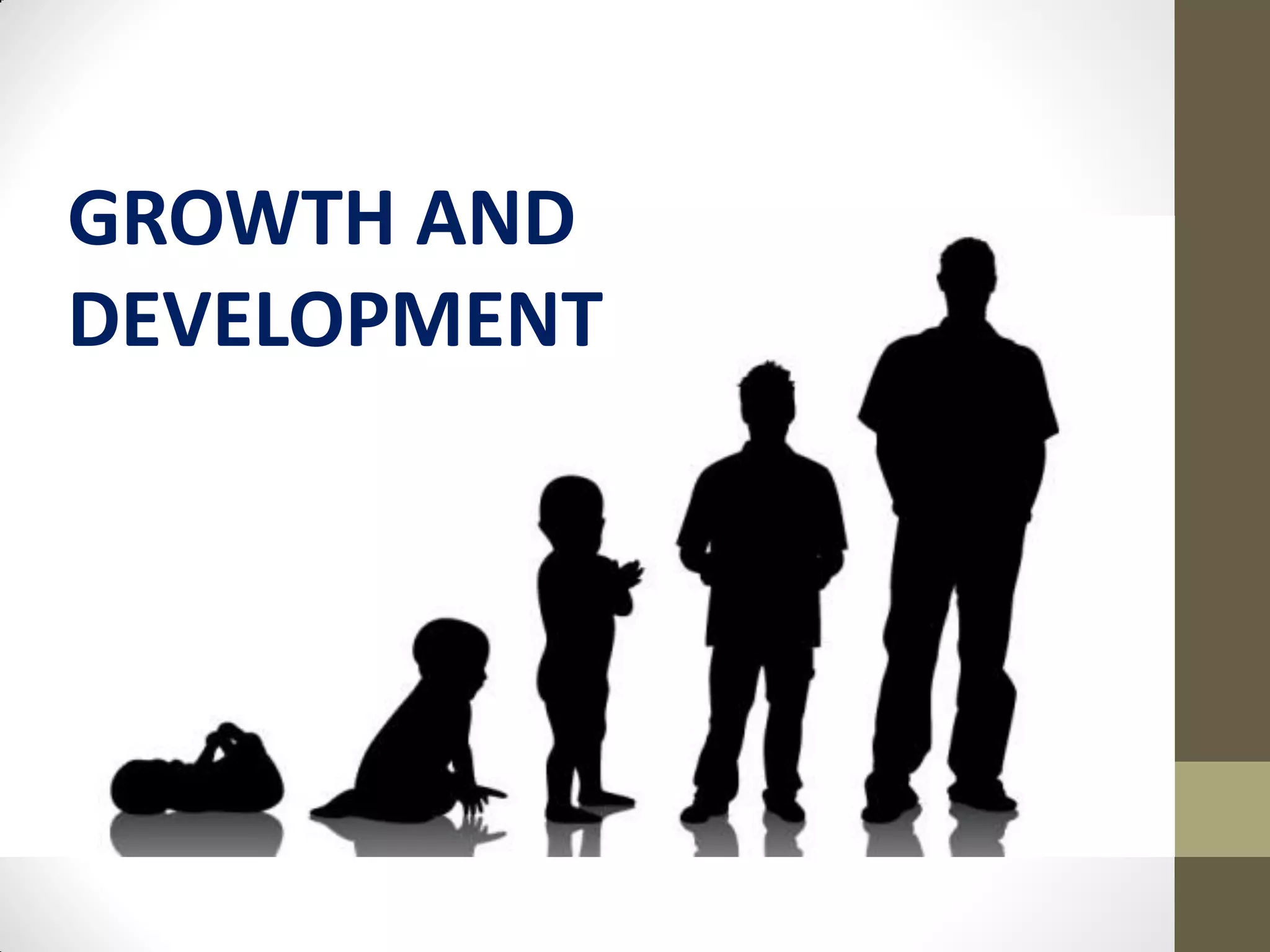
GROWTH AND
DEVELOPMENT
Growth and Development
Growth refers to structural and
physiological changes while
Development refers to growth
as well as changes in behavior
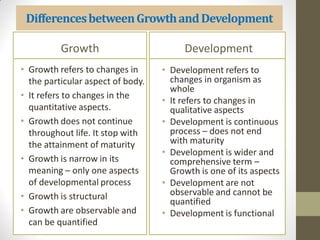
DifferencesbetweenGrowthandDevelopment
Growth
• Growth refers to changes in
the particular aspect of body.
• It refers to changes in the
quantitative aspects.
• Growth does not continue
throughout life. It stop with
the attainment of maturity
• Growth is narrow in its
meaning – only one aspects
of developmental process
• Growth is structural
• Growth are observable and
can be quantified
Development
• Development refers to
changes in organism as
whole
• It refers to changes in
qualitative aspects
• Development is continuous
process – does not end
with maturity
• Development is wider and
comprehensive term –
Growth is one of its aspects
• Development are not
observable and cannot be
quantified
• Development is functional
1. Growth proceeds more rapidly in the early years of
life,
2. The rate of growth is not uniform in the life of an
individual.
3. Growth is gradual but continuous.
4. It is cumulative in nature.
5. The tempo of growth is not even.
6. It is a complex process.
7. It take place at different rates for different parts of the
body.
8. Growth follows definite sequence and predictable
pattern.
CHARACTERISTICS OF GROWTH
PRINCIPLES OF DEVELOPMENT
1. Development is a product of the interaction between
heredity and environment.
2. Development is a product of the interaction between
maturation and learning
3. Development is continuous and gradual.
4. Development follows an orderly sequence.
5. Development is a cumulative and positive process
6. Development is an individualised process.
7. Development is proceeds from general to specific.
8. Development is predictable
9. Development is spiral and not linear.
FACTORS INFLUENCING DEVELOPMENT
A. Heredity and Environment
B. Maturation and Learning
Heredity is the sum total of the physical and mental
characteristics that an individual inherits from his
parents. These characteristics are transmitted to
the person from his parents through genes in the
chromosomes.
Environment is everything, other than heredity,
that influences an individual’s growth and
development. The physical surroundings,
education, training, experiences, nourishment and
all other stimulations come under environmental
condition
Maturation refers to the unfolding of biological
inherited potentialities as a function of time or in
an age-related sequence. Development changes
result from both maturation and experience with
environment.
Learning refers to changes in behavior or
performance as a consequence of experience .
It implies exercise and experience.
STAGES OF DEVELOPMENT
1. Pre natal period
(conception to 250 days)
2.Infancy
(0 – 3 years)
3. Early childhood
(3 – 6 years)
4. Later childhood
(6 – 12years)
5. Adolescence
(12 – 19 years)
6. Adulthood
(beyond 19)
ASPECTS OF DEVELOPMENT
1.Physical development
2.Motor development
3.Emotional development
4.Social development
5.Moral development
6.Mental development
7.Development of language
8.Development of Attitude, Interest and
Values
Try to seize the knowledge…
Thank you
NISHAD MUHAMMED
nishadcld68@gmail.com
Keyi sahib B . Ed
College,Thaliparamba

Growth and development

  • 1.
  • 2.
    Growth and Development Growthrefers to structural and physiological changes while Development refers to growth as well as changes in behavior
  • 3.
    DifferencesbetweenGrowthandDevelopment Growth • Growth refersto changes in the particular aspect of body. • It refers to changes in the quantitative aspects. • Growth does not continue throughout life. It stop with the attainment of maturity • Growth is narrow in its meaning – only one aspects of developmental process • Growth is structural • Growth are observable and can be quantified Development • Development refers to changes in organism as whole • It refers to changes in qualitative aspects • Development is continuous process – does not end with maturity • Development is wider and comprehensive term – Growth is one of its aspects • Development are not observable and cannot be quantified • Development is functional
  • 4.
    1. Growth proceedsmore rapidly in the early years of life, 2. The rate of growth is not uniform in the life of an individual. 3. Growth is gradual but continuous. 4. It is cumulative in nature. 5. The tempo of growth is not even. 6. It is a complex process. 7. It take place at different rates for different parts of the body. 8. Growth follows definite sequence and predictable pattern. CHARACTERISTICS OF GROWTH
  • 5.
    PRINCIPLES OF DEVELOPMENT 1.Development is a product of the interaction between heredity and environment. 2. Development is a product of the interaction between maturation and learning 3. Development is continuous and gradual. 4. Development follows an orderly sequence. 5. Development is a cumulative and positive process 6. Development is an individualised process. 7. Development is proceeds from general to specific. 8. Development is predictable 9. Development is spiral and not linear.
  • 6.
    FACTORS INFLUENCING DEVELOPMENT A.Heredity and Environment B. Maturation and Learning
  • 7.
    Heredity is thesum total of the physical and mental characteristics that an individual inherits from his parents. These characteristics are transmitted to the person from his parents through genes in the chromosomes. Environment is everything, other than heredity, that influences an individual’s growth and development. The physical surroundings, education, training, experiences, nourishment and all other stimulations come under environmental condition
  • 8.
    Maturation refers tothe unfolding of biological inherited potentialities as a function of time or in an age-related sequence. Development changes result from both maturation and experience with environment. Learning refers to changes in behavior or performance as a consequence of experience . It implies exercise and experience.
  • 9.
    STAGES OF DEVELOPMENT 1.Pre natal period (conception to 250 days) 2.Infancy (0 – 3 years) 3. Early childhood (3 – 6 years) 4. Later childhood (6 – 12years) 5. Adolescence (12 – 19 years) 6. Adulthood (beyond 19)
  • 10.
    ASPECTS OF DEVELOPMENT 1.Physicaldevelopment 2.Motor development 3.Emotional development 4.Social development 5.Moral development 6.Mental development 7.Development of language 8.Development of Attitude, Interest and Values
  • 11.
    Try to seizethe knowledge… Thank you NISHAD MUHAMMED nishadcld68@gmail.com Keyi sahib B . Ed College,Thaliparamba