Curriculum Development in
Higher Education
Dr. Z. Zayapragassarazan PhD.,
Associate Professor of Educational Technology
Department of Medical Education
JIPMER
Puducherry-605006.
Mobile: 9894846929
E-mail: zprazan@yahoo.co.in
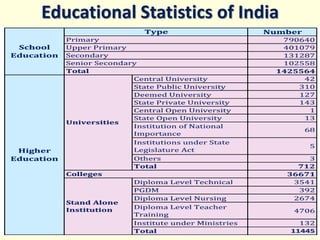
Educational Statistics of India
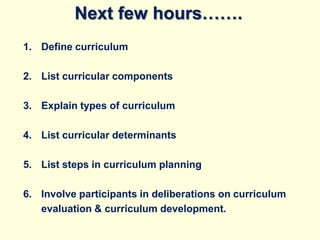
Next few hours…….
1. Define curriculum
2. List curricular components
3. Explain types of curriculum
4. List curricular determinants
5. List steps in curriculum planning
6. Involve participants in deliberations on curriculum
evaluation & curriculum development.
The strengths of ideal autonomy
• Innovations
• Experimentation
• Expansion and maximization of potentials
• Quality improvement
• Societal relevance
• Full involvement of teachers in the entire system
• Confidence building between students and teachers
• Transparency in teaching and evaluation
• Increased scope for educational reforms
• Speedy implementation of programmes
Curriculum
A plan of educational experiences
offered to a learner under the
guidance of an educational
institution.
Curricular Components
1. Learning objectives
2. Selection & organization of content
(syllabus)
3. Pattern of teaching & learning
including time schedule
4. Program of assessment
5. Learning resources
Types of Curriculum
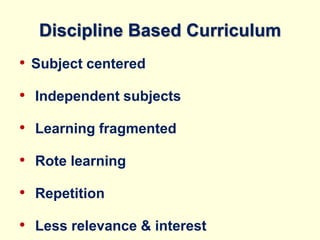
Discipline Based Curriculum
• Subject centered
• Independent subjects
• Learning fragmented
• Rote learning
• Repetition
• Less relevance & interest
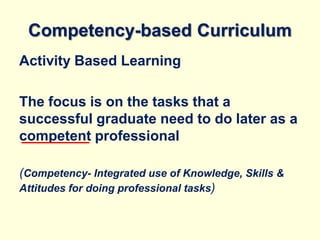
Competency-based Curriculum
Activity Based Learning
The focus is on the tasks that a
successful graduate need to do later as a
competent professional
(Competency- Integrated use of Knowledge, Skills &
Attitudes for doing professional tasks)
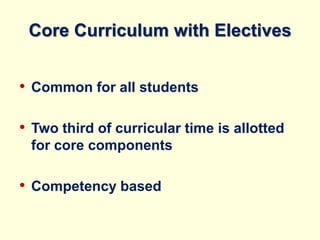
Core Curriculum with Electives
• Common for all students
• Two third of curricular time is allotted
for core components
• Competency based
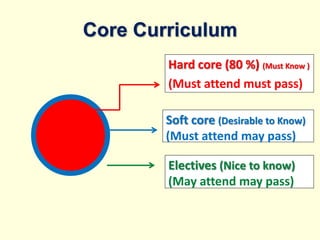
Core Curriculum
Hard core (80 %) (Must Know )
(Must attend must pass)
Soft core (Desirable to Know)
(Must attend may pass)
Electives (Nice to know)
(May attend may pass)
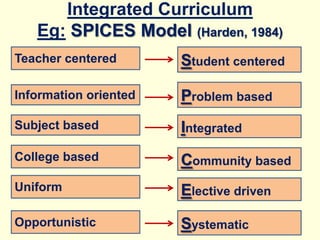
Integrated Curriculum
Eg: SPICES Model (Harden, 1984)
Teacher centered Student centered
Information oriented Problem based
Integrated
Community based
Subject based
College based
Uniform Elective driven
Opportunistic Systematic
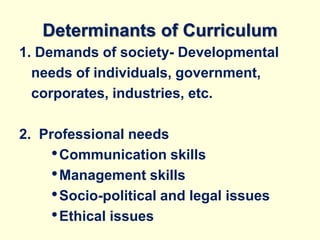
Determinants of Curriculum
1. Demands of society- Developmental
needs of individuals, government,
corporates, industries, etc.
2. Professional needs
•Communication skills
•Management skills
•Socio-political and legal issues
•Ethical issues
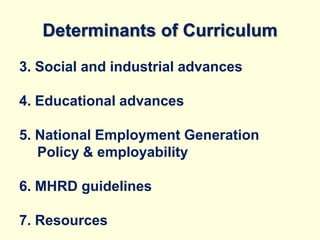
Determinants of Curriculum
3. Social and industrial advances
4. Educational advances
5. National Employment Generation
Policy & employability
6. MHRD guidelines
7. Resources
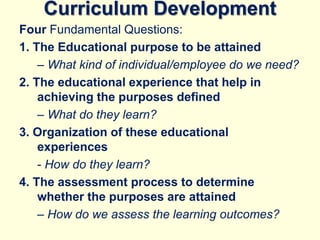
Curriculum Development
Four Fundamental Questions:
1. The Educational purpose to be attained
– What kind of individual/employee do we need?
2. The educational experience that help in
achieving the purposes defined
– What do they learn?
3. Organization of these educational
experiences
- How do they learn?
4. The assessment process to determine
whether the purposes are attained
– How do we assess the learning outcomes?
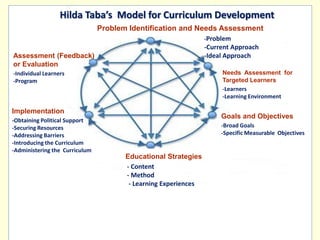
Problem Identification and Needs Assessment
-Problem
-Current Approach
-Ideal Approach
Needs Assessment for
Targeted Learners
-Learners
-Learning Environment
Goals and Objectives
-Broad Goals
-Specific Measurable Objectives
Educational Strategies
- Content
- Method
- Learning Experiences
Implementation
-Obtaining Political Support
-Securing Resources
-Addressing Barriers
-Introducing the Curriculum
-Administering the Curriculum
Assessment (Feedback)
or Evaluation
-Individual Learners
-Program
Hilda Taba’s Model for Curriculum Development
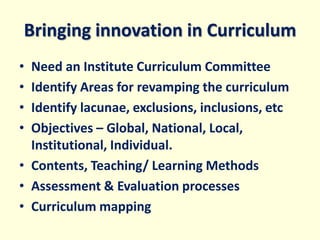
Bringing innovation in Curriculum
• Need an Institute Curriculum Committee
• Identify Areas for revamping the curriculum
• Identify lacunae, exclusions, inclusions, etc
• Objectives – Global, National, Local,
Institutional, Individual.
• Contents, Teaching/ Learning Methods
• Assessment & Evaluation processes
• Curriculum mapping
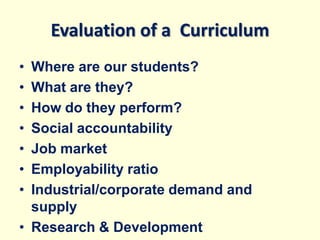
Evaluation of a Curriculum
• Where are our students?
• What are they?
• How do they perform?
• Social accountability
• Job market
• Employability ratio
• Industrial/corporate demand and
supply
• Research & Development
?
Curriculum Development Exercise-1
Topic:
Identify one major lacuna (gap) in the existing
curriculum and provide solution for the same.
Method:
Think, Pair, Share
Think, Pair & Share
The think, pair, share strategy is a
cooperative learning technique that
encourages individual participation and is
applicable across all levels and class sizes.
Learners think through questions using three
distinct steps:
Think
Pair
Share
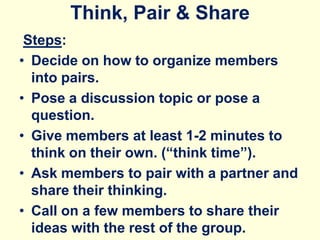
Think, Pair & Share
Steps:
• Decide on how to organize members
into pairs.
• Pose a discussion topic or pose a
question.
• Give members at least 1-2 minutes to
think on their own. (“think time”).
• Ask members to pair with a partner and
share their thinking.
• Call on a few members to share their
ideas with the rest of the group.
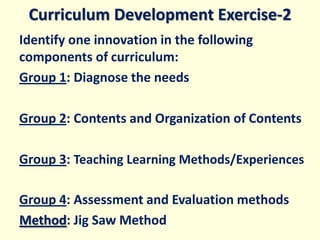
Curriculum Development Exercise-2
Identify one innovation in the following
components of curriculum:
Group 1: Diagnose the needs
Group 2: Contents and Organization of Contents
Group 3: Teaching Learning Methods/Experiences
Group 4: Assessment and Evaluation methods
Method: Jig Saw Method
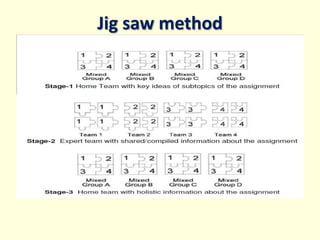
Jig saw method
Curriculum - Checklist
1. Have the objectives been specified? Are these
relevant and feasible?
2. Has the course content been decided?
3. Has the decision been made on
-Who will teach?
-When will it be taught?
-How long will it be taught?
-What are the course materials, references, required?
-What other T/L aids are required?
-What assessment methods will be used to check
whether the specified objectives are achieved?
5. How will the curriculum be evaluated including a
provision for change, if necessary?
Summary
• A curriculum is a plan of educational
experiences with clearly stated
components.
• The type of a curriculum is decided
based on the developmental needs of
society.
• Effectiveness of a curriculum depends
on its determinants.
• Proper steps need to be followed while
developing a curriculum.
Thank you

Curriculum development in higher education

  • 1.
    Curriculum Development in HigherEducation Dr. Z. Zayapragassarazan PhD., Associate Professor of Educational Technology Department of Medical Education JIPMER Puducherry-605006. Mobile: 9894846929 E-mail: zprazan@yahoo.co.in
  • 2.
  • 3.
    Next few hours……. 1.Define curriculum 2. List curricular components 3. Explain types of curriculum 4. List curricular determinants 5. List steps in curriculum planning 6. Involve participants in deliberations on curriculum evaluation & curriculum development.
  • 4.
    The strengths ofideal autonomy • Innovations • Experimentation • Expansion and maximization of potentials • Quality improvement • Societal relevance • Full involvement of teachers in the entire system • Confidence building between students and teachers • Transparency in teaching and evaluation • Increased scope for educational reforms • Speedy implementation of programmes
  • 5.
    Curriculum A plan ofeducational experiences offered to a learner under the guidance of an educational institution.
  • 6.
    Curricular Components 1. Learningobjectives 2. Selection & organization of content (syllabus) 3. Pattern of teaching & learning including time schedule 4. Program of assessment 5. Learning resources
  • 7.
  • 8.
    Discipline Based Curriculum •Subject centered • Independent subjects • Learning fragmented • Rote learning • Repetition • Less relevance & interest
  • 9.
    Competency-based Curriculum Activity BasedLearning The focus is on the tasks that a successful graduate need to do later as a competent professional (Competency- Integrated use of Knowledge, Skills & Attitudes for doing professional tasks)
  • 10.
    Core Curriculum withElectives • Common for all students • Two third of curricular time is allotted for core components • Competency based
  • 11.
    Core Curriculum Hard core(80 %) (Must Know ) (Must attend must pass) Soft core (Desirable to Know) (Must attend may pass) Electives (Nice to know) (May attend may pass)
  • 12.
    Integrated Curriculum Eg: SPICESModel (Harden, 1984) Teacher centered Student centered Information oriented Problem based Integrated Community based Subject based College based Uniform Elective driven Opportunistic Systematic
  • 13.
    Determinants of Curriculum 1.Demands of society- Developmental needs of individuals, government, corporates, industries, etc. 2. Professional needs •Communication skills •Management skills •Socio-political and legal issues •Ethical issues
  • 14.
    Determinants of Curriculum 3.Social and industrial advances 4. Educational advances 5. National Employment Generation Policy & employability 6. MHRD guidelines 7. Resources
  • 15.
    Curriculum Development Four FundamentalQuestions: 1. The Educational purpose to be attained – What kind of individual/employee do we need? 2. The educational experience that help in achieving the purposes defined – What do they learn? 3. Organization of these educational experiences - How do they learn? 4. The assessment process to determine whether the purposes are attained – How do we assess the learning outcomes?
  • 16.
    Problem Identification andNeeds Assessment -Problem -Current Approach -Ideal Approach Needs Assessment for Targeted Learners -Learners -Learning Environment Goals and Objectives -Broad Goals -Specific Measurable Objectives Educational Strategies - Content - Method - Learning Experiences Implementation -Obtaining Political Support -Securing Resources -Addressing Barriers -Introducing the Curriculum -Administering the Curriculum Assessment (Feedback) or Evaluation -Individual Learners -Program Hilda Taba’s Model for Curriculum Development
  • 17.
    Bringing innovation inCurriculum • Need an Institute Curriculum Committee • Identify Areas for revamping the curriculum • Identify lacunae, exclusions, inclusions, etc • Objectives – Global, National, Local, Institutional, Individual. • Contents, Teaching/ Learning Methods • Assessment & Evaluation processes • Curriculum mapping
  • 18.
    Evaluation of aCurriculum • Where are our students? • What are they? • How do they perform? • Social accountability • Job market • Employability ratio • Industrial/corporate demand and supply • Research & Development
  • 19.
  • 20.
    Curriculum Development Exercise-1 Topic: Identifyone major lacuna (gap) in the existing curriculum and provide solution for the same. Method: Think, Pair, Share
  • 21.
    Think, Pair &Share The think, pair, share strategy is a cooperative learning technique that encourages individual participation and is applicable across all levels and class sizes. Learners think through questions using three distinct steps: Think Pair Share
  • 22.
    Think, Pair &Share Steps: • Decide on how to organize members into pairs. • Pose a discussion topic or pose a question. • Give members at least 1-2 minutes to think on their own. (“think time”). • Ask members to pair with a partner and share their thinking. • Call on a few members to share their ideas with the rest of the group.
  • 23.
    Curriculum Development Exercise-2 Identifyone innovation in the following components of curriculum: Group 1: Diagnose the needs Group 2: Contents and Organization of Contents Group 3: Teaching Learning Methods/Experiences Group 4: Assessment and Evaluation methods Method: Jig Saw Method
  • 24.
  • 25.
    Curriculum - Checklist 1.Have the objectives been specified? Are these relevant and feasible? 2. Has the course content been decided? 3. Has the decision been made on -Who will teach? -When will it be taught? -How long will it be taught? -What are the course materials, references, required? -What other T/L aids are required? -What assessment methods will be used to check whether the specified objectives are achieved? 5. How will the curriculum be evaluated including a provision for change, if necessary?
  • 26.
    Summary • A curriculumis a plan of educational experiences with clearly stated components. • The type of a curriculum is decided based on the developmental needs of society. • Effectiveness of a curriculum depends on its determinants. • Proper steps need to be followed while developing a curriculum.
  • 27.