Creating Effective Teams (Without having to herd cats) Dr. Matthew Ganis Trustee:  Mahopac Public Library Senior Technical Staff Member:  IBM Professor: Computer Science/Astronomy, Pace University (current slides available at:  http://webpage.pace.edu/mganis)
Who am I ? My Name is Matt Ganis. I’m a 20+ year veteran of IBM, where I’ve been a developer, managed development teams, led (many) teams, and participated on too many teams to mention… I’m very active locally where I’m a member of several teams in the my community (MPL, scout leader, HS mentor, etc) My dissertation research was in the effects of large teams over several smaller co-operating teams (self organization) I’m *VERY* good at stating the obvious ;-)
What exactly IS an effective team ? An effective team has certain characteristics that allow the team members to function more efficiently and productively. They develop ways to share leadership roles and ways to share accountability for their work products, shifting the emphasis from the  individual  to  several individuals  within the team.
What are the characteristics ? Team members share leadership roles They develop their own scope of work The team schedules work to be done and  commits  to taking time allotted to do work They develop tangible work products They are mutually accountable for work products Individual performance is based on achieving team products Problems are (regularly) discussed and  resolved  by the team
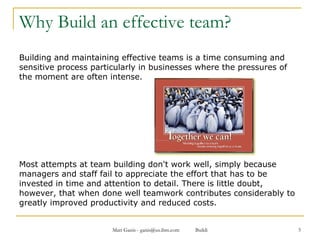
Why Build an effective team? Building and maintaining effective teams is a time consuming and sensitive process particularly in businesses where the pressures of the moment are often intense. Most attempts at team building don't work well, simply because managers and staff fail to appreciate the effort that has to be invested in time and attention to detail. There is little doubt, however, that when done well teamwork contributes considerably to greatly improved productivity and reduced costs.
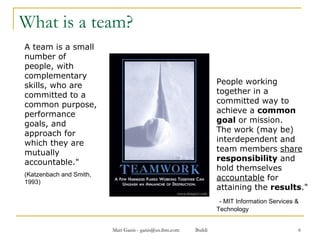
What is a team? A team is a small number of people, with complementary skills, who are committed to a common purpose, performance goals, and approach for which they are mutually accountable."  (Katzenbach and Smith, 1993) People working together in a committed way to achieve a  common goal  or mission.  The work (may be) interdependent and team members  share   responsibility  and hold themselves  accountable  for attaining the  results ."  - MIT Information Services & Technology
What are the Characteristics of an effective team
Characteristics of an Effective Team Effective teams operate in an environment in which there is  two way trust  in an environment of open and honest communication
Characteristics of an Effective Team Feedback on "performance" should be two-way and constant.  It should provide information to all members of the team on how their work supports the specific and overall effort of the team and the practice.  Listening  is a feature of that communication.
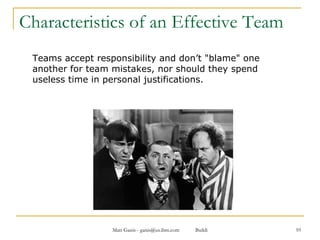
Characteristics of an Effective Team Teams accept responsibility and don’t "blame" one another for team mistakes, nor should they spend useless time in personal justifications.
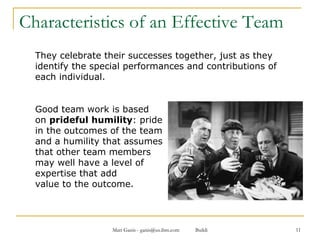
Characteristics of an Effective Team They celebrate their successes together, just as they identify the special performances and contributions of each individual.  Good team work is based  on  prideful humility : pride  in the outcomes of the team  and a humility that assumes that other team members  may well have a level of  expertise that add value to the outcome.
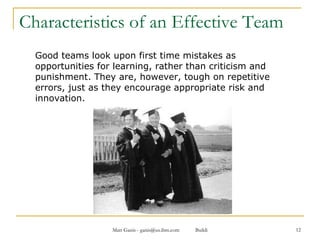
Characteristics of an Effective Team Good teams look upon first time mistakes as opportunities for learning, rather than criticism and punishment. They are, however, tough on repetitive errors, just as they encourage appropriate risk and innovation.
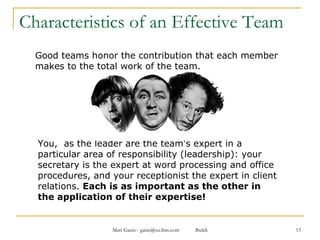
Characteristics of an Effective Team Good teams honor the contribution that each member makes to the total work of the team. You,  as the leader are the team's expert in a particular area of responsibility (leadership): your secretary is the expert at word processing and office procedures, and your receptionist the expert in client relations.  Each is as important as the other in the application of their expertise!
How do you achieve these things ?
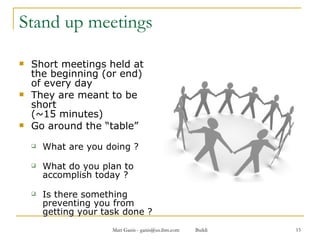
Stand up meetings Short meetings held at the beginning (or end) of every day  They are meant to be short  (~15 minutes) Go around the “table” What are you doing ? What do you plan to accomplish today ? Is there something preventing you from getting your task done ?
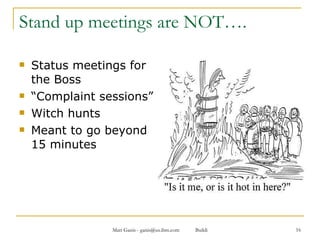
Stand up meetings are NOT…. Status meetings for the Boss “ Complaint sessions” Witch hunts Meant to go beyond 15 minutes
How to be an effective team MEMBER
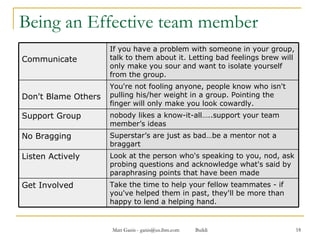
Being an Effective team member Look at the person who's speaking to you, nod, ask probing questions and acknowledge what's said by paraphrasing points that have been made Listen Actively Take the time to help your fellow teammates - if you've helped them in past, they'll be more than happy to lend a helping hand. Get Involved Superstar’s are just as bad…be a mentor not a braggart No Bragging nobody likes a know-it-all…..support your team member’s ideas Support Group  You're not fooling anyone, people know who isn't pulling his/her weight in a group. Pointing the finger will only make you look cowardly. Don't Blame Others If you have a problem with someone in your group, talk to them about it. Letting bad feelings brew will only make you sour and want to isolate yourself from the group. Communicate
How do we form a “GREAT” team ?
How do we form a “GREAT” team ? Lots of training Hire smart people Good Leadership Others….
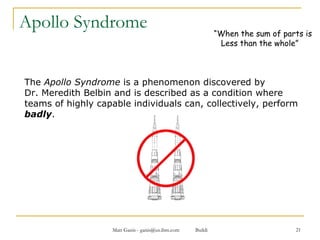
Apollo Syndrome The  Apollo Syndrome  is a phenomenon discovered by  Dr. Meredith Belbin and is described as a condition where teams of highly capable individuals can, collectively, perform  badly . “ When the sum of parts is Less than the whole”
Apollo Teams Belbin’s criteria for selecting his teams: Ability and  aptitude tests to select those with high analytical skills.  The initial perception of Belbin's Apollo teams was that they were bound to win in the team competitions. However, the results were quite the reverse, and the Apollo teams often finished near the bottom of eight teams.
Why did they fail ? (what can we learn) They spent excessive time in abortive or destructive debate, trying to persuade other team members to adopt their own view, and demonstrating a flair for spotting weaknesses in others' arguments.  They had difficulties in their decision making, with little coherence in the decisions reached (several pressing and necessary jobs were often omitted). Team members tended to act along their own favorite lines without taking account of what fellow members were doing, resulting in teams that were difficult to manage. In some instances, teams recognized what was happening but over compensated - they avoided confrontation, which equally led to problems in decision making.
But they can work…. The successful Apollo teams were characterized by: The absence of highly dominant individuals, and A particular style of leadership. Successful leaders were skeptical people who sought to impose some shape or pattern on group discussion, and on the outcome of group activities.  They focused attention on the setting of objectives and priorities, and shaping the way team effort was applied. The successful leaders were tough, discriminating people who could both hold their ground in any company, yet not dominate the group.
 
Creating a Team In its simplest terms, the stages involved in team building are: Clarify the collective goals Identify those inhibitors that prevent them from reaching their goals and remove them Put enablers that assist them Measure and monitor progress, to ensure the goals are achieved
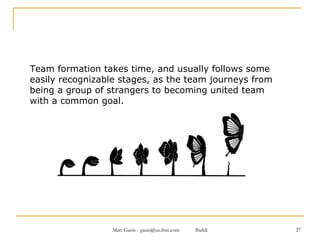
Team formation takes time, and usually follows some easily recognizable stages, as the team journeys from being a group of strangers to becoming united team with a common goal.
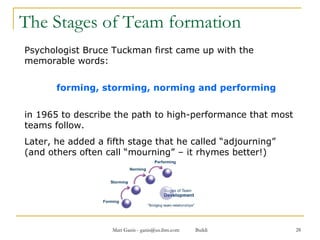
The Stages of Team formation Psychologist Bruce Tuckman first came up with the memorable words:  forming, storming, norming and performing in 1965 to describe the path to high-performance that most teams follow.  Later, he added a fifth stage that he called “adjourning” (and others often call “mourning” – it rhymes better!)
Forming Teams initially go through a " Forming " stage in which members are  positive   and  polite  (some members may be anxious, as they haven’t yet worked out exactly what work the team will involve).  Others are simply excited about the task ahead.  As leader, you play a dominant role at this stage: other members’ roles and responsibilities are less clear.
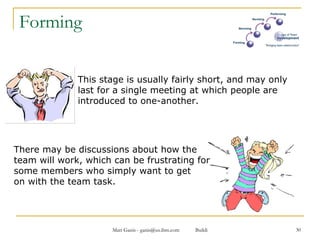
Forming This stage is usually fairly short, and may only  last for a single meeting at which people are  introduced to one-another.  There may be discussions about how the  team will work, which can be frustrating for  some members who simply want to get  on with the team task.
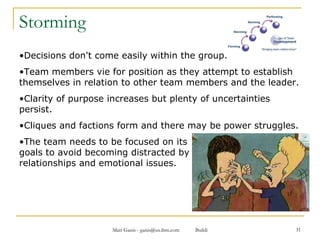
Storming Decisions don't come easily within the group.  Team members vie for position as they attempt to establish themselves in relation to other team members and the leader.  Clarity of purpose increases but plenty of uncertainties persist.  Cliques and factions form and there may be power struggles.  The team needs to be focused on its  goals to avoid becoming distracted by  relationships and emotional issues.
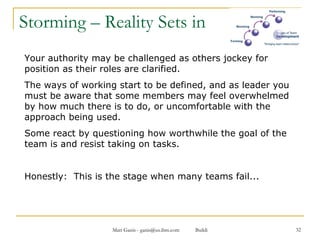
Storming – Reality Sets in Your authority may be challenged as others jockey for position as their roles are clarified.  The ways of working start to be defined, and as leader you must be aware that some members may feel overwhelmed by how much there is to do, or uncomfortable with the approach being used.  Some react by questioning how worthwhile the goal of the team is and resist taking on tasks.  Honestly:  This is the stage when many teams fail...
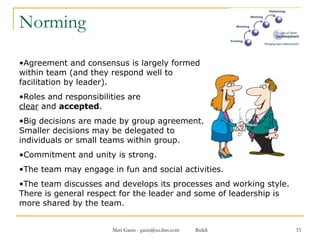
Norming Agreement and consensus is largely formed  within team (and they respond well to  facilitation by leader).  Roles and responsibilities are  clear  and  accepted .  Big decisions are made by group agreement.  Smaller decisions may be delegated to  individuals or small teams within group.  Commitment and unity is strong.  The team may engage in fun and social activities.  The team discusses and develops its processes and working style. There is general respect for the leader and some of leadership is more shared by the team.
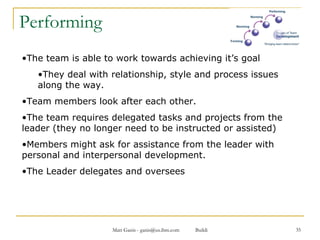
Performing The team is more strategically aware - they know clearly what they are doing and why .  They have a shared vision and can stand on its own feet with no interference or participation from the leader.  The team has a high degree of autonomy. Disagreements occur but now they are resolved within the team positively and necessary changes to processes and structure are made by the team.
Performing The team is able to work towards achieving it’s goal  They deal with relationship, style and process issues  along the way.  Team members look after each other.  The team requires delegated tasks and projects from the leader (they no longer need to be instructed or assisted) Members might ask for assistance from the leader with personal and interpersonal development.  The Leader delegates and oversees
How do we get better ?
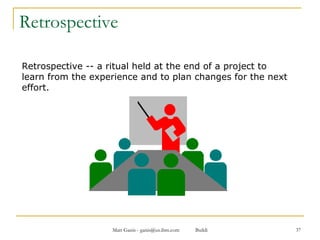
Retrospective Retrospective -- a ritual held at the end of a project to learn from the experience and to plan changes for the next effort.
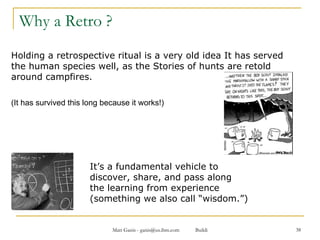
Why a Retro ?  Holding a retrospective ritual is a very old idea It has served the human species well, as the Stories of hunts are retold around campfires.  (It has survived this long because it works!)  It’s a fundamental vehicle to    discover, share, and pass along   the learning from experience   (something we also call “wisdom.”)
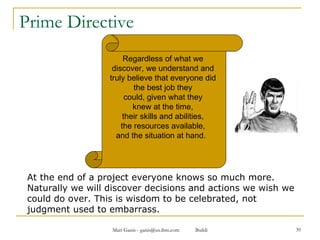
Prime Directive At the end of a project everyone knows so much more. Naturally we will discover decisions and actions we wish we could do over. This is wisdom to be celebrated, not judgment used to embarrass. Regardless of what we  discover, we understand and  truly believe that everyone did  the best job they  could, given what they  knew at the time,  their skills and abilities,  the resources available,  and the situation at hand.
How do we go about this ? Remember, we are telling a story as a group, so we define a timeline of the project that several “milestones” that have meaning to the group Within this timeline, we ask all of the participates to make comments about the milestones, using the following four questions: What did we do well, that if we don’t discuss we might forget? What did we learn? What should we do differently next time? What still puzzles us?
What can you do as a leader ?
What are the best qualities of a leader  Strong,  decisive and  knowledgeable  or  quiet,  supportive,  cooperative Leaders should have two main concerns: people and production High concern for people motivates the team and they become more productive,  High concern for production creates sense of achievement and satisfaction
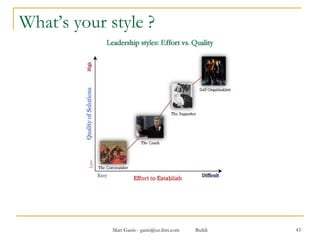
What’s your style ?
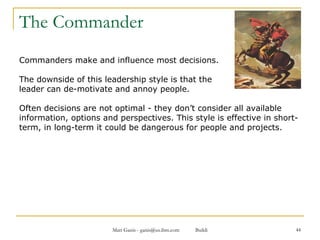
The Commander Commanders make and influence most decisions.  The downside of this leadership style is that the  leader can de-motivate and annoy people.  Often decisions are not optimal - they don’t consider all available information, options and perspectives. This style is effective in short-term, in long-term it could be dangerous for people and projects.
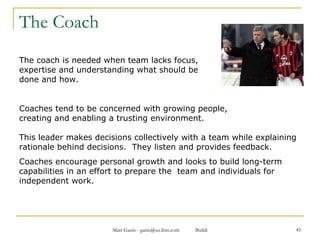
The Coach The coach is needed when team lacks focus,  expertise and understanding what should be  done and how. Coaches tend to be concerned with growing people,  creating and enabling a trusting environment.  This leader makes decisions collectively with a team while explaining rationale behind decisions.  They listen and provides feedback.  Coaches encourage personal growth and looks to build long-term capabilities in an effort to prepare the  team and individuals for independent work.
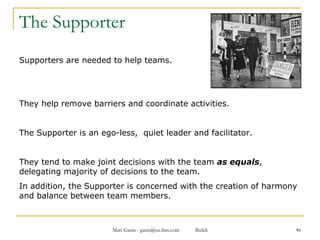
The Supporter Supporters are needed to help teams.  They help remove barriers and coordinate activities.  The Supporter is an ego-less,  quiet leader and facilitator.  They tend to make joint decisions with the team  as equals , delegating majority of decisions to the team.  In addition, the Supporter is concerned with the creation of harmony and balance between team members.
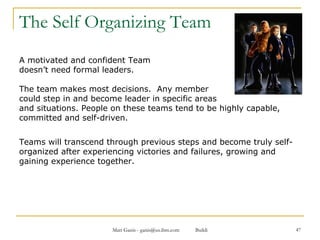
The Self Organizing Team A motivated and confident Team  doesn’t need formal leaders.  The team makes most decisions.  Any member  could step in and become leader in specific areas  and situations. People on these teams tend to be highly capable, committed and self-driven.  Teams will transcend through previous steps and become truly self-organized after experiencing victories and failures, growing and gaining experience together.
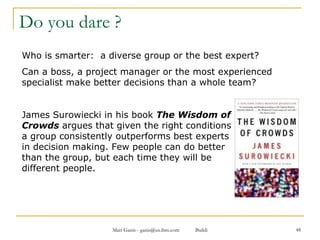
Do you dare ? Who is smarter:  a diverse group or the best expert?  Can a boss, a project manager or the most experienced specialist make better decisions than a whole team? James Surowiecki in his book  The Wisdom of  Crowds  argues that given the right conditions  a group consistently outperforms best experts  in decision making. Few people can do better  than the group, but each time they will be  different people.
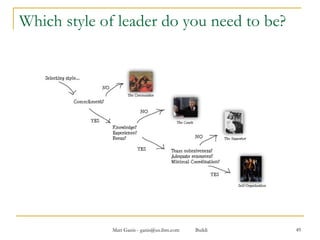
Which style of leader do you need to be?
Summary Form a culture of self-reliance Lead them, but at some point set them free You can never communicate too much You can be ineffective – so be careful Look for ways to improve – don’t be complacent  It takes work to keep these teams moving forward
Thank you !!!!
Exercises
Team building exercise On your way to a “once in lifetime vacation” your plane crashes and you are stranded on Matt’s version  of “Survivor Island” 10 of you find yourselves to be seemingly the only  people left on the Earth Because this is a “Haunted” island, If 3 of you wish to survive, 7 of you will have to leave soon. If all of you stay, then you will ALL die within 2 weeks
Your Island contains: Sewage system Water Seeds Some clothes A few books Some medical facilities but no operating material A greenhouse
We have 10 people (roles) A scientist - 1 A religious leader - 2 A married couple – 3 and 4  A five year old girl - 5 An army officer - 6 An elderly woman – 7  A disabled person – 8  A lawyer - 9 A doctor -10 Library director - 11
What you need to do Allow each person to speak Decide whether some will leave and the others stay Decide who will leave and who will stay 􀂄 Identify team spokesperson
Purpose of this exercise Get a Team working together Have the team make decisions together Identifying team leader Influence of the leader in the decision making
Debrief Explain the reasons for making the choice 􀂄 What influenced decision making? 􀂄 Did anyone emerge as a leader? (Why?) How did this influence the choices of people that stayed or left ?
Command  versus self-directed
Do you NEED a boss? Form teams of 2 – a “master” and “servant” The goal is to have the servant walk 60 steps in 2 minutes The Master will tell the servant what to do: Can only use the following commands: Forward, backward, left, right, faster, slower There can be no other communication
Servants, let’s set you “free” Walk 60 steps – on your own – NO MASTER What’s different ?
What’s the story ?
Story telling If you were given a folder, please DO not show the contents to anyone else with a folder All of the pictures somehow fit together into a logical sequence Your goal:  Determine the sequence

Creating Effective Teams Final V4

  • 1.
    Creating Effective Teams(Without having to herd cats) Dr. Matthew Ganis Trustee: Mahopac Public Library Senior Technical Staff Member: IBM Professor: Computer Science/Astronomy, Pace University (current slides available at: http://webpage.pace.edu/mganis)
  • 2.
    Who am I? My Name is Matt Ganis. I’m a 20+ year veteran of IBM, where I’ve been a developer, managed development teams, led (many) teams, and participated on too many teams to mention… I’m very active locally where I’m a member of several teams in the my community (MPL, scout leader, HS mentor, etc) My dissertation research was in the effects of large teams over several smaller co-operating teams (self organization) I’m *VERY* good at stating the obvious ;-)
  • 3.
    What exactly ISan effective team ? An effective team has certain characteristics that allow the team members to function more efficiently and productively. They develop ways to share leadership roles and ways to share accountability for their work products, shifting the emphasis from the individual to several individuals within the team.
  • 4.
    What are thecharacteristics ? Team members share leadership roles They develop their own scope of work The team schedules work to be done and commits to taking time allotted to do work They develop tangible work products They are mutually accountable for work products Individual performance is based on achieving team products Problems are (regularly) discussed and resolved by the team
  • 5.
    Why Build aneffective team? Building and maintaining effective teams is a time consuming and sensitive process particularly in businesses where the pressures of the moment are often intense. Most attempts at team building don't work well, simply because managers and staff fail to appreciate the effort that has to be invested in time and attention to detail. There is little doubt, however, that when done well teamwork contributes considerably to greatly improved productivity and reduced costs.
  • 6.
    What is ateam? A team is a small number of people, with complementary skills, who are committed to a common purpose, performance goals, and approach for which they are mutually accountable." (Katzenbach and Smith, 1993) People working together in a committed way to achieve a common goal or mission. The work (may be) interdependent and team members share responsibility and hold themselves accountable for attaining the results ." - MIT Information Services & Technology
  • 7.
    What are theCharacteristics of an effective team
  • 8.
    Characteristics of anEffective Team Effective teams operate in an environment in which there is two way trust in an environment of open and honest communication
  • 9.
    Characteristics of anEffective Team Feedback on "performance" should be two-way and constant. It should provide information to all members of the team on how their work supports the specific and overall effort of the team and the practice. Listening is a feature of that communication.
  • 10.
    Characteristics of anEffective Team Teams accept responsibility and don’t "blame" one another for team mistakes, nor should they spend useless time in personal justifications.
  • 11.
    Characteristics of anEffective Team They celebrate their successes together, just as they identify the special performances and contributions of each individual. Good team work is based on prideful humility : pride in the outcomes of the team and a humility that assumes that other team members may well have a level of expertise that add value to the outcome.
  • 12.
    Characteristics of anEffective Team Good teams look upon first time mistakes as opportunities for learning, rather than criticism and punishment. They are, however, tough on repetitive errors, just as they encourage appropriate risk and innovation.
  • 13.
    Characteristics of anEffective Team Good teams honor the contribution that each member makes to the total work of the team. You, as the leader are the team's expert in a particular area of responsibility (leadership): your secretary is the expert at word processing and office procedures, and your receptionist the expert in client relations. Each is as important as the other in the application of their expertise!
  • 14.
    How do youachieve these things ?
  • 15.
    Stand up meetingsShort meetings held at the beginning (or end) of every day They are meant to be short (~15 minutes) Go around the “table” What are you doing ? What do you plan to accomplish today ? Is there something preventing you from getting your task done ?
  • 16.
    Stand up meetingsare NOT…. Status meetings for the Boss “ Complaint sessions” Witch hunts Meant to go beyond 15 minutes
  • 17.
    How to bean effective team MEMBER
  • 18.
    Being an Effectiveteam member Look at the person who's speaking to you, nod, ask probing questions and acknowledge what's said by paraphrasing points that have been made Listen Actively Take the time to help your fellow teammates - if you've helped them in past, they'll be more than happy to lend a helping hand. Get Involved Superstar’s are just as bad…be a mentor not a braggart No Bragging nobody likes a know-it-all…..support your team member’s ideas Support Group You're not fooling anyone, people know who isn't pulling his/her weight in a group. Pointing the finger will only make you look cowardly. Don't Blame Others If you have a problem with someone in your group, talk to them about it. Letting bad feelings brew will only make you sour and want to isolate yourself from the group. Communicate
  • 19.
    How do weform a “GREAT” team ?
  • 20.
    How do weform a “GREAT” team ? Lots of training Hire smart people Good Leadership Others….
  • 21.
    Apollo Syndrome The Apollo Syndrome is a phenomenon discovered by Dr. Meredith Belbin and is described as a condition where teams of highly capable individuals can, collectively, perform badly . “ When the sum of parts is Less than the whole”
  • 22.
    Apollo Teams Belbin’scriteria for selecting his teams: Ability and aptitude tests to select those with high analytical skills. The initial perception of Belbin's Apollo teams was that they were bound to win in the team competitions. However, the results were quite the reverse, and the Apollo teams often finished near the bottom of eight teams.
  • 23.
    Why did theyfail ? (what can we learn) They spent excessive time in abortive or destructive debate, trying to persuade other team members to adopt their own view, and demonstrating a flair for spotting weaknesses in others' arguments. They had difficulties in their decision making, with little coherence in the decisions reached (several pressing and necessary jobs were often omitted). Team members tended to act along their own favorite lines without taking account of what fellow members were doing, resulting in teams that were difficult to manage. In some instances, teams recognized what was happening but over compensated - they avoided confrontation, which equally led to problems in decision making.
  • 24.
    But they canwork…. The successful Apollo teams were characterized by: The absence of highly dominant individuals, and A particular style of leadership. Successful leaders were skeptical people who sought to impose some shape or pattern on group discussion, and on the outcome of group activities. They focused attention on the setting of objectives and priorities, and shaping the way team effort was applied. The successful leaders were tough, discriminating people who could both hold their ground in any company, yet not dominate the group.
  • 25.
  • 26.
    Creating a TeamIn its simplest terms, the stages involved in team building are: Clarify the collective goals Identify those inhibitors that prevent them from reaching their goals and remove them Put enablers that assist them Measure and monitor progress, to ensure the goals are achieved
  • 27.
    Team formation takestime, and usually follows some easily recognizable stages, as the team journeys from being a group of strangers to becoming united team with a common goal.
  • 28.
    The Stages ofTeam formation Psychologist Bruce Tuckman first came up with the memorable words: forming, storming, norming and performing in 1965 to describe the path to high-performance that most teams follow. Later, he added a fifth stage that he called “adjourning” (and others often call “mourning” – it rhymes better!)
  • 29.
    Forming Teams initiallygo through a " Forming " stage in which members are positive and polite (some members may be anxious, as they haven’t yet worked out exactly what work the team will involve). Others are simply excited about the task ahead. As leader, you play a dominant role at this stage: other members’ roles and responsibilities are less clear.
  • 30.
    Forming This stageis usually fairly short, and may only last for a single meeting at which people are introduced to one-another. There may be discussions about how the team will work, which can be frustrating for some members who simply want to get on with the team task.
  • 31.
    Storming Decisions don'tcome easily within the group. Team members vie for position as they attempt to establish themselves in relation to other team members and the leader. Clarity of purpose increases but plenty of uncertainties persist. Cliques and factions form and there may be power struggles. The team needs to be focused on its goals to avoid becoming distracted by relationships and emotional issues.
  • 32.
    Storming – RealitySets in Your authority may be challenged as others jockey for position as their roles are clarified. The ways of working start to be defined, and as leader you must be aware that some members may feel overwhelmed by how much there is to do, or uncomfortable with the approach being used. Some react by questioning how worthwhile the goal of the team is and resist taking on tasks. Honestly: This is the stage when many teams fail...
  • 33.
    Norming Agreement andconsensus is largely formed within team (and they respond well to facilitation by leader). Roles and responsibilities are clear and accepted . Big decisions are made by group agreement. Smaller decisions may be delegated to individuals or small teams within group. Commitment and unity is strong. The team may engage in fun and social activities. The team discusses and develops its processes and working style. There is general respect for the leader and some of leadership is more shared by the team.
  • 34.
    Performing The teamis more strategically aware - they know clearly what they are doing and why . They have a shared vision and can stand on its own feet with no interference or participation from the leader. The team has a high degree of autonomy. Disagreements occur but now they are resolved within the team positively and necessary changes to processes and structure are made by the team.
  • 35.
    Performing The teamis able to work towards achieving it’s goal They deal with relationship, style and process issues along the way. Team members look after each other. The team requires delegated tasks and projects from the leader (they no longer need to be instructed or assisted) Members might ask for assistance from the leader with personal and interpersonal development. The Leader delegates and oversees
  • 36.
    How do weget better ?
  • 37.
    Retrospective Retrospective --a ritual held at the end of a project to learn from the experience and to plan changes for the next effort.
  • 38.
    Why a Retro? Holding a retrospective ritual is a very old idea It has served the human species well, as the Stories of hunts are retold around campfires. (It has survived this long because it works!) It’s a fundamental vehicle to discover, share, and pass along the learning from experience (something we also call “wisdom.”)
  • 39.
    Prime Directive Atthe end of a project everyone knows so much more. Naturally we will discover decisions and actions we wish we could do over. This is wisdom to be celebrated, not judgment used to embarrass. Regardless of what we discover, we understand and truly believe that everyone did the best job they could, given what they knew at the time, their skills and abilities, the resources available, and the situation at hand.
  • 40.
    How do wego about this ? Remember, we are telling a story as a group, so we define a timeline of the project that several “milestones” that have meaning to the group Within this timeline, we ask all of the participates to make comments about the milestones, using the following four questions: What did we do well, that if we don’t discuss we might forget? What did we learn? What should we do differently next time? What still puzzles us?
  • 41.
    What can youdo as a leader ?
  • 42.
    What are thebest qualities of a leader Strong, decisive and knowledgeable or quiet, supportive, cooperative Leaders should have two main concerns: people and production High concern for people motivates the team and they become more productive, High concern for production creates sense of achievement and satisfaction
  • 43.
  • 44.
    The Commander Commandersmake and influence most decisions. The downside of this leadership style is that the leader can de-motivate and annoy people. Often decisions are not optimal - they don’t consider all available information, options and perspectives. This style is effective in short-term, in long-term it could be dangerous for people and projects.
  • 45.
    The Coach Thecoach is needed when team lacks focus, expertise and understanding what should be done and how. Coaches tend to be concerned with growing people, creating and enabling a trusting environment. This leader makes decisions collectively with a team while explaining rationale behind decisions. They listen and provides feedback. Coaches encourage personal growth and looks to build long-term capabilities in an effort to prepare the team and individuals for independent work.
  • 46.
    The Supporter Supportersare needed to help teams. They help remove barriers and coordinate activities. The Supporter is an ego-less, quiet leader and facilitator. They tend to make joint decisions with the team as equals , delegating majority of decisions to the team. In addition, the Supporter is concerned with the creation of harmony and balance between team members.
  • 47.
    The Self OrganizingTeam A motivated and confident Team doesn’t need formal leaders. The team makes most decisions. Any member could step in and become leader in specific areas and situations. People on these teams tend to be highly capable, committed and self-driven. Teams will transcend through previous steps and become truly self-organized after experiencing victories and failures, growing and gaining experience together.
  • 48.
    Do you dare? Who is smarter: a diverse group or the best expert? Can a boss, a project manager or the most experienced specialist make better decisions than a whole team? James Surowiecki in his book The Wisdom of Crowds argues that given the right conditions a group consistently outperforms best experts in decision making. Few people can do better than the group, but each time they will be different people.
  • 49.
    Which style ofleader do you need to be?
  • 50.
    Summary Form aculture of self-reliance Lead them, but at some point set them free You can never communicate too much You can be ineffective – so be careful Look for ways to improve – don’t be complacent It takes work to keep these teams moving forward
  • 51.
  • 52.
  • 53.
    Team building exerciseOn your way to a “once in lifetime vacation” your plane crashes and you are stranded on Matt’s version of “Survivor Island” 10 of you find yourselves to be seemingly the only people left on the Earth Because this is a “Haunted” island, If 3 of you wish to survive, 7 of you will have to leave soon. If all of you stay, then you will ALL die within 2 weeks
  • 54.
    Your Island contains:Sewage system Water Seeds Some clothes A few books Some medical facilities but no operating material A greenhouse
  • 55.
    We have 10people (roles) A scientist - 1 A religious leader - 2 A married couple – 3 and 4 A five year old girl - 5 An army officer - 6 An elderly woman – 7 A disabled person – 8 A lawyer - 9 A doctor -10 Library director - 11
  • 56.
    What you needto do Allow each person to speak Decide whether some will leave and the others stay Decide who will leave and who will stay 􀂄 Identify team spokesperson
  • 57.
    Purpose of thisexercise Get a Team working together Have the team make decisions together Identifying team leader Influence of the leader in the decision making
  • 58.
    Debrief Explain thereasons for making the choice 􀂄 What influenced decision making? 􀂄 Did anyone emerge as a leader? (Why?) How did this influence the choices of people that stayed or left ?
  • 59.
    Command versusself-directed
  • 60.
    Do you NEEDa boss? Form teams of 2 – a “master” and “servant” The goal is to have the servant walk 60 steps in 2 minutes The Master will tell the servant what to do: Can only use the following commands: Forward, backward, left, right, faster, slower There can be no other communication
  • 61.
    Servants, let’s setyou “free” Walk 60 steps – on your own – NO MASTER What’s different ?
  • 62.
  • 63.
    Story telling Ifyou were given a folder, please DO not show the contents to anyone else with a folder All of the pictures somehow fit together into a logical sequence Your goal: Determine the sequence

Editor's Notes

  • #3 Teams come in all shapes and sizes – I really want to focus on teams in a business sense, or what I might call “professional teams”
  • #4 What do we want from our teams ? Why do we form them ? Why not just work alone ? We want to highlight efficient and productive (or efficient at being productive) The ultimate goal is to have group consensus or better yet – group decision making and group leaders
  • #6 How do you form a team ? Do you just put a bunch of people in a room and have a team ? We need to nurture them beyond just being a group of people with a (hopefully) common goal
  • #7 We have a lot of common themes going on: - Commitment - Accountability - Common Goals - Shared Responsibility
  • #9 What do you do to earn trust in your people ? Do they trust you ? Or do you just think they do ?
  • #10 If you listen, do you understand ? Or does your mind wander as someone is talking ?
  • #12 Gold stars as a reward – see: http://www.csis.pace.edu/~bergin/fivepedpat.html People look up to as a leader. They tend to work best when they feel good about themselves. They like to feel appreciated. SOLUTION When a team member does something well they should be praised for it. This can occur either publicly or privately. It can be a simple few words spoken in private or a public display of appreciation
  • #13 Recognizing mistakes…..not all the time, but let’s celebrate our success and understand our mistakes
  • #14 This is KEY Everyone has a strength, and everyone can contribute It might not be a bad idea to have everyone vocalize their strengths/weaknesses
  • #20 How would you go about forming the “best” team ?
  • #45 Skills and traits of Commanders are very important as they are the main factor of success. The Commander should be energetic, confident, decisive. Also as Commanders make most decisions they should be knowledgeable, forward-thinking and broad-minded.
  • #46 The downside of this style could be micro-management and low concern for productivity. Important qualities for Coaches: knowledgeable, empathetic and cooperative.
  • #47 Important qualities for The Supporter: good communicator and facilitator, socially skilled and diplomatic
  • #48 The Team have shared purpose, principles and values. Team members trust, support and respect each other. Almost everything is possible for such team.