GROUP BEHAVIOUR
Presented By:
Shahzad Musawwir Farid
Vikram Thakur , Manish
Kumar
Uzair Ashraf , Anil Singh
Malik Lovepreet , Pallavi
Pratibha , Harpreet , Rajat
WHAT IS GROUP?
A group is a collection of people with some common characteristics
or purpose.
•A group can consist of any number of people.
•The group members share beliefs, principles, and standards about
areas of common interest and they come together to work on
common tasks for agreed purposes and outcomes.
•People in groups are defined by themselves and by others as group
members, in other words individuals are aware that they are part of a
group.
GROUP BEHAVIOUR
2
WHY PEOPLES JOIN GROUPS?
The people often join groups since the groups give the members a
stability and enhances their achievement capacity. The main reasons
to join groups are:
Have a sense of security
Have a status
Develop Self-esteem
Power
Goal Achievement
GROUP BEHAVIOUR
3
TYPES OF GROUPS?
GROUP BEHAVIOUR
4
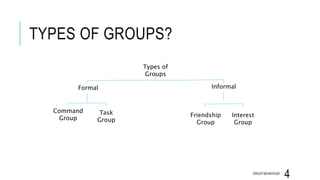
Types of
Groups
Formal Informal
Command
Group
Task
Group
Friendship
Group
Interest
Group
FORMAL GROUPS
Command Group: Command groups are specified by the
organizational chart and often consist of a supervisor and the
subordinates that report to that supervisor.
An example of a command group is an academic department
chairman and the faculty members in that department.
Task Group: Task groups consist of people who work together to
achieve a common task. Members are brought together to accomplish
a narrow range of goals within a specified time period. Task groups
are also commonly referred to as task forces.
Examples of assigned tasks are the development of a new product,
the improvement of a production process, or the proposal of a
motivational contest.
GROUP BEHAVIOUR
5
INFORMAL GROUPS
Friendship Group: Friendship groups are formed by members who
enjoy similar social activities, political beliefs, religious values, or
other common bonds. Members enjoy each other's company and
often meet after work to participate in these activities.
For example, a group of employees who form a friendship group
may have an exercise group, a softball team, or a potluck lunch once
a month.
Interest Group: Interest groups usually continue over time and may
last longer than general informal groups. Members of interest groups
may not be part of the same organizational department but they are
bound together by some other common interest.
An example of an interest group would be students who come
together to form a study group for a specific class.
GROUP BEHAVIOUR
6
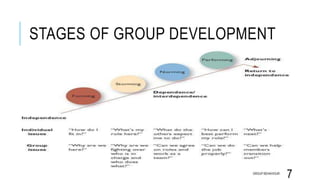
STAGES OF GROUP DEVELOPMENT
GROUP BEHAVIOUR
7
GROUP BEHAVIOUR MODEL
Roles
Norms
Status
Size
Cohesiveness
GROUP BEHAVIOUR
8
ROLES
Role
oA set of expected behaviour patterns attributed to someone occupying a given
position in a social unit
Role Identity
oCertain attitudes and behaviours consistent with a role.
Role Perception
oAn individual’s view of how he or she is supposed to act in a given situation-
received by external stimuli
Role Expectations
oHow others believe a person should act in a given situation
Role Conflict
oA situation in which an individual is confronted by divergent role expectations
GROUP BEHAVIOUR
9
NORMS
Groups have established norms of behaviour. Most of these norms
are unwritten and not formal ones, but they are cautiously followed
by members in the group.
Conformity to group norms and pressures applied on group
members to conform these norms.
Individualist workplace behaviour is another common organizational
norm which gets violated often in organizations.
GROUP BEHAVIOUR
10
THE HAWTHORNE STUDIES
A series of studies undertaken by Elton Mayo at Western
Electric Company’s Hawthorne Works in Chicago between 1924
and 1932.
Research Conclusions:
oGroup influences (norms) were significant in affecting individual behaviour.
oGroup standards (norms) were highly effective in establishing individual
worker output.
oMoney was less a factor in determining worker output than were group
standards, sentiments, and security.
GROUP BEHAVIOUR
11
STATUS
A socially defined position or rank given to groups or group
members by others
Determined by
The power a person wields over others
A person’s ability to contribute to a group’s goals
An individual’s personal characteristics
GROUP BEHAVIOUR
12
IMPACT OF STATUS
High-status members:
 Often have more freedom to deviate from norms
 Are better able to resist conformity pressures
Interaction among members of groups is influenced by status
 High status people are more confident
 Low status members may not participate
 Group creativity may suffer
GROUP BEHAVIOUR
13
SIZE
The size of a group affects the group’s overall behaviour
Smaller groups are faster at completing tasks – members perform
better
Large groups are consistently better at problem solving
Large groups are good at gaining input.
Smaller groups are better doing something with input
Prevent Social Loafing
GROUP BEHAVIOUR
14
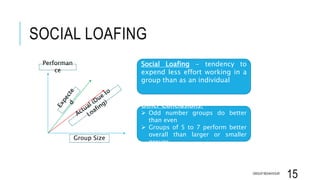
SOCIAL LOAFING
GROUP BEHAVIOUR
15
Other Conclusions:
 Odd number groups do better
than even
 Groups of 5 to 7 perform better
overall than larger or smaller
groups
Performan
ce
Group Size
Social Loafing - tendency to
expend less effort working in a
group than as an individual
COHESIVENESS
The degree to which members are attracted to each other and
motivated to stay in the group
Affects productivity
Strongly cohesive groups may overlook performance failures
Weakly cohesive groups may look deep into individual differences
Ways to manage Cohesion
Make group smaller (Sometimes larger to break strong but undesirable cohesion)
Encourage agreement with group goals
Increase time members spend together
Stimulate competition with other groups
Give group rewards
GROUP BEHAVIOUR
16
GROUP TASKS
Decision-making
• Large groups facilitate the pooling of information about complex tasks.
• Smaller groups are better suited to coordinating and facilitating the implementation
of complex tasks.
• Simple, routine standardized tasks reduce the requirement that group processes be
effective in order for the group to perform well.
GROUP BEHAVIOUR
17
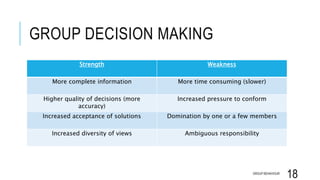
GROUP DECISION MAKING
Strength Weakness
More complete information More time consuming (slower)
Higher quality of decisions (more
accuracy)
Increased pressure to conform
Increased acceptance of solutions Domination by one or a few members
Increased diversity of views Ambiguous responsibility
GROUP BEHAVIOUR
18
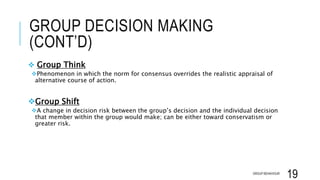
GROUP DECISION MAKING
(CONT’D)
 Group Think
Phenomenon in which the norm for consensus overrides the realistic appraisal of
alternative course of action.
Group Shift
A change in decision risk between the group’s decision and the individual decision
that member within the group would make; can be either toward conservatism or
greater risk.
GROUP BEHAVIOUR
19
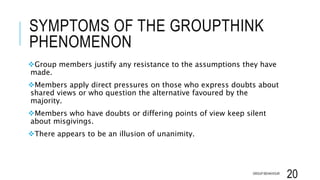
SYMPTOMS OF THE GROUPTHINK
PHENOMENON
Group members justify any resistance to the assumptions they have
made.
Members apply direct pressures on those who express doubts about
shared views or who question the alternative favoured by the
majority.
Members who have doubts or differing points of view keep silent
about misgivings.
There appears to be an illusion of unanimity.
GROUP BEHAVIOUR
20
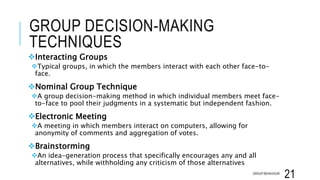
GROUP DECISION-MAKING
TECHNIQUES
Interacting Groups
Typical groups, in which the members interact with each other face-to-
face.
Nominal Group Technique
A group decision-making method in which individual members meet face-
to-face to pool their judgments in a systematic but independent fashion.
Electronic Meeting
A meeting in which members interact on computers, allowing for
anonymity of comments and aggregation of votes.
Brainstorming
An idea-generation process that specifically encourages any and all
alternatives, while withholding any criticism of those alternatives
GROUP BEHAVIOUR
21
CONCLUSION
Although most humans are by nature social creatures, cooperative
group work is not something that comes without effort. Such group
activities require that a sense of trust be built between members, as
well as a feeling of shared responsibility. This means a responsibility
to carry your own weight in the group, as well as a responsibility to
all of the other members of the group.
GROUP BEHAVIOUR
22
“Group behaviour
measures the
immeasurable”
THANK YOU
GROUP BEHAVIOUR
23

Group behaviour

  • 1.
    GROUP BEHAVIOUR Presented By: ShahzadMusawwir Farid Vikram Thakur , Manish Kumar Uzair Ashraf , Anil Singh Malik Lovepreet , Pallavi Pratibha , Harpreet , Rajat
  • 2.
    WHAT IS GROUP? Agroup is a collection of people with some common characteristics or purpose. •A group can consist of any number of people. •The group members share beliefs, principles, and standards about areas of common interest and they come together to work on common tasks for agreed purposes and outcomes. •People in groups are defined by themselves and by others as group members, in other words individuals are aware that they are part of a group. GROUP BEHAVIOUR 2
  • 3.
    WHY PEOPLES JOINGROUPS? The people often join groups since the groups give the members a stability and enhances their achievement capacity. The main reasons to join groups are: Have a sense of security Have a status Develop Self-esteem Power Goal Achievement GROUP BEHAVIOUR 3
  • 4.
    TYPES OF GROUPS? GROUPBEHAVIOUR 4 Types of Groups Formal Informal Command Group Task Group Friendship Group Interest Group
  • 5.
    FORMAL GROUPS Command Group:Command groups are specified by the organizational chart and often consist of a supervisor and the subordinates that report to that supervisor. An example of a command group is an academic department chairman and the faculty members in that department. Task Group: Task groups consist of people who work together to achieve a common task. Members are brought together to accomplish a narrow range of goals within a specified time period. Task groups are also commonly referred to as task forces. Examples of assigned tasks are the development of a new product, the improvement of a production process, or the proposal of a motivational contest. GROUP BEHAVIOUR 5
  • 6.
    INFORMAL GROUPS Friendship Group:Friendship groups are formed by members who enjoy similar social activities, political beliefs, religious values, or other common bonds. Members enjoy each other's company and often meet after work to participate in these activities. For example, a group of employees who form a friendship group may have an exercise group, a softball team, or a potluck lunch once a month. Interest Group: Interest groups usually continue over time and may last longer than general informal groups. Members of interest groups may not be part of the same organizational department but they are bound together by some other common interest. An example of an interest group would be students who come together to form a study group for a specific class. GROUP BEHAVIOUR 6
  • 7.
    STAGES OF GROUPDEVELOPMENT GROUP BEHAVIOUR 7
  • 8.
  • 9.
    ROLES Role oA set ofexpected behaviour patterns attributed to someone occupying a given position in a social unit Role Identity oCertain attitudes and behaviours consistent with a role. Role Perception oAn individual’s view of how he or she is supposed to act in a given situation- received by external stimuli Role Expectations oHow others believe a person should act in a given situation Role Conflict oA situation in which an individual is confronted by divergent role expectations GROUP BEHAVIOUR 9
  • 10.
    NORMS Groups have establishednorms of behaviour. Most of these norms are unwritten and not formal ones, but they are cautiously followed by members in the group. Conformity to group norms and pressures applied on group members to conform these norms. Individualist workplace behaviour is another common organizational norm which gets violated often in organizations. GROUP BEHAVIOUR 10
  • 11.
    THE HAWTHORNE STUDIES Aseries of studies undertaken by Elton Mayo at Western Electric Company’s Hawthorne Works in Chicago between 1924 and 1932. Research Conclusions: oGroup influences (norms) were significant in affecting individual behaviour. oGroup standards (norms) were highly effective in establishing individual worker output. oMoney was less a factor in determining worker output than were group standards, sentiments, and security. GROUP BEHAVIOUR 11
  • 12.
    STATUS A socially definedposition or rank given to groups or group members by others Determined by The power a person wields over others A person’s ability to contribute to a group’s goals An individual’s personal characteristics GROUP BEHAVIOUR 12
  • 13.
    IMPACT OF STATUS High-statusmembers:  Often have more freedom to deviate from norms  Are better able to resist conformity pressures Interaction among members of groups is influenced by status  High status people are more confident  Low status members may not participate  Group creativity may suffer GROUP BEHAVIOUR 13
  • 14.
    SIZE The size ofa group affects the group’s overall behaviour Smaller groups are faster at completing tasks – members perform better Large groups are consistently better at problem solving Large groups are good at gaining input. Smaller groups are better doing something with input Prevent Social Loafing GROUP BEHAVIOUR 14
  • 15.
    SOCIAL LOAFING GROUP BEHAVIOUR 15 OtherConclusions:  Odd number groups do better than even  Groups of 5 to 7 perform better overall than larger or smaller groups Performan ce Group Size Social Loafing - tendency to expend less effort working in a group than as an individual
  • 16.
    COHESIVENESS The degree towhich members are attracted to each other and motivated to stay in the group Affects productivity Strongly cohesive groups may overlook performance failures Weakly cohesive groups may look deep into individual differences Ways to manage Cohesion Make group smaller (Sometimes larger to break strong but undesirable cohesion) Encourage agreement with group goals Increase time members spend together Stimulate competition with other groups Give group rewards GROUP BEHAVIOUR 16
  • 17.
    GROUP TASKS Decision-making • Largegroups facilitate the pooling of information about complex tasks. • Smaller groups are better suited to coordinating and facilitating the implementation of complex tasks. • Simple, routine standardized tasks reduce the requirement that group processes be effective in order for the group to perform well. GROUP BEHAVIOUR 17
  • 18.
    GROUP DECISION MAKING StrengthWeakness More complete information More time consuming (slower) Higher quality of decisions (more accuracy) Increased pressure to conform Increased acceptance of solutions Domination by one or a few members Increased diversity of views Ambiguous responsibility GROUP BEHAVIOUR 18
  • 19.
    GROUP DECISION MAKING (CONT’D) Group Think Phenomenon in which the norm for consensus overrides the realistic appraisal of alternative course of action. Group Shift A change in decision risk between the group’s decision and the individual decision that member within the group would make; can be either toward conservatism or greater risk. GROUP BEHAVIOUR 19
  • 20.
    SYMPTOMS OF THEGROUPTHINK PHENOMENON Group members justify any resistance to the assumptions they have made. Members apply direct pressures on those who express doubts about shared views or who question the alternative favoured by the majority. Members who have doubts or differing points of view keep silent about misgivings. There appears to be an illusion of unanimity. GROUP BEHAVIOUR 20
  • 21.
    GROUP DECISION-MAKING TECHNIQUES Interacting Groups Typicalgroups, in which the members interact with each other face-to- face. Nominal Group Technique A group decision-making method in which individual members meet face- to-face to pool their judgments in a systematic but independent fashion. Electronic Meeting A meeting in which members interact on computers, allowing for anonymity of comments and aggregation of votes. Brainstorming An idea-generation process that specifically encourages any and all alternatives, while withholding any criticism of those alternatives GROUP BEHAVIOUR 21
  • 22.
    CONCLUSION Although most humansare by nature social creatures, cooperative group work is not something that comes without effort. Such group activities require that a sense of trust be built between members, as well as a feeling of shared responsibility. This means a responsibility to carry your own weight in the group, as well as a responsibility to all of the other members of the group. GROUP BEHAVIOUR 22 “Group behaviour measures the immeasurable”
  • 23.