Group Behaviour
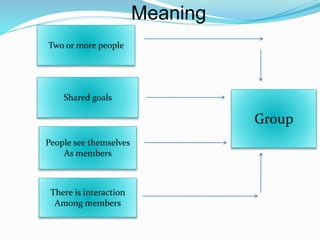
MTweoa onr minorge people 
Shared goals 
People see themselves 
As members 
There is interaction 
Among members 
Group 
Meaning
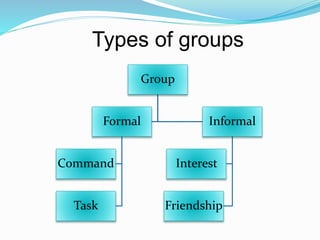
Types of groups 
Group 
Formal 
Command 
Task 
Informal 
Interest 
Friendship
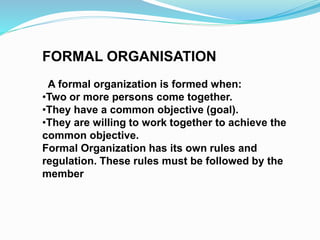
FORMAL ORGANISATION 
A formal organization is formed when: 
•Two or more persons come together. 
•They have a common objective (goal). 
•They are willing to work together to achieve the 
common objective. 
Formal Organization has its own rules and 
regulation. These rules must be followed by the 
member
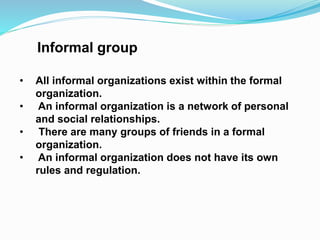
Informal group 
• All informal organizations exist within the formal 
organization. 
• An informal organization is a network of personal 
and social relationships. 
• There are many groups of friends in a formal 
organization. 
• An informal organization does not have its own 
rules and regulation.
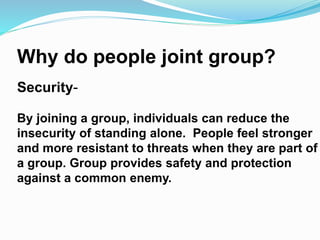
Why do people joint group? 
Security- 
By joining a group, individuals can reduce the 
insecurity of standing alone. People feel stronger 
and more resistant to threats when they are part of 
a group. Group provides safety and protection 
against a common enemy.
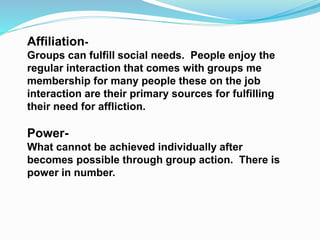
Affiliation- 
Groups can fulfill social needs. People enjoy the 
regular interaction that comes with groups me 
membership for many people these on the job 
interaction are their primary sources for fulfilling 
their need for affliction. 
Power- 
What cannot be achieved individually after 
becomes possible through group action. There is 
power in number.
Goal achievement- 
Through pooling of knowledge, resources, 
talents and power in-group, people are able to 
achieve goals that may not be possible 
individually. More than one person can achieve 
one particular goal easily. In such instances 
management will rely on the use of formal group 
Self-esteem- 
Membership of prestigious groups increases the 
self-esteem of people. It generates positive 
felling of self worth.
Status- 
Individuals get recognition and status when they 
are members of groups that are considered to be 
important by other. people look at them with 
respect and awe.
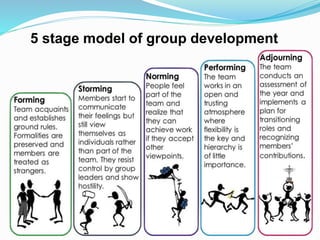
5 stage model of group development
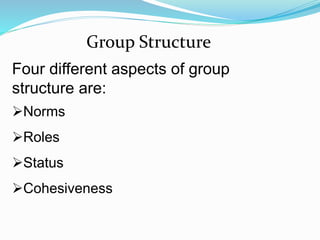
Group Structure 
Four different aspects of group 
structure are: 
Norms 
Roles 
Status 
Cohesiveness
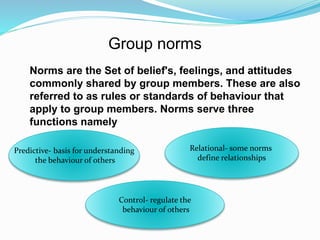
Group norms 
Norms are the Set of belief's, feelings, and attitudes 
commonly shared by group members. These are also 
referred to as rules or standards of behaviour that 
apply to group members. Norms serve three 
functions namely 
Predictive- basis for understanding 
the behaviour of others 
Relational- some norms 
define relationships 
Control- regulate the 
behaviour of others
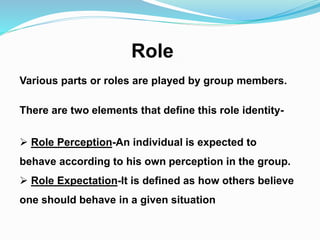
Role 
Various parts or roles are played by group members. 
There are two elements that define this role identity- 
 Role Perception-An individual is expected to 
behave according to his own perception in the group. 
 Role Expectation-It is defined as how others believe 
one should behave in a given situation
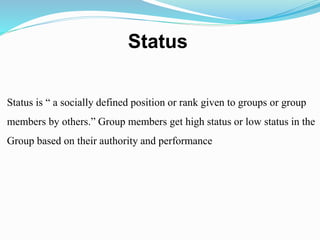
Status 
Status is “ a socially defined position or rank given to groups or group 
members by others.” Group members get high status or low status in the 
Group based on their authority and performance
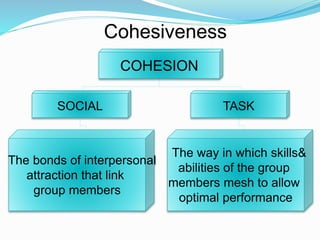
Cohesiveness 
COHESION 
SOCIAL TASK 
The bonds of interpersonal 
attraction that link 
group members 
The way in which skills& 
abilities of the group 
members mesh to allow 
optimal performance
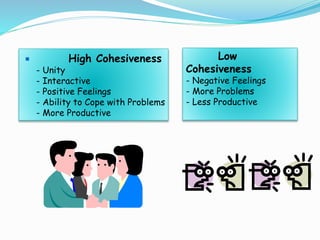
 High Cohesiveness 
- Unity 
- Interactive 
- Positive Feelings 
- Ability to Cope with Problems 
- More Productive 
Low 
Cohesiveness 
- Negative Feelings 
- More Problems 
- Less Productive
Group Decision-making 
 Group Decision making is a process of taking 
decisions collectively by group of members. 
 Group consists of committees, taskforce, team 
& other formal & informal groups. 
 Group decisions would become particularly 
appropriate for non programmed decisions i.e. 
new or unique decisions e.g. moving to new 
market, product diversification, new investment 
etc.
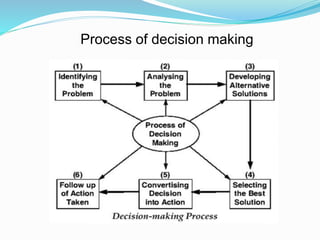
Process of decision making
TECHNIQUES OF GROUP DECISION MAKING 
•Brain storming 
•Nominal group technique 
•Electronic meetings 
•Interacting groups
Brainstorming 
•Brainstorming is a group technique by which efforts 
are made to find a conclusion for a specific problem 
by gathering a list of ideas spontaneously 
contributed by its member. 
•Generate as many ideas as possible, suspending 
evaluation until all the ideas have been suggested.
Nominal group technique 
•Individuals silently list their ideas. 
•Ideas are written on a chart one at a time until 
all ideas are listed. 
•Discussion is permitted but only to clarify the 
ideas. No criticism allowed. 
•A written vote is taken
INTERACTING GROUPS 
• Most of the decision making in a group 
happens in a meeting. 
•The most important advantage is that the 
members can interact face to face. 
• Disadvantage is that the decisions taken in 
interacting groups are affected by group 
think, pressure to conform etc.
Electronic meetings 
•The members of the group interact with the help of 
computers through connected computer terminals. 
•Projector screen is used to show the individual 
comments and votes on an issue. 
•This method reduces group think and the time 
wasted in socializing the meeting.
Conclusion 
The groups operate on a common tasks and common 
attitudes. The group behaviour is how you interact 
between the group members in social situation. 
The group behaviour is essential to study since it 
helps to find how the relationships are made within a 
group. This helps to know how a group is made and 
how it should be organized, lead and promoted .
Group behaviour

Group behaviour

  • 1.
  • 2.
    MTweoa onr minorgepeople Shared goals People see themselves As members There is interaction Among members Group Meaning
  • 3.
    Types of groups Group Formal Command Task Informal Interest Friendship
  • 4.
    FORMAL ORGANISATION Aformal organization is formed when: •Two or more persons come together. •They have a common objective (goal). •They are willing to work together to achieve the common objective. Formal Organization has its own rules and regulation. These rules must be followed by the member
  • 5.
    Informal group •All informal organizations exist within the formal organization. • An informal organization is a network of personal and social relationships. • There are many groups of friends in a formal organization. • An informal organization does not have its own rules and regulation.
  • 6.
    Why do peoplejoint group? Security- By joining a group, individuals can reduce the insecurity of standing alone. People feel stronger and more resistant to threats when they are part of a group. Group provides safety and protection against a common enemy.
  • 7.
    Affiliation- Groups canfulfill social needs. People enjoy the regular interaction that comes with groups me membership for many people these on the job interaction are their primary sources for fulfilling their need for affliction. Power- What cannot be achieved individually after becomes possible through group action. There is power in number.
  • 8.
    Goal achievement- Throughpooling of knowledge, resources, talents and power in-group, people are able to achieve goals that may not be possible individually. More than one person can achieve one particular goal easily. In such instances management will rely on the use of formal group Self-esteem- Membership of prestigious groups increases the self-esteem of people. It generates positive felling of self worth.
  • 9.
    Status- Individuals getrecognition and status when they are members of groups that are considered to be important by other. people look at them with respect and awe.
  • 10.
    5 stage modelof group development
  • 11.
    Group Structure Fourdifferent aspects of group structure are: Norms Roles Status Cohesiveness
  • 12.
    Group norms Normsare the Set of belief's, feelings, and attitudes commonly shared by group members. These are also referred to as rules or standards of behaviour that apply to group members. Norms serve three functions namely Predictive- basis for understanding the behaviour of others Relational- some norms define relationships Control- regulate the behaviour of others
  • 13.
    Role Various partsor roles are played by group members. There are two elements that define this role identity-  Role Perception-An individual is expected to behave according to his own perception in the group.  Role Expectation-It is defined as how others believe one should behave in a given situation
  • 14.
    Status Status is“ a socially defined position or rank given to groups or group members by others.” Group members get high status or low status in the Group based on their authority and performance
  • 15.
    Cohesiveness COHESION SOCIALTASK The bonds of interpersonal attraction that link group members The way in which skills& abilities of the group members mesh to allow optimal performance
  • 16.
     High Cohesiveness - Unity - Interactive - Positive Feelings - Ability to Cope with Problems - More Productive Low Cohesiveness - Negative Feelings - More Problems - Less Productive
  • 17.
    Group Decision-making Group Decision making is a process of taking decisions collectively by group of members.  Group consists of committees, taskforce, team & other formal & informal groups.  Group decisions would become particularly appropriate for non programmed decisions i.e. new or unique decisions e.g. moving to new market, product diversification, new investment etc.
  • 18.
  • 19.
    TECHNIQUES OF GROUPDECISION MAKING •Brain storming •Nominal group technique •Electronic meetings •Interacting groups
  • 20.
    Brainstorming •Brainstorming isa group technique by which efforts are made to find a conclusion for a specific problem by gathering a list of ideas spontaneously contributed by its member. •Generate as many ideas as possible, suspending evaluation until all the ideas have been suggested.
  • 21.
    Nominal group technique •Individuals silently list their ideas. •Ideas are written on a chart one at a time until all ideas are listed. •Discussion is permitted but only to clarify the ideas. No criticism allowed. •A written vote is taken
  • 22.
    INTERACTING GROUPS •Most of the decision making in a group happens in a meeting. •The most important advantage is that the members can interact face to face. • Disadvantage is that the decisions taken in interacting groups are affected by group think, pressure to conform etc.
  • 23.
    Electronic meetings •Themembers of the group interact with the help of computers through connected computer terminals. •Projector screen is used to show the individual comments and votes on an issue. •This method reduces group think and the time wasted in socializing the meeting.
  • 24.
    Conclusion The groupsoperate on a common tasks and common attitudes. The group behaviour is how you interact between the group members in social situation. The group behaviour is essential to study since it helps to find how the relationships are made within a group. This helps to know how a group is made and how it should be organized, lead and promoted .