Foundations of Group
Behavior
“Two or more individuals, interacting and
interdependent, who have come together
to achieve particular objectives.”
Robbins (1998)
Definitions Of A Group
 The interactions that take place among
the members of a group are called
group dynamics.
 Groups are the basic fundamental
units of an organization.
 It is a primary source of social identity
for employees.
Nature of groups
 The term group dynamics was coined
by Kurt Lewin in 1930s.
 There are three views regarding the
nature of groups.
1. Normative:- How a group is to be
organized and how its activities are to
be carried out.
2. Group dynamics consists of a set of
techniques like role plays,
brainstorming, sensitivity training, team
building, Johari window and self
managed teams.
3. Regarding internal nature of groups-
how groups are formed, their structure,
processes and their functioning. How
groups affects the individual members,
other groups and the org. as a whole.
Dynamics of group formation
 Acc. to the Theory of Propinquity- ,
people associate with one another due
to geographical proximity. Ex. People
in the same office.
 Acc to the Balance theory- people who
have similar attitudes toward certain
objects and goals tend to form a
group.
 Acc. to the Exchange theory- the
reward-cost outcomes of interactions
serve as the basis for group formation.
Affiliations and associations takes
place when rewards are greater than
the costs incurred.
 Most important reason to form group is
to to satisfy social needs.
Types of Groups- formal and
Informal
Formal
 defined by the organisation’s structure,
with designated work assignments
establishing tasks.
 the behaviours that members should
engage in are stipulated by and
directed toward organisational goals.
 Formal groups are further classified
into Command groups and Task
groups.
 Command groups are relatively
permanent in nature.
 Task groups are formed to carry out
specific tasks. They are temporary in
nature.
Informal
 alliances that are neither formally
structured nor organisationally
determined.
 natural formations in the work
environment that appear in response
to the need for social contact.
 Informal groups are divided into-
Friendship and Interest groups
 Friendship groups are permanent in
nature. Formed because of cordial
relationships that the members share.
 Interest groups are relatively
temporary and are organized around a
common activity or interest.
Stages of Group development
 The five –stage model
 Punctuated Equilibrium model
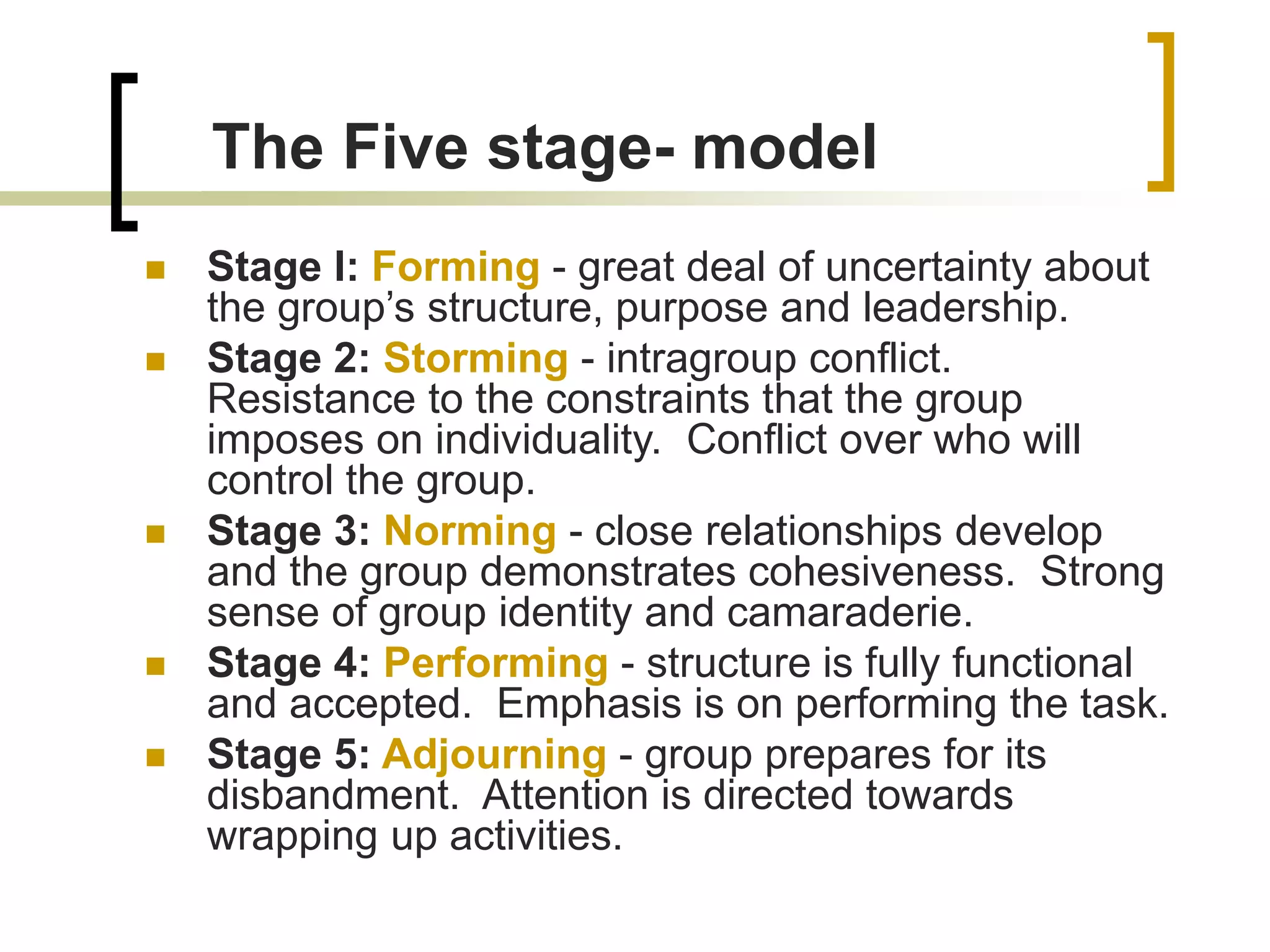
 Stage I: Forming - great deal of uncertainty about
the group’s structure, purpose and leadership.
 Stage 2: Storming - intragroup conflict.
Resistance to the constraints that the group
imposes on individuality. Conflict over who will
control the group.
 Stage 3: Norming - close relationships develop
and the group demonstrates cohesiveness. Strong
sense of group identity and camaraderie.
 Stage 4: Performing - structure is fully functional
and accepted. Emphasis is on performing the task.
 Stage 5: Adjourning - group prepares for its
disbandment. Attention is directed towards
wrapping up activities.
The Five stage- model
Punctuated Equilibrium Model
Studies have confirmed that groups do not develop
in a universal sequence of stages BUT the timing of
when groups form and change the way they work is
Highly consistent:
1. The first meeting sets the group’s direction.
2. The first phase of group activity is one of inertia.
3. A transition takes place at the end of the first phase which
occurs exactly when a group has used up half its allotted time.
4. The transition initiates major changes.
5. A second phase of inertia follows the transition.
6. The group’s last meeting is characterised by markedly
accelerated activity.
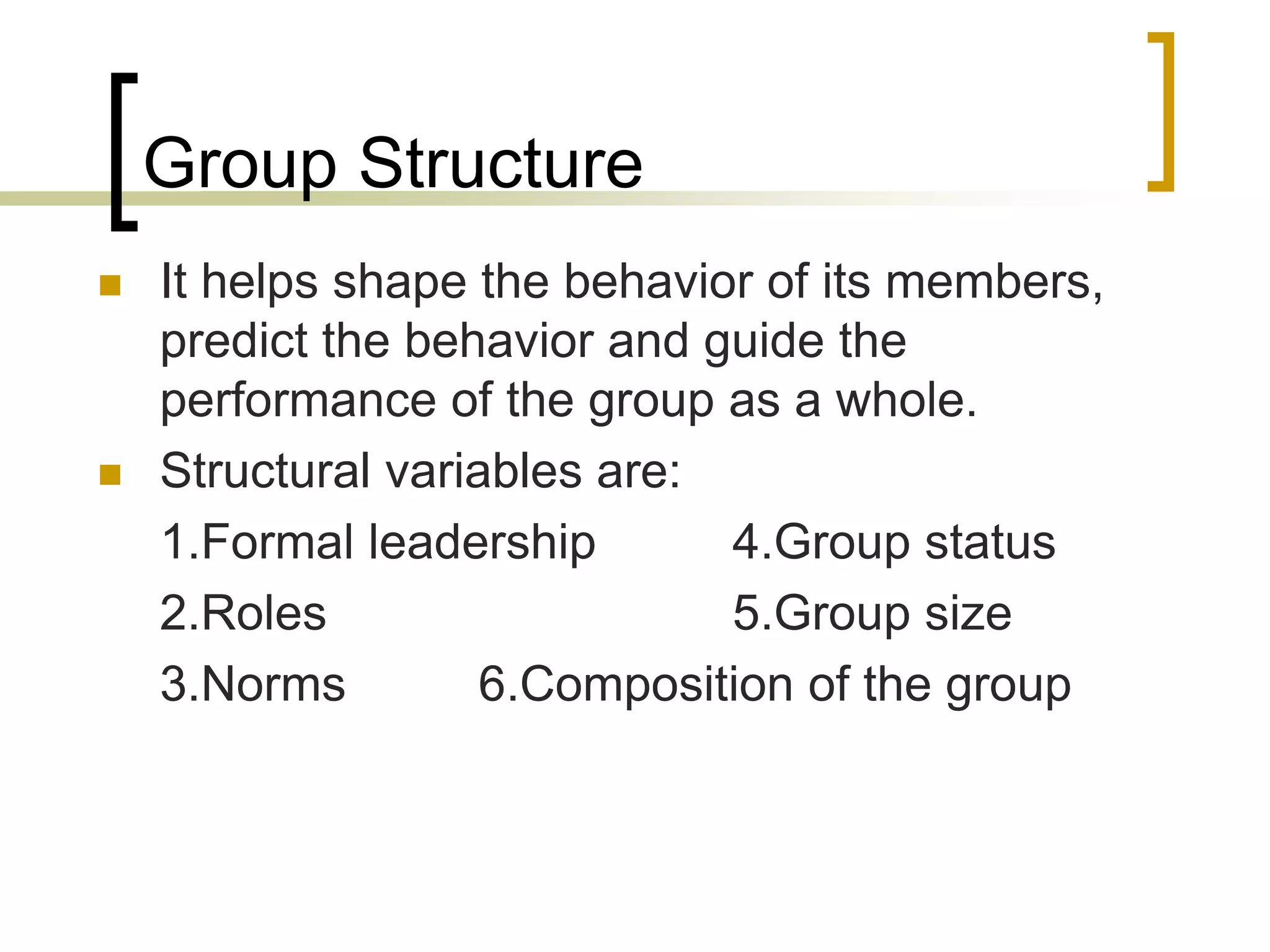
Group Structure
 It helps shape the behavior of its members,
predict the behavior and guide the
performance of the group as a whole.
 Structural variables are:
1.Formal leadership 4.Group status
2.Roles 5.Group size
3.Norms 6.Composition of the group
Formal leadership
 Leader’s behavior has a
significant impact on the group
behavior and performance
 Style of a leader is imitated by the
members of the group.
Roles
 Set of behavior pattern which an individual
occupying a certain position in society is
expected to display.
 Dimensions of role are:
Role Identity: Attitudes and behavior of an
individual gives rise to role identity
Role perception: Involves understanding
how one is supposed to behave in a
particular role.
Role Expectations: how an individual is
expected to behave in a given
situation.
Role conflict: An individual who is
required to perform diverse roles in life
may find that compliance with one role
hinders his compliance with another
role.
Norms
 Acceptable standards of behaviour within a
group that are shared by the group’s members.
1. Norms related to performance
2. Norms related to appearance
3. Norms related to informal social arrangements.
4. Norms that regulate the allocation of resources.
Status
 A socially defined position or rank
given to groups or group members by
others.
Size of a group
 12 or more are good for obtaining diverse input.
 Approx. 7 members tend to be more effective for
taking action.
 Groups of 5-7 members exercise the best
elements of both small and large groups.
 Social Loafing - The tendency for individuals to
expend less effort when working collectively
than when working individually.
Composition of a group
 Most group activities require a variety
of skills and knowledge. Research
studies show that heterogeneous
groups (those composed of dissimilar
individuals in terms of gender,
personalities, opinions, abilities, skills
and perspectives) are likely to perform
more effectively.
 Group demography - The degree to which
members of a group share a common
demographic attribute such as age, sex,
race, educational level or length of service
in the organisation, and the impact of this
attribute on turnover. Cohorts are
individuals who hold a common attribute.
Research has shown that turnover is higher
among those with dissimilar experiences
because of communication problems,
conflict, and power struggles.
Group Tasks
 Large groups facilitate pooling of information e.g.
addition of a diverse perspective to a problem-
solving committee.
 When the task is to co-ordinate and implement a
decision, larger groups are not so effective.
 Therefore, the size-performance relationship is
moderated by the group’s task requirements.
Group Processes
 The processes that go on within a work
group e.g. communication patterns, group
decision processes, leader behaviour,
power dynamics, conflict interactions etc.
 Processes are important to understanding
work group behaviour e.g. Synergy.
(Social loafing is negative synergy.)
Social Facilitation effect
 Tendency of people show significant
improvement in the performance of the
task when they are performing it in
front of others than they are
performing it in private.

Group behaviour.ppt

  • 1.
  • 2.
    “Two or moreindividuals, interacting and interdependent, who have come together to achieve particular objectives.” Robbins (1998) Definitions Of A Group
  • 3.
     The interactionsthat take place among the members of a group are called group dynamics.  Groups are the basic fundamental units of an organization.  It is a primary source of social identity for employees.
  • 4.
    Nature of groups The term group dynamics was coined by Kurt Lewin in 1930s.  There are three views regarding the nature of groups. 1. Normative:- How a group is to be organized and how its activities are to be carried out.
  • 5.
    2. Group dynamicsconsists of a set of techniques like role plays, brainstorming, sensitivity training, team building, Johari window and self managed teams. 3. Regarding internal nature of groups- how groups are formed, their structure, processes and their functioning. How groups affects the individual members, other groups and the org. as a whole.
  • 6.
    Dynamics of groupformation  Acc. to the Theory of Propinquity- , people associate with one another due to geographical proximity. Ex. People in the same office.  Acc to the Balance theory- people who have similar attitudes toward certain objects and goals tend to form a group.
  • 7.
     Acc. tothe Exchange theory- the reward-cost outcomes of interactions serve as the basis for group formation. Affiliations and associations takes place when rewards are greater than the costs incurred.  Most important reason to form group is to to satisfy social needs.
  • 8.
    Types of Groups-formal and Informal Formal  defined by the organisation’s structure, with designated work assignments establishing tasks.  the behaviours that members should engage in are stipulated by and directed toward organisational goals.
  • 9.
     Formal groupsare further classified into Command groups and Task groups.  Command groups are relatively permanent in nature.  Task groups are formed to carry out specific tasks. They are temporary in nature.
  • 10.
    Informal  alliances thatare neither formally structured nor organisationally determined.  natural formations in the work environment that appear in response to the need for social contact.
  • 11.
     Informal groupsare divided into- Friendship and Interest groups  Friendship groups are permanent in nature. Formed because of cordial relationships that the members share.  Interest groups are relatively temporary and are organized around a common activity or interest.
  • 12.
    Stages of Groupdevelopment  The five –stage model  Punctuated Equilibrium model
  • 13.
     Stage I:Forming - great deal of uncertainty about the group’s structure, purpose and leadership.  Stage 2: Storming - intragroup conflict. Resistance to the constraints that the group imposes on individuality. Conflict over who will control the group.  Stage 3: Norming - close relationships develop and the group demonstrates cohesiveness. Strong sense of group identity and camaraderie.  Stage 4: Performing - structure is fully functional and accepted. Emphasis is on performing the task.  Stage 5: Adjourning - group prepares for its disbandment. Attention is directed towards wrapping up activities. The Five stage- model
  • 14.
    Punctuated Equilibrium Model Studieshave confirmed that groups do not develop in a universal sequence of stages BUT the timing of when groups form and change the way they work is Highly consistent: 1. The first meeting sets the group’s direction. 2. The first phase of group activity is one of inertia. 3. A transition takes place at the end of the first phase which occurs exactly when a group has used up half its allotted time. 4. The transition initiates major changes. 5. A second phase of inertia follows the transition. 6. The group’s last meeting is characterised by markedly accelerated activity.
  • 15.
    Group Structure  Ithelps shape the behavior of its members, predict the behavior and guide the performance of the group as a whole.  Structural variables are: 1.Formal leadership 4.Group status 2.Roles 5.Group size 3.Norms 6.Composition of the group
  • 16.
    Formal leadership  Leader’sbehavior has a significant impact on the group behavior and performance  Style of a leader is imitated by the members of the group.
  • 17.
    Roles  Set ofbehavior pattern which an individual occupying a certain position in society is expected to display.  Dimensions of role are: Role Identity: Attitudes and behavior of an individual gives rise to role identity Role perception: Involves understanding how one is supposed to behave in a particular role.
  • 18.
    Role Expectations: howan individual is expected to behave in a given situation. Role conflict: An individual who is required to perform diverse roles in life may find that compliance with one role hinders his compliance with another role.
  • 19.
    Norms  Acceptable standardsof behaviour within a group that are shared by the group’s members. 1. Norms related to performance 2. Norms related to appearance 3. Norms related to informal social arrangements. 4. Norms that regulate the allocation of resources.
  • 20.
    Status  A sociallydefined position or rank given to groups or group members by others.
  • 21.
    Size of agroup  12 or more are good for obtaining diverse input.  Approx. 7 members tend to be more effective for taking action.  Groups of 5-7 members exercise the best elements of both small and large groups.  Social Loafing - The tendency for individuals to expend less effort when working collectively than when working individually.
  • 22.
    Composition of agroup  Most group activities require a variety of skills and knowledge. Research studies show that heterogeneous groups (those composed of dissimilar individuals in terms of gender, personalities, opinions, abilities, skills and perspectives) are likely to perform more effectively.
  • 23.
     Group demography- The degree to which members of a group share a common demographic attribute such as age, sex, race, educational level or length of service in the organisation, and the impact of this attribute on turnover. Cohorts are individuals who hold a common attribute. Research has shown that turnover is higher among those with dissimilar experiences because of communication problems, conflict, and power struggles.
  • 24.
    Group Tasks  Largegroups facilitate pooling of information e.g. addition of a diverse perspective to a problem- solving committee.  When the task is to co-ordinate and implement a decision, larger groups are not so effective.  Therefore, the size-performance relationship is moderated by the group’s task requirements.
  • 25.
    Group Processes  Theprocesses that go on within a work group e.g. communication patterns, group decision processes, leader behaviour, power dynamics, conflict interactions etc.  Processes are important to understanding work group behaviour e.g. Synergy. (Social loafing is negative synergy.)
  • 26.
    Social Facilitation effect Tendency of people show significant improvement in the performance of the task when they are performing it in front of others than they are performing it in private.