RAKSHITH RAJ U M
Dept. OF VAHEE
Organization can be viewed as a social
system of co-operation that is designed to enhance
individual effort at goal accomplishment.
• Organizations differ in many respects their goals,
ethnic composition of their population etc., but one
can sense or 'feel' the individuality of an
organization.
This individuality is labelled as the atmosphere of the
organization.
Other similar commonly used terms are: tone of the
organization, environment, personality of the organization
or organization's climate.
Ex : In one organization members may seem relaxed and
at ease with each other while in another we may find
greater tension which is seen on members' faces, their
speech, how they work etc.
Concept of Organizational Climate
 Organizational climate is a term that was probably first
used by Cornell in 1955.
 He used the term to denote a "delicate blending of
interpretations or perceptions by persons in the organization
of their jobs or roles in relationship to others and their
interpretation of the roles of others in the organization". He
interpreted organization in the sense of a formal structure.
 The term 'climate' is coined to refer to the general feeling,
tone of the persons in groups towards each other and some
of the attitudes they reveal in their behaviour.
 Argyris (1957) used the term - personality for
organizational climate while some others referred the term
as a general flow of behaviour and feeling.
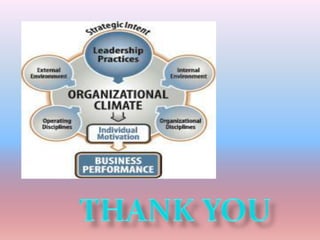
 Organizational climate is created by the interaction,
with one another of the organizational components
namely culture, structure, system, leadership behaviour
and psychological needs of the members of the
organization.
Characteristics of Organisational Climate
1. General Perception
2. Abstract and Intangible Concept
3. Unique and District Identity
4. Enduring Quality
5. Multi-Dimensional Concept
www.yourarticlelibrary.com
Types of Organizational Climate
Open Climate
• It has relatively more openness
• Employees not hindered in their work either by the
management or the authority.
• They work together without complaints or infighting.
• They are intimate and friendly with one another.
• They are not overloaded and are motivated enough to
overcome difficulties and frustration.
• They have job satisfaction
Autonomous Climate
• This has less openness than open climate.
• Almost complete freedom to provide their own structure
for-interaction.
• Achieve their goals easily , quickly and work together
well and accomplish tasks of the organization.
• Has set procedures and regulations which provide
guidelines.
Controlled Climate
• This manifests lesser degree of openness than both open
and autonomous climate types.
• The climate is marked by emphasis on achievement at the
expense of satisfaction of social needs.
• All work hard and there is hardly any time for friendly
relations with others or for deviation from established
controls and directives.
• Job satisfaction is not from satisfaction of social needs
but from task accomplishment
Familiar Climate
• The main features of this climate is the obviously
friendly manner of both the Manager and the members.
• Social needs satisfaction is extremely high and like big
happy family
• Job satisfaction will be average which will come from
social needs satisfaction.
• Manager is afraid to make changes.
• No motivation
Paternal Climate
• This climate is characterised by ineffective attempts of the
manager to control members as well as to satisfy their social
needs.
• It is a partly closed climate and his behaviour is
non-motivating.
• S/he becomes intrusive and wants to know everything at
once.
• Manager takes care of things as best as he can.
• They do not enjoy friendly relations with each other nor
have adequate satisfaction.
Closed Climate
• This is the most closed climate and the least genuine
and it characterises the other extreme of the climate
spectrum.
• S/He sets up rules which are normally arbitary.
• S/He will "go by the book" rather than get too involved
personally with teachers and their problems.
• No motivation
Factors Influencing Organisational Climate
Lawrence James and Allan Jones have classified the
following factors that influence organisational climate:
1. Organisational Context: Mission, goals and objectives,
function etc.
2. Organisational Structure: Size, degree of centralization and
operating procedures.
3. Leadership Process: Leadership styles, communication,
decision making and related processes.
www.yourarticlelibrary.com
4. Physical Environment: Employee safety, environmental
stresses and physical space characteristics.
5. Organisational Values and Norms: Conformity, loyalty,
impersonality and reciprocity.
The following techniques are generally helpful in
improving the climate of the organization:
1. Effective Communication System
2. Concern for People
3. Participative Decision Making
4. Change in Policies, Procedures and rules
5. Technological Changes
Organisation climate

Organisation climate

  • 1.
    RAKSHITH RAJ UM Dept. OF VAHEE
  • 3.
    Organization can beviewed as a social system of co-operation that is designed to enhance individual effort at goal accomplishment. • Organizations differ in many respects their goals, ethnic composition of their population etc., but one can sense or 'feel' the individuality of an organization.
  • 4.
    This individuality islabelled as the atmosphere of the organization. Other similar commonly used terms are: tone of the organization, environment, personality of the organization or organization's climate. Ex : In one organization members may seem relaxed and at ease with each other while in another we may find greater tension which is seen on members' faces, their speech, how they work etc.
  • 5.
    Concept of OrganizationalClimate  Organizational climate is a term that was probably first used by Cornell in 1955.  He used the term to denote a "delicate blending of interpretations or perceptions by persons in the organization of their jobs or roles in relationship to others and their interpretation of the roles of others in the organization". He interpreted organization in the sense of a formal structure.  The term 'climate' is coined to refer to the general feeling, tone of the persons in groups towards each other and some of the attitudes they reveal in their behaviour.
  • 6.
     Argyris (1957)used the term - personality for organizational climate while some others referred the term as a general flow of behaviour and feeling.  Organizational climate is created by the interaction, with one another of the organizational components namely culture, structure, system, leadership behaviour and psychological needs of the members of the organization.
  • 7.
    Characteristics of OrganisationalClimate 1. General Perception 2. Abstract and Intangible Concept 3. Unique and District Identity 4. Enduring Quality 5. Multi-Dimensional Concept www.yourarticlelibrary.com
  • 8.
    Types of OrganizationalClimate Open Climate • It has relatively more openness • Employees not hindered in their work either by the management or the authority. • They work together without complaints or infighting. • They are intimate and friendly with one another. • They are not overloaded and are motivated enough to overcome difficulties and frustration. • They have job satisfaction
  • 9.
    Autonomous Climate • Thishas less openness than open climate. • Almost complete freedom to provide their own structure for-interaction. • Achieve their goals easily , quickly and work together well and accomplish tasks of the organization. • Has set procedures and regulations which provide guidelines.
  • 10.
    Controlled Climate • Thismanifests lesser degree of openness than both open and autonomous climate types. • The climate is marked by emphasis on achievement at the expense of satisfaction of social needs. • All work hard and there is hardly any time for friendly relations with others or for deviation from established controls and directives. • Job satisfaction is not from satisfaction of social needs but from task accomplishment
  • 11.
    Familiar Climate • Themain features of this climate is the obviously friendly manner of both the Manager and the members. • Social needs satisfaction is extremely high and like big happy family • Job satisfaction will be average which will come from social needs satisfaction. • Manager is afraid to make changes. • No motivation
  • 12.
    Paternal Climate • Thisclimate is characterised by ineffective attempts of the manager to control members as well as to satisfy their social needs. • It is a partly closed climate and his behaviour is non-motivating. • S/he becomes intrusive and wants to know everything at once. • Manager takes care of things as best as he can. • They do not enjoy friendly relations with each other nor have adequate satisfaction.
  • 13.
    Closed Climate • Thisis the most closed climate and the least genuine and it characterises the other extreme of the climate spectrum. • S/He sets up rules which are normally arbitary. • S/He will "go by the book" rather than get too involved personally with teachers and their problems. • No motivation
  • 14.
    Factors Influencing OrganisationalClimate Lawrence James and Allan Jones have classified the following factors that influence organisational climate: 1. Organisational Context: Mission, goals and objectives, function etc. 2. Organisational Structure: Size, degree of centralization and operating procedures. 3. Leadership Process: Leadership styles, communication, decision making and related processes. www.yourarticlelibrary.com
  • 15.
    4. Physical Environment:Employee safety, environmental stresses and physical space characteristics. 5. Organisational Values and Norms: Conformity, loyalty, impersonality and reciprocity.
  • 16.
    The following techniquesare generally helpful in improving the climate of the organization: 1. Effective Communication System 2. Concern for People 3. Participative Decision Making 4. Change in Policies, Procedures and rules 5. Technological Changes