POST
TRANSLATIONAL
MODIFICATIONS
Group Members
Introduction
Sajid Khan
01
Post-Translational Modifications in Prokaryotes
Bukhtawar Gul
02
Post-Translational Modifications in Eukaryotes
Mehrab Azram
03
04
05
06
Maimoona Anjum
Role of Post-Translational Modifications in Prokaryotes
Hira Nawaz
Tayyaba Ali
Role of Post-Translational Modifications in Eukaryotes
Comparative Analysis and Conclusion
INTRODUCTION
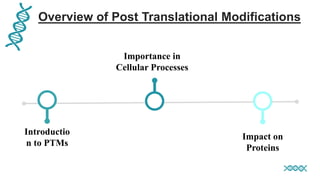
Overview of Post Translational Modifications
Introductio
n to PTMs
Importance in
Cellular Processes
Impact on
Proteins
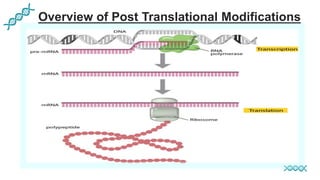
Overview of Post Translational Modifications
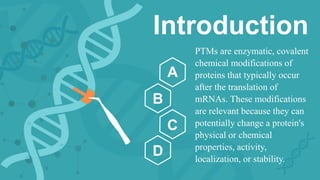
Introduction
PTMs are enzymatic, covalent
chemical modifications of
proteins that typically occur
after the translation of
mRNAs. These modifications
are relevant because they can
potentially change a protein's
physical or chemical
properties, activity,
localization, or stability.
A
B
C
D
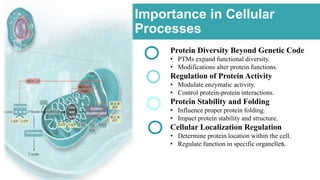
Importance in Cellular
Processes
Protein Diversity Beyond Genetic Code
• PTMs expand functional diversity.
• Modifications alter protein functions.
Regulation of Protein Activity
• Modulate enzymatic activity.
• Control protein-protein interactions.
Protein Stability and Folding
• Influence proper protein folding.
• Impact protein stability and structure.
Cellular Localization Regulation
• Determine protein location within the cell.
• Regulate function in specific organelles.
Post-Translational
Modifications in Prokaryotes
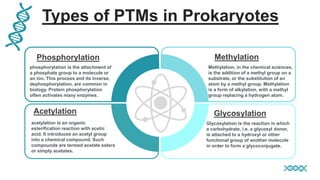
Types of PTMs in Prokaryotes
phosphorylation is the attachment of
a phosphate group to a molecule or
an ion. This process and its inverse,
dephosphorylation, are common in
biology. Protein phosphorylation
often activates many enzymes.
Phosphorylation Methylation
Methylation, in the chemical sciences,
is the addition of a methyl group on a
substrate, or the substitution of an
atom by a methyl group. Methylation
is a form of alkylation, with a methyl
group replacing a hydrogen atom.
Acetylation Glycosylation
acetylation is an organic
esterification reaction with acetic
acid. It introduces an acetyl group
into a chemical compound. Such
compounds are termed acetate esters
or simply acetates.
Glycosylation is the reaction in which
a carbohydrate, i.e. a glycosyl donor,
is attached to a hydroxyl or other
functional group of another molecule
in order to form a glycoconjugate.
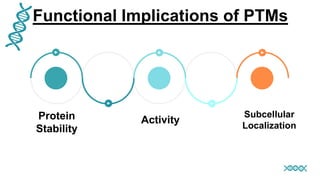
Functional Implications of PTMs
Protein
Stability
Subcellular
Localization
Activity
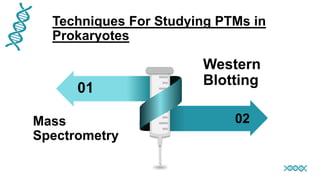
Techniques For Studying PTMs in
Prokaryotes
01
02
Mass
Spectrometry
Western
Blotting
Post-Translational
Modifications in Eukaryotes
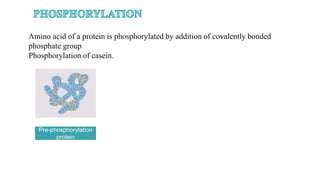
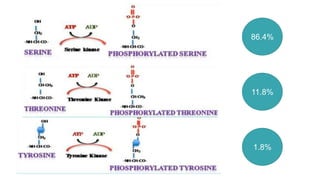
Pre-phosphorylation
protein
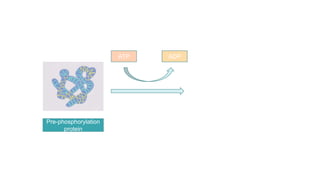
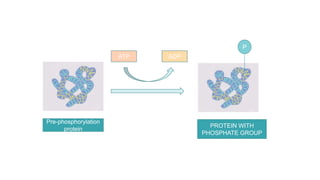
Amino acid of a protein is phosphorylated by addition of covalently bonded
phosphate group
Phosphorylation of casein.
Pre-phosphorylation
protein
ATP ADP
Pre-phosphorylation
protein
ATP ADP
P
PROTEIN WITH
PHOSPHATE GROUP
86.4%
11.8%
1.8%
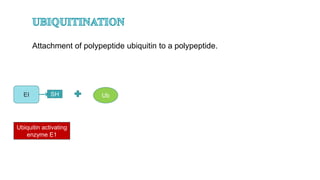
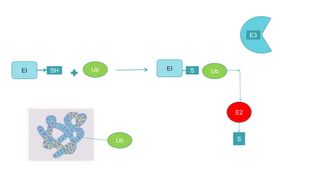
EI SH Ub
Ubiquitin activating
enzyme E1
Attachment of polypeptide ubiquitin to a polypeptide.
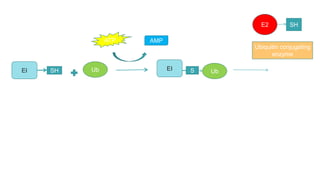
EI SH Ub EI S Ub
E2 SH
Ubiquitin conjugating
enzyme
ATP AMP
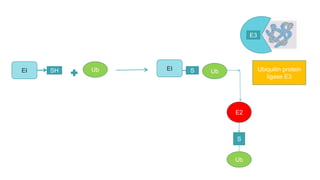
EI SH Ub EI S
Ub
E2
S
Ub
E3
Ubiquitin protein
ligase E3
EI SH Ub EI S
Ub
E2
S
Ub
E3
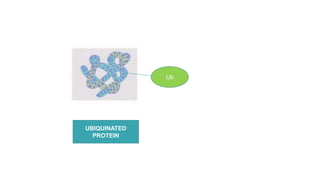
Ub
UBIQUINATED
PROTEIN
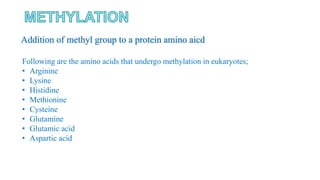
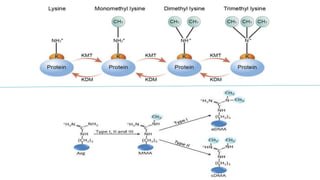
Addition of methyl group to a protein amino aicd
Following are the amino acids that undergo methylation in eukaryotes;
• Arginine
• Lysine
• Histidine
• Methionine
• Cysteine
• Glutamine
• Glutamic acid
• Aspartic acid
1
2
3
4
5
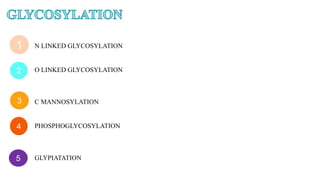
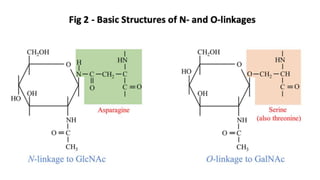
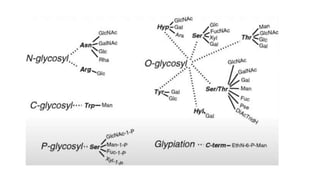
N LINKED GLYCOSYLATION
O LINKED GLYCOSYLATION
C MANNOSYLATION
PHOSPHOGLYCOSYLATION
GLYPIATATION
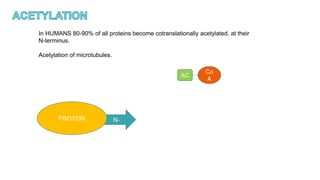
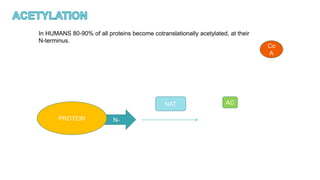
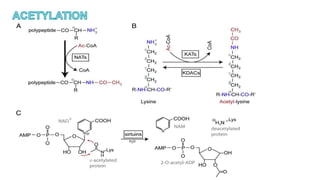
In HUMANS 80-90% of all proteins become cotranslationally acetylated, at their
N-terminus.
Acetylation of microtubules.
N-
PROTEIN
Co
A
AC
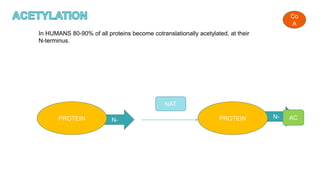
In HUMANS 80-90% of all proteins become cotranslationally acetylated, at their
N-terminus.
N-
PROTEIN
Co
A
AC
NAT
N-
In HUMANS 80-90% of all proteins become cotranslationally acetylated, at their
N-terminus.
N-
PROTEIN
Co
A
AC
NAT
PROTEIN
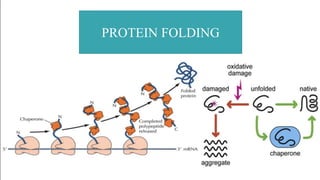
PROTEIN FOLDING
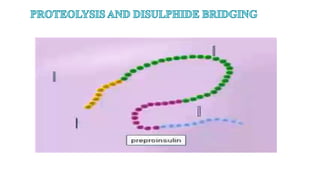
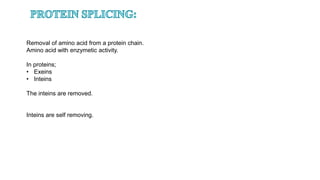
Removal of amino acid from a protein chain.
Amino acid with enzymetic activity.
In proteins;
• Exeins
• Inteins
The inteins are removed.
Inteins are self removing.
You can simply impress your audience and
add a unique zing and appeal to your
Presentations. Easy to change colors,
photos and Text. Get a modern
PowerPoint Presentation that is beautifully
designed. You can simply impress your
audience and add a unique zing and
appeal to your Presentations. Easy to
change colors, photos and Text. Get a
modern PowerPoint Presentation that is
beautifully designed.
Role of Post-Translational
Modifications in Prokaryotes
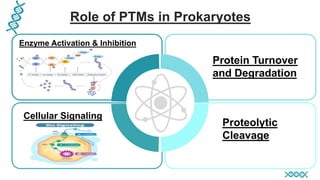
Role of PTMs in Prokaryotes
Enzyme Activation & Inhibition
Cellular Signaling
Protein Turnover
and Degradation
Proteolytic
Cleavage
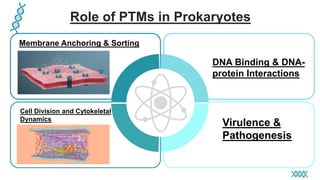
Role of PTMs in Prokaryotes
Membrane Anchoring & Sorting
Cell Division and Cytokeletal
Dynamics
DNA Binding & DNA-
protein Interactions
Virulence &
Pathogenesis
Role of Post-Translational
Modifications in Eukaryotes
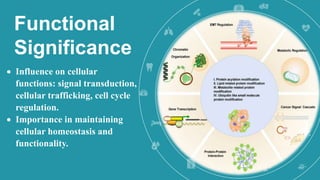
Functional
Significance
 Influence on cellular
functions: signal transduction,
cellular trafficking, cell cycle
regulation.
 Importance in maintaining
cellular homeostasis and
functionality.
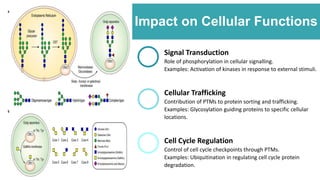
Impact on Cellular Functions
Signal Transduction
Role of phosphorylation in cellular signalling.
Examples: Activation of kinases in response to external stimuli.
Cellular Trafficking
Contribution of PTMs to protein sorting and trafficking.
Examples: Glycosylation guiding proteins to specific cellular
locations.
Cell Cycle Regulation
Control of cell cycle checkpoints through PTMs.
Examples: Ubiquitination in regulating cell cycle protein
degradation.
01
02
Association with
Diseases
Disease
mechanisms
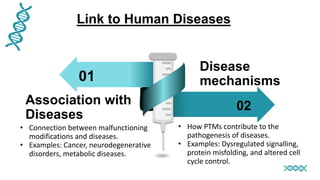
Link to Human Diseases
• Connection between malfunctioning
modifications and diseases.
• Examples: Cancer, neurodegenerative
disorders, metabolic diseases.
• How PTMs contribute to the
pathogenesis of diseases.
• Examples: Dysregulated signalling,
protein misfolding, and altered cell
cycle control.
01
02
Protentional
Interventions
Advancements
in Treatments
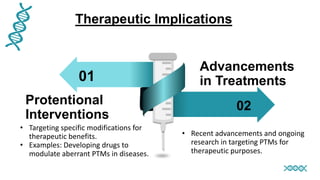
Therapeutic Implications
• Targeting specific modifications for
therapeutic benefits.
• Examples: Developing drugs to
modulate aberrant PTMs in diseases.
• Recent advancements and ongoing
research in targeting PTMs for
therapeutic purposes.
COMPARATIVE ANALYSIS
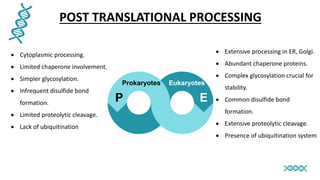
POST TRANSLATIONAL PROCESSING
 Cytoplasmic processing.
 Limited chaperone involvement.
 Simpler glycosylation.
 Infrequent disulfide bond
formation.
 Limited proteolytic cleavage.
 Lack of ubiquitination
E
Eukaryotes
Prokaryotes
P
 Extensive processing in ER, Golgi.
 Abundant chaperone proteins.
 Complex glycosylation crucial for
stability.
 Common disulfide bond
formation.
 Extensive proteolytic cleavage.
 Presence of ubiquitination system
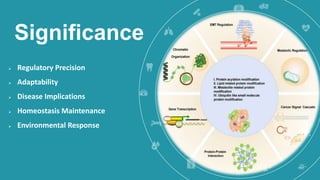
Significance
 Regulatory Precision
 Adaptability
 Disease Implications
 Homeostasis Maintenance
 Environmental Response
Conclusion
Post-translational processing
causally shapes protein
functionality, influencing
cellular dynamics and
contributing significantly to
disease pathways. Its dynamic
nature plays a pivotal role in
cellular responses,
underscoring its impact on the
intricacies of biological
systems..
A
B
C
D
Thank You

Group 7 - Post Translational Modifications.pptx

  • 1.
  • 2.
    Group Members Introduction Sajid Khan 01 Post-TranslationalModifications in Prokaryotes Bukhtawar Gul 02 Post-Translational Modifications in Eukaryotes Mehrab Azram 03 04 05 06 Maimoona Anjum Role of Post-Translational Modifications in Prokaryotes Hira Nawaz Tayyaba Ali Role of Post-Translational Modifications in Eukaryotes Comparative Analysis and Conclusion
  • 3.
  • 4.
    Overview of PostTranslational Modifications Introductio n to PTMs Importance in Cellular Processes Impact on Proteins
  • 5.
    Overview of PostTranslational Modifications
  • 6.
    Introduction PTMs are enzymatic,covalent chemical modifications of proteins that typically occur after the translation of mRNAs. These modifications are relevant because they can potentially change a protein's physical or chemical properties, activity, localization, or stability. A B C D
  • 7.
    Importance in Cellular Processes ProteinDiversity Beyond Genetic Code • PTMs expand functional diversity. • Modifications alter protein functions. Regulation of Protein Activity • Modulate enzymatic activity. • Control protein-protein interactions. Protein Stability and Folding • Influence proper protein folding. • Impact protein stability and structure. Cellular Localization Regulation • Determine protein location within the cell. • Regulate function in specific organelles.
  • 8.
  • 9.
    Types of PTMsin Prokaryotes phosphorylation is the attachment of a phosphate group to a molecule or an ion. This process and its inverse, dephosphorylation, are common in biology. Protein phosphorylation often activates many enzymes. Phosphorylation Methylation Methylation, in the chemical sciences, is the addition of a methyl group on a substrate, or the substitution of an atom by a methyl group. Methylation is a form of alkylation, with a methyl group replacing a hydrogen atom. Acetylation Glycosylation acetylation is an organic esterification reaction with acetic acid. It introduces an acetyl group into a chemical compound. Such compounds are termed acetate esters or simply acetates. Glycosylation is the reaction in which a carbohydrate, i.e. a glycosyl donor, is attached to a hydroxyl or other functional group of another molecule in order to form a glycoconjugate.
  • 10.
    Functional Implications ofPTMs Protein Stability Subcellular Localization Activity
  • 11.
    Techniques For StudyingPTMs in Prokaryotes 01 02 Mass Spectrometry Western Blotting
  • 12.
  • 13.
    Pre-phosphorylation protein Amino acid ofa protein is phosphorylated by addition of covalently bonded phosphate group Phosphorylation of casein.
  • 14.
  • 15.
  • 16.
  • 17.
    EI SH Ub Ubiquitinactivating enzyme E1 Attachment of polypeptide ubiquitin to a polypeptide.
  • 18.
    EI SH UbEI S Ub E2 SH Ubiquitin conjugating enzyme ATP AMP
  • 19.
    EI SH UbEI S Ub E2 S Ub E3 Ubiquitin protein ligase E3
  • 20.
    EI SH UbEI S Ub E2 S Ub E3
  • 21.
  • 22.
    Addition of methylgroup to a protein amino aicd Following are the amino acids that undergo methylation in eukaryotes; • Arginine • Lysine • Histidine • Methionine • Cysteine • Glutamine • Glutamic acid • Aspartic acid
  • 24.
    1 2 3 4 5 N LINKED GLYCOSYLATION OLINKED GLYCOSYLATION C MANNOSYLATION PHOSPHOGLYCOSYLATION GLYPIATATION
  • 27.
    In HUMANS 80-90%of all proteins become cotranslationally acetylated, at their N-terminus. Acetylation of microtubules. N- PROTEIN Co A AC
  • 28.
    In HUMANS 80-90%of all proteins become cotranslationally acetylated, at their N-terminus. N- PROTEIN Co A AC NAT
  • 29.
    N- In HUMANS 80-90%of all proteins become cotranslationally acetylated, at their N-terminus. N- PROTEIN Co A AC NAT PROTEIN
  • 32.
  • 33.
    Removal of aminoacid from a protein chain. Amino acid with enzymetic activity. In proteins; • Exeins • Inteins The inteins are removed. Inteins are self removing.
  • 34.
    You can simplyimpress your audience and add a unique zing and appeal to your Presentations. Easy to change colors, photos and Text. Get a modern PowerPoint Presentation that is beautifully designed. You can simply impress your audience and add a unique zing and appeal to your Presentations. Easy to change colors, photos and Text. Get a modern PowerPoint Presentation that is beautifully designed.
  • 35.
  • 36.
    Role of PTMsin Prokaryotes Enzyme Activation & Inhibition Cellular Signaling Protein Turnover and Degradation Proteolytic Cleavage
  • 37.
    Role of PTMsin Prokaryotes Membrane Anchoring & Sorting Cell Division and Cytokeletal Dynamics DNA Binding & DNA- protein Interactions Virulence & Pathogenesis
  • 38.
  • 39.
    Functional Significance  Influence oncellular functions: signal transduction, cellular trafficking, cell cycle regulation.  Importance in maintaining cellular homeostasis and functionality.
  • 40.
    Impact on CellularFunctions Signal Transduction Role of phosphorylation in cellular signalling. Examples: Activation of kinases in response to external stimuli. Cellular Trafficking Contribution of PTMs to protein sorting and trafficking. Examples: Glycosylation guiding proteins to specific cellular locations. Cell Cycle Regulation Control of cell cycle checkpoints through PTMs. Examples: Ubiquitination in regulating cell cycle protein degradation.
  • 41.
    01 02 Association with Diseases Disease mechanisms Link toHuman Diseases • Connection between malfunctioning modifications and diseases. • Examples: Cancer, neurodegenerative disorders, metabolic diseases. • How PTMs contribute to the pathogenesis of diseases. • Examples: Dysregulated signalling, protein misfolding, and altered cell cycle control.
  • 42.
    01 02 Protentional Interventions Advancements in Treatments Therapeutic Implications •Targeting specific modifications for therapeutic benefits. • Examples: Developing drugs to modulate aberrant PTMs in diseases. • Recent advancements and ongoing research in targeting PTMs for therapeutic purposes.
  • 43.
  • 44.
    POST TRANSLATIONAL PROCESSING Cytoplasmic processing.  Limited chaperone involvement.  Simpler glycosylation.  Infrequent disulfide bond formation.  Limited proteolytic cleavage.  Lack of ubiquitination E Eukaryotes Prokaryotes P  Extensive processing in ER, Golgi.  Abundant chaperone proteins.  Complex glycosylation crucial for stability.  Common disulfide bond formation.  Extensive proteolytic cleavage.  Presence of ubiquitination system
  • 45.
    Significance  Regulatory Precision Adaptability  Disease Implications  Homeostasis Maintenance  Environmental Response
  • 46.
    Conclusion Post-translational processing causally shapesprotein functionality, influencing cellular dynamics and contributing significantly to disease pathways. Its dynamic nature plays a pivotal role in cellular responses, underscoring its impact on the intricacies of biological systems.. A B C D
  • 47.