Microbiology
laboratory
Submitted to:
Ma’am Nafeesa
Submitted by:
Group #2
Faryal Akhtar
Maria Masood
Itrat Rida Bukhari
Alisha Sarfraz
Hamnah Zahid
Saifullah
Hajra Zahid
Qurat ul ain
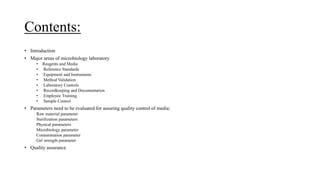
Contents:
• Introduction
• Major areas of microbiology laboratory
• Reagents and Media
• Reference Standards
• Equipment and Instruments
• Method Validation
• Laboratory Controls
• Recordkeeping and Documentation
• Employee Training
• Sample Control
• Parameters need to be evaluated for assuring quality control of media:
Raw material parameter
Sterilization parameters
Physical parameters
Microbiology parameter
Contamination parameter
Gel strength parameter
• Quality assurance
Introduction:
• Microbiology laboratories may be involved in:
• Sterility testing:
• Detection, isolation, enumeration and identification of
microorganisms
• Bacteria, yeast and molds
• Testing for bacterial endotoxins in different materials
• (e.g. Starting materials, water, surfaces, garments and the
environment)
Personnel:
• Microbiological testing:
• Should be performed and supervised by an experienced person
only.
• Personal should be qualified in microbiology or equivalent.
• They should have basic training in microbiology.
• They should have relevant practical experience before
commencing testing.
Cont’d…
• Current job descriptions of all the personnel's should be
maintained.
• personnel's involved in tests, calibrations, verifications and
validations.
• Laboratory should maintain all the records of personnel
which describe their qualifications, training and experience.
Cont’d…
• The laboratory management should ensure that all personnel have received
adequate training for
• Competent performance of tests
• Operation of equipment
• This should include training in
• Basic techniques e.g. plate pouring, counting of colonies, aseptic technique, media
preparation, serial dilutions and,
• Basic techniques in identification
Cont’d…
• Only competent personnel should perform the tests on samples.
• Otherwise testing should be done under adequate supervision.
• competence should be monitored continuously with provision for retaining where
necessary.
• Where a method or technique is not in regular use, the competency of personnel to
perform the test should be verified before testing is undertaken.
• Personnel should be trained in necessary procedures for containment of
microorganisms within the laboratory facility.
• Personnel should be trained in safe handling of microorganisms.
Environment:
• Microbiology laboratories should be dedicated and separated from other areas
specially from production areas.
• Microbiology laboratories should be designed to suit the operations to be carried
out in them.
• There should be sufficient space for all activities to avoid contamination and cross
contamination.
• There should be suitable space for samples, reference organisms, testing and
records.
• Due to nature of some materials i.e., sterile media or incubated cultures, separate
storage locations may be necessary.
Contd..
• Laboratory should be appropriately designed.
• They should take into account the suitability of the construction
materials to enable appropriate cleaning, disinfection, and
minimize the risks of contamination.
• There should be separate air supplies to laboratories and
production areas.
• The air supplied to laboratory should not be a source of
contamination.
Cont’d..
• Access to microbiological laboratory should be restricted to authorized personnel
only.
• Personnel should be made aware of:
• The appropriate entry and exit procedures included gowning, the intended use of
particular area.
• The restrictions imposed on working within such area.
• The reasons for imposing such restrictions.
• The appropriate contaminant levels.
Major areas of microbiological laboratory
1. Reagents and Media
2. Reference Standards
3. Equipment and Instruments
4. Method Validation
5. Laboratory Controls
6. Recordkeeping and Documentation
7. Employee Training
8. Sample Control
Major areas of microbiological laboratory
1. REAGENTS AND MEDIA:
• It’s important to choose the correct media or components in making media based
on the use of accepted sources or references for formulas.
• The capability of the media to promote the growth of organisms may be affected
by the media preparation process, sterilization (overheating), and storage.
2. REFERENCE STANDARDS:
• Microbial cultures are delicate standards.
• Procedures should specify careful handling instructions.
3. EQUIPMENTS AND INSTRUMENTS:
EQUIPMENTS
• Incubators
• Refrigerators
• Water bathes
• Autoclave
• INSTRUMENTS
• KQCL machine
• pH meter
• Balance
• Spectrophotometers
• Air sampler (viable, none-viable)
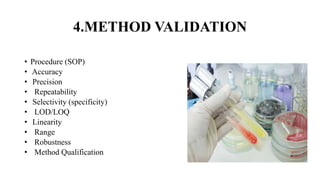
4.METHOD VALIDATION
• Procedure (SOP)
• Accuracy
• Precision
• Repeatability
• Selectivity (specificity)
• LOD/LOQ
• Linearity
• Range
• Robustness
• Method Qualification
5. LABORATORY CONTROLS
• The Micro Lab should practice aseptic techniques during
testing in general, to avoid microbial contamination.
• In the Micro Lab, areas where EM, water, or product
samples are handled/incubated must be adequately
separated from areas where there are tests that involve live
cultures or sub culturing, microbial ID, or investigations
6.RECORD KEEPING AND
DOUMENTATION:
• DOCUMENTATION
• Microbiologist training and verification of proficiency.
• Reports reviewed by QAU or a qualified responsible manager
• Investigation of data deviations.
• RECORD KEEPING
• Proper recordkeeping is critical for the Micro Lab.
• A test should be performed as per SOP, and the laboratory notebook should
provide a record of all critical details needed to confirm the integrity of the data.
Major areas of microbiological laboratory
• 7.TRAINING OF PERSONNEL
• Company
• Department
• Demonstrated proficiency
• Maintain the proficiency
• 8. SAMPLE CONTROL
• Procedure
• Traceability
QUALITY CONTROL
PARAMETERS
Parameters:
• Quality control procedures of media are divided into different sections according
to the parameters that need evaluation:
• Raw material parameters
• Sterilization parameters
• Physical parameters
• Microbiological parameters
• Contamination parameters
• Gel strength parameters
Raw Material parameters
It includes following ;
• Culture Media
• Water
• Petri dishes
• Blood
Culture media:
It play a vital role in any microbiology laboratory. They are widely employed for
isolation, identification and sensitivity testing of different pathogenic microorganisms.
Most of the laboratories usually prepare their own media for routine diagnostics as well
as research purposes. Therefore the Quality control of culture media is very important.
However, to ensure that the media is of good quality and capable of giving satisfactory
results, proper quality management system is essential. For that purpose certain
parameters of media prepared should be thoroughly checked and then passed for
laboratory use.
Water:
The quality of the media depends directly upon the quality of the raw materials used for
their preparation. Water is the most important raw material used for the preparation of
culture media. The parameters to be checked are presence of copper ions, conductivity and
pH . Ideally there should be no copper ions present in water because it is inhibitory for the
growth of microorganisms. The conductivity should be less than 15 µS (micro siemens). The
pH of the water should be slightly on the acidic side , But should not be less than 5.5.
Petri Dishes:
The quality of Petri dish used for pouring of media is also an important factor. Normally
petri dishes are ethylene oxide (EtO) sterilized or gamma irradiated. If EtO sterilized they
should be then checked for residual EtO toxicity, as this may affect the growth of the
microorganisms. The maximum permissible limit for residual EtO is 1 µg/g and it can be
measured by standard gas chromatographic methods.
Blood
Blood is the most important one of them. Hence the quality of the blood plays an
important role in the performance of the blood containing media. The sterility,
homogeneity, viscosity and color of the blood should be scrupulously checked
before it is used for media preparation. For other additives the certificate of analysis
and sterility conditions should be considered.
Sterilization parameters
Sterilization of the media plays an important role in the quality of the media.
Generally autoclaving is carried out for sterilizing the media. However, the time of
autoclaving and the quantity of media sterilized should be closely regulated . Heat
treatment of complex culture media may result in its nutrient destruction .
The volume of the media in one sterilization batch should be kept small, ideally two
liters. Regular checking of the sterilization process by indicators should be done;
temperature and pressure should also be constantly monitored. Sterilization indicators
used includes biological indicators such as spores of Bacillus stearothermophilus and
Bowie Dick .
Physical Parameters
Physical Parameters involve :
Physical Characteristics of Media
pH of Media
Physical Characteristics :
The gross physical appearance of media often suggests the quality. Media prepared should be
screened for physical characteristics such as excessive bubbles , unequal filling of plates
(uniform leveling), cracked medium in plate and crystallization.
All the above mentioned characters can be checked visually by naked eye. However, for
unequal filling of plates, thickness of medium can be checked at four points. These four
points are the two ends of the two diameters of the plate, which are at right angles to each
other. Thus all the four sides can be simultaneously checked. The thickness at the four points
is noted down and the mean thickness is determined and reported as mean thickness of the
medium in the plate, which must be 4.0 ± 0.2 .
Cont’d…
pH of Media
The pH value of the medium is also one of the important physical characters, which must
be checked. It can be measured while preparation of the medium before and after
autoclaving by using the standard pH meter.
Microbiological Parameters
Growth supporting characteristics is the most important parameter while conducting
quality control of media. Standard inoculating procedures should be used. The results
should be examined both qualitatively and quantitatively and while testing new lots, both
previous batch and new batch should be simultaneously grown.
Microbiological Parameters
National committee for clinical laboratory standards (NCCLS) has laid down certain
guidelines for the control organisms to be used for every medium, the desired inoculum
concentration and their expected growth results. Inoculum for every medium can be
prepared according to the following method:
The control organism is inoculated in soya bean casein digest (SCD) broth and
incubated for 4 hours to get a appropriate cell density .A 10 µL quantity of inoculum
diluted in normal saline or in SCD broth should be used for selective and nonselective
media respectively . After inoculation, the plates are incubated at 37°C for 24 hours and
their growth and colony characteristics are observed .
Contamination parameters
This is a very crucial parameter for the determination of the quality of media. The batch
must be checked for contamination before passing for laboratory use. It is also
suggested that the whole batch of the prepared media be checked for contamination by
keeping the plates at least for three days at room temperature. Alternatively, two plates
from the test batch can be taken and placed into the incubator set at 37°C for 24 hours.
If contamination occurs again, it is inferred that contamination has occurred in the
prepared batch. As per recommendations more than 10% contamination requires the
batch to be discarded.
Gel Strength parameters
The gel strength is measured by using a tripod stand with a central rod that is used
to impart pressure on the agar. The lower end of the rod has a spherical portion,
which rests on the medium surface. The upper end of the rod has a platform on
which standard weights are placed. The spherical portion of the central rod is placed
on the medium and weights are placed on the upper platform one by one and
observed for some time. The process is continued until the agar breaks .
A gel strength of about 300 - 500 dynes/cm2 will give satisfactory results
Good Laboratory Practices In
Microbiology Lab
The principles of GLP aim to ensure and promote safety, consistency, high quality, and
reliability of chemicals in microbiology lab. Following are the basic requirements for GLP.
Analyst Certification :
All analyst working in the QC lab should be educated and qualified analysts.
Test is invalid if unqualified analyst has carried it out.
Instrumentation Calibration ;
Calibration calendar will be maintained for all the QC instruments.
The instrument will be tagged with instrument details such as instrument
ID and instrument name
The instrument and glassware calibration will be carried out as per SOP.
Cont’d…
Material /Reagents Certification :
Container for laboratory reagents/materials must be labeled with information such as
date received, date opened, preparation date, expiration time etc.
All the reagents or materials will be stored at its specified storage condition
All the volumetric glassware used must be calibrated
There will be a list of all the chemicals and reagents, which should be displayed on the
respective rack.
All the cupboards and drawers should be numbered, list of materials kept inside each
cupboard
and drawer should be maintained.
Use the protective gloves, masks during reagent preparation and standardization.
Cont’d..
Lab Facilities Certification :
Separate Area will be provided for microbiological analysis.
lab will be design appropriately to carry out the operation
Sufficient space will be provided for storage of test sample, reference samples, media and
records.
Documentation:
At a minimum Microbiology lab should have the following documents:
• Sampling Procedures
• Standard Operating Procedure
• Method of analysis
• Analytical work sheet an records
• All the documents will be stored in secured manner.
Washing and Cleaning of Glass wares
There will be a cleaning schedule for the microbiology lab.
The cleaning will be done according to schedule.
The cleaning will be done with RO or WFI water and qualified
cleaning agent.
All the new and old glassware and plastic ware will be cleaned
as per SOP. The cleaned glassware will be labeled and will be
kept at the specified space . Before use, check the glassware/
laboratory ware for its cleanliness as it does not have any brown
spot, residue or visible traces.
Cont’d..
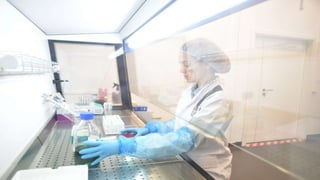
Handling of Waste:
There will be discard procedure for every type of waste
generated in the microbiology lab.
Handle the spilled material in a manner to avoid contact with
skin.
Discard the cytotoxic waste as per the procedure .
Quality Assurance(QA)
• The sum total of all activities that are performed to ensure
quality of the product.
• The standardized definition of quality refers to all those
features of a product which are required by the customer.
Objectives of quality in lab
• Support provision of high quality health care,
• Reduce morbidity
• Reduce mortality
• Reduce economic lab
 Ensure credibility of lab
 Generate confidence in lab results
Consequences of poor quality
• Inappropriate action
Over investigation
Over treatment
Mistreatment
• Inappropriate inaction
Lack of investigation
No treatment
Factors affecting the performance of
equipment:
 Proper installation
 Calibration
 Validation
 Training of operators
Microscopes(action required)
• Clean oil immersion& objective lens paper
• Remove slides
• Cover microscope with dust cover
• Adjust optic system
• Clean optic system& microscope
Conclusions
• Implementation of GLP and quality control should start from
top level management and investigators.
• Organization also spend some amount of fund to implement
GLP and quality control for safety purpose and long-term
benefit of organization itself.
• If one person in top management is aware of GLP and quality
control it is easy to implement GLP in organization for top
management.
• GLP training is not one-time training event, the training of GLP
give to the whole organization

Gp 2 - Good Lab Practices for Microbiology Lab.pptx

  • 1.
    Microbiology laboratory Submitted to: Ma’am Nafeesa Submittedby: Group #2 Faryal Akhtar Maria Masood Itrat Rida Bukhari Alisha Sarfraz Hamnah Zahid Saifullah Hajra Zahid Qurat ul ain
  • 2.
    Contents: • Introduction • Majorareas of microbiology laboratory • Reagents and Media • Reference Standards • Equipment and Instruments • Method Validation • Laboratory Controls • Recordkeeping and Documentation • Employee Training • Sample Control • Parameters need to be evaluated for assuring quality control of media: Raw material parameter Sterilization parameters Physical parameters Microbiology parameter Contamination parameter Gel strength parameter • Quality assurance
  • 3.
    Introduction: • Microbiology laboratoriesmay be involved in: • Sterility testing: • Detection, isolation, enumeration and identification of microorganisms • Bacteria, yeast and molds • Testing for bacterial endotoxins in different materials • (e.g. Starting materials, water, surfaces, garments and the environment)
  • 4.
    Personnel: • Microbiological testing: •Should be performed and supervised by an experienced person only. • Personal should be qualified in microbiology or equivalent. • They should have basic training in microbiology. • They should have relevant practical experience before commencing testing.
  • 5.
    Cont’d… • Current jobdescriptions of all the personnel's should be maintained. • personnel's involved in tests, calibrations, verifications and validations. • Laboratory should maintain all the records of personnel which describe their qualifications, training and experience.
  • 6.
    Cont’d… • The laboratorymanagement should ensure that all personnel have received adequate training for • Competent performance of tests • Operation of equipment • This should include training in • Basic techniques e.g. plate pouring, counting of colonies, aseptic technique, media preparation, serial dilutions and, • Basic techniques in identification
  • 7.
    Cont’d… • Only competentpersonnel should perform the tests on samples. • Otherwise testing should be done under adequate supervision. • competence should be monitored continuously with provision for retaining where necessary. • Where a method or technique is not in regular use, the competency of personnel to perform the test should be verified before testing is undertaken. • Personnel should be trained in necessary procedures for containment of microorganisms within the laboratory facility. • Personnel should be trained in safe handling of microorganisms.
  • 8.
    Environment: • Microbiology laboratoriesshould be dedicated and separated from other areas specially from production areas. • Microbiology laboratories should be designed to suit the operations to be carried out in them. • There should be sufficient space for all activities to avoid contamination and cross contamination. • There should be suitable space for samples, reference organisms, testing and records. • Due to nature of some materials i.e., sterile media or incubated cultures, separate storage locations may be necessary.
  • 9.
    Contd.. • Laboratory shouldbe appropriately designed. • They should take into account the suitability of the construction materials to enable appropriate cleaning, disinfection, and minimize the risks of contamination. • There should be separate air supplies to laboratories and production areas. • The air supplied to laboratory should not be a source of contamination.
  • 10.
    Cont’d.. • Access tomicrobiological laboratory should be restricted to authorized personnel only. • Personnel should be made aware of: • The appropriate entry and exit procedures included gowning, the intended use of particular area. • The restrictions imposed on working within such area. • The reasons for imposing such restrictions. • The appropriate contaminant levels.
  • 11.
    Major areas ofmicrobiological laboratory 1. Reagents and Media 2. Reference Standards 3. Equipment and Instruments 4. Method Validation 5. Laboratory Controls 6. Recordkeeping and Documentation 7. Employee Training 8. Sample Control
  • 12.
    Major areas ofmicrobiological laboratory 1. REAGENTS AND MEDIA: • It’s important to choose the correct media or components in making media based on the use of accepted sources or references for formulas. • The capability of the media to promote the growth of organisms may be affected by the media preparation process, sterilization (overheating), and storage. 2. REFERENCE STANDARDS: • Microbial cultures are delicate standards. • Procedures should specify careful handling instructions.
  • 13.
    3. EQUIPMENTS ANDINSTRUMENTS: EQUIPMENTS • Incubators • Refrigerators • Water bathes • Autoclave • INSTRUMENTS • KQCL machine • pH meter • Balance • Spectrophotometers • Air sampler (viable, none-viable)
  • 14.
    4.METHOD VALIDATION • Procedure(SOP) • Accuracy • Precision • Repeatability • Selectivity (specificity) • LOD/LOQ • Linearity • Range • Robustness • Method Qualification
  • 15.
    5. LABORATORY CONTROLS •The Micro Lab should practice aseptic techniques during testing in general, to avoid microbial contamination. • In the Micro Lab, areas where EM, water, or product samples are handled/incubated must be adequately separated from areas where there are tests that involve live cultures or sub culturing, microbial ID, or investigations
  • 16.
    6.RECORD KEEPING AND DOUMENTATION: •DOCUMENTATION • Microbiologist training and verification of proficiency. • Reports reviewed by QAU or a qualified responsible manager • Investigation of data deviations. • RECORD KEEPING • Proper recordkeeping is critical for the Micro Lab. • A test should be performed as per SOP, and the laboratory notebook should provide a record of all critical details needed to confirm the integrity of the data.
  • 17.
    Major areas ofmicrobiological laboratory • 7.TRAINING OF PERSONNEL • Company • Department • Demonstrated proficiency • Maintain the proficiency • 8. SAMPLE CONTROL • Procedure • Traceability
  • 18.
  • 19.
    Parameters: • Quality controlprocedures of media are divided into different sections according to the parameters that need evaluation: • Raw material parameters • Sterilization parameters • Physical parameters • Microbiological parameters • Contamination parameters • Gel strength parameters
  • 20.
    Raw Material parameters Itincludes following ; • Culture Media • Water • Petri dishes • Blood Culture media: It play a vital role in any microbiology laboratory. They are widely employed for isolation, identification and sensitivity testing of different pathogenic microorganisms. Most of the laboratories usually prepare their own media for routine diagnostics as well as research purposes. Therefore the Quality control of culture media is very important. However, to ensure that the media is of good quality and capable of giving satisfactory results, proper quality management system is essential. For that purpose certain parameters of media prepared should be thoroughly checked and then passed for laboratory use.
  • 21.
    Water: The quality ofthe media depends directly upon the quality of the raw materials used for their preparation. Water is the most important raw material used for the preparation of culture media. The parameters to be checked are presence of copper ions, conductivity and pH . Ideally there should be no copper ions present in water because it is inhibitory for the growth of microorganisms. The conductivity should be less than 15 µS (micro siemens). The pH of the water should be slightly on the acidic side , But should not be less than 5.5. Petri Dishes: The quality of Petri dish used for pouring of media is also an important factor. Normally petri dishes are ethylene oxide (EtO) sterilized or gamma irradiated. If EtO sterilized they should be then checked for residual EtO toxicity, as this may affect the growth of the microorganisms. The maximum permissible limit for residual EtO is 1 µg/g and it can be measured by standard gas chromatographic methods.
  • 22.
    Blood Blood is themost important one of them. Hence the quality of the blood plays an important role in the performance of the blood containing media. The sterility, homogeneity, viscosity and color of the blood should be scrupulously checked before it is used for media preparation. For other additives the certificate of analysis and sterility conditions should be considered.
  • 23.
    Sterilization parameters Sterilization ofthe media plays an important role in the quality of the media. Generally autoclaving is carried out for sterilizing the media. However, the time of autoclaving and the quantity of media sterilized should be closely regulated . Heat treatment of complex culture media may result in its nutrient destruction . The volume of the media in one sterilization batch should be kept small, ideally two liters. Regular checking of the sterilization process by indicators should be done; temperature and pressure should also be constantly monitored. Sterilization indicators used includes biological indicators such as spores of Bacillus stearothermophilus and Bowie Dick .
  • 24.
    Physical Parameters Physical Parametersinvolve : Physical Characteristics of Media pH of Media Physical Characteristics : The gross physical appearance of media often suggests the quality. Media prepared should be screened for physical characteristics such as excessive bubbles , unequal filling of plates (uniform leveling), cracked medium in plate and crystallization. All the above mentioned characters can be checked visually by naked eye. However, for unequal filling of plates, thickness of medium can be checked at four points. These four points are the two ends of the two diameters of the plate, which are at right angles to each other. Thus all the four sides can be simultaneously checked. The thickness at the four points is noted down and the mean thickness is determined and reported as mean thickness of the medium in the plate, which must be 4.0 ± 0.2 .
  • 25.
    Cont’d… pH of Media ThepH value of the medium is also one of the important physical characters, which must be checked. It can be measured while preparation of the medium before and after autoclaving by using the standard pH meter. Microbiological Parameters Growth supporting characteristics is the most important parameter while conducting quality control of media. Standard inoculating procedures should be used. The results should be examined both qualitatively and quantitatively and while testing new lots, both previous batch and new batch should be simultaneously grown.
  • 26.
    Microbiological Parameters National committeefor clinical laboratory standards (NCCLS) has laid down certain guidelines for the control organisms to be used for every medium, the desired inoculum concentration and their expected growth results. Inoculum for every medium can be prepared according to the following method: The control organism is inoculated in soya bean casein digest (SCD) broth and incubated for 4 hours to get a appropriate cell density .A 10 µL quantity of inoculum diluted in normal saline or in SCD broth should be used for selective and nonselective media respectively . After inoculation, the plates are incubated at 37°C for 24 hours and their growth and colony characteristics are observed .
  • 27.
    Contamination parameters This isa very crucial parameter for the determination of the quality of media. The batch must be checked for contamination before passing for laboratory use. It is also suggested that the whole batch of the prepared media be checked for contamination by keeping the plates at least for three days at room temperature. Alternatively, two plates from the test batch can be taken and placed into the incubator set at 37°C for 24 hours. If contamination occurs again, it is inferred that contamination has occurred in the prepared batch. As per recommendations more than 10% contamination requires the batch to be discarded.
  • 28.
    Gel Strength parameters Thegel strength is measured by using a tripod stand with a central rod that is used to impart pressure on the agar. The lower end of the rod has a spherical portion, which rests on the medium surface. The upper end of the rod has a platform on which standard weights are placed. The spherical portion of the central rod is placed on the medium and weights are placed on the upper platform one by one and observed for some time. The process is continued until the agar breaks . A gel strength of about 300 - 500 dynes/cm2 will give satisfactory results
  • 29.
    Good Laboratory PracticesIn Microbiology Lab The principles of GLP aim to ensure and promote safety, consistency, high quality, and reliability of chemicals in microbiology lab. Following are the basic requirements for GLP. Analyst Certification : All analyst working in the QC lab should be educated and qualified analysts. Test is invalid if unqualified analyst has carried it out. Instrumentation Calibration ; Calibration calendar will be maintained for all the QC instruments. The instrument will be tagged with instrument details such as instrument ID and instrument name The instrument and glassware calibration will be carried out as per SOP.
  • 30.
    Cont’d… Material /Reagents Certification: Container for laboratory reagents/materials must be labeled with information such as date received, date opened, preparation date, expiration time etc. All the reagents or materials will be stored at its specified storage condition All the volumetric glassware used must be calibrated There will be a list of all the chemicals and reagents, which should be displayed on the respective rack. All the cupboards and drawers should be numbered, list of materials kept inside each cupboard and drawer should be maintained. Use the protective gloves, masks during reagent preparation and standardization.
  • 31.
    Cont’d.. Lab Facilities Certification: Separate Area will be provided for microbiological analysis. lab will be design appropriately to carry out the operation Sufficient space will be provided for storage of test sample, reference samples, media and records. Documentation: At a minimum Microbiology lab should have the following documents: • Sampling Procedures • Standard Operating Procedure • Method of analysis • Analytical work sheet an records • All the documents will be stored in secured manner.
  • 32.
    Washing and Cleaningof Glass wares There will be a cleaning schedule for the microbiology lab. The cleaning will be done according to schedule. The cleaning will be done with RO or WFI water and qualified cleaning agent. All the new and old glassware and plastic ware will be cleaned as per SOP. The cleaned glassware will be labeled and will be kept at the specified space . Before use, check the glassware/ laboratory ware for its cleanliness as it does not have any brown spot, residue or visible traces.
  • 33.
    Cont’d.. Handling of Waste: Therewill be discard procedure for every type of waste generated in the microbiology lab. Handle the spilled material in a manner to avoid contact with skin. Discard the cytotoxic waste as per the procedure .
  • 35.
    Quality Assurance(QA) • Thesum total of all activities that are performed to ensure quality of the product. • The standardized definition of quality refers to all those features of a product which are required by the customer.
  • 36.
    Objectives of qualityin lab • Support provision of high quality health care, • Reduce morbidity • Reduce mortality • Reduce economic lab  Ensure credibility of lab  Generate confidence in lab results
  • 37.
    Consequences of poorquality • Inappropriate action Over investigation Over treatment Mistreatment • Inappropriate inaction Lack of investigation No treatment
  • 38.
    Factors affecting theperformance of equipment:  Proper installation  Calibration  Validation  Training of operators
  • 39.
    Microscopes(action required) • Cleanoil immersion& objective lens paper • Remove slides • Cover microscope with dust cover • Adjust optic system • Clean optic system& microscope
  • 40.
    Conclusions • Implementation ofGLP and quality control should start from top level management and investigators. • Organization also spend some amount of fund to implement GLP and quality control for safety purpose and long-term benefit of organization itself. • If one person in top management is aware of GLP and quality control it is easy to implement GLP in organization for top management. • GLP training is not one-time training event, the training of GLP give to the whole organization